Errors in Measurement andErrors in Measurement and
its Analysisits Analysis
Submitted By
Ravinder Kumar
No Measurement is Accurate!No Measurement is Accurate!
Errors occur because of:Errors occur because of:
1. Parallax error (incorrectly sighting the measurement).1. Parallax error (incorrectly sighting the measurement).
2. Calibration error (if the scale is not accurately drawn).2. Calibration error (if the scale is not accurately drawn).
3. Zero error (if the device doesn’t have a zero or isn’t3. Zero error (if the device doesn’t have a zero or isn’t
correctly set to zero).correctly set to zero).
4. Damage (if the device is damaged or faulty).4. Damage (if the device is damaged or faulty).
5. Limit of reading of the measurement device (the5. Limit of reading of the measurement device (the
measurement can only be as accurate as the smallest unitmeasurement can only be as accurate as the smallest unit
of measurement of the device).of measurement of the device).
DefinitionsDefinitions
1.1. Limit of ReadingLimit of Reading: is the smallest unit of: is the smallest unit of
measurement on the measuring instrument.measurement on the measuring instrument.
2. The2. The Greatest Possible ErrorGreatest Possible Error (also called the(also called the
absolute error): is equal to half the limit ofabsolute error): is equal to half the limit of
reading.reading.
3. The3. The Upper and Lower LimitsUpper and Lower Limits: are the smallest: are the smallest
and largest value between which a measurementand largest value between which a measurement
can lie.can lie.
Types of Errors
Basically Three types of errors are studied:-
1. Gross Errors
2. Systematic Errors
3. Random Errors
Gross Errors
Gross Errors mainly covers the human mistakes in
reading instruments and recording and calculating
measurement results.
Example:- Due to oversight, The read of Temperature
as 31.5 while the actual reading may be 21.5 .̊ ̊
Gross Errors may be of any amount and then
their mathematical analysis is impossible. Then
these are avoided by adopting two means:-
1. Great care is must in reading and recording
the data.
2. Two , Three or even more reading should be
taken for the quantity under measurement.
Systematic Errors
Systematic Errors classified into three categories :-
1. Instrumental Errors
2. Environmental Errors
3. Observational Errors
Instrumental Errors
These errors arises due to three main reasons.
1. Due to inherent shortcoming in the instrument.
Example:- If the spring used in permanent magnet
instrument has become weak then instrument will
always read high. Errors may caused because of
friction , hysteresis , or even gear backlash.
2. Due to misuse of the instruments.
3. Due to Loading effects of instruments.
Environmental Errors
These errors are due to conditions external to
the measuring Device including conditions in
the are surrounding the instrument.
These may be effects of Temperature, Pressure,
Humidity, Dust, Vibrations or of external
magnetic or electrostatic fields.
Observational Errors
There are many sources of observational errors:-
-- Parallax, i.e. Apparent displacement when the
line of vision is not normal to the scale.
-- Inaccurate estimate of average reading.
-- Wrong scale reading and wrong recording the
data.
-- Incorrect conversion of units between
consecutive reading.
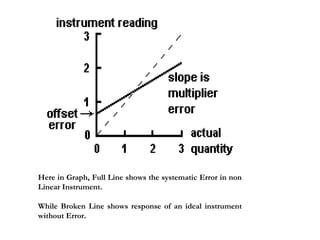
Here in Graph, Full Line shows the systematic Error in non
Linear Instrument.
While Broken Line shows response of an ideal instrument
without Error.
Random Errors
The quantity being measured is affected by many
happenings in the universe. We are aware for
some of the factors influencing the
measurement, but about the rest we are
unaware. The errors caused by happening or
disturbances about which we are unaware are
Random Errors. Its also known as residual
Errors.
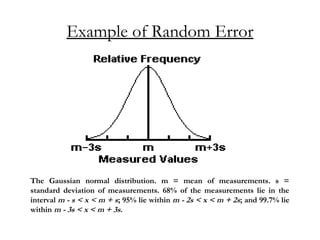
Example of Random Error
The Gaussian normal distribution. m = mean of measurements. s =
standard deviation of measurements. 68% of the measurements lie in the
interval m - s < x < m + s; 95% lie within m - 2s < x < m + 2s; and 99.7% lie
within m - 3s < x < m + 3s.
Statistical Analysis of Data
The Experimental Data is obtained in Two
Forms of the tests:-
1. Multi sample Test
2. Single Sample Test
1. Multi sample Test:- In this test, The Repeated
measurement of a given quantity are done
using different test conditions such as
employing different instruments, Different
ways of measurement and by employing
different observers.
2. Single Sample Test :- A single measurement for
succession of measurement done under
identical conditions excepting for time is
known as single sample Test.
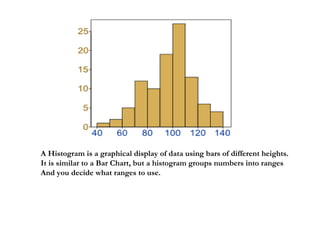
Histogram
When The Number of multi sample
observations are taken experimentally, There is a
scatter of the data about some central value.
One method presenting test results in the form
of histogram. It is also called frequency
distribution curve.
A Histogram is a graphical display of data using bars of different heights.
It is similar to a Bar Chart, but a histogram groups numbers into ranges
And you decide what ranges to use.
Arithmetic Mean
The best approximation that can be made
of a number of readings of the same
quantity is the arithmetic mean. It is also
called Mean value. This mean is computed
by summing all the values and dividing by
the number of measurements.
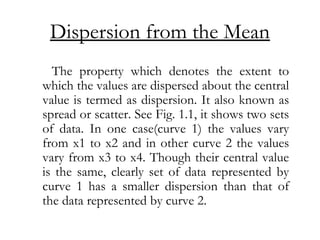
Dispersion from the Mean
The property which denotes the extent to
which the values are dispersed about the central
value is termed as dispersion. It also known as
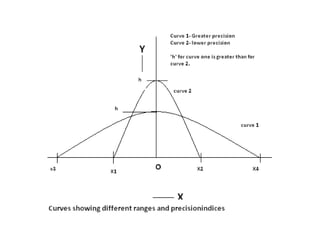
spread or scatter. See Fig. 1.1, it shows two sets
of data. In one case(curve 1) the values vary
from x1 to x2 and in other curve 2 the values
vary from x3 to x4. Though their central value
is the same, clearly set of data represented by
curve 1 has a smaller dispersion than that of
the data represented by curve 2.
There are certain terms which must be defined
as they form the basis defining the measure of
dispersion of data:
1. Range
2.Deviation
3.Average deviation
4. Standard deviation
5. variance
Range And Deviation
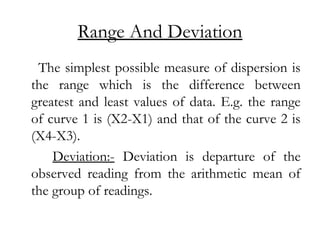
The simplest possible measure of dispersion is
the range which is the difference between
greatest and least values of data. E.g. the range
of curve 1 is (X2-X1) and that of the curve 2 is
(X4-X3).
Deviation:- Deviation is departure of the
observed reading from the arithmetic mean of
the group of readings.
Average And Standard Deviation
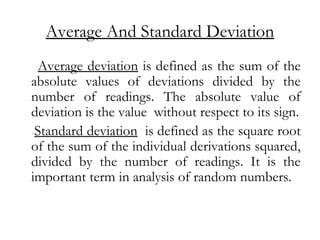
Average deviation is defined as the sum of the
absolute values of deviations divided by the
number of readings. The absolute value of
deviation is the value without respect to its sign.
Standard deviation is defined as the square root
of the sum of the individual derivations squared,
divided by the number of readings. It is the
important term in analysis of random numbers.
Variance
The variance is the mean square deviation which
is same as Standard deviation except that square
root is not extracted.

Errors in measurement

  • 1.
    Errors in MeasurementandErrors in Measurement and its Analysisits Analysis Submitted By Ravinder Kumar
  • 2.
    No Measurement isAccurate!No Measurement is Accurate! Errors occur because of:Errors occur because of: 1. Parallax error (incorrectly sighting the measurement).1. Parallax error (incorrectly sighting the measurement). 2. Calibration error (if the scale is not accurately drawn).2. Calibration error (if the scale is not accurately drawn). 3. Zero error (if the device doesn’t have a zero or isn’t3. Zero error (if the device doesn’t have a zero or isn’t correctly set to zero).correctly set to zero). 4. Damage (if the device is damaged or faulty).4. Damage (if the device is damaged or faulty). 5. Limit of reading of the measurement device (the5. Limit of reading of the measurement device (the measurement can only be as accurate as the smallest unitmeasurement can only be as accurate as the smallest unit of measurement of the device).of measurement of the device).
  • 3.
    DefinitionsDefinitions 1.1. Limit ofReadingLimit of Reading: is the smallest unit of: is the smallest unit of measurement on the measuring instrument.measurement on the measuring instrument. 2. The2. The Greatest Possible ErrorGreatest Possible Error (also called the(also called the absolute error): is equal to half the limit ofabsolute error): is equal to half the limit of reading.reading. 3. The3. The Upper and Lower LimitsUpper and Lower Limits: are the smallest: are the smallest and largest value between which a measurementand largest value between which a measurement can lie.can lie.
  • 4.
    Types of Errors BasicallyThree types of errors are studied:- 1. Gross Errors 2. Systematic Errors 3. Random Errors
  • 5.
    Gross Errors Gross Errorsmainly covers the human mistakes in reading instruments and recording and calculating measurement results. Example:- Due to oversight, The read of Temperature as 31.5 while the actual reading may be 21.5 .̊ ̊
  • 6.
    Gross Errors maybe of any amount and then their mathematical analysis is impossible. Then these are avoided by adopting two means:- 1. Great care is must in reading and recording the data. 2. Two , Three or even more reading should be taken for the quantity under measurement.
  • 7.
    Systematic Errors Systematic Errorsclassified into three categories :- 1. Instrumental Errors 2. Environmental Errors 3. Observational Errors
  • 8.
    Instrumental Errors These errorsarises due to three main reasons. 1. Due to inherent shortcoming in the instrument. Example:- If the spring used in permanent magnet instrument has become weak then instrument will always read high. Errors may caused because of friction , hysteresis , or even gear backlash. 2. Due to misuse of the instruments. 3. Due to Loading effects of instruments.
  • 9.
    Environmental Errors These errorsare due to conditions external to the measuring Device including conditions in the are surrounding the instrument. These may be effects of Temperature, Pressure, Humidity, Dust, Vibrations or of external magnetic or electrostatic fields.
  • 10.
    Observational Errors There aremany sources of observational errors:- -- Parallax, i.e. Apparent displacement when the line of vision is not normal to the scale. -- Inaccurate estimate of average reading. -- Wrong scale reading and wrong recording the data. -- Incorrect conversion of units between consecutive reading.
  • 11.
    Here in Graph,Full Line shows the systematic Error in non Linear Instrument. While Broken Line shows response of an ideal instrument without Error.
  • 12.
    Random Errors The quantitybeing measured is affected by many happenings in the universe. We are aware for some of the factors influencing the measurement, but about the rest we are unaware. The errors caused by happening or disturbances about which we are unaware are Random Errors. Its also known as residual Errors.
  • 13.
    Example of RandomError The Gaussian normal distribution. m = mean of measurements. s = standard deviation of measurements. 68% of the measurements lie in the interval m - s < x < m + s; 95% lie within m - 2s < x < m + 2s; and 99.7% lie within m - 3s < x < m + 3s.
  • 14.
    Statistical Analysis ofData The Experimental Data is obtained in Two Forms of the tests:- 1. Multi sample Test 2. Single Sample Test
  • 15.
    1. Multi sampleTest:- In this test, The Repeated measurement of a given quantity are done using different test conditions such as employing different instruments, Different ways of measurement and by employing different observers. 2. Single Sample Test :- A single measurement for succession of measurement done under identical conditions excepting for time is known as single sample Test.
  • 16.
    Histogram When The Numberof multi sample observations are taken experimentally, There is a scatter of the data about some central value. One method presenting test results in the form of histogram. It is also called frequency distribution curve.
  • 17.
    A Histogram isa graphical display of data using bars of different heights. It is similar to a Bar Chart, but a histogram groups numbers into ranges And you decide what ranges to use.
  • 18.
    Arithmetic Mean The bestapproximation that can be made of a number of readings of the same quantity is the arithmetic mean. It is also called Mean value. This mean is computed by summing all the values and dividing by the number of measurements.
  • 19.
    Dispersion from theMean The property which denotes the extent to which the values are dispersed about the central value is termed as dispersion. It also known as spread or scatter. See Fig. 1.1, it shows two sets of data. In one case(curve 1) the values vary from x1 to x2 and in other curve 2 the values vary from x3 to x4. Though their central value is the same, clearly set of data represented by curve 1 has a smaller dispersion than that of the data represented by curve 2.
  • 21.
    There are certainterms which must be defined as they form the basis defining the measure of dispersion of data: 1. Range 2.Deviation 3.Average deviation 4. Standard deviation 5. variance
  • 22.
    Range And Deviation Thesimplest possible measure of dispersion is the range which is the difference between greatest and least values of data. E.g. the range of curve 1 is (X2-X1) and that of the curve 2 is (X4-X3). Deviation:- Deviation is departure of the observed reading from the arithmetic mean of the group of readings.
  • 23.
    Average And StandardDeviation Average deviation is defined as the sum of the absolute values of deviations divided by the number of readings. The absolute value of deviation is the value without respect to its sign. Standard deviation is defined as the square root of the sum of the individual derivations squared, divided by the number of readings. It is the important term in analysis of random numbers.
  • 24.
    Variance The variance isthe mean square deviation which is same as Standard deviation except that square root is not extracted.