Continuity and End Behavior
A function is said to be continuous when it has no breaks in its graph.  Another way to 
think of this ­ a function is continuous if you can draw it without lifting your pencil.   

If there is a break in the graph the function is discontinuous at that point.

There are three different kinds of discontinuity.

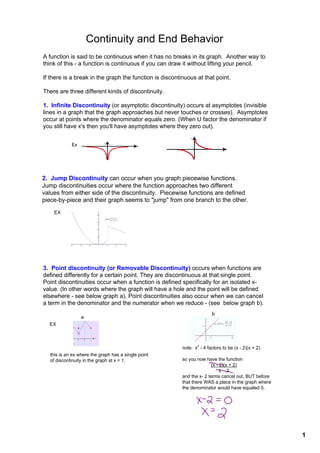
1.  Infinite Discontinuity (or asymptotic discontinuity) occurs at asymptotes (invisible 
lines in a graph that the graph approaches but never touches or crosses).  Asymptotes 
occur at points where the denominator equals zero. (When U factor the denominator if 
you still have x's then you'll have asymptotes where they zero out).
Ex

2.  Jump Discontinuity can occur when you graph piecewise functions.  
Jump discontinuities occur where the function approaches two different 
values from either side of the discontinuity.  Piecewise functions are defined 
piece­by­piece and their graph seems to "jump" from one branch to the other. 
EX

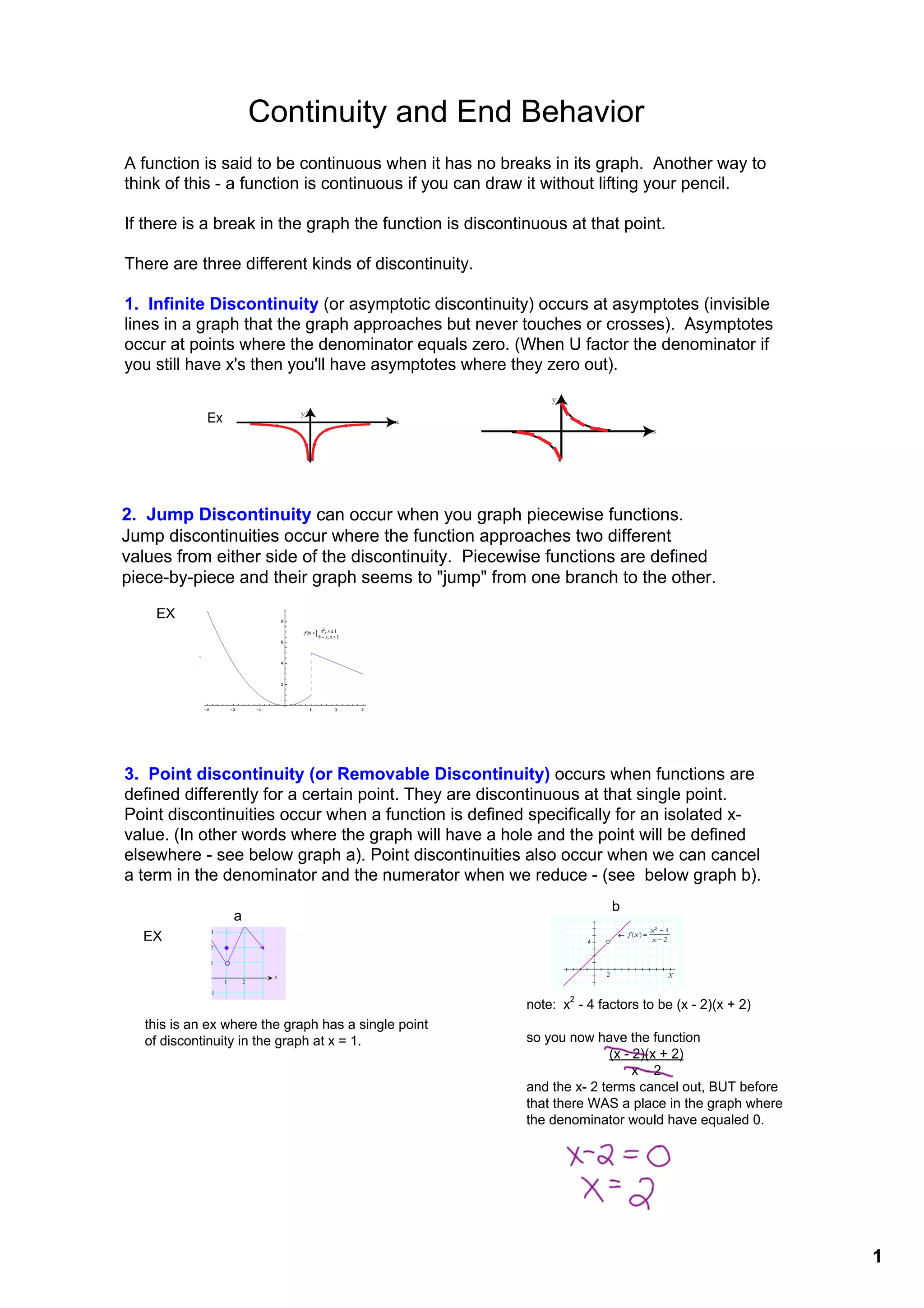
3.  Point discontinuity (or Removable Discontinuity) occurs when functions are 
defined differently for a certain point. They are discontinuous at that single point.  
Point discontinuities occur when a function is defined specifically for an isolated x­
value. (In other words where the graph will have a hole and the point will be defined 
elsewhere ­ see below graph a). Point discontinuities also occur when we can cancel 
a term in the denominator and the numerator when we reduce ­ (see  below graph b). 
a

b

EX

note:  x2 ­ 4 factors to be (x ­ 2)(x + 2)
this is an ex where the graph has a single point
of discontinuity in the graph at x = 1.

so you now have the function
(x ­ 2)(x + 2)
      x  ­ 2
and the x­ 2 terms cancel out, BUT before 
that there WAS a place in the graph where 
the denominator would have equaled 0.

1
b
a
c

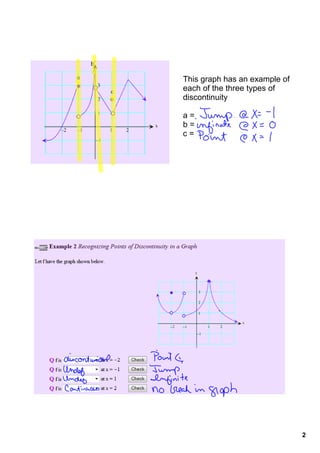
This graph has an example of 
each of the three types of 
discontinuity

a = jump discontinuity
b = infinite discontinuity
c = point discontinuity

Give it a try:  Scroll to Ex 2 from the below link

2
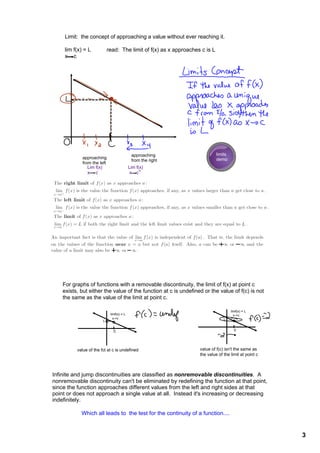
Limit:  the concept of approaching a value without ever reaching it.
lim f(x) = L
x    c

read:  The limit of f(x) as x approaches c is L

approaching
from the right

approaching
from the left
Lim f(x)
x     c­

limits
demo

Lim f(x)
 x    c+

Cited from:  
http://faculty.weber.edu/ptalaga/math1100/LAB8.pdf

For graphs of functions with a removable discontinuity, the limit of f(x) at point c 
exists, but either the value of the function at c is undefined or the value of f(c) is not 
the same as the value of the limit at point c.

L

limf(x) = L
  x­>c

limf(x) = L
  x­>c

L

c

c

value of the fct at c is undefined

value of f(c) isn't the same as
the value of the limit at point c

Infinite and jump discontinuities are classified as nonremovable discontinuities.  A 
nonremovable discontinuity can't be eliminated by redefining the function at that point, 
since the function approaches different values from the left and right sides at that 
point or does not approach a single value at all.  Instead it's increasing or decreasing 
indefinitely.
Which all leads to  the test for the continuity of a function....

3
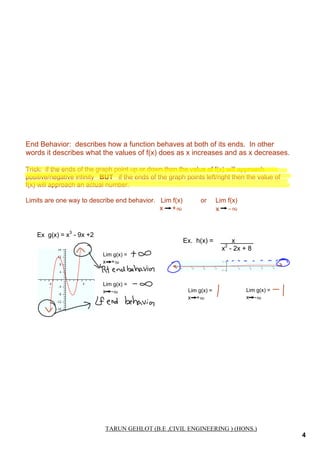
End Behavior:  describes how a function behaves at both of its ends.  In other 
words it describes what the values of f(x) does as x increases and as x decreases.
Trick:  if the ends of the graph point up or down then the value of f(x) will approach 
positive/negative infinity   BUT   if the ends of the graph points left/right then the value of 
f(x) will approach an actual number.
Limits are one way to describe end behavior.   Lim f(x)          or     Lim f(x)
                                                                         x     +∞
x -∞

Ex  g(x) = x3 ­ 9x +2

Ex.  h(x) =          x             
                     x2 ­ 2x + 8
Lim g(x) =
x    +∞

+∞

Lim g(x) =
x    ­∞

­∞
Lim g(x) =
x    +∞

0

Lim g(x) =
x    ­∞

0

TARUN GEHLOT ( B.E
TARUN GEHLOT (B.E ,CIVIL ENGINEERING ) (HONS.)

4

Continuity and end_behavior