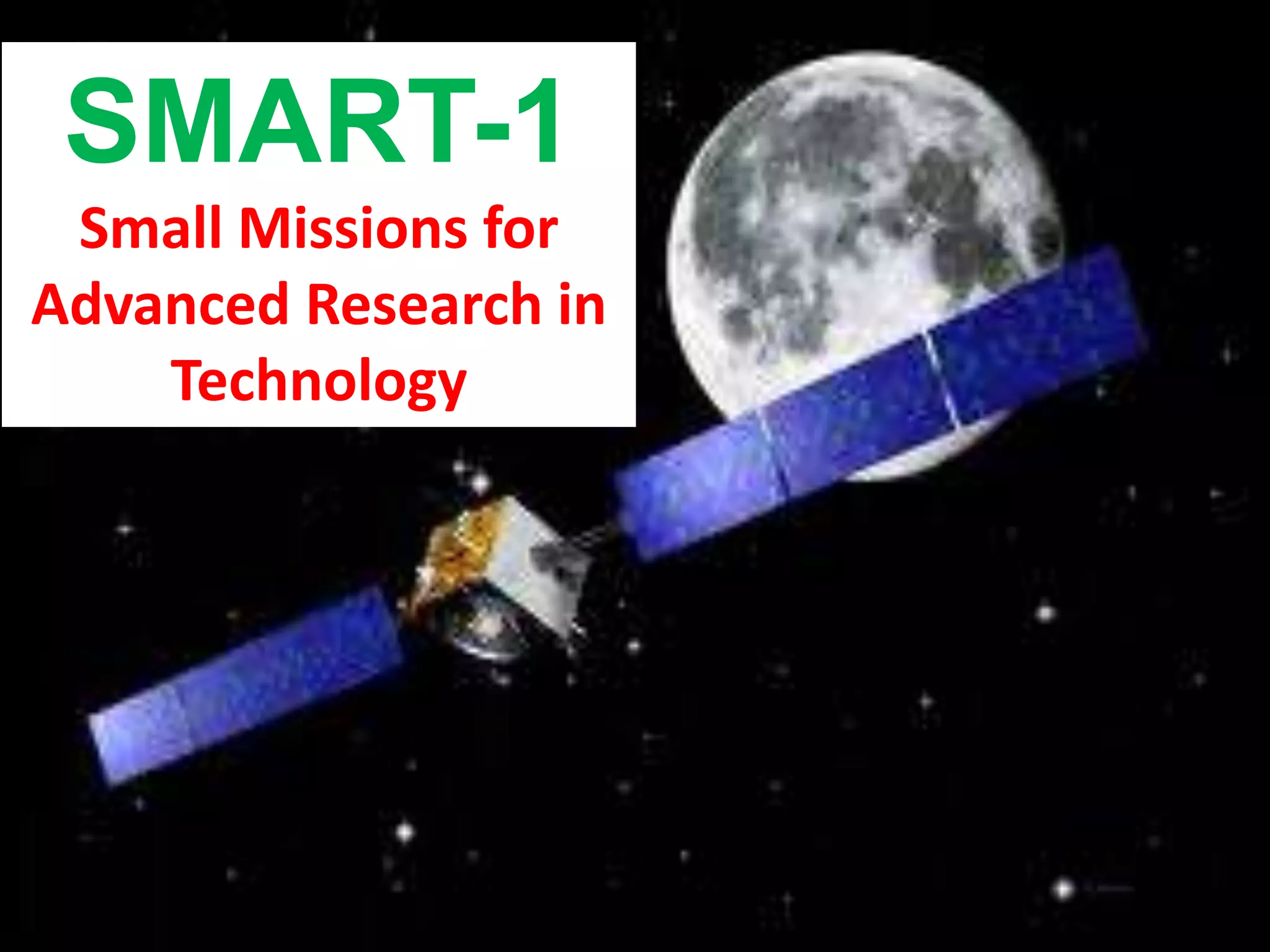
SMART-1
Small Missions for
Advanced Research in
Technology
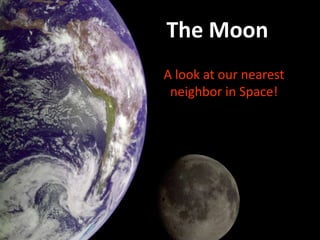
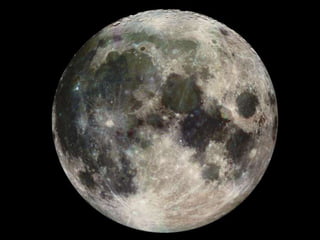
The Moon
A look at our nearest
neighbor in Space!
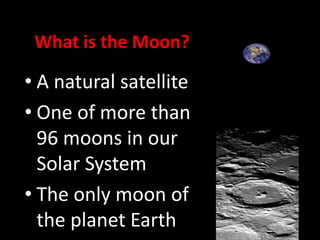
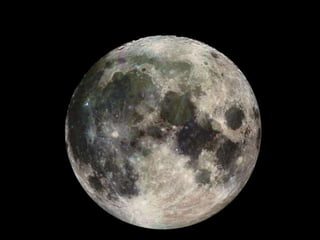
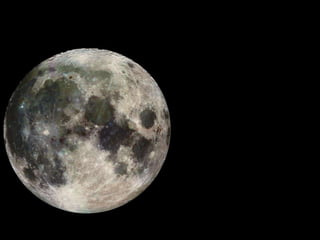
What is the Moon?

• A natural satellite
• One of more than
96 moons in our
Solar System
• The only moon of
the planet Earth
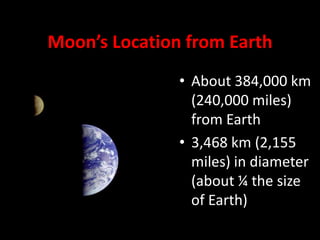
Moon’s Location from Earth
• About 384,000 km
(240,000 miles)
from Earth
• 3,468 km (2,155
miles) in diameter
(about ¼ the size
of Earth)
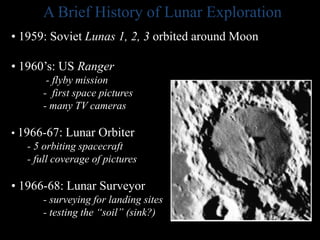
A Brief History of Lunar Exploration
• 1959: Soviet Lunas 1, 2, 3 orbited around Moon
• 1960’s: US Ranger
- flyby mission
- first space pictures
- many TV cameras
• 1966-67: Lunar Orbiter
- 5 orbiting spacecraft
- full coverage of pictures

• 1966-68: Lunar Surveyor
- surveying for landing sites
- testing the “soil” (sink?)
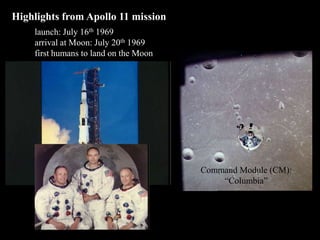
Highlights from Apollo 11 mission
launch: July 16th 1969
arrival at Moon: July 20th 1969
first humans to land on the Moon

Command Module (CM):
“Columbia”
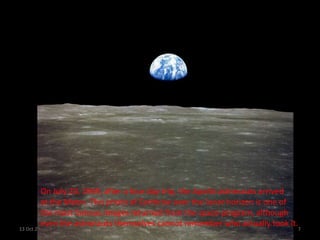
On July 20, 1969, after a four day trip, the Apollo astronauts arrived
at the Moon. This photo of Earthrise over the lunar horizon is one of
the most famous images returned from the space program, although
even the astronauts themselves cannot remember who actually took it.

13 Oct 2003

Solar System - Dr. C.C. Lang

7
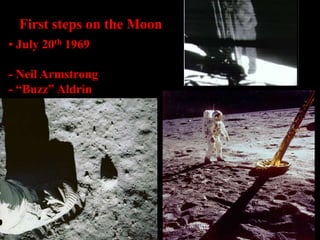
First steps on the Moon
• July 20th 1969
- Neil Armstrong
- “Buzz” Aldrin

13 Oct 2003

Solar System - Dr. C.C. Lang

8
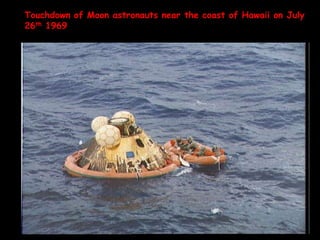
Touchdown of Moon astronauts near the coast of Hawaii on July
26th 1969
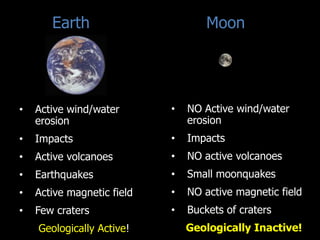
Earth

Moon

•

Active wind/water
erosion

•

NO Active wind/water
erosion

•

Impacts

•

Impacts

•

Active volcanoes

•

NO active volcanoes

•

Earthquakes

•

Small moonquakes

•

Active magnetic field

•

NO active magnetic field

•

Few craters

•

Buckets of craters

Geologically Active!

Geologically Inactive!
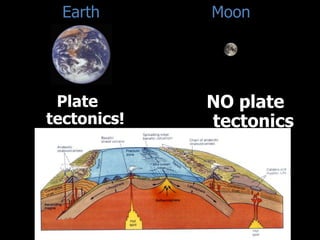
Earth

Plate
tectonics!

Moon

NO plate
tectonics
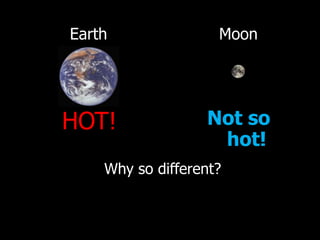
Earth

Moon

HOT!

Not so
hot!

Why so different?
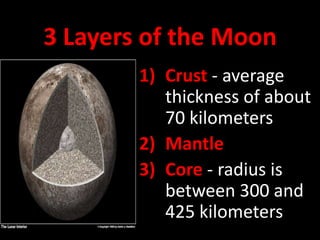
3 Layers of the Moon
1) Crust - average
thickness of about
70 kilometers
2) Mantle
3) Core - radius is
between 300 and
425 kilometers
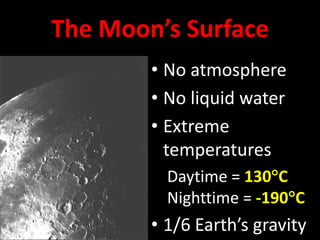
The Moon’s Surface
• No atmosphere
• No liquid water
• Extreme
temperatures
Daytime = 130C
Nighttime = -190C

• 1/6 Earth’s gravity
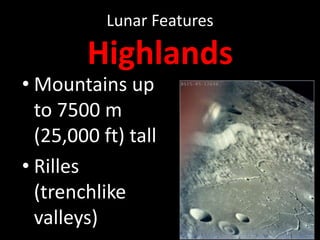
Lunar Features

Highlands

• Mountains up
to 7500 m
(25,000 ft) tall
• Rilles
(trenchlike
valleys)
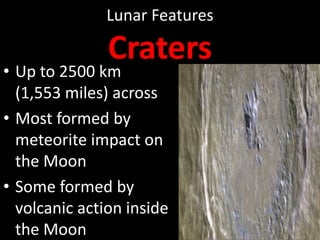
Lunar Features

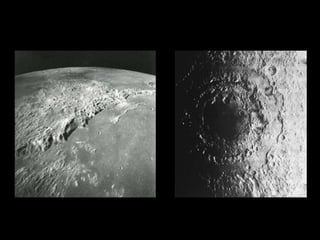
Craters

• Up to 2500 km
(1,553 miles) across
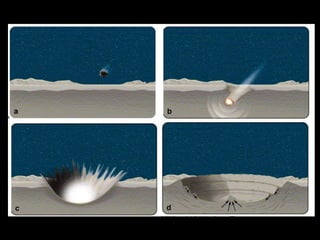
• Most formed by
meteorite impact on
the Moon
• Some formed by
volcanic action inside
the Moon
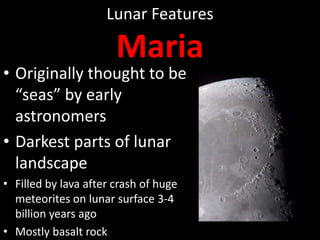
Lunar Features

Maria

• Originally thought to be
“seas” by early
astronomers
• Darkest parts of lunar
landscape
• Filled by lava after crash of huge
meteorites on lunar surface 3-4
billion years ago
• Mostly basalt rock
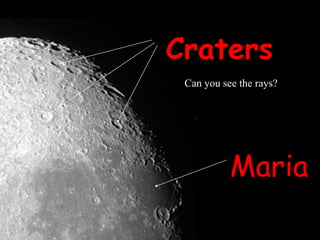
Craters
Can you see the rays?

Maria
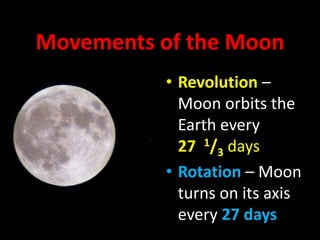
Movements of the Moon
• Revolution –
Moon orbits the
Earth every
27 1/3 days
• Rotation – Moon
turns on its axis
every 27 days
Movements of the Moon
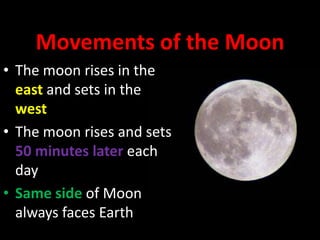
• The moon rises in the
east and sets in the
west
• The moon rises and sets
50 minutes later each
day
• Same side of Moon
always faces Earth
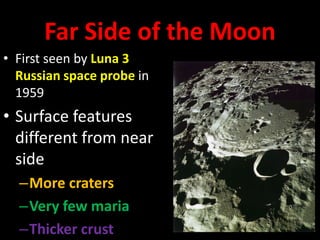
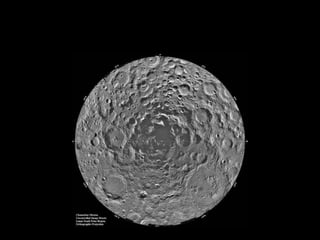
Far Side of the Moon
• First seen by Luna 3
Russian space probe in
1959

• Surface features
different from near
side
–More craters
–Very few maria
–Thicker crust
Lunar Formation Models
The moon is a sister world that formed in
orbit around Earth as the Earth formed.
The moon formed somewhere else in the
solar system then was captured into orbit
around Earth.
Early Earth spun so fast that it spun off the
moon.
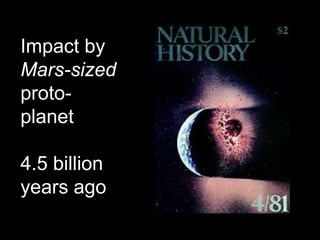
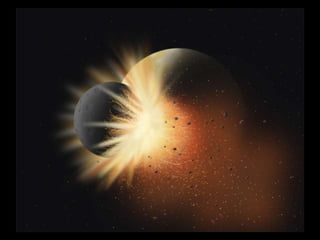
Impact by
Mars-sized
protoplanet
4.5 billion
years ago
Copyrighted, LPI
Copyrighted, LPI
Copyrighted, LPI
Copyrighted, LPI
Copyrighted, LPI
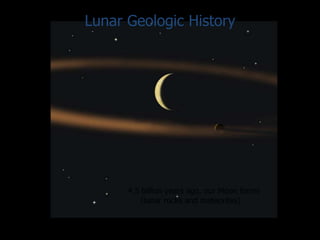
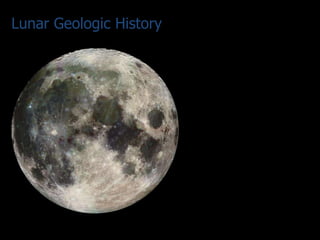
Lunar Geologic History

4.5 billion years ago, our Moon forms
(lunar rocks and meteorites)

Copyrighted, LPI
Copyrighted, LPI
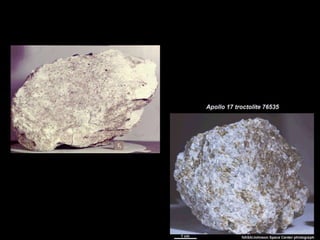
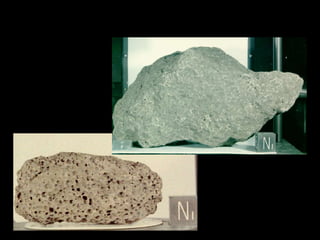
Magma Ocean Rocks
76535
Troctolite
4.2-4.3 Ga

60025
Anorthosite
4.44-4.51 Ga
95% Plag Feld (anorthite)
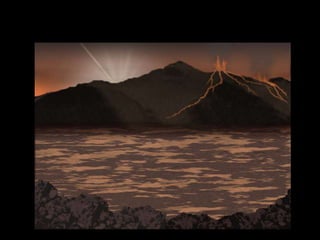
Magma Ocean!
No Water!
Lunar Geologic History
Highlands - light, rough
(Terrae)
Mostly anorthosite
(plagioclase feldspars lots of calcium and
aluminum)
“In place” rocks are 4.5
to 4.3 billion years old
BIG Dark areas?
Lunar Impact Basins

Imbrium Rim

Big, frequent impacts until 3.8 billion years ago
Impact events continue on all moons and planets today

Orientale Basin
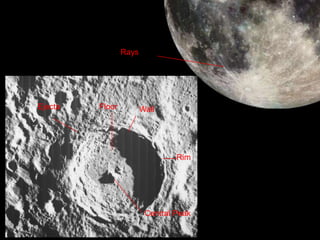
Rays

Ejecta

Floor

Wall

Tycho Crater
Rim

Central Peak

Young – 100 MY
85 kilometers
across
Fresh (rays) =
young
Impacts …“the most fundamental
process on the terrestrial planets…”
Eugene and Carolyn Shoemaker
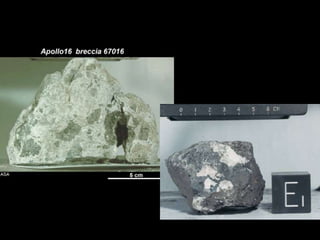
Breccias and Impact Melts
15445
Impact melt + clasts

67016
Polymict Breccia
Lunar Geologic History
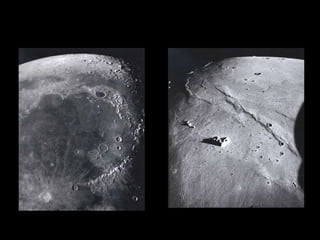
Mare Volcanism

Mare Imbrium
Volcanism after impacts – most before 3 Ga (to 1 Ga)

SW Mare Imbrium
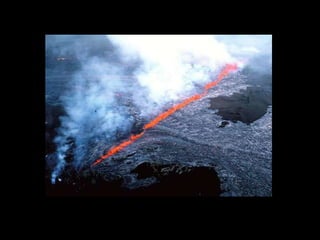
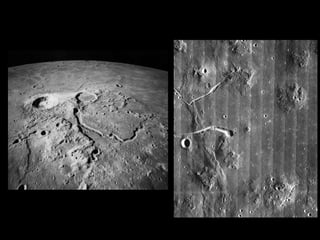
Lunar Volcanism

Aristarchus Plateau

Marius Hills
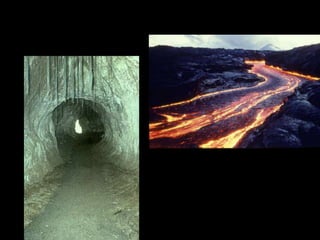
Lava Tubes

Apollo 17
Lunar Basalts
15555

3.3 Ga

15016
Lunar Geologic History

Lowlands – dark, smooth
Maria (16%)

Basalt – fine grained dark
igneous rock rich in iron
and magnesium (stuff
that sank in magma
ocean)
Few hundred meters thick
Rocks are 4.3 to 3.1 billion
years old … volcanic
flows as recently as 1
billion years ago!!
And then ….

All was quiet.
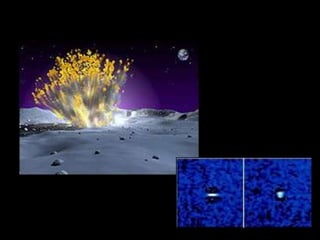
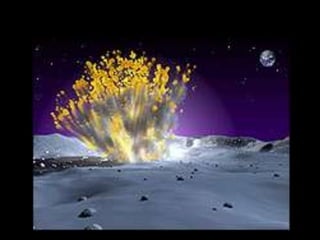
• Except for impacts...

7 November; ~30 lb TNT
3 m-wide crater (estimate)
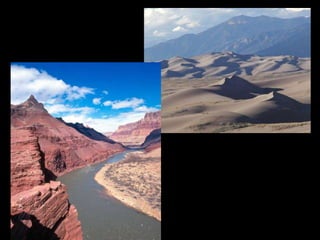
• No Wind
• No Flowing Water
• No Erosion
• Except for impacts...
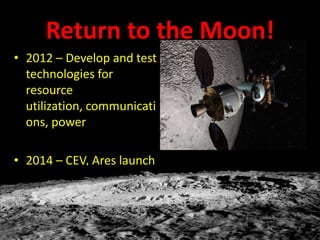
Return to the Moon!
• 2012 – Develop and test
technologies for
resource
utilization, communicati
ons, power
• 2014 – CEV, Ares launch
vehicle
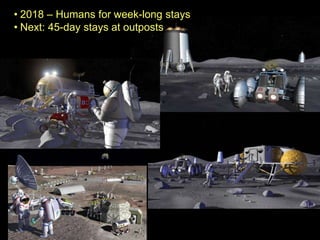
• 2018 – Humans for week-long stays
• Next: 45-day stays at outposts
Free powerpoints at http://www.worldofteaching.com

Earth's Moon