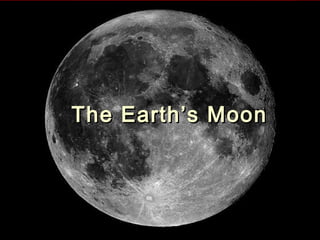
The Earth’s MoonThe Earth’s Moon
SatellitesSatellites
 Satellite: Any body thatSatellite: Any body that orbitsorbits aa
larger bodylarger body
 1957: First artificial satellite,1957: First artificial satellite,
Sputnik,Sputnik, launched by the Sovietslaunched by the Soviets
 Earth’s onlyEarth’s only naturalnatural satellite is thesatellite is the
moon.moon.
The MoonThe Moon
 Force of gravity is 1/6Force of gravity is 1/6thth
that ofthat of
Earth’sEarth’s
Lack of atmosphere also means that
there is a huge temperature range:
134o
C in the day, -170o
C at night
Very little gravity so it has no atmosphere;Very little gravity so it has no atmosphere;
therefore it has no weathertherefore it has no weather
The MoonThe Moon
 Your weight wouldYour weight would
change, but notchange, but not
your massyour mass
The MoonThe Moon
 1969-1972: The US sent 61969-1972: The US sent 6 ApolloApollo
missions to the moonmissions to the moon
Moon rotates once every 27.3 days, but appears to take 29.5 days.
It needs time to “catch up” from the delay crated by the rotation of the
earth
The Lunar SurfaceThe Lunar Surface
From youngest to oldest -From youngest to oldest -
Rilles : collapsed lava tubesRilles : collapsed lava tubes
Maria: dark areas on the moon;Maria: dark areas on the moon;
made of solidified lavamade of solidified lava
– Remains of ancient volcanoesRemains of ancient volcanoes
– Looks like riverbeds but no water everLooks like riverbeds but no water ever
on moonon moon
Highlands: light areas; created fromHighlands: light areas; created from
meteorites hitting the moonmeteorites hitting the moon
Rilles – collapsed lava tubesRilles – collapsed lava tubes
Straight rille
Sinous rille
MariaMaria
The Lunar SurfaceThe Lunar Surface
 Craters: bowl-shaped depressions,Craters: bowl-shaped depressions,
most from the moons earlymost from the moons early
formation; named for famousformation; named for famous
scientistsscientists
 Rays: streaks that extend from theRays: streaks that extend from the
impact sitesimpact sites
– Most formed 4 billion of years ago from debris
that bombarded all other bodies in solar
system
Moon FormationsMoon Formations
 PBS:PBS:
 http://mass.pbslearningmedia.org/resourchttp://mass.pbslearningmedia.org/resourc
e/npls12.sci.ess.eiu.tourmoon/tour-of-the-e/npls12.sci.ess.eiu.tourmoon/tour-of-the-
moon/moon/
Rays - streaksRays - streaks
Lunar RocksLunar Rocks
 regolithregolith - layer of dust and ground- layer of dust and ground
up rock created from meteoriteup rock created from meteorite
impactsimpacts
 Moons rocks are similar to EarthMoons rocks are similar to Earth
rocks –rocks –
silicatessilicates
Galileo Was RightGalileo Was Right
 From the Earth to the Moon: Part 10From the Earth to the Moon: Part 10
– Gathering of lunar rocksGathering of lunar rocks
Interior of the MoonInterior of the Moon
 Information found usingInformation found using
seismographsseismographs
 Less dense than the interior of theLess dense than the interior of the
EarthEarth
– Density = mass / volumeDensity = mass / volume
Interior of the MoonInterior of the Moon
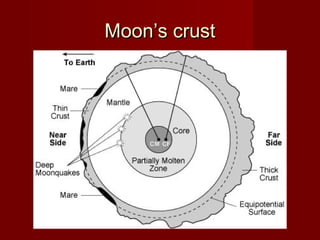
 Crust is thinner on the Earth-facingCrust is thinner on the Earth-facing
sideside
Mantle pulled closer on Earth-Mantle pulled closer on Earth-
facing side when ancient magmafacing side when ancient magma
below surface existed – makingbelow surface existed – making
crust thinnercrust thinner
Interior of the MoonInterior of the Moon
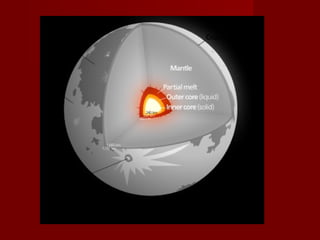
 Core – made of ironCore – made of iron
Determined the iron is solid, unlike Earth’sDetermined the iron is solid, unlike Earth’s
core, because it is not magneticcore, because it is not magnetic
Lack of magnetism is due to lack ofLack of magnetism is due to lack of
convectionconvection
Moon’s crustMoon’s crust
Current Theory of Moon’sCurrent Theory of Moon’s
CreationCreation
 Giant impact theory: formed whenGiant impact theory: formed when
a Mars-sized object struck thea Mars-sized object struck the
EarthEarth
– Fragments ejected from the EarthFragments ejected from the Earth
(mostly less dense crust and mantle)(mostly less dense crust and mantle)
– Eventually formed moonEventually formed moon
 Explains why the moon is lessExplains why the moon is less
dense than the Earthdense than the Earth
Impact TheoryImpact Theory
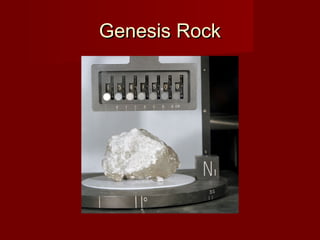
 Supported by moon rocksSupported by moon rocks
– Anothrocite – “Genisis Rock”Anothrocite – “Genisis Rock”
– Chemical analysis of the Genesis Rock
indicated it is an anorthosite, composed
mostly of a type of plagioclase feldspar 
– formed in the early stages of the solar system,
at least 4 billion years ago. 
– recovered in a crater of the Moon, near other
rocks of its kind.
Genesis RockGenesis Rock
Impact TheoryImpact Theory
 11stst
phase: Mars-sized object struckphase: Mars-sized object struck
the Earththe Earth
 22ndnd
phase: moon was covered withphase: moon was covered with
molten lava – densest materialmolten lava – densest material
moved to the centermoved to the center
 33rdrd
phase: meteorite impactphase: meteorite impact
“punches” through thin crust; liquid“punches” through thin crust; liquid
rock seeps throughrock seeps through
 Current phase: less loose materialCurrent phase: less loose material
in solar system; only rayed cratersin solar system; only rayed craters
 http://www.youtube.com/watch?http://www.youtube.com/watch?
v=WGTBJHFNywIv=WGTBJHFNywI
Impact TheoryImpact Theory
New Theory (2012)New Theory (2012)
 Impact of Mars-sizedImpact of Mars-sized meteoritemeteorite (Theia)(Theia) notnot
likelylikely
 New study of samples of the Moon areNew study of samples of the Moon are
virtually identical with the Earthvirtually identical with the Earth
 Studied titanium isotopesStudied titanium isotopes
 Meteorite sample shown extremelyMeteorite sample shown extremely
diverse titanium isotope compositiondiverse titanium isotope composition
New Theory (2012)New Theory (2012)
 Scientists theorize that Theia might haveScientists theorize that Theia might have
been made solely of icebeen made solely of ice
 Or that a proto-Earth was spinning muchOr that a proto-Earth was spinning much
faster, allowing more mixing offaster, allowing more mixing of
compositioncomposition

The Earth's Moon

  • 1.
    The Earth’s MoonTheEarth’s Moon
  • 2.
    SatellitesSatellites  Satellite: Anybody thatSatellite: Any body that orbitsorbits aa larger bodylarger body  1957: First artificial satellite,1957: First artificial satellite, Sputnik,Sputnik, launched by the Sovietslaunched by the Soviets  Earth’s onlyEarth’s only naturalnatural satellite is thesatellite is the moon.moon.
  • 3.
    The MoonThe Moon Force of gravity is 1/6Force of gravity is 1/6thth that ofthat of Earth’sEarth’s
  • 4.
    Lack of atmospherealso means that there is a huge temperature range: 134o C in the day, -170o C at night Very little gravity so it has no atmosphere;Very little gravity so it has no atmosphere; therefore it has no weathertherefore it has no weather
  • 5.
    The MoonThe Moon Your weight wouldYour weight would change, but notchange, but not your massyour mass
  • 6.
    The MoonThe Moon 1969-1972: The US sent 61969-1972: The US sent 6 ApolloApollo missions to the moonmissions to the moon
  • 7.
    Moon rotates onceevery 27.3 days, but appears to take 29.5 days. It needs time to “catch up” from the delay crated by the rotation of the earth
  • 8.
    The Lunar SurfaceTheLunar Surface From youngest to oldest -From youngest to oldest - Rilles : collapsed lava tubesRilles : collapsed lava tubes Maria: dark areas on the moon;Maria: dark areas on the moon; made of solidified lavamade of solidified lava – Remains of ancient volcanoesRemains of ancient volcanoes – Looks like riverbeds but no water everLooks like riverbeds but no water ever on moonon moon Highlands: light areas; created fromHighlands: light areas; created from meteorites hitting the moonmeteorites hitting the moon
  • 9.
    Rilles – collapsedlava tubesRilles – collapsed lava tubes Straight rille Sinous rille
  • 10.
  • 11.
    The Lunar SurfaceTheLunar Surface  Craters: bowl-shaped depressions,Craters: bowl-shaped depressions, most from the moons earlymost from the moons early formation; named for famousformation; named for famous scientistsscientists  Rays: streaks that extend from theRays: streaks that extend from the impact sitesimpact sites – Most formed 4 billion of years ago from debris that bombarded all other bodies in solar system
  • 12.
    Moon FormationsMoon Formations PBS:PBS:  http://mass.pbslearningmedia.org/resourchttp://mass.pbslearningmedia.org/resourc e/npls12.sci.ess.eiu.tourmoon/tour-of-the-e/npls12.sci.ess.eiu.tourmoon/tour-of-the- moon/moon/
  • 13.
  • 14.
    Lunar RocksLunar Rocks regolithregolith - layer of dust and ground- layer of dust and ground up rock created from meteoriteup rock created from meteorite impactsimpacts  Moons rocks are similar to EarthMoons rocks are similar to Earth rocks –rocks – silicatessilicates
  • 15.
    Galileo Was RightGalileoWas Right  From the Earth to the Moon: Part 10From the Earth to the Moon: Part 10 – Gathering of lunar rocksGathering of lunar rocks
  • 16.
    Interior of theMoonInterior of the Moon  Information found usingInformation found using seismographsseismographs  Less dense than the interior of theLess dense than the interior of the EarthEarth – Density = mass / volumeDensity = mass / volume
  • 17.
    Interior of theMoonInterior of the Moon  Crust is thinner on the Earth-facingCrust is thinner on the Earth-facing sideside Mantle pulled closer on Earth-Mantle pulled closer on Earth- facing side when ancient magmafacing side when ancient magma below surface existed – makingbelow surface existed – making crust thinnercrust thinner
  • 19.
    Interior of theMoonInterior of the Moon  Core – made of ironCore – made of iron Determined the iron is solid, unlike Earth’sDetermined the iron is solid, unlike Earth’s core, because it is not magneticcore, because it is not magnetic Lack of magnetism is due to lack ofLack of magnetism is due to lack of convectionconvection
  • 20.
  • 21.
    Current Theory ofMoon’sCurrent Theory of Moon’s CreationCreation  Giant impact theory: formed whenGiant impact theory: formed when a Mars-sized object struck thea Mars-sized object struck the EarthEarth – Fragments ejected from the EarthFragments ejected from the Earth (mostly less dense crust and mantle)(mostly less dense crust and mantle) – Eventually formed moonEventually formed moon  Explains why the moon is lessExplains why the moon is less dense than the Earthdense than the Earth
  • 22.
  • 23.
    Impact TheoryImpact Theory Supported by moon rocksSupported by moon rocks – Anothrocite – “Genisis Rock”Anothrocite – “Genisis Rock” – Chemical analysis of the Genesis Rock indicated it is an anorthosite, composed mostly of a type of plagioclase feldspar  – formed in the early stages of the solar system, at least 4 billion years ago.  – recovered in a crater of the Moon, near other rocks of its kind.
  • 24.
  • 25.
    Impact TheoryImpact Theory 11stst phase: Mars-sized object struckphase: Mars-sized object struck the Earththe Earth  22ndnd phase: moon was covered withphase: moon was covered with molten lava – densest materialmolten lava – densest material moved to the centermoved to the center  33rdrd phase: meteorite impactphase: meteorite impact “punches” through thin crust; liquid“punches” through thin crust; liquid rock seeps throughrock seeps through  Current phase: less loose materialCurrent phase: less loose material in solar system; only rayed cratersin solar system; only rayed craters
  • 26.
  • 27.
  • 28.
    New Theory (2012)NewTheory (2012)  Impact of Mars-sizedImpact of Mars-sized meteoritemeteorite (Theia)(Theia) notnot likelylikely  New study of samples of the Moon areNew study of samples of the Moon are virtually identical with the Earthvirtually identical with the Earth  Studied titanium isotopesStudied titanium isotopes  Meteorite sample shown extremelyMeteorite sample shown extremely diverse titanium isotope compositiondiverse titanium isotope composition
  • 29.
    New Theory (2012)NewTheory (2012)  Scientists theorize that Theia might haveScientists theorize that Theia might have been made solely of icebeen made solely of ice  Or that a proto-Earth was spinning muchOr that a proto-Earth was spinning much faster, allowing more mixing offaster, allowing more mixing of compositioncomposition

Editor's Notes

  • #7 Mass is the amount of matter in an object NASA Nation al Aeronautics and Space Administration Apollo (1961 to 1972) was the third US human spaceflight program Project Mercury (one man), conceived during President Eisenhower, sent the first man in to space Project Gemini (two man) 1962 to 1966 – support the Apollo missions
  • #8 Moon orbits 27.3 days as compared to distant stars 2 additional days are needed to “catch up” because the earth is not stationary. The movement of the earth puts the moon a little behind its real location because the earth revolves in the same direction as the moon The earth travels 0.075 of its circuit around the sun in 27.3 days. That causes a difference between the orbit seen on earth verses the orbit seen from space
  • #9 Rilles is German for groove
  • #10 Sinous rilles – meander in a curved path like a mature river – remains of collapsed lava tubes – remains controversial Arcuate rilles – have a smooth curve and are found along the dark edges of maria – made when lava flowed, cooled and contracted and sunk Straight rilles – follow long linear paths – created by sections of crust sunken between two parallel faults