CONTENTS
 INTRODUCTION
 RADIOMETRIC DATING
 NEODYMIUM
 SAMARIUM
 GEOCHEMISTRY
 AGE DETERMINATION
 CHONDRTIES&ACHONDRITIES
 CONCLUSION
 REFERENCE
INTRODUCTION
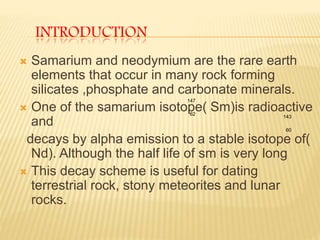
 Samarium and neodymium are the rare earth
elements that occur in many rock forming
silicates ,phosphate and carbonate minerals.
 One of the samarium isotope( Sm)is radioactive
and
decays by alpha emission to a stable isotope of(
Nd). Although the half life of sm is very long
 This decay scheme is useful for dating
terrestrial rock, stony meteorites and lunar
rocks.
147
62
143
60
RADIOMETRIC DATING
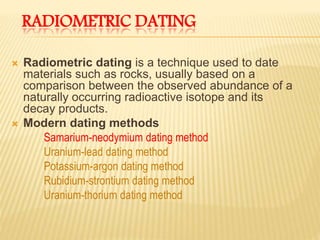
 Radiometric dating is a technique used to date
materials such as rocks, usually based on a
comparison between the observed abundance of a
naturally occurring radioactive isotope and its
decay products.
 Modern dating methods
Samarium-neodymium dating method
Uranium-lead dating method
Potassium-argon dating method
Rubidium-strontium dating method
Uranium-thorium dating method
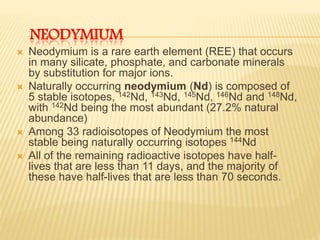
NEODYMIUM
 Neodymium is a rare earth element (REE) that occurs
in many silicate, phosphate, and carbonate minerals
by substitution for major ions.
 Naturally occurring neodymium (Nd) is composed of
5 stable isotopes, 142Nd, 143Nd, 145Nd, 146Nd and 148Nd,
with 142Nd being the most abundant (27.2% natural
abundance)
 Among 33 radioisotopes of Neodymium the most
stable being naturally occurring isotopes 144Nd
 All of the remaining radioactive isotopes have half-
lives that are less than 11 days, and the majority of
these have half-lives that are less than 70 seconds.
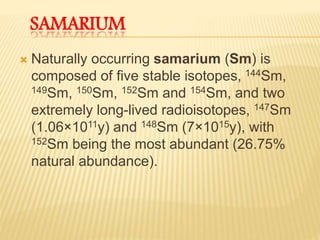
SAMARIUM
 Naturally occurring samarium (Sm) is
composed of five stable isotopes, 144Sm,
149Sm, 150Sm, 152Sm and 154Sm, and two
extremely long-lived radioisotopes, 147Sm
(1.06×10¹¹y) and 148Sm (7×10¹⁵y), with
152Sm being the most abundant (26.75%
natural abundance).
GEOCHEMISTRY
 Neodymium and samarium are rare earth
elements. The rare earth elements generally
form ions with a charge of +3 whose radii
decrease with increasing atomic number 1.15 Å
in lanthanum to 0.93 Å in lutetium.
 The REE occur in high concentrations in several
economically important minerals such as
monazite & cerite.
 The REE also occur as trace elements in
common rock forming minerals in which they
replace major ions.
CONT…
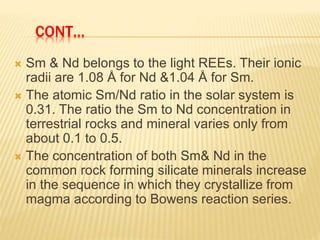
 Sm & Nd belongs to the light REEs. Their ionic
radii are 1.08 Å for Nd &1.04 Å for Sm.
 The atomic Sm/Nd ratio in the solar system is
0.31. The ratio the Sm to Nd concentration in
terrestrial rocks and mineral varies only from
about 0.1 to 0.5.
 The concentration of both Sm& Nd in the
common rock forming silicate minerals increase
in the sequence in which they crystallize from
magma according to Bowens reaction series.
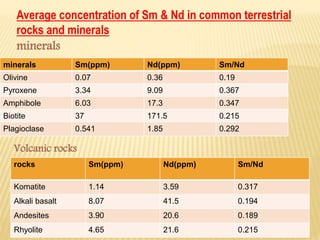
minerals Sm(ppm) Nd(ppm) Sm/Nd
Olivine 0.07 0.36 0.19
Pyroxene 3.34 9.09 0.367
Amphibole 6.03 17.3 0.347
Biotite 37 171.5 0.215
Plagioclase 0.541 1.85 0.292
Volcanic rocks
rocks Sm(ppm) Nd(ppm) Sm/Nd
Komatite 1.14 3.59 0.317
Alkali basalt 8.07 41.5 0.194
Andesites 3.90 20.6 0.189
Rhyolite 4.65 21.6 0.215
minerals
Average concentration of Sm & Nd in common terrestrial
rocks and minerals
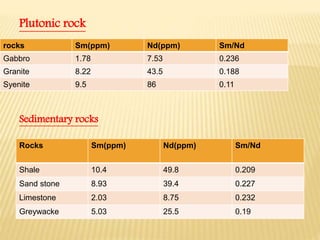
rocks Sm(ppm) Nd(ppm) Sm/Nd
Gabbro 1.78 7.53 0.236
Granite 8.22 43.5 0.188
Syenite 9.5 86 0.11
Rocks Sm(ppm) Nd(ppm) Sm/Nd
Shale 10.4 49.8 0.209
Sand stone 8.93 39.4 0.227
Limestone 2.03 8.75 0.232
Greywacke 5.03 25.5 0.19
Plutonic rock
Sedimentary rocks
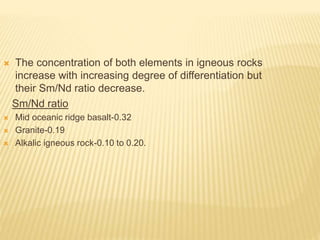
 The concentration of both elements in igneous rocks
increase with increasing degree of differentiation but
their Sm/Nd ratio decrease.
Sm/Nd ratio
 Mid oceanic ridge basalt-0.32
 Granite-0.19
 Alkalic igneous rock-0.10 to 0.20.
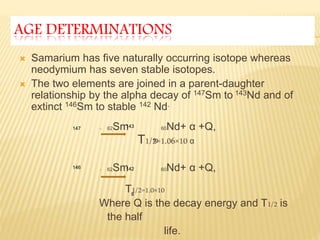
AGE DETERMINATIONS
 Samarium has five naturally occurring isotope whereas
neodymium has seven stable isotopes.
 The two elements are joined in a parent-daughter
relationship by the alpha decay of 147Sm to 143Nd and of
extinct 146Sm to stable 142 Nd.
 62Sm 60Nd+ α +Q,
T1/2=1.06×10 α
 62Sm 60Nd+ α +Q,
T1/2=1.0×10
Where Q is the decay energy and T1/2 is
the half
life.
147 143
10
146 142
8
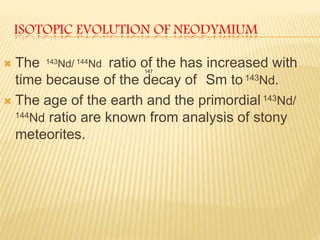
ISOTOPIC EVOLUTION OF NEODYMIUM
 The 143Nd/ 144Nd ratio of the has increased with
time because of the decay of Sm to 143Nd.
 The age of the earth and the primordial 143Nd/
144Nd ratio are known from analysis of stony
meteorites.
147
CHONDRITES & ACHONDRITES
 Many stony meteorites have been dated by the Sm-Nd
method by analyzing mineral fraction separated from
individual specimens.
 The isotopic evolution of Nd in the earth is represented by a
model that assumes that the Sm/Nd ratio of the earth is
equal to that of chondritic meteorites. Jacobsen and
wasserburg analyzed five chondrites and achondrites
determined that these meteorites have an average Sm/ Nd
ratio of 0.1967 & used this result calculate the 143Nd/ 144Nd
ratio of chondritic reservoir at the present time assuming
that the age of the earth is 4.6 billion yrs..
147 144
CHUR , EPSILON &MODAL DATES
 The isotopic evolution of Nd in the earth is described in
terms of a model called CHUR (chondritic uniform
reservoir). This modal assumes that terrestrial Nd has
evolved in a uniform reservoir whose Sm/Nd ratio is equal to
that of chondritic meteorites.
CONT…….
 The Sm/Nd ratio of CHUR is lower than that of the solar
nebula and that the age of the is taken to be 4.6 b yrs.
 Partial melting of CHUR give rise to magma having lower
Sm/Nd ratios than CHUR.
 The igneous rocks that form from this magma therefore
have lower present day 143Nd/ 144Nd ratios than CHUR,
whereas the residual solids have a higher Sm/Nd ratio as a
result the present day 143Nd/ 144Nd ratio of the rocks formed
from the silicate liquid is than that of CHUR.
CONCLUSION
 Samarium and neodymium are rare earth elements joined in
a parent daughter relationship by the alpha decay of Sm to
stable Nd.
 This decay scheme is useful for dating terrestrial rock, stony
meteorites and lunar rocks.
 Both elements are widely distributed in common minerals
and rocks but their concentrations are generally less than 10
ppm.
 The Sm-Nd system is more valuable than the Rb-Sr system
for dating ancient volcanics because of the greater stability
of Sm/Nd compared with Rb/Sr during alteration processes.
REFERENCE
 Gunter Faure (1986), principles of isotope
geology, John Wiley & sons, p.p-200 to 213.
 C.S. Pichamuthu(1985), Archaean geology,
Oxford& ibh publishing co, p.p-139 to145.
 WEB:
www.google.com
www.wikipedia.com
www.geology.com
Samarium neodymium isotope system

Samarium neodymium isotope system

  • 2.
    CONTENTS  INTRODUCTION  RADIOMETRICDATING  NEODYMIUM  SAMARIUM  GEOCHEMISTRY  AGE DETERMINATION  CHONDRTIES&ACHONDRITIES  CONCLUSION  REFERENCE
  • 3.
    INTRODUCTION  Samarium andneodymium are the rare earth elements that occur in many rock forming silicates ,phosphate and carbonate minerals.  One of the samarium isotope( Sm)is radioactive and decays by alpha emission to a stable isotope of( Nd). Although the half life of sm is very long  This decay scheme is useful for dating terrestrial rock, stony meteorites and lunar rocks. 147 62 143 60
  • 4.
    RADIOMETRIC DATING  Radiometricdating is a technique used to date materials such as rocks, usually based on a comparison between the observed abundance of a naturally occurring radioactive isotope and its decay products.  Modern dating methods Samarium-neodymium dating method Uranium-lead dating method Potassium-argon dating method Rubidium-strontium dating method Uranium-thorium dating method
  • 5.
    NEODYMIUM  Neodymium isa rare earth element (REE) that occurs in many silicate, phosphate, and carbonate minerals by substitution for major ions.  Naturally occurring neodymium (Nd) is composed of 5 stable isotopes, 142Nd, 143Nd, 145Nd, 146Nd and 148Nd, with 142Nd being the most abundant (27.2% natural abundance)  Among 33 radioisotopes of Neodymium the most stable being naturally occurring isotopes 144Nd  All of the remaining radioactive isotopes have half- lives that are less than 11 days, and the majority of these have half-lives that are less than 70 seconds.
  • 6.
    SAMARIUM  Naturally occurringsamarium (Sm) is composed of five stable isotopes, 144Sm, 149Sm, 150Sm, 152Sm and 154Sm, and two extremely long-lived radioisotopes, 147Sm (1.06×10¹¹y) and 148Sm (7×10¹⁵y), with 152Sm being the most abundant (26.75% natural abundance).
  • 7.
    GEOCHEMISTRY  Neodymium andsamarium are rare earth elements. The rare earth elements generally form ions with a charge of +3 whose radii decrease with increasing atomic number 1.15 Å in lanthanum to 0.93 Å in lutetium.  The REE occur in high concentrations in several economically important minerals such as monazite & cerite.  The REE also occur as trace elements in common rock forming minerals in which they replace major ions.
  • 8.
    CONT…  Sm &Nd belongs to the light REEs. Their ionic radii are 1.08 Å for Nd &1.04 Å for Sm.  The atomic Sm/Nd ratio in the solar system is 0.31. The ratio the Sm to Nd concentration in terrestrial rocks and mineral varies only from about 0.1 to 0.5.  The concentration of both Sm& Nd in the common rock forming silicate minerals increase in the sequence in which they crystallize from magma according to Bowens reaction series.
  • 9.
    minerals Sm(ppm) Nd(ppm)Sm/Nd Olivine 0.07 0.36 0.19 Pyroxene 3.34 9.09 0.367 Amphibole 6.03 17.3 0.347 Biotite 37 171.5 0.215 Plagioclase 0.541 1.85 0.292 Volcanic rocks rocks Sm(ppm) Nd(ppm) Sm/Nd Komatite 1.14 3.59 0.317 Alkali basalt 8.07 41.5 0.194 Andesites 3.90 20.6 0.189 Rhyolite 4.65 21.6 0.215 minerals Average concentration of Sm & Nd in common terrestrial rocks and minerals
  • 10.
    rocks Sm(ppm) Nd(ppm)Sm/Nd Gabbro 1.78 7.53 0.236 Granite 8.22 43.5 0.188 Syenite 9.5 86 0.11 Rocks Sm(ppm) Nd(ppm) Sm/Nd Shale 10.4 49.8 0.209 Sand stone 8.93 39.4 0.227 Limestone 2.03 8.75 0.232 Greywacke 5.03 25.5 0.19 Plutonic rock Sedimentary rocks
  • 11.
     The concentrationof both elements in igneous rocks increase with increasing degree of differentiation but their Sm/Nd ratio decrease. Sm/Nd ratio  Mid oceanic ridge basalt-0.32  Granite-0.19  Alkalic igneous rock-0.10 to 0.20.
  • 12.
    AGE DETERMINATIONS  Samariumhas five naturally occurring isotope whereas neodymium has seven stable isotopes.  The two elements are joined in a parent-daughter relationship by the alpha decay of 147Sm to 143Nd and of extinct 146Sm to stable 142 Nd.  62Sm 60Nd+ α +Q, T1/2=1.06×10 α  62Sm 60Nd+ α +Q, T1/2=1.0×10 Where Q is the decay energy and T1/2 is the half life. 147 143 10 146 142 8
  • 13.
    ISOTOPIC EVOLUTION OFNEODYMIUM  The 143Nd/ 144Nd ratio of the has increased with time because of the decay of Sm to 143Nd.  The age of the earth and the primordial 143Nd/ 144Nd ratio are known from analysis of stony meteorites. 147
  • 14.
    CHONDRITES & ACHONDRITES Many stony meteorites have been dated by the Sm-Nd method by analyzing mineral fraction separated from individual specimens.  The isotopic evolution of Nd in the earth is represented by a model that assumes that the Sm/Nd ratio of the earth is equal to that of chondritic meteorites. Jacobsen and wasserburg analyzed five chondrites and achondrites determined that these meteorites have an average Sm/ Nd ratio of 0.1967 & used this result calculate the 143Nd/ 144Nd ratio of chondritic reservoir at the present time assuming that the age of the earth is 4.6 billion yrs.. 147 144
  • 15.
    CHUR , EPSILON&MODAL DATES  The isotopic evolution of Nd in the earth is described in terms of a model called CHUR (chondritic uniform reservoir). This modal assumes that terrestrial Nd has evolved in a uniform reservoir whose Sm/Nd ratio is equal to that of chondritic meteorites.
  • 16.
    CONT…….  The Sm/Ndratio of CHUR is lower than that of the solar nebula and that the age of the is taken to be 4.6 b yrs.  Partial melting of CHUR give rise to magma having lower Sm/Nd ratios than CHUR.  The igneous rocks that form from this magma therefore have lower present day 143Nd/ 144Nd ratios than CHUR, whereas the residual solids have a higher Sm/Nd ratio as a result the present day 143Nd/ 144Nd ratio of the rocks formed from the silicate liquid is than that of CHUR.
  • 17.
    CONCLUSION  Samarium andneodymium are rare earth elements joined in a parent daughter relationship by the alpha decay of Sm to stable Nd.  This decay scheme is useful for dating terrestrial rock, stony meteorites and lunar rocks.  Both elements are widely distributed in common minerals and rocks but their concentrations are generally less than 10 ppm.  The Sm-Nd system is more valuable than the Rb-Sr system for dating ancient volcanics because of the greater stability of Sm/Nd compared with Rb/Sr during alteration processes.
  • 18.
    REFERENCE  Gunter Faure(1986), principles of isotope geology, John Wiley & sons, p.p-200 to 213.  C.S. Pichamuthu(1985), Archaean geology, Oxford& ibh publishing co, p.p-139 to145.  WEB: www.google.com www.wikipedia.com www.geology.com