IGNEOUS PETROLOGY 2013
Masoom Shani Page 1
Igneous Petrology
PETROGRAPHY
The description and systematic classification of rocks, aided by the microscopic examination of
thin sections.
PETROLOGY
The study of the origin, occurrence, structure and history of rocks, much broader process/study
than petrography.
PETROGENESIS
A branch of petrology dealing with the origin and formation of rocks. It involves a combination
of mineralogical, chemical and field data.
Petrologic, petrographic, and petrogenetic studies can be applied to igneous, metamorphic or
sedimentary rocks.
The Earth’s Interior
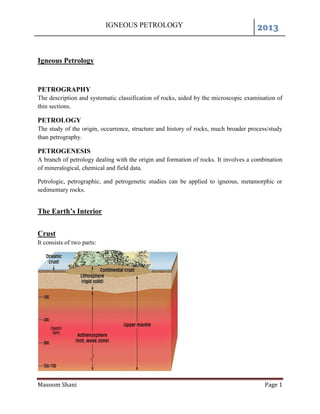
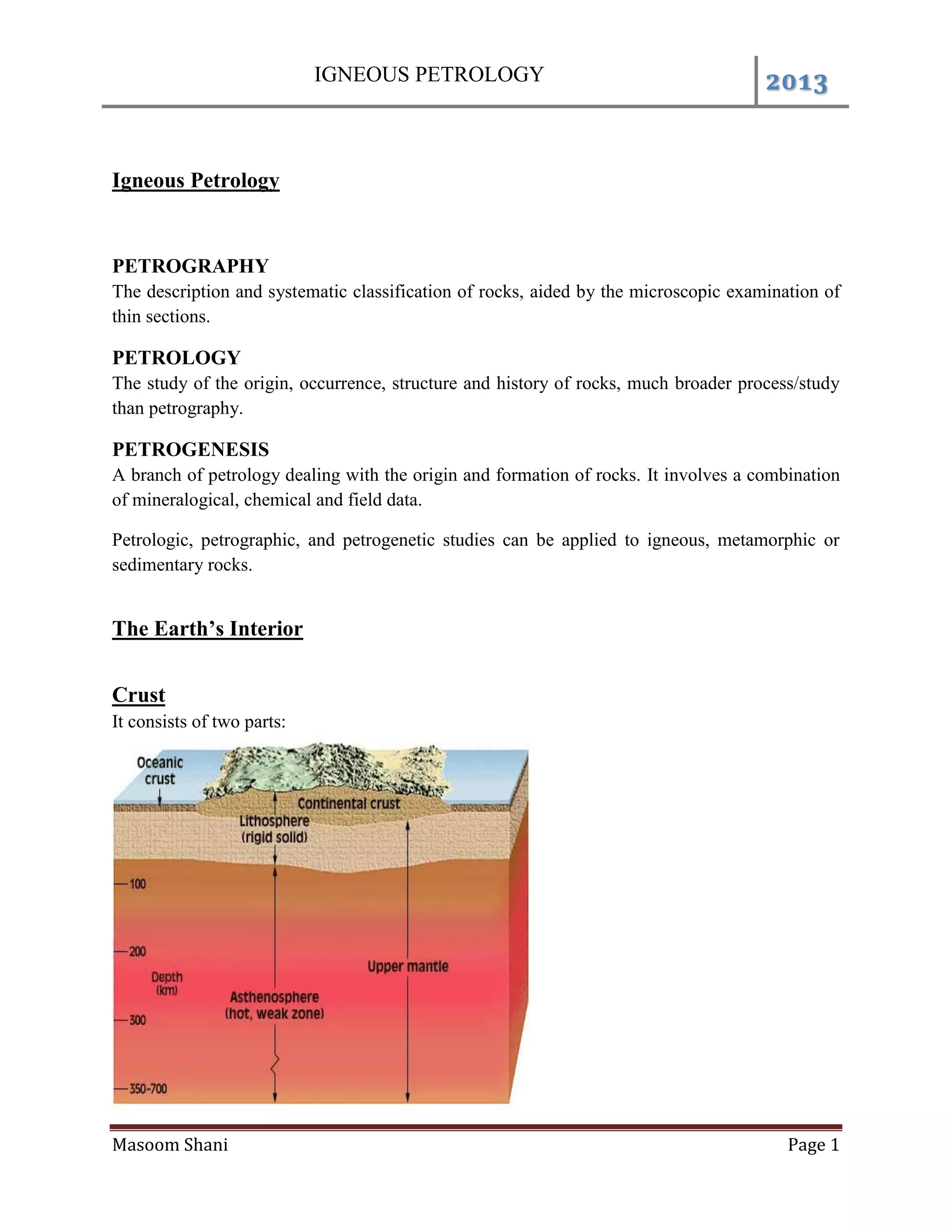
Crust
It consists of two parts:
IGNEOUS PETROLOGY 2013
Masoom Shani Page 2
Oceanic crust
 Thin: 10 km
 Relatively uniform stratigraphy = ophiolite suite:
1. Sediments
2. pillow basalt
3. sheeted dikes
4. more massive gabbro
5. ultramafic (mantle)
Continental Crust
 Thicker: 20-90 km, average ~35 km
 Highly variable composition
 Average composition is granodiorite
Mantle
 Peridotite (ultramafic)
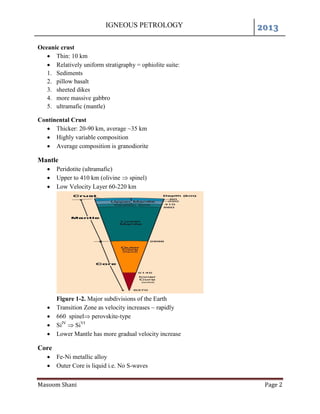
 Upper to 410 km (olivine  spinel)
 Low Velocity Layer 60-220 km
Figure 1-2. Major subdivisions of the Earth
 Transition Zone as velocity increases ~ rapidly
 660 spinel perovskite-type
 SiIV
 SiVI
 Lower Mantle has more gradual velocity increase
Core
 Fe-Ni metallic alloy
 Outer Core is liquid i.e. No S-waves
IGNEOUS PETROLOGY 2013
Masoom Shani Page 3
 Inner Core is solid
Figure 1-3. Variation in P and S wave velocities with depth. Compositional subdivisions
of the Earth are on the left, rheological subdivisions on the right. After Kearey and Vine
(1990), Global Tectonics. © Blackwell Scientific. Oxford.
NOMENCLATURE AND CLASSIFICATION
 Formation of minerals in an igneous rock is controlled by the chemical composition of
the magma and the physical- chemical conditions present during crystallization.
 Mineralogical composition and texture are used to describe, name and classify rocks.
 Both overall chemistry (whole-rock chemistry) and the chemistry of constitute minerals
offer clues to igneous rock origins.
 Studies of rock chemistry reveal where magmas form and how they are modified before
they solidify.
 The problem in rock classification is the selection of a basis for classification.
 Proposed classifications use texture, mineralogy, chemistry, geographic location and rock
associations.
 Systems of nomenclature and classification may reflect: genetic, textural, chemical or
mineralogical features.
GENETIC CLASSIFICATION
 Basic system which classifies rocks on the basis of where they form.
 Plutonic - at depth
IGNEOUS PETROLOGY 2013
Masoom Shani Page 4
 Hypabyssal - intermediate depth
 Volcanic - on the Earth's surface.
 But this system is not very practical, but it serves as a first approximation, it tells nothing
about mineralogy, chemistry of the rocks and cannot distinguish basalt from rhyolite.
TEXTURAL CLASSIFICATION
 It relies on the grain size of individual minerals in the rock.
 Aphanitic - fine grained < 1 mm
 Phaneritic - medium grained 1 to 5 mm
 Coarse grained (pegmatitic) > 5 mm
 Glassy- no crystal structure
 Porphyritic Texture-Two stages of cooling, i.e. slow cooling to grow a few large crystals,
followed by rapid cooling to grow many smaller crystals could result in a porphyritic
texture, a texture with two or more distinct sizes of grains. In a porphyritic texture, the
larger grains are called phenocryst and the material surrounding the phenocryst is
called groundmass or matrix.
 This system has the same shortcomings as a genetic classification, however specific
textures present may aid in classification, e.g., phenocryst, ophitic, coronas, but these are
not indicative of a specific environment of formation or a specific lithology.
CHEMICAL CLASSIFICATION
 This type of classification requires a complete chemical analysis of the rock
 A chemical classification system has been proposed for volcanic rocks and a comparable
scheme for plutonic rocks is not available. This leaves us with a system based on
mineralogy.
MINERALOGICAL CLASSIFICATION
 The one gaining application is the result of several years’ work by the IUGS Sub-
commission on the Classification of Igneous Rocks or Streckeissen Classification.
CLASSIFICATION SYSTEMS
 Several aspects which historically have played and continue to play a role in the
classification of igneous rocks should also be considered.
GRADATION IN SILICA CONTENT
 It referred to as acid or basic, implying a range of silica content.
1. Acidic > 66 wt% SiO2
e.g! Granites ~ 72 wt% SiO2, granodiorite ~ 68 wt% SiO2
2. Intermediate - 52 to 66 wt% SiO2
e.g! Andesite 57 wt% SiO2
IGNEOUS PETROLOGY 2013
Masoom Shani Page 5
3. Basic - 45 to 52 wt% SiO2
e.g! Basalts range from 48 to 50 wt%
4. Ultrabasic - < 45 wt% SiO2
e.g! Peridotite 41 to 42 wt% SiO2
COLOUR GRADATION
 Felsic rocks are light coloured, contain felsic minerals (e.g. qtz, feldspar, and
feldspathoids) which are themselves light in colour and have a low density which
contribute to the pale colour of the rock.
 Mafic Rocks are denser and dark coloured, the result of containing mafic minerals
(pyroxene, amphibole, olivine, and biotite). These minerals contribute to the green,
brown and black colour of these rocks.
Chemistry of Igneous rocks
 Modern chemical analyses of igneous rocks generally include a major elements analyses
and minor or trace elements analyses.
 Earth is composed almost entirely of 15 elements, 12 of which are the dominant elements
of the crust.
 The crustal elements, considered to be the major elements, in order of decreasing
abundance, are O, Si, Al, Fe, Ca, Na, Mg, K, Ti, H, P and Mn.
Composition of Earth shells
The chemical composition of rocks is determined by analyzing a powder of the rock.
Routine geochemical analysis of geologic materials can be carried out using either or a
combination of the following two techniques:
IGNEOUS PETROLOGY 2013
Masoom Shani Page 6
1. X-ray Fluorescence Spectroscopy (XRF) to determine both major and trace elements
2. Atomic Absorption Spectrometry (AAS) to determine both major and trace elements
The composition of an igneous rock is dependent on:
A. Composition of the source material. B. Depth of melting
C. Tectonic environment where crystallization occurs. e.g; rifting vs. subduction
D. Secondary alteration
SATURATION CONCEPT
It is used in reference to the SiO2 and Al2O3 which are the two most abundant components of
igneous rocks.
SiO2 Saturation
Minerals present in igneous rocks can be divided into two groups:
 Those which are compatible with quartz or primary SiO2 mineral (tridymite, cristobalite)
these minerals are saturated with respect to Si, e.g feldspars, pyroxenes.
 Those which never occur with a primary silica mineral. These are undersaturated
minerals, e.g. Mg-rich olivine, nepheline.
 The occurrence of quartz with an undersaturated mineral causes a reaction between the
two minerals to form a saturated mineral.
2SiO2 + NaAlSiO4 ===> NaAlSi3O8
Qtz + Ne ===> Albite
SiO2 + Mg2SiO4 ===> 2MgSiO3
Qtz + Ol ===> En
Shand (1927) proposed the following list of minerals, subdivided on the basis of silica saturation
and/or undersaturation, i.e. those that coexist with quartz (+Q) and those that do not coexist with
quartz (-Q).
Saturated (+Q) Undersaturated (-Q)
All feldspars leucite
All pyroxenes nepheline
All amphiboles sodalite
Fayalite (Fe-rich olivine) analcite etc.
 Undersaturated and saturated minerals can coexist stably under magmatic conditions, but
quartz, tridymite and cristobalite can only coexist stably with saturated minerals. For
IGNEOUS PETROLOGY 2013
Masoom Shani Page 7
example Q + ne is an impossible igneous assemblage, as is Q + Ol (Mg - rich) (see
reactions above), but Q + Ol (Fe- rich) is stable.
Rock Classification (Silica saturation)
1. Oversaturated - contains primary silica mineral.
2. Saturated - contains neither quartz nor an unsaturated mineral.
3. Unsaturated - contains unsaturated minerals.
Al2O3 Saturation
Four subdivisions of rocks independent of silica saturation, based on the molecular proportions
of Al2O3, Na2O, K2O and CaO applied mainly to granitic lithologies.
Per-aluminous
If the conc. of alumina is greater than the concentration of the sum of Na2O, K2O and CaO, then
it is known as “Per-aluminous”.
i.e; Al2O3 > (Na2O + K2O + CaO)
Metaluminous
If the conc. of alumina is less than the concentration of the sum of Na2O, K2O and CaO but the
conc. of alumina is greater than the sum of the conc. of Na2O and K2O, then it is known as
“Meta-aluminous”.
i.e; Al2O3 < (Na2O + K2O + CaO) but Al2O3 > (Na2O + K2O)
Sub-aluminous
If the conc. of alumina is equal to the concentration of the sum of Na2O and K2O, then it is
known as “Sub-alumimous”.
i.e; Al2O3 = (Na2O + K2O)
Per-alkaline
If the conc. of alumina is less than the concentration of the sum of Na2O and K2O, then it is
known as “Per-alkaline.”
i.e; Al2O3 < (Na2O + K2O)
IGNEOUS PETROLOGY 2013
Masoom Shani Page 8
Bowen’s Reaction Series
The crystallization of magma (the process by which hot, liquid magma cools and solidifies to
become a rock) is one of the most important concepts in igneous geology and is described by
Bowen’s Reaction Series. This process is called Magmatic Differentiation –the process by
which liquid magma can crystallize (solidify) to form volcanic rock of different compositions.
Bowen’s Reaction Series was performed common in a la extrusive igneous rocks: Basalt. Basalt
is a dark volcanic rock rich in iron, magnesium, calcium and silicates. It is thought to be
representative of the magma that exits deep within the Earth’s crust and is the reason Bowen chose to
use it in his laboratory experiments.
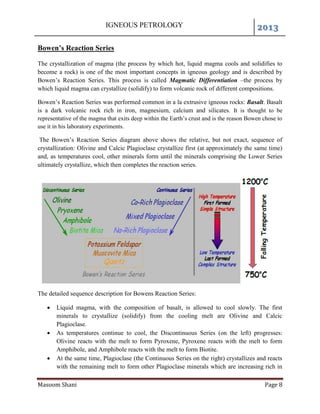
The Bowen’s Reaction Series diagram above shows the relative, but not exact, sequence of
crystallization: Olivine and Calcic Plagioclase crystallize first (at approximately the same time)
and, as temperatures cool, other minerals form until the minerals comprising the Lower Series
ultimately crystallize, which then completes the reaction series.
The detailed sequence description for Bowens Reaction Series:
 Liquid magma, with the composition of basalt, is allowed to cool slowly. The first
minerals to crystallize (solidify) from the cooling melt are Olivine and Calcic
Plagioclase.
 As temperatures continue to cool, the Discontinuous Series (on the left) progresses:
Olivine reacts with the melt to form Pyroxene, Pyroxene reacts with the melt to form
Amphibole, and Amphibole reacts with the melt to form Biotite.
 At the same time, Plagioclase (the Continuous Series on the right) crystallizes and reacts
with the remaining melt to form other Plagioclase minerals which are increasing rich in
IGNEOUS PETROLOGY 2013
Masoom Shani Page 9
sodium. In other words, as temperatures cool, Plagioclase crystallizes but its composition
becomes more sodic with falling temperatures.
 The process of crystallization of minerals in the Discontinuous and Continuous Series
ends when all of the iron-magnesium minerals (Discontinuous Series) and Plagioclase
(Continuous Series) are formed.
 After all the Discontinuous Series and Continuous Series minerals crystallize,
temperatures continue to cool and minerals in the Lower Series begin form from the
remaining magma melt. Potassium Feldspar, Muscovite, and Quartz crystallize in that
order, and comprise the Lower Series. As these minerals form, they do NOT react with
the remaining melt, they simply cool to become solid.
VARIATION DIAGRAMS
A main objective of any research program on igneous rocks is to describe and display chemical
variations for simplicity and to facilitate condensing information. The best way to simplify and
condense analytical data is by graphical means.
Harker Variation or Bi-variant (x-y) Diagrams
These diagrams visually present the variation in 2 chemical parameters. It is the oldest method
and is known as the variation diagram or Harker diagram which dates from 1909, and plots
oxides of elements against SiO2.
Explanation
Harker Diagrams gives a concept about Bowen Reaction Series.
Oxides (K2O, Na2O, CaO, MgO, and Al2O3) plotted against Silica (SiO2) form linear arrays. A
set of such plots is called a Harker diagram.
SiO2 is generally chosen because it is the most abundant oxide in igneous rocks and exhibits a
wide variation in composition. This type of graphical presentation is useful for large quantities of
analytical data and yields an approximation of inter-element variations for a group of samples.
With increasing Silica the following trends are evident:
FeO, MgO and CaO decrease in abundance.
K2O and Na2O increase.
Al2O3 does not exhibit a strong variation.
The explanation of these plots is as follows:
IGNEOUS PETROLOGY 2013
Masoom Shani Page 10
FeO with silica:
This oxide has inverse relationship with silica. It means that with increasing FeO, silica decrease
and when conc. of FeO decreases, silica increases as shown in fig.
MgO with silica:
This oxide has inverse relationship with silica. It means that with increasing MgO, silica
decrease and when conc. of MgO decreases, silica increases as shown in fig.
CaO with silica:
This oxide has inverse relationship with silica. It means that with increasing MgO, silica
decrease and when conc. of MgO decreases, silica increases as shown in fig.
K2O with silica:
This oxide has direct relationship with silica. It means that with increasing K2O, silica increases
and when conc. of K2O decreases, silica also decreases as shown in fig.
Na2O with silica:
This oxide has direct relationship with silica. It means that with increasing Na2O, silica increases
and when conc. of Na2O decreases, silica also decreases as shown in fig.
Al2O3 with silica:
Al2O3 does not exhibit a strong variation.
IGNEOUS PETROLOGY 2013
Masoom Shani Page 11
Triangular or Ternary Variation Diagrams
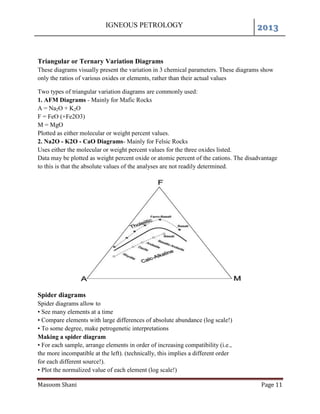
These diagrams visually present the variation in 3 chemical parameters. These diagrams show
only the ratios of various oxides or elements, rather than their actual values
Two types of triangular variation diagrams are commonly used:
1. AFM Diagrams - Mainly for Mafic Rocks
A = Na2O + K2O
F = FeO (+Fe2O3)
M = MgO
Plotted as either molecular or weight percent values.
2. Na2O - K2O - CaO Diagrams- Mainly for Felsic Rocks
Uses either the molecular or weight percent values for the three oxides listed.
Data may be plotted as weight percent oxide or atomic percent of the cations. The disadvantage
to this is that the absolute values of the analyses are not readily determined.
Spider diagrams
Spider diagrams allow to
• See many elements at a time
• Compare elements with large differences of absolute abundance (log scale!)
• To some degree, make petrogenetic interpretations
Making a spider diagram
• For each sample, arrange elements in order of increasing compatibility (i.e.,
the more incompatible at the left). (technically, this implies a different order
for each different source!).
• Plot the normalized value of each element (log scale!)
IGNEOUS PETROLOGY 2013
Masoom Shani Page 12
• Link the dots
• Look at the “anomalies”!
It is also known as Transition metal diagrams
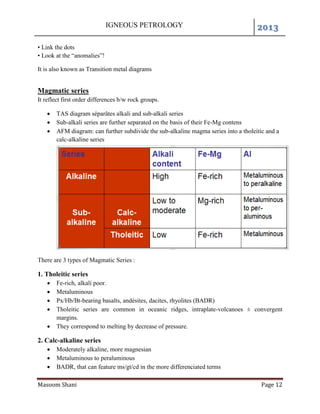
Magmatic series
It reflect first order differences b/w rock groups.
 TAS diagram séparâtes alkali and sub-alkali series
 Sub-alkali series are further separated on the basis of their Fe-Mg contens
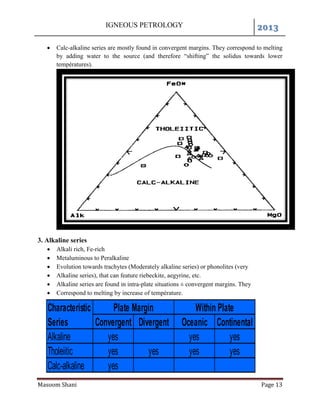
 AFM diagram: can further subdivide the sub-alkaline magma series into a tholeitic and a
calc-alkaline series
There are 3 types of Magmatic Series :
1. Tholeitic series
 Fe-rich, alkali poor.
 Metaluminous
 Px/Hb/Bt-bearing basalts, andésites, dacites, rhyolites (BADR)
 Tholeitic series are common in oceanic ridges, intraplate-volcanoes ± convergent
margins.
 They correspond to melting by decrease of pressure.
2. Calc-alkaline series
 Moderately alkaline, more magnesian
 Metaluminous to peraluminous
 BADR, that can feature ms/gt/cd in the more differenciated terms
IGNEOUS PETROLOGY 2013
Masoom Shani Page 13
 Calc-alkaline series are mostly found in convergent margins. They correspond to melting
by adding water to the source (and therefore “shifting” the solidus towards lower
températures).
3. Alkaline series
 Alkali rich, Fe-rich
 Metaluminous to Peralkaline
 Evolution towards trachytes (Moderately alkaline series) or phonolites (very
 Alkaline series), that can feature riebeckite, aegyrine, etc.
 Alkaline series are found in intra-plate situations ± convergent margins. They
 Correspond to melting by increase of température.
Characteristic
Series Convergent Divergent Oceanic Continental
Alkaline yes yes yes
Tholeiitic yes yes yes yes
Calc-alkaline yes
Plate Margin Within Plate
IGNEOUS PETROLOGY 2013
Masoom Shani Page 14
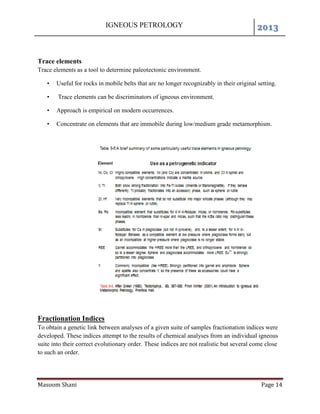
Trace elements
Trace elements as a tool to determine paleotectonic environment.
• Useful for rocks in mobile belts that are no longer recognizably in their original setting.
• Trace elements can be discriminators of igneous environment.
• Approach is empirical on modern occurrences.
• Concentrate on elements that are immobile during low/medium grade metamorphism.
Fractionation Indices
To obtain a genetic link between analyses of a given suite of samples fractionation indices were
developed. These indices attempt to the results of chemical analyses from an individual igneous
suite into their correct evolutionary order. These indices are not realistic but several come close
to such an order.
IGNEOUS PETROLOGY 2013
Masoom Shani Page 15
MgO Index
This is used for basaltic rocks. Positive correlations are produced for Na2O, K2O, and P2O5
indicating enrichment in these oxides with successive liquids. Negative correlations result for
CaO.
Mg-Fe Ratios
Again used for basaltic rocks. These involve a ratio of Mg to Fe:
MgO/MgO+FeO (ferrous)
MgO/MgO+FeO+Fe2O3 (ferric)
Mg/Mg+Fe (uses atomic proportions of the cations).
Normative Ab/Ab+An
Based on the values of Na2O and CaO. Only good for rocks which crystallize plagioclase, not
effected by mafic mineral formation. Generally applied to granites.
The above three indices are only good for specific lithologies, and thus have a restricted
application.
Two fractionation indices, based on complex equations have been suggested for more
comprehensive use.
Solidification Index (Kuno, 1959)
SI = 100 MgO/ (MgO+FeO+Fe2O3+Na2O+K2O)
For basalts this is similar to Mg/Fe ratios due to the relatively poor alkali content. As
fractionation progresses the residual liquids become enriched in alkalis, thus Na2O and K2O
contents offset the Mg-Fe index. For mafic rocks SI is high, for felsic rocks SI is low.
Differentiation Index (Thornton and tuttle, 1960)
DI = normative Q+Or+Ab+Ne+Ks+Lc
This is based on the normative analysis results. For mafic rocks DI will be low, because in
normative calculation these minerals are minor. Felsic rocks DI will be high because these
minerals are abundant in the norm.
MODAL ANALYSIS
Two types of analysis are useful when examining Igneous Rocks:
Modal analysis - requires only a thin section,
IGNEOUS PETROLOGY 2013
Masoom Shani Page 16
Normative analysis - requires a chemical analysis.
MODAL ANALYSIS
Produces an accurate representation of the distribution and volume percent of the mineral within
a thin section.
Three methods of analysis are used:
1. Measure the surface area of mineral grains of the same mineral, relative to the total
surface area of the thin section.
2. Measure the intercepts of each mineral along a series of lines.
3. POINT COUNT - Count each mineral occurrence along a series of traverse line across a
given thin section. For a statistically valid result > 2000 individual points must be
counted.
The number of grains counted, the spacing between points and successive traverse lines is
dependent on the mean grain size of the sample.
Advantages
1. One can compare rocks from different areas if you only have a thin section
2. No chemical analysis is required, using a petrographic microscope.
3. Gives the maximum and minimum grain sizes.
Disadvantages
1. Meaningless if the sample has a preferred orientation of one or more minerals.
2. Porphyritic rocks are difficult to count.
3. Total area of sample must be sufficiently larger than the max. Diameter of the smallest
grain size.
NORMATIVE ANALYSIS OR NORM
 Normative analysis is defined as the calculation of a theoretical assemblage of standard
minerals for a rock based, on the whole rock chemical composition as determined by
analytical techniques.
 The original purpose for the norm was essentially taxonomic.
 An elaborate classification scheme based on the normative mineral percentages was
proposed.
 The classification groups together rocks of similar bulk composition irrespective of their
mineralogy. Various types of NORMs have been proposed - CIPW, Niggli, and Barth.
 Each of these proposals has its own specific advantages and/or disadvantages.
IGNEOUS PETROLOGY 2013
Masoom Shani Page 17
CIPW Norm
 This NORM was very elegant and based on a number of simplifications:
 The magma crystallizes under anhydrous conditions so that no hydrous minerals
(hornblende, biotite) are formed.
 The ferromagnesian minerals are assumed to be free of Al2O3.
 The Fe/Mg ratio for all ferromagnesian minerals is assumed to be the same.
 Several minerals are assumed to be incompatible, thus nepheline and/or olivine never
appear with quartz in the norm.
Barth mesonorm
 It is used commonly when examining granitic rocks.
OPHIOLITES
 Ophio is Greek word for "snake", lite means "stone" from the Greek lithos.
 The name is given because ophiolites have similarity in colour and texture with snakes,
some greenish colour.
Definition
An abductive part of the oceanic crust is known as “ophiolites”. OR
An Ophiolite is a section of the Earth's oceanic crust and the underlying upper mantle that has
been uplifted or emplaced to be exposed within continental crustal rocks.
Formation of Ophiolites
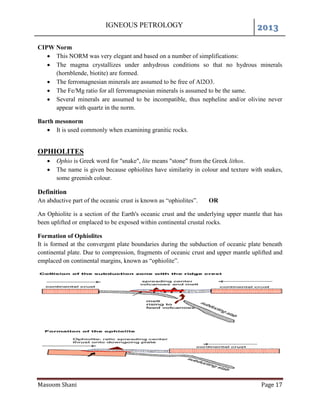
It is formed at the convergent plate boundaries during the subduction of oceanic plate beneath
continental plate. Due to compression, fragments of oceanic crust and upper mantle uplifted and
emplaced on continental margins, known as “ophiolite”.
IGNEOUS PETROLOGY 2013
Masoom Shani Page 18
Lithology of Ophiolites
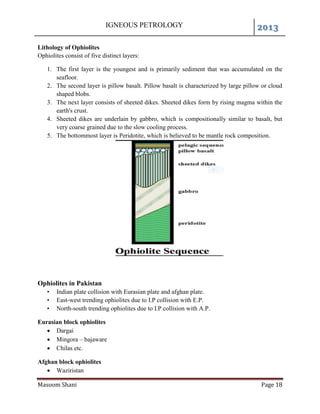
Ophiolites consist of five distinct layers:
1. The first layer is the youngest and is primarily sediment that was accumulated on the
seafloor.
2. The second layer is pillow basalt. Pillow basalt is characterized by large pillow or cloud
shaped blobs.
3. The next layer consists of sheeted dikes. Sheeted dikes form by rising magma within the
earth's crust.
4. Sheeted dikes are underlain by gabbro, which is compositionally similar to basalt, but
very coarse grained due to the slow cooling process.
5. The bottommost layer is Peridotite, which is believed to be mantle rock composition.
Ophiolites in Pakistan
• Indian plate collision with Eurasian plate and afghan plate.
• East-west trending ophiolites due to I.P collision with E.P.
• North-south trending ophiolites due to I.P collision with A.P.
Eurasian block ophiolites
 Dargai
 Mingora – bajaware
 Chilas etc.
Afghan block ophiolites
 Waziristan
IGNEOUS PETROLOGY 2013
Masoom Shani Page 19
 Zhob
 Muslim Bagh
 Bela etc.
Conclusions
 Ophiolites are slabs of ancient oceanic crust abducted/preserved onto the continental
crust/earth surface.
 They are located in collisional boundaries.
 Their compostion is sediments, lavas, sheeted dikes, gabbros, and ultramafic rocks.
 Have similarity with oceanic crust.
Granitoids
“Granitoids” (sensu lato): loosely applied to a wide range of felsic plutonic rocks, similar to
granite which mineralogically are composed predominantly of feldspar and quartz
Examples
 Granite
 Quartz Monzonite
 Quartz Diorite and
 Syenite etc.
Explanation
 Associated volcanics are common and have same origin, but are typically eroded away.
 Most granitoids of significant volume occur in areas where the continental crust has been
thickened by orogeny, either continental arc subduction or collision of sialic masses.
Many granites, however, may post-date the thickening event by tens of millions of years.
 Because the crust is solid in its normal state, some thermal disturbance is required to form
granitoids
 Most workers are of the opinion that the majority of granitoids are derived by crustal
anatexis, but that the mantle may also be involved. The mantle contribution may range
from that of a source of heat for crustal anatexis, or it may be the source of material as
well.
Granitoids Classification
There are usually four types:
1. I-type
2. S-type
IGNEOUS PETROLOGY 2013
Masoom Shani Page 20
3. M-type
4. A-type
I-type Granitoids
 These types of granitoids derived from the melting of mafic mantle-derived igneous
source, probably sub-crustal under plate. e.g; Andean Granites
 It may be Metaluminous and peraluminous.
 Its common oxide is magnetite.
 It is hornblende-rich
S-type Granitoids
 It is derived from partial melting of peraluminous sedimentary rocks imprinted by
weathering at surface of earth.
 It is always peraluminous.
 Its common oxide is ilmenite.
 It is biotite-rich and may contain muscovite, andalusite etc.
M-type Granitoids
 It is derived from mantle source.
 It includes both immature arc plutons found in ophiolites oceanic crust.
A-type Granitoids
It is derived from anorogenic.
It is commonly intruded into non-orogenic setting.
Generally higher in SiO2, alkalies, Fe/Mg, halogens F, Cl, Zr than I-type.
IUGS Classification of Igneous Rocks
IUGS Classification of igneous rocks is as follows:
IGNEOUS PETROLOGY 2013
Masoom Shani Page 21
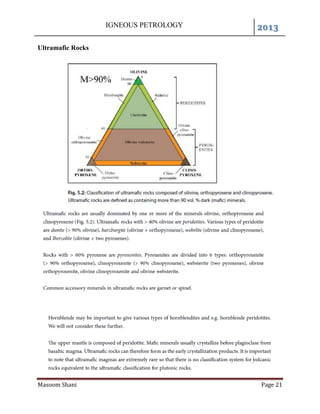
Ultramafic Rocks
IGNEOUS PETROLOGY 2013
Masoom Shani Page 22
IGNEOUS PETROLOGY 2013
Masoom Shani Page 23
IGNEOUS PETROLOGY 2013
Masoom Shani Page 24
IGNEOUS PETROLOGY 2013
Masoom Shani Page 25
IGNEOUS PETROLOGY 2013
Masoom Shani Page 26

Igneous petrology.....Masoom

  • 1.
    IGNEOUS PETROLOGY 2013 MasoomShani Page 1 Igneous Petrology PETROGRAPHY The description and systematic classification of rocks, aided by the microscopic examination of thin sections. PETROLOGY The study of the origin, occurrence, structure and history of rocks, much broader process/study than petrography. PETROGENESIS A branch of petrology dealing with the origin and formation of rocks. It involves a combination of mineralogical, chemical and field data. Petrologic, petrographic, and petrogenetic studies can be applied to igneous, metamorphic or sedimentary rocks. The Earth’s Interior Crust It consists of two parts:
  • 2.
    IGNEOUS PETROLOGY 2013 MasoomShani Page 2 Oceanic crust  Thin: 10 km  Relatively uniform stratigraphy = ophiolite suite: 1. Sediments 2. pillow basalt 3. sheeted dikes 4. more massive gabbro 5. ultramafic (mantle) Continental Crust  Thicker: 20-90 km, average ~35 km  Highly variable composition  Average composition is granodiorite Mantle  Peridotite (ultramafic)  Upper to 410 km (olivine  spinel)  Low Velocity Layer 60-220 km Figure 1-2. Major subdivisions of the Earth  Transition Zone as velocity increases ~ rapidly  660 spinel perovskite-type  SiIV  SiVI  Lower Mantle has more gradual velocity increase Core  Fe-Ni metallic alloy  Outer Core is liquid i.e. No S-waves
  • 3.
    IGNEOUS PETROLOGY 2013 MasoomShani Page 3  Inner Core is solid Figure 1-3. Variation in P and S wave velocities with depth. Compositional subdivisions of the Earth are on the left, rheological subdivisions on the right. After Kearey and Vine (1990), Global Tectonics. © Blackwell Scientific. Oxford. NOMENCLATURE AND CLASSIFICATION  Formation of minerals in an igneous rock is controlled by the chemical composition of the magma and the physical- chemical conditions present during crystallization.  Mineralogical composition and texture are used to describe, name and classify rocks.  Both overall chemistry (whole-rock chemistry) and the chemistry of constitute minerals offer clues to igneous rock origins.  Studies of rock chemistry reveal where magmas form and how they are modified before they solidify.  The problem in rock classification is the selection of a basis for classification.  Proposed classifications use texture, mineralogy, chemistry, geographic location and rock associations.  Systems of nomenclature and classification may reflect: genetic, textural, chemical or mineralogical features. GENETIC CLASSIFICATION  Basic system which classifies rocks on the basis of where they form.  Plutonic - at depth
  • 4.
    IGNEOUS PETROLOGY 2013 MasoomShani Page 4  Hypabyssal - intermediate depth  Volcanic - on the Earth's surface.  But this system is not very practical, but it serves as a first approximation, it tells nothing about mineralogy, chemistry of the rocks and cannot distinguish basalt from rhyolite. TEXTURAL CLASSIFICATION  It relies on the grain size of individual minerals in the rock.  Aphanitic - fine grained < 1 mm  Phaneritic - medium grained 1 to 5 mm  Coarse grained (pegmatitic) > 5 mm  Glassy- no crystal structure  Porphyritic Texture-Two stages of cooling, i.e. slow cooling to grow a few large crystals, followed by rapid cooling to grow many smaller crystals could result in a porphyritic texture, a texture with two or more distinct sizes of grains. In a porphyritic texture, the larger grains are called phenocryst and the material surrounding the phenocryst is called groundmass or matrix.  This system has the same shortcomings as a genetic classification, however specific textures present may aid in classification, e.g., phenocryst, ophitic, coronas, but these are not indicative of a specific environment of formation or a specific lithology. CHEMICAL CLASSIFICATION  This type of classification requires a complete chemical analysis of the rock  A chemical classification system has been proposed for volcanic rocks and a comparable scheme for plutonic rocks is not available. This leaves us with a system based on mineralogy. MINERALOGICAL CLASSIFICATION  The one gaining application is the result of several years’ work by the IUGS Sub- commission on the Classification of Igneous Rocks or Streckeissen Classification. CLASSIFICATION SYSTEMS  Several aspects which historically have played and continue to play a role in the classification of igneous rocks should also be considered. GRADATION IN SILICA CONTENT  It referred to as acid or basic, implying a range of silica content. 1. Acidic > 66 wt% SiO2 e.g! Granites ~ 72 wt% SiO2, granodiorite ~ 68 wt% SiO2 2. Intermediate - 52 to 66 wt% SiO2 e.g! Andesite 57 wt% SiO2
  • 5.
    IGNEOUS PETROLOGY 2013 MasoomShani Page 5 3. Basic - 45 to 52 wt% SiO2 e.g! Basalts range from 48 to 50 wt% 4. Ultrabasic - < 45 wt% SiO2 e.g! Peridotite 41 to 42 wt% SiO2 COLOUR GRADATION  Felsic rocks are light coloured, contain felsic minerals (e.g. qtz, feldspar, and feldspathoids) which are themselves light in colour and have a low density which contribute to the pale colour of the rock.  Mafic Rocks are denser and dark coloured, the result of containing mafic minerals (pyroxene, amphibole, olivine, and biotite). These minerals contribute to the green, brown and black colour of these rocks. Chemistry of Igneous rocks  Modern chemical analyses of igneous rocks generally include a major elements analyses and minor or trace elements analyses.  Earth is composed almost entirely of 15 elements, 12 of which are the dominant elements of the crust.  The crustal elements, considered to be the major elements, in order of decreasing abundance, are O, Si, Al, Fe, Ca, Na, Mg, K, Ti, H, P and Mn. Composition of Earth shells The chemical composition of rocks is determined by analyzing a powder of the rock. Routine geochemical analysis of geologic materials can be carried out using either or a combination of the following two techniques:
  • 6.
    IGNEOUS PETROLOGY 2013 MasoomShani Page 6 1. X-ray Fluorescence Spectroscopy (XRF) to determine both major and trace elements 2. Atomic Absorption Spectrometry (AAS) to determine both major and trace elements The composition of an igneous rock is dependent on: A. Composition of the source material. B. Depth of melting C. Tectonic environment where crystallization occurs. e.g; rifting vs. subduction D. Secondary alteration SATURATION CONCEPT It is used in reference to the SiO2 and Al2O3 which are the two most abundant components of igneous rocks. SiO2 Saturation Minerals present in igneous rocks can be divided into two groups:  Those which are compatible with quartz or primary SiO2 mineral (tridymite, cristobalite) these minerals are saturated with respect to Si, e.g feldspars, pyroxenes.  Those which never occur with a primary silica mineral. These are undersaturated minerals, e.g. Mg-rich olivine, nepheline.  The occurrence of quartz with an undersaturated mineral causes a reaction between the two minerals to form a saturated mineral. 2SiO2 + NaAlSiO4 ===> NaAlSi3O8 Qtz + Ne ===> Albite SiO2 + Mg2SiO4 ===> 2MgSiO3 Qtz + Ol ===> En Shand (1927) proposed the following list of minerals, subdivided on the basis of silica saturation and/or undersaturation, i.e. those that coexist with quartz (+Q) and those that do not coexist with quartz (-Q). Saturated (+Q) Undersaturated (-Q) All feldspars leucite All pyroxenes nepheline All amphiboles sodalite Fayalite (Fe-rich olivine) analcite etc.  Undersaturated and saturated minerals can coexist stably under magmatic conditions, but quartz, tridymite and cristobalite can only coexist stably with saturated minerals. For
  • 7.
    IGNEOUS PETROLOGY 2013 MasoomShani Page 7 example Q + ne is an impossible igneous assemblage, as is Q + Ol (Mg - rich) (see reactions above), but Q + Ol (Fe- rich) is stable. Rock Classification (Silica saturation) 1. Oversaturated - contains primary silica mineral. 2. Saturated - contains neither quartz nor an unsaturated mineral. 3. Unsaturated - contains unsaturated minerals. Al2O3 Saturation Four subdivisions of rocks independent of silica saturation, based on the molecular proportions of Al2O3, Na2O, K2O and CaO applied mainly to granitic lithologies. Per-aluminous If the conc. of alumina is greater than the concentration of the sum of Na2O, K2O and CaO, then it is known as “Per-aluminous”. i.e; Al2O3 > (Na2O + K2O + CaO) Metaluminous If the conc. of alumina is less than the concentration of the sum of Na2O, K2O and CaO but the conc. of alumina is greater than the sum of the conc. of Na2O and K2O, then it is known as “Meta-aluminous”. i.e; Al2O3 < (Na2O + K2O + CaO) but Al2O3 > (Na2O + K2O) Sub-aluminous If the conc. of alumina is equal to the concentration of the sum of Na2O and K2O, then it is known as “Sub-alumimous”. i.e; Al2O3 = (Na2O + K2O) Per-alkaline If the conc. of alumina is less than the concentration of the sum of Na2O and K2O, then it is known as “Per-alkaline.” i.e; Al2O3 < (Na2O + K2O)
  • 8.
    IGNEOUS PETROLOGY 2013 MasoomShani Page 8 Bowen’s Reaction Series The crystallization of magma (the process by which hot, liquid magma cools and solidifies to become a rock) is one of the most important concepts in igneous geology and is described by Bowen’s Reaction Series. This process is called Magmatic Differentiation –the process by which liquid magma can crystallize (solidify) to form volcanic rock of different compositions. Bowen’s Reaction Series was performed common in a la extrusive igneous rocks: Basalt. Basalt is a dark volcanic rock rich in iron, magnesium, calcium and silicates. It is thought to be representative of the magma that exits deep within the Earth’s crust and is the reason Bowen chose to use it in his laboratory experiments. The Bowen’s Reaction Series diagram above shows the relative, but not exact, sequence of crystallization: Olivine and Calcic Plagioclase crystallize first (at approximately the same time) and, as temperatures cool, other minerals form until the minerals comprising the Lower Series ultimately crystallize, which then completes the reaction series. The detailed sequence description for Bowens Reaction Series:  Liquid magma, with the composition of basalt, is allowed to cool slowly. The first minerals to crystallize (solidify) from the cooling melt are Olivine and Calcic Plagioclase.  As temperatures continue to cool, the Discontinuous Series (on the left) progresses: Olivine reacts with the melt to form Pyroxene, Pyroxene reacts with the melt to form Amphibole, and Amphibole reacts with the melt to form Biotite.  At the same time, Plagioclase (the Continuous Series on the right) crystallizes and reacts with the remaining melt to form other Plagioclase minerals which are increasing rich in
  • 9.
    IGNEOUS PETROLOGY 2013 MasoomShani Page 9 sodium. In other words, as temperatures cool, Plagioclase crystallizes but its composition becomes more sodic with falling temperatures.  The process of crystallization of minerals in the Discontinuous and Continuous Series ends when all of the iron-magnesium minerals (Discontinuous Series) and Plagioclase (Continuous Series) are formed.  After all the Discontinuous Series and Continuous Series minerals crystallize, temperatures continue to cool and minerals in the Lower Series begin form from the remaining magma melt. Potassium Feldspar, Muscovite, and Quartz crystallize in that order, and comprise the Lower Series. As these minerals form, they do NOT react with the remaining melt, they simply cool to become solid. VARIATION DIAGRAMS A main objective of any research program on igneous rocks is to describe and display chemical variations for simplicity and to facilitate condensing information. The best way to simplify and condense analytical data is by graphical means. Harker Variation or Bi-variant (x-y) Diagrams These diagrams visually present the variation in 2 chemical parameters. It is the oldest method and is known as the variation diagram or Harker diagram which dates from 1909, and plots oxides of elements against SiO2. Explanation Harker Diagrams gives a concept about Bowen Reaction Series. Oxides (K2O, Na2O, CaO, MgO, and Al2O3) plotted against Silica (SiO2) form linear arrays. A set of such plots is called a Harker diagram. SiO2 is generally chosen because it is the most abundant oxide in igneous rocks and exhibits a wide variation in composition. This type of graphical presentation is useful for large quantities of analytical data and yields an approximation of inter-element variations for a group of samples. With increasing Silica the following trends are evident: FeO, MgO and CaO decrease in abundance. K2O and Na2O increase. Al2O3 does not exhibit a strong variation. The explanation of these plots is as follows:
  • 10.
    IGNEOUS PETROLOGY 2013 MasoomShani Page 10 FeO with silica: This oxide has inverse relationship with silica. It means that with increasing FeO, silica decrease and when conc. of FeO decreases, silica increases as shown in fig. MgO with silica: This oxide has inverse relationship with silica. It means that with increasing MgO, silica decrease and when conc. of MgO decreases, silica increases as shown in fig. CaO with silica: This oxide has inverse relationship with silica. It means that with increasing MgO, silica decrease and when conc. of MgO decreases, silica increases as shown in fig. K2O with silica: This oxide has direct relationship with silica. It means that with increasing K2O, silica increases and when conc. of K2O decreases, silica also decreases as shown in fig. Na2O with silica: This oxide has direct relationship with silica. It means that with increasing Na2O, silica increases and when conc. of Na2O decreases, silica also decreases as shown in fig. Al2O3 with silica: Al2O3 does not exhibit a strong variation.
  • 11.
    IGNEOUS PETROLOGY 2013 MasoomShani Page 11 Triangular or Ternary Variation Diagrams These diagrams visually present the variation in 3 chemical parameters. These diagrams show only the ratios of various oxides or elements, rather than their actual values Two types of triangular variation diagrams are commonly used: 1. AFM Diagrams - Mainly for Mafic Rocks A = Na2O + K2O F = FeO (+Fe2O3) M = MgO Plotted as either molecular or weight percent values. 2. Na2O - K2O - CaO Diagrams- Mainly for Felsic Rocks Uses either the molecular or weight percent values for the three oxides listed. Data may be plotted as weight percent oxide or atomic percent of the cations. The disadvantage to this is that the absolute values of the analyses are not readily determined. Spider diagrams Spider diagrams allow to • See many elements at a time • Compare elements with large differences of absolute abundance (log scale!) • To some degree, make petrogenetic interpretations Making a spider diagram • For each sample, arrange elements in order of increasing compatibility (i.e., the more incompatible at the left). (technically, this implies a different order for each different source!). • Plot the normalized value of each element (log scale!)
  • 12.
    IGNEOUS PETROLOGY 2013 MasoomShani Page 12 • Link the dots • Look at the “anomalies”! It is also known as Transition metal diagrams Magmatic series It reflect first order differences b/w rock groups.  TAS diagram séparâtes alkali and sub-alkali series  Sub-alkali series are further separated on the basis of their Fe-Mg contens  AFM diagram: can further subdivide the sub-alkaline magma series into a tholeitic and a calc-alkaline series There are 3 types of Magmatic Series : 1. Tholeitic series  Fe-rich, alkali poor.  Metaluminous  Px/Hb/Bt-bearing basalts, andésites, dacites, rhyolites (BADR)  Tholeitic series are common in oceanic ridges, intraplate-volcanoes ± convergent margins.  They correspond to melting by decrease of pressure. 2. Calc-alkaline series  Moderately alkaline, more magnesian  Metaluminous to peraluminous  BADR, that can feature ms/gt/cd in the more differenciated terms
  • 13.
    IGNEOUS PETROLOGY 2013 MasoomShani Page 13  Calc-alkaline series are mostly found in convergent margins. They correspond to melting by adding water to the source (and therefore “shifting” the solidus towards lower températures). 3. Alkaline series  Alkali rich, Fe-rich  Metaluminous to Peralkaline  Evolution towards trachytes (Moderately alkaline series) or phonolites (very  Alkaline series), that can feature riebeckite, aegyrine, etc.  Alkaline series are found in intra-plate situations ± convergent margins. They  Correspond to melting by increase of température. Characteristic Series Convergent Divergent Oceanic Continental Alkaline yes yes yes Tholeiitic yes yes yes yes Calc-alkaline yes Plate Margin Within Plate
  • 14.
    IGNEOUS PETROLOGY 2013 MasoomShani Page 14 Trace elements Trace elements as a tool to determine paleotectonic environment. • Useful for rocks in mobile belts that are no longer recognizably in their original setting. • Trace elements can be discriminators of igneous environment. • Approach is empirical on modern occurrences. • Concentrate on elements that are immobile during low/medium grade metamorphism. Fractionation Indices To obtain a genetic link between analyses of a given suite of samples fractionation indices were developed. These indices attempt to the results of chemical analyses from an individual igneous suite into their correct evolutionary order. These indices are not realistic but several come close to such an order.
  • 15.
    IGNEOUS PETROLOGY 2013 MasoomShani Page 15 MgO Index This is used for basaltic rocks. Positive correlations are produced for Na2O, K2O, and P2O5 indicating enrichment in these oxides with successive liquids. Negative correlations result for CaO. Mg-Fe Ratios Again used for basaltic rocks. These involve a ratio of Mg to Fe: MgO/MgO+FeO (ferrous) MgO/MgO+FeO+Fe2O3 (ferric) Mg/Mg+Fe (uses atomic proportions of the cations). Normative Ab/Ab+An Based on the values of Na2O and CaO. Only good for rocks which crystallize plagioclase, not effected by mafic mineral formation. Generally applied to granites. The above three indices are only good for specific lithologies, and thus have a restricted application. Two fractionation indices, based on complex equations have been suggested for more comprehensive use. Solidification Index (Kuno, 1959) SI = 100 MgO/ (MgO+FeO+Fe2O3+Na2O+K2O) For basalts this is similar to Mg/Fe ratios due to the relatively poor alkali content. As fractionation progresses the residual liquids become enriched in alkalis, thus Na2O and K2O contents offset the Mg-Fe index. For mafic rocks SI is high, for felsic rocks SI is low. Differentiation Index (Thornton and tuttle, 1960) DI = normative Q+Or+Ab+Ne+Ks+Lc This is based on the normative analysis results. For mafic rocks DI will be low, because in normative calculation these minerals are minor. Felsic rocks DI will be high because these minerals are abundant in the norm. MODAL ANALYSIS Two types of analysis are useful when examining Igneous Rocks: Modal analysis - requires only a thin section,
  • 16.
    IGNEOUS PETROLOGY 2013 MasoomShani Page 16 Normative analysis - requires a chemical analysis. MODAL ANALYSIS Produces an accurate representation of the distribution and volume percent of the mineral within a thin section. Three methods of analysis are used: 1. Measure the surface area of mineral grains of the same mineral, relative to the total surface area of the thin section. 2. Measure the intercepts of each mineral along a series of lines. 3. POINT COUNT - Count each mineral occurrence along a series of traverse line across a given thin section. For a statistically valid result > 2000 individual points must be counted. The number of grains counted, the spacing between points and successive traverse lines is dependent on the mean grain size of the sample. Advantages 1. One can compare rocks from different areas if you only have a thin section 2. No chemical analysis is required, using a petrographic microscope. 3. Gives the maximum and minimum grain sizes. Disadvantages 1. Meaningless if the sample has a preferred orientation of one or more minerals. 2. Porphyritic rocks are difficult to count. 3. Total area of sample must be sufficiently larger than the max. Diameter of the smallest grain size. NORMATIVE ANALYSIS OR NORM  Normative analysis is defined as the calculation of a theoretical assemblage of standard minerals for a rock based, on the whole rock chemical composition as determined by analytical techniques.  The original purpose for the norm was essentially taxonomic.  An elaborate classification scheme based on the normative mineral percentages was proposed.  The classification groups together rocks of similar bulk composition irrespective of their mineralogy. Various types of NORMs have been proposed - CIPW, Niggli, and Barth.  Each of these proposals has its own specific advantages and/or disadvantages.
  • 17.
    IGNEOUS PETROLOGY 2013 MasoomShani Page 17 CIPW Norm  This NORM was very elegant and based on a number of simplifications:  The magma crystallizes under anhydrous conditions so that no hydrous minerals (hornblende, biotite) are formed.  The ferromagnesian minerals are assumed to be free of Al2O3.  The Fe/Mg ratio for all ferromagnesian minerals is assumed to be the same.  Several minerals are assumed to be incompatible, thus nepheline and/or olivine never appear with quartz in the norm. Barth mesonorm  It is used commonly when examining granitic rocks. OPHIOLITES  Ophio is Greek word for "snake", lite means "stone" from the Greek lithos.  The name is given because ophiolites have similarity in colour and texture with snakes, some greenish colour. Definition An abductive part of the oceanic crust is known as “ophiolites”. OR An Ophiolite is a section of the Earth's oceanic crust and the underlying upper mantle that has been uplifted or emplaced to be exposed within continental crustal rocks. Formation of Ophiolites It is formed at the convergent plate boundaries during the subduction of oceanic plate beneath continental plate. Due to compression, fragments of oceanic crust and upper mantle uplifted and emplaced on continental margins, known as “ophiolite”.
  • 18.
    IGNEOUS PETROLOGY 2013 MasoomShani Page 18 Lithology of Ophiolites Ophiolites consist of five distinct layers: 1. The first layer is the youngest and is primarily sediment that was accumulated on the seafloor. 2. The second layer is pillow basalt. Pillow basalt is characterized by large pillow or cloud shaped blobs. 3. The next layer consists of sheeted dikes. Sheeted dikes form by rising magma within the earth's crust. 4. Sheeted dikes are underlain by gabbro, which is compositionally similar to basalt, but very coarse grained due to the slow cooling process. 5. The bottommost layer is Peridotite, which is believed to be mantle rock composition. Ophiolites in Pakistan • Indian plate collision with Eurasian plate and afghan plate. • East-west trending ophiolites due to I.P collision with E.P. • North-south trending ophiolites due to I.P collision with A.P. Eurasian block ophiolites  Dargai  Mingora – bajaware  Chilas etc. Afghan block ophiolites  Waziristan
  • 19.
    IGNEOUS PETROLOGY 2013 MasoomShani Page 19  Zhob  Muslim Bagh  Bela etc. Conclusions  Ophiolites are slabs of ancient oceanic crust abducted/preserved onto the continental crust/earth surface.  They are located in collisional boundaries.  Their compostion is sediments, lavas, sheeted dikes, gabbros, and ultramafic rocks.  Have similarity with oceanic crust. Granitoids “Granitoids” (sensu lato): loosely applied to a wide range of felsic plutonic rocks, similar to granite which mineralogically are composed predominantly of feldspar and quartz Examples  Granite  Quartz Monzonite  Quartz Diorite and  Syenite etc. Explanation  Associated volcanics are common and have same origin, but are typically eroded away.  Most granitoids of significant volume occur in areas where the continental crust has been thickened by orogeny, either continental arc subduction or collision of sialic masses. Many granites, however, may post-date the thickening event by tens of millions of years.  Because the crust is solid in its normal state, some thermal disturbance is required to form granitoids  Most workers are of the opinion that the majority of granitoids are derived by crustal anatexis, but that the mantle may also be involved. The mantle contribution may range from that of a source of heat for crustal anatexis, or it may be the source of material as well. Granitoids Classification There are usually four types: 1. I-type 2. S-type
  • 20.
    IGNEOUS PETROLOGY 2013 MasoomShani Page 20 3. M-type 4. A-type I-type Granitoids  These types of granitoids derived from the melting of mafic mantle-derived igneous source, probably sub-crustal under plate. e.g; Andean Granites  It may be Metaluminous and peraluminous.  Its common oxide is magnetite.  It is hornblende-rich S-type Granitoids  It is derived from partial melting of peraluminous sedimentary rocks imprinted by weathering at surface of earth.  It is always peraluminous.  Its common oxide is ilmenite.  It is biotite-rich and may contain muscovite, andalusite etc. M-type Granitoids  It is derived from mantle source.  It includes both immature arc plutons found in ophiolites oceanic crust. A-type Granitoids It is derived from anorogenic. It is commonly intruded into non-orogenic setting. Generally higher in SiO2, alkalies, Fe/Mg, halogens F, Cl, Zr than I-type. IUGS Classification of Igneous Rocks IUGS Classification of igneous rocks is as follows:
  • 21.
    IGNEOUS PETROLOGY 2013 MasoomShani Page 21 Ultramafic Rocks
  • 22.
  • 23.
  • 24.
  • 25.
  • 26.