© 2007 Pearson Education Inc., publishing as Pearson Addison-Wesley
Today
• Terrestrial Planets
– Earth/moon, Venus, Mars, Mercury
1
Homework due now
Exam next Thursday
© 2007 Pearson Education Inc., publishing as Pearson Addison-Wesley
Exam Review Session
• This Monday, 6-8 PM, this room
• Completely driven by your questions! The
TAs will not prepare summary slides, but
can go to the lecture slides if needed.
• When your questions are done, the review is
over
• Don’t ask them what will be on the exam;
they don’t know :)
2
© 2007 Pearson Education Inc., publishing as Pearson Addison-Wesley
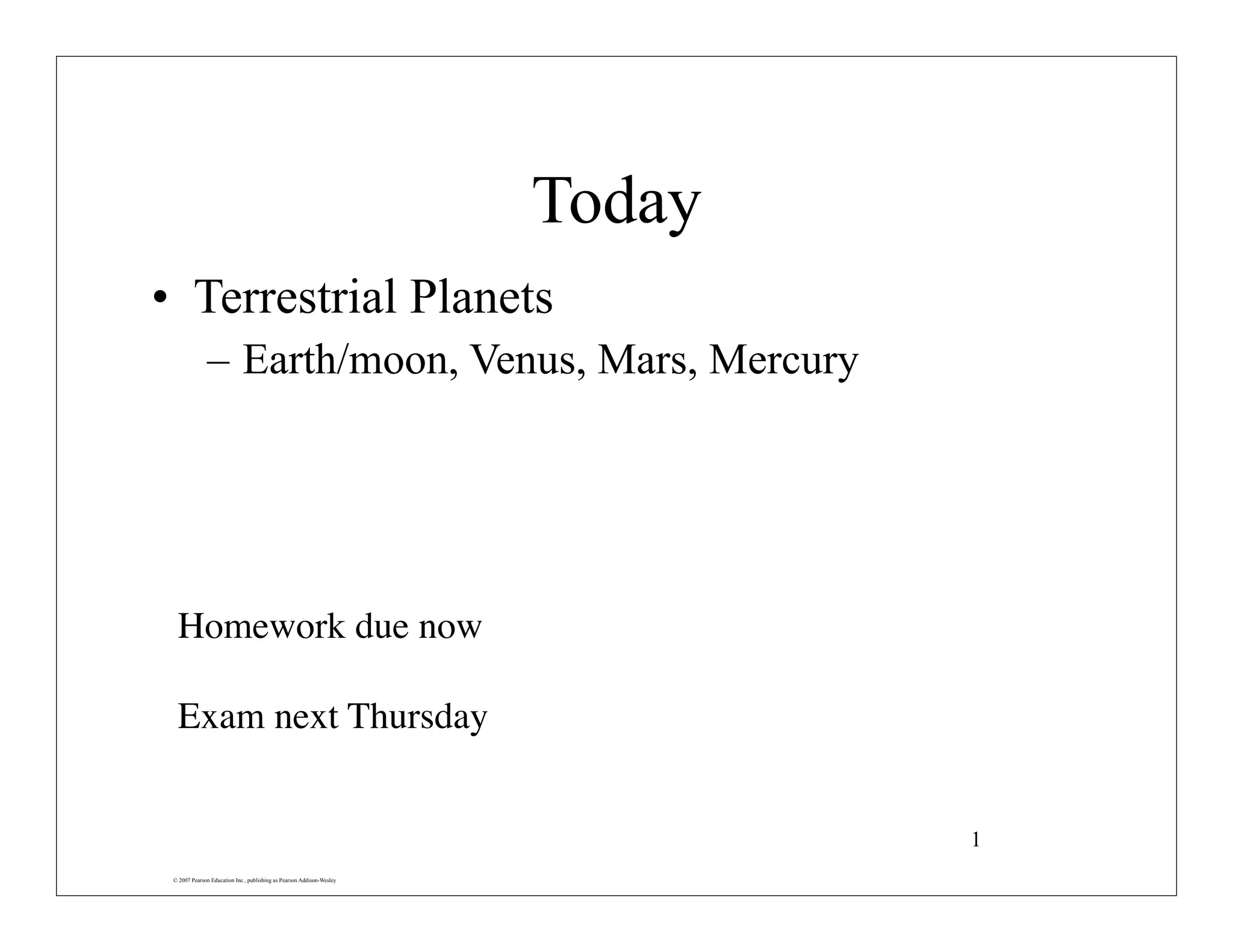
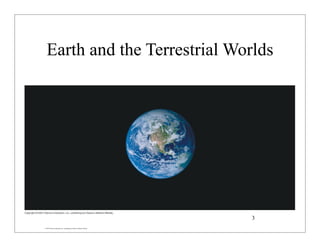
Earth and the Terrestrial Worlds
3
© 2007 Pearson Education Inc., publishing as Pearson Addison-Wesley
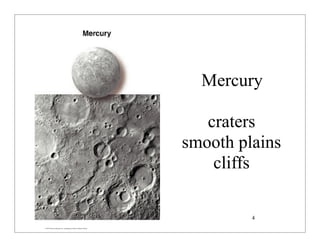
Mercury
craters
smooth plains
cliffs
4
© 2007 Pearson Education Inc., publishing as Pearson Addison-Wesley
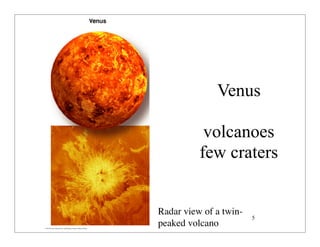
Venus
volcanoes
few craters
Radar view of a twin-
peaked volcano
5
© 2007 Pearson Education Inc., publishing as Pearson Addison-Wesley
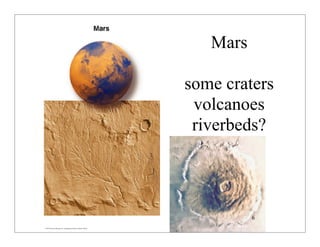
Mars
some craters
volcanoes
riverbeds?
6
© 2007 Pearson Education Inc., publishing as Pearson Addison-Wesley
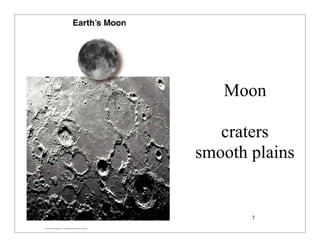
Moon
craters
smooth plains
7
© 2007 Pearson Education Inc., publishing as Pearson Addison-Wesley
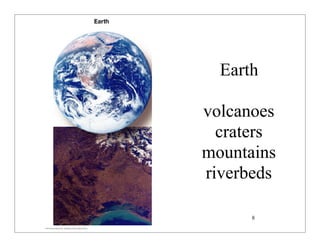
Earth
volcanoes
craters
mountains
riverbeds
8
© 2007 Pearson Education Inc., publishing as Pearson Addison-Wesley
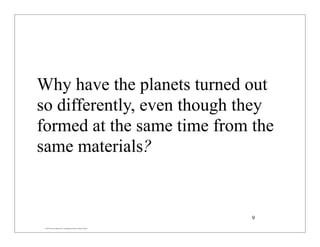
Why have the planets turned out
so differently, even though they
formed at the same time from the
same materials?
9
Terrestrial Planets
A.Distance from the Sun
B.Strength of their magnetic field
C. Size/mass of the planets
D.Presence or absence of a large moon
E. I don’t know
The terrestrial planets (including our Moon) have
a wide variety of appearances. What is the main cause
of their geological differences (as opposed to the presence
or absence of life)?
10
© 2007 Pearson Education Inc., publishing as Pearson Addison-Wesley
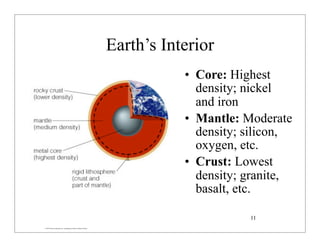
Earth’s Interior
• Core: Highest
density; nickel
and iron
• Mantle: Moderate
density; silicon,
oxygen, etc.
• Crust: Lowest
density; granite,
basalt, etc.
11
© 2007 Pearson Education Inc., publishing as Pearson Addison-Wesley
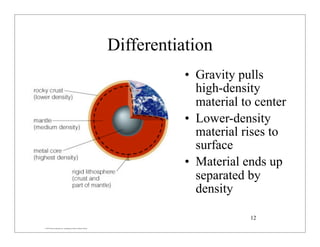
Differentiation
• Gravity pulls
high-density
material to center
• Lower-density
material rises to
surface
• Material ends up
separated by
density
12
© 2007 Pearson Education Inc., publishing as Pearson Addison-Wesley
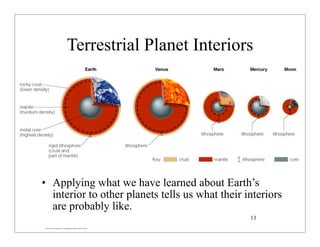
Terrestrial Planet Interiors
• Applying what we have learned about Earth’s
interior to other planets tells us what their interiors
are probably like.
13
© 2007 Pearson Education Inc., publishing as Pearson Addison-Wesley
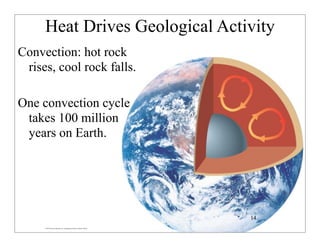
Heat Drives Geological Activity
Convection: hot rock
rises, cool rock falls.
One convection cycle
takes 100 million
years on Earth.
14
© 2007 Pearson Education Inc., publishing as Pearson Addison-Wesley
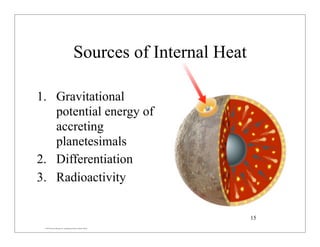
Sources of Internal Heat
1. Gravitational
potential energy of
accreting
planetesimals
2. Differentiation
3. Radioactivity
15
© 2007 Pearson Education Inc., publishing as Pearson Addison-Wesley
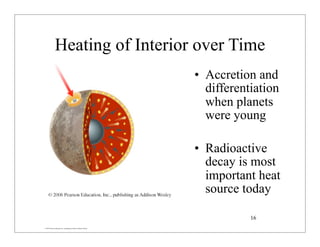
Heating of Interior over Time
• Accretion and
differentiation
when planets
were young
• Radioactive
decay is most
important heat
source today
16
© 2007 Pearson Education Inc., publishing as Pearson Addison-Wesley
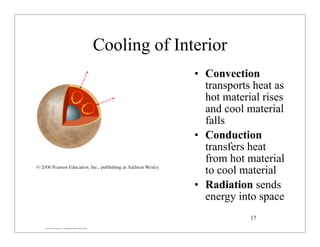
Cooling of Interior
• Convection
transports heat as
hot material rises
and cool material
falls
• Conduction
transfers heat
from hot material
to cool material
• Radiation sends
energy into space
17
© 2007 Pearson Education Inc., publishing as Pearson Addison-Wesley
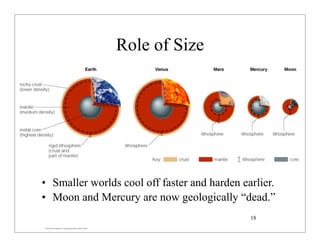
Role of Size
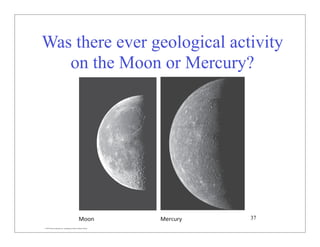
• Smaller worlds cool off faster and harden earlier.
• Moon and Mercury are now geologically “dead.”
18
© 2007 Pearson Education Inc., publishing as Pearson Addison-Wesley
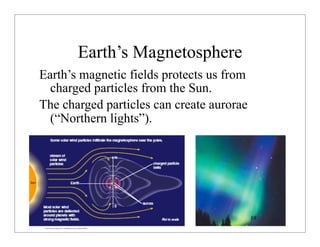
Earth’s Magnetosphere
Earth’s magnetic fields protects us from
charged particles from the Sun.
The charged particles can create aurorae
(“Northern lights”).
19
© 2007 Pearson Education Inc., publishing as Pearson Addison-Wesley
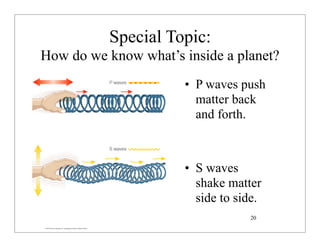
Special Topic:
How do we know what’s inside a planet?
• P waves push
matter back
and forth.
• S waves
shake matter
side to side.
20
© 2007 Pearson Education Inc., publishing as Pearson Addison-Wesley
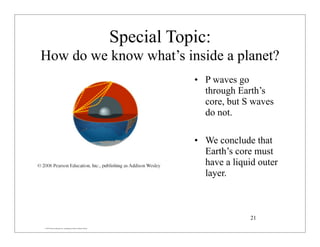
Special Topic:
How do we know what’s inside a planet?
• P waves go
through Earth’s
core, but S waves
do not.
• We conclude that
Earth’s core must
have a liquid outer
layer.
21
© 2007 Pearson Education Inc., publishing as Pearson Addison-Wesley
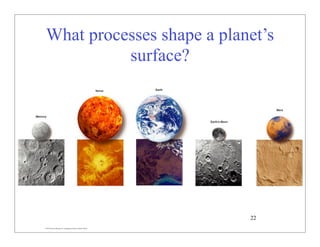
What processes shape a planet’s
surface?
22
© 2007 Pearson Education Inc., publishing as Pearson Addison-Wesley
Geological Processes
• Impact cratering
— Impacts by asteroids or comets
• Volcanism
— Eruption of molten rock onto surface
• Tectonics
— Disruption of a planet’s surface by internal
stresses
• Erosion
— Surface changes made by wind, water, or ice
23
© 2007 Pearson Education Inc., publishing as Pearson Addison-Wesley
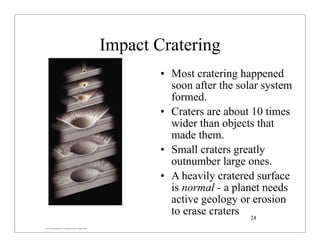
Impact Cratering
• Most cratering happened
soon after the solar system
formed.
• Craters are about 10 times
wider than objects that
made them.
• Small craters greatly
outnumber large ones.
• A heavily cratered surface
is normal - a planet needs
active geology or erosion
to erase craters 24
© 2007 Pearson Education Inc., publishing as Pearson Addison-Wesley
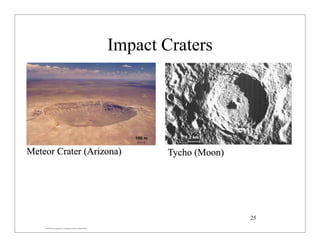
Impact Craters
Meteor Crater (Arizona) Tycho (Moon)
25
© 2007 Pearson Education Inc., publishing as Pearson Addison-Wesley
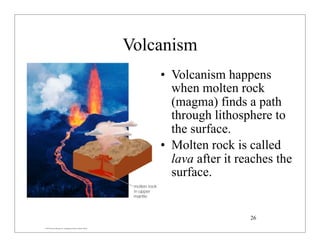
Volcanism
• Volcanism happens
when molten rock
(magma) finds a path
through lithosphere to
the surface.
• Molten rock is called
lava after it reaches the
surface.
26
© 2007 Pearson Education Inc., publishing as Pearson Addison-Wesley
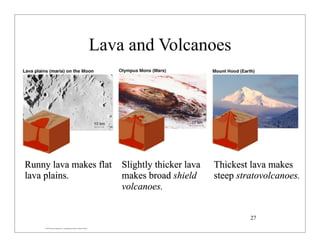
Lava and Volcanoes
Runny lava makes flat
lava plains.
Slightly thicker lava
makes broad shield
volcanoes.
Thickest lava makes
steep stratovolcanoes.
27
© 2007 Pearson Education Inc., publishing as Pearson Addison-Wesley
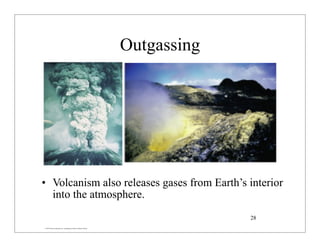
Outgassing
• Volcanism also releases gases from Earth’s interior
into the atmosphere.
28
© 2007 Pearson Education Inc., publishing as Pearson Addison-Wesley
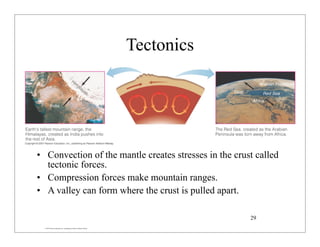
Tectonics
• Convection of the mantle creates stresses in the crust called
tectonic forces.
• Compression forces make mountain ranges.
• A valley can form where the crust is pulled apart.
29
© 2007 Pearson Education Inc., publishing as Pearson Addison-Wesley
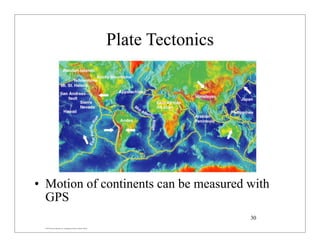
Plate Tectonics
• Motion of continents can be measured with
GPS
30
© 2007 Pearson Education Inc., publishing as Pearson Addison-Wesley
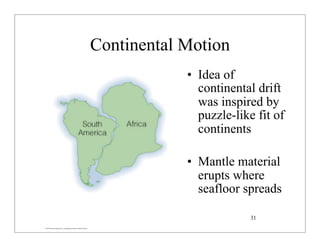
Continental Motion
• Idea of
continental drift
was inspired by
puzzle-like fit of
continents
• Mantle material
erupts where
seafloor spreads
31
© 2007 Pearson Education Inc., publishing as Pearson Addison-Wesley
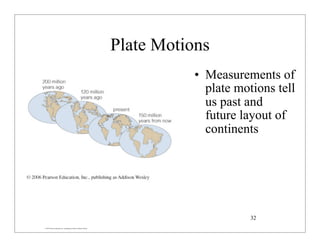
Plate Motions
• Measurements of
plate motions tell
us past and
future layout of
continents
32
© 2007 Pearson Education Inc., publishing as Pearson Addison-Wesley
Erosion
• Erosion is a blanket term for weather-driven
processes that break down or transport rock.
• Processes that cause erosion include
— Glaciers
— Rivers
— Wind
33
© 2007 Pearson Education Inc., publishing as Pearson Addison-Wesley
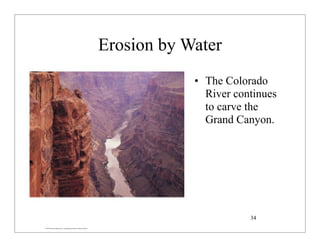
Erosion by Water
• The Colorado
River continues
to carve the
Grand Canyon.
34
© 2007 Pearson Education Inc., publishing as Pearson Addison-Wesley
Erosion by Ice
• Glaciers carved
the Yosemite
Valley.
35
© 2007 Pearson Education Inc., publishing as Pearson Addison-Wesley
Erosion by Wind
• Wind wears
away rock and
builds up sand
dunes.
36
© 2007 Pearson Education Inc., publishing as Pearson Addison-Wesley
Was there ever geological activity
on the Moon or Mercury?
37
© 2007 Pearson Education Inc., publishing as Pearson Addison-Wesley
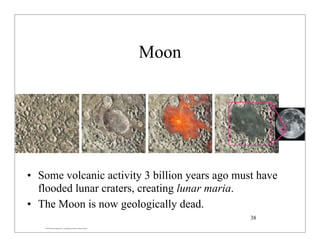
Moon
• Some volcanic activity 3 billion years ago must have
flooded lunar craters, creating lunar maria.
• The Moon is now geologically dead.
38
© 2007 Pearson Education Inc., publishing as Pearson Addison-Wesley
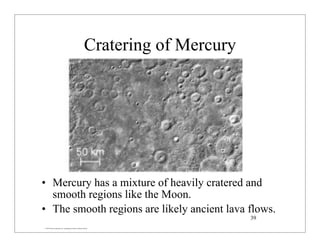
Cratering of Mercury
• Mercury has a mixture of heavily cratered and
smooth regions like the Moon.
• The smooth regions are likely ancient lava flows.
39
© 2007 Pearson Education Inc., publishing as Pearson Addison-Wesley
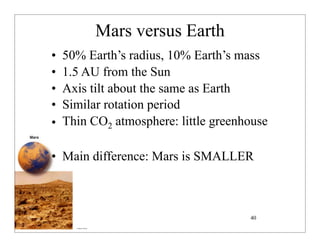
Mars versus Earth
• 50% Earth’s radius, 10% Earth’s mass
• 1.5 AU from the Sun
• Axis tilt about the same as Earth
• Similar rotation period
• Thin CO2 atmosphere: little greenhouse
• Main difference: Mars is SMALLER
40
© 2007 Pearson Education Inc., publishing as Pearson Addison-Wesley
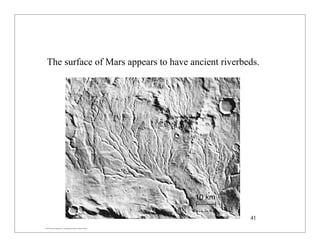
The surface of Mars appears to have ancient riverbeds.
41
© 2007 Pearson Education Inc., publishing as Pearson Addison-Wesley
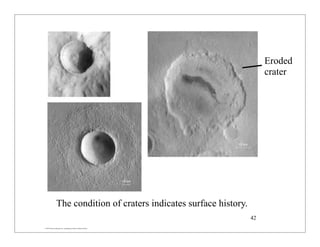
The condition of craters indicates surface history.
Eroded
crater
42
© 2007 Pearson Education Inc., publishing as Pearson Addison-Wesley
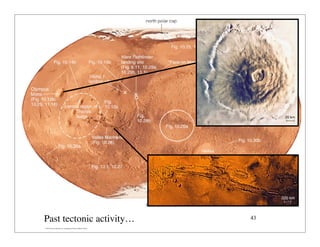
Past tectonic activity… 43
© 2007 Pearson Education Inc., publishing as Pearson Addison-Wesley
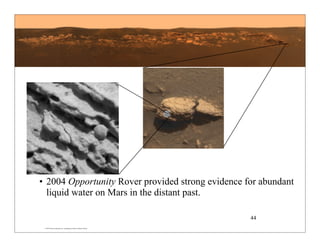
• 2004 Opportunity Rover provided strong evidence for abundant
liquid water on Mars in the distant past.
44
© 2007 Pearson Education Inc., publishing as Pearson Addison-Wesley
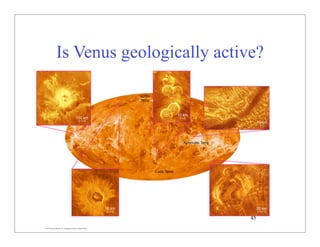
Is Venus geologically active?
45
© 2007 Pearson Education Inc., publishing as Pearson Addison-Wesley
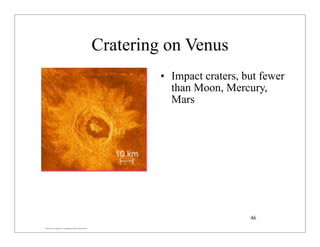
Cratering on Venus
• Impact craters, but fewer
than Moon, Mercury,
Mars
46
© 2007 Pearson Education Inc., publishing as Pearson Addison-Wesley
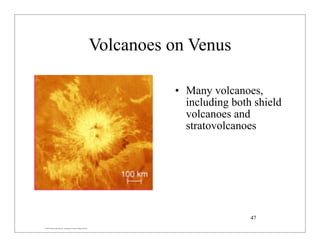
Volcanoes on Venus
• Many volcanoes,
including both shield
volcanoes and
stratovolcanoes
47
© 2007 Pearson Education Inc., publishing as Pearson Addison-Wesley
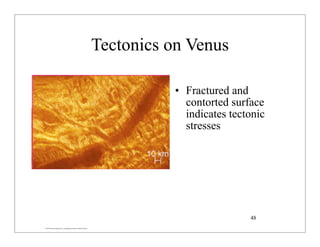
Tectonics on Venus
• Fractured and
contorted surface
indicates tectonic
stresses
48
© 2007 Pearson Education Inc., publishing as Pearson Addison-Wesley
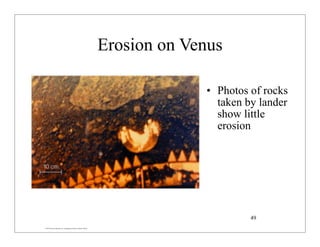
Erosion on Venus
• Photos of rocks
taken by lander
show little
erosion
49
© 2007 Pearson Education Inc., publishing as Pearson Addison-Wesley
Does Venus have plate tectonics?
• Most of Earth’s major geological features
can be attributed to plate tectonics, which
gradually remakes Earth’s surface.
• Venus does not appear to have plate
tectonics, but its entire surface seems to
have been “repaved” 750 million years
ago.
50
© 2007 Pearson Education Inc., publishing as Pearson Addison-Wesley
Terrestrial planet surfaces
• Craters are the normal state
– need geological activity to erase
• e.g.,
– Volcanism
– Erosion
– Plate tectonics
51

class9 The Terrestrial Planets-Geology.pdf

  • 1.
    © 2007 PearsonEducation Inc., publishing as Pearson Addison-Wesley Today • Terrestrial Planets – Earth/moon, Venus, Mars, Mercury 1 Homework due now Exam next Thursday
  • 2.
    © 2007 PearsonEducation Inc., publishing as Pearson Addison-Wesley Exam Review Session • This Monday, 6-8 PM, this room • Completely driven by your questions! The TAs will not prepare summary slides, but can go to the lecture slides if needed. • When your questions are done, the review is over • Don’t ask them what will be on the exam; they don’t know :) 2
  • 3.
    © 2007 PearsonEducation Inc., publishing as Pearson Addison-Wesley Earth and the Terrestrial Worlds 3
  • 4.
    © 2007 PearsonEducation Inc., publishing as Pearson Addison-Wesley Mercury craters smooth plains cliffs 4
  • 5.
    © 2007 PearsonEducation Inc., publishing as Pearson Addison-Wesley Venus volcanoes few craters Radar view of a twin- peaked volcano 5
  • 6.
    © 2007 PearsonEducation Inc., publishing as Pearson Addison-Wesley Mars some craters volcanoes riverbeds? 6
  • 7.
    © 2007 PearsonEducation Inc., publishing as Pearson Addison-Wesley Moon craters smooth plains 7
  • 8.
    © 2007 PearsonEducation Inc., publishing as Pearson Addison-Wesley Earth volcanoes craters mountains riverbeds 8
  • 9.
    © 2007 PearsonEducation Inc., publishing as Pearson Addison-Wesley Why have the planets turned out so differently, even though they formed at the same time from the same materials? 9
  • 10.
    Terrestrial Planets A.Distance fromthe Sun B.Strength of their magnetic field C. Size/mass of the planets D.Presence or absence of a large moon E. I don’t know The terrestrial planets (including our Moon) have a wide variety of appearances. What is the main cause of their geological differences (as opposed to the presence or absence of life)? 10
  • 11.
    © 2007 PearsonEducation Inc., publishing as Pearson Addison-Wesley Earth’s Interior • Core: Highest density; nickel and iron • Mantle: Moderate density; silicon, oxygen, etc. • Crust: Lowest density; granite, basalt, etc. 11
  • 12.
    © 2007 PearsonEducation Inc., publishing as Pearson Addison-Wesley Differentiation • Gravity pulls high-density material to center • Lower-density material rises to surface • Material ends up separated by density 12
  • 13.
    © 2007 PearsonEducation Inc., publishing as Pearson Addison-Wesley Terrestrial Planet Interiors • Applying what we have learned about Earth’s interior to other planets tells us what their interiors are probably like. 13
  • 14.
    © 2007 PearsonEducation Inc., publishing as Pearson Addison-Wesley Heat Drives Geological Activity Convection: hot rock rises, cool rock falls. One convection cycle takes 100 million years on Earth. 14
  • 15.
    © 2007 PearsonEducation Inc., publishing as Pearson Addison-Wesley Sources of Internal Heat 1. Gravitational potential energy of accreting planetesimals 2. Differentiation 3. Radioactivity 15
  • 16.
    © 2007 PearsonEducation Inc., publishing as Pearson Addison-Wesley Heating of Interior over Time • Accretion and differentiation when planets were young • Radioactive decay is most important heat source today 16
  • 17.
    © 2007 PearsonEducation Inc., publishing as Pearson Addison-Wesley Cooling of Interior • Convection transports heat as hot material rises and cool material falls • Conduction transfers heat from hot material to cool material • Radiation sends energy into space 17
  • 18.
    © 2007 PearsonEducation Inc., publishing as Pearson Addison-Wesley Role of Size • Smaller worlds cool off faster and harden earlier. • Moon and Mercury are now geologically “dead.” 18
  • 19.
    © 2007 PearsonEducation Inc., publishing as Pearson Addison-Wesley Earth’s Magnetosphere Earth’s magnetic fields protects us from charged particles from the Sun. The charged particles can create aurorae (“Northern lights”). 19
  • 20.
    © 2007 PearsonEducation Inc., publishing as Pearson Addison-Wesley Special Topic: How do we know what’s inside a planet? • P waves push matter back and forth. • S waves shake matter side to side. 20
  • 21.
    © 2007 PearsonEducation Inc., publishing as Pearson Addison-Wesley Special Topic: How do we know what’s inside a planet? • P waves go through Earth’s core, but S waves do not. • We conclude that Earth’s core must have a liquid outer layer. 21
  • 22.
    © 2007 PearsonEducation Inc., publishing as Pearson Addison-Wesley What processes shape a planet’s surface? 22
  • 23.
    © 2007 PearsonEducation Inc., publishing as Pearson Addison-Wesley Geological Processes • Impact cratering — Impacts by asteroids or comets • Volcanism — Eruption of molten rock onto surface • Tectonics — Disruption of a planet’s surface by internal stresses • Erosion — Surface changes made by wind, water, or ice 23
  • 24.
    © 2007 PearsonEducation Inc., publishing as Pearson Addison-Wesley Impact Cratering • Most cratering happened soon after the solar system formed. • Craters are about 10 times wider than objects that made them. • Small craters greatly outnumber large ones. • A heavily cratered surface is normal - a planet needs active geology or erosion to erase craters 24
  • 25.
    © 2007 PearsonEducation Inc., publishing as Pearson Addison-Wesley Impact Craters Meteor Crater (Arizona) Tycho (Moon) 25
  • 26.
    © 2007 PearsonEducation Inc., publishing as Pearson Addison-Wesley Volcanism • Volcanism happens when molten rock (magma) finds a path through lithosphere to the surface. • Molten rock is called lava after it reaches the surface. 26
  • 27.
    © 2007 PearsonEducation Inc., publishing as Pearson Addison-Wesley Lava and Volcanoes Runny lava makes flat lava plains. Slightly thicker lava makes broad shield volcanoes. Thickest lava makes steep stratovolcanoes. 27
  • 28.
    © 2007 PearsonEducation Inc., publishing as Pearson Addison-Wesley Outgassing • Volcanism also releases gases from Earth’s interior into the atmosphere. 28
  • 29.
    © 2007 PearsonEducation Inc., publishing as Pearson Addison-Wesley Tectonics • Convection of the mantle creates stresses in the crust called tectonic forces. • Compression forces make mountain ranges. • A valley can form where the crust is pulled apart. 29
  • 30.
    © 2007 PearsonEducation Inc., publishing as Pearson Addison-Wesley Plate Tectonics • Motion of continents can be measured with GPS 30
  • 31.
    © 2007 PearsonEducation Inc., publishing as Pearson Addison-Wesley Continental Motion • Idea of continental drift was inspired by puzzle-like fit of continents • Mantle material erupts where seafloor spreads 31
  • 32.
    © 2007 PearsonEducation Inc., publishing as Pearson Addison-Wesley Plate Motions • Measurements of plate motions tell us past and future layout of continents 32
  • 33.
    © 2007 PearsonEducation Inc., publishing as Pearson Addison-Wesley Erosion • Erosion is a blanket term for weather-driven processes that break down or transport rock. • Processes that cause erosion include — Glaciers — Rivers — Wind 33
  • 34.
    © 2007 PearsonEducation Inc., publishing as Pearson Addison-Wesley Erosion by Water • The Colorado River continues to carve the Grand Canyon. 34
  • 35.
    © 2007 PearsonEducation Inc., publishing as Pearson Addison-Wesley Erosion by Ice • Glaciers carved the Yosemite Valley. 35
  • 36.
    © 2007 PearsonEducation Inc., publishing as Pearson Addison-Wesley Erosion by Wind • Wind wears away rock and builds up sand dunes. 36
  • 37.
    © 2007 PearsonEducation Inc., publishing as Pearson Addison-Wesley Was there ever geological activity on the Moon or Mercury? 37
  • 38.
    © 2007 PearsonEducation Inc., publishing as Pearson Addison-Wesley Moon • Some volcanic activity 3 billion years ago must have flooded lunar craters, creating lunar maria. • The Moon is now geologically dead. 38
  • 39.
    © 2007 PearsonEducation Inc., publishing as Pearson Addison-Wesley Cratering of Mercury • Mercury has a mixture of heavily cratered and smooth regions like the Moon. • The smooth regions are likely ancient lava flows. 39
  • 40.
    © 2007 PearsonEducation Inc., publishing as Pearson Addison-Wesley Mars versus Earth • 50% Earth’s radius, 10% Earth’s mass • 1.5 AU from the Sun • Axis tilt about the same as Earth • Similar rotation period • Thin CO2 atmosphere: little greenhouse • Main difference: Mars is SMALLER 40
  • 41.
    © 2007 PearsonEducation Inc., publishing as Pearson Addison-Wesley The surface of Mars appears to have ancient riverbeds. 41
  • 42.
    © 2007 PearsonEducation Inc., publishing as Pearson Addison-Wesley The condition of craters indicates surface history. Eroded crater 42
  • 43.
    © 2007 PearsonEducation Inc., publishing as Pearson Addison-Wesley Past tectonic activity… 43
  • 44.
    © 2007 PearsonEducation Inc., publishing as Pearson Addison-Wesley • 2004 Opportunity Rover provided strong evidence for abundant liquid water on Mars in the distant past. 44
  • 45.
    © 2007 PearsonEducation Inc., publishing as Pearson Addison-Wesley Is Venus geologically active? 45
  • 46.
    © 2007 PearsonEducation Inc., publishing as Pearson Addison-Wesley Cratering on Venus • Impact craters, but fewer than Moon, Mercury, Mars 46
  • 47.
    © 2007 PearsonEducation Inc., publishing as Pearson Addison-Wesley Volcanoes on Venus • Many volcanoes, including both shield volcanoes and stratovolcanoes 47
  • 48.
    © 2007 PearsonEducation Inc., publishing as Pearson Addison-Wesley Tectonics on Venus • Fractured and contorted surface indicates tectonic stresses 48
  • 49.
    © 2007 PearsonEducation Inc., publishing as Pearson Addison-Wesley Erosion on Venus • Photos of rocks taken by lander show little erosion 49
  • 50.
    © 2007 PearsonEducation Inc., publishing as Pearson Addison-Wesley Does Venus have plate tectonics? • Most of Earth’s major geological features can be attributed to plate tectonics, which gradually remakes Earth’s surface. • Venus does not appear to have plate tectonics, but its entire surface seems to have been “repaved” 750 million years ago. 50
  • 51.
    © 2007 PearsonEducation Inc., publishing as Pearson Addison-Wesley Terrestrial planet surfaces • Craters are the normal state – need geological activity to erase • e.g., – Volcanism – Erosion – Plate tectonics 51