System on Chip Buses
Mr. A. B. Shinde
Assistant Professor,
Electronics Engineering,
PVPIT, Budhgaon.
shindesir.pvp@gmail.com
1
SoC Buses Overview
 AMBA bus
 ASB (Advanced System Bus)
 AHB (Advanced High-
performance Bus)
 APB (Advanced Peripheral
Bus)
 Avalon
 CoreConnect
 PLB (Processor Local Bus)
 OPB (On-chip Peripheral Bus)
 STBus
 Type I (Peripheral protocol)
 Type II (Basic Protocol)
 Type III (Advanced protocol)
2
 Wishbone
 CoreFrame
 Marble
 PI bus
 OCP
 VCI (Virtual Component Interface)
 SiliconBackplane Network
SoC Buses Overview
 AMBA bus
 ASB (Advanced System Bus)
 AHB (Advanced High-
performance Bus)
 APB (Advanced Peripheral
Bus)
 Avalon
 CoreConnect
 PLB (Processor Local Bus)
 OPB (On-chip Peripheral
Bus)
 STBus
 Type I (Peripheral protocol)
 Type II (Basic Protocol)
 Type III (Advanced protocol)
3
 Wishbone
 CoreFrame
 Marble
 PI bus
 OCP
 VCI (Virtual Component
Interface)
 SiliconBackplane Network
AMBA bus
 AMBA is Advanced Microcontroller Bus Architecture
 The AMBA protocol is an open standard, on-chip bus specification. It provides
a strategy for the interconnection and management of functional blocks that
makes up a System-on-Chip (SoC).
 The AMBA protocol enhances a reusable design methodology by defining a
common backbone for SoC modules.
 Originally developed in 1995, the AMBA Specification has been refined and
extended with additional protocol support to provide the capabilities required
for SoC design.
 IP re-use is an essential component in reducing SoC development costs and
timescales.
 AMBA provides the interface standard that enables IP re-use meeting the
essential requirements
4
AMBA bus
 AMBA (Advanced Microcontroller Bus Architecture) is a bus standard
devised by ARM with aim to support efficient on-chip communications
among ARM processor cores.
 Nowadays, AMBA is one of the leading on-chip busing systems used in
high performance SoC design.
 AMBA is hierarchically organized into two bus segments, system- and
peripheral-bus, mutually connected via bridge that buffers data and
operations between them.
 Standard bus protocols for connecting on-chip components generalized
for different SoC structures, independent of the processor type, are
defined by AMBA specifications.
 AMBA does not define method of arbitration.
 Instead it allows the arbiter to be designed to suit the applications
needs, the best.
5
AMBA bus
 The three distinct buses specified within the AMBA bus are:
 ASB
 ASB - first generation of AMBA system bus used for simple cost-
effective designs that support burst transfer, pipelined transfer
operation, and multiple bus masters.
 AHB
 AHB - later generation of AMBA bus is intended for high performance
high-clock synthesizable designs.
 It provides high-bandwidth communication channel between
embedded processor (ARM, MIPS, AVR, DSP 320xx, 8051, etc.) and
high performance peripherals/ hardware accelerators (ASICs MPEG,
color LCD, etc), on-chip SRAM, on-chip external memory interface,
and APB bridge.
 AHB supports a multiple bus masters operation, peripheral and a
burst transfer, split transactions, wide data bus configurations, and
non tristate implementations.
6
AMBA bus
 The three distinct buses specified within the AMBA bus are:
 APB
 APB - is used to connect general purpose low speed low-power
peripheral devices.
 The bridge is peripheral bus master, while all buses devices (Timer,
UART, PIA, etc) are slaves.
 APB is static bus that provides a simple addressing with latched
addresses and control signals for easy interfacing.
7
AMBA bus
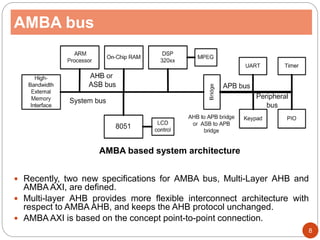
 Recently, two new specifications for AMBA bus, Multi-Layer AHB and
AMBA AXI, are defined.
 Multi-layer AHB provides more flexible interconnect architecture with
respect to AMBA AHB, and keeps the AHB protocol unchanged.
 AMBA AXI is based on the concept point-to-point connection.
8
AMBA based system architecture
9
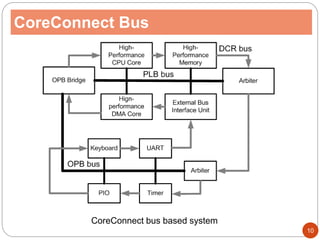
CoreConnect Bus
10
CoreConnect bus based system
CoreConnect Bus
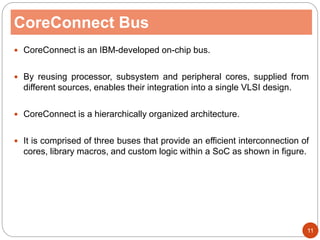
 CoreConnect is an IBM-developed on-chip bus.
 By reusing processor, subsystem and peripheral cores, supplied from
different sources, enables their integration into a single VLSI design.
 CoreConnect is a hierarchically organized architecture.
 It is comprised of three buses that provide an efficient interconnection of
cores, library macros, and custom logic within a SoC as shown in figure.
11
CoreConnect Bus
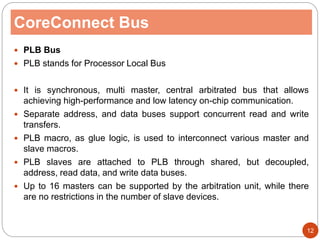
 PLB Bus
 PLB stands for Processor Local Bus
 It is synchronous, multi master, central arbitrated bus that allows
achieving high-performance and low latency on-chip communication.
 Separate address, and data buses support concurrent read and write
transfers.
 PLB macro, as glue logic, is used to interconnect various master and
slave macros.
 PLB slaves are attached to PLB through shared, but decoupled,
address, read data, and write data buses.
 Up to 16 masters can be supported by the arbitration unit, while there
are no restrictions in the number of slave devices.
12
CoreConnect Bus
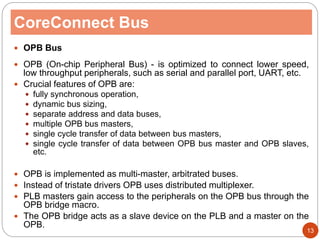
 OPB Bus
 OPB (On-chip Peripheral Bus) - is optimized to connect lower speed,
low throughput peripherals, such as serial and parallel port, UART, etc.
 Crucial features of OPB are:
 fully synchronous operation,
 dynamic bus sizing,
 separate address and data buses,
 multiple OPB bus masters,
 single cycle transfer of data between bus masters,
 single cycle transfer of data between OPB bus master and OPB slaves,
etc.
 OPB is implemented as multi-master, arbitrated buses.
 Instead of tristate drivers OPB uses distributed multiplexer.
 PLB masters gain access to the peripherals on the OPB bus through the
OPB bridge macro.
 The OPB bridge acts as a slave device on the PLB and a master on the
OPB.
13
CoreConnect Bus
 DCR Bus:
 DCR bus (Device Control Register bus) is a single master bus mainly
used as an alternative relatively low speed datapath to the system for:
 (a) passing status and setting configuration information into the
individual device-control-registers between the Processor Core and
others SoC constituents such as Auxiliary Processors, On-Chip
Memory, System Cores, Peripheral Cores, etc; and
 (b) design for testability purposes.
 DCR is synchronous bus based on a ring topology implemented as
distributed multiplexer across the chip. It consists of a 10-bit address
bus and a 32-bit data bus.
 CoreConnect implements arbitration based on a static priority, with
programmable priority fairness.
14
ST Bus
15
ST Bus interconnect
ST Bus
 ST Bus is an on-chip bus protocol developed by ST Microelectronics.
 It represents a set of protocol, interfaces and architectural specifications
intended to implement the communication network of digital systems.
 The ST Bus interfaces and protocols are closely related to the Virtual
Component Interface (VCI) industry standard.
 ST Bus implements both the protocols definition and the bus
components.
16
ST Bus
 The following protocols are used
 Type I (Peripheral protocol)
 Type II (Basic Protocol)
 Type III (Advanced protocol)
 The ST Bus is modular and allows master and slaves of any protocol type and
data size to communicate, through the use of appropriate type/size converters.
 A wide variety of arbitration policies is also available, such as bandwidth
limitation, latency arbitration, LRU, priority-based arbitration, etc.
 The components interconnected by the ST Bus can be either initiators (initiates
transactions on the bus by sending requests, such as CPUs or ASICs) or targets
(responds to requests, such as memories, registers or dedicated peripherals).
 Initiators can load or store data through the ST Bus backbone. Some resources
might be both initiators and peripheral/targets.
17
Wishbone Bus
 Wishbone bus architecture was developed by Silicore Corporation.
 In August 2002, OpenCores (organization that promotes open IP cores
development) put it into the public domain.
 This means that Wishbone is not copyrighted and can be freely copied
and distributed.
18
Wishbone Bus
 The Wishbone defines two types of interfaces, called master and slave.
 Master interfaces are IPs which are capable of initiating bus cycles.
 slave interfaces are capable of accepting bus cycles.
 The hardware implementations support various types of interconnection
topologies such as:
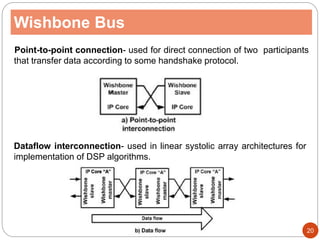
 point-to-point connection
 dataflow interconnection
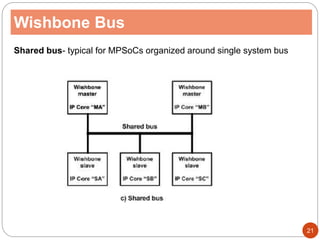
 shared bus
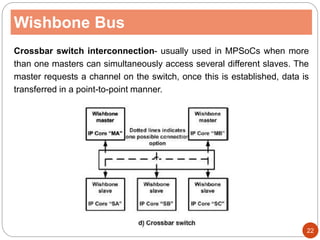
 crossbar switch interconnection
19
Wishbone Bus
Point-to-point connection- used for direct connection of two participants
that transfer data according to some handshake protocol.
20
Dataflow interconnection- used in linear systolic array architectures for
implementation of DSP algorithms.
Wishbone Bus
Shared bus- typical for MPSoCs organized around single system bus
21
Wishbone Bus
22
Crossbar switch interconnection- usually used in MPSoCs when more
than one masters can simultaneously access several different slaves. The
master requests a channel on the switch, once this is established, data is
transferred in a point-to-point manner.
Conclusion
The benefits of the SoC approaches are numerous like
improvements in system performance,
cost,
size,
power dissipation and
design turnaround time.
Chip integration continues to advance at a fast pace, the desire for efficient
interconnects rapidly increase.
Currently on-chip interconnections networks are mostly implemented using
traditional interconnects like buses.
23
Thank You
24
Any ?s

System on chip buses

  • 1.
    System on ChipBuses Mr. A. B. Shinde Assistant Professor, Electronics Engineering, PVPIT, Budhgaon. shindesir.pvp@gmail.com 1
  • 2.
    SoC Buses Overview AMBA bus  ASB (Advanced System Bus)  AHB (Advanced High- performance Bus)  APB (Advanced Peripheral Bus)  Avalon  CoreConnect  PLB (Processor Local Bus)  OPB (On-chip Peripheral Bus)  STBus  Type I (Peripheral protocol)  Type II (Basic Protocol)  Type III (Advanced protocol) 2  Wishbone  CoreFrame  Marble  PI bus  OCP  VCI (Virtual Component Interface)  SiliconBackplane Network
  • 3.
    SoC Buses Overview AMBA bus  ASB (Advanced System Bus)  AHB (Advanced High- performance Bus)  APB (Advanced Peripheral Bus)  Avalon  CoreConnect  PLB (Processor Local Bus)  OPB (On-chip Peripheral Bus)  STBus  Type I (Peripheral protocol)  Type II (Basic Protocol)  Type III (Advanced protocol) 3  Wishbone  CoreFrame  Marble  PI bus  OCP  VCI (Virtual Component Interface)  SiliconBackplane Network
  • 4.
    AMBA bus  AMBAis Advanced Microcontroller Bus Architecture  The AMBA protocol is an open standard, on-chip bus specification. It provides a strategy for the interconnection and management of functional blocks that makes up a System-on-Chip (SoC).  The AMBA protocol enhances a reusable design methodology by defining a common backbone for SoC modules.  Originally developed in 1995, the AMBA Specification has been refined and extended with additional protocol support to provide the capabilities required for SoC design.  IP re-use is an essential component in reducing SoC development costs and timescales.  AMBA provides the interface standard that enables IP re-use meeting the essential requirements 4
  • 5.
    AMBA bus  AMBA(Advanced Microcontroller Bus Architecture) is a bus standard devised by ARM with aim to support efficient on-chip communications among ARM processor cores.  Nowadays, AMBA is one of the leading on-chip busing systems used in high performance SoC design.  AMBA is hierarchically organized into two bus segments, system- and peripheral-bus, mutually connected via bridge that buffers data and operations between them.  Standard bus protocols for connecting on-chip components generalized for different SoC structures, independent of the processor type, are defined by AMBA specifications.  AMBA does not define method of arbitration.  Instead it allows the arbiter to be designed to suit the applications needs, the best. 5
  • 6.
    AMBA bus  Thethree distinct buses specified within the AMBA bus are:  ASB  ASB - first generation of AMBA system bus used for simple cost- effective designs that support burst transfer, pipelined transfer operation, and multiple bus masters.  AHB  AHB - later generation of AMBA bus is intended for high performance high-clock synthesizable designs.  It provides high-bandwidth communication channel between embedded processor (ARM, MIPS, AVR, DSP 320xx, 8051, etc.) and high performance peripherals/ hardware accelerators (ASICs MPEG, color LCD, etc), on-chip SRAM, on-chip external memory interface, and APB bridge.  AHB supports a multiple bus masters operation, peripheral and a burst transfer, split transactions, wide data bus configurations, and non tristate implementations. 6
  • 7.
    AMBA bus  Thethree distinct buses specified within the AMBA bus are:  APB  APB - is used to connect general purpose low speed low-power peripheral devices.  The bridge is peripheral bus master, while all buses devices (Timer, UART, PIA, etc) are slaves.  APB is static bus that provides a simple addressing with latched addresses and control signals for easy interfacing. 7
  • 8.
    AMBA bus  Recently,two new specifications for AMBA bus, Multi-Layer AHB and AMBA AXI, are defined.  Multi-layer AHB provides more flexible interconnect architecture with respect to AMBA AHB, and keeps the AHB protocol unchanged.  AMBA AXI is based on the concept point-to-point connection. 8 AMBA based system architecture
  • 9.
  • 10.
  • 11.
    CoreConnect Bus  CoreConnectis an IBM-developed on-chip bus.  By reusing processor, subsystem and peripheral cores, supplied from different sources, enables their integration into a single VLSI design.  CoreConnect is a hierarchically organized architecture.  It is comprised of three buses that provide an efficient interconnection of cores, library macros, and custom logic within a SoC as shown in figure. 11
  • 12.
    CoreConnect Bus  PLBBus  PLB stands for Processor Local Bus  It is synchronous, multi master, central arbitrated bus that allows achieving high-performance and low latency on-chip communication.  Separate address, and data buses support concurrent read and write transfers.  PLB macro, as glue logic, is used to interconnect various master and slave macros.  PLB slaves are attached to PLB through shared, but decoupled, address, read data, and write data buses.  Up to 16 masters can be supported by the arbitration unit, while there are no restrictions in the number of slave devices. 12
  • 13.
    CoreConnect Bus  OPBBus  OPB (On-chip Peripheral Bus) - is optimized to connect lower speed, low throughput peripherals, such as serial and parallel port, UART, etc.  Crucial features of OPB are:  fully synchronous operation,  dynamic bus sizing,  separate address and data buses,  multiple OPB bus masters,  single cycle transfer of data between bus masters,  single cycle transfer of data between OPB bus master and OPB slaves, etc.  OPB is implemented as multi-master, arbitrated buses.  Instead of tristate drivers OPB uses distributed multiplexer.  PLB masters gain access to the peripherals on the OPB bus through the OPB bridge macro.  The OPB bridge acts as a slave device on the PLB and a master on the OPB. 13
  • 14.
    CoreConnect Bus  DCRBus:  DCR bus (Device Control Register bus) is a single master bus mainly used as an alternative relatively low speed datapath to the system for:  (a) passing status and setting configuration information into the individual device-control-registers between the Processor Core and others SoC constituents such as Auxiliary Processors, On-Chip Memory, System Cores, Peripheral Cores, etc; and  (b) design for testability purposes.  DCR is synchronous bus based on a ring topology implemented as distributed multiplexer across the chip. It consists of a 10-bit address bus and a 32-bit data bus.  CoreConnect implements arbitration based on a static priority, with programmable priority fairness. 14
  • 15.
    ST Bus 15 ST Businterconnect
  • 16.
    ST Bus  STBus is an on-chip bus protocol developed by ST Microelectronics.  It represents a set of protocol, interfaces and architectural specifications intended to implement the communication network of digital systems.  The ST Bus interfaces and protocols are closely related to the Virtual Component Interface (VCI) industry standard.  ST Bus implements both the protocols definition and the bus components. 16
  • 17.
    ST Bus  Thefollowing protocols are used  Type I (Peripheral protocol)  Type II (Basic Protocol)  Type III (Advanced protocol)  The ST Bus is modular and allows master and slaves of any protocol type and data size to communicate, through the use of appropriate type/size converters.  A wide variety of arbitration policies is also available, such as bandwidth limitation, latency arbitration, LRU, priority-based arbitration, etc.  The components interconnected by the ST Bus can be either initiators (initiates transactions on the bus by sending requests, such as CPUs or ASICs) or targets (responds to requests, such as memories, registers or dedicated peripherals).  Initiators can load or store data through the ST Bus backbone. Some resources might be both initiators and peripheral/targets. 17
  • 18.
    Wishbone Bus  Wishbonebus architecture was developed by Silicore Corporation.  In August 2002, OpenCores (organization that promotes open IP cores development) put it into the public domain.  This means that Wishbone is not copyrighted and can be freely copied and distributed. 18
  • 19.
    Wishbone Bus  TheWishbone defines two types of interfaces, called master and slave.  Master interfaces are IPs which are capable of initiating bus cycles.  slave interfaces are capable of accepting bus cycles.  The hardware implementations support various types of interconnection topologies such as:  point-to-point connection  dataflow interconnection  shared bus  crossbar switch interconnection 19
  • 20.
    Wishbone Bus Point-to-point connection-used for direct connection of two participants that transfer data according to some handshake protocol. 20 Dataflow interconnection- used in linear systolic array architectures for implementation of DSP algorithms.
  • 21.
    Wishbone Bus Shared bus-typical for MPSoCs organized around single system bus 21
  • 22.
    Wishbone Bus 22 Crossbar switchinterconnection- usually used in MPSoCs when more than one masters can simultaneously access several different slaves. The master requests a channel on the switch, once this is established, data is transferred in a point-to-point manner.
  • 23.
    Conclusion The benefits ofthe SoC approaches are numerous like improvements in system performance, cost, size, power dissipation and design turnaround time. Chip integration continues to advance at a fast pace, the desire for efficient interconnects rapidly increase. Currently on-chip interconnections networks are mostly implemented using traditional interconnects like buses. 23
  • 24.