System level design
Agenda
Part 1
Microprocessor and silicon technology Evolution
Memories
Bus architectures
System On Chip
Part 2
GPU
FPGA
Architectural design
Collaboration tools
Open Source
02/02/2015
System level design
Part 1
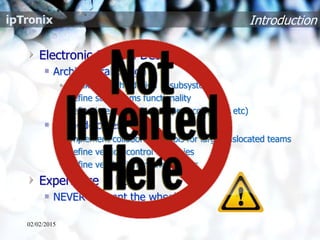
Electronic System Design
Architectural design
• Break down the design in subsystems
• Define subsystems functionality
• Define interfaces (Busses, protocols, APIs etc)

Methodologies
• Implement collaboration tools for large, dislocated teams
• Define version control strategies
• Define verification methodologies
Experience is key
NEVER reinvent the wheel
Introduction
02/02/2015
History
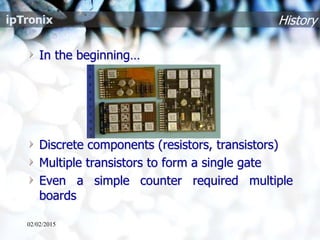
In the beginning…
Discrete components (resistors, transistors)
Multiple transistors to form a single gate
Even a simple counter required multiple
boards
02/02/2015
History
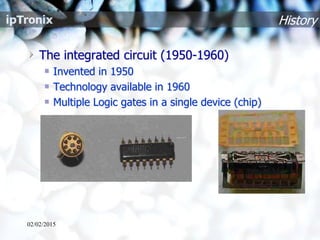
The integrated circuit (1950-1960)
Invented in 1950
Technology available in 1960
Multiple Logic gates in a single device (chip)
02/02/2015
Notes
• Great inventions are visionary
• Not necessarily an invention is feasible
immediately
• Designer shall foresee technological breakthroughs
02/02/2015
History
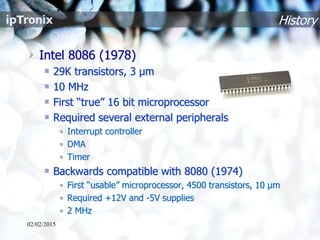
Intel 8086 (1978)
29K transistors, 3 µm
10 MHz
First “true” 16 bit microprocessor
Required several external peripherals
• Interrupt controller
• DMA
• Timer
Backwards compatible with 8080 (1974)
• First “usable” microprocessor, 4500 transistors, 10 µm
• Required +12V and -5V supplies
• 2 MHz
02/02/2015
Notes
• First microprocessors are 40 years old
• Latest x86 core i7 is backwards compatible with
something from 36 years ago!
02/02/2015
History
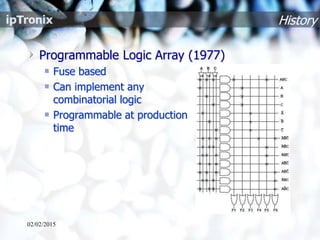
Programmable Logic Array (1977)
Fuse based
Can implement any
combinatorial logic
Programmable at production
time
02/02/2015
History
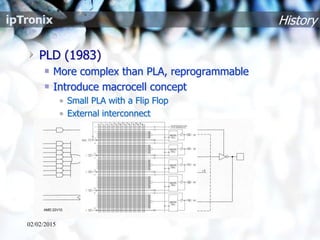
PLD (1983)
More complex than PLA, reprogrammable
Introduce macrocell concept
• Small PLA with a Flip Flop
• External interconnect
02/02/2015
History
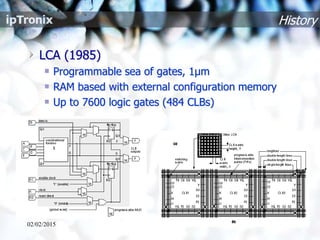
LCA (1985)
Programmable sea of gates, 1µm
RAM based with external configuration memory
Up to 7600 logic gates (484 CLBs)
02/02/2015
Notes
• Moving from OTP to reprogrammable made big
difference
• Programmable logic is key when ASSPs are not
available
• Same design flow as ASICs
02/02/2015
History
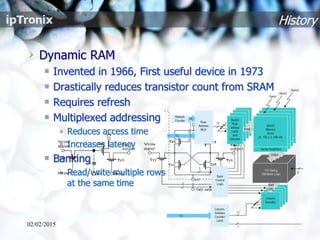
Dynamic RAM
Invented in 1966, First useful device in 1973
Drastically reduces transistor count from SRAM
Requires refresh
Multiplexed addressing
• Reduces access time
• Increases latency
Banking
• Read/write multiple rows
at the same time
02/02/2015
History
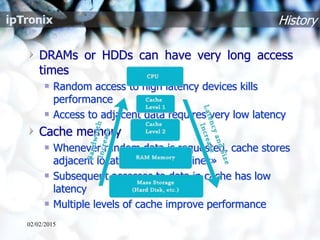
DRAMs or HDDs can have very long access
times
Random access to high latency devices kills
performance
Access to adjacent data requires very low latency
Cache memory
Whenever random data is requested, cache stores
adjacent locations in «cache lines»
Subsequent accesses to data in cache has low
latency
Multiple levels of cache improve performance
02/02/2015
Notes
• Thinking outside the box allows revolutionary
solutions
• Tradeoffs are acceptable when benefits prevail
• New technologies limitations stimulate more
innovation
02/02/2015
History
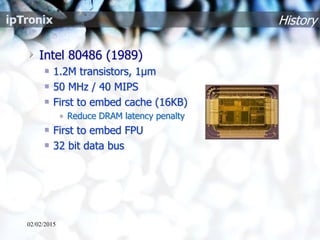
Intel 80486 (1989)
1.2M transistors, 1µm
50 MHz / 40 MIPS
First to embed cache (16KB)
• Reduce DRAM latency penalty
First to embed FPU
32 bit data bus
02/02/2015
Notes
• 10x technology shrink in 15 years (101µm)
• Embedding of widely used external coprocessors
02/02/2015
History
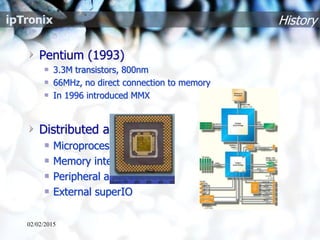
Pentium (1993)
3.3M transistors, 800nm
66MHz, no direct connection to memory
In 1996 introduced MMX
Distributed architectures
Microprocessor
Memory interface bridge
Peripheral and bus bridge
External superIO
02/02/2015
Notes
• Processor doesn’t interface directly with memory
anymore
• Northbridge routes processor accesses among
memory and high speed busses abstracting them
• Peripherals get integrated in Southbridge
02/02/2015
History
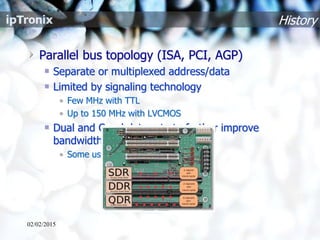
Parallel bus topology (ISA, PCI, AGP)
Separate or multiplexed address/data
Limited by signaling technology
• Few MHz with TTL
• Up to 150 MHz with LVCMOS
Dual and Quad data rate to further improve
bandwidth (mainly on memories)
• Some use of differential signaling
02/02/2015
History
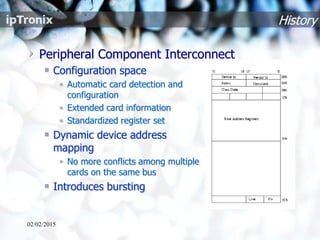
Peripheral Component Interconnect
Configuration space
• Automatic card detection and
configuration
• Extended card information
• Standardized register set
Dynamic device address
mapping
• No more conflicts among multiple
cards on the same bus
Introduces bursting
02/02/2015
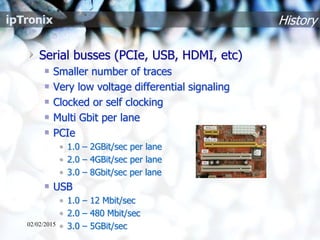
Serial busses (PCIe, USB, HDMI, etc)
Smaller number of traces
Very low voltage differential signaling
Clocked or self clocking
Multi Gbit per lane
PCIe
• 1.0 – 2GBit/sec per lane
• 2.0 – 4GBit/sec per lane
• 3.0 – 8Gbit/sec per lane
USB
• 1.0 – 12 Mbit/sec
• 2.0 – 480 Mbit/sec
• 3.0 – 5GBit/sec
History
02/02/2015
History
02/02/2015
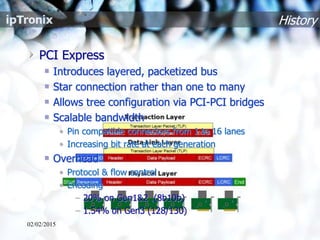
PCI Express
Introduces layered, packetized bus
Star connection rather than one to many
Allows tree configuration via PCI-PCI bridges
Scalable bandwidth
• Pin compatible connectors from 1 to 16 lanes
• Increasing bit rate at each generation
Overhead
• Protocol & flow control
• Encoding
– 20% on Gen1&2 (8b10b)
– 1.54% on Gen3 (128/130)
Notes
• Communication between subsystems is key
• Bandwidth can be increased without brute force
• High speed, low voltage serial is faster and more
energy efficient than parallel LVCMOS
02/02/2015
System on Chip
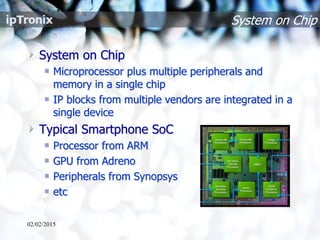
System on Chip
Microprocessor plus multiple peripherals and
memory in a single chip
IP blocks from multiple vendors are integrated in a
single device
Typical Smartphone SoC
Processor from ARM
GPU from Adreno
Peripherals from Synopsys
etc
02/02/2015
Interconnect
Interconnection between IP blocks
Ensure interoperability
Maximize performance
Address system complexity
Multiple masters
Locked transfers
Cache coherency
Testability
Multicore debugging
System trace
Performance counters
02/02/2015
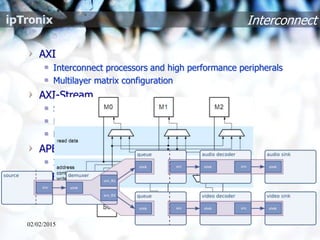
AXI
Interconnect processors and high performance peripherals
Multilayer matrix configuration
AXI-Stream
Streaming interface for packetized data flow
Multiple data widths within same interconnect
Backpressure support
APB
Interconnect low speed peripherals
ATB
Add tracing capability to any peripheral
Interconnect
02/02/2015
Notes
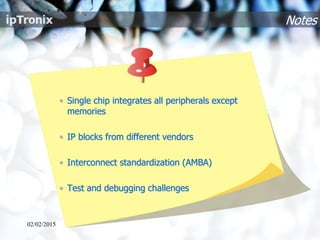
• Single chip integrates all peripherals except
memories
• IP blocks from different vendors
• Interconnect standardization (AMBA)
• Test and debugging challenges
02/02/2015
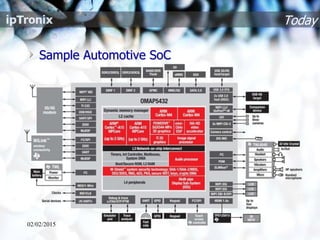
Today
Sample Automotive SoC
02/02/2015
Questions
02/02/2015
Thank you
System level design
Part 2
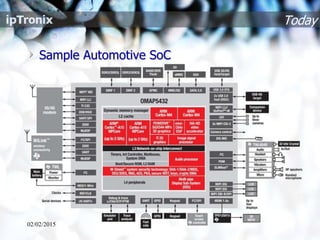
Today
Sample Automotive SoC
02/02/2015
Today
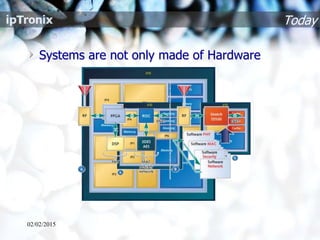
Systems are not only made of Hardware
02/02/2015
Notes
• Big - Little Architecture
• Heterogeneous processors for different tasks
• Codecs implemented in software
• Application specific interfaces
02/02/2015
Quiz Time
Most common performance bottlenecks
02/02/2015
Bottlenecks
Memory Latency
DDR clock speeds exceed multiple GHz
Column access time in the order of 5ns
Row access time still in the order of 50ns
Can be worked around with multiple levels of
Cache memory
Bandwidth
Clock frequency is limited by technology
Large busses are expensive
Can be worked around with distributed memory
02/02/2015
GPUs
Graphics Processing Unit
Started as dedicated vertex processors
Evolved thowards SW programmable shaders
Now used for massively parallel computation
• OpenCL
• Cuda
Massively parallel
Hundreds of parallel processors
Multiple chips can be teamed for increased
performance
02/02/2015
Today
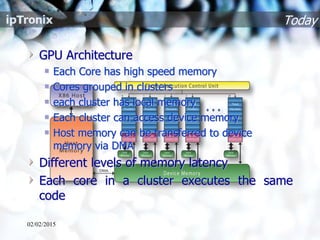
GPU Architecture
Each Core has high speed memory
Cores grouped in clusters
each cluster has local memory
Each cluster can access device memory
Host memory can be transferred to device
memory via DMA
Different levels of memory latency
Each core in a cluster executes the same
code
02/02/2015
Today
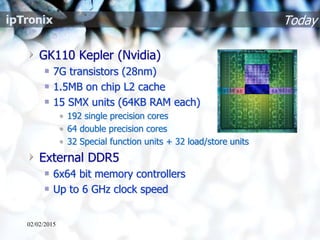
GK110 Kepler (Nvidia)
7G transistors (28nm)
1.5MB on chip L2 cache
15 SMX units (64KB RAM each)
• 192 single precision cores
• 64 double precision cores
• 32 Special function units + 32 load/store units
External DDR5
6x64 bit memory controllers
Up to 6 GHz clock speed
02/02/2015
Notes
• Peripherals may be more complex than main
processor
• Eliminating bottlenecks by architecture, not just
brute force
• Transforming dedicated HW in SW programmable
devices creates value
02/02/2015
Today
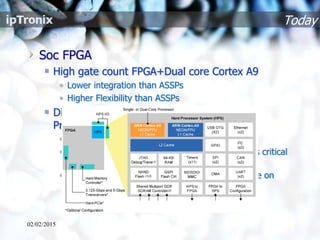
Soc FPGA
High gate count FPGA+Dual core Cortex A9
• Lower integration than ASSPs
• Higher Flexibility than ASSPs
Direct interconnection between FPGA and
Processor
• Possibility to accelerate software with FPGA IP
• Lower system cost implementing in software less critical
Ips
• On the fly reprogramming to repurpose hardware on
demand
02/02/2015
Trends
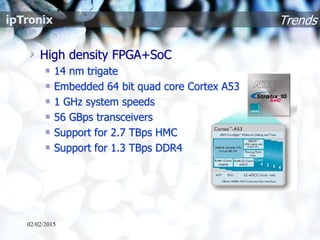
High density FPGA+SoC
14 nm trigate
Embedded 64 bit quad core Cortex A53
1 GHz system speeds
56 GBps transceivers
Support for 2.7 TBps HMC
Support for 1.3 TBps DDR4
02/02/2015
Trends
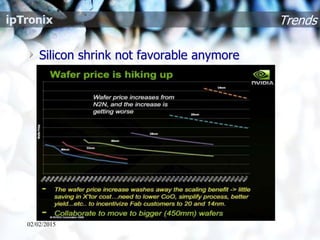
Silicon shrink not favorable anymore
02/02/2015
Notes
• Integration of hard IP with programmable fabric
• ASIC design cost skyrocketing is favoring FPGAs
• Large library of IP cores (including open source)
• FPGA to accelerate critical algorithms
02/02/2015
Trends
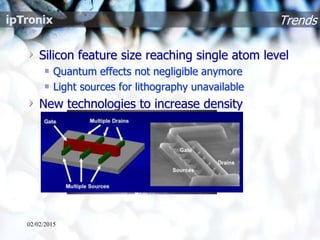
Silicon feature size reaching single atom level
Quantum effects not negligible anymore
Light sources for lithography unavailable
New technologies to increase density
02/02/2015
Trends
02/02/2015
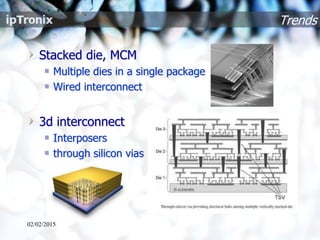
Stacked die, MCM
Multiple dies in a single package
Wired interconnect
3d interconnect
Interposers
through silicon vias
Trends
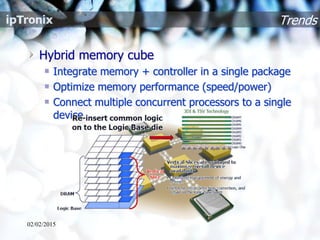
Hybrid memory cube
Integrate memory + controller in a single package
Optimize memory performance (speed/power)
Connect multiple concurrent processors to a single
device
02/02/2015
Summary
• Chip density is increasing regardless of physical limits
• Systems are gradually being condensed to a single chip
• Chips requiring multiple technologies are manufactured with
MCM or 3D processes
• System components from multiple vendors are integrated in single
chips
• Software IS a system component
02/02/2015
What we learnt
Summary
• Whenever Moore’s law is hitting a wall breakthroughs keep
it going
• Thinking outside the box is vital for innovation
• System design requires knowledge of leading edge technologies
• System optimization requires in depth knowledge IP block
functionality at all levels
02/02/2015
Questions
02/02/2015
System Design Methodologies
Theory
Electronic System Design
Methodologies
• Implement collaboration/Knowledge management tools
• Define version control strategies
• Define verification methodologies
Architectural design
• Break down the design in subsystems
• Define subsystems functionality
• Define interfaces (Busses, protocols, APIs etc)
Subsystem implementation
• Unit test design
• RTL coding
• Simulation
• Synthesis and timing closure (ASIC/FPGA)
02/02/2015
Methodologies
System design requires organization
Even small groups can have communication issues
Even a single developer can miss information
Collaboration/Knowledge management tools
Requirement and bug tracking
Revision control
Project planning
Build automation
02/02/2015
Methodologies
Requirement tracking
Keep track of specifications
Clearly define dependencies
Help partitioning in smaller tasks
Bug Tracking
Track issues and their solutions
• Solutions to old problems can shorten new ones
• Knowledge of issues can prevent repeating mistakes
Clearly identify which changes have been adopted
for a specific issue
• Regression testing
02/02/2015
Methodologies – Version Control
Version Control
Keep track of modifications and their reasons
• Always comment your commits
• Possibly reference bug tracker
Allow multiple developers to work concurrently
Branch/tag
• Branching allows separate development environments for
each developer
• Developers can commit broken code in branches
• Merge branches only when code is reliable
• Tag when code is stable or on milestones
02/02/2015
Methodologies - verification
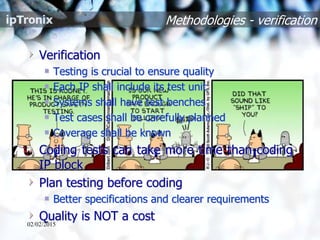
Verification
Testing is crucial to ensure quality
Each IP shall include its test unit
Systems shall have test benches
Test cases shall be carefully planned
Coverage shall be known
Coding tests can take more time than coding
IP block
Plan testing before coding
Better specifications and clearer requirements
Quality is NOT a cost02/02/2015
Methodologies - Documentation
Always document your work!
Sharing knowledge improves teamwork
Documentation adds value to your work
You can’t remember everything
Issues
Synchronization with artifact versions
Completeness
02/02/2015
Methodologies - Documentation
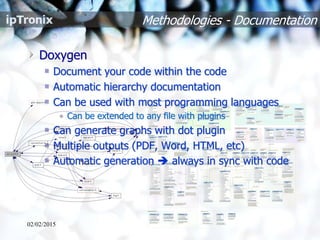
Doxygen
Document your code within the code
Automatic hierarchy documentation
Can be used with most programming languages
• Can be extended to any file with plugins
Can generate graphs with dot plugin
Multiple outputs (PDF, Word, HTML, etc)
Automatic generation  always in sync with code
02/02/2015
Architectural design
Before you start…
Search for existing solutions
• Literature
• Patents
• Open source
List requirements
• Define input and outputs
• Clearly understand criticalities
List use cases
• Define what resources are required for each scenario
02/02/2015
Architectural design
Partition design in independent units
Small
• Easy to maintain
• Simple to understand
Reusable
• Generalize a problem whenever possible
• Create a library of tested, robust building blocks
Documented
• Possibly use self documentation tools
• Test bench with use cases
02/02/2015
Architectural design - Interfaces
Always try to use standard interfaces
Blocks can be reused more easily
Understand implications of an interface
architecture
If non standard interface is required…
Define a standard (and document it)
Check it against known use cases
Explore interface weak points and benefits
02/02/2015
Open Source
Benefits
Collaborative design
improves quality, stability through peer review
Huge code base for software and hardware IP
Drawbacks
Heterogeneous code styles and interfaces
No warranty on quality/functionality
Limited support from community
02/02/2015
Open Source
Business models
Open Source libraries and interfaces
• Company releases parts of code to community
• Community improves code functionality and reliability
• Establish trust with customers and partners
Open Source applications and platforms
• Sell support and customization services
• Sell HW products
• Gain visibility and business opportunities
• Possibility of mixed Open/Closed source approach
02/02/2015
Questions
02/02/2015
Thank you

Seminario utovrm

  • 1.
  • 2.
    Agenda Part 1 Microprocessor andsilicon technology Evolution Memories Bus architectures System On Chip Part 2 GPU FPGA Architectural design Collaboration tools Open Source 02/02/2015
  • 3.
  • 4.
    Electronic System Design Architecturaldesign • Break down the design in subsystems • Define subsystems functionality • Define interfaces (Busses, protocols, APIs etc) Methodologies • Implement collaboration tools for large, dislocated teams • Define version control strategies • Define verification methodologies Experience is key NEVER reinvent the wheel Introduction 02/02/2015
  • 5.
    History In the beginning… Discretecomponents (resistors, transistors) Multiple transistors to form a single gate Even a simple counter required multiple boards 02/02/2015
  • 6.
    History The integrated circuit(1950-1960) Invented in 1950 Technology available in 1960 Multiple Logic gates in a single device (chip) 02/02/2015
  • 7.
    Notes • Great inventionsare visionary • Not necessarily an invention is feasible immediately • Designer shall foresee technological breakthroughs 02/02/2015
  • 8.
    History Intel 8086 (1978) 29Ktransistors, 3 µm 10 MHz First “true” 16 bit microprocessor Required several external peripherals • Interrupt controller • DMA • Timer Backwards compatible with 8080 (1974) • First “usable” microprocessor, 4500 transistors, 10 µm • Required +12V and -5V supplies • 2 MHz 02/02/2015
  • 9.
    Notes • First microprocessorsare 40 years old • Latest x86 core i7 is backwards compatible with something from 36 years ago! 02/02/2015
  • 10.
    History Programmable Logic Array(1977) Fuse based Can implement any combinatorial logic Programmable at production time 02/02/2015
  • 11.
    History PLD (1983) More complexthan PLA, reprogrammable Introduce macrocell concept • Small PLA with a Flip Flop • External interconnect 02/02/2015
  • 12.
    History LCA (1985) Programmable seaof gates, 1µm RAM based with external configuration memory Up to 7600 logic gates (484 CLBs) 02/02/2015
  • 13.
    Notes • Moving fromOTP to reprogrammable made big difference • Programmable logic is key when ASSPs are not available • Same design flow as ASICs 02/02/2015
  • 14.
    History Dynamic RAM Invented in1966, First useful device in 1973 Drastically reduces transistor count from SRAM Requires refresh Multiplexed addressing • Reduces access time • Increases latency Banking • Read/write multiple rows at the same time 02/02/2015
  • 15.
    History DRAMs or HDDscan have very long access times Random access to high latency devices kills performance Access to adjacent data requires very low latency Cache memory Whenever random data is requested, cache stores adjacent locations in «cache lines» Subsequent accesses to data in cache has low latency Multiple levels of cache improve performance 02/02/2015
  • 16.
    Notes • Thinking outsidethe box allows revolutionary solutions • Tradeoffs are acceptable when benefits prevail • New technologies limitations stimulate more innovation 02/02/2015
  • 17.
    History Intel 80486 (1989) 1.2Mtransistors, 1µm 50 MHz / 40 MIPS First to embed cache (16KB) • Reduce DRAM latency penalty First to embed FPU 32 bit data bus 02/02/2015
  • 18.
    Notes • 10x technologyshrink in 15 years (101µm) • Embedding of widely used external coprocessors 02/02/2015
  • 19.
    History Pentium (1993) 3.3M transistors,800nm 66MHz, no direct connection to memory In 1996 introduced MMX Distributed architectures Microprocessor Memory interface bridge Peripheral and bus bridge External superIO 02/02/2015
  • 20.
    Notes • Processor doesn’tinterface directly with memory anymore • Northbridge routes processor accesses among memory and high speed busses abstracting them • Peripherals get integrated in Southbridge 02/02/2015
  • 21.
    History Parallel bus topology(ISA, PCI, AGP) Separate or multiplexed address/data Limited by signaling technology • Few MHz with TTL • Up to 150 MHz with LVCMOS Dual and Quad data rate to further improve bandwidth (mainly on memories) • Some use of differential signaling 02/02/2015
  • 22.
    History Peripheral Component Interconnect Configurationspace • Automatic card detection and configuration • Extended card information • Standardized register set Dynamic device address mapping • No more conflicts among multiple cards on the same bus Introduces bursting 02/02/2015
  • 23.
    Serial busses (PCIe,USB, HDMI, etc) Smaller number of traces Very low voltage differential signaling Clocked or self clocking Multi Gbit per lane PCIe • 1.0 – 2GBit/sec per lane • 2.0 – 4GBit/sec per lane • 3.0 – 8Gbit/sec per lane USB • 1.0 – 12 Mbit/sec • 2.0 – 480 Mbit/sec • 3.0 – 5GBit/sec History 02/02/2015
  • 24.
    History 02/02/2015 PCI Express Introduces layered,packetized bus Star connection rather than one to many Allows tree configuration via PCI-PCI bridges Scalable bandwidth • Pin compatible connectors from 1 to 16 lanes • Increasing bit rate at each generation Overhead • Protocol & flow control • Encoding – 20% on Gen1&2 (8b10b) – 1.54% on Gen3 (128/130)
  • 25.
    Notes • Communication betweensubsystems is key • Bandwidth can be increased without brute force • High speed, low voltage serial is faster and more energy efficient than parallel LVCMOS 02/02/2015
  • 26.
    System on Chip Systemon Chip Microprocessor plus multiple peripherals and memory in a single chip IP blocks from multiple vendors are integrated in a single device Typical Smartphone SoC Processor from ARM GPU from Adreno Peripherals from Synopsys etc 02/02/2015
  • 27.
    Interconnect Interconnection between IPblocks Ensure interoperability Maximize performance Address system complexity Multiple masters Locked transfers Cache coherency Testability Multicore debugging System trace Performance counters 02/02/2015
  • 28.
    AXI Interconnect processors andhigh performance peripherals Multilayer matrix configuration AXI-Stream Streaming interface for packetized data flow Multiple data widths within same interconnect Backpressure support APB Interconnect low speed peripherals ATB Add tracing capability to any peripheral Interconnect 02/02/2015
  • 29.
    Notes • Single chipintegrates all peripherals except memories • IP blocks from different vendors • Interconnect standardization (AMBA) • Test and debugging challenges 02/02/2015
  • 30.
  • 31.
  • 32.
  • 33.
  • 34.
  • 35.
    Today Systems are notonly made of Hardware 02/02/2015
  • 36.
    Notes • Big -Little Architecture • Heterogeneous processors for different tasks • Codecs implemented in software • Application specific interfaces 02/02/2015
  • 37.
    Quiz Time Most commonperformance bottlenecks 02/02/2015
  • 38.
    Bottlenecks Memory Latency DDR clockspeeds exceed multiple GHz Column access time in the order of 5ns Row access time still in the order of 50ns Can be worked around with multiple levels of Cache memory Bandwidth Clock frequency is limited by technology Large busses are expensive Can be worked around with distributed memory 02/02/2015
  • 39.
    GPUs Graphics Processing Unit Startedas dedicated vertex processors Evolved thowards SW programmable shaders Now used for massively parallel computation • OpenCL • Cuda Massively parallel Hundreds of parallel processors Multiple chips can be teamed for increased performance 02/02/2015
  • 40.
    Today GPU Architecture Each Corehas high speed memory Cores grouped in clusters each cluster has local memory Each cluster can access device memory Host memory can be transferred to device memory via DMA Different levels of memory latency Each core in a cluster executes the same code 02/02/2015
  • 41.
    Today GK110 Kepler (Nvidia) 7Gtransistors (28nm) 1.5MB on chip L2 cache 15 SMX units (64KB RAM each) • 192 single precision cores • 64 double precision cores • 32 Special function units + 32 load/store units External DDR5 6x64 bit memory controllers Up to 6 GHz clock speed 02/02/2015
  • 42.
    Notes • Peripherals maybe more complex than main processor • Eliminating bottlenecks by architecture, not just brute force • Transforming dedicated HW in SW programmable devices creates value 02/02/2015
  • 43.
    Today Soc FPGA High gatecount FPGA+Dual core Cortex A9 • Lower integration than ASSPs • Higher Flexibility than ASSPs Direct interconnection between FPGA and Processor • Possibility to accelerate software with FPGA IP • Lower system cost implementing in software less critical Ips • On the fly reprogramming to repurpose hardware on demand 02/02/2015
  • 44.
    Trends High density FPGA+SoC 14nm trigate Embedded 64 bit quad core Cortex A53 1 GHz system speeds 56 GBps transceivers Support for 2.7 TBps HMC Support for 1.3 TBps DDR4 02/02/2015
  • 45.
    Trends Silicon shrink notfavorable anymore 02/02/2015
  • 46.
    Notes • Integration ofhard IP with programmable fabric • ASIC design cost skyrocketing is favoring FPGAs • Large library of IP cores (including open source) • FPGA to accelerate critical algorithms 02/02/2015
  • 47.
    Trends Silicon feature sizereaching single atom level Quantum effects not negligible anymore Light sources for lithography unavailable New technologies to increase density 02/02/2015
  • 48.
    Trends 02/02/2015 Stacked die, MCM Multipledies in a single package Wired interconnect 3d interconnect Interposers through silicon vias
  • 49.
    Trends Hybrid memory cube Integratememory + controller in a single package Optimize memory performance (speed/power) Connect multiple concurrent processors to a single device 02/02/2015
  • 50.
    Summary • Chip densityis increasing regardless of physical limits • Systems are gradually being condensed to a single chip • Chips requiring multiple technologies are manufactured with MCM or 3D processes • System components from multiple vendors are integrated in single chips • Software IS a system component 02/02/2015 What we learnt
  • 51.
    Summary • Whenever Moore’slaw is hitting a wall breakthroughs keep it going • Thinking outside the box is vital for innovation • System design requires knowledge of leading edge technologies • System optimization requires in depth knowledge IP block functionality at all levels 02/02/2015
  • 52.
  • 53.
  • 54.
    Theory Electronic System Design Methodologies •Implement collaboration/Knowledge management tools • Define version control strategies • Define verification methodologies Architectural design • Break down the design in subsystems • Define subsystems functionality • Define interfaces (Busses, protocols, APIs etc) Subsystem implementation • Unit test design • RTL coding • Simulation • Synthesis and timing closure (ASIC/FPGA) 02/02/2015
  • 55.
    Methodologies System design requiresorganization Even small groups can have communication issues Even a single developer can miss information Collaboration/Knowledge management tools Requirement and bug tracking Revision control Project planning Build automation 02/02/2015
  • 56.
    Methodologies Requirement tracking Keep trackof specifications Clearly define dependencies Help partitioning in smaller tasks Bug Tracking Track issues and their solutions • Solutions to old problems can shorten new ones • Knowledge of issues can prevent repeating mistakes Clearly identify which changes have been adopted for a specific issue • Regression testing 02/02/2015
  • 57.
    Methodologies – VersionControl Version Control Keep track of modifications and their reasons • Always comment your commits • Possibly reference bug tracker Allow multiple developers to work concurrently Branch/tag • Branching allows separate development environments for each developer • Developers can commit broken code in branches • Merge branches only when code is reliable • Tag when code is stable or on milestones 02/02/2015
  • 58.
    Methodologies - verification Verification Testingis crucial to ensure quality Each IP shall include its test unit Systems shall have test benches Test cases shall be carefully planned Coverage shall be known Coding tests can take more time than coding IP block Plan testing before coding Better specifications and clearer requirements Quality is NOT a cost02/02/2015
  • 59.
    Methodologies - Documentation Alwaysdocument your work! Sharing knowledge improves teamwork Documentation adds value to your work You can’t remember everything Issues Synchronization with artifact versions Completeness 02/02/2015
  • 60.
    Methodologies - Documentation Doxygen Documentyour code within the code Automatic hierarchy documentation Can be used with most programming languages • Can be extended to any file with plugins Can generate graphs with dot plugin Multiple outputs (PDF, Word, HTML, etc) Automatic generation  always in sync with code 02/02/2015
  • 61.
    Architectural design Before youstart… Search for existing solutions • Literature • Patents • Open source List requirements • Define input and outputs • Clearly understand criticalities List use cases • Define what resources are required for each scenario 02/02/2015
  • 62.
    Architectural design Partition designin independent units Small • Easy to maintain • Simple to understand Reusable • Generalize a problem whenever possible • Create a library of tested, robust building blocks Documented • Possibly use self documentation tools • Test bench with use cases 02/02/2015
  • 63.
    Architectural design -Interfaces Always try to use standard interfaces Blocks can be reused more easily Understand implications of an interface architecture If non standard interface is required… Define a standard (and document it) Check it against known use cases Explore interface weak points and benefits 02/02/2015
  • 64.
    Open Source Benefits Collaborative design improvesquality, stability through peer review Huge code base for software and hardware IP Drawbacks Heterogeneous code styles and interfaces No warranty on quality/functionality Limited support from community 02/02/2015
  • 65.
    Open Source Business models OpenSource libraries and interfaces • Company releases parts of code to community • Community improves code functionality and reliability • Establish trust with customers and partners Open Source applications and platforms • Sell support and customization services • Sell HW products • Gain visibility and business opportunities • Possibility of mixed Open/Closed source approach 02/02/2015
  • 66.
  • 67.