System on Chip Design,
Architecture and Applications
By : Dimas Ruliandi
Introduction
SoC Architecture
SoC Design
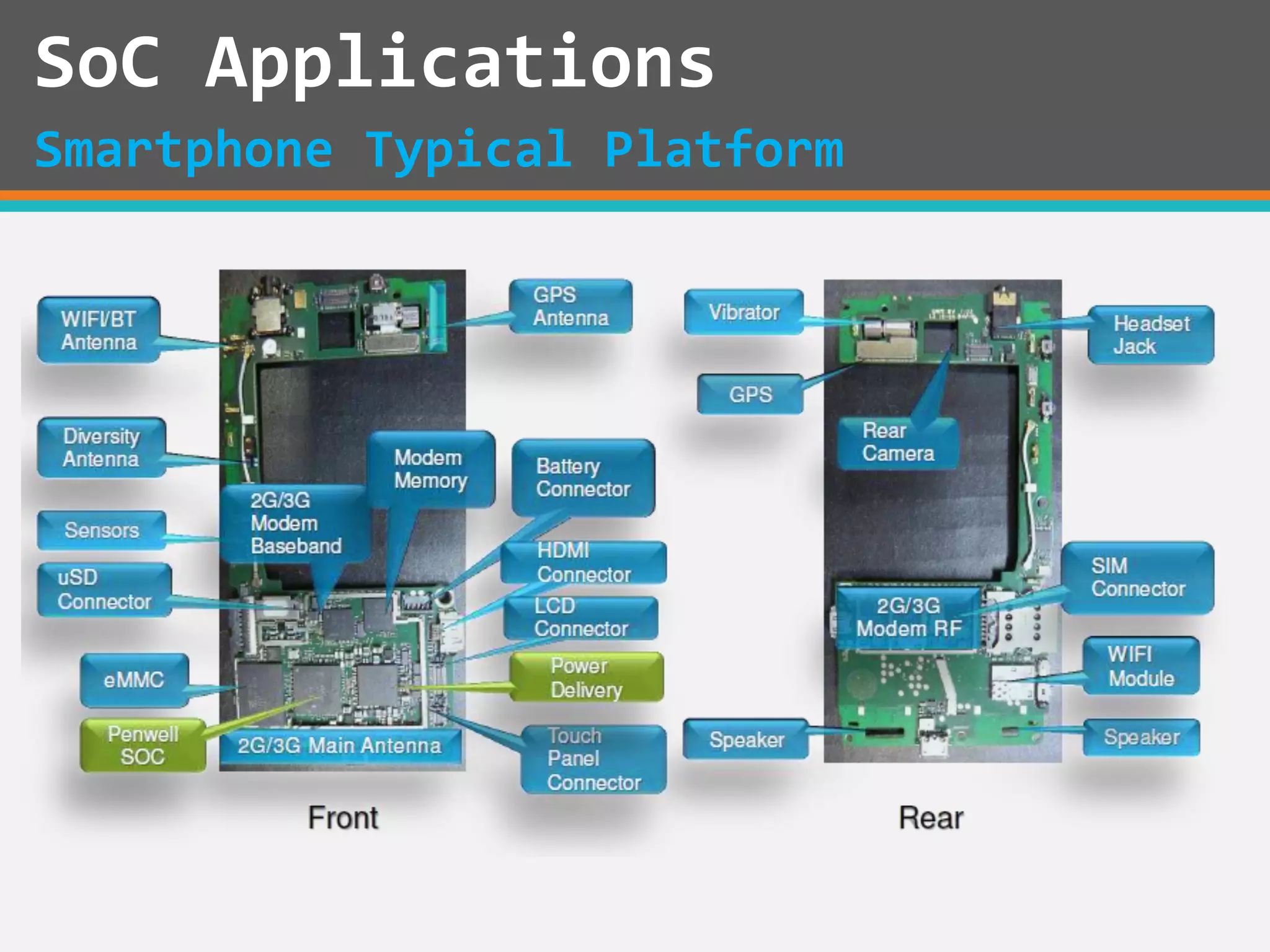
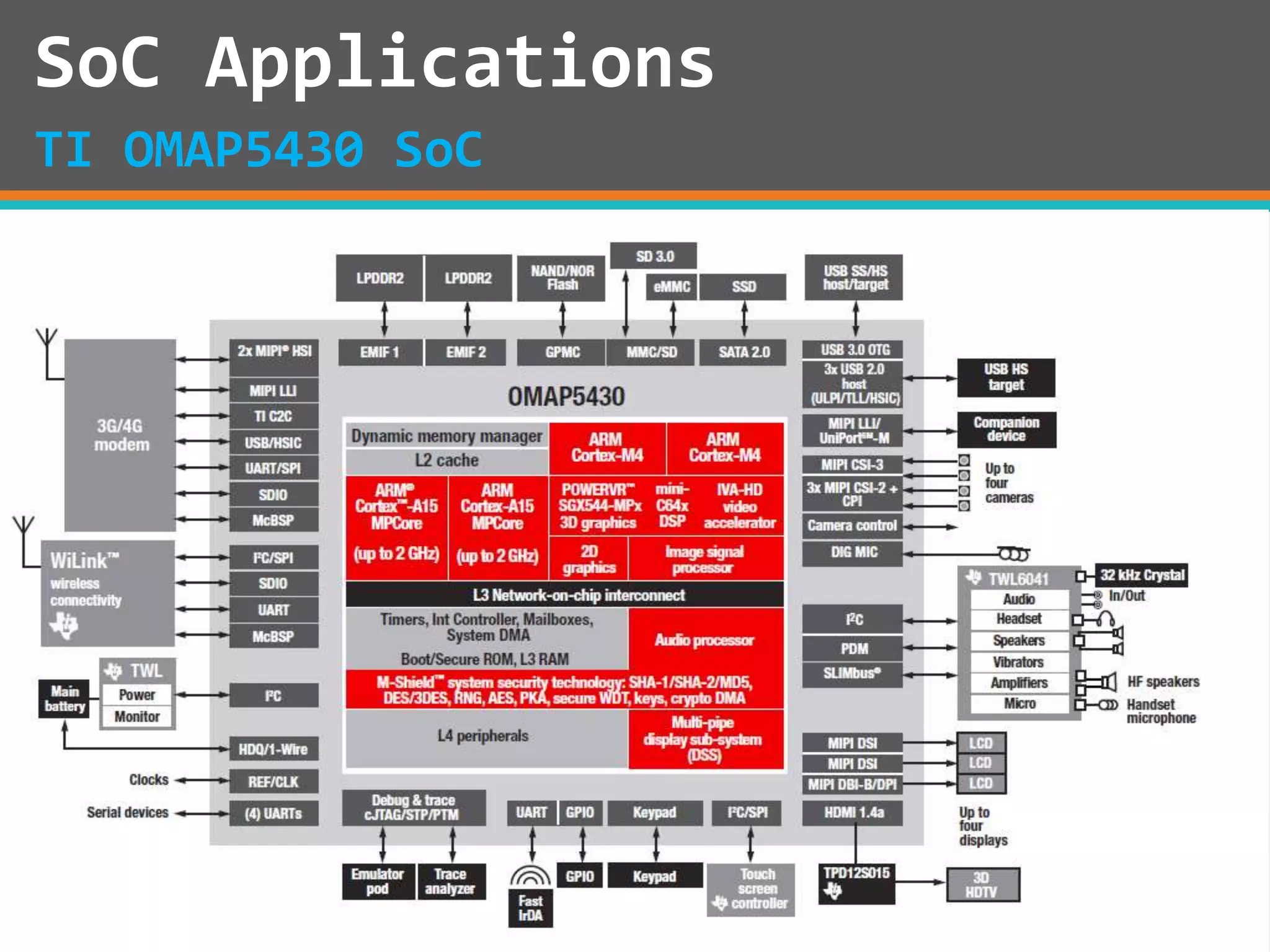
SoC Applications
Summary
Refferences
Outline
Introduction
• Technological Advances
• today’s chip can contains billions of transistors .
• transistor gate lengths are now in term of nano meters .
• approximately every 18 months the number of transistors on a chip
doubles – Moore’s law .
• The Consequences
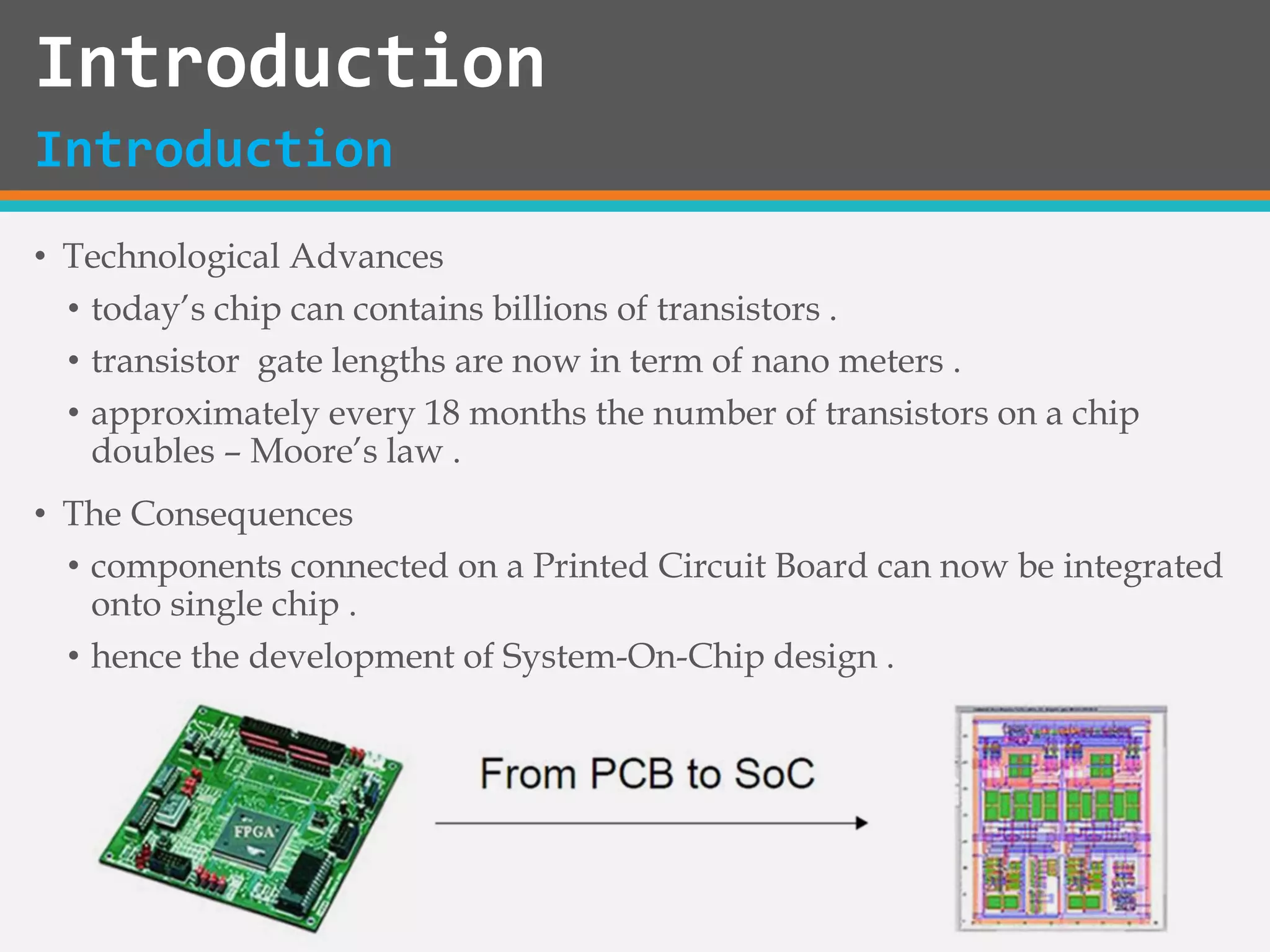
• components connected on a Printed Circuit Board can now be integrated
onto single chip .
• hence the development of System-On-Chip design .
Introduction
• SoC: System-on-a-Chip or System-on-Chip
• System:
•A collection of all kinds of components and/or
subsystems that are appropriately interconnected to
perform the specified functions for end user
• SoC refers to integrating all components into a single
integrated circuit (chip)
Introduction
What is SoC..?
SoC
Introduction
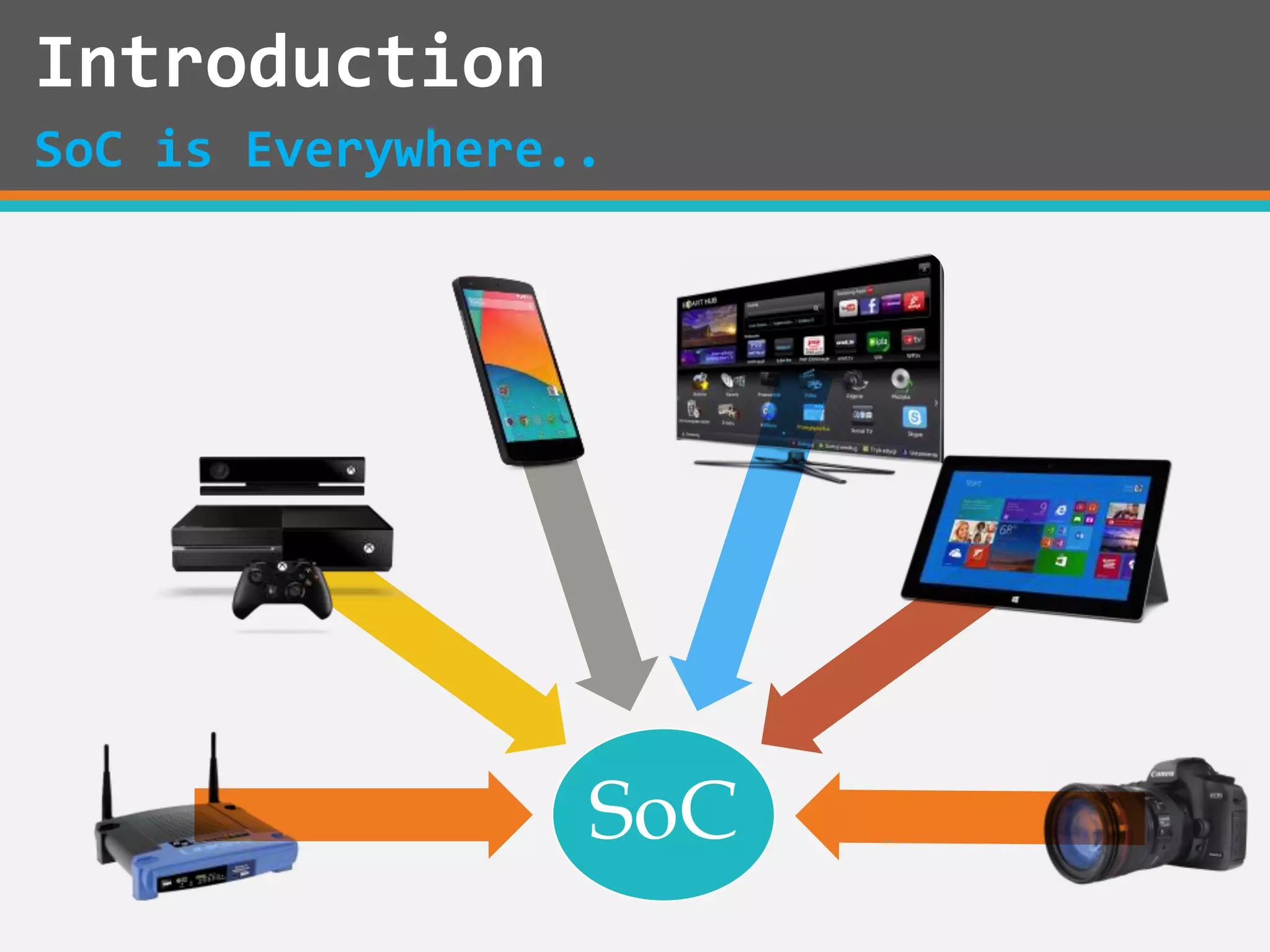
SoC is Everywhere..
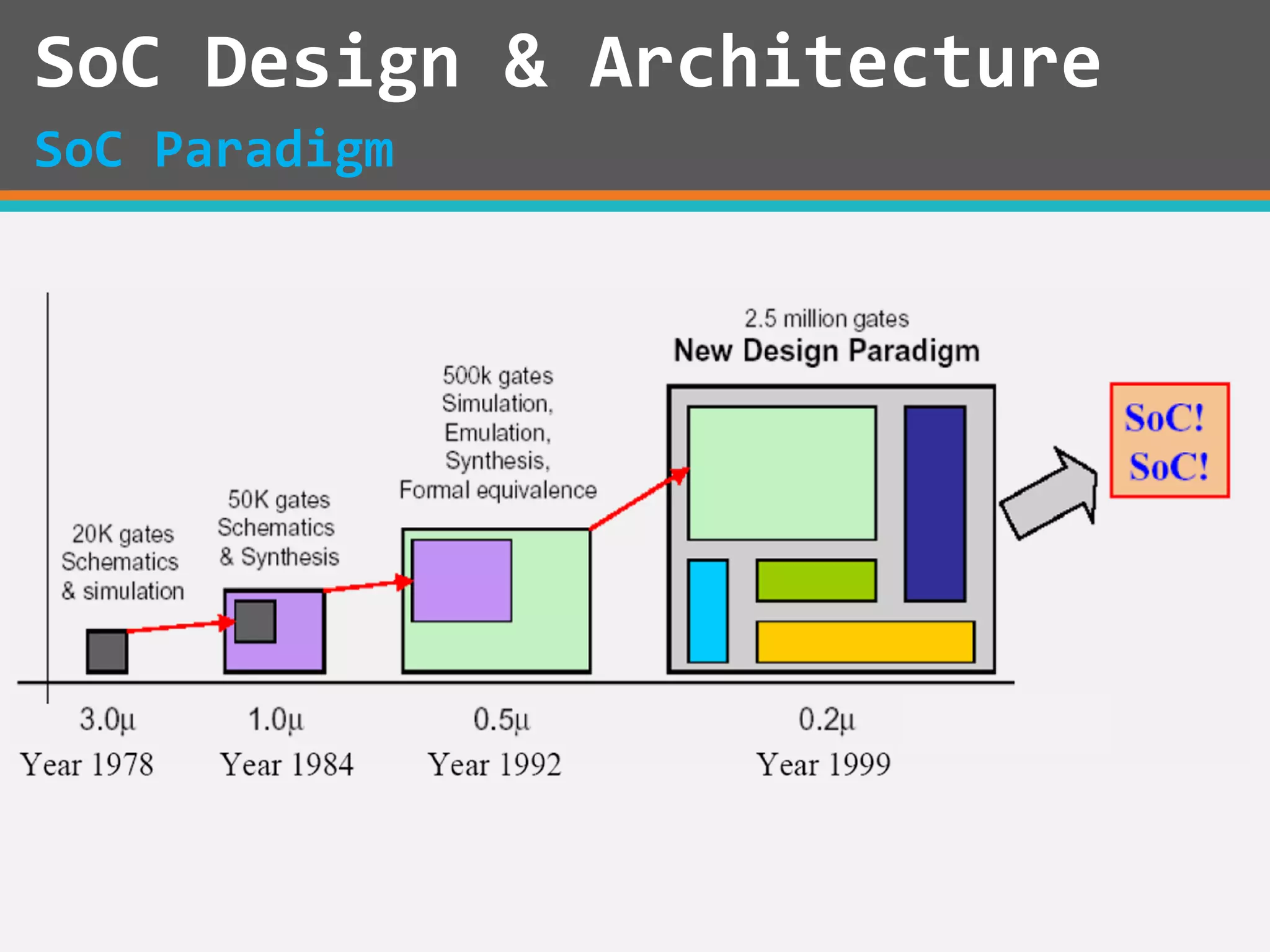
SoC Design & Architecture
SoC Paradigm
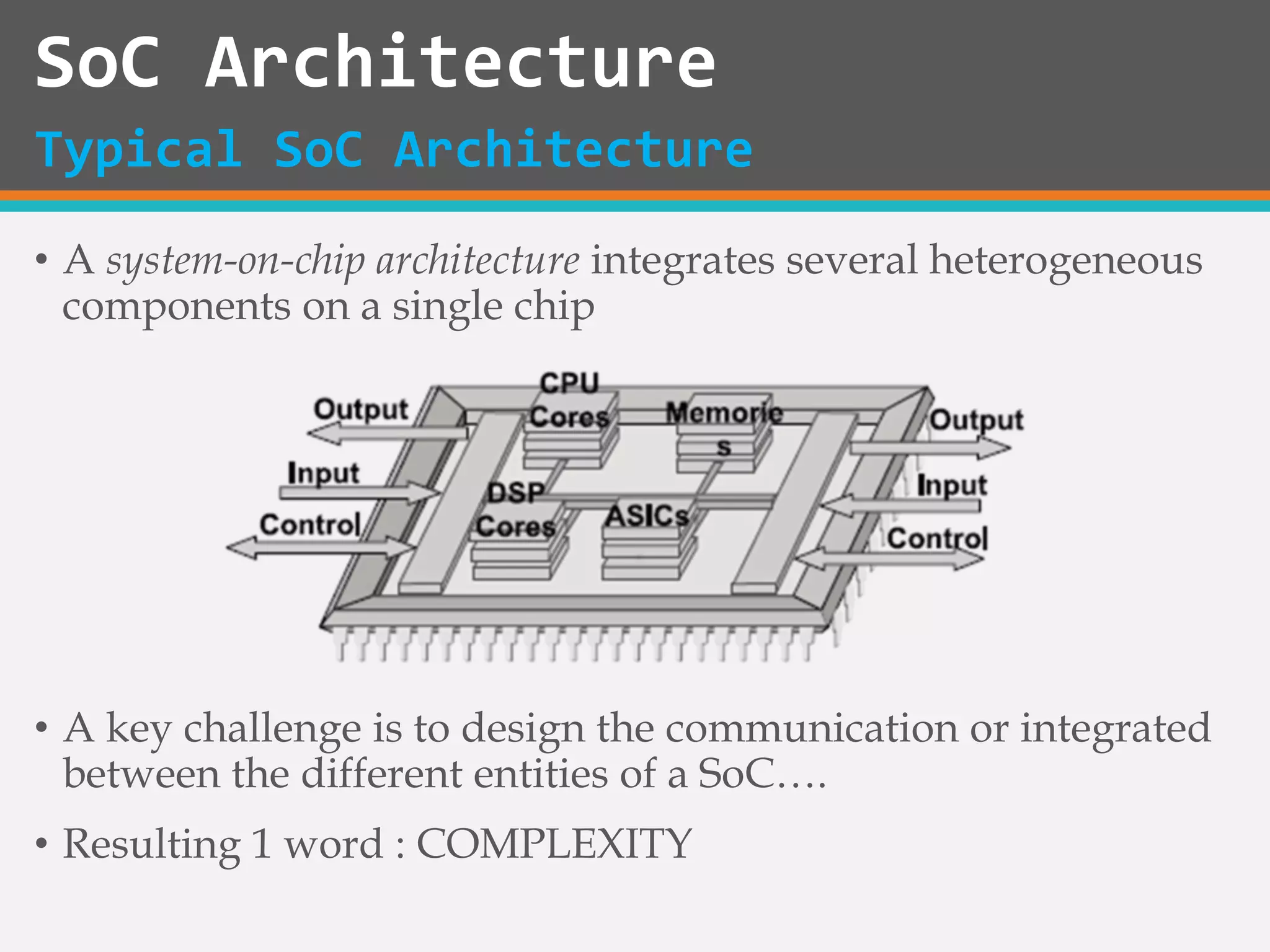
• A system-on-chip architecture integrates several heterogeneous
components on a single chip
• A key challenge is to design the communication or integrated
between the different entities of a SoC….
• Resulting 1 word : COMPLEXITY
SoC Architecture
Typical SoC Architecture
• Smaller device geometries, new processing (e.g., SOI)
• Higher density integration
• Low Power requirement
• Higher frequencies
• Design Complexity
• Verification, at different levels
• Time-to-market pressure
SoC Design
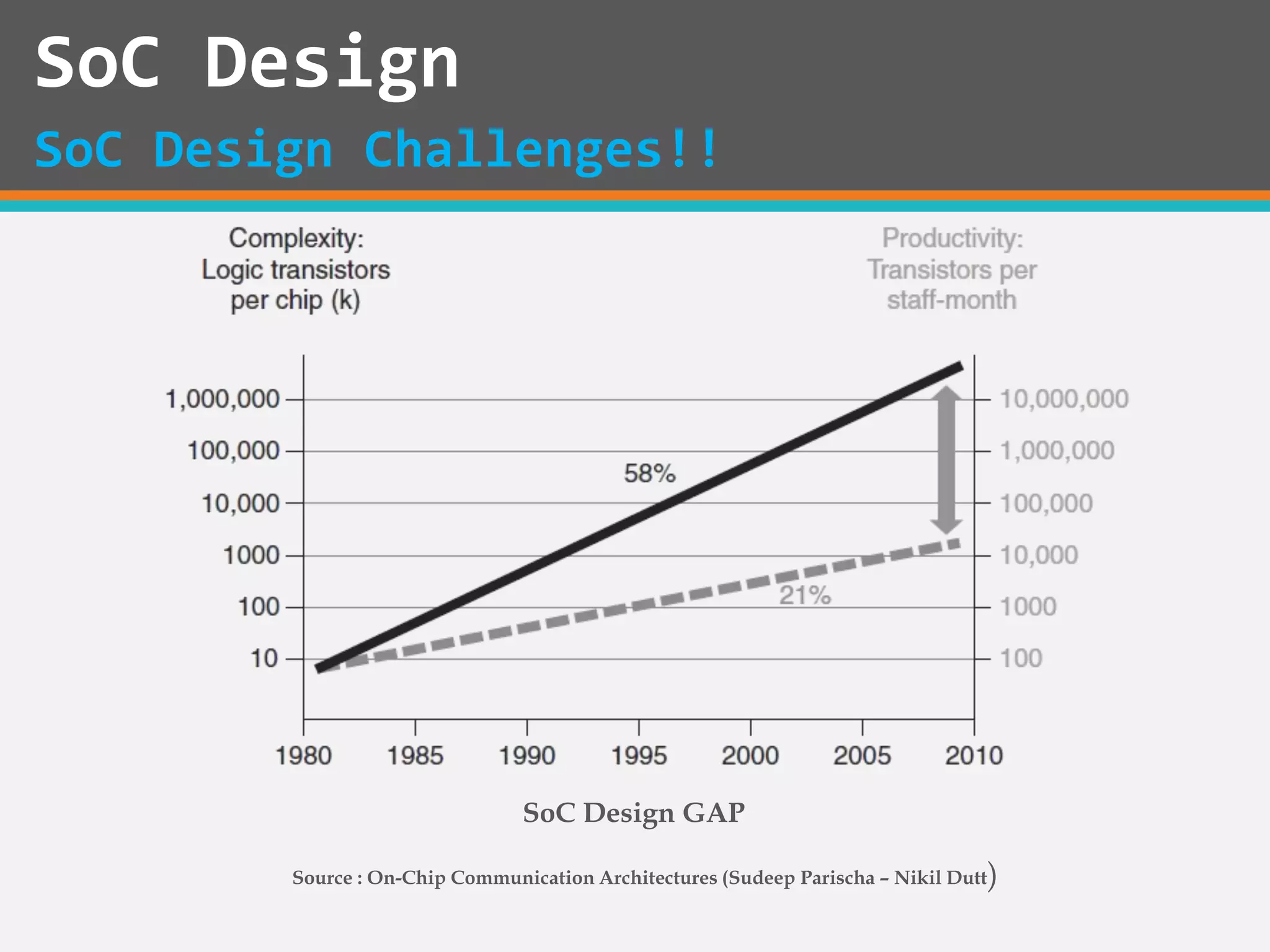
SoC Design Challenges!!
Source : On-Chip Communication Architectures (Sudeep Parischa – Nikil Dutt)
SoC Design
SoC Design Challenges!!
SoC Design GAP
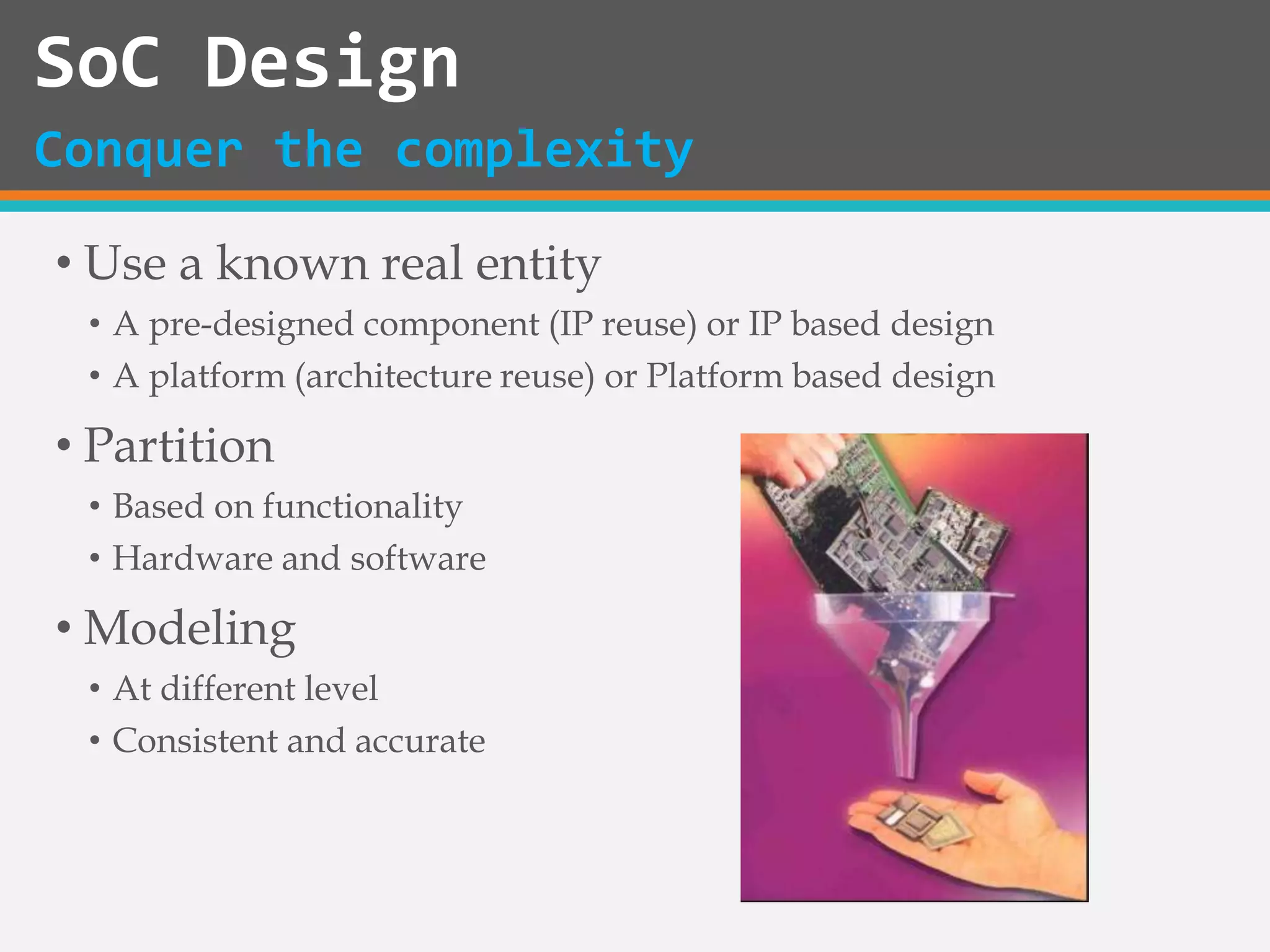
• Use a known real entity
• A pre-designed component (IP reuse) or IP based design
• A platform (architecture reuse) or Platform based design
• Partition
• Based on functionality
• Hardware and software
• Modeling
• At different level
• Consistent and accurate
SoC Design
Conquer the complexity
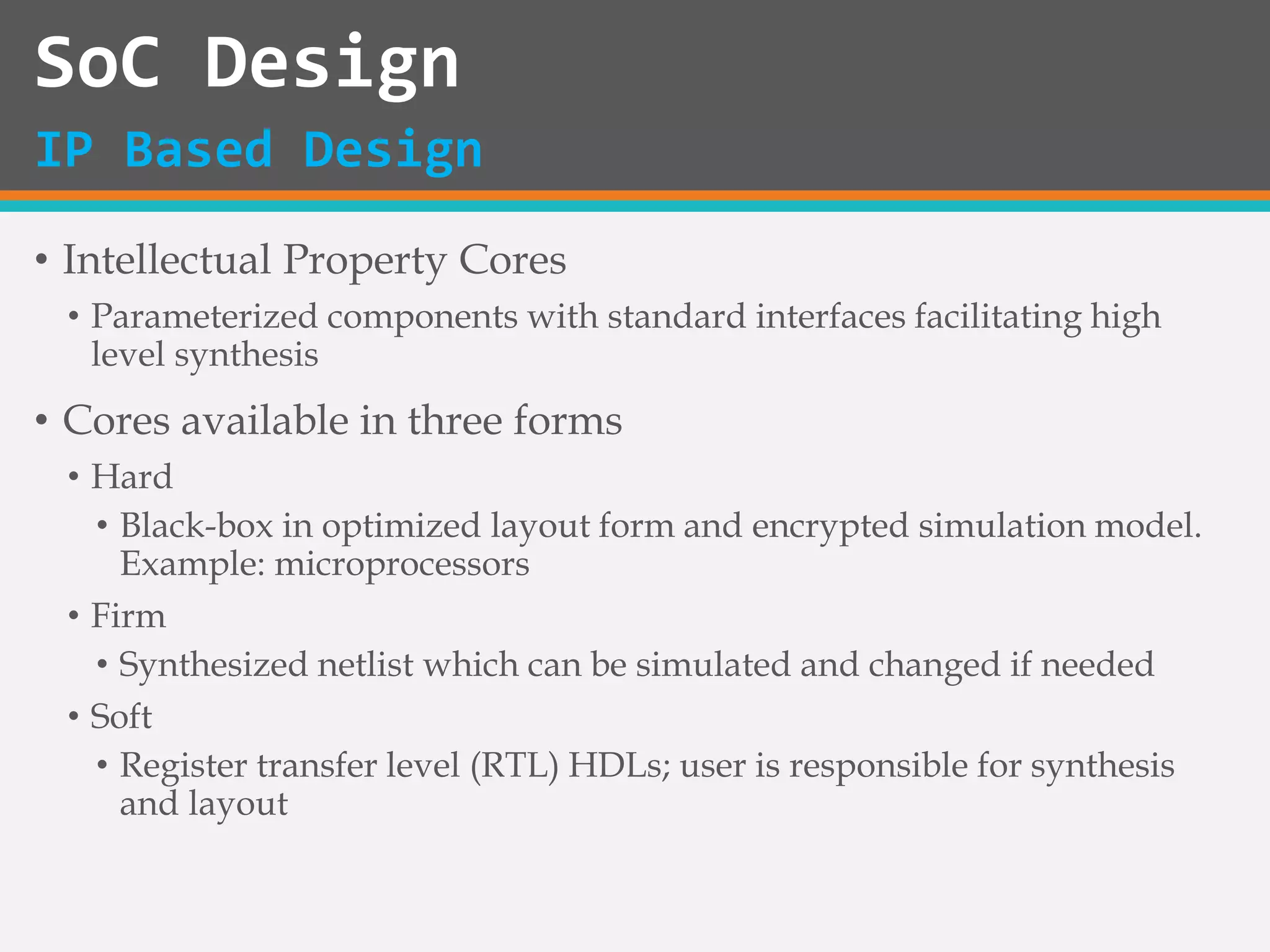
• Intellectual Property Cores
• Parameterized components with standard interfaces facilitating high
level synthesis
• Cores available in three forms
• Hard
• Black-box in optimized layout form and encrypted simulation model.
Example: microprocessors
• Firm
• Synthesized netlist which can be simulated and changed if needed
• Soft
• Register transfer level (RTL) HDLs; user is responsible for synthesis
and layout
SoC Design
IP Based Design
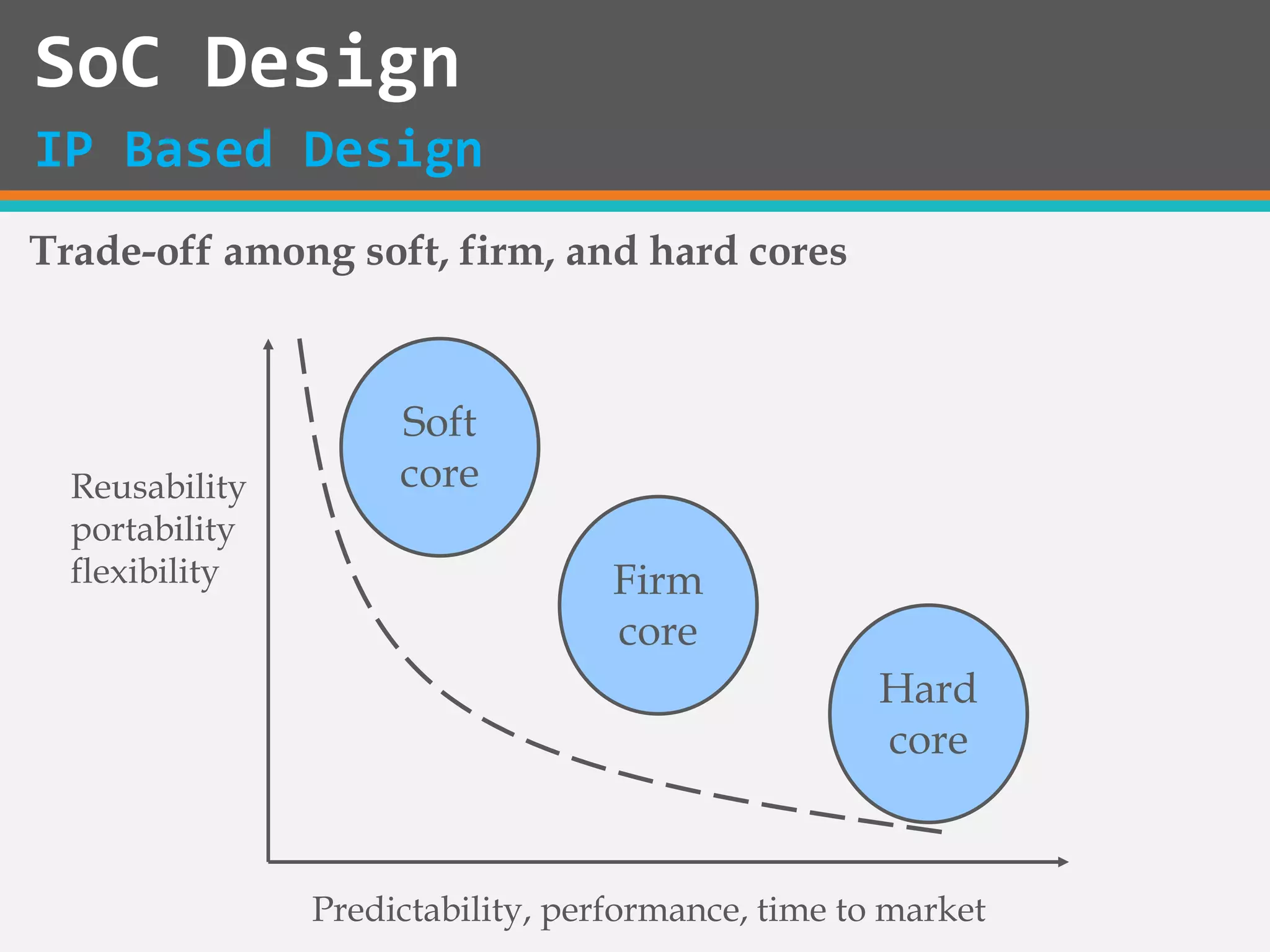
Reusability
portability
flexibility
Predictability, performance, time to market
Soft
core
Firm
core
Hard
core
Trade-off among soft, firm, and hard cores
SoC Design
IP Based Design
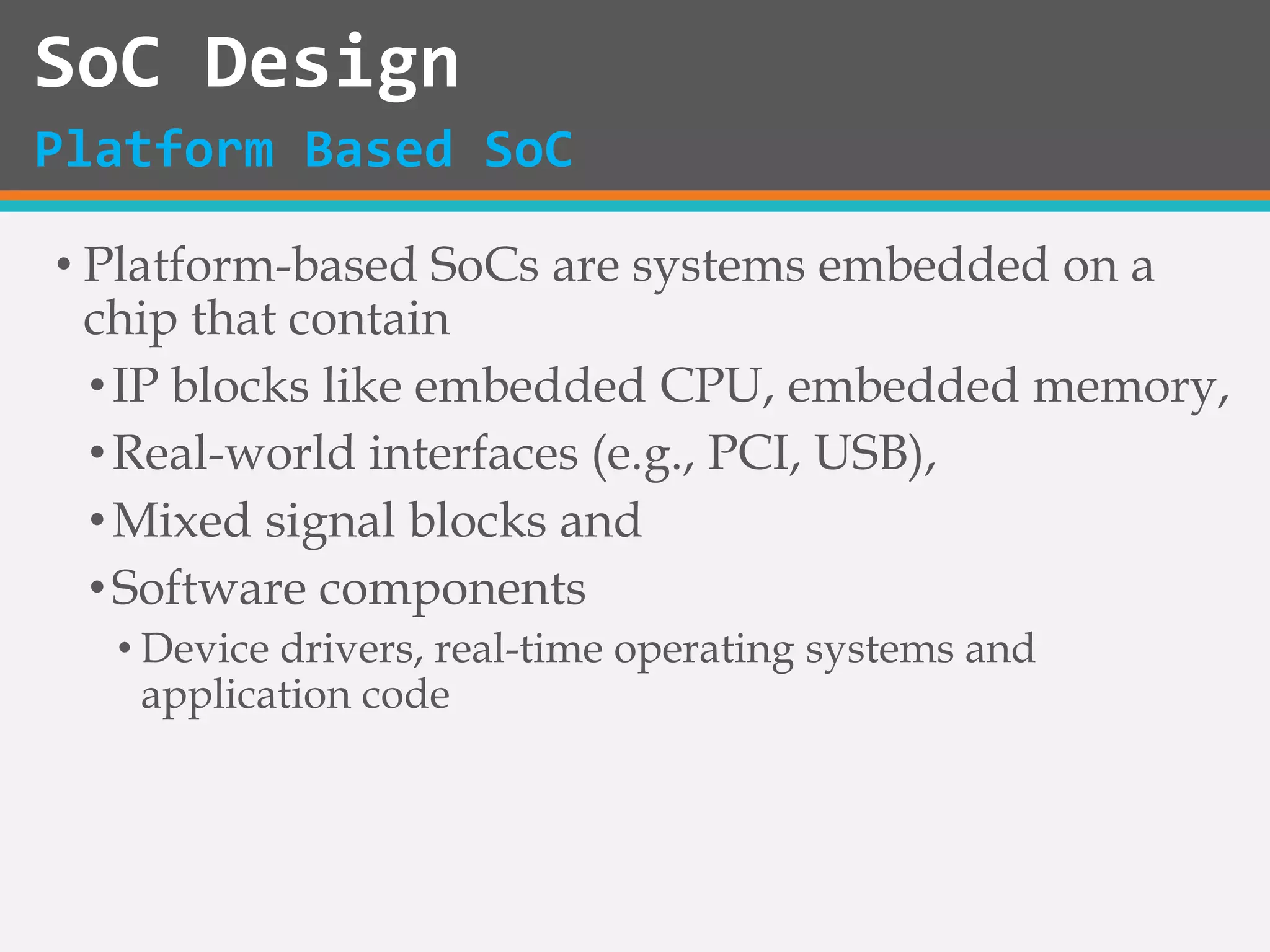
• Platform-based SoCs are systems embedded on a
chip that contain
•IP blocks like embedded CPU, embedded memory,
•Real-world interfaces (e.g., PCI, USB),
•Mixed signal blocks and
•Software components
• Device drivers, real-time operating systems and
application code
SoC Design
Platform Based SoC
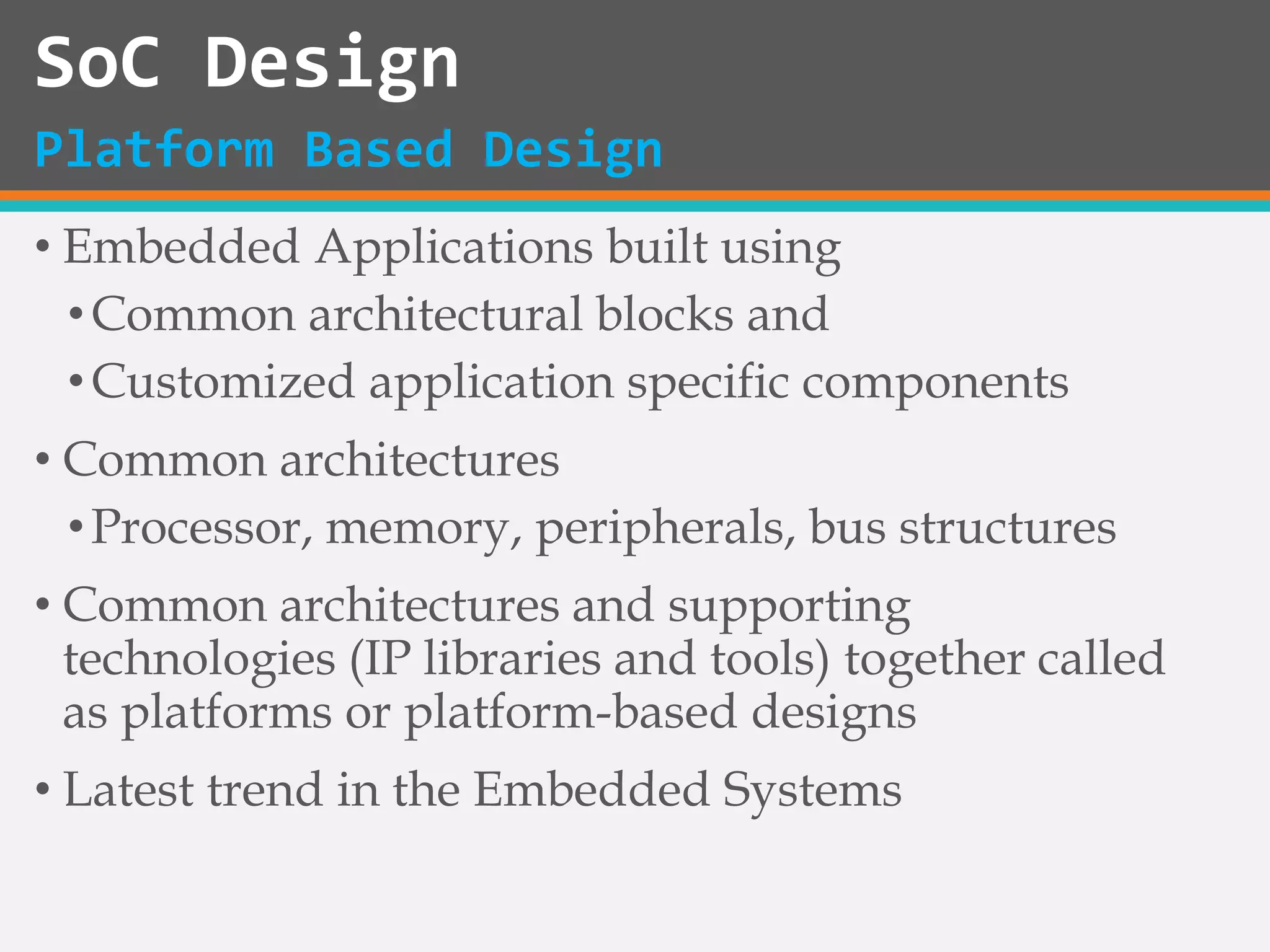
• Embedded Applications built using
•Common architectural blocks and
•Customized application specific components
• Common architectures
•Processor, memory, peripherals, bus structures
• Common architectures and supporting
technologies (IP libraries and tools) together called
as platforms or platform-based designs
• Latest trend in the Embedded Systems
SoC Design
Platform Based Design
SoC Design
SoC Platform Design
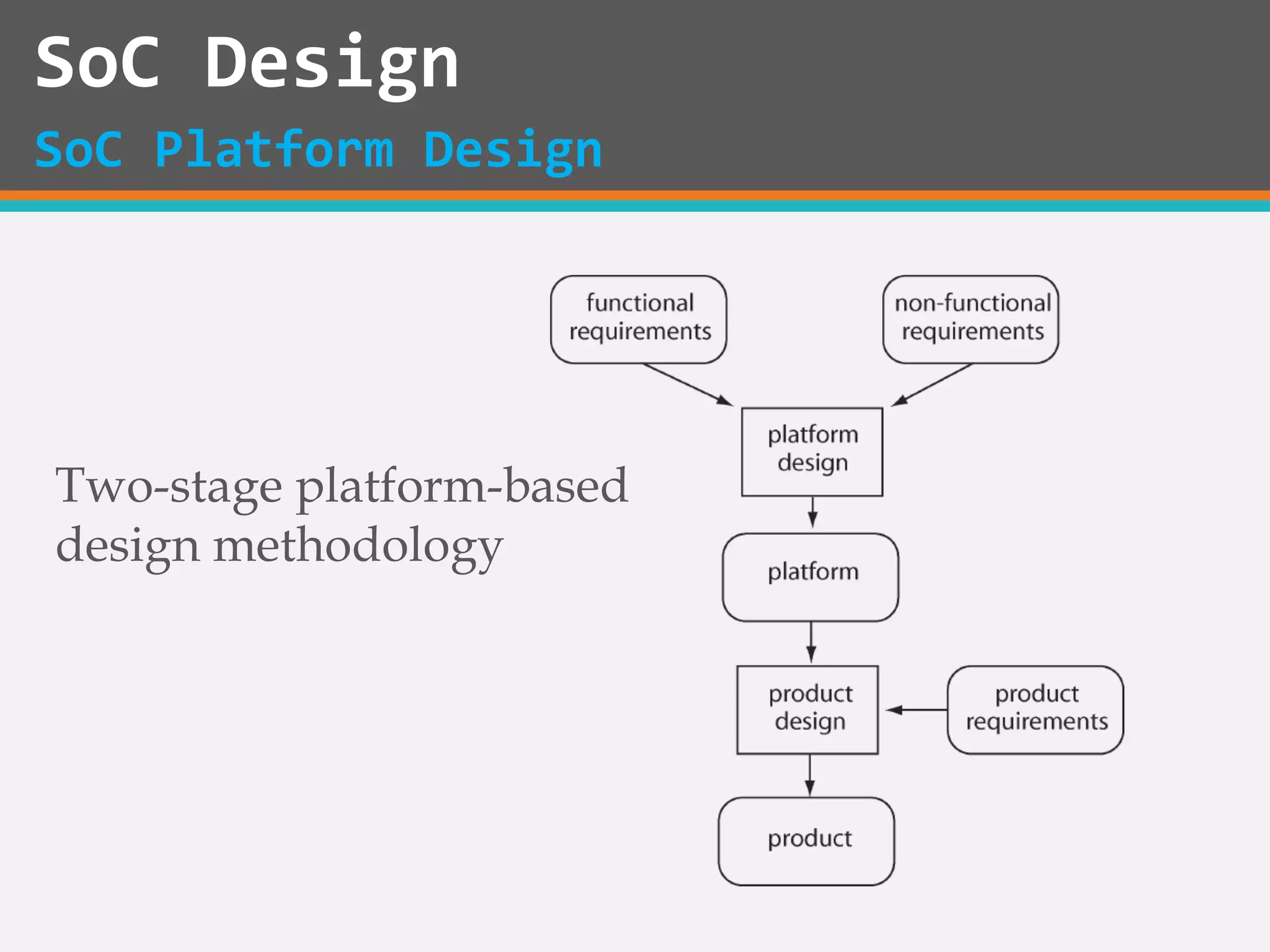
Two-stage platform-based
design methodology
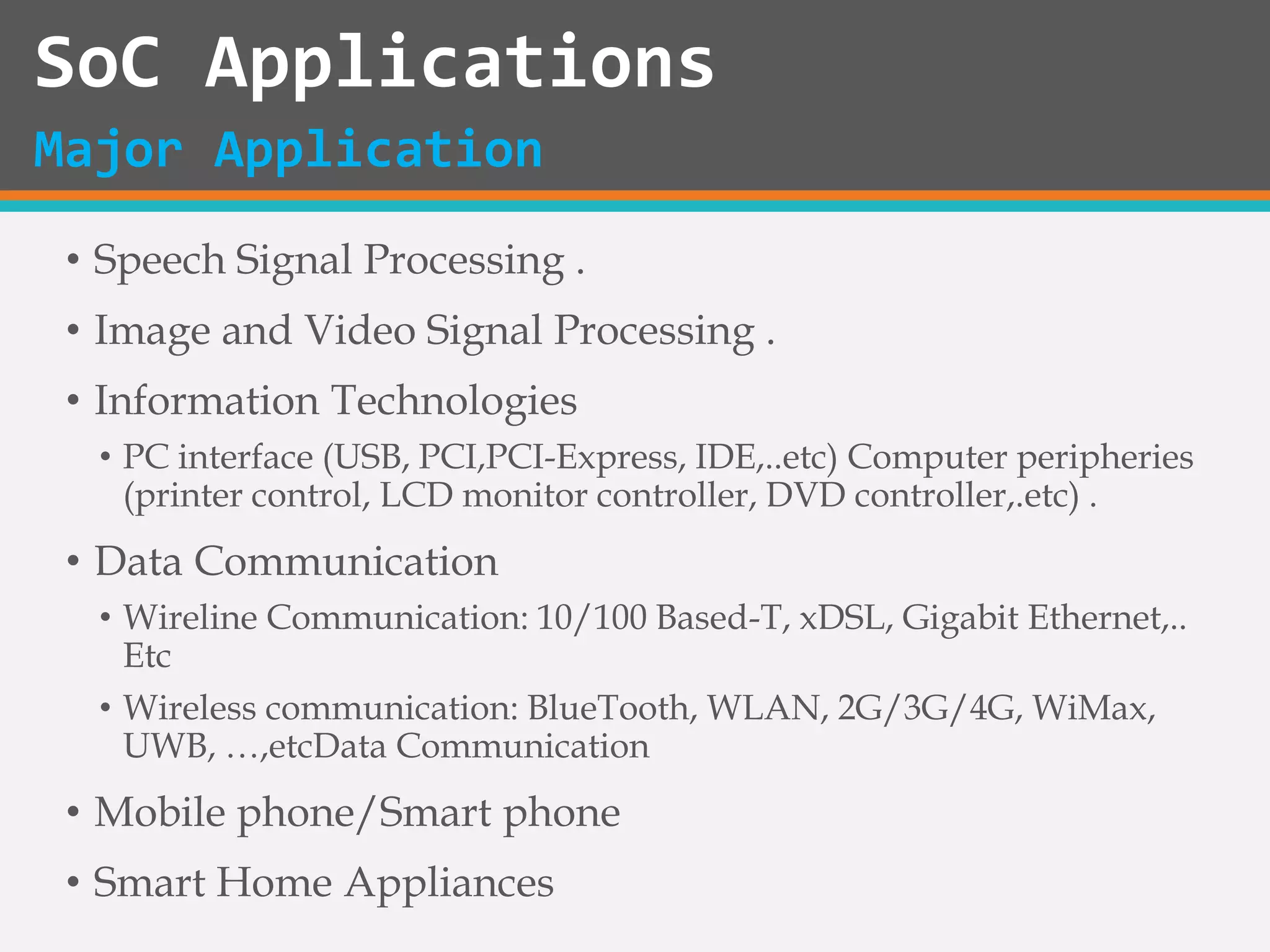
• Speech Signal Processing .
• Image and Video Signal Processing .
• Information Technologies
• PC interface (USB, PCI,PCI-Express, IDE,..etc) Computer peripheries
(printer control, LCD monitor controller, DVD controller,.etc) .
• Data Communication
• Wireline Communication: 10/100 Based-T, xDSL, Gigabit Ethernet,..
Etc
• Wireless communication: BlueTooth, WLAN, 2G/3G/4G, WiMax,
UWB, …,etcData Communication
• Mobile phone/Smart phone
• Smart Home Appliances
SoC Applications
Major Application
SoC Applications
Smartphone Typical Platform
SoC Applications
TI OMAP5430 SoC
• Technological advances mean that complete systems
can now be implemented on a single chip
• The benefits that this brings are :
– Lower cost per gate
– Lower power consumption
– Faster circuit operation
– More reliable implementation
– Smaller physical size
– Greater design security
– Significant in terms of speed , area and power
Summary
• The principle drawbacks of SoC design are
associated with the design pressures
imposed on today’s engineers , such as :
– Time-to-market demands
– Exponential fabrication cost
– Increased system complexity
– Increased verification requirements
Summary
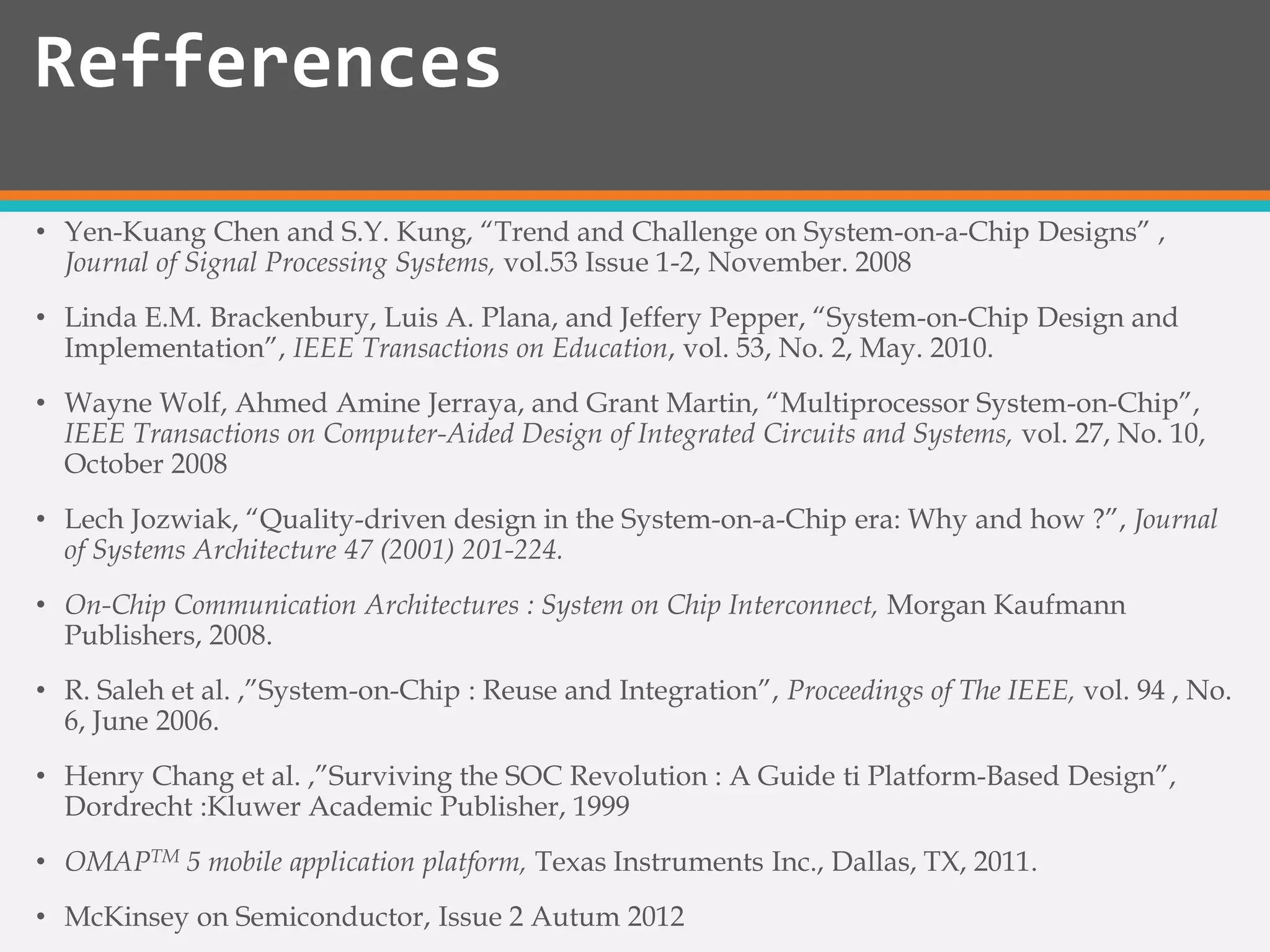
• Yen-Kuang Chen and S.Y. Kung, “Trend and Challenge on System-on-a-Chip Designs” ,
Journal of Signal Processing Systems, vol.53 Issue 1-2, November. 2008
• Linda E.M. Brackenbury, Luis A. Plana, and Jeffery Pepper, “System-on-Chip Design and
Implementation”, IEEE Transactions on Education, vol. 53, No. 2, May. 2010.
• Wayne Wolf, Ahmed Amine Jerraya, and Grant Martin, “Multiprocessor System-on-Chip”,
IEEE Transactions on Computer-Aided Design of Integrated Circuits and Systems, vol. 27, No. 10,
October 2008
• Lech Jozwiak, “Quality-driven design in the System-on-a-Chip era: Why and how ?”, Journal
of Systems Architecture 47 (2001) 201-224.
• On-Chip Communication Architectures : System on Chip Interconnect, Morgan Kaufmann
Publishers, 2008.
• R. Saleh et al. ,”System-on-Chip : Reuse and Integration”, Proceedings of The IEEE, vol. 94 , No.
6, June 2006.
• Henry Chang et al. ,”Surviving the SOC Revolution : A Guide ti Platform-Based Design”,
Dordrecht :Kluwer Academic Publisher, 1999
• OMAPTM 5 mobile application platform, Texas Instruments Inc., Dallas, TX, 2011.
• McKinsey on Semiconductor, Issue 2 Autum 2012
Refferences
System on Chip (SoC)

System on Chip (SoC)

  • 1.
    System on ChipDesign, Architecture and Applications By : Dimas Ruliandi
  • 2.
    Introduction SoC Architecture SoC Design SoCApplications Summary Refferences Outline
  • 3.
    Introduction • Technological Advances •today’s chip can contains billions of transistors . • transistor gate lengths are now in term of nano meters . • approximately every 18 months the number of transistors on a chip doubles – Moore’s law . • The Consequences • components connected on a Printed Circuit Board can now be integrated onto single chip . • hence the development of System-On-Chip design . Introduction
  • 4.
    • SoC: System-on-a-Chipor System-on-Chip • System: •A collection of all kinds of components and/or subsystems that are appropriately interconnected to perform the specified functions for end user • SoC refers to integrating all components into a single integrated circuit (chip) Introduction What is SoC..?
  • 5.
  • 6.
    SoC Design &Architecture SoC Paradigm
  • 7.
    • A system-on-chiparchitecture integrates several heterogeneous components on a single chip • A key challenge is to design the communication or integrated between the different entities of a SoC…. • Resulting 1 word : COMPLEXITY SoC Architecture Typical SoC Architecture
  • 8.
    • Smaller devicegeometries, new processing (e.g., SOI) • Higher density integration • Low Power requirement • Higher frequencies • Design Complexity • Verification, at different levels • Time-to-market pressure SoC Design SoC Design Challenges!!
  • 9.
    Source : On-ChipCommunication Architectures (Sudeep Parischa – Nikil Dutt) SoC Design SoC Design Challenges!! SoC Design GAP
  • 10.
    • Use aknown real entity • A pre-designed component (IP reuse) or IP based design • A platform (architecture reuse) or Platform based design • Partition • Based on functionality • Hardware and software • Modeling • At different level • Consistent and accurate SoC Design Conquer the complexity
  • 11.
    • Intellectual PropertyCores • Parameterized components with standard interfaces facilitating high level synthesis • Cores available in three forms • Hard • Black-box in optimized layout form and encrypted simulation model. Example: microprocessors • Firm • Synthesized netlist which can be simulated and changed if needed • Soft • Register transfer level (RTL) HDLs; user is responsible for synthesis and layout SoC Design IP Based Design
  • 12.
    Reusability portability flexibility Predictability, performance, timeto market Soft core Firm core Hard core Trade-off among soft, firm, and hard cores SoC Design IP Based Design
  • 13.
    • Platform-based SoCsare systems embedded on a chip that contain •IP blocks like embedded CPU, embedded memory, •Real-world interfaces (e.g., PCI, USB), •Mixed signal blocks and •Software components • Device drivers, real-time operating systems and application code SoC Design Platform Based SoC
  • 14.
    • Embedded Applicationsbuilt using •Common architectural blocks and •Customized application specific components • Common architectures •Processor, memory, peripherals, bus structures • Common architectures and supporting technologies (IP libraries and tools) together called as platforms or platform-based designs • Latest trend in the Embedded Systems SoC Design Platform Based Design
  • 15.
    SoC Design SoC PlatformDesign Two-stage platform-based design methodology
  • 16.
    • Speech SignalProcessing . • Image and Video Signal Processing . • Information Technologies • PC interface (USB, PCI,PCI-Express, IDE,..etc) Computer peripheries (printer control, LCD monitor controller, DVD controller,.etc) . • Data Communication • Wireline Communication: 10/100 Based-T, xDSL, Gigabit Ethernet,.. Etc • Wireless communication: BlueTooth, WLAN, 2G/3G/4G, WiMax, UWB, …,etcData Communication • Mobile phone/Smart phone • Smart Home Appliances SoC Applications Major Application
  • 17.
  • 18.
  • 19.
    • Technological advancesmean that complete systems can now be implemented on a single chip • The benefits that this brings are : – Lower cost per gate – Lower power consumption – Faster circuit operation – More reliable implementation – Smaller physical size – Greater design security – Significant in terms of speed , area and power Summary
  • 20.
    • The principledrawbacks of SoC design are associated with the design pressures imposed on today’s engineers , such as : – Time-to-market demands – Exponential fabrication cost – Increased system complexity – Increased verification requirements Summary
  • 21.
    • Yen-Kuang Chenand S.Y. Kung, “Trend and Challenge on System-on-a-Chip Designs” , Journal of Signal Processing Systems, vol.53 Issue 1-2, November. 2008 • Linda E.M. Brackenbury, Luis A. Plana, and Jeffery Pepper, “System-on-Chip Design and Implementation”, IEEE Transactions on Education, vol. 53, No. 2, May. 2010. • Wayne Wolf, Ahmed Amine Jerraya, and Grant Martin, “Multiprocessor System-on-Chip”, IEEE Transactions on Computer-Aided Design of Integrated Circuits and Systems, vol. 27, No. 10, October 2008 • Lech Jozwiak, “Quality-driven design in the System-on-a-Chip era: Why and how ?”, Journal of Systems Architecture 47 (2001) 201-224. • On-Chip Communication Architectures : System on Chip Interconnect, Morgan Kaufmann Publishers, 2008. • R. Saleh et al. ,”System-on-Chip : Reuse and Integration”, Proceedings of The IEEE, vol. 94 , No. 6, June 2006. • Henry Chang et al. ,”Surviving the SOC Revolution : A Guide ti Platform-Based Design”, Dordrecht :Kluwer Academic Publisher, 1999 • OMAPTM 5 mobile application platform, Texas Instruments Inc., Dallas, TX, 2011. • McKinsey on Semiconductor, Issue 2 Autum 2012 Refferences