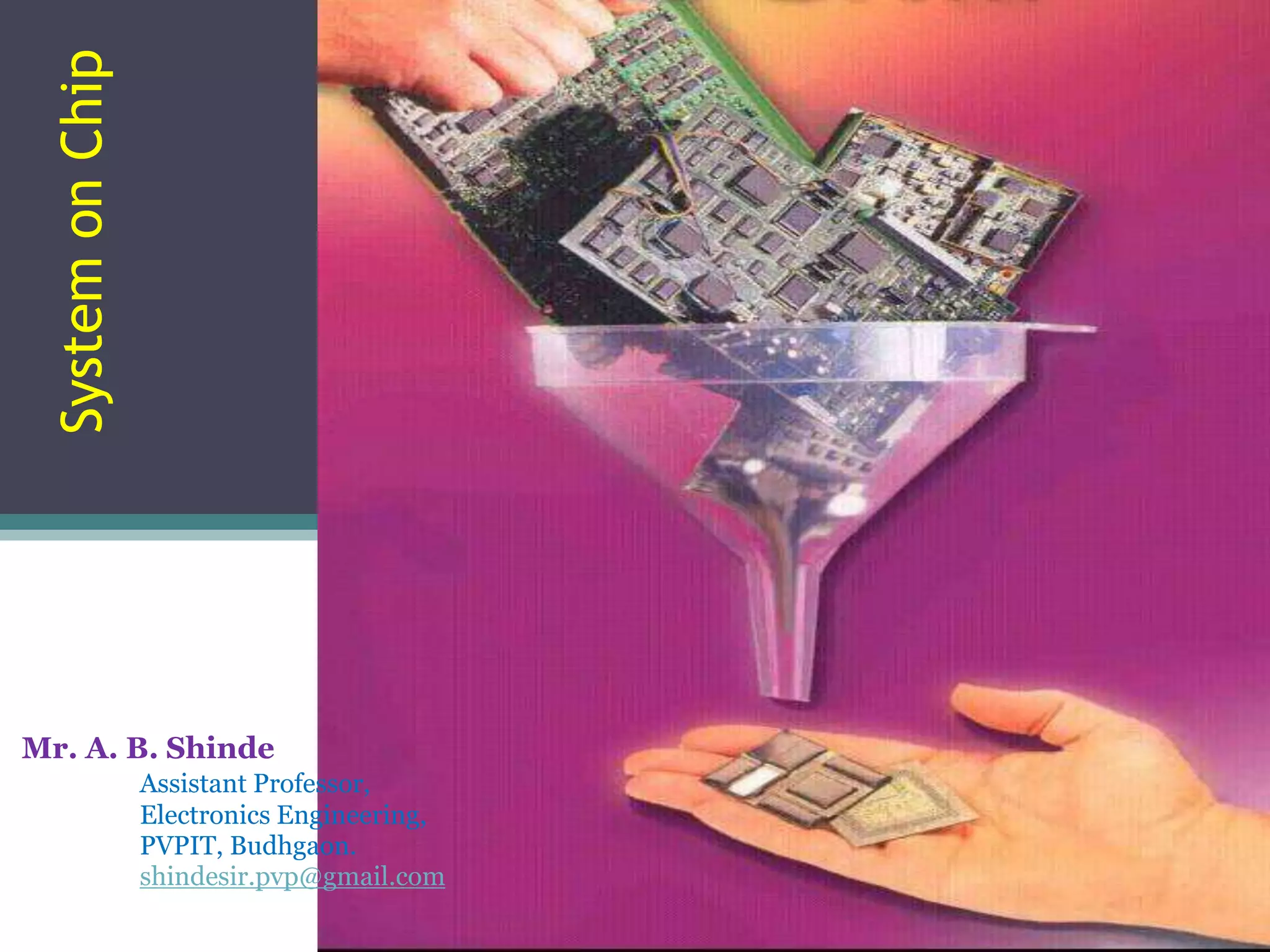

SystemonChip
Mr. A. B. Shinde
Assistant Professor,
Electronics Engineering,
PVPIT, Budhgaon.
shindesir.pvp@gmail.com
Objective:
• Students will be able to understand the overview of
System On Chip and Course Contents.
2
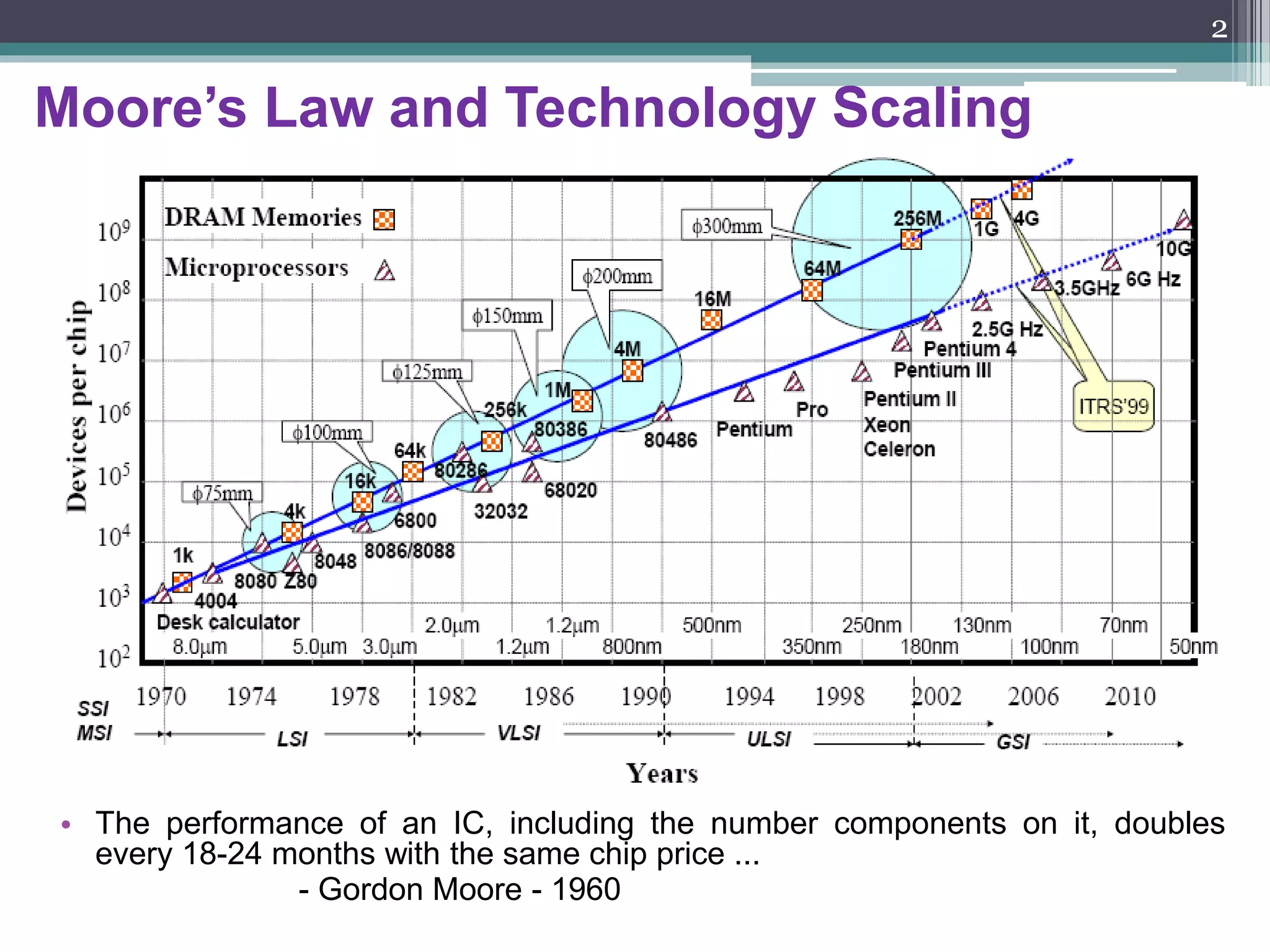
Moore’s Law and Technology Scaling
• The performance of an IC, including the number components on it, doubles
every 18-24 months with the same chip price ...
- Gordon Moore - 1960
3
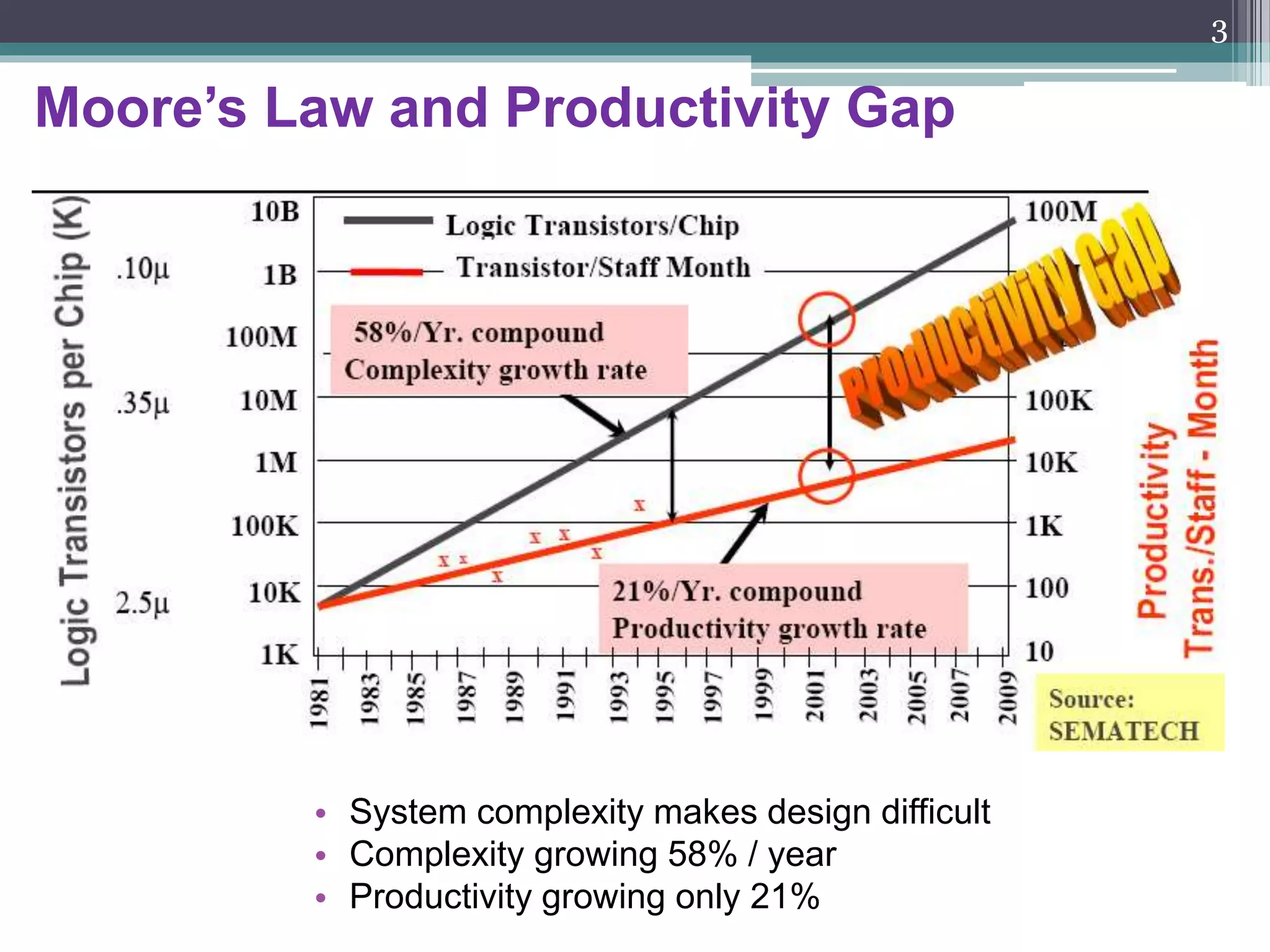
Moore’s Law and Productivity Gap
• System complexity makes design difficult
• Complexity growing 58% / year
• Productivity growing only 21%
4
Trends in IC technology
• IC Technology:
The first IC was fabricated in the late 1960’s. This revolution has changed the
direction of research after the invention of IC. The following are some important
trends come into use with reference to the IC technology.
• Technology scaling:
The scaling principles describe the pace, expressed in a scaling factor, at
which geometrical parameters of MOS devices, interconnect wires and the
supply voltage value scale when moving to smaller process technologies.
The scaling factor is 0.7 i.e.
 The reduction in the silicon area by a factor of 2,
 The increase of the chip performance by roughly a factor of 1.5,
 The reduction of power consumption by a factor of 2.
5
Trends in IC technology cont…
• System-on-a-chip
Various system components, such as memories, logic, RF modules
and sensors, which were traditionally integrated on a printed circuit
board (PCB), could be integrated on a single chip using silicon as an
implementation medium, is called as ‘system-on-a-chip’ (SoC).
• Ambient computing
Major consequences of the ultra-large scale integration is a clear
change in the use of computing. Unlike the first two general-purpose
computing phases, the third phase features computing which is hidden
in the background and thus almost invisible to a user. This type of
computing is referred to as ‘ambient computing’.
6
Trends in IC technology cont…
• Embedded systems on silicon
An embedded system is a system designed to perform a dedicated
or a narrow range of functions as a part of a larger system, usually with
a minimal end-user interaction. Unlike other, general-purpose computing
systems, embedded systems are application-domain-specific.
7
Trends in IC technology cont…
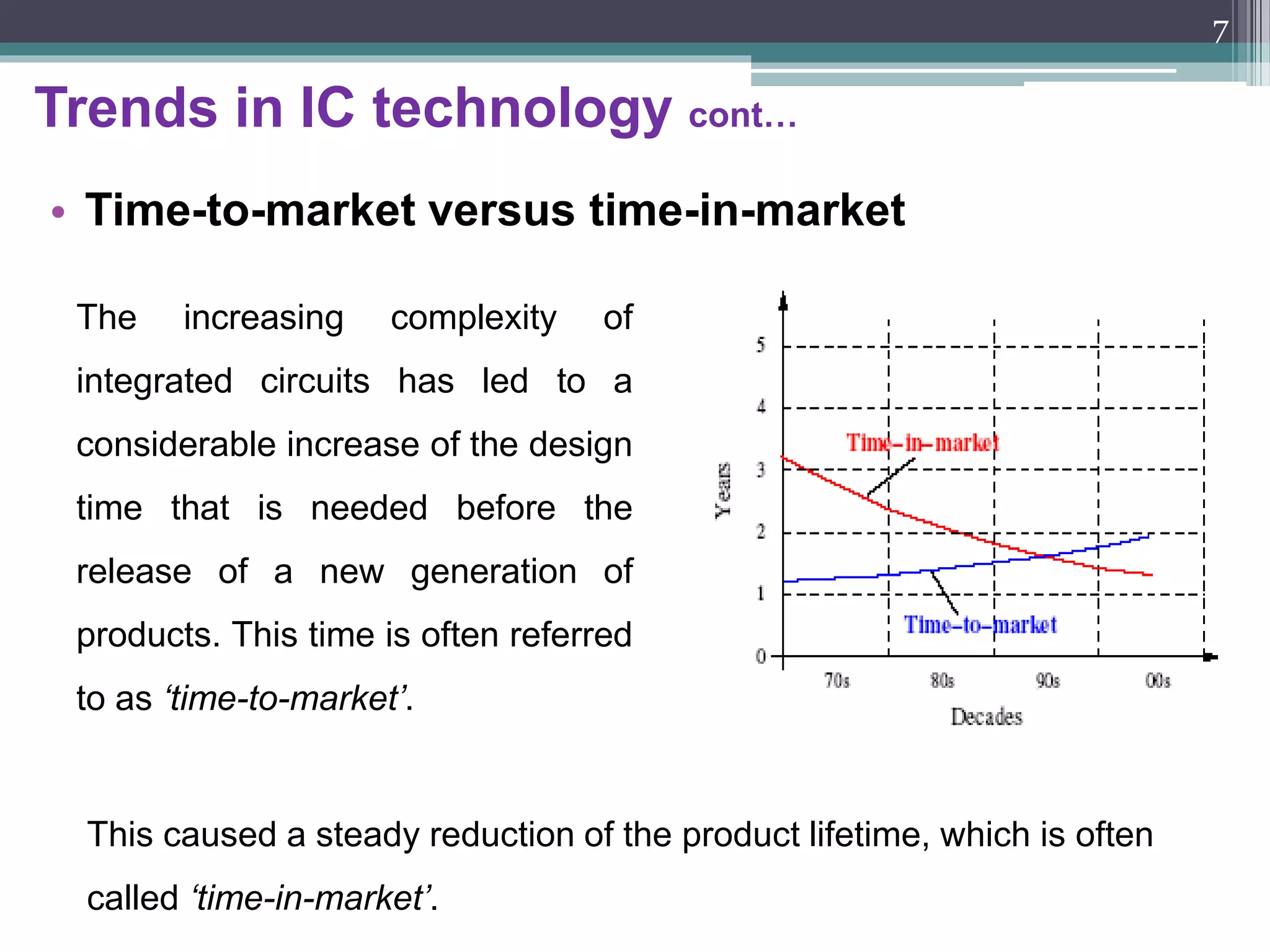
• Time-to-market versus time-in-market
The increasing complexity of
integrated circuits has led to a
considerable increase of the design
time that is needed before the
release of a new generation of
products. This time is often referred
to as ‘time-to-market’.
This caused a steady reduction of the product lifetime, which is often
called ‘time-in-market’.
8
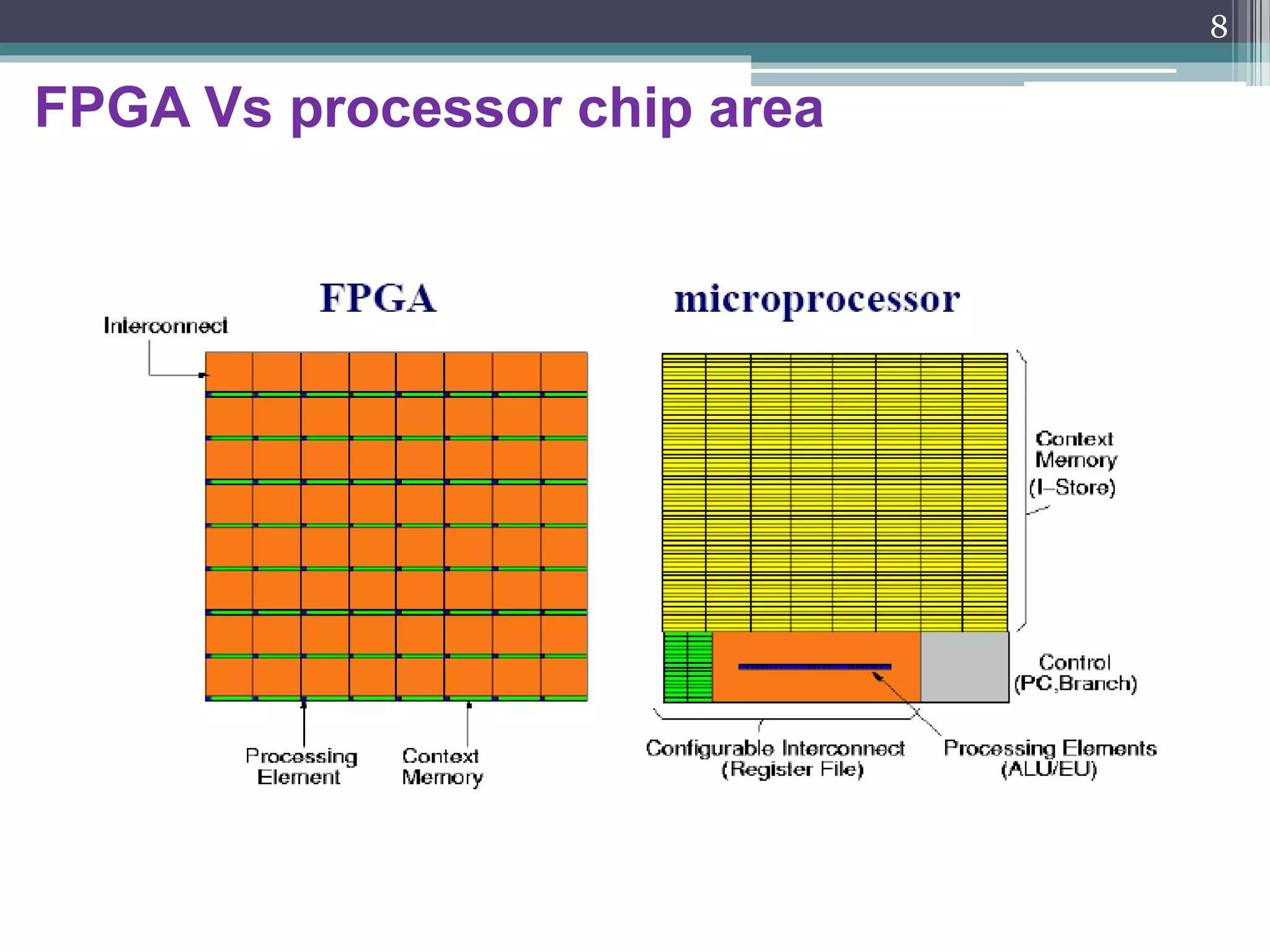
FPGA Vs processor chip area
9
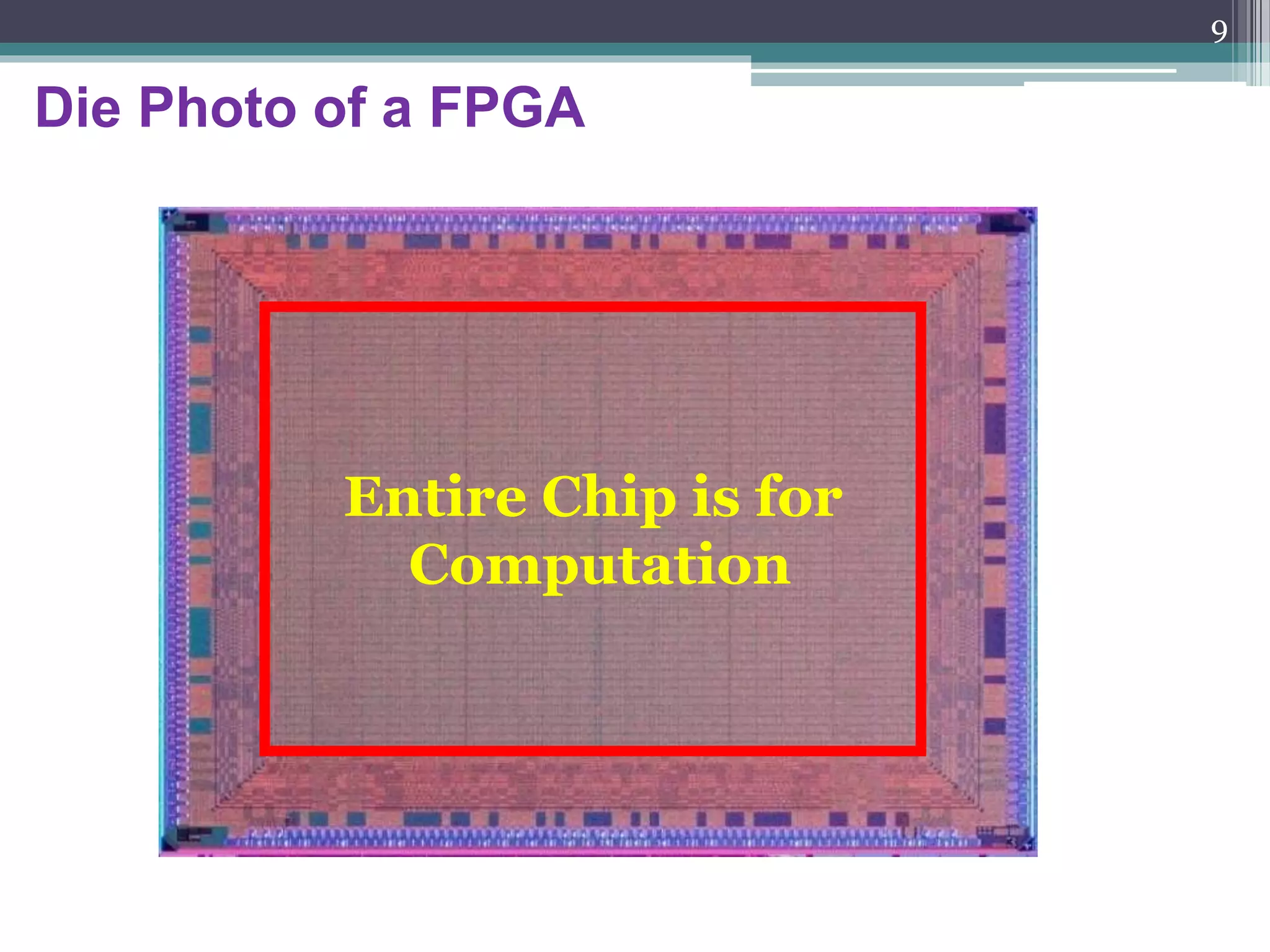
Die Photo of a FPGA
Entire Chip is for
Computation
10
Introduction to SoC - History
• First generation chips contained a few transistors.
• Today, silicon technology allows us to build chips consisting of hundreds
of millions of transistors (Intel Pentium IV: 0.09 micron). This technology
has enabled new levels of system integration onto a single chip.
• Mobile phones, portable computers and Internet appliances will be built
using a single chip.
• The demand for more powerful products and the huge capacity of today’
s silicon technology have moved System-on-Chip (SoC) designs from
leading edge to mainstream design practice.
• “System on Chip” (SoC) technology will put the maximum amount of
technology into the smallest possible space.
11
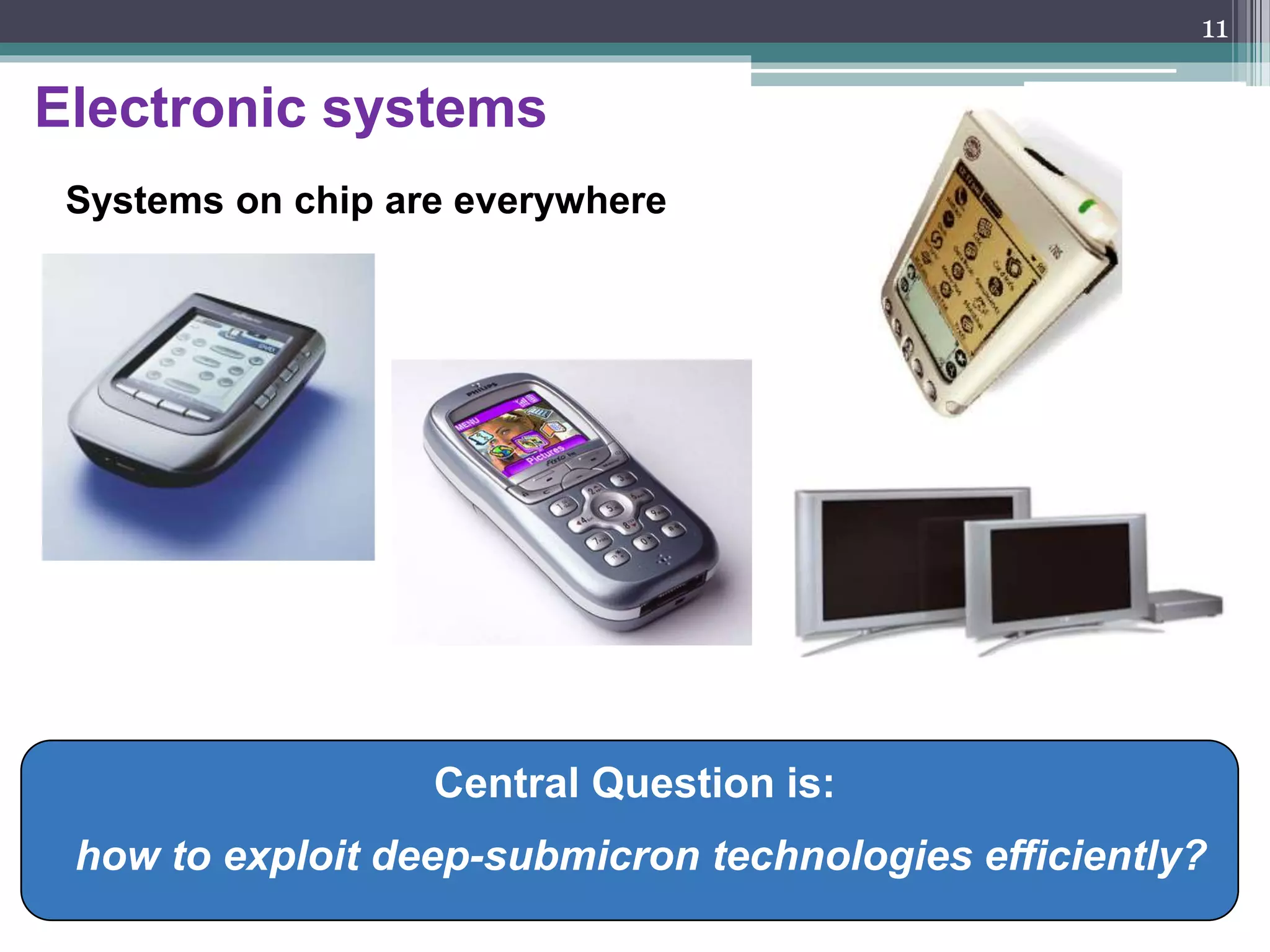
Electronic systems
Systems on chip are everywhere
Central Question is:
how to exploit deep-submicron technologies efficiently?
12
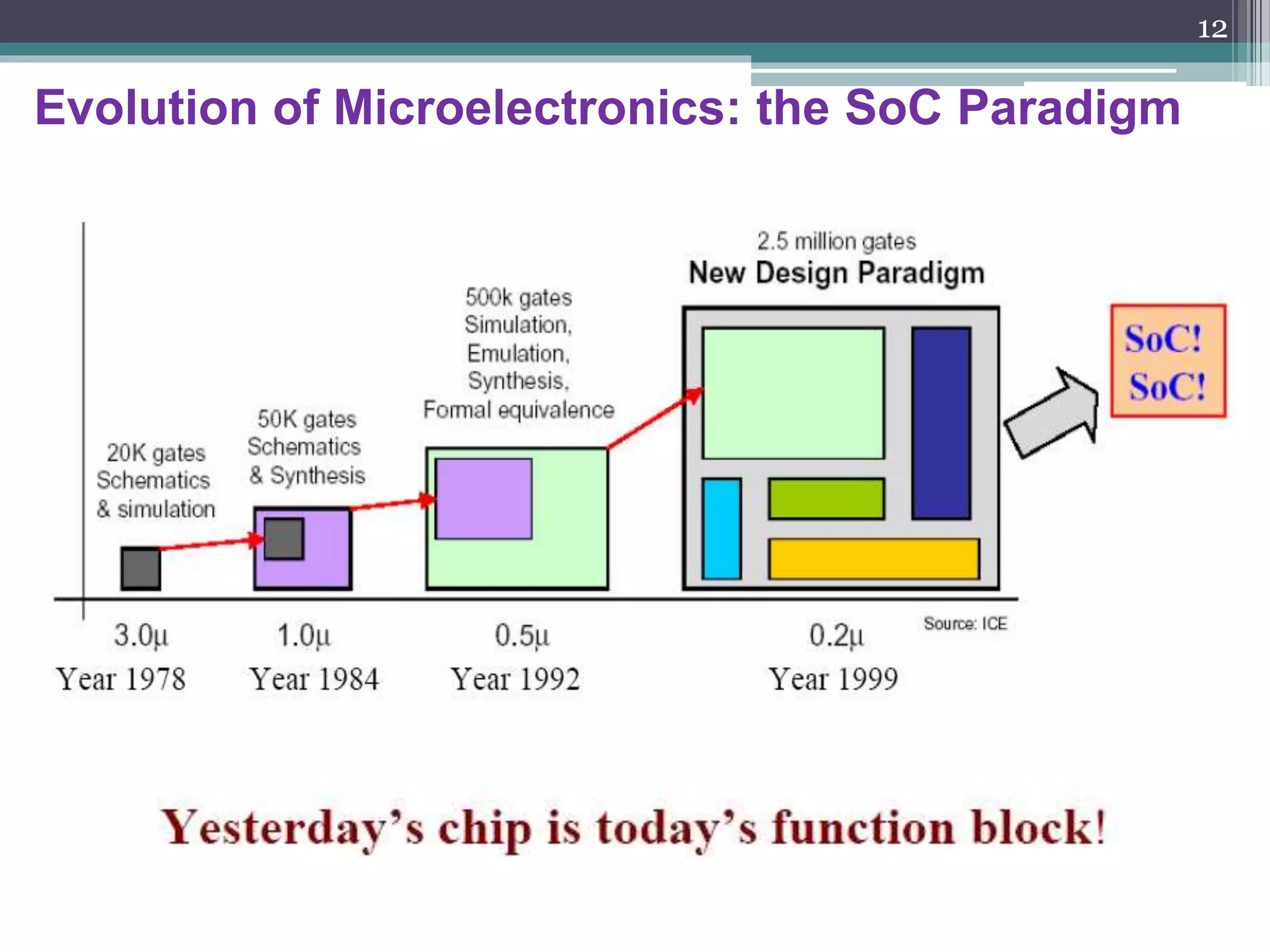
Evolution of Microelectronics: the SoC Paradigm
13
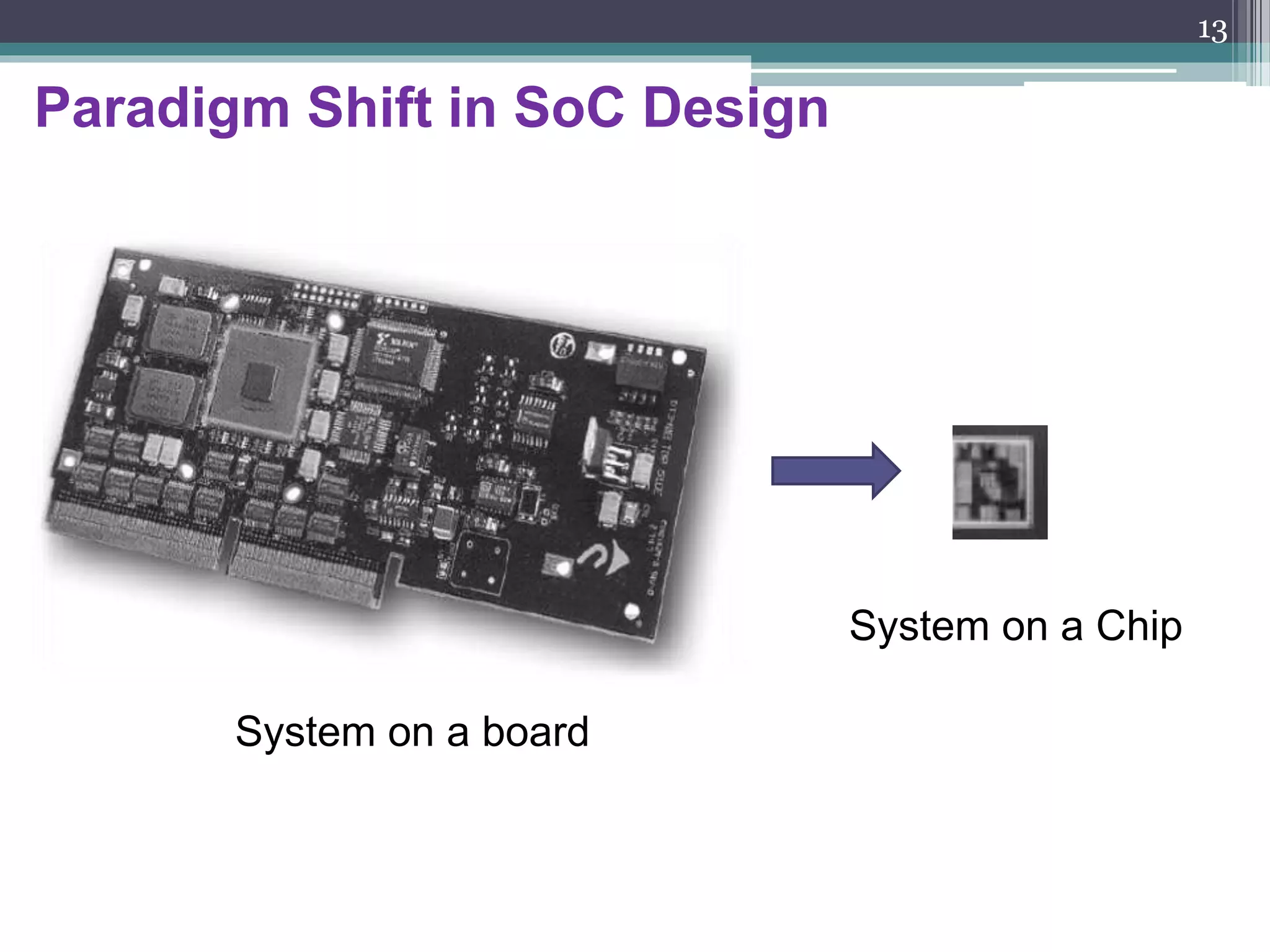
Paradigm Shift in SoC Design
System on a board
System on a Chip
14
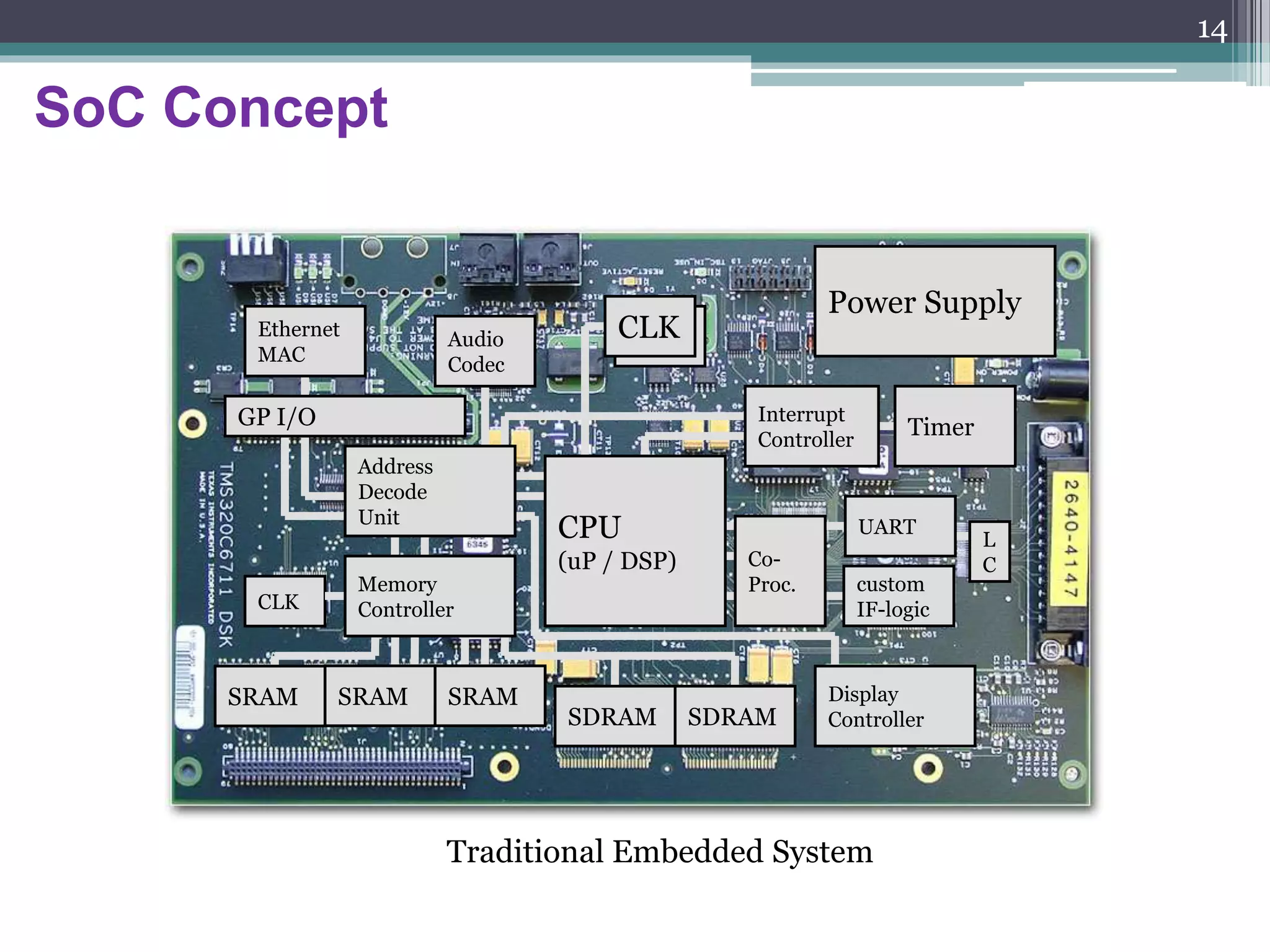
Power Supply
CLKCLK
CLK
custom
IF-logic
SDRAM SDRAM
SRAM SRAMSRAM
Memory
Controller
UART
L
C
Display
Controller
Interrupt
Controller
Timer
Audio
Codec
CPU
(uP / DSP) Co-
Proc.
GP I/O
Address
Decode
Unit
Ethernet
MAC
Traditional Embedded System
SoC Concept
15
FPGA
CLKCLK
CLK
custom
IF-logic
SDRAM SDRAM
SRAM SRAMSRAM
Memory
Controller
UART
Display
Controller
Timer
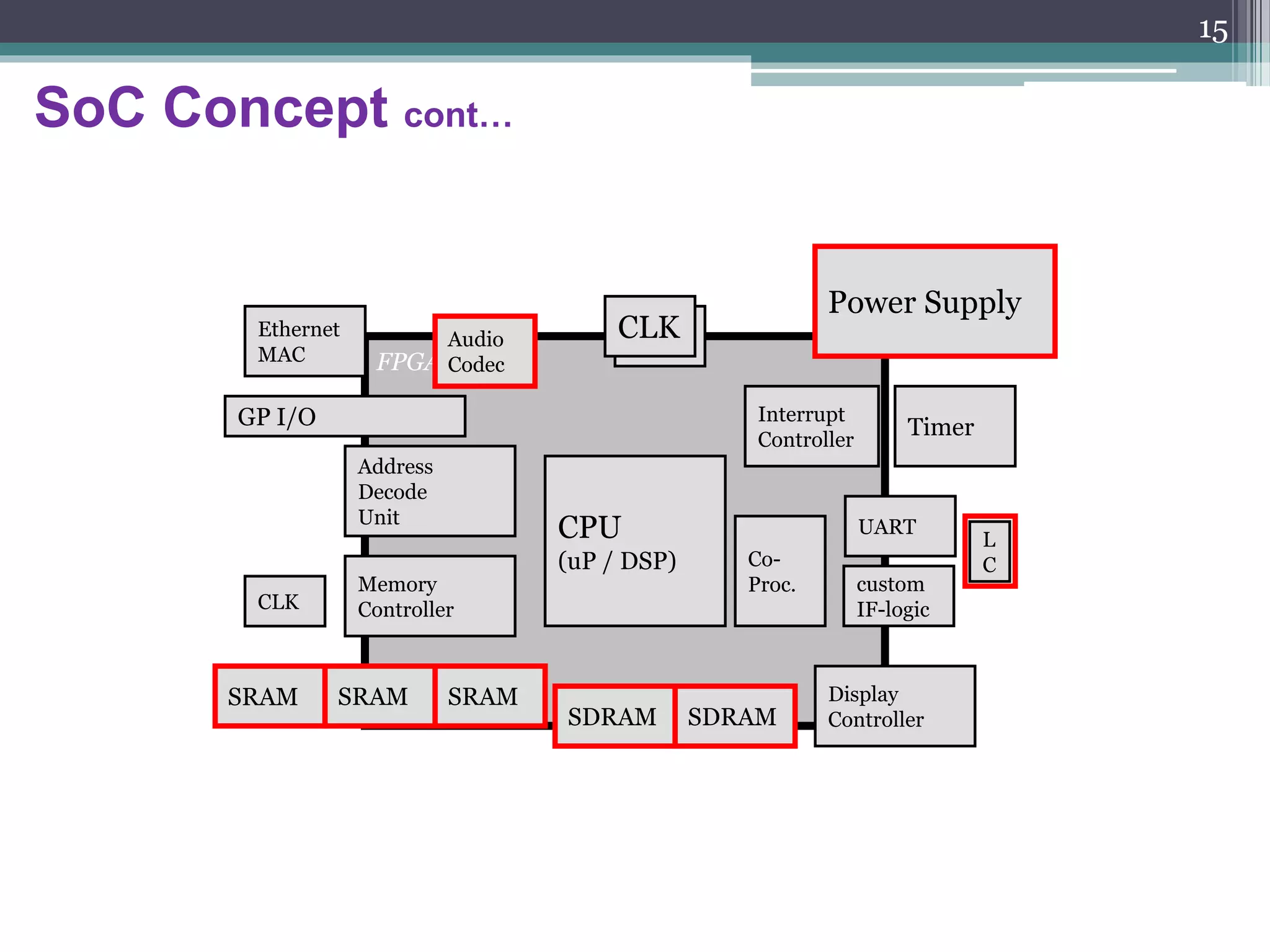
Power Supply
L
C
Audio
Codec
CPU
(uP / DSP) Co-
Proc.
GP I/O
Address
Decode
Unit
Ethernet
MAC
Interrupt
Controller
SoC Concept cont…
16
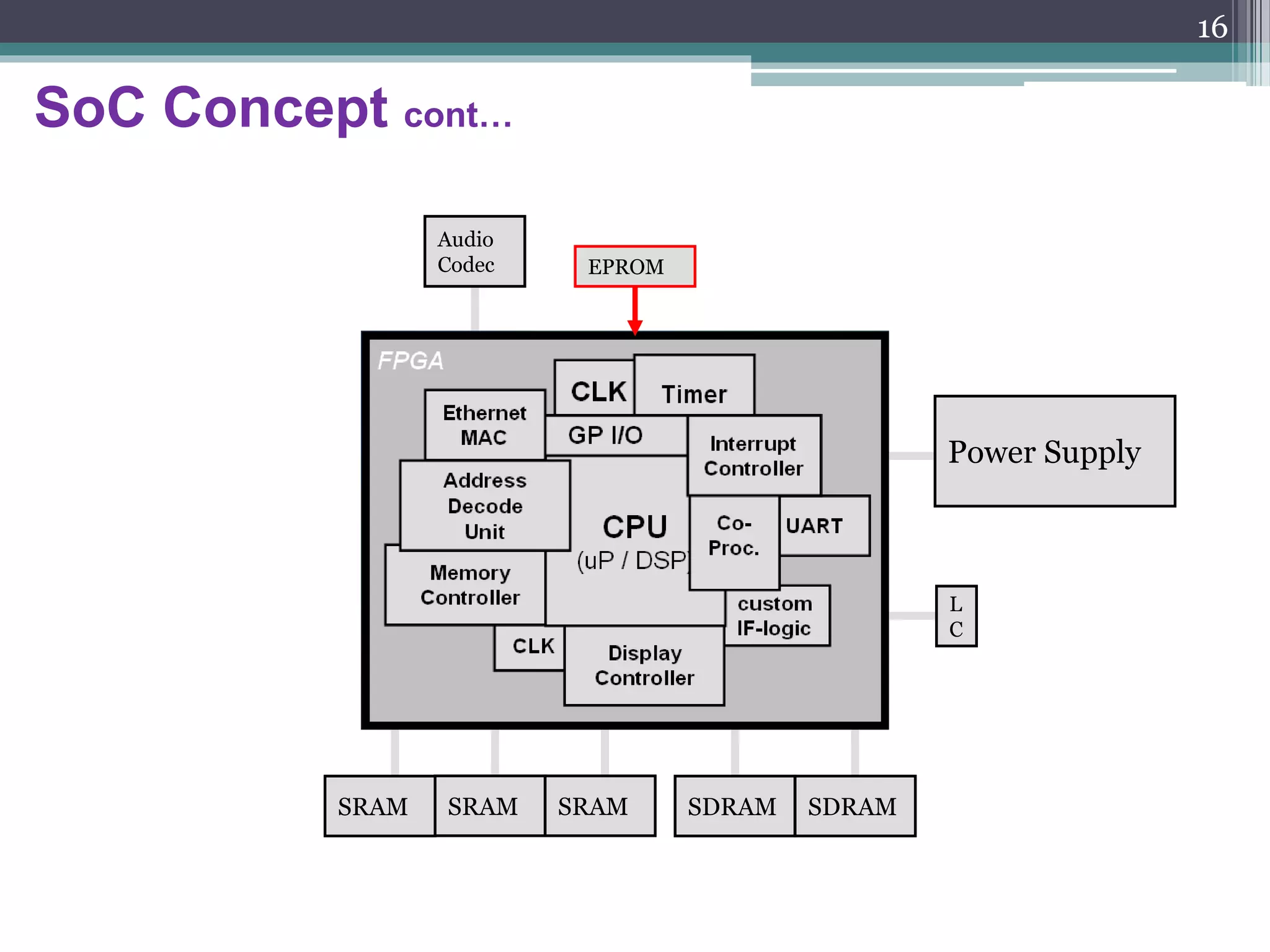
Power Supply
SDRAM SDRAMSRAM SRAMSRAM
L
C
Audio
Codec EPROM
SoC Concept cont…
17
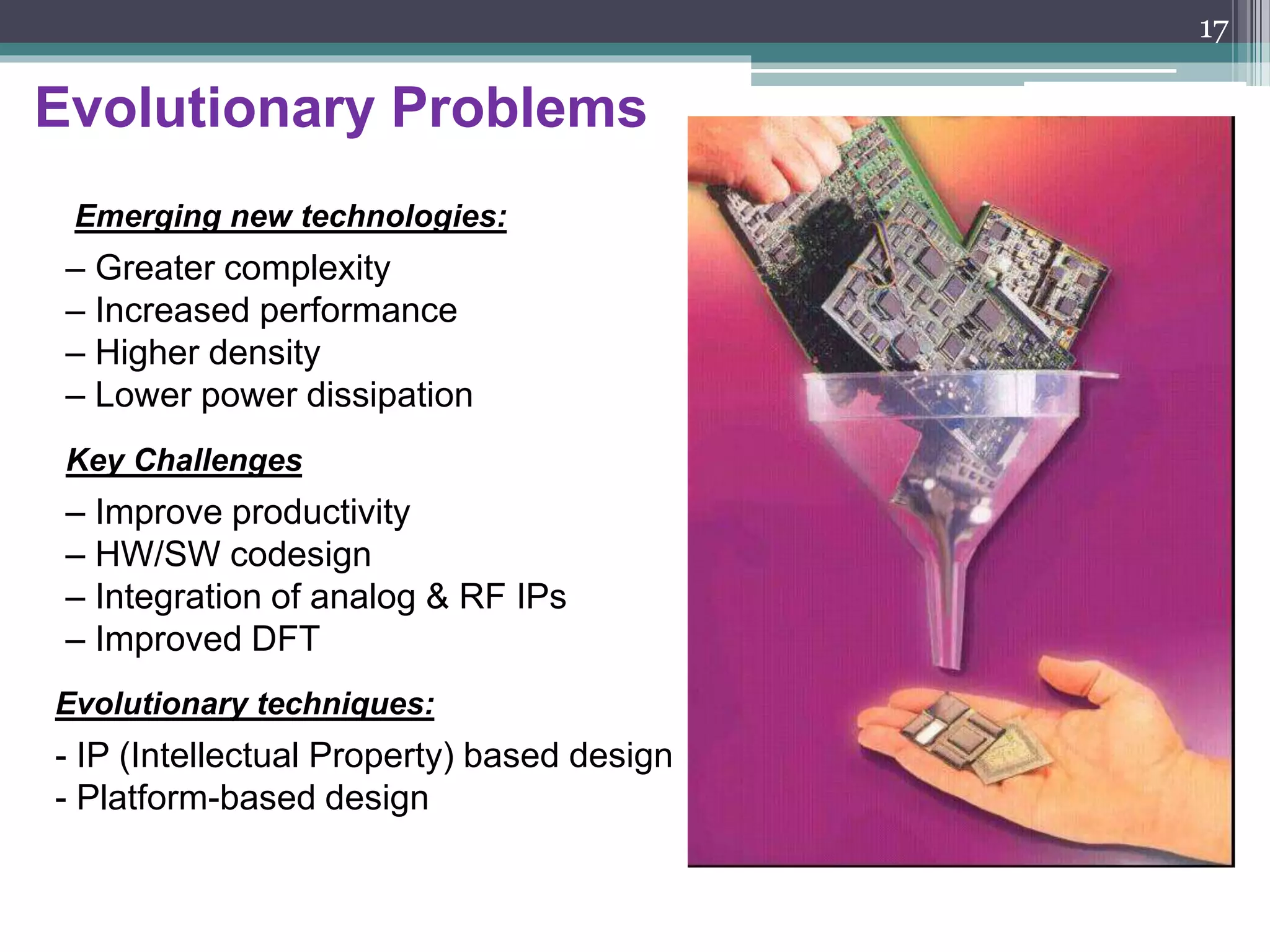
Evolutionary Problems
Key Challenges
– Improve productivity
– HW/SW codesign
– Integration of analog & RF IPs
– Improved DFT
Emerging new technologies:
– Greater complexity
– Increased performance
– Higher density
– Lower power dissipation
Evolutionary techniques:
- IP (Intellectual Property) based design
- Platform-based design
18
Migration from ASICs to SoCs
ASICs are logic chips designed by end customers to perform a
specific function for a desired application.
ASIC vendors supply libraries for each technology they provide. In
most cases, these libraries contain predesigned and preverified logic
circuits.
ASIC technologies are:
 gate array
 standard cell
 full custom
19
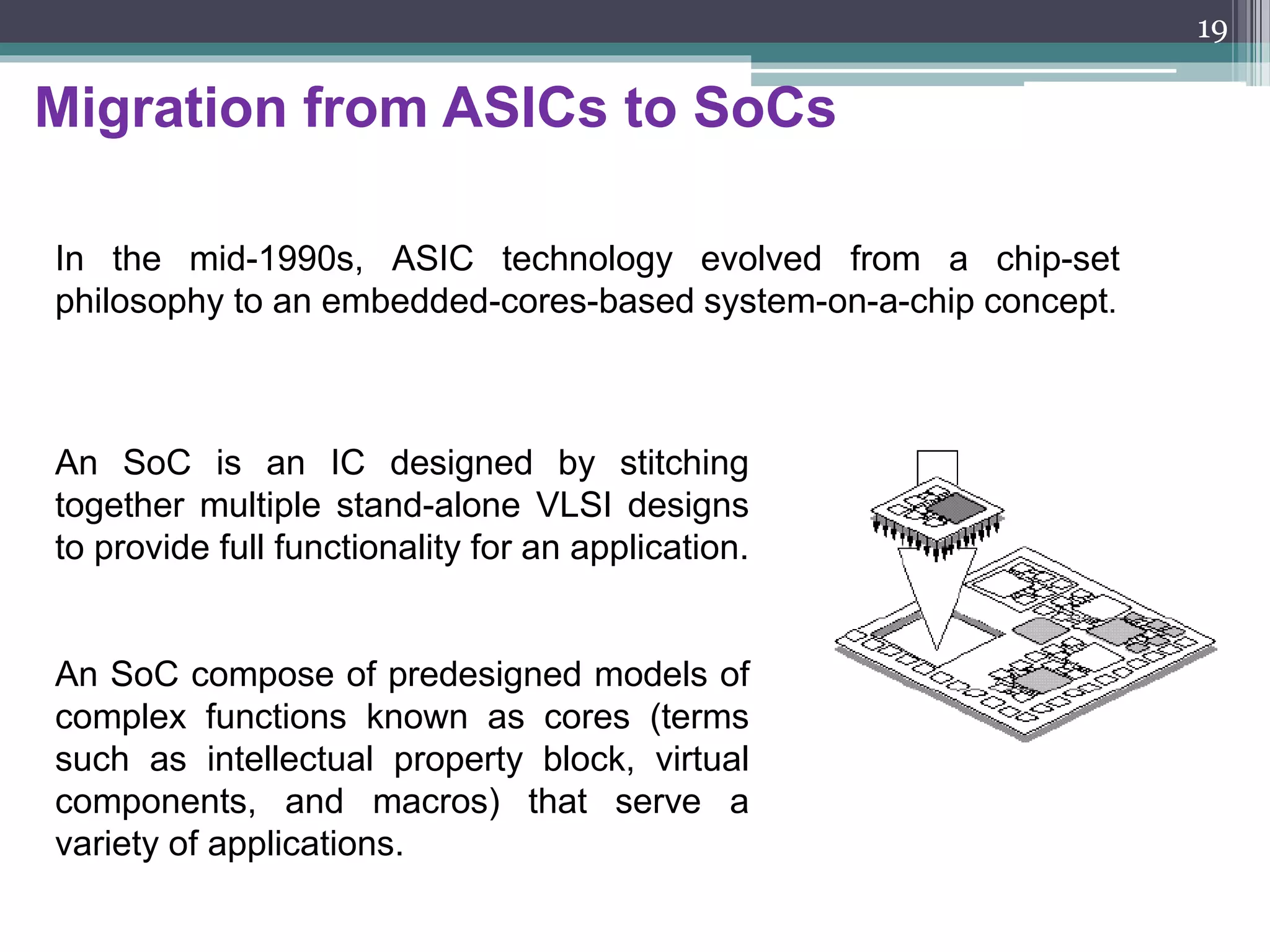
Migration from ASICs to SoCs
In the mid-1990s, ASIC technology evolved from a chip-set
philosophy to an embedded-cores-based system-on-a-chip concept.
An SoC is an IC designed by stitching
together multiple stand-alone VLSI designs
to provide full functionality for an application.
20
Three forms of SoC design
The scenario for SoC design is characterized by three forms:
1. ASIC vendor design: This refers to the design in which all the
components in the chip are designed as well as fabricated by an
ASIC vendor.
2. Integrated design: This refers to the design by an ASIC vendor in
which all components are not designed by that vendor. It implies the
use of cores obtained from some other source such as a core/IP
vendor or a foundry.
3. Desktop design: This refers to the design by a fabless company that
uses cores which for the most part have been obtained from other
source such as IP companies, EDA companies, design services
companies, or a foundry.
21
SoC Design Challenges
Why does it take longer to design SOCs compared to traditional ASICs?
We must examine factors influencing the degree of difficulty and Turn
Around Time (TAT) (the time taken from gate-level netlist to metal mask-
ready stage) for designing ASICs and SOCs.
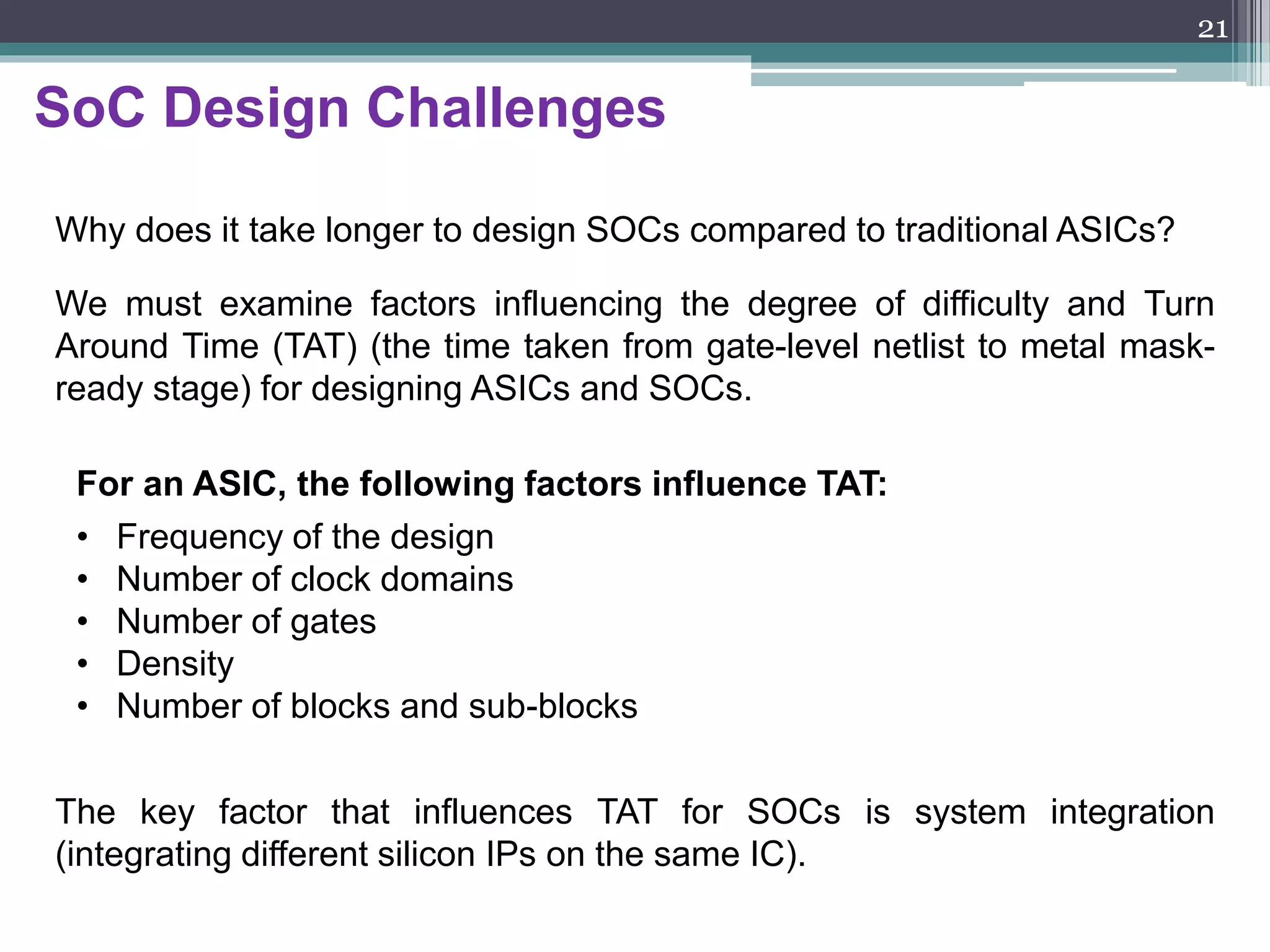
For an ASIC, the following factors influence TAT:
• Frequency of the design
• Number of clock domains
• Number of gates
• Density
• Number of blocks and sub-blocks
The key factor that influences TAT for SOCs is system integration
(integrating different silicon IPs on the same IC).
22
SoC Design Challenges
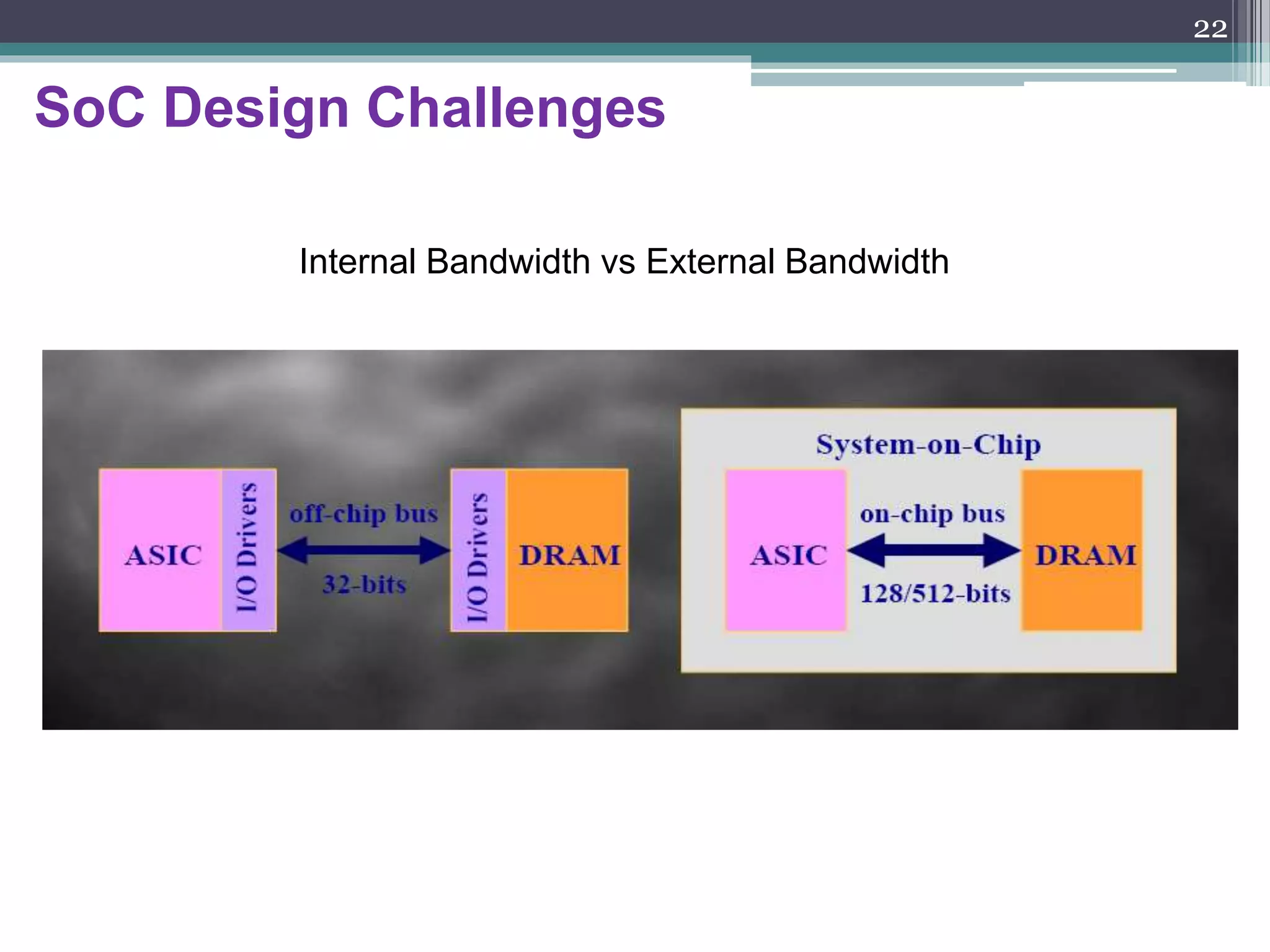
Internal Bandwidth vs External Bandwidth
23
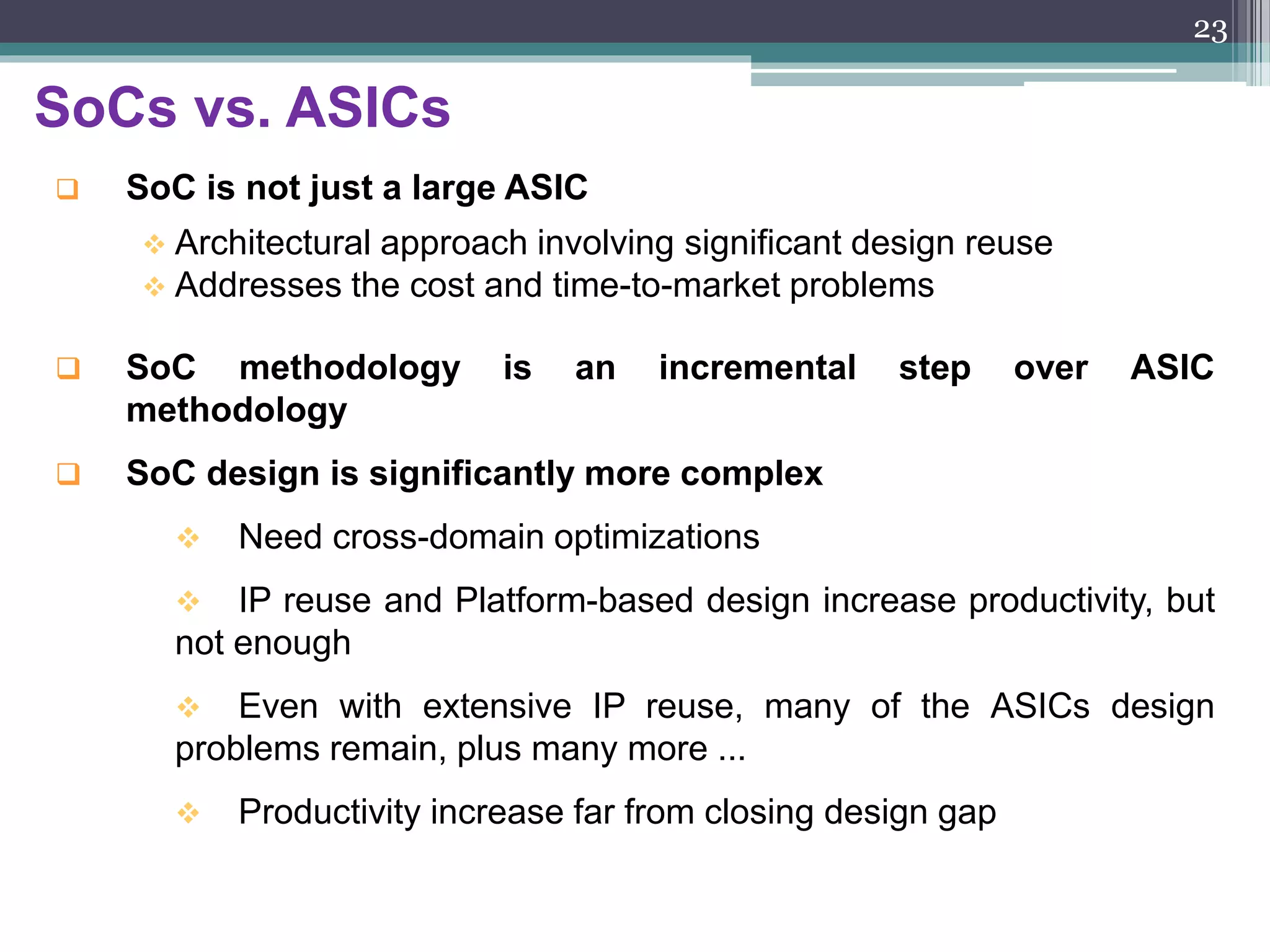
SoCs vs. ASICs
 SoC methodology is an incremental step over ASIC
methodology
 SoC design is significantly more complex
 Need cross-domain optimizations
 IP reuse and Platform-based design increase productivity, but
not enough
 Even with extensive IP reuse, many of the ASICs design
problems remain, plus many more ...
 Productivity increase far from closing design gap
 SoC is not just a large ASIC
 Architectural approach involving significant design reuse
 Addresses the cost and time-to-market problems
24
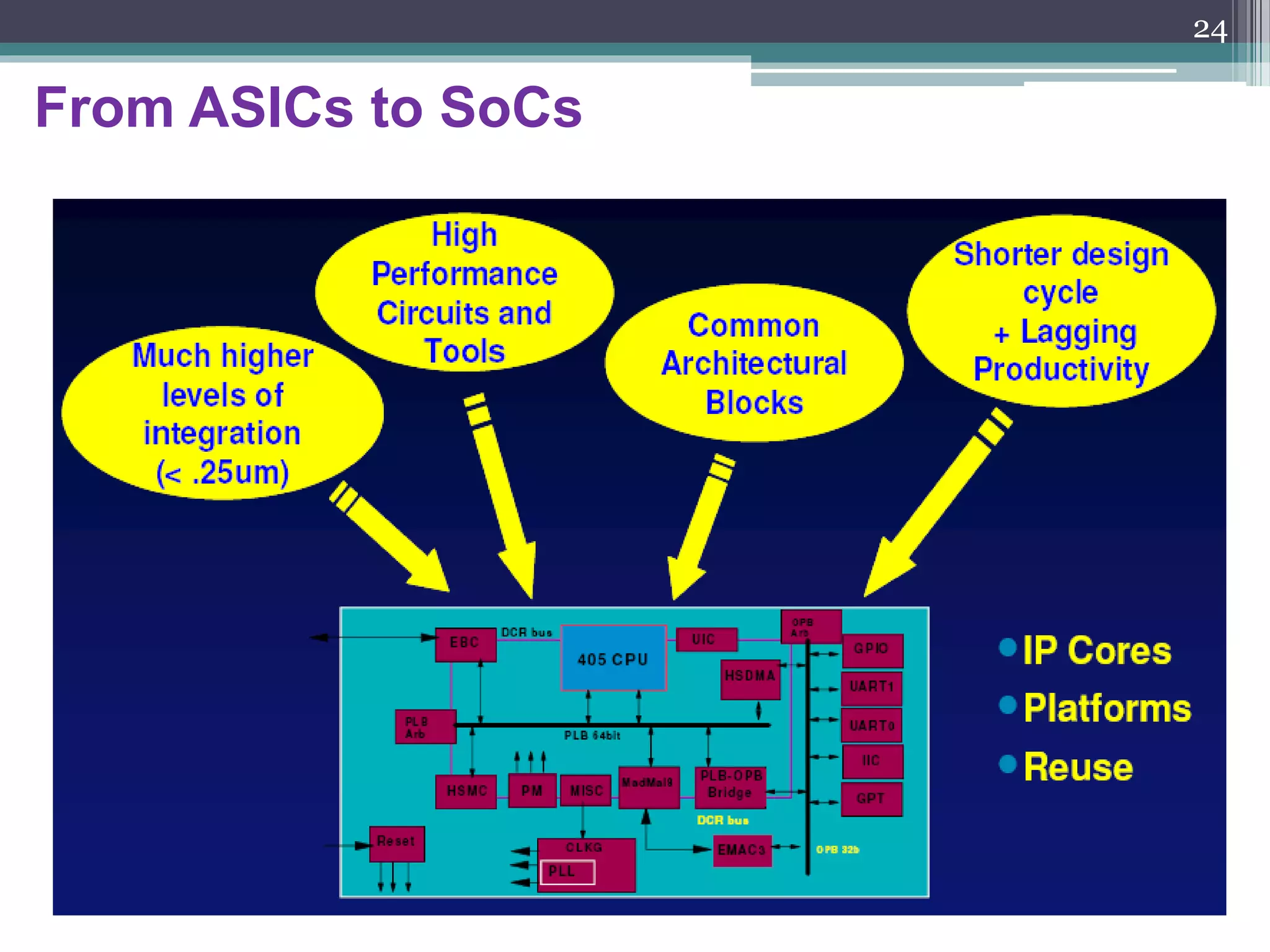
From ASICs to SoCs
25
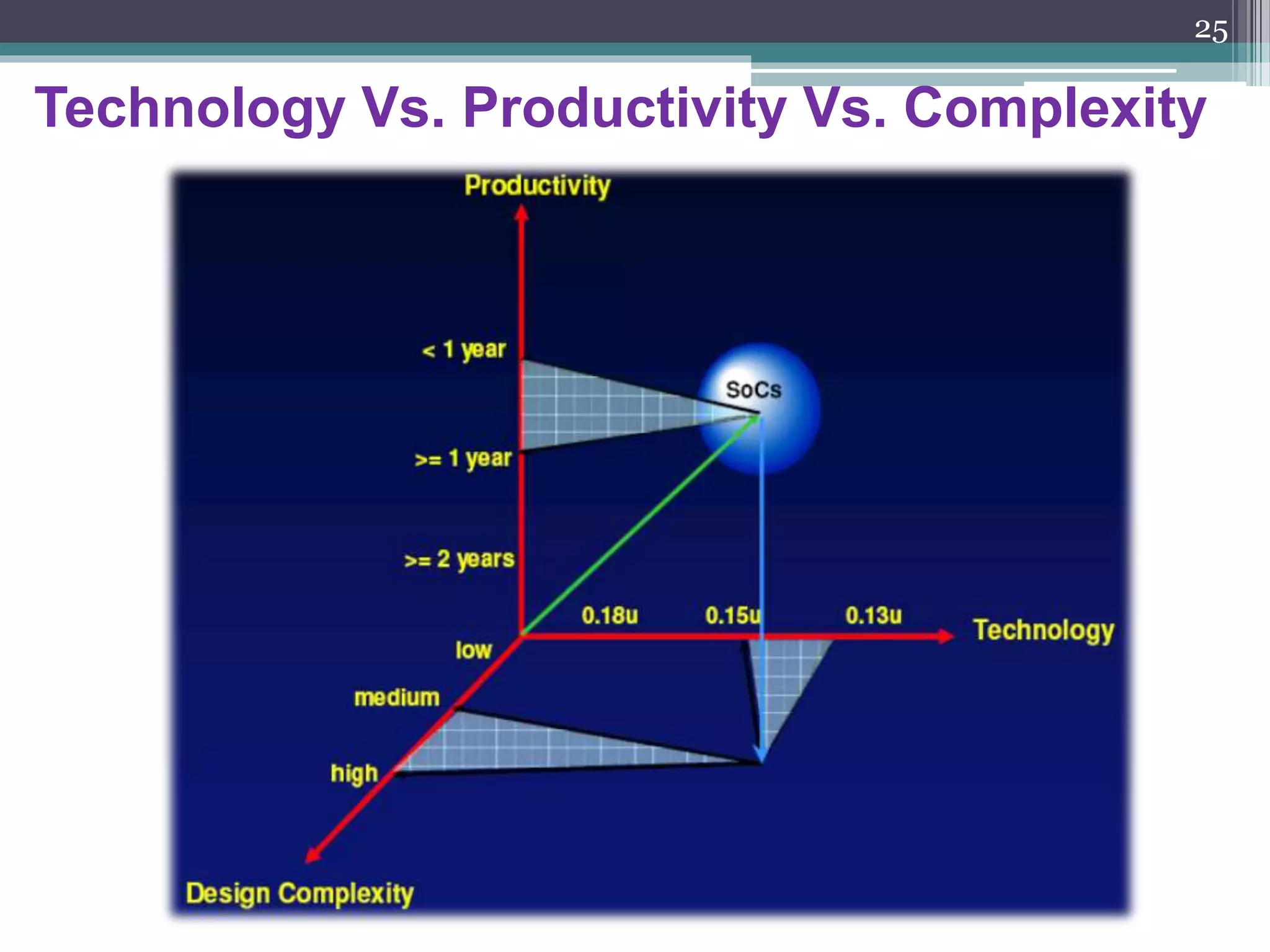
Technology Vs. Productivity Vs. Complexity
26
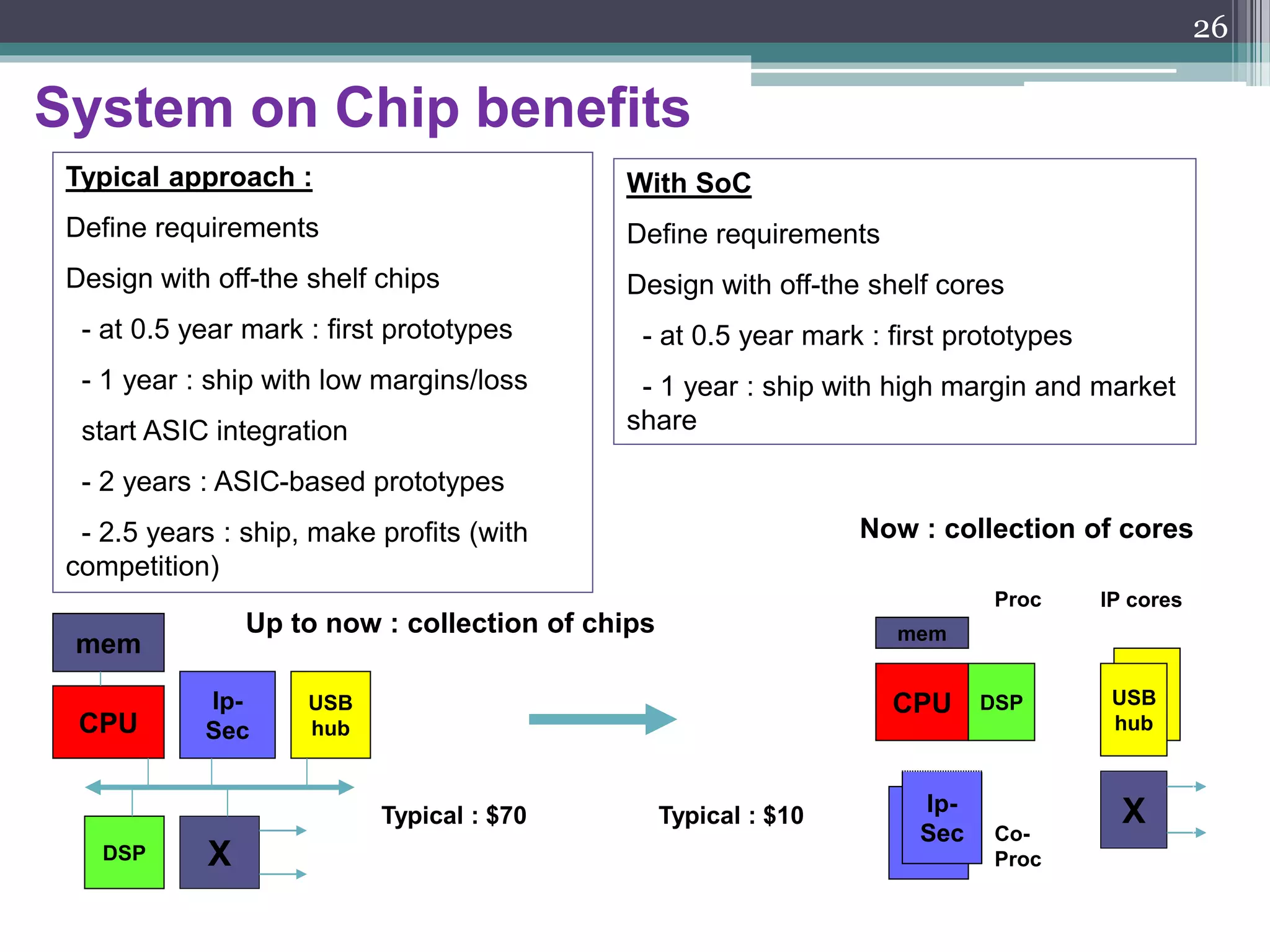
System on Chip benefits
CPU
DSP
Ip-
Sec
mem
X
USB
hub
mem
CPU DSP USB
hub
Ip-
Sec
X
Proc
Co-
Proc
IP cores
Typical : $10
Up to now : collection of chips
Now : collection of cores
Typical : $70
Typical approach :
Define requirements
Design with off-the shelf chips
- at 0.5 year mark : first prototypes
- 1 year : ship with low margins/loss
start ASIC integration
- 2 years : ASIC-based prototypes
- 2.5 years : ship, make profits (with
competition)
With SoC
Define requirements
Design with off-the shelf cores
- at 0.5 year mark : first prototypes
- 1 year : ship with high margin and market
share
27
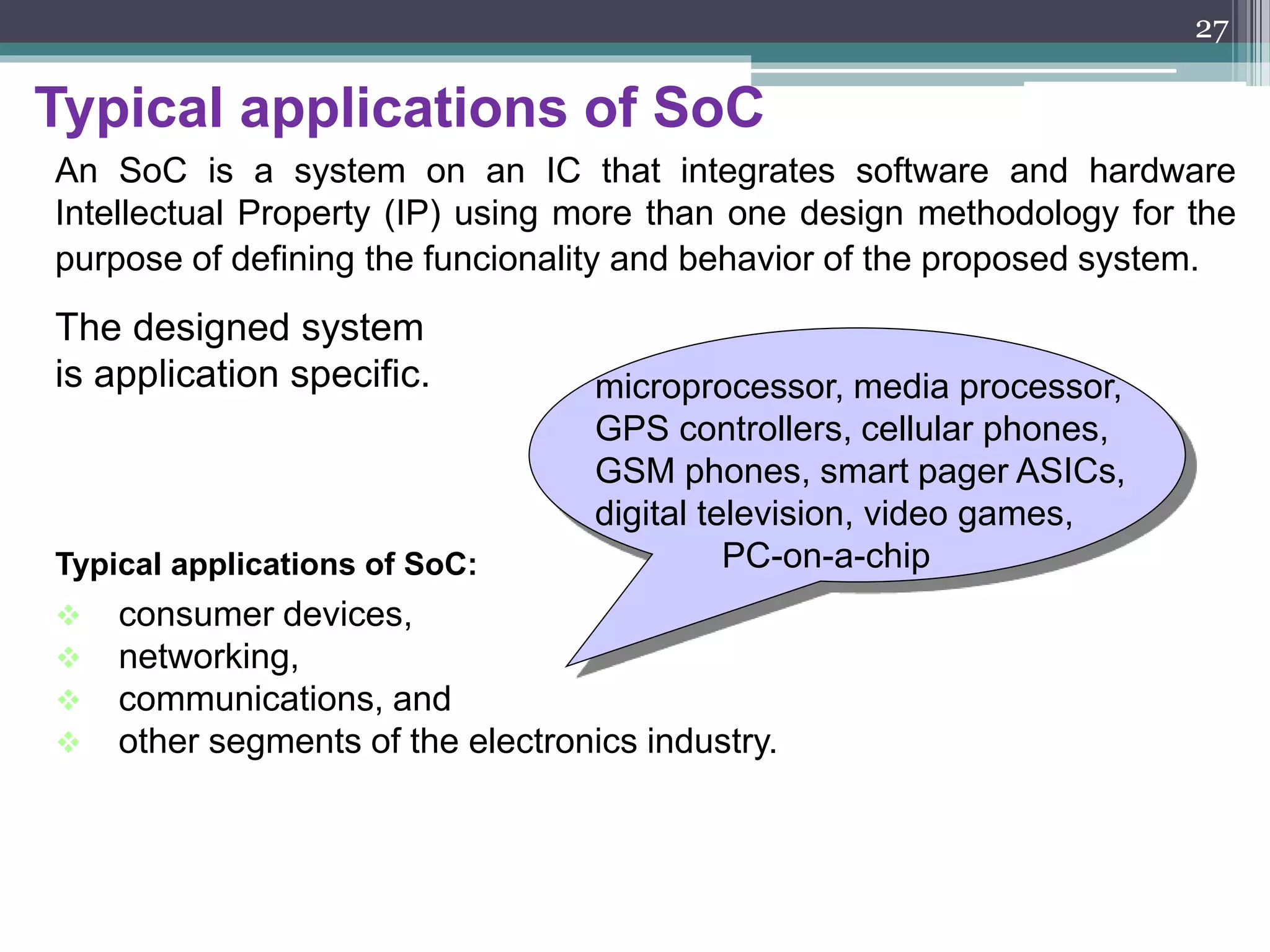
Typical applications of SoC
An SoC is a system on an IC that integrates software and hardware
Intellectual Property (IP) using more than one design methodology for the
purpose of defining the funcionality and behavior of the proposed system.
The designed system
is application specific.
Typical applications of SoC:
 consumer devices,
 networking,
 communications, and
 other segments of the electronics industry.
microprocessor, media processor,
GPS controllers, cellular phones,
GSM phones, smart pager ASICs,
digital television, video games,
PC-on-a-chip
28
The design process of SoCs
SoC designs are made possible by deep submicron technology. This
technology presents a whole set of design challenges including:
 interconnect delays,
 clock and power distribution, and
 the placement and routing of millions of gates.
These physical design problems can have a significant impact on
the functional design of SoCs and on the design process itself.
The first step in system design is specifying the required functionality.
The second step is to transform the system funcionality into an architecture
which define the system implementation by specifying the number and types
of components and connections between them.
29
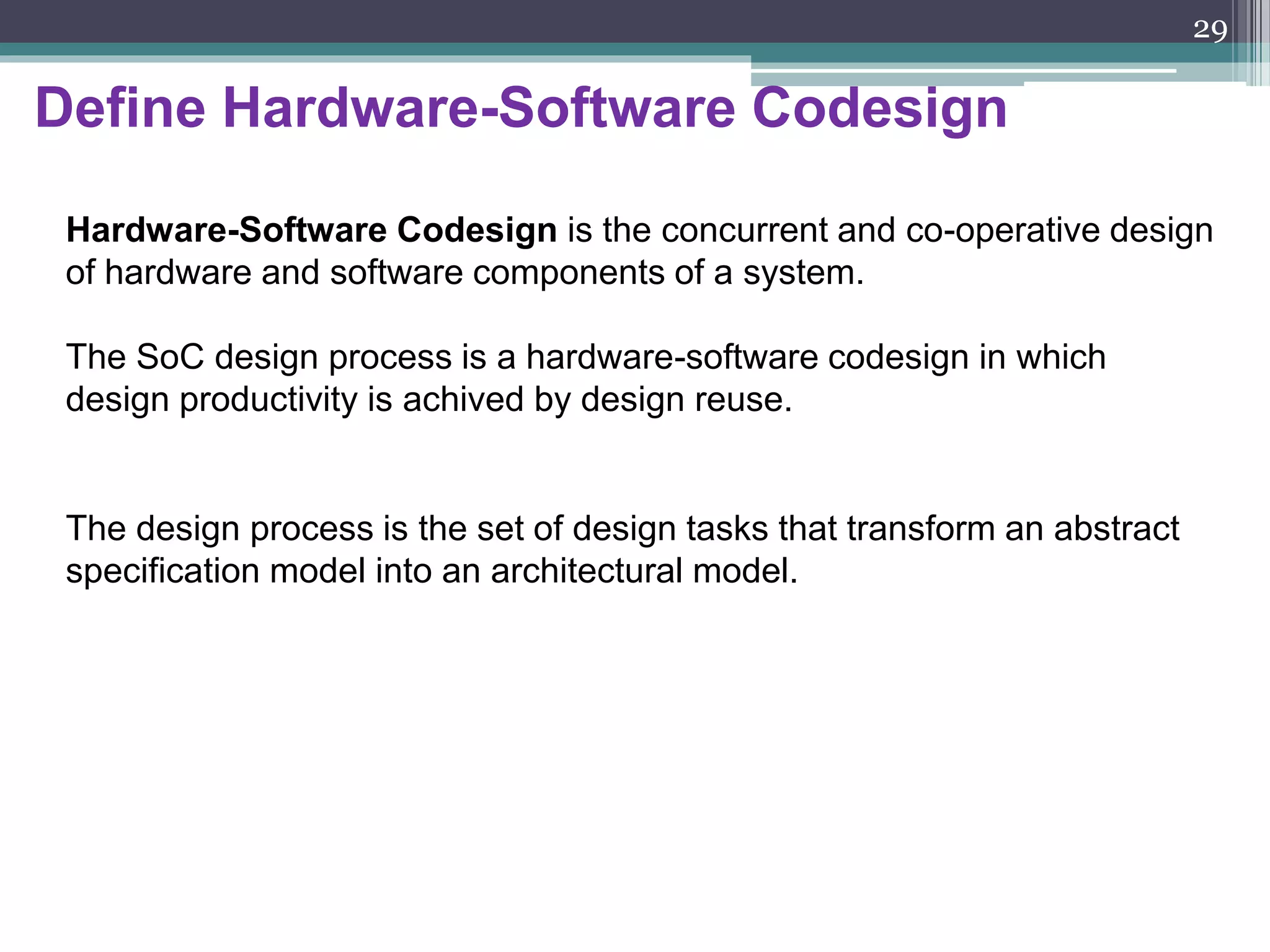
Define Hardware-Software Codesign
Hardware-Software Codesign is the concurrent and co-operative design
of hardware and software components of a system.
The SoC design process is a hardware-software codesign in which
design productivity is achived by design reuse.
The design process is the set of design tasks that transform an abstract
specification model into an architectural model.
30
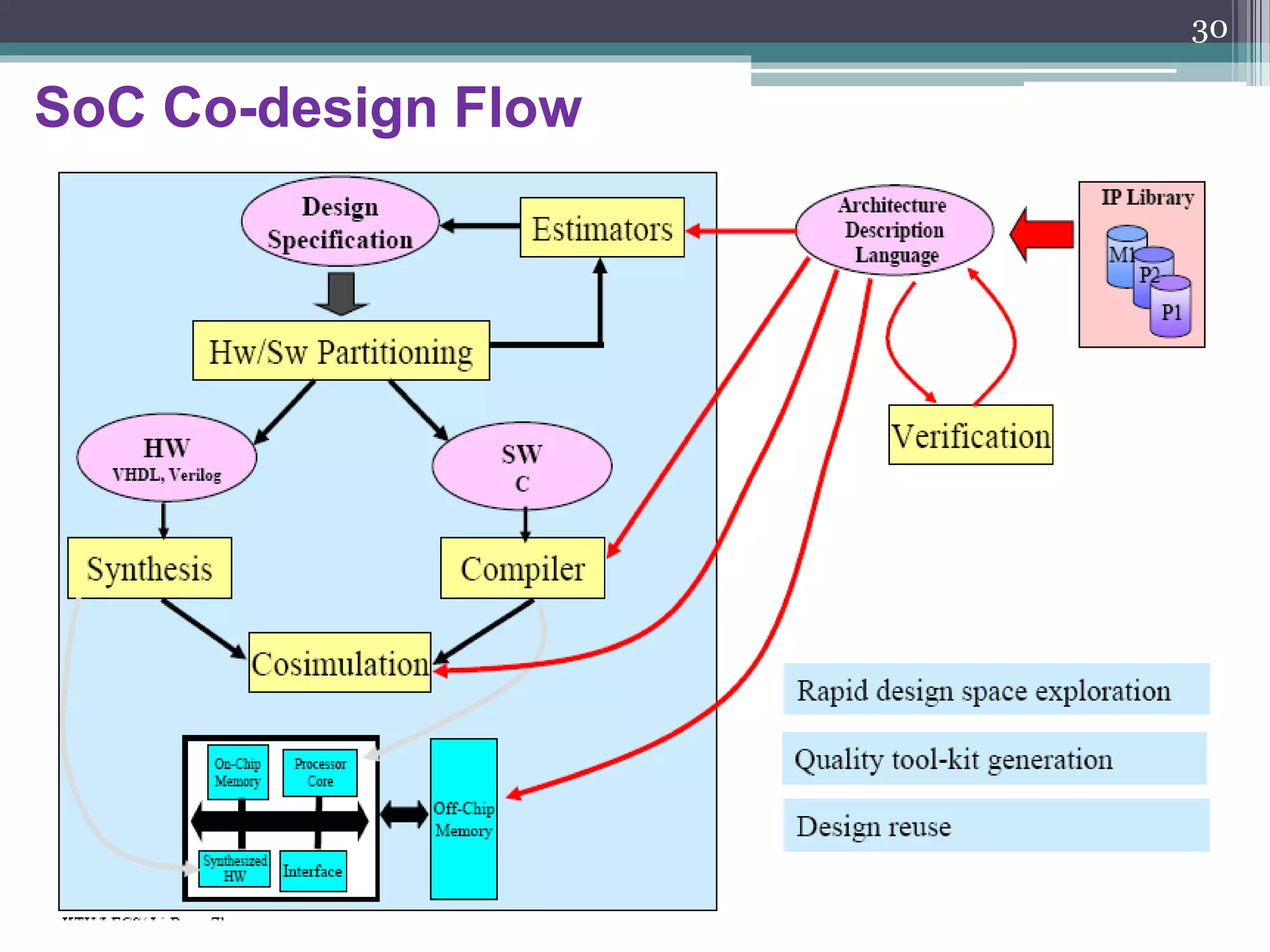
SoC Co-design Flow
31
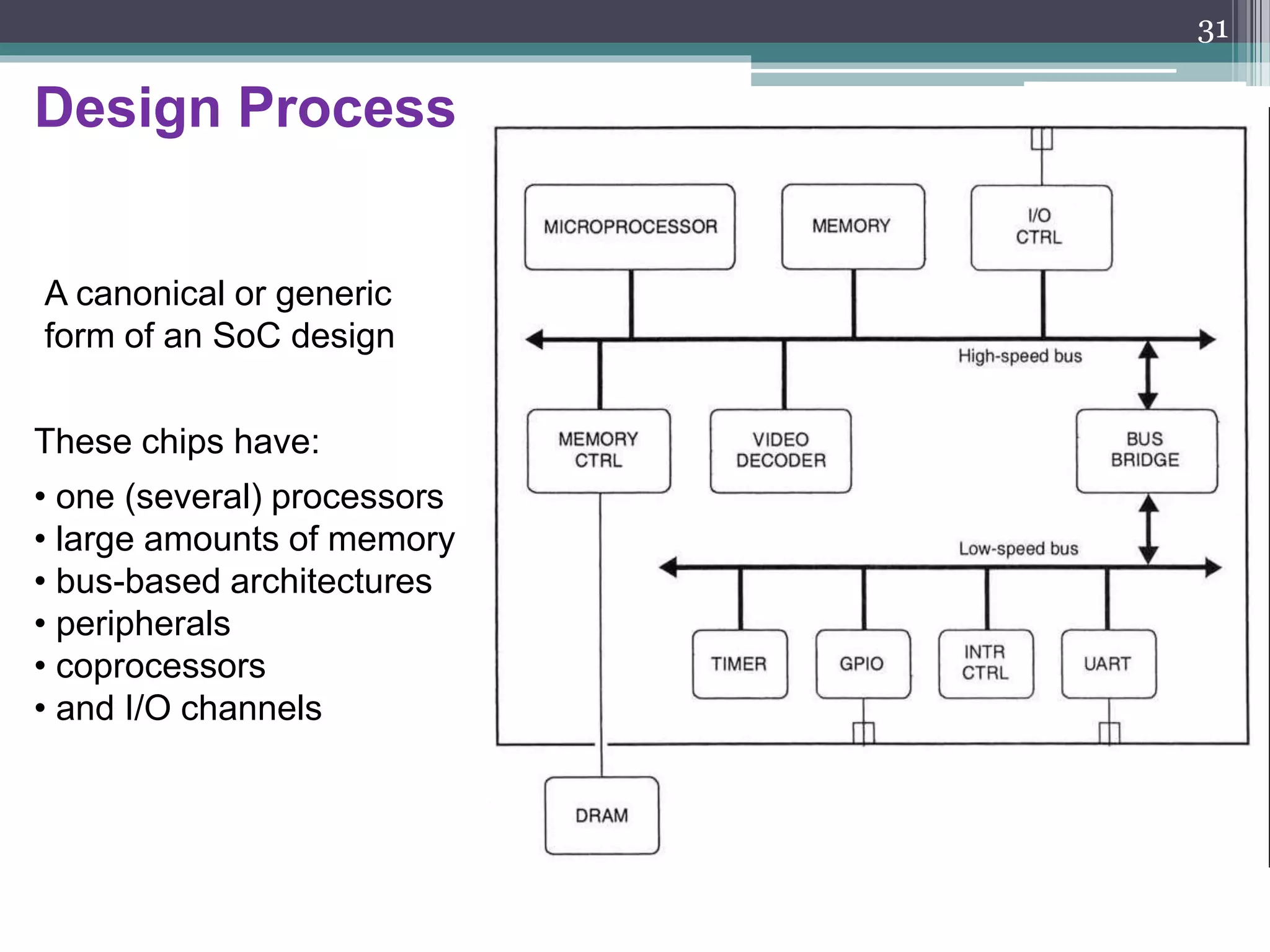
Design Process
A canonical or generic
form of an SoC design
These chips have:
• one (several) processors
• large amounts of memory
• bus-based architectures
• peripherals
• coprocessors
• and I/O channels
32
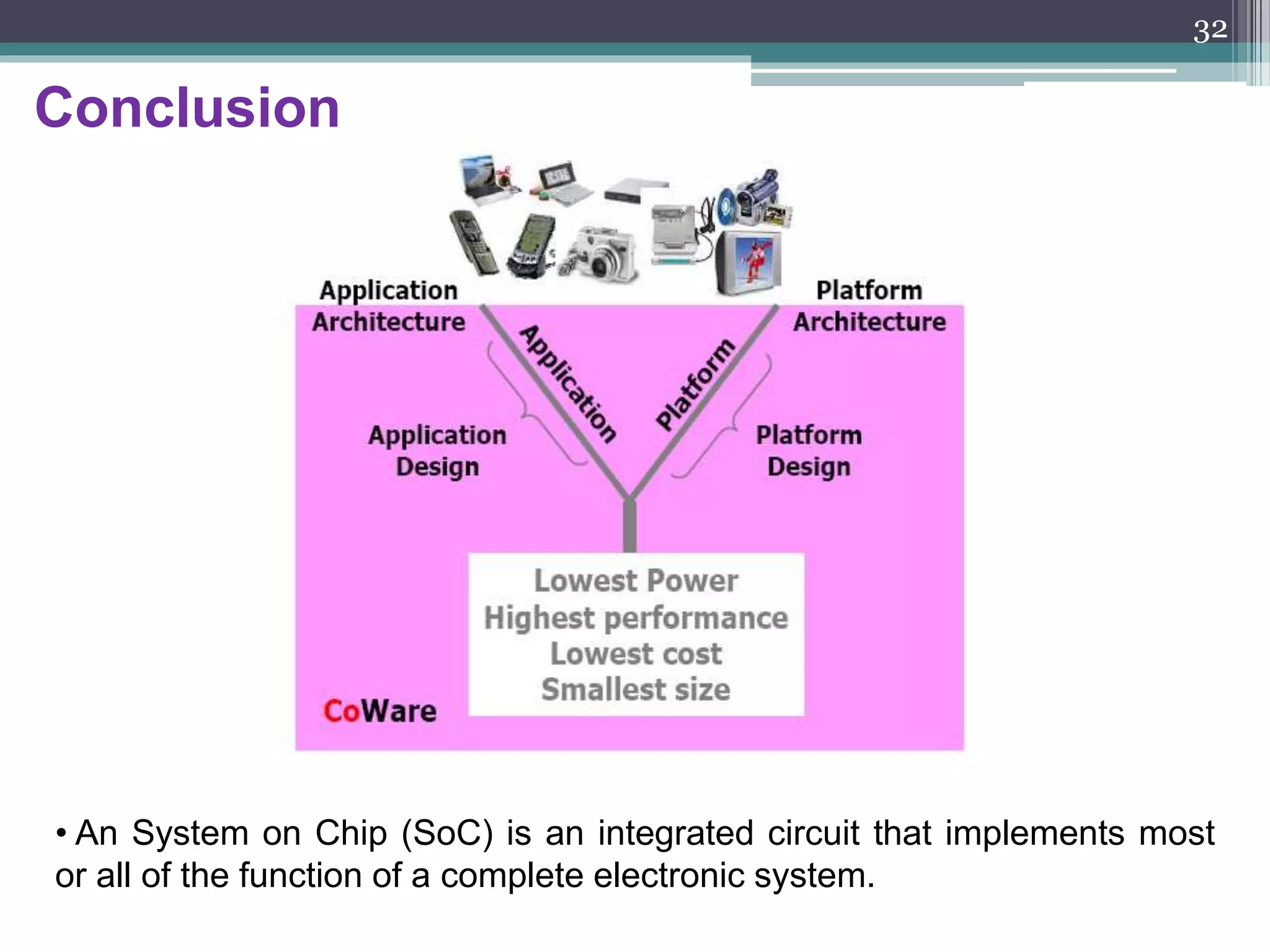
Conclusion
• An System on Chip (SoC) is an integrated circuit that implements most
or all of the function of a complete electronic system.
33
Any Queries ?
(This Presentation is Published Only for Educational Purpose)
34

System On Chip

  • 1.
    SystemonChip Mr. A. B.Shinde Assistant Professor, Electronics Engineering, PVPIT, Budhgaon. shindesir.pvp@gmail.com
  • 2.
    Objective: • Students willbe able to understand the overview of System On Chip and Course Contents. 2
  • 3.
    Moore’s Law andTechnology Scaling • The performance of an IC, including the number components on it, doubles every 18-24 months with the same chip price ... - Gordon Moore - 1960 3
  • 4.
    Moore’s Law andProductivity Gap • System complexity makes design difficult • Complexity growing 58% / year • Productivity growing only 21% 4
  • 5.
    Trends in ICtechnology • IC Technology: The first IC was fabricated in the late 1960’s. This revolution has changed the direction of research after the invention of IC. The following are some important trends come into use with reference to the IC technology. • Technology scaling: The scaling principles describe the pace, expressed in a scaling factor, at which geometrical parameters of MOS devices, interconnect wires and the supply voltage value scale when moving to smaller process technologies. The scaling factor is 0.7 i.e.  The reduction in the silicon area by a factor of 2,  The increase of the chip performance by roughly a factor of 1.5,  The reduction of power consumption by a factor of 2. 5
  • 6.
    Trends in ICtechnology cont… • System-on-a-chip Various system components, such as memories, logic, RF modules and sensors, which were traditionally integrated on a printed circuit board (PCB), could be integrated on a single chip using silicon as an implementation medium, is called as ‘system-on-a-chip’ (SoC). • Ambient computing Major consequences of the ultra-large scale integration is a clear change in the use of computing. Unlike the first two general-purpose computing phases, the third phase features computing which is hidden in the background and thus almost invisible to a user. This type of computing is referred to as ‘ambient computing’. 6
  • 7.
    Trends in ICtechnology cont… • Embedded systems on silicon An embedded system is a system designed to perform a dedicated or a narrow range of functions as a part of a larger system, usually with a minimal end-user interaction. Unlike other, general-purpose computing systems, embedded systems are application-domain-specific. 7
  • 8.
    Trends in ICtechnology cont… • Time-to-market versus time-in-market The increasing complexity of integrated circuits has led to a considerable increase of the design time that is needed before the release of a new generation of products. This time is often referred to as ‘time-to-market’. This caused a steady reduction of the product lifetime, which is often called ‘time-in-market’. 8
  • 9.
    FPGA Vs processorchip area 9
  • 10.
    Die Photo ofa FPGA Entire Chip is for Computation 10
  • 11.
    Introduction to SoC- History • First generation chips contained a few transistors. • Today, silicon technology allows us to build chips consisting of hundreds of millions of transistors (Intel Pentium IV: 0.09 micron). This technology has enabled new levels of system integration onto a single chip. • Mobile phones, portable computers and Internet appliances will be built using a single chip. • The demand for more powerful products and the huge capacity of today’ s silicon technology have moved System-on-Chip (SoC) designs from leading edge to mainstream design practice. • “System on Chip” (SoC) technology will put the maximum amount of technology into the smallest possible space. 11
  • 12.
    Electronic systems Systems onchip are everywhere Central Question is: how to exploit deep-submicron technologies efficiently? 12
  • 13.
    Evolution of Microelectronics:the SoC Paradigm 13
  • 14.
    Paradigm Shift inSoC Design System on a board System on a Chip 14
  • 15.
    Power Supply CLKCLK CLK custom IF-logic SDRAM SDRAM SRAMSRAMSRAM Memory Controller UART L C Display Controller Interrupt Controller Timer Audio Codec CPU (uP / DSP) Co- Proc. GP I/O Address Decode Unit Ethernet MAC Traditional Embedded System SoC Concept 15
  • 16.
    FPGA CLKCLK CLK custom IF-logic SDRAM SDRAM SRAM SRAMSRAM Memory Controller UART Display Controller Timer PowerSupply L C Audio Codec CPU (uP / DSP) Co- Proc. GP I/O Address Decode Unit Ethernet MAC Interrupt Controller SoC Concept cont… 16
  • 17.
    Power Supply SDRAM SDRAMSRAMSRAMSRAM L C Audio Codec EPROM SoC Concept cont… 17
  • 18.
    Evolutionary Problems Key Challenges –Improve productivity – HW/SW codesign – Integration of analog & RF IPs – Improved DFT Emerging new technologies: – Greater complexity – Increased performance – Higher density – Lower power dissipation Evolutionary techniques: - IP (Intellectual Property) based design - Platform-based design 18
  • 19.
    Migration from ASICsto SoCs ASICs are logic chips designed by end customers to perform a specific function for a desired application. ASIC vendors supply libraries for each technology they provide. In most cases, these libraries contain predesigned and preverified logic circuits. ASIC technologies are:  gate array  standard cell  full custom 19
  • 20.
    Migration from ASICsto SoCs In the mid-1990s, ASIC technology evolved from a chip-set philosophy to an embedded-cores-based system-on-a-chip concept. An SoC is an IC designed by stitching together multiple stand-alone VLSI designs to provide full functionality for an application. 20
  • 21.
    Three forms ofSoC design The scenario for SoC design is characterized by three forms: 1. ASIC vendor design: This refers to the design in which all the components in the chip are designed as well as fabricated by an ASIC vendor. 2. Integrated design: This refers to the design by an ASIC vendor in which all components are not designed by that vendor. It implies the use of cores obtained from some other source such as a core/IP vendor or a foundry. 3. Desktop design: This refers to the design by a fabless company that uses cores which for the most part have been obtained from other source such as IP companies, EDA companies, design services companies, or a foundry. 21
  • 22.
    SoC Design Challenges Whydoes it take longer to design SOCs compared to traditional ASICs? We must examine factors influencing the degree of difficulty and Turn Around Time (TAT) (the time taken from gate-level netlist to metal mask- ready stage) for designing ASICs and SOCs. For an ASIC, the following factors influence TAT: • Frequency of the design • Number of clock domains • Number of gates • Density • Number of blocks and sub-blocks The key factor that influences TAT for SOCs is system integration (integrating different silicon IPs on the same IC). 22
  • 23.
    SoC Design Challenges InternalBandwidth vs External Bandwidth 23
  • 24.
    SoCs vs. ASICs SoC methodology is an incremental step over ASIC methodology  SoC design is significantly more complex  Need cross-domain optimizations  IP reuse and Platform-based design increase productivity, but not enough  Even with extensive IP reuse, many of the ASICs design problems remain, plus many more ...  Productivity increase far from closing design gap  SoC is not just a large ASIC  Architectural approach involving significant design reuse  Addresses the cost and time-to-market problems 24
  • 25.
  • 26.
    Technology Vs. ProductivityVs. Complexity 26
  • 27.
    System on Chipbenefits CPU DSP Ip- Sec mem X USB hub mem CPU DSP USB hub Ip- Sec X Proc Co- Proc IP cores Typical : $10 Up to now : collection of chips Now : collection of cores Typical : $70 Typical approach : Define requirements Design with off-the shelf chips - at 0.5 year mark : first prototypes - 1 year : ship with low margins/loss start ASIC integration - 2 years : ASIC-based prototypes - 2.5 years : ship, make profits (with competition) With SoC Define requirements Design with off-the shelf cores - at 0.5 year mark : first prototypes - 1 year : ship with high margin and market share 27
  • 28.
    Typical applications ofSoC An SoC is a system on an IC that integrates software and hardware Intellectual Property (IP) using more than one design methodology for the purpose of defining the funcionality and behavior of the proposed system. The designed system is application specific. Typical applications of SoC:  consumer devices,  networking,  communications, and  other segments of the electronics industry. microprocessor, media processor, GPS controllers, cellular phones, GSM phones, smart pager ASICs, digital television, video games, PC-on-a-chip 28
  • 29.
    The design processof SoCs SoC designs are made possible by deep submicron technology. This technology presents a whole set of design challenges including:  interconnect delays,  clock and power distribution, and  the placement and routing of millions of gates. These physical design problems can have a significant impact on the functional design of SoCs and on the design process itself. The first step in system design is specifying the required functionality. The second step is to transform the system funcionality into an architecture which define the system implementation by specifying the number and types of components and connections between them. 29
  • 30.
    Define Hardware-Software Codesign Hardware-SoftwareCodesign is the concurrent and co-operative design of hardware and software components of a system. The SoC design process is a hardware-software codesign in which design productivity is achived by design reuse. The design process is the set of design tasks that transform an abstract specification model into an architectural model. 30
  • 31.
  • 32.
    Design Process A canonicalor generic form of an SoC design These chips have: • one (several) processors • large amounts of memory • bus-based architectures • peripherals • coprocessors • and I/O channels 32
  • 33.
    Conclusion • An Systemon Chip (SoC) is an integrated circuit that implements most or all of the function of a complete electronic system. 33
  • 34.
    Any Queries ? (ThisPresentation is Published Only for Educational Purpose) 34