ACTEL FPGAs
Dr. D. V. Kamath
Professor, Department of E&C Engg.,
Manipal Institute of Technology, Manipal
1
2
FPGAs
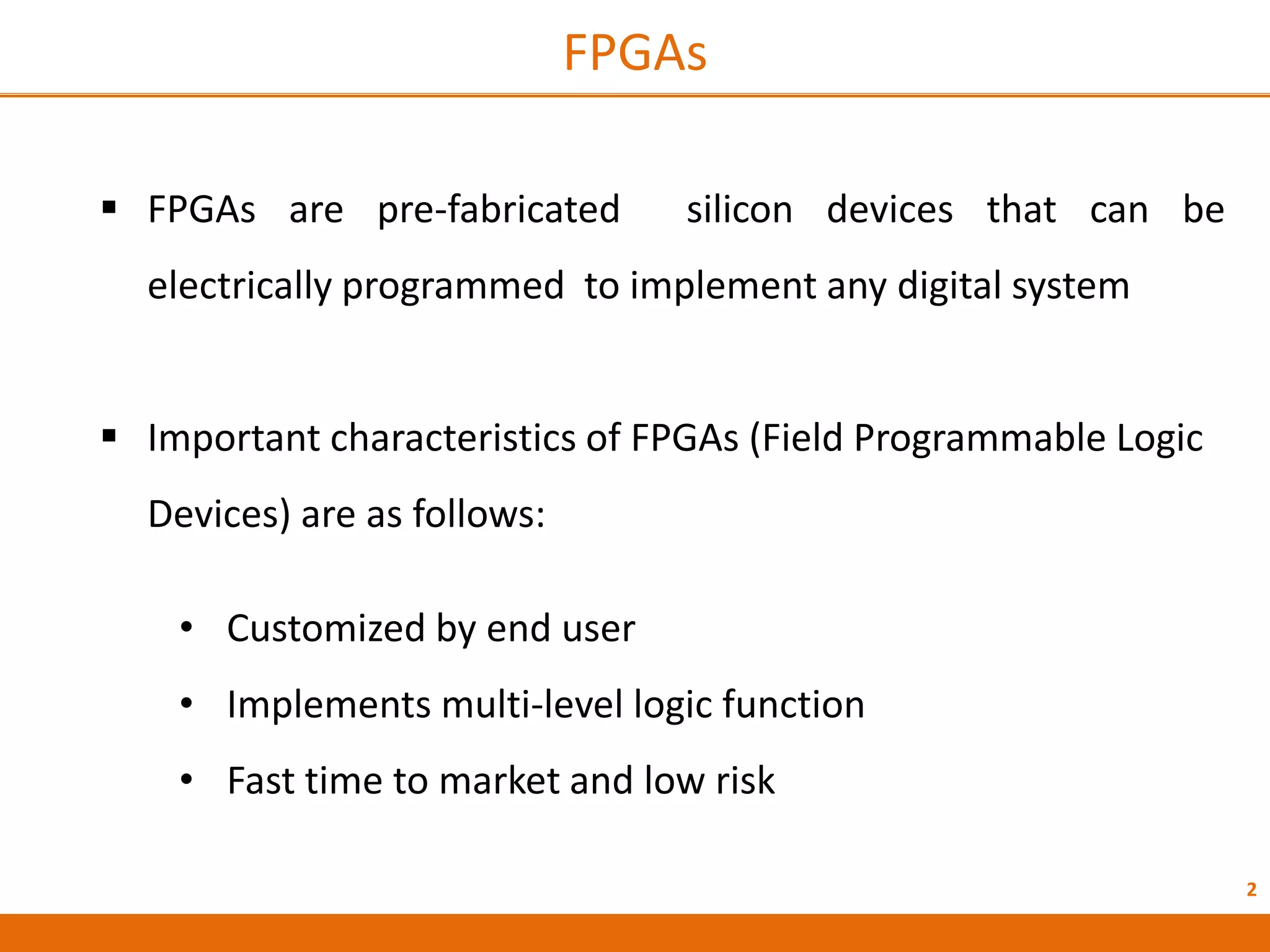
 FPGAs are pre-fabricated silicon devices that can be
electrically programmed to implement any digital system
 Important characteristics of FPGAs (Field Programmable Logic
Devices) are as follows:
• Customized by end user
• Implements multi-level logic function
• Fast time to market and low risk
3
FPGAs
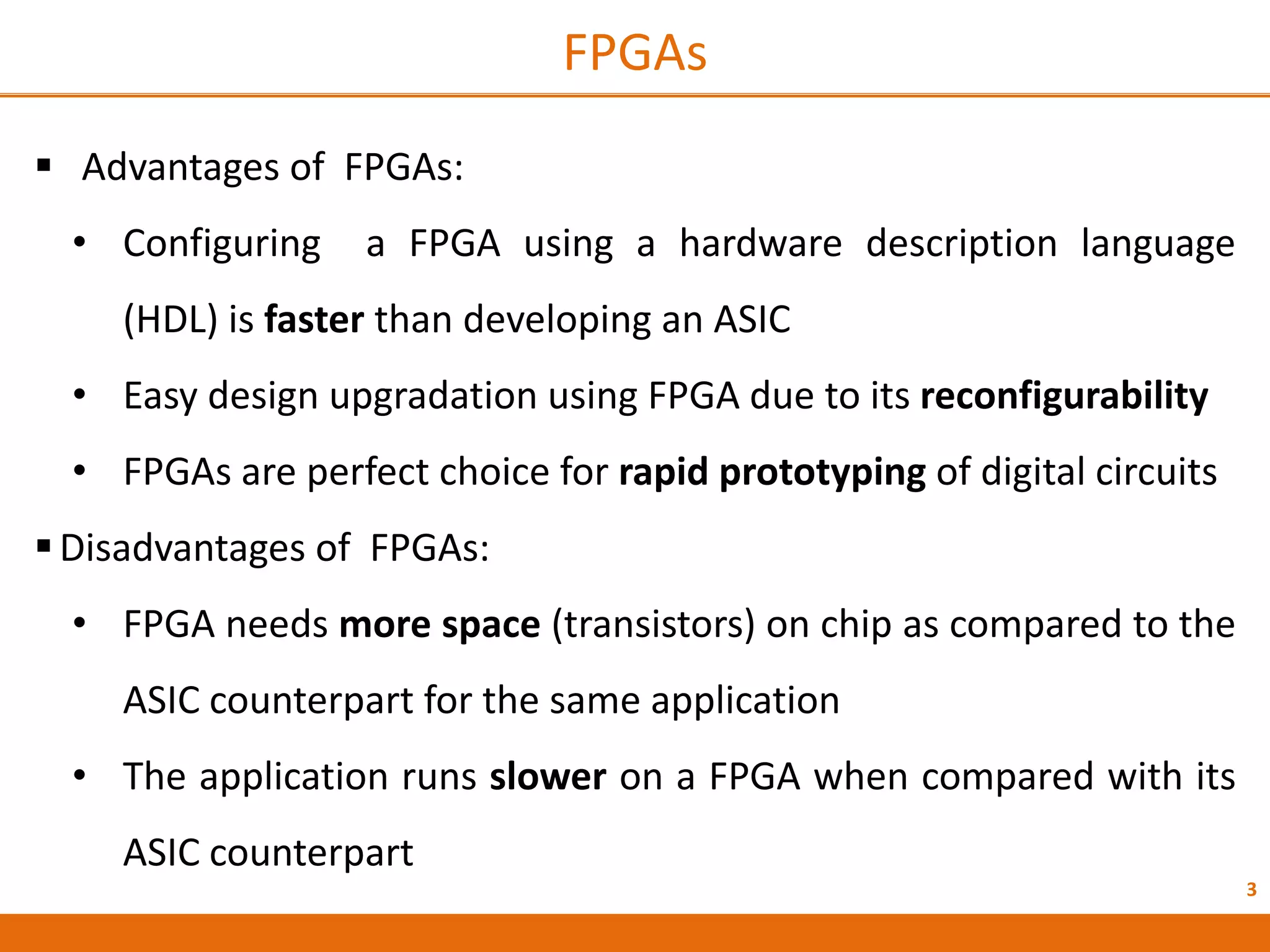
 Advantages of FPGAs:
• Configuring a FPGA using a hardware description language
(HDL) is faster than developing an ASIC
• Easy design upgradation using FPGA due to its reconfigurability
• FPGAs are perfect choice for rapid prototyping of digital circuits
Disadvantages of FPGAs:
• FPGA needs more space (transistors) on chip as compared to the
ASIC counterpart for the same application
• The application runs slower on a FPGA when compared with its
ASIC counterpart
4
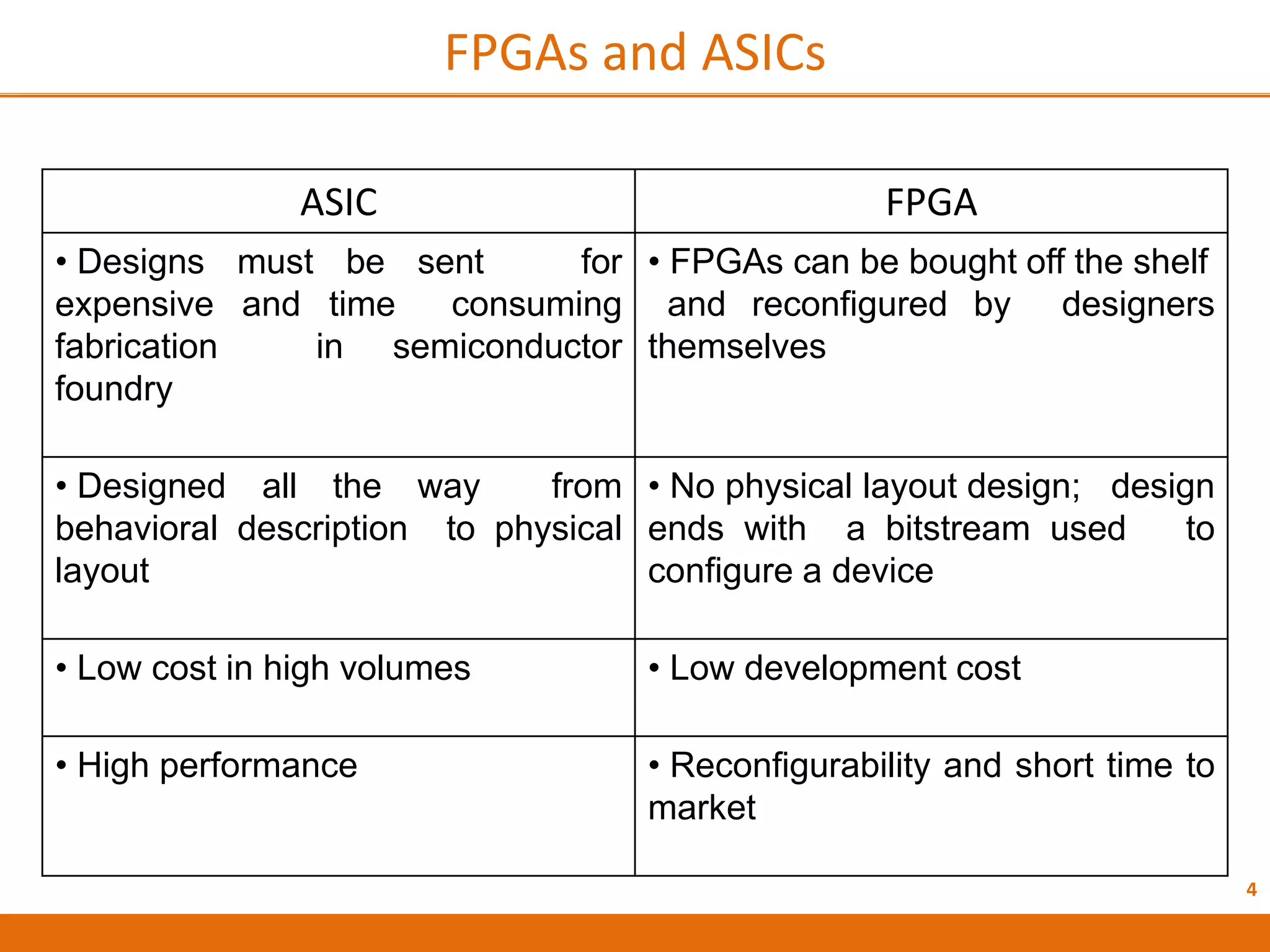
FPGAs and ASICs
ASIC FPGA
• Designs must be sent for
expensive and time consuming
fabrication in semiconductor
foundry
• FPGAs can be bought off the shelf
and reconfigured by designers
themselves
• Designed all the way from
behavioral description to physical
layout
• No physical layout design; design
ends with a bitstream used to
configure a device
• Low cost in high volumes • Low development cost
• High performance • Reconfigurability and short time to
market
5
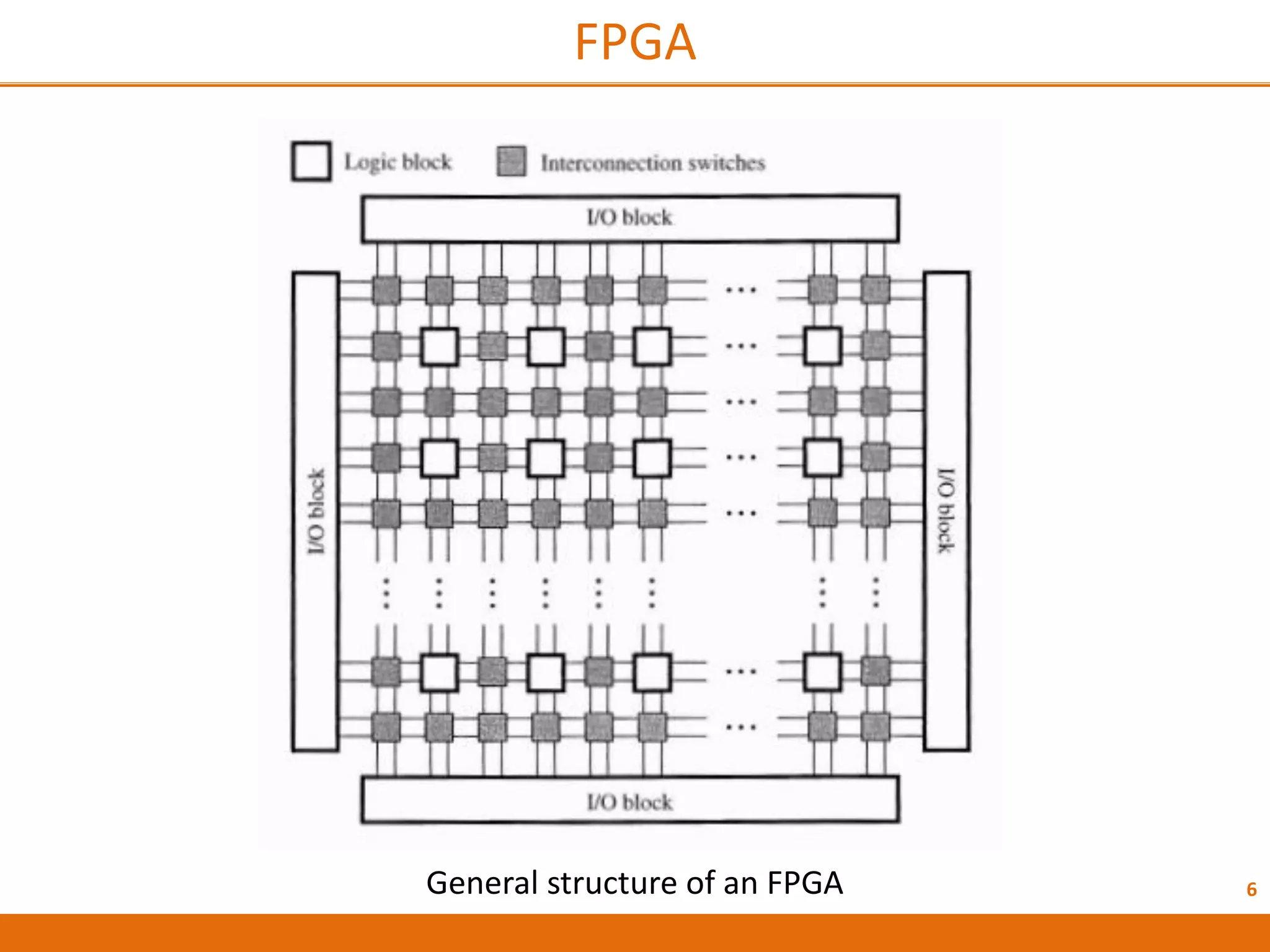
FPGA architecture
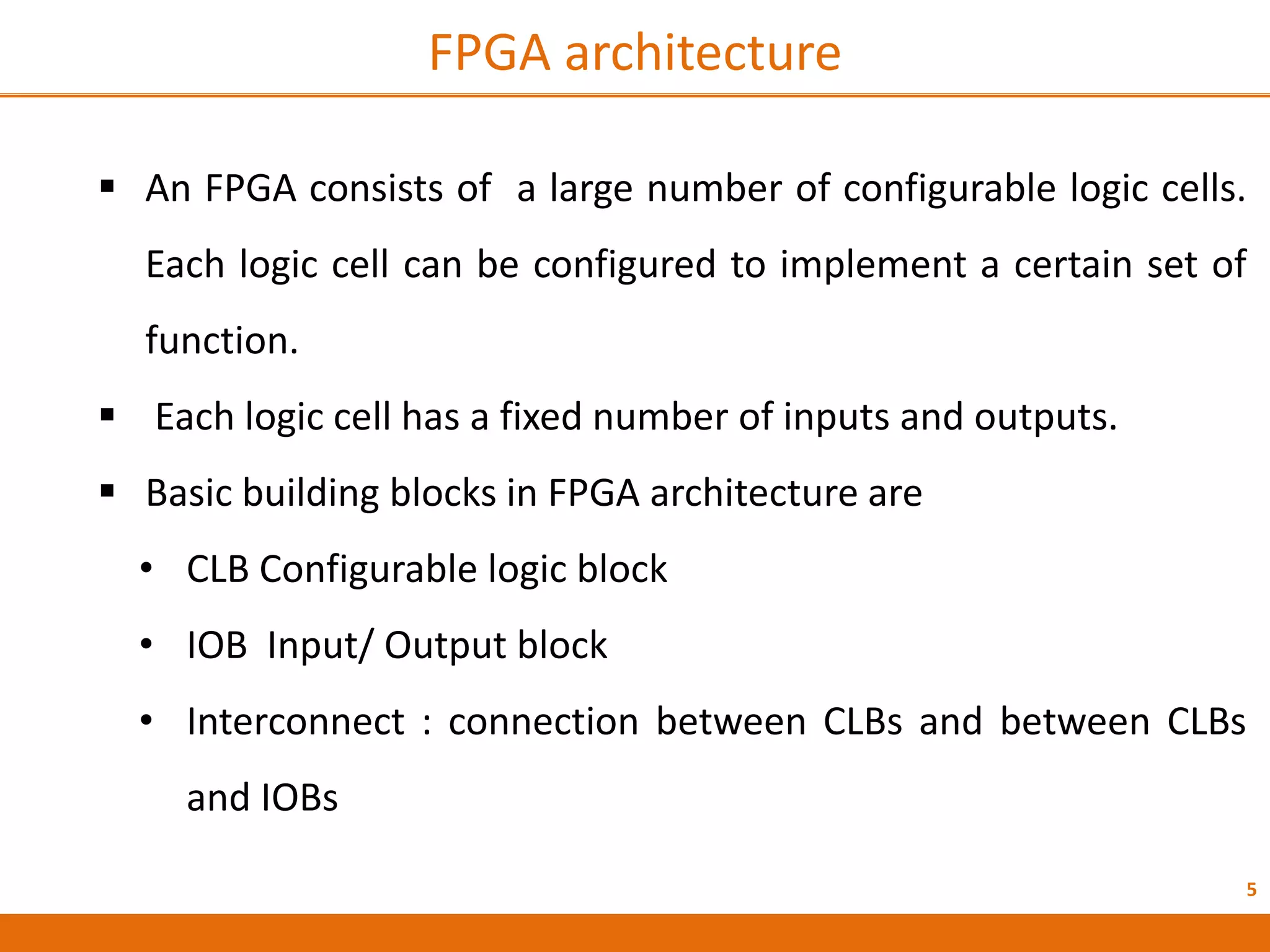
 An FPGA consists of a large number of configurable logic cells.
Each logic cell can be configured to implement a certain set of
function.
 Each logic cell has a fixed number of inputs and outputs.
 Basic building blocks in FPGA architecture are
• CLB Configurable logic block
• IOB Input/ Output block
• Interconnect : connection between CLBs and between CLBs
and IOBs
6
FPGA
General structure of an FPGA
7
FPGAs
Two types of FPGAs
 Reprogrammable FPGA
Uses memory based logic cells
Uses sRAM configuration cell
Vendors : Xilinx , Lattice, Atmel, Altera
 One-time Programmable(OTP) FPGA
Uses multiplexer based logic cells
Antifuse switch based
Vendors : Actel, Quicklogic
Xilinx Inc. and Altera Corp. share 60% of the FPGA market.
8
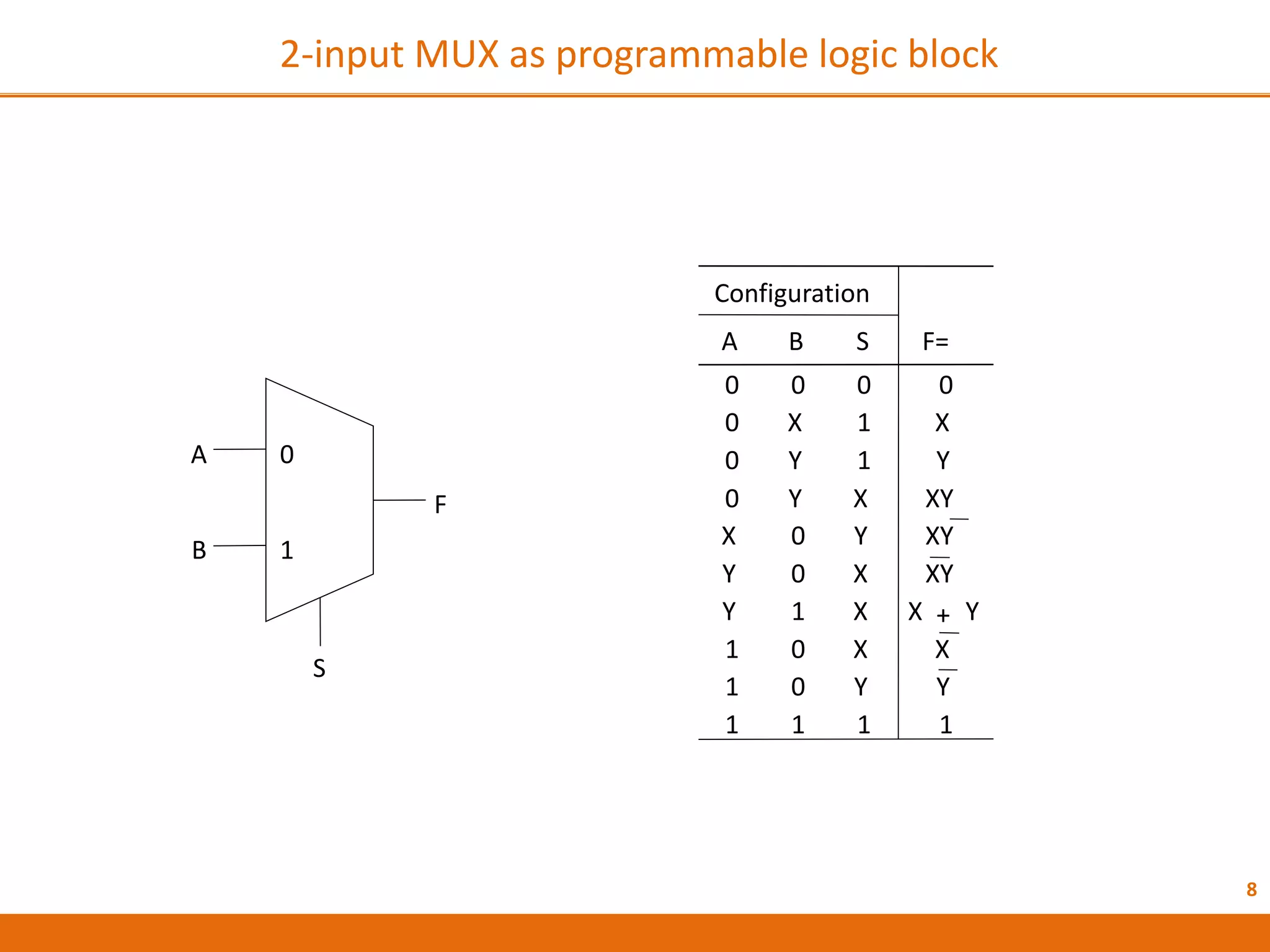
2-input MUX as programmable logic block
F
A 0
B
S
1
Configuration
A B S F=
0 0 0 0
0 X 1 X
0 Y 1 Y
0 Y X XY
X 0 Y
Y 0 X
Y 1 X X + Y
1 0 X
1 0 Y
1 1 1 1
XY
XY
X
Y
9
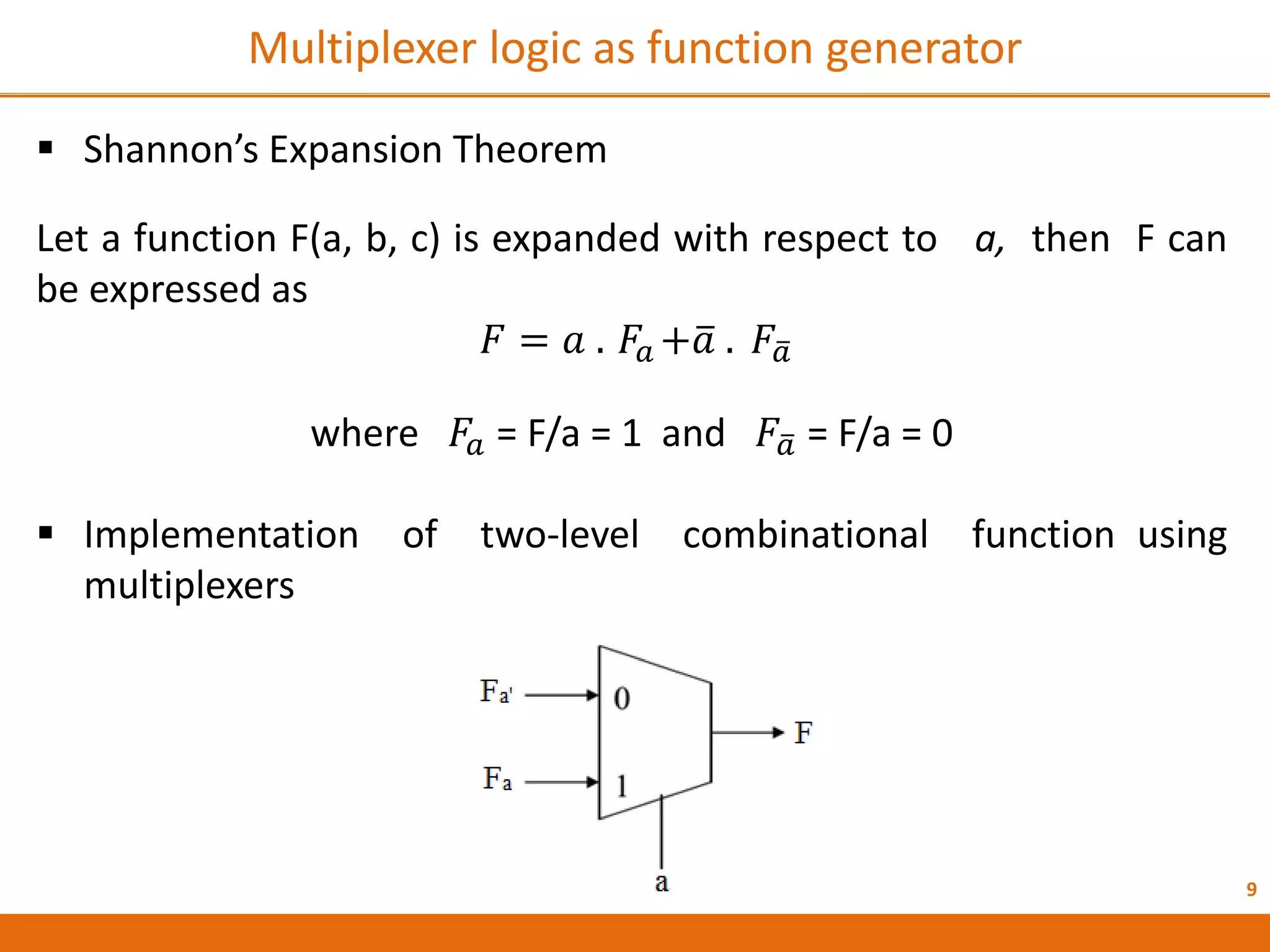
Multiplexer logic as function generator
 Shannon’s Expansion Theorem
Let a function F(a, b, c) is expanded with respect to a, then F can
be expressed as
𝐹 = 𝑎 . 𝐹𝑎 +𝑎 . 𝐹𝑎
where 𝐹𝑎 = F/a = 1 and 𝐹𝑎 = F/a = 0
 Implementation of two-level combinational function using
multiplexers
10
Multiplexer logic as function generator
Shannon’s Expansion Theorem
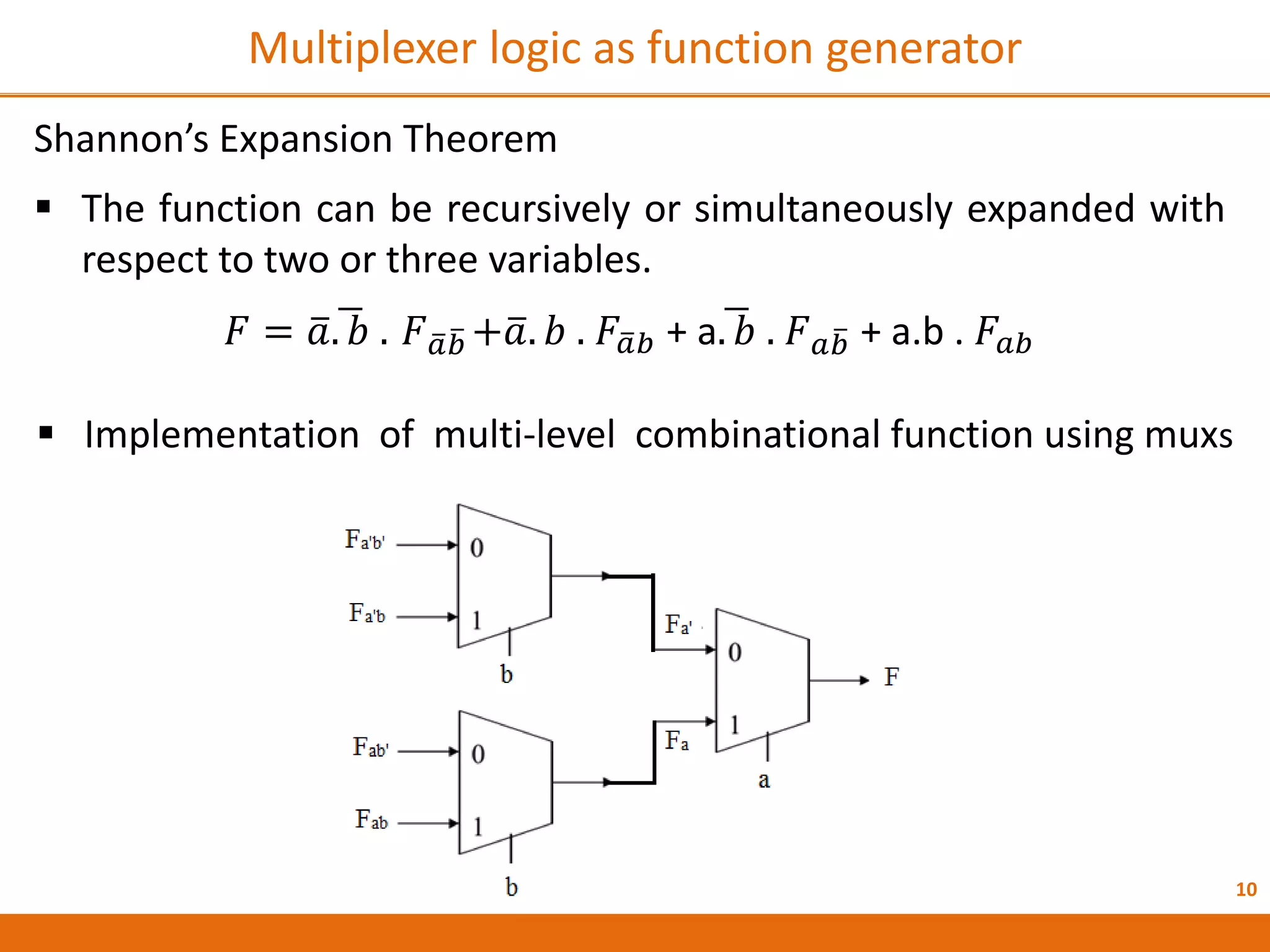
 The function can be recursively or simultaneously expanded with
respect to two or three variables.
𝐹 = 𝑎. 𝑏 . 𝐹 𝑎 𝑏 +𝑎. 𝑏 . 𝐹𝑎 𝑏 + a. 𝑏 . 𝐹 𝑎𝑏 + a.b . 𝐹𝑎𝑏
 Implementation of multi-level combinational function using muxs
11
ACTEL FPGAs
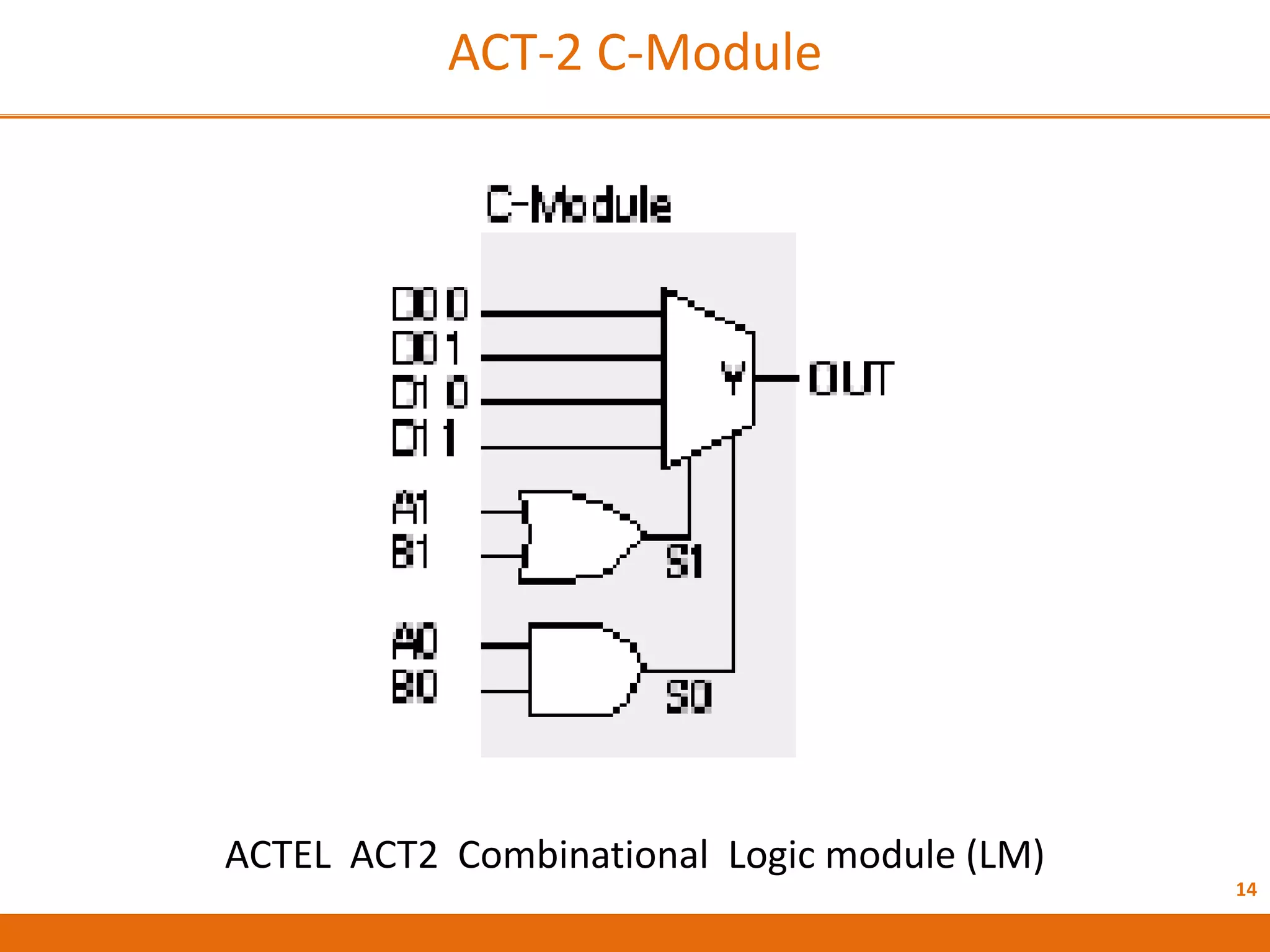
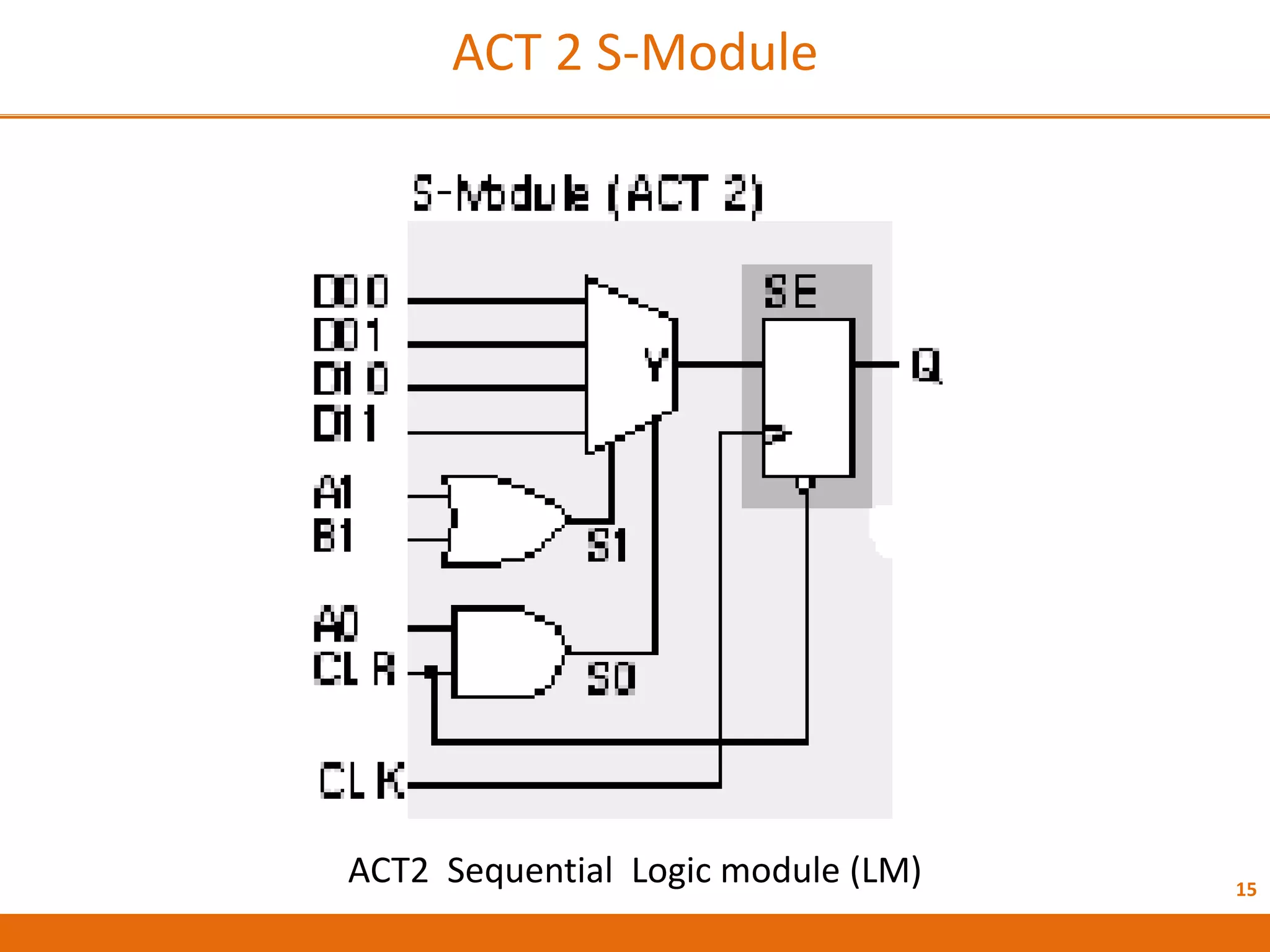
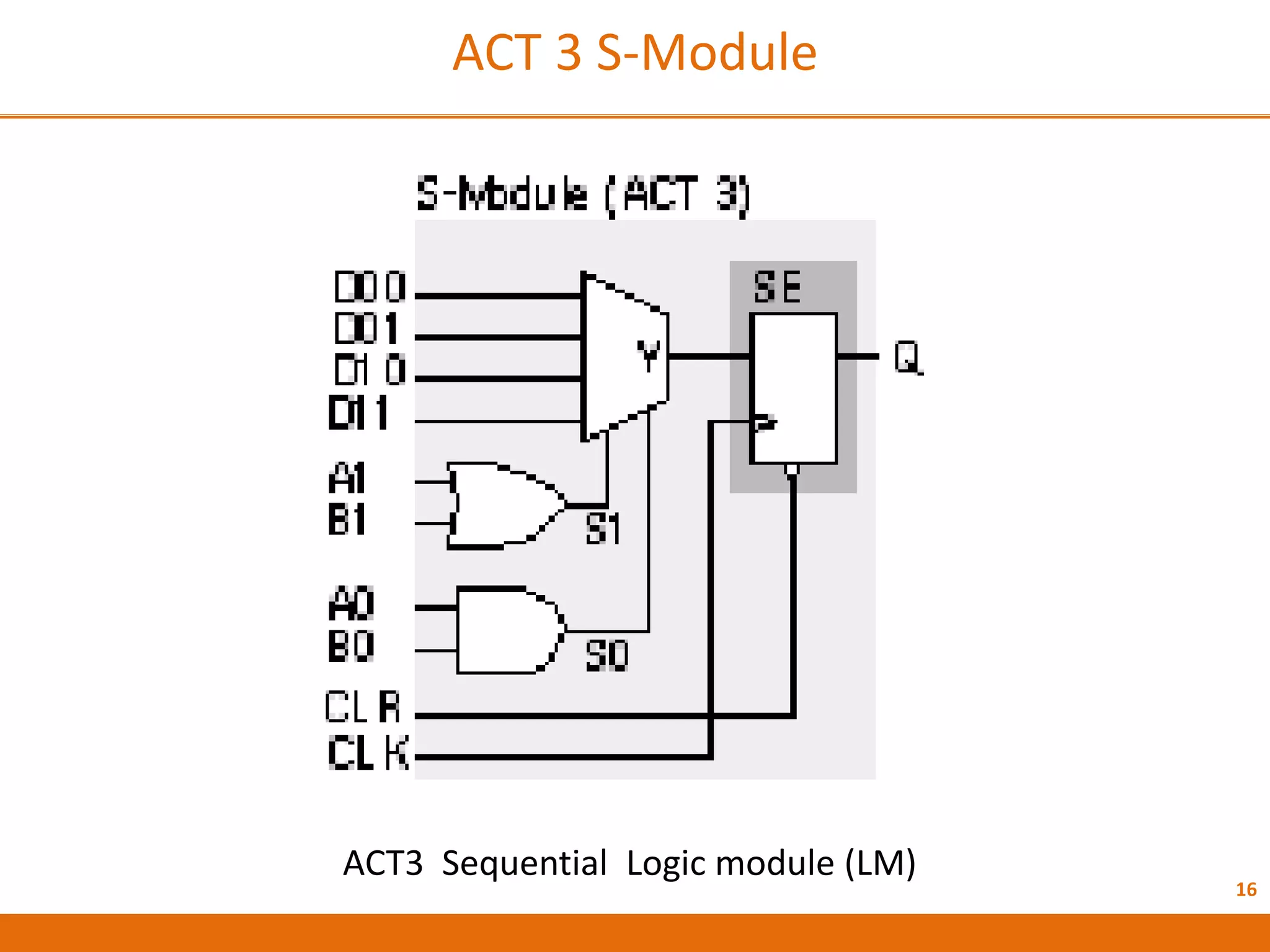
 ACTEL FPGA uses multiplexer based logic cells
 The multiplexer-based logic module is typically composed of a
tree of 2-to-1 MUXes.
 Different types of Logic Modules(LMs) available are :
ACT 1 LM
ACT 2 - C, ACT 2 - S
ACT 3 - C, ACT 3 - S
12
ACTEL FPGAs
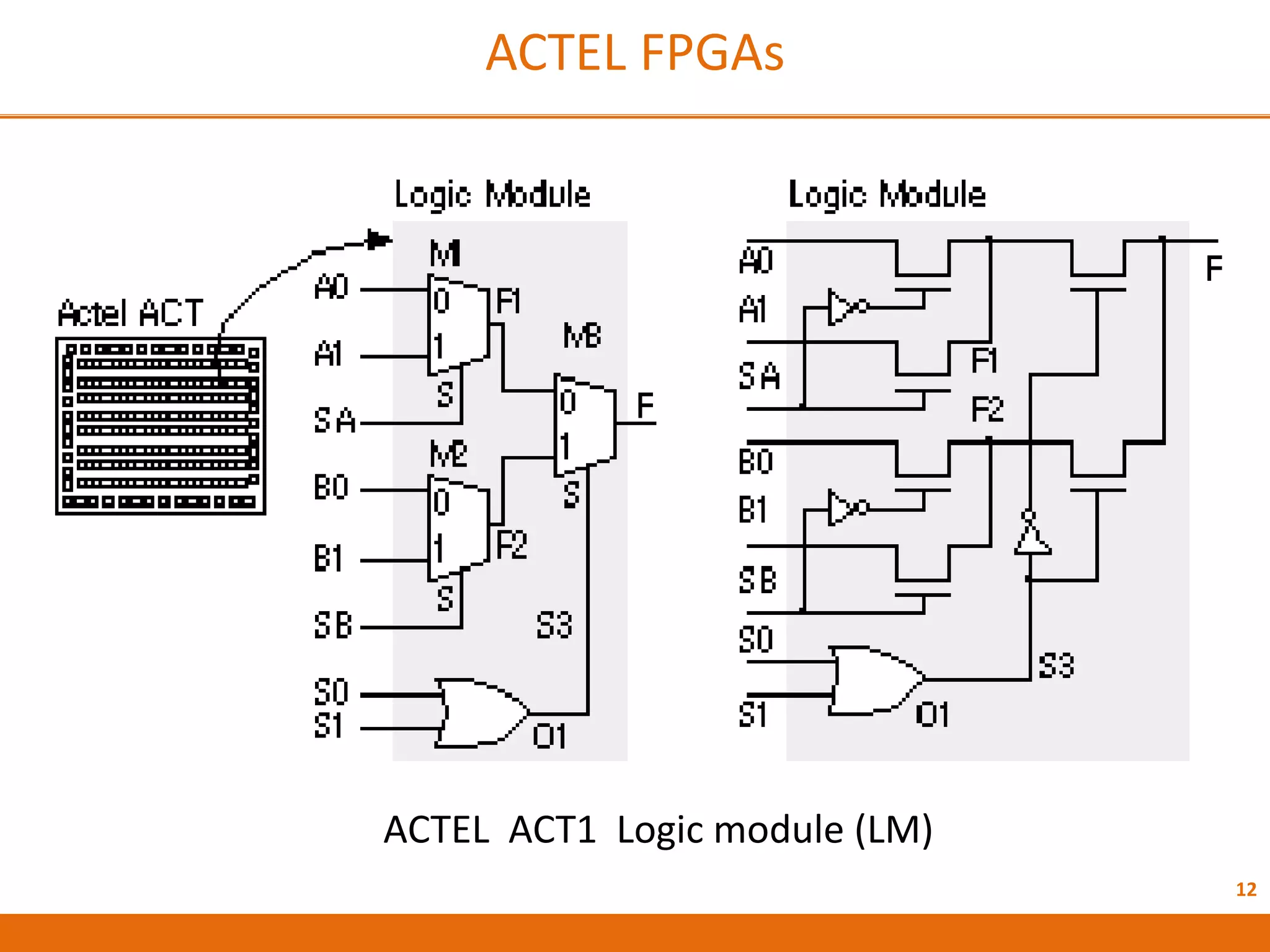
ACTEL ACT1 Logic module (LM)
13
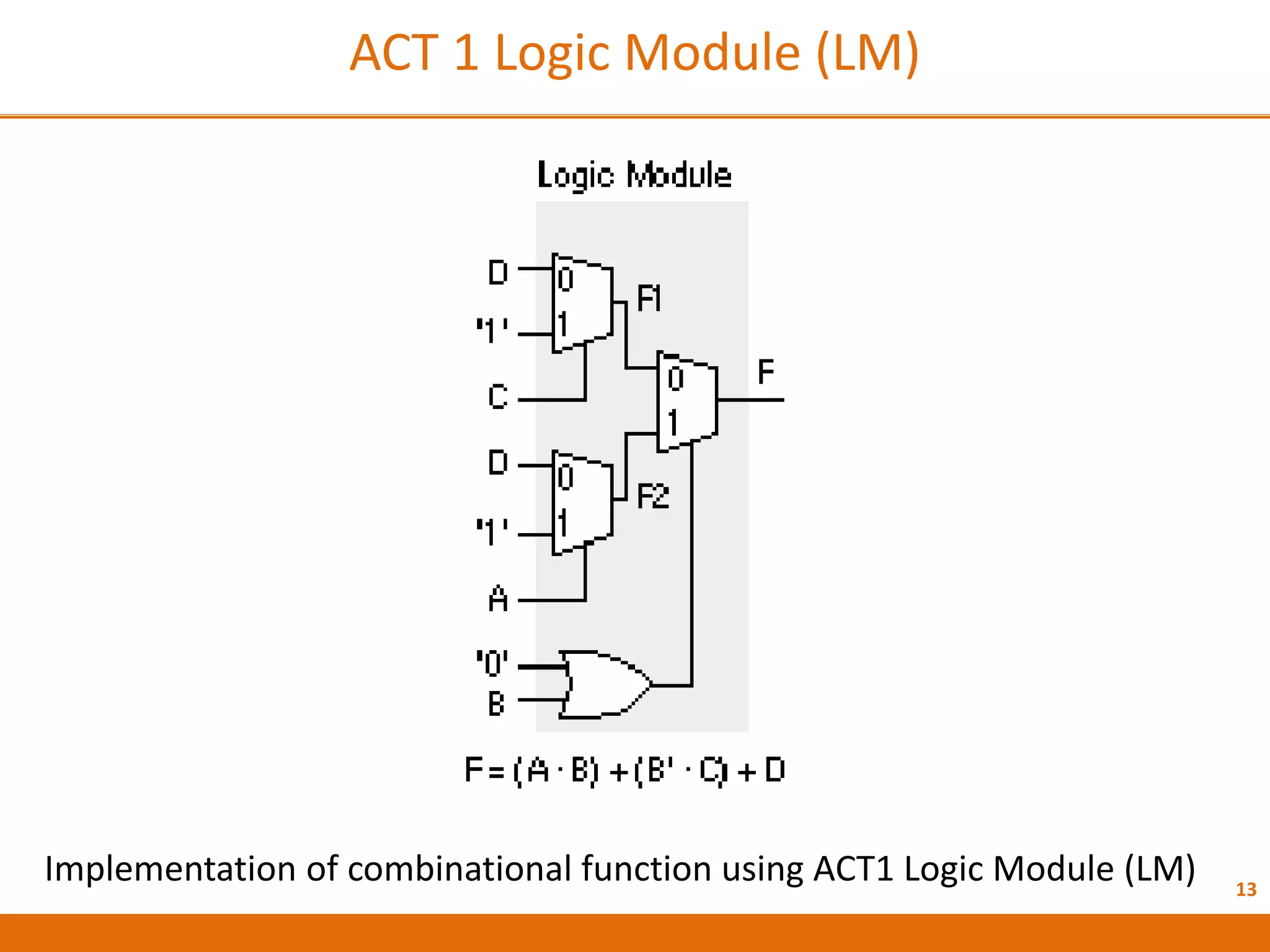
ACT 1 Logic Module (LM)
Implementation of combinational function using ACT1 Logic Module (LM)
14
ACT-2 C-Module
ACTEL ACT2 Combinational Logic module (LM)
15
ACT 2 S-Module
ACT2 Sequential Logic module (LM)
16
ACT 3 S-Module
ACT3 Sequential Logic module (LM)
17
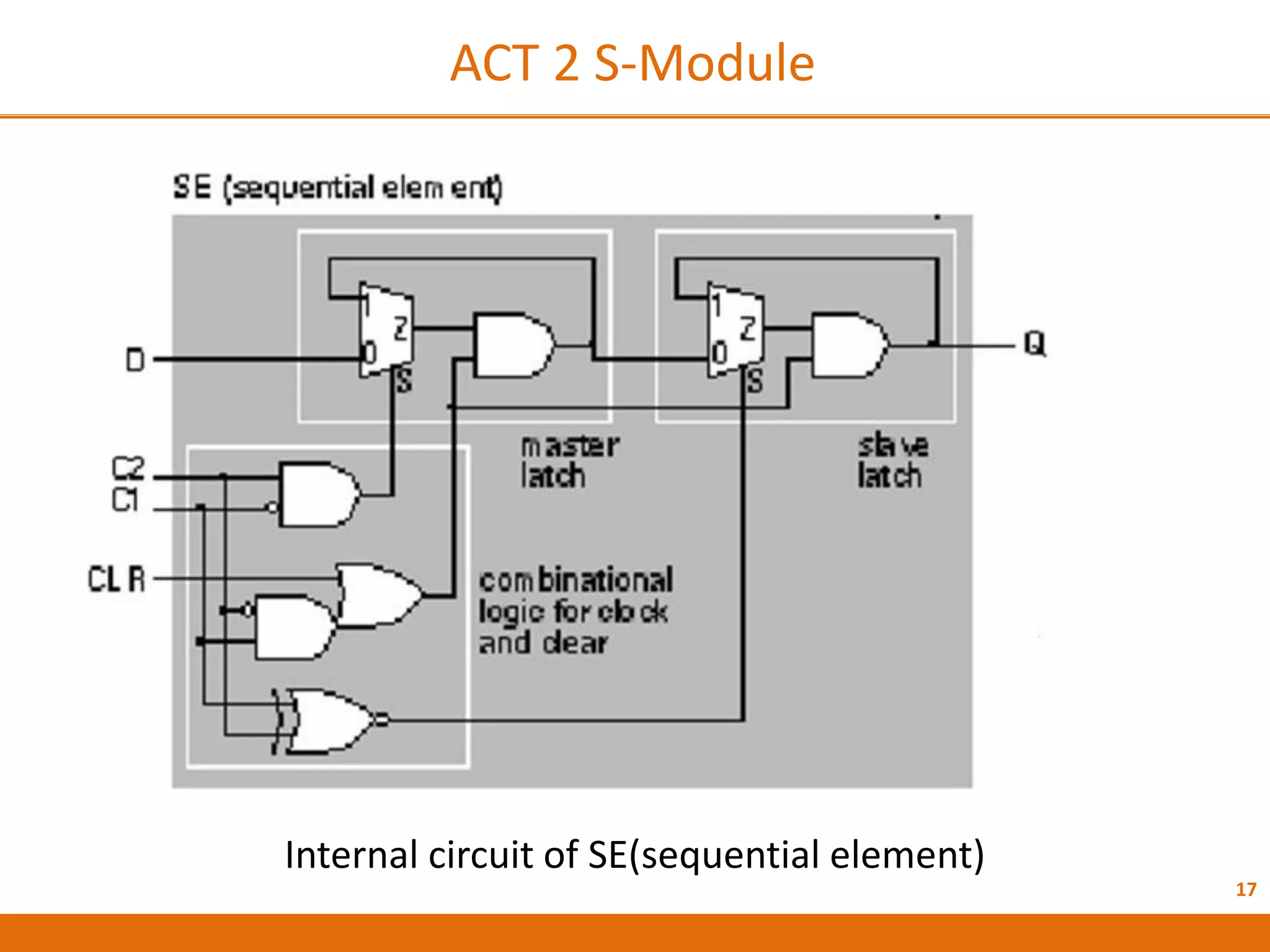
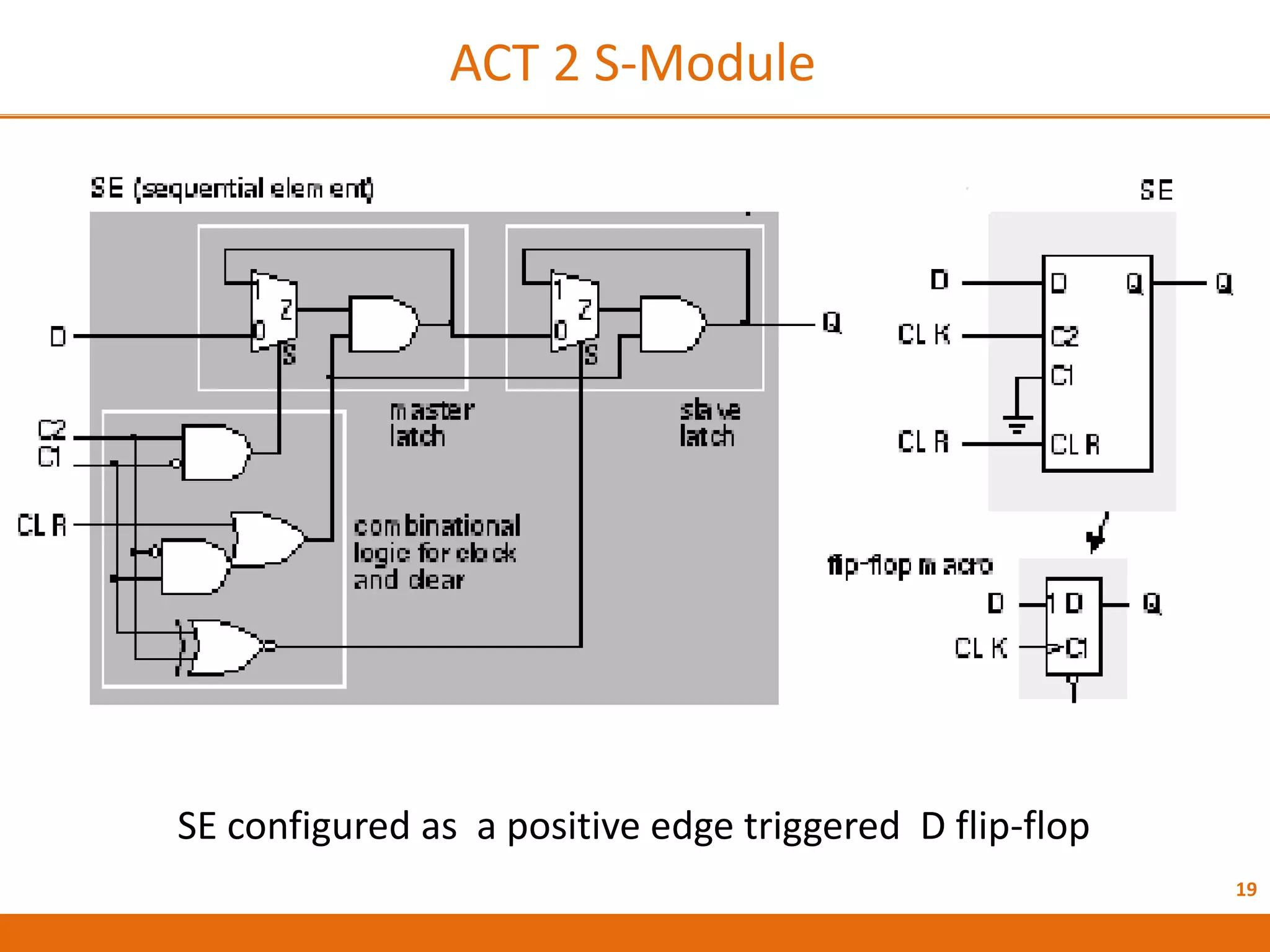
ACT 2 S-Module
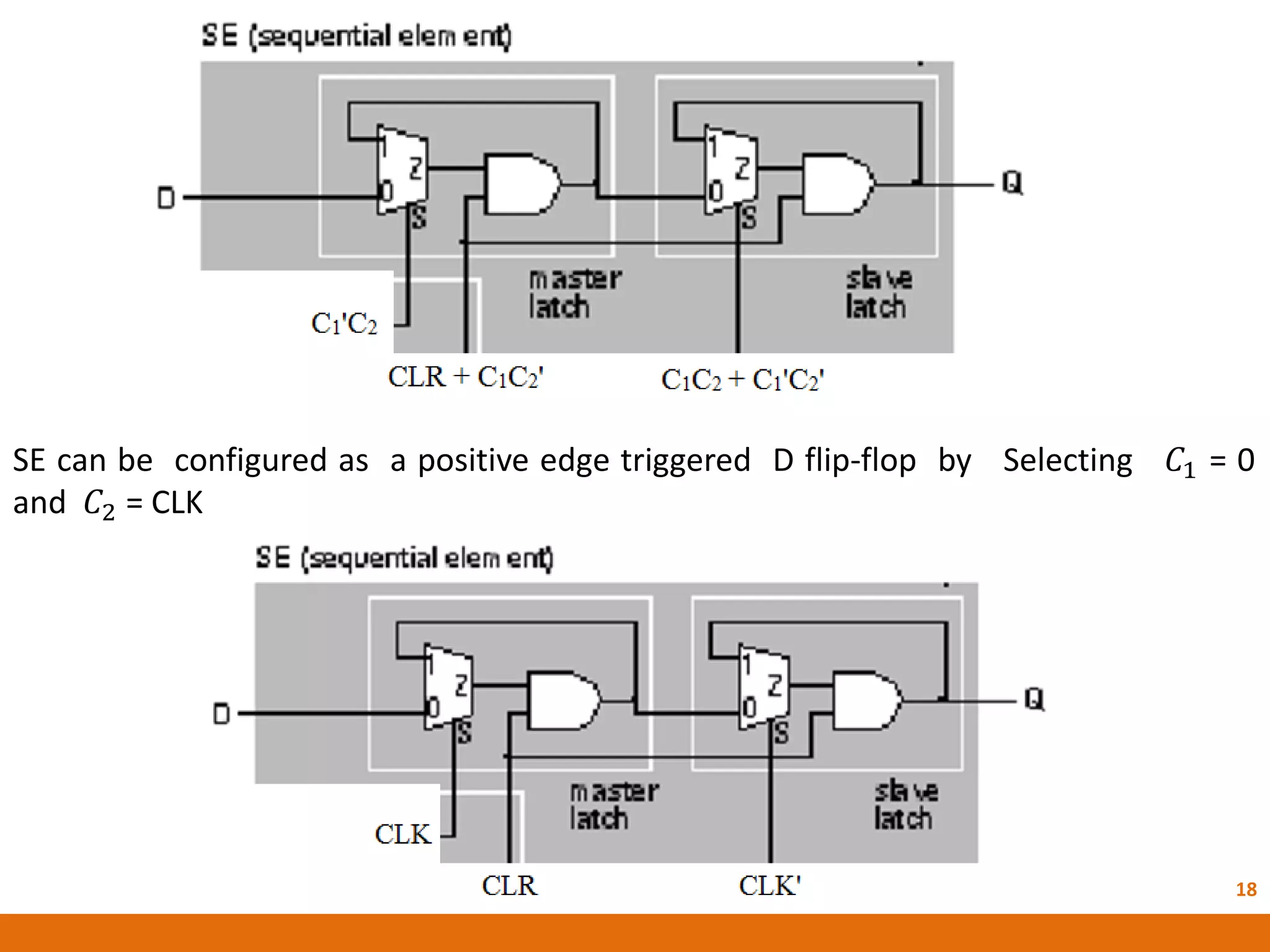
Internal circuit of SE(sequential element)
18
SE can be configured as a positive edge triggered D flip-flop by Selecting 𝐶1 = 0
and 𝐶2 = CLK
19
ACT 2 S-Module
SE configured as a positive edge triggered D flip-flop
20
• reachdvkamath@yahoo.com
• dv.kamath@manipal.edu
Contact

Actel fpga

  • 1.
    ACTEL FPGAs Dr. D.V. Kamath Professor, Department of E&C Engg., Manipal Institute of Technology, Manipal 1
  • 2.
    2 FPGAs  FPGAs arepre-fabricated silicon devices that can be electrically programmed to implement any digital system  Important characteristics of FPGAs (Field Programmable Logic Devices) are as follows: • Customized by end user • Implements multi-level logic function • Fast time to market and low risk
  • 3.
    3 FPGAs  Advantages ofFPGAs: • Configuring a FPGA using a hardware description language (HDL) is faster than developing an ASIC • Easy design upgradation using FPGA due to its reconfigurability • FPGAs are perfect choice for rapid prototyping of digital circuits Disadvantages of FPGAs: • FPGA needs more space (transistors) on chip as compared to the ASIC counterpart for the same application • The application runs slower on a FPGA when compared with its ASIC counterpart
  • 4.
    4 FPGAs and ASICs ASICFPGA • Designs must be sent for expensive and time consuming fabrication in semiconductor foundry • FPGAs can be bought off the shelf and reconfigured by designers themselves • Designed all the way from behavioral description to physical layout • No physical layout design; design ends with a bitstream used to configure a device • Low cost in high volumes • Low development cost • High performance • Reconfigurability and short time to market
  • 5.
    5 FPGA architecture  AnFPGA consists of a large number of configurable logic cells. Each logic cell can be configured to implement a certain set of function.  Each logic cell has a fixed number of inputs and outputs.  Basic building blocks in FPGA architecture are • CLB Configurable logic block • IOB Input/ Output block • Interconnect : connection between CLBs and between CLBs and IOBs
  • 6.
  • 7.
    7 FPGAs Two types ofFPGAs  Reprogrammable FPGA Uses memory based logic cells Uses sRAM configuration cell Vendors : Xilinx , Lattice, Atmel, Altera  One-time Programmable(OTP) FPGA Uses multiplexer based logic cells Antifuse switch based Vendors : Actel, Quicklogic Xilinx Inc. and Altera Corp. share 60% of the FPGA market.
  • 8.
    8 2-input MUX asprogrammable logic block F A 0 B S 1 Configuration A B S F= 0 0 0 0 0 X 1 X 0 Y 1 Y 0 Y X XY X 0 Y Y 0 X Y 1 X X + Y 1 0 X 1 0 Y 1 1 1 1 XY XY X Y
  • 9.
    9 Multiplexer logic asfunction generator  Shannon’s Expansion Theorem Let a function F(a, b, c) is expanded with respect to a, then F can be expressed as 𝐹 = 𝑎 . 𝐹𝑎 +𝑎 . 𝐹𝑎 where 𝐹𝑎 = F/a = 1 and 𝐹𝑎 = F/a = 0  Implementation of two-level combinational function using multiplexers
  • 10.
    10 Multiplexer logic asfunction generator Shannon’s Expansion Theorem  The function can be recursively or simultaneously expanded with respect to two or three variables. 𝐹 = 𝑎. 𝑏 . 𝐹 𝑎 𝑏 +𝑎. 𝑏 . 𝐹𝑎 𝑏 + a. 𝑏 . 𝐹 𝑎𝑏 + a.b . 𝐹𝑎𝑏  Implementation of multi-level combinational function using muxs
  • 11.
    11 ACTEL FPGAs  ACTELFPGA uses multiplexer based logic cells  The multiplexer-based logic module is typically composed of a tree of 2-to-1 MUXes.  Different types of Logic Modules(LMs) available are : ACT 1 LM ACT 2 - C, ACT 2 - S ACT 3 - C, ACT 3 - S
  • 12.
    12 ACTEL FPGAs ACTEL ACT1Logic module (LM)
  • 13.
    13 ACT 1 LogicModule (LM) Implementation of combinational function using ACT1 Logic Module (LM)
  • 14.
    14 ACT-2 C-Module ACTEL ACT2Combinational Logic module (LM)
  • 15.
    15 ACT 2 S-Module ACT2Sequential Logic module (LM)
  • 16.
    16 ACT 3 S-Module ACT3Sequential Logic module (LM)
  • 17.
    17 ACT 2 S-Module Internalcircuit of SE(sequential element)
  • 18.
    18 SE can beconfigured as a positive edge triggered D flip-flop by Selecting 𝐶1 = 0 and 𝐶2 = CLK
  • 19.
    19 ACT 2 S-Module SEconfigured as a positive edge triggered D flip-flop
  • 20.