PRINCIPLE (BEER’S LAMBERT’S LAW)
VISIBLE SPECTROPHOTOMETER
(SINGLE BEAM & DOUBLE BEAM)
PAPER 4 UNIT 4
_PRASHANT SINGH
BEER’S LAW = when a ray of monochromatic light passes through an
absorbance medium, its intensity decreases exponentially as the
concentration of the absorbing medium increases, provided the length of the
absorbing medium is constant.
Equation :
Where as, I = Intensity of transmitted ray
Iо = Intensity of the incident ray .
k1 = constant
c = concentration of he absorbing medium
LAMBERT’S LAW = when a ray of monochromatic light passes through an
absorbing medium, its intensity decreases exponentially as the light of the
absorbing medium increases, provided the concentration of the absorbing
medium is constant.
Equation =
Where as, I = Intensity of transmitted ray
Iо = Intensity of the incident ray .
k2 = constant
l = path lenghtof he absorbing medium
BEER’S-LAMBERT’S LAW
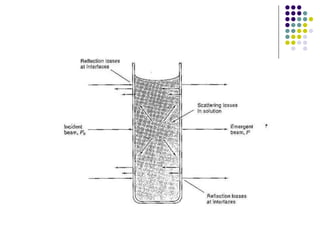
 When a ray of monochromatic light of initial intensity Iо passes through a
solution or a transparent vessel, some of the light is absorb so that the
intensity of the transmitted light I is less than Iо.
 The relationship between I and Iо depends on the path length l of the
absorbing medium and the concentration C of the absorbing solution
 Equation
Transmittance (T)
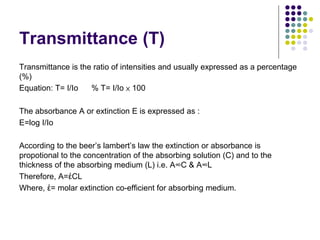
Transmittance is the ratio of intensities and usually expressed as a percentage
(%)
Equation: T= I/Iо % T= I/Iо × 100
The absorbance A or extinction E is expressed as :
E=log I/Iо
According to the beer’s lambert’s law the extinction or absorbance is
propotional to the concentration of the absorbing solution (C) and to the
thickness of the absorbing medium (L) i.e. A∞C & A∞L
Therefore, A=ἐCL
Where, ἐ= molar extinction co-efficient for absorbing medium.
Transmittance
I0 I
b
303.2
log)log(
)log(303.2)ln(
0
00
0
0
00
0
k
bcAT
I
I
I
I
kbc
I
I
dbkc
I
dI
kcdb
I
dI
I
I
T
I
I
b





 


Electronic Spectroscopy
 Ultraviolet (UV) and visible (VIS) spectroscopy
 This is the earliest method of molecular
spectroscopy.
 A phenomenon of interaction of molecules with
ultraviolet and visible lights.
 Absorption of photon results in electronic
transition of a molecule, and electrons are
promoted from ground state to higher
electronic states.
UV and Visible Spectroscopy
 In structure determination : UV-VIS
spectroscopy is used to detect the presence of
chromophores like dienes, aromatics,
polyenes, and conjugated ketones, etc.
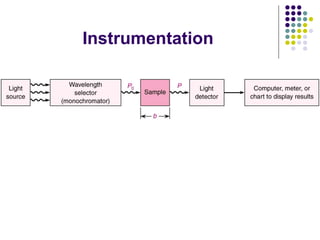
Instrumentation
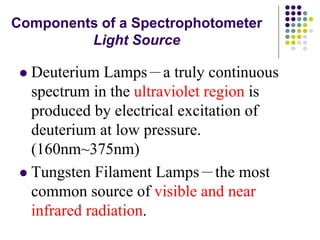
Components of a Spectrophotometer
Light Source
 Deuterium Lamps-a truly continuous
spectrum in the ultraviolet region is
produced by electrical excitation of
deuterium at low pressure.
(160nm~375nm)
 Tungsten Filament Lamps-the most
common source of visible and near
infrared radiation.
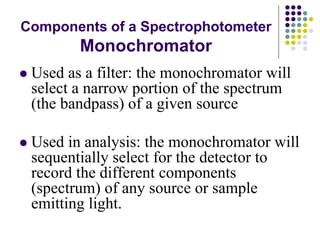
Components of a Spectrophotometer
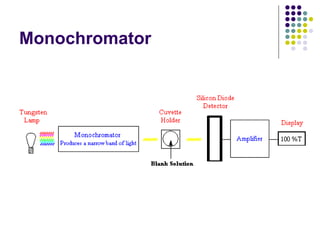
Monochromator
 Used as a filter: the monochromator will
select a narrow portion of the spectrum
(the bandpass) of a given source
 Used in analysis: the monochromator will
sequentially select for the detector to
record the different components
(spectrum) of any source or sample
emitting light.
Monochromator
Grating
Detector
Barrier Layer/Photovoltaic
Principle of Barrier
Layer/Photovoltaic Detector
 This device measures the intensity of photons
by means of the voltage developed across the
semiconductor layer.
 Electrons, ejected by photons from the
semiconductor, are collected by the silver
layer.
 The potential depends on the number of
photons hitting the detector.
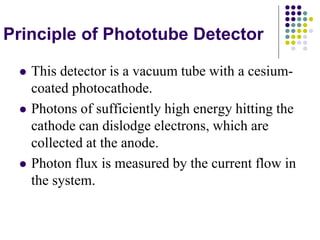
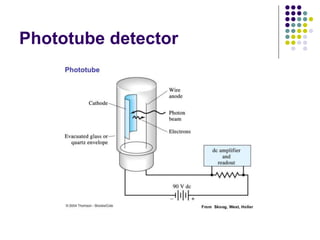
Principle of Phototube Detector
 This detector is a vacuum tube with a cesium-
coated photocathode.
 Photons of sufficiently high energy hitting the
cathode can dislodge electrons, which are
collected at the anode.
 Photon flux is measured by the current flow in
the system.
Phototube detector
Detector
Photomultiplier
Principle of Photomultiplier
Detector
 The type is commonly used.
 The detector consists of a photoemissive
cathode coupled with a series of electron-
multiplying dynode stages, and usually called
a photomultiplier.
 The primary electrons ejected from the photo-
cathode are accelerated by an electric field so
as to strike a small area on the first dynode.
Principle of Photomultiplier
Detector
 The impinging electrons strike with enough
energy to eject two to five secondary electrons,
which are accelerated to the second dynode to
eject still more electrons.
 A photomultiplier may have 9 to 16 stages,
and overall gain of 106~109 electrons per
incident photon.
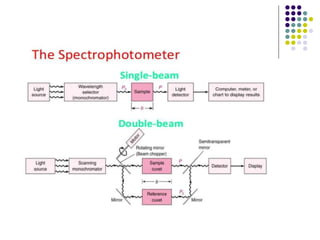
Single and Double Beam
Spectrometer
 Single-Beam: There is only one light beam or
optical path from the source through to the
detector.
 Double-Beam: The light from the source, after
passing through the monochromator, is split
into two separate beams-one for the sample
and the other for the reference.
advantage
 Less expensive
 High sensitivity
disadavntage
 Instability due to lack of
compensation for
disturbance like voltage
fluctuation, mechanical
components instability or
drift in energy of light
source.
 Such drifts result in
abnormal fluctuation in
the result
Single beam
spectrophotometer
Double beam
spectrophotometer
advantage
 No warm up time
 Better level of detection
 Instability factor do not
affect the measurement
in real time result
disadvantage
 expensive
Application
 UV/Vis spectroscopy is routinely used in analytical
chemistry for the quantitative determination of different
analytes, such as transition metal ions, highly conjugated
organic compounds, and biological macromolecules.
 Spectroscopic analysis is commonly carried out in
solutions but solids and gases may also be studied.
Quantitative Analysis
Beer’s Law
A=bc
: the molar absorptivity (L mol-1 cm-1)
b: the path length of the sample
c :the concentration of the compound in
solution, expressed in mol L-1
Spectroscopy - principle, procedure & application

Spectroscopy - principle, procedure & application

  • 1.
    PRINCIPLE (BEER’S LAMBERT’SLAW) VISIBLE SPECTROPHOTOMETER (SINGLE BEAM & DOUBLE BEAM) PAPER 4 UNIT 4 _PRASHANT SINGH
  • 2.
    BEER’S LAW =when a ray of monochromatic light passes through an absorbance medium, its intensity decreases exponentially as the concentration of the absorbing medium increases, provided the length of the absorbing medium is constant. Equation : Where as, I = Intensity of transmitted ray Iо = Intensity of the incident ray . k1 = constant c = concentration of he absorbing medium
  • 3.
    LAMBERT’S LAW =when a ray of monochromatic light passes through an absorbing medium, its intensity decreases exponentially as the light of the absorbing medium increases, provided the concentration of the absorbing medium is constant. Equation = Where as, I = Intensity of transmitted ray Iо = Intensity of the incident ray . k2 = constant l = path lenghtof he absorbing medium
  • 4.
    BEER’S-LAMBERT’S LAW  Whena ray of monochromatic light of initial intensity Iо passes through a solution or a transparent vessel, some of the light is absorb so that the intensity of the transmitted light I is less than Iо.  The relationship between I and Iо depends on the path length l of the absorbing medium and the concentration C of the absorbing solution  Equation
  • 5.
    Transmittance (T) Transmittance isthe ratio of intensities and usually expressed as a percentage (%) Equation: T= I/Iо % T= I/Iо × 100 The absorbance A or extinction E is expressed as : E=log I/Iо According to the beer’s lambert’s law the extinction or absorbance is propotional to the concentration of the absorbing solution (C) and to the thickness of the absorbing medium (L) i.e. A∞C & A∞L Therefore, A=ἐCL Where, ἐ= molar extinction co-efficient for absorbing medium.
  • 6.
  • 8.
    Electronic Spectroscopy  Ultraviolet(UV) and visible (VIS) spectroscopy  This is the earliest method of molecular spectroscopy.  A phenomenon of interaction of molecules with ultraviolet and visible lights.  Absorption of photon results in electronic transition of a molecule, and electrons are promoted from ground state to higher electronic states.
  • 9.
    UV and VisibleSpectroscopy  In structure determination : UV-VIS spectroscopy is used to detect the presence of chromophores like dienes, aromatics, polyenes, and conjugated ketones, etc.
  • 10.
  • 11.
    Components of aSpectrophotometer Light Source  Deuterium Lamps-a truly continuous spectrum in the ultraviolet region is produced by electrical excitation of deuterium at low pressure. (160nm~375nm)  Tungsten Filament Lamps-the most common source of visible and near infrared radiation.
  • 12.
    Components of aSpectrophotometer Monochromator  Used as a filter: the monochromator will select a narrow portion of the spectrum (the bandpass) of a given source  Used in analysis: the monochromator will sequentially select for the detector to record the different components (spectrum) of any source or sample emitting light.
  • 13.
  • 14.
  • 15.
  • 16.
    Principle of Barrier Layer/PhotovoltaicDetector  This device measures the intensity of photons by means of the voltage developed across the semiconductor layer.  Electrons, ejected by photons from the semiconductor, are collected by the silver layer.  The potential depends on the number of photons hitting the detector.
  • 17.
    Principle of PhototubeDetector  This detector is a vacuum tube with a cesium- coated photocathode.  Photons of sufficiently high energy hitting the cathode can dislodge electrons, which are collected at the anode.  Photon flux is measured by the current flow in the system.
  • 18.
  • 19.
  • 20.
    Principle of Photomultiplier Detector The type is commonly used.  The detector consists of a photoemissive cathode coupled with a series of electron- multiplying dynode stages, and usually called a photomultiplier.  The primary electrons ejected from the photo- cathode are accelerated by an electric field so as to strike a small area on the first dynode.
  • 21.
    Principle of Photomultiplier Detector The impinging electrons strike with enough energy to eject two to five secondary electrons, which are accelerated to the second dynode to eject still more electrons.  A photomultiplier may have 9 to 16 stages, and overall gain of 106~109 electrons per incident photon.
  • 22.
    Single and DoubleBeam Spectrometer  Single-Beam: There is only one light beam or optical path from the source through to the detector.  Double-Beam: The light from the source, after passing through the monochromator, is split into two separate beams-one for the sample and the other for the reference.
  • 24.
    advantage  Less expensive High sensitivity disadavntage  Instability due to lack of compensation for disturbance like voltage fluctuation, mechanical components instability or drift in energy of light source.  Such drifts result in abnormal fluctuation in the result Single beam spectrophotometer
  • 25.
    Double beam spectrophotometer advantage  Nowarm up time  Better level of detection  Instability factor do not affect the measurement in real time result disadvantage  expensive
  • 26.
    Application  UV/Vis spectroscopyis routinely used in analytical chemistry for the quantitative determination of different analytes, such as transition metal ions, highly conjugated organic compounds, and biological macromolecules.  Spectroscopic analysis is commonly carried out in solutions but solids and gases may also be studied.
  • 27.
    Quantitative Analysis Beer’s Law A=bc :the molar absorptivity (L mol-1 cm-1) b: the path length of the sample c :the concentration of the compound in solution, expressed in mol L-1

Editor's Notes