Spectroscopy
contents
• Introduction
• Electromagnetic radiation
• Various terms
• Absorption spectroscopy
• UV/visible spectroscopy
• Applications
• Spectroscopy is the study of the interaction
between electromagnetic radiation and matter. The
matter can be atoms, molecules or ions
spectrometer
Spectrometer is something which can be used to measure
the presence of particular compound or particle in a molecule
Spectrum...
• Spectrum is a plot of the amount of light absorbed by a
sample versus the wavelength of the light
• The amount of light absorbed is called the absorbance
Electromagnetic radiation
• EM is a form of energy that is all around us
• EM is a form of energy and has both electrical and magnetic
characteristics
• Electricity and magnetism were once thought to be separate forces
• James clerk maxwell developed a unified theory of
electromagnetism
• The study of electromagnetism deals with how electrically charged
particles interact with each other and with magnetic fields
Electromagnetic radiation
• Electromagnetic radiation is a form of energy and has both
electrical and magnetic characteristics
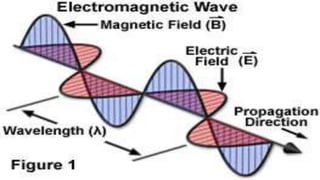
• The electric and magnetic fields in n electromagnetic wave
oscillate along directions perpendicular to the propagation
direction of the wave
Electomagnetic spectrum
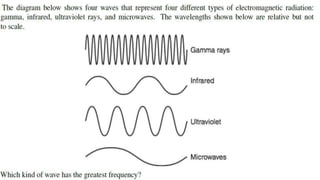
• A short wavelength means that the frequency will be higher
because one cycle can pass in a shorter amount of time
according to the university of wisconsin
• Similarily a longer wavelength has a lower frequency because
each cycle takes longer to complete
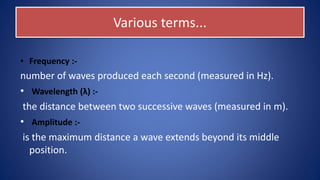
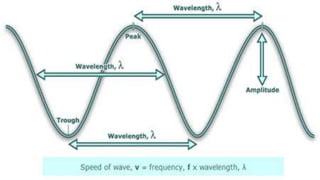
Various terms...
• Frequency :-
number of waves produced each second (measured in Hz).
• Wavelength (λ) :-
the distance between two successive waves (measured in m).
• Amplitude :-
is the maximum distance a wave extends beyond its middle
position.
Electromagnetic spectrum
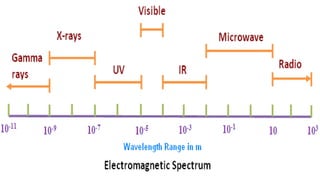
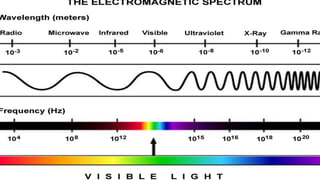
• Electromagnetic spectrum ranges from very short wavelenth
(gamma rays) to very long wavelenths(radio waves)
• The visible region of the spectrum extends approximately over
the wavelenth range 400-700nm
• The shorter wavelenghts being the blue end of the spectrum
and the longer wavelength the red
Electromagnetic spectrum
• The wavelength between 400 and 200nm make up the near
ultraviolet region of the spectrum
• The wavelength above 700nm to approximately 2000nm the
ultraviolet region
With matter
Interaction of electromagnetic radiation
• The nature of the interaction between radiation and
matter may include-
1. absorption
2. emission
3. scattering
• They help in the study of matter with respect to
1. qualitative study
2. quantitative study
Interaction with matter...
• The effect of electromagnetic radiation on interaction with matter
depends on energy associated with the radiation
• Very energetic radiations (UV and x-ray) may cause an electron to be
ejected from the molecules
• Radiation in the infrared region of the spectrum have much less
energy they can cause vibrations in molecules
Interaction with matter...
• Microwave radiation is even less energetic than infrared
radiation it can neither induce electronic transition in
molecules nor can it cause vibrations it can only cause
molecules to rotate
• Ultraviolet, visible - electronic transitions
• Infrared - molecular vibrations
• Microwave - molecular rotation
Types of spectroscopy
• When radiation meets matter, the radiation is either
scattered, emitted or absorbed
• so they are of three types
1.absorption spectroscopy
2.scattering spectroscopy
3.emission spectroscopy
Absorption spectroscopy
• In absorption spectroscopy an electromagnetic radiation is
absorbed by an atom or molecule
Which undergoes transition from a lower energy state to a higher
energy or excited state
• Absorption occurs only when the energy of radiation matches the
difference in energy between two energy levels
Scattering spectroscopy…
• Scattering spectroscopy measures certain physical properties by
measuring the amount of light that a substance scatters at
certain wavelenths .
• One of the most useful applications of light scattering
spectroscopy is RAMAN SPECTROSCOPY
Emission spectroscopy:
• Atoms or molecules that are excited to high energy levels can
decay to lower levels by emitting radiation
• The substance first absorbs energy and then emits this energy
as light
• Emission can be induced by sources of energy such as flame or
electromagnetic radiation
Principles of absorption spectroscopy…
Lamberts law:
• It states that when monochromatic light passes through a
transparent medium, the intensity of transmitted light decreases
exponentially as the thickness of absorbing material increases
Beer’s law:
• It stats that the intensity of transmitted monochromatic light
decreases exponentially as the concentration of the absorbing
substance increases
Beer-lamberts law...
• The Beer-Lambert law states that the amount of light
absorbed by a substance dissolved in a fully transmitting
solvent is directly proportional to the concentration of the
substance and the path length.
Spectrophotometer...
• A spectrophotometer is an instrument that measures the
amount of light absorbed by a sample.
• used to measure the concentration of solutes in solution by
measuring the amount of the light that is absorbed by the
solution in a cuvette placed in the spectrophotometer .
Parts...
• Light source
• A monochromator
• Sample holder(cuvvette)
• Light detector
Light source…
• The function of the light source is to provide a sufficient of
light
• The light source typically yields a high output of polychromatic
light over a wide range of the spectrum.
Tungsten Lamp
• Tungsten Halogen Lamp, it is the most common light source
used in spectrophotometer.
• This lamp consists of a tungsten filament enclosed in a glass
envelope,
• with a wavelength range of about 330 to 900 nm, are used for
the visible region. It has long life about 1200h
Hydrogen / Deuterium Lamps
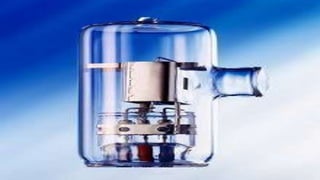
• For the ultraviolet region, hydrogen or deuterium lamps are
frequently used.
• their range is approximately 200 to 450 nm.
• Deuterium lamps are generally more stable
• and has long life about 500h.
• This lamp generates continuous or discontinuous spectral.
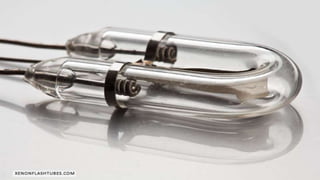
Xenon flash lamps
• 1)Their range between ( 190nm - 1000 nm)
• 2) Emit both UV and visible wavelengths
• 3) Long life
• 4) Do not heat up the instrument
• 5) Reduce warm up time
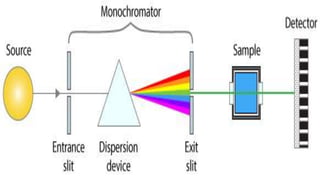
Monochromator
• Monochromator Accepts polychromatic input light from a lamp
and outputs monochromatic light.
• Monochromator consists of three parts:
• I) Entrance slit
• II) Exit slit
• III) Dispersion device
Dispersion devices
• Dispersion devices causes a different wavelength of light to be dispersion
at different angles monochromators used for function.
• Types of dispersion devices :
• Prism:- is used to isolate different wavelength .
• If a parallel beam of radiation falls on a prism , the radiation of two
different wavelength will be bent through different angles.
• Prism may be made of glass or quartz.
• The glass prisms are suitable for radiation essentially in the visible range
• whereas the quartz prism can cover the ultraviolet spectrum also.
• It is found that the dispersion given by glass is about three times that of
quartz.
Filter
• Filters separate different parts of the electromagnetic spectrum by
absorbing or reflecting certain wavelengths and transmitting other
wavelengths.
• Absorption filters:-
are glass substrates containing absorbing species that absorb certain
wavelength.
• Interference filters:-
are made of multiple dielectric thin films on a substrate.
• They use interference to selectively transmit or reflect a certain
range of wavelengths.
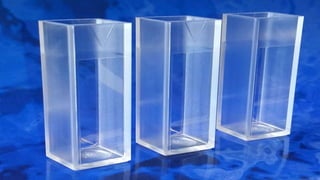
Absorption cells(Cuvettes)
• A cuvette is a kind of cell (usually a small square tube) sealed at
one end
• made of Plastic, glass or optical grade quartz
• designed to hold samples for spectroscopic experiments.
• Cuvette should be as clear as possible, without impurities that
might affect a spectroscopic reading
Why should we use quartz cuvettes for
measuring absorbance in the UV range and
plastic cuvettes in the visible range?
Why the cuvettes have two forsted sides?
Types of spectrophotometer
• There are two classes of spectrophotometers:
1.Single beam spectrophotometer
2.double beam spectrophotometer
Single beam spectophotometer
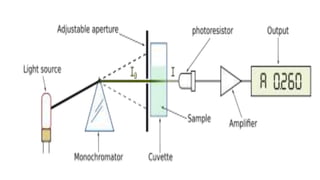
• The single beam spectrophotometer was the first invented,
• all the light passes through the sample.
• In this case, to measure the intensity of the incident light, the sample must
be removed so all the light can pass through.
• This type is cheaper because there are less parts and the system is less
complicated.
• low cost,
• high Sensitivity , because the optical system is simple.
• The disadvantage is that an appreciable amount of Time elapses between
taking the reference and Making the sample measurement
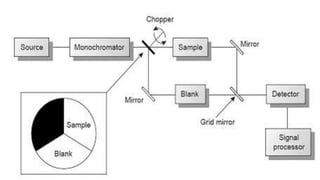
Double beam spectophotometer
• The double beam instrument design aims to eliminate drift by
measuring blank and sample virtually simultaneously.
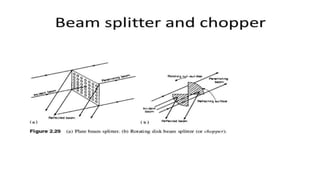
• A chopper alternately transmits and reflects the light beam so that
it travels down the blank and the sample optical paths to a single
detector.
• high stability because reference and sample are measured virtually
at the same moment in time.
• The disadvantages are
higher cost,
lower sensitivity
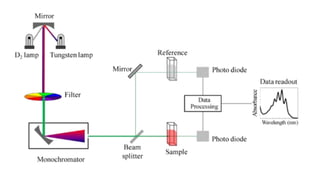
Split beam spectophotometer
• The split beam spectrophotometer is similar to the double
beam spectrophotometer but it uses a beam splitter instead of
a chopper.
• Thus blank and sample measurements can be made at the
same moment in time.
• Spectra are measured in the same way as with a double beam
spectrophotometer.
• The advantage of this design is good stability,.
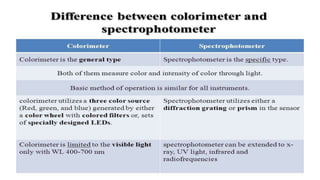
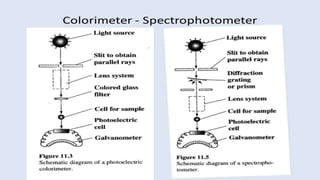
What is the difference between colorimeter
and spectrophotometer
Spectroscopy
Spectroscopy
Spectroscopy
Spectroscopy

Spectroscopy

  • 1.
  • 2.
    contents • Introduction • Electromagneticradiation • Various terms • Absorption spectroscopy • UV/visible spectroscopy • Applications
  • 3.
    • Spectroscopy isthe study of the interaction between electromagnetic radiation and matter. The matter can be atoms, molecules or ions
  • 4.
    spectrometer Spectrometer is somethingwhich can be used to measure the presence of particular compound or particle in a molecule
  • 5.
    Spectrum... • Spectrum isa plot of the amount of light absorbed by a sample versus the wavelength of the light • The amount of light absorbed is called the absorbance
  • 6.
    Electromagnetic radiation • EMis a form of energy that is all around us • EM is a form of energy and has both electrical and magnetic characteristics • Electricity and magnetism were once thought to be separate forces • James clerk maxwell developed a unified theory of electromagnetism • The study of electromagnetism deals with how electrically charged particles interact with each other and with magnetic fields
  • 7.
    Electromagnetic radiation • Electromagneticradiation is a form of energy and has both electrical and magnetic characteristics • The electric and magnetic fields in n electromagnetic wave oscillate along directions perpendicular to the propagation direction of the wave
  • 9.
    Electomagnetic spectrum • Ashort wavelength means that the frequency will be higher because one cycle can pass in a shorter amount of time according to the university of wisconsin • Similarily a longer wavelength has a lower frequency because each cycle takes longer to complete
  • 10.
    Various terms... • Frequency:- number of waves produced each second (measured in Hz). • Wavelength (λ) :- the distance between two successive waves (measured in m). • Amplitude :- is the maximum distance a wave extends beyond its middle position.
  • 12.
    Electromagnetic spectrum • Electromagneticspectrum ranges from very short wavelenth (gamma rays) to very long wavelenths(radio waves) • The visible region of the spectrum extends approximately over the wavelenth range 400-700nm • The shorter wavelenghts being the blue end of the spectrum and the longer wavelength the red
  • 13.
    Electromagnetic spectrum • Thewavelength between 400 and 200nm make up the near ultraviolet region of the spectrum • The wavelength above 700nm to approximately 2000nm the ultraviolet region
  • 19.
    With matter Interaction ofelectromagnetic radiation
  • 20.
    • The natureof the interaction between radiation and matter may include- 1. absorption 2. emission 3. scattering • They help in the study of matter with respect to 1. qualitative study 2. quantitative study
  • 21.
    Interaction with matter... •The effect of electromagnetic radiation on interaction with matter depends on energy associated with the radiation • Very energetic radiations (UV and x-ray) may cause an electron to be ejected from the molecules • Radiation in the infrared region of the spectrum have much less energy they can cause vibrations in molecules
  • 22.
    Interaction with matter... •Microwave radiation is even less energetic than infrared radiation it can neither induce electronic transition in molecules nor can it cause vibrations it can only cause molecules to rotate • Ultraviolet, visible - electronic transitions • Infrared - molecular vibrations • Microwave - molecular rotation
  • 23.
  • 24.
    • When radiationmeets matter, the radiation is either scattered, emitted or absorbed • so they are of three types 1.absorption spectroscopy 2.scattering spectroscopy 3.emission spectroscopy
  • 25.
    Absorption spectroscopy • Inabsorption spectroscopy an electromagnetic radiation is absorbed by an atom or molecule Which undergoes transition from a lower energy state to a higher energy or excited state • Absorption occurs only when the energy of radiation matches the difference in energy between two energy levels
  • 26.
    Scattering spectroscopy… • Scatteringspectroscopy measures certain physical properties by measuring the amount of light that a substance scatters at certain wavelenths . • One of the most useful applications of light scattering spectroscopy is RAMAN SPECTROSCOPY
  • 27.
    Emission spectroscopy: • Atomsor molecules that are excited to high energy levels can decay to lower levels by emitting radiation • The substance first absorbs energy and then emits this energy as light • Emission can be induced by sources of energy such as flame or electromagnetic radiation
  • 28.
    Principles of absorptionspectroscopy… Lamberts law: • It states that when monochromatic light passes through a transparent medium, the intensity of transmitted light decreases exponentially as the thickness of absorbing material increases Beer’s law: • It stats that the intensity of transmitted monochromatic light decreases exponentially as the concentration of the absorbing substance increases
  • 29.
    Beer-lamberts law... • TheBeer-Lambert law states that the amount of light absorbed by a substance dissolved in a fully transmitting solvent is directly proportional to the concentration of the substance and the path length.
  • 30.
    Spectrophotometer... • A spectrophotometeris an instrument that measures the amount of light absorbed by a sample. • used to measure the concentration of solutes in solution by measuring the amount of the light that is absorbed by the solution in a cuvette placed in the spectrophotometer .
  • 31.
    Parts... • Light source •A monochromator • Sample holder(cuvvette) • Light detector
  • 32.
    Light source… • Thefunction of the light source is to provide a sufficient of light • The light source typically yields a high output of polychromatic light over a wide range of the spectrum.
  • 33.
    Tungsten Lamp • TungstenHalogen Lamp, it is the most common light source used in spectrophotometer. • This lamp consists of a tungsten filament enclosed in a glass envelope, • with a wavelength range of about 330 to 900 nm, are used for the visible region. It has long life about 1200h
  • 35.
    Hydrogen / DeuteriumLamps • For the ultraviolet region, hydrogen or deuterium lamps are frequently used. • their range is approximately 200 to 450 nm. • Deuterium lamps are generally more stable • and has long life about 500h. • This lamp generates continuous or discontinuous spectral.
  • 37.
    Xenon flash lamps •1)Their range between ( 190nm - 1000 nm) • 2) Emit both UV and visible wavelengths • 3) Long life • 4) Do not heat up the instrument • 5) Reduce warm up time
  • 39.
    Monochromator • Monochromator Acceptspolychromatic input light from a lamp and outputs monochromatic light. • Monochromator consists of three parts: • I) Entrance slit • II) Exit slit • III) Dispersion device
  • 40.
    Dispersion devices • Dispersiondevices causes a different wavelength of light to be dispersion at different angles monochromators used for function. • Types of dispersion devices : • Prism:- is used to isolate different wavelength . • If a parallel beam of radiation falls on a prism , the radiation of two different wavelength will be bent through different angles. • Prism may be made of glass or quartz. • The glass prisms are suitable for radiation essentially in the visible range • whereas the quartz prism can cover the ultraviolet spectrum also. • It is found that the dispersion given by glass is about three times that of quartz.
  • 41.
    Filter • Filters separatedifferent parts of the electromagnetic spectrum by absorbing or reflecting certain wavelengths and transmitting other wavelengths. • Absorption filters:- are glass substrates containing absorbing species that absorb certain wavelength. • Interference filters:- are made of multiple dielectric thin films on a substrate. • They use interference to selectively transmit or reflect a certain range of wavelengths.
  • 42.
    Absorption cells(Cuvettes) • Acuvette is a kind of cell (usually a small square tube) sealed at one end • made of Plastic, glass or optical grade quartz • designed to hold samples for spectroscopic experiments. • Cuvette should be as clear as possible, without impurities that might affect a spectroscopic reading
  • 44.
    Why should weuse quartz cuvettes for measuring absorbance in the UV range and plastic cuvettes in the visible range?
  • 45.
    Why the cuvetteshave two forsted sides?
  • 49.
    Types of spectrophotometer •There are two classes of spectrophotometers: 1.Single beam spectrophotometer 2.double beam spectrophotometer
  • 50.
    Single beam spectophotometer •The single beam spectrophotometer was the first invented, • all the light passes through the sample. • In this case, to measure the intensity of the incident light, the sample must be removed so all the light can pass through. • This type is cheaper because there are less parts and the system is less complicated. • low cost, • high Sensitivity , because the optical system is simple. • The disadvantage is that an appreciable amount of Time elapses between taking the reference and Making the sample measurement
  • 52.
    Double beam spectophotometer •The double beam instrument design aims to eliminate drift by measuring blank and sample virtually simultaneously. • A chopper alternately transmits and reflects the light beam so that it travels down the blank and the sample optical paths to a single detector. • high stability because reference and sample are measured virtually at the same moment in time. • The disadvantages are higher cost, lower sensitivity
  • 54.
    Split beam spectophotometer •The split beam spectrophotometer is similar to the double beam spectrophotometer but it uses a beam splitter instead of a chopper. • Thus blank and sample measurements can be made at the same moment in time. • Spectra are measured in the same way as with a double beam spectrophotometer. • The advantage of this design is good stability,.
  • 57.
    What is thedifference between colorimeter and spectrophotometer