UV-Visible Molecular
Absorption Spectrophotometry
Theory, Instrumentation, Merits,
Limitations, Applications
By
Ch.Krishna
Analytical laboratory
EPTRI, Hyderabad
Property of matter is used
Gravimetry - Weight
Volumetry – precipitation, redox
complexometric
Light - matter - Absorb
Reflect
Transmits
Why spectrophotometry ?
A need to to analyse at trace quantities in
the samples
Gravimetry and volumetry fails at ppm and
lower levels
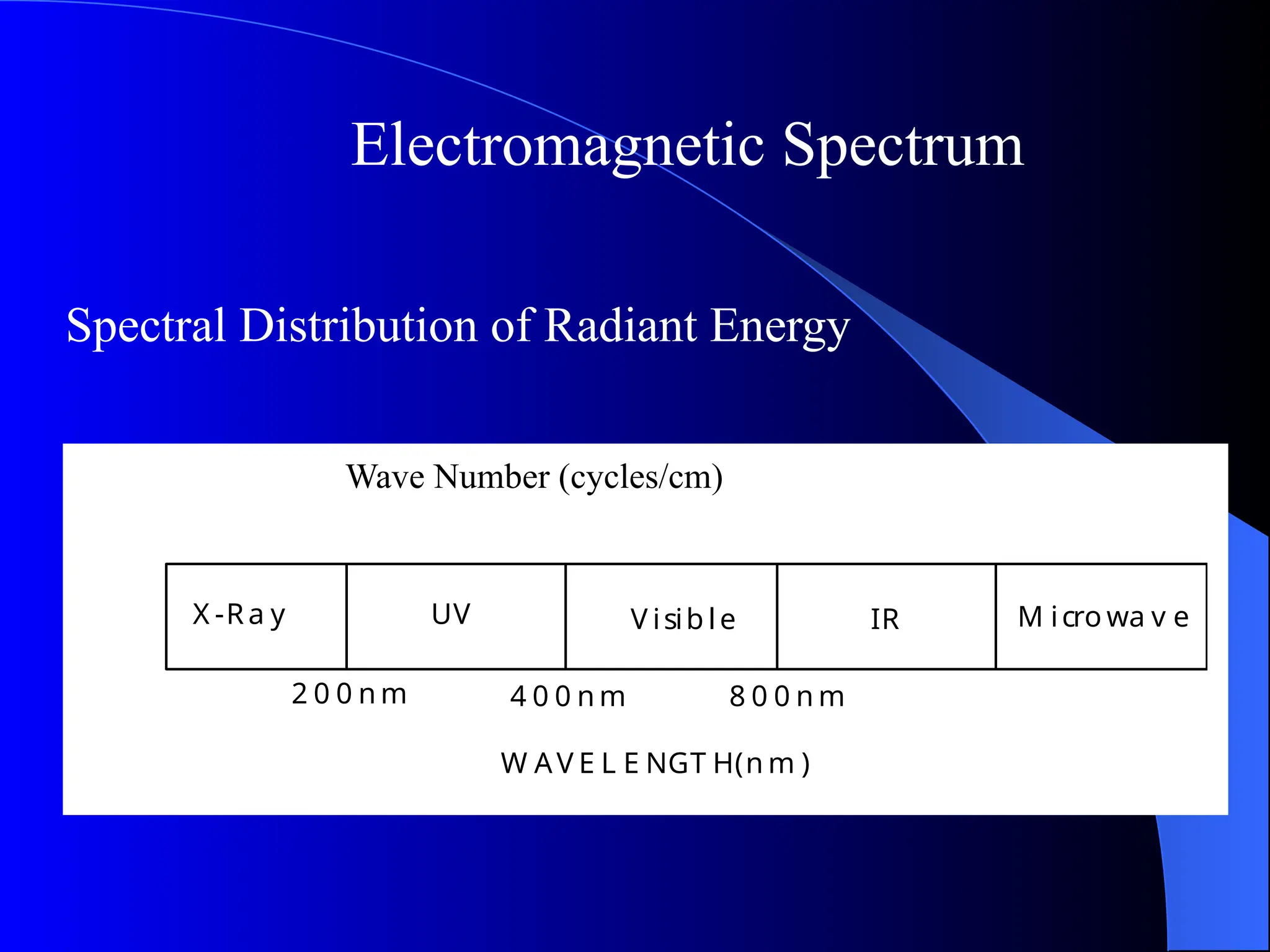
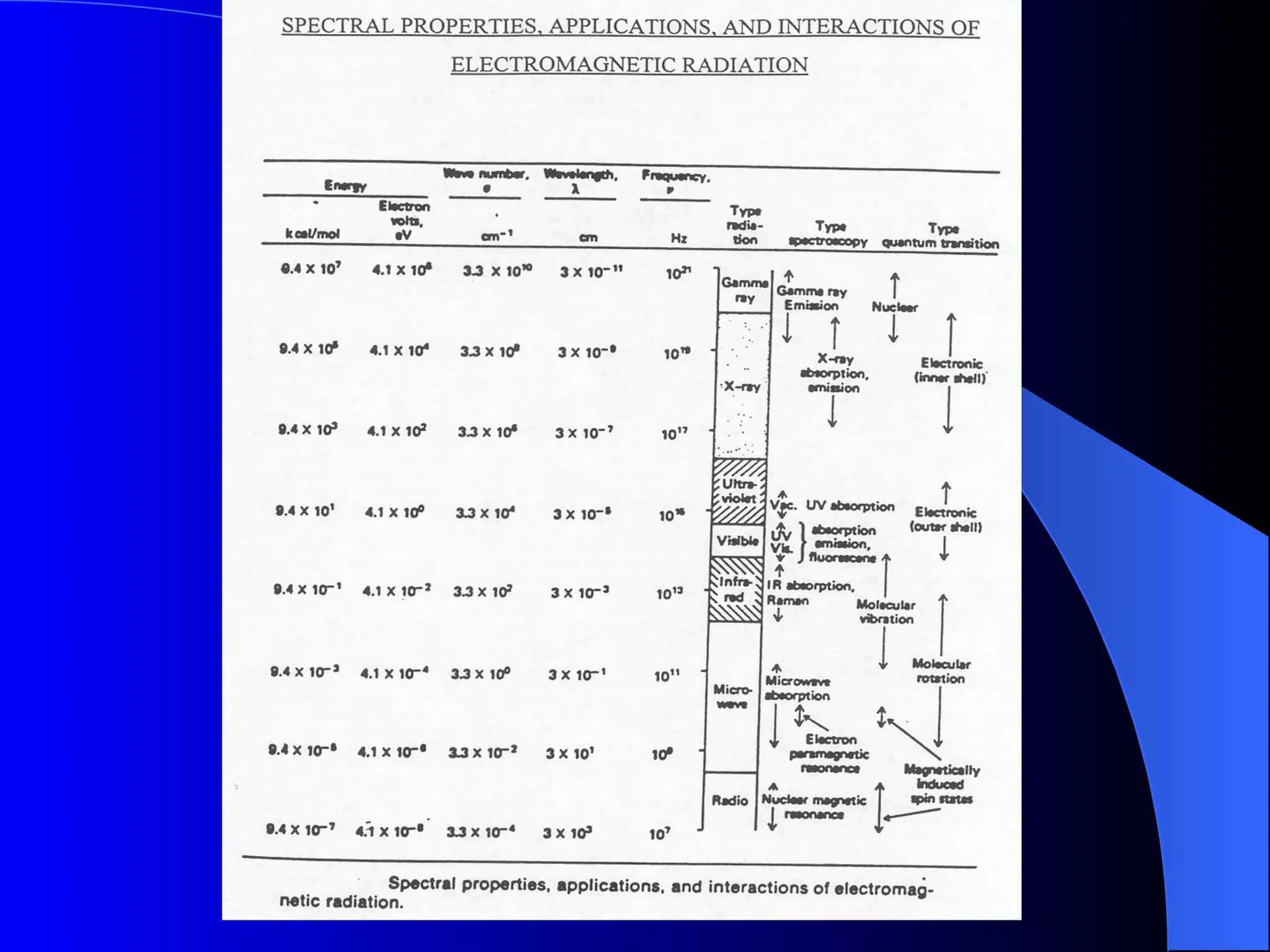
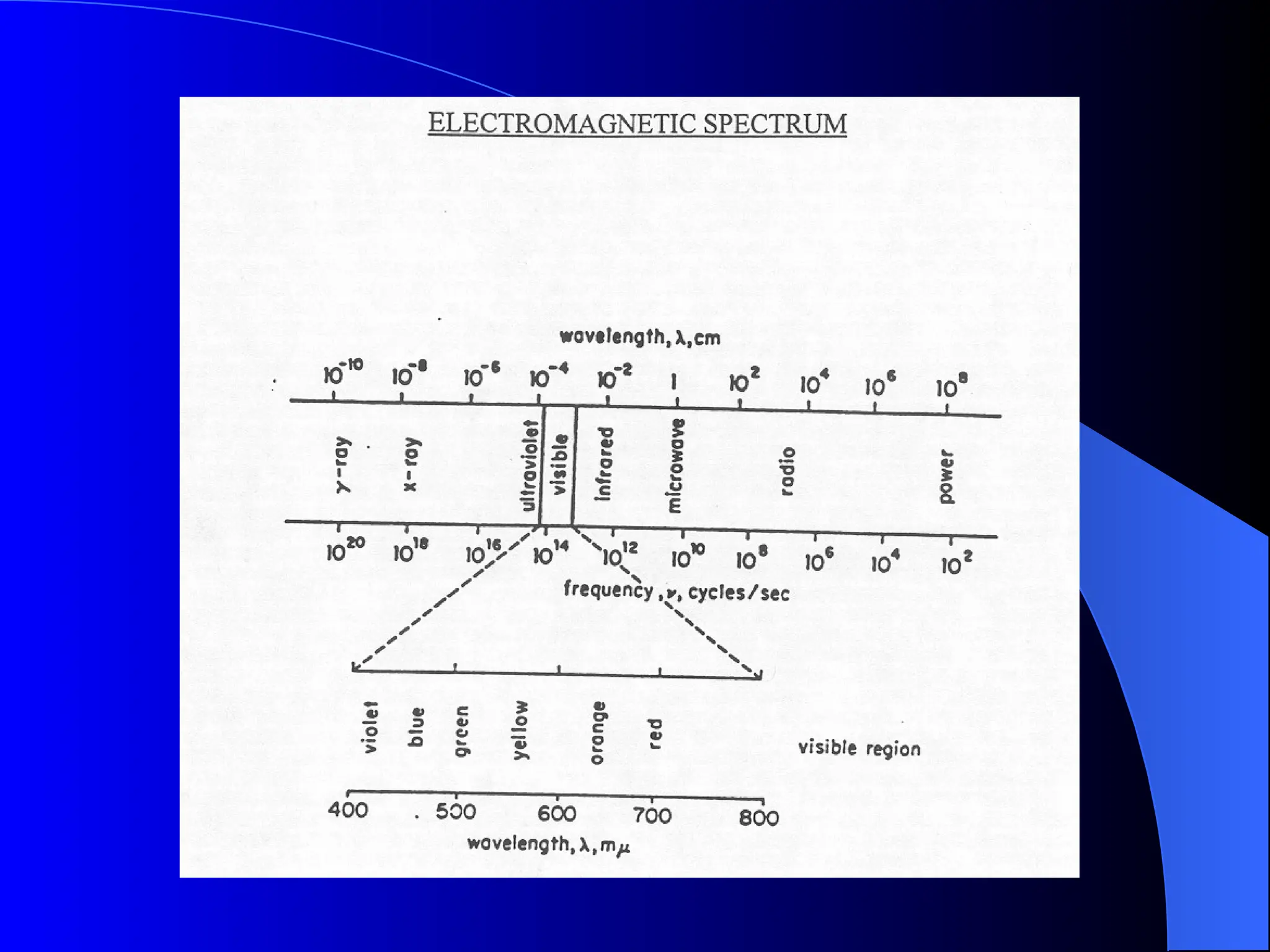
Electromagnetic Spectrum
Spectral Distribution of Radiant Energy
Wave Number (cycles/cm)
X -Ra y UV V isib le IR M icro wa v e
2 0 0 n m 4 0 0 n m 8 0 0 n m
W AV E L E NGT H(n m )
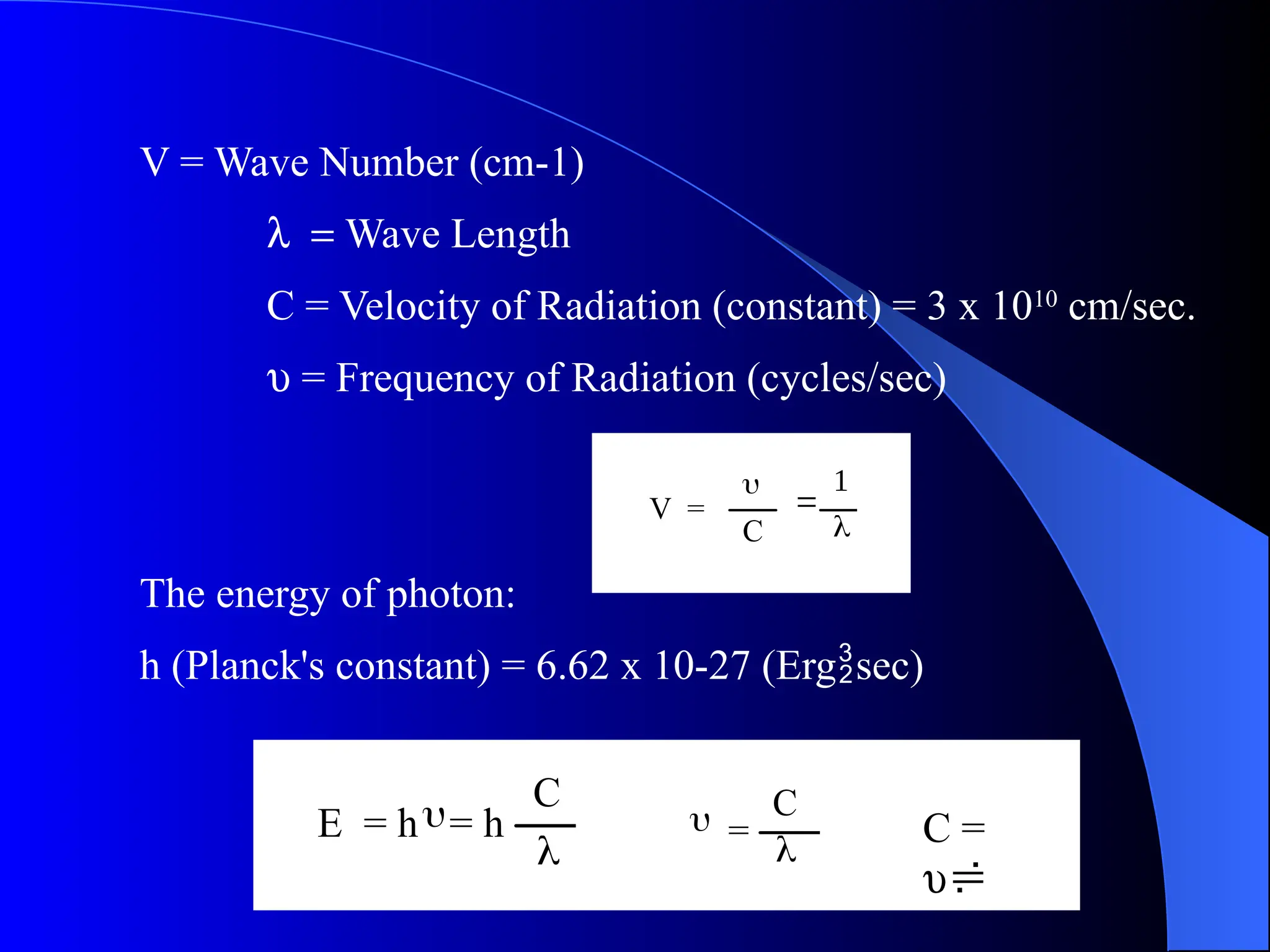
V = Wave Number (cm-1)
l = Wave Length
C = Velocity of Radiation (constant) = 3 x 10¹⁰
cm/sec.
u = Frequency of Radiation (cycles/sec)
The energy of photon:
h (Planck's constant) = 6.62 x 10⁻²⁷ (Ergsec)
V =

C 


E = h = h
C

 C
= 
 C =
u
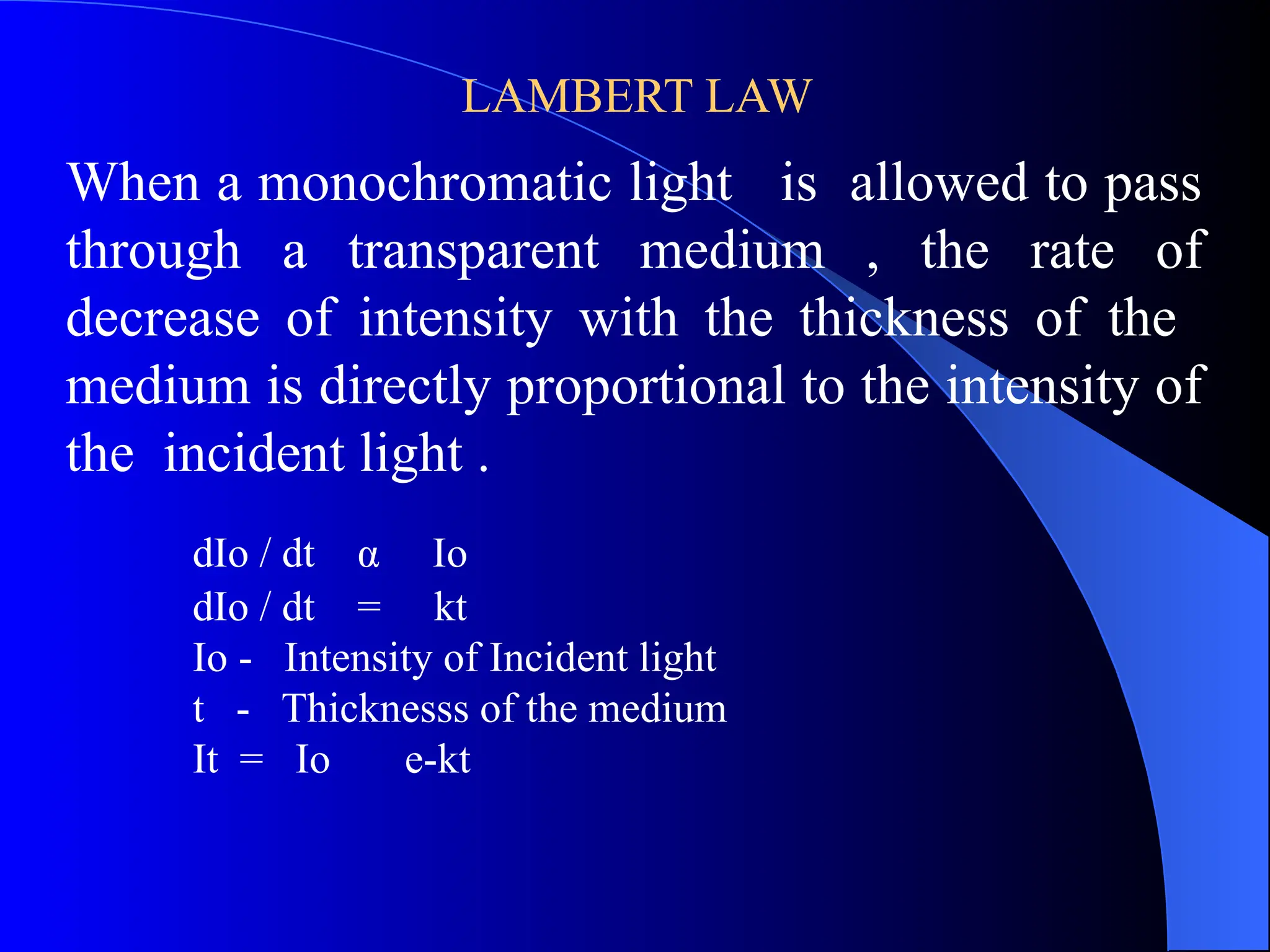
LAMBERT LAW
When a monochromatic light is allowed to pass
through a transparent medium , the rate of
decrease of intensity with the thickness of the
medium is directly proportional to the intensity of
the incident light .
dIo / dt α Io
dIo / dt = kt
Io - Intensity of Incident light
t - Thicknesss of the medium
It = Io e-kt
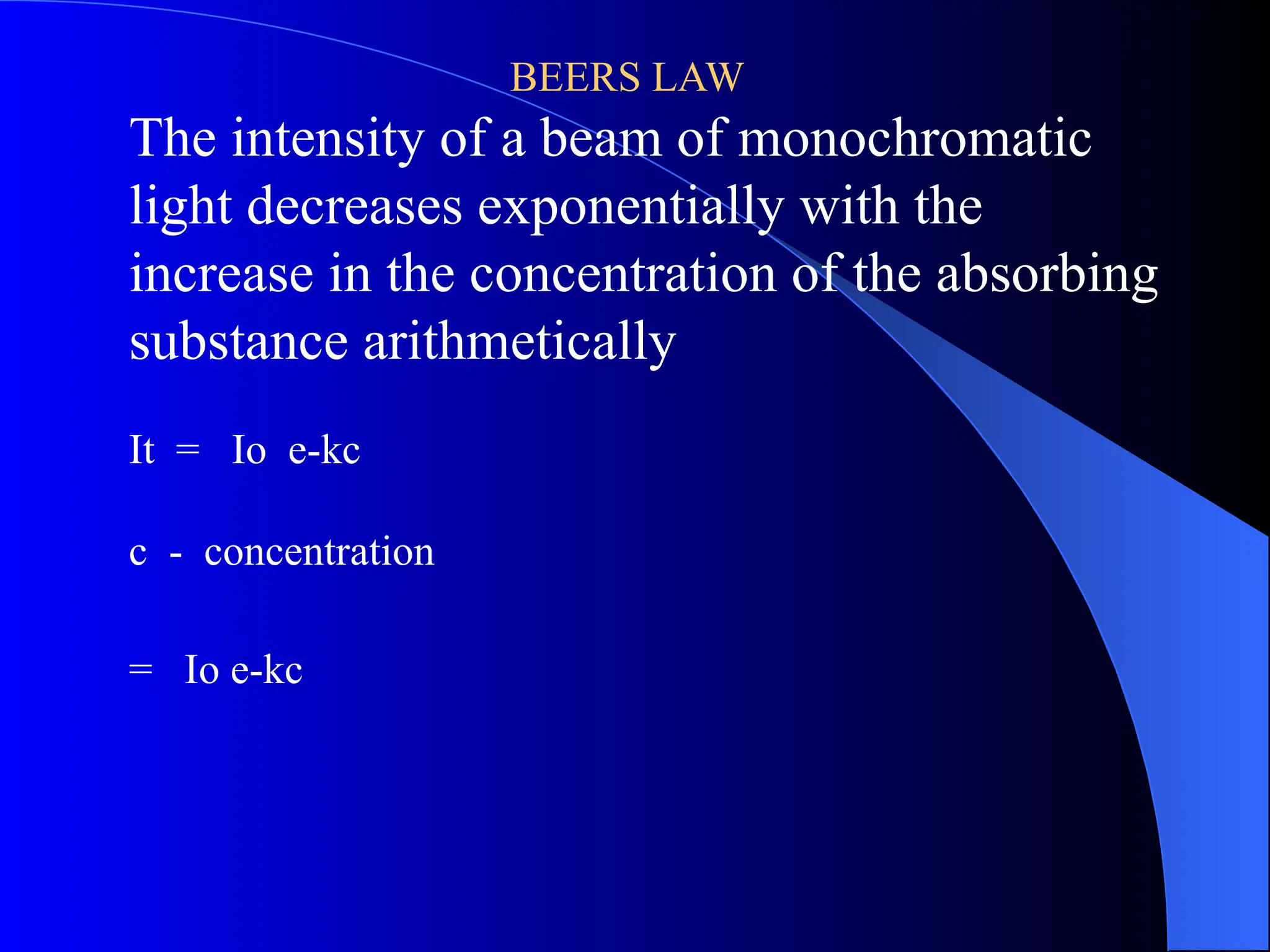
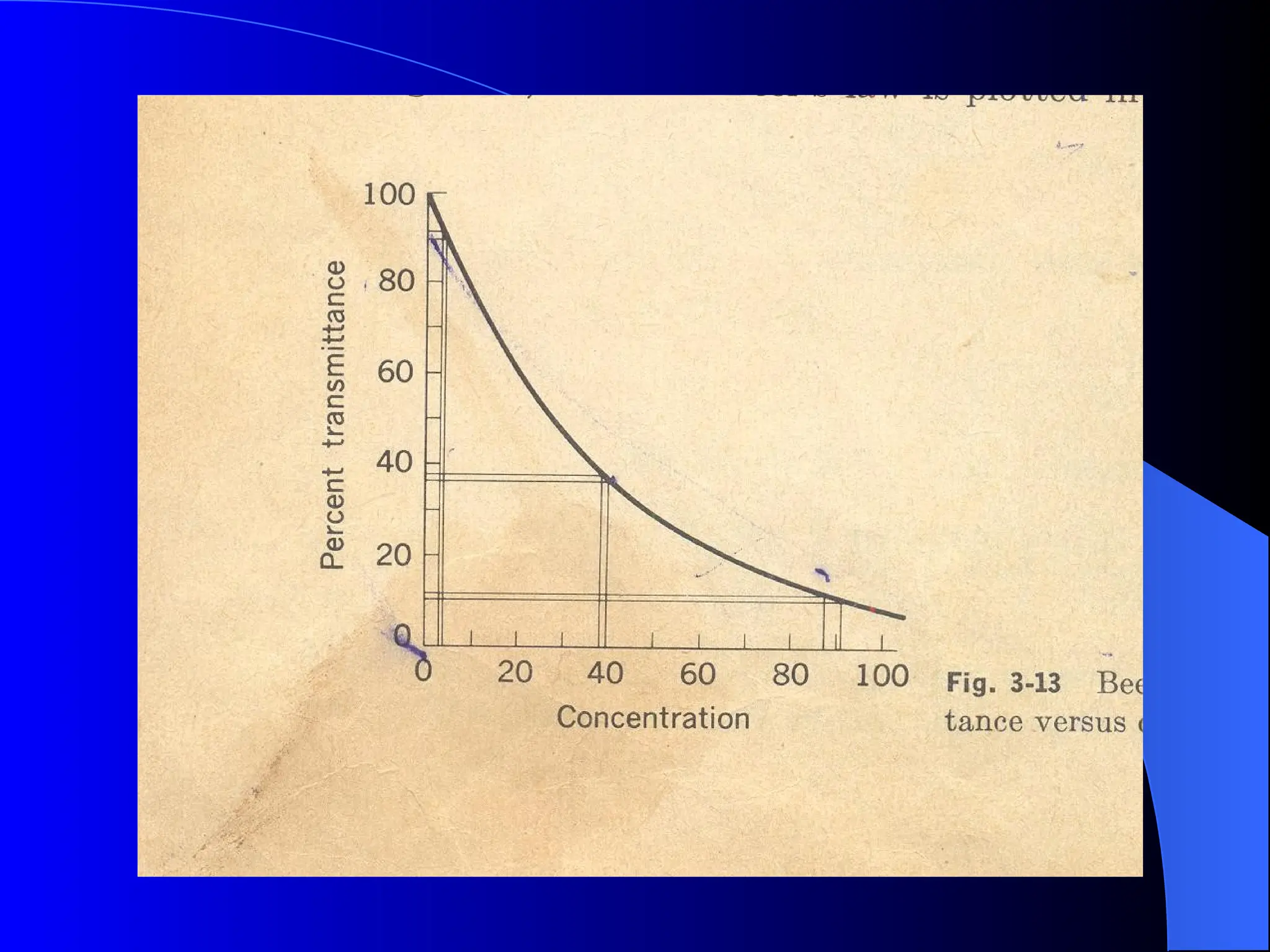
BEERS LAW
The intensity of a beam of monochromatic
light decreases exponentially with the
increase in the concentration of the absorbing
substance arithmetically
It = Io e-kc
c - concentration
= Io e-kc
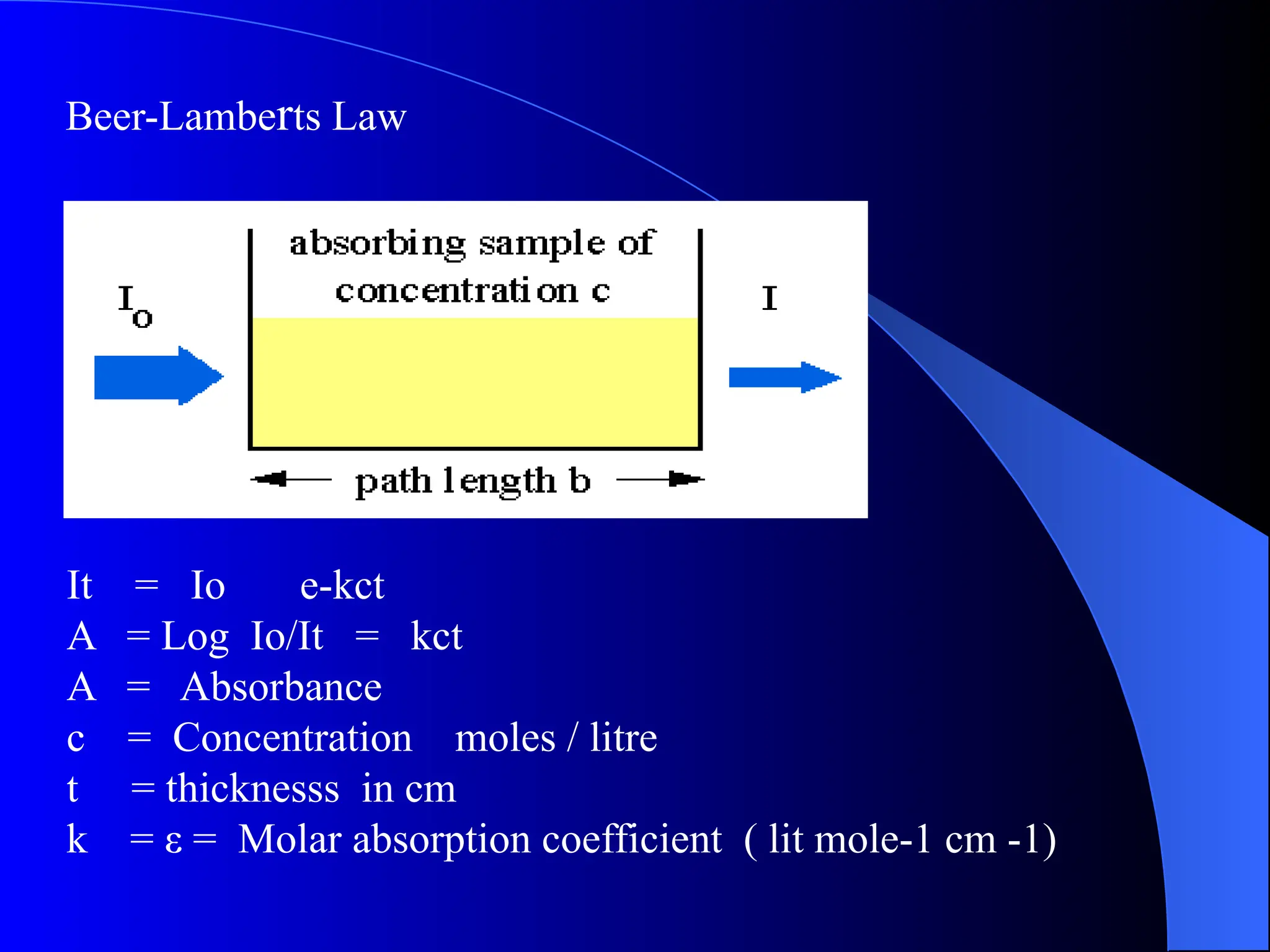
It = Io e-kct
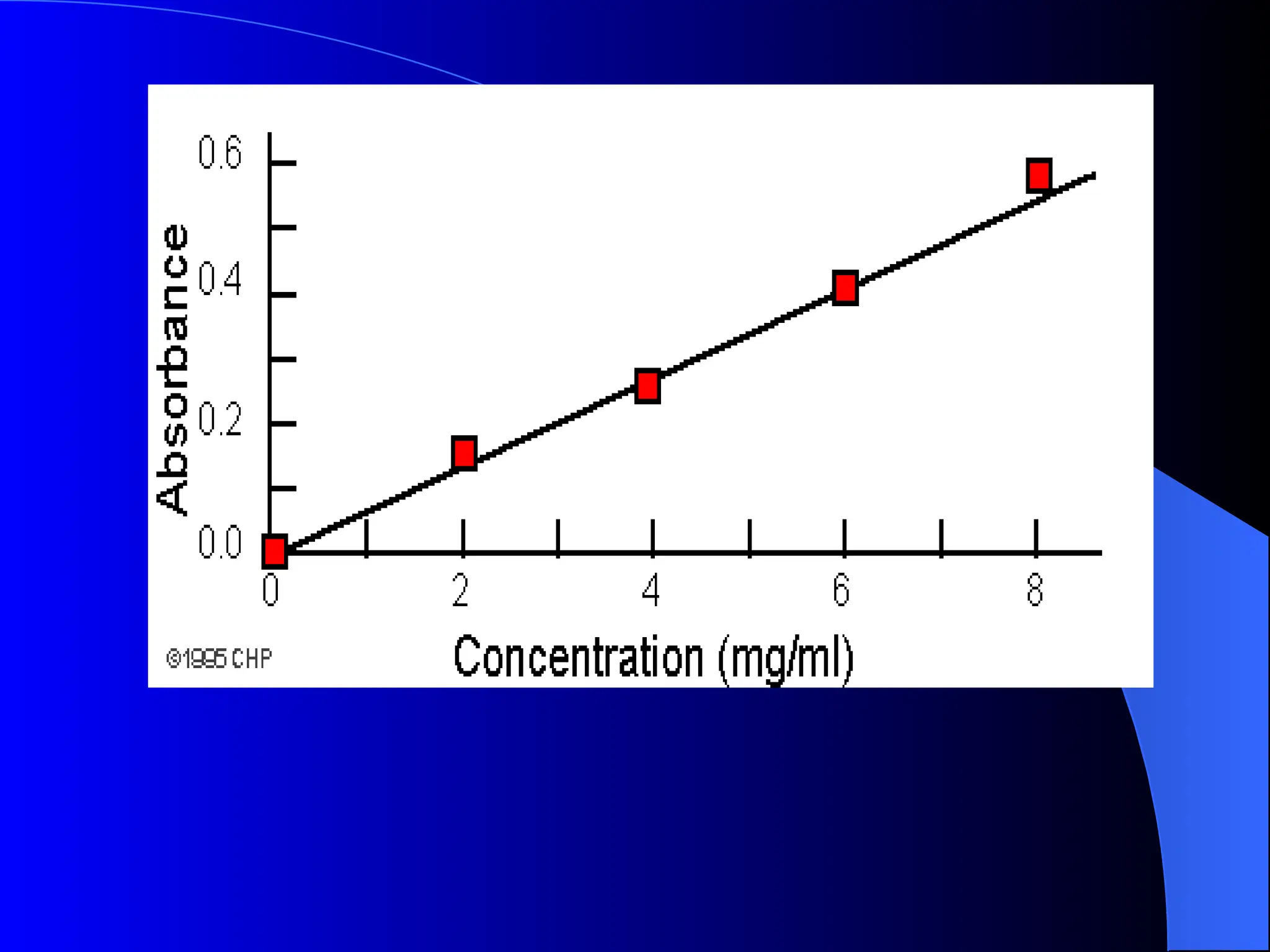
A = Log Io/It = kct
A = Absorbance
c = Concentration moles / litre
t = thicknesss in cm
k = ε = Molar absorption coefficient ( lit mole-1 cm -1)
Beer-Lamberts Law
Limitations of the Beer-Lambert law
The linearity of the Beer-Lambert law is limited by
chemical and instrumental factors. Causes of

nonlinearity include:
deviations in absorptivity coefficients at high
concentrations (>0.01M) due to electrostatic
interactions between molecules in close proximity
scattering of light due to particulates in the sample
fluoresecence or phosphorescence of the sample
changes in refractive index at high analyte
concentration
shifts in chemical equilibria as a function of
concentration
non-monochromatic radiation, deviations can be
minimized by using a relatively flat part of the
absorption spectrum such as the maximum of an
absorption band
stray light
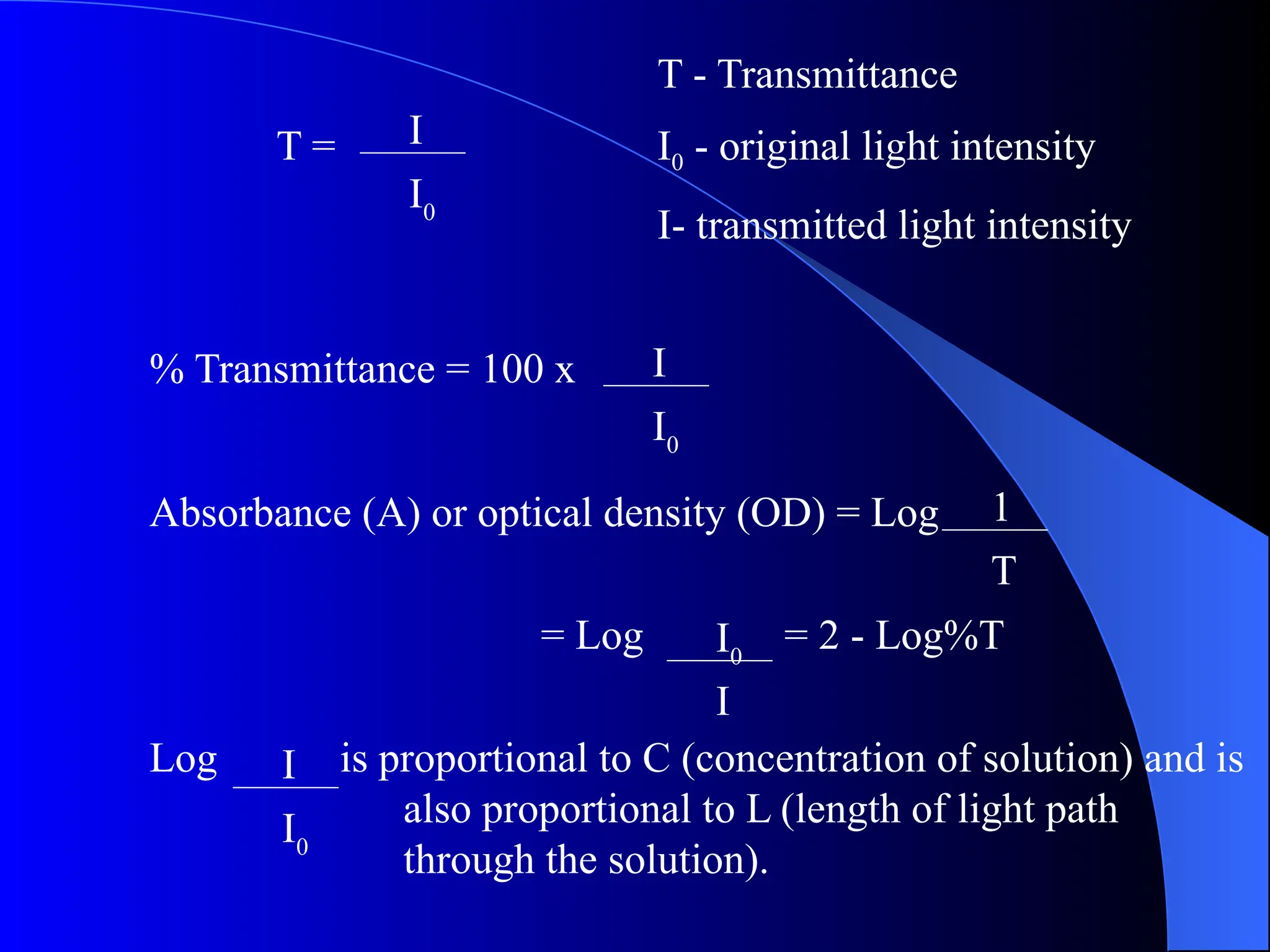
T - Transmittance
T = I0 - original light intensity
I- transmitted light intensity
% Transmittance = 100 x
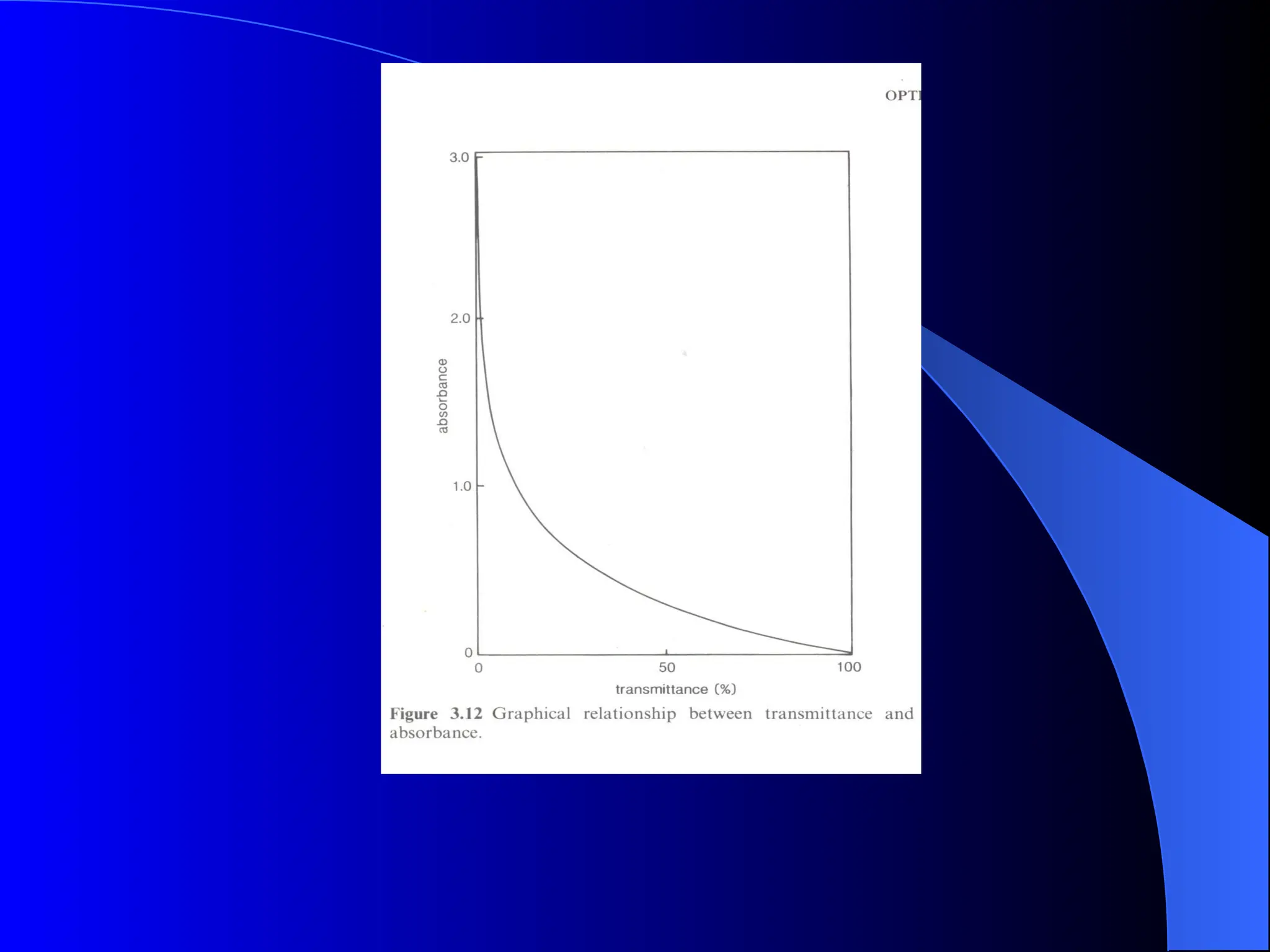
Absorbance (A) or optical density (OD) = Log
= Log = 2 - Log%T
Log is proportional to C (concentration of solution) and is
also proportional to L (length of light path
through the solution).
I
I0
I
I0
I0
I
1
T
I
I0
STEPS IN DEVELOPING A SPECTROPHOTOMETRIC
ANALYTICAL METHOD
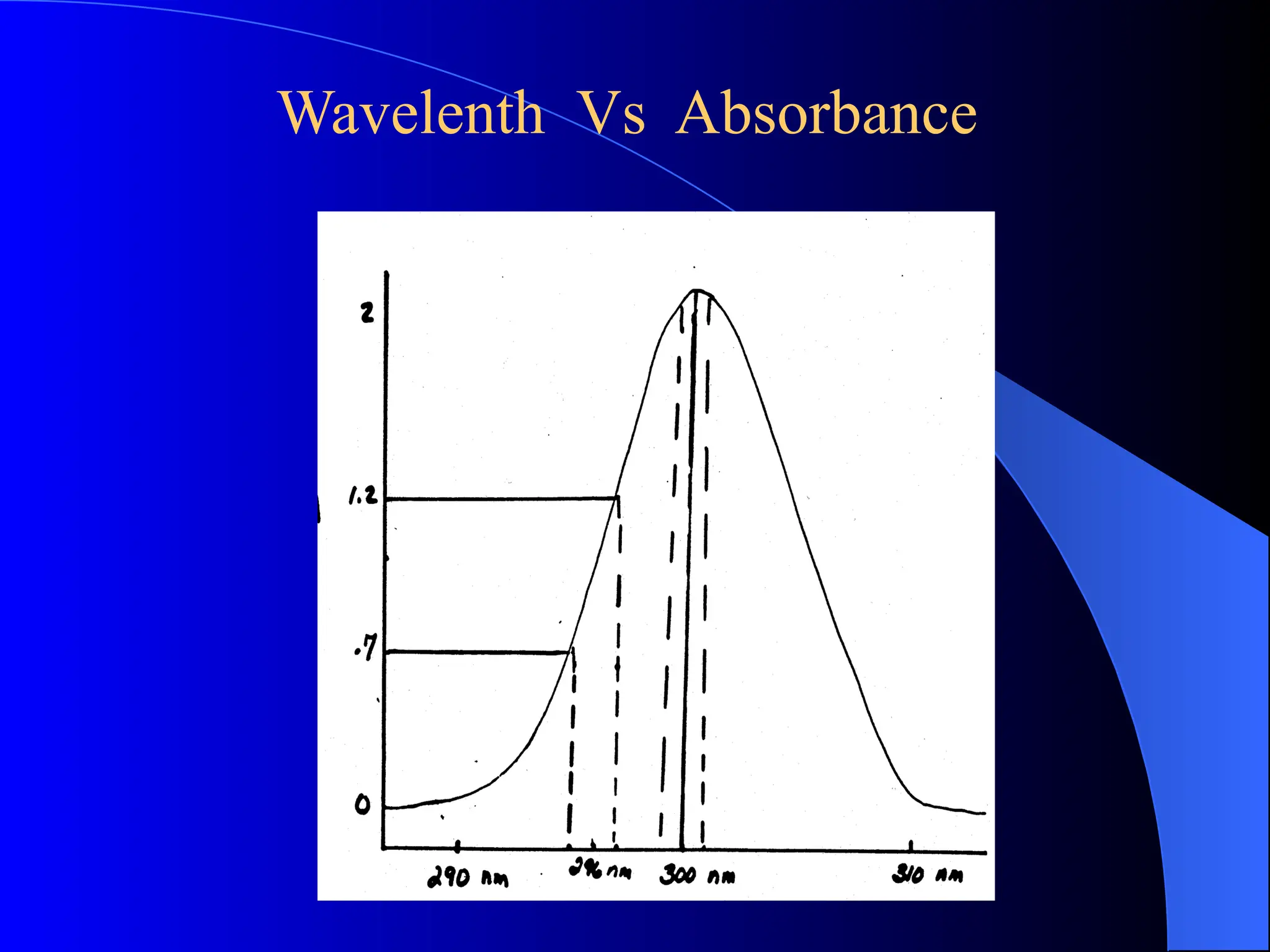
1. Run the sample for spectrum
2. Obtain a monochromatic
wavelength for the maximum
absorption wavelength.
3. Calculate the concentration
of your sample using Beer
Lambert Equation: A = KCL
Wavelenth Vs Absorbance
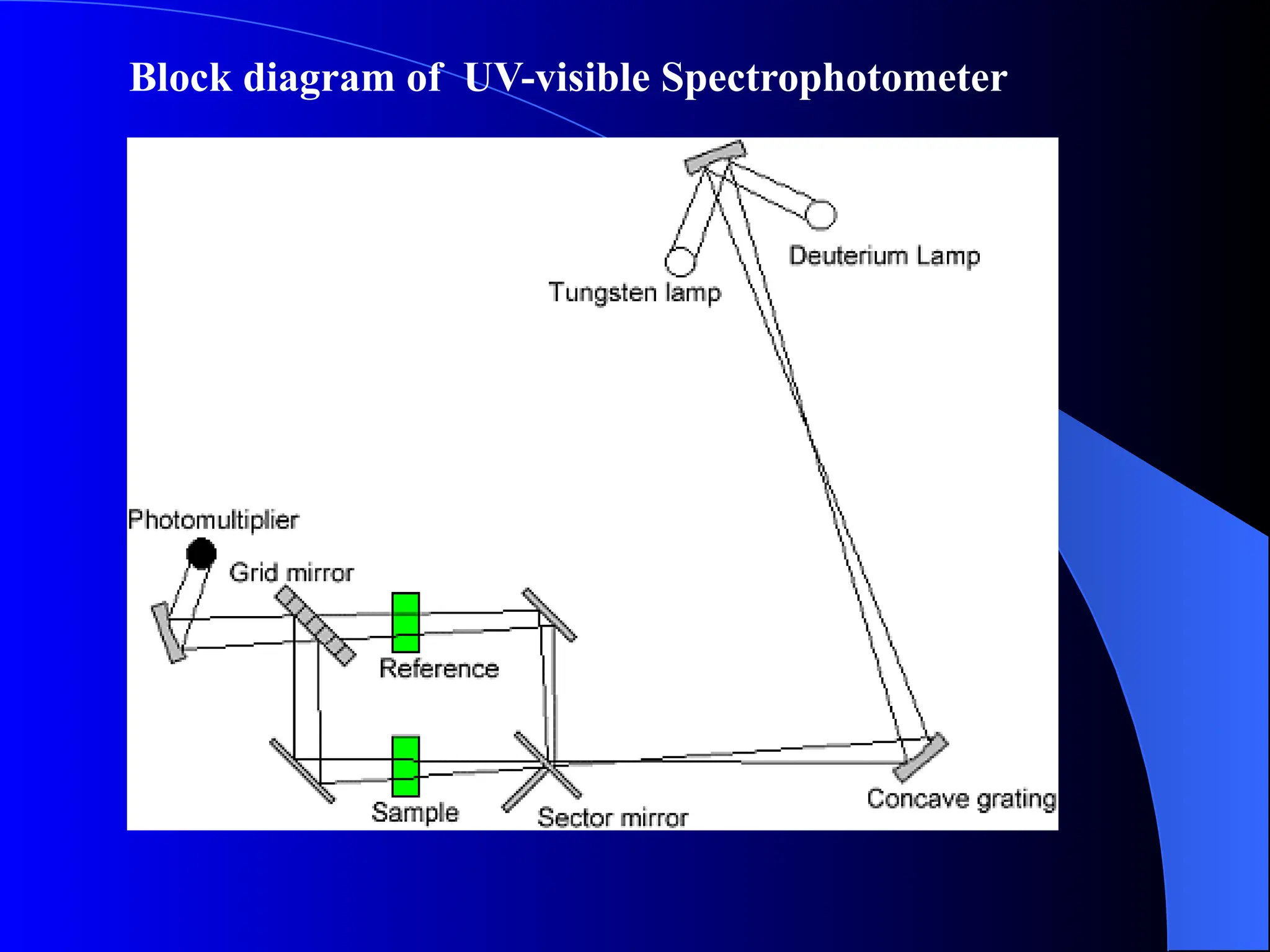
Block diagram of UV-visible Spectrophotometer
Instruments for measuring the absorption of U.V.
or visible radiation are made up of the following
components:
Sources (UV and visible)
Wavelength selector (monochromator)
Sample containers
Detector
Signal processor and readout
Sources of UV radiation
The electrical excitation of deuterium or hydrogen at low
pressure produces a continuous UV spectrum Both
deuterium and hydrogen lamps emit radiation in the
range 160 - 375 nm.
Quartz windows must be used in these lamps, and quartz
cuvettes must be used, because glass absorbs radiation of
wavelengths less than 350 nm.
Sources of visible radiation
The tungsten filament lamp is commonly employed as
a source of visible light. This type of lamp is used in
the wavelength range of 350 - 2500 nm. The energy
emitted by a tungsten filament lamp is proportional to
the fourth power of the operating voltage. This means
that for the energy output to be stable, the voltage to
the lamp must be very stable indeed. Electronic voltage
regulators or constant-voltage transformers are used to
ensure this stability.
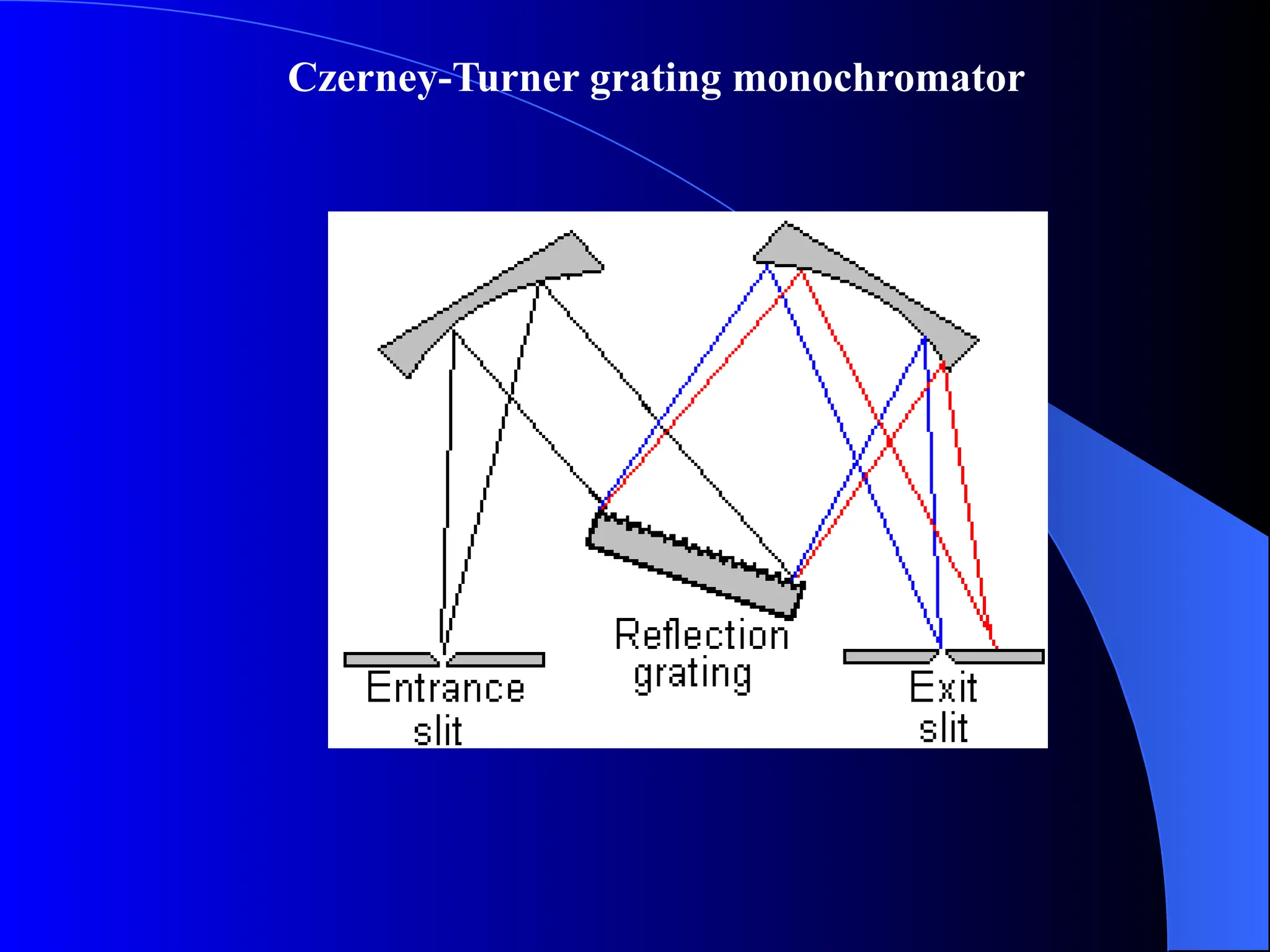
Czerney-Turner grating monochromator
Cuvettes
The containers for the sample and
reference solution must be transparent
to the radiation which will pass through
them. Quartz or fused silica cuvettes are
required for spectroscopy in the UV
region. These cells are also transparent
in the visible region.
Detectors
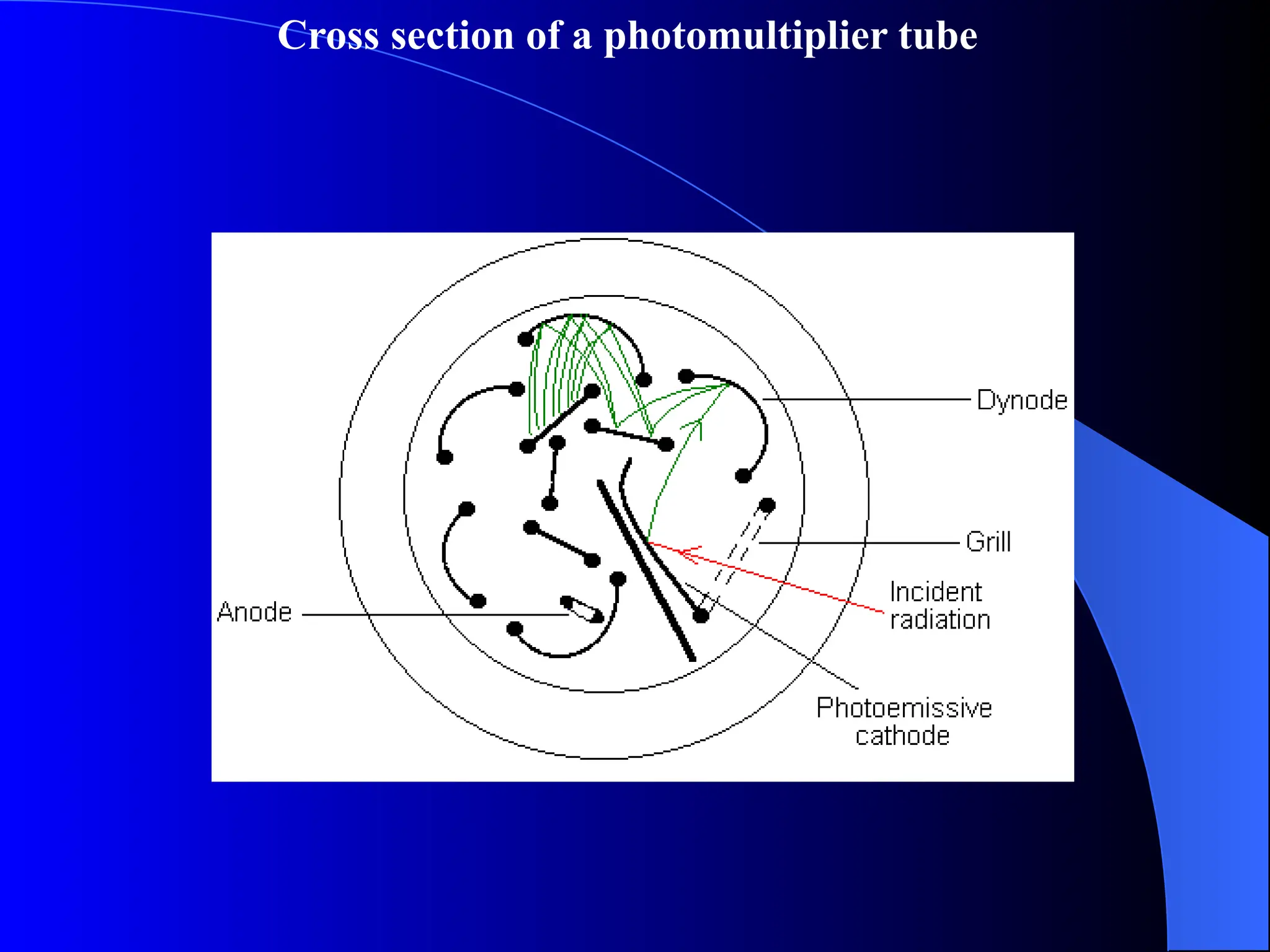
The photomultiplier tube is a commonly used detector in UV-Vis
spectroscopy.
photoemissive cathode (a cathode which emits electrons when
struck by photons of radiation),
dynodes (which emit several electrons for each electron striking
them) and an anode.
Each original photon produces 10-6 TO 10-7 electrons. The
resulting current is amplified and measured.
Photomultipliers are very sensitive to UV and visible radiation.
They have fast response times. Intense light damages
photomultipliers; they are limited to measuring low power
radiation.
Cross section of a photomultiplier tube
Advantages
Very simple to handle
Determine elemental concentration at ppm levels
It has good precision when compared to flame techniques
Non-metals like S, P, F can be determined easily
Some refractory elements like Th, Zr, ant Ti can be determined at
ppm levels
Limitations
Long sample preparation time
Requires separation of interfering ion
one or two elements can be determined at a time
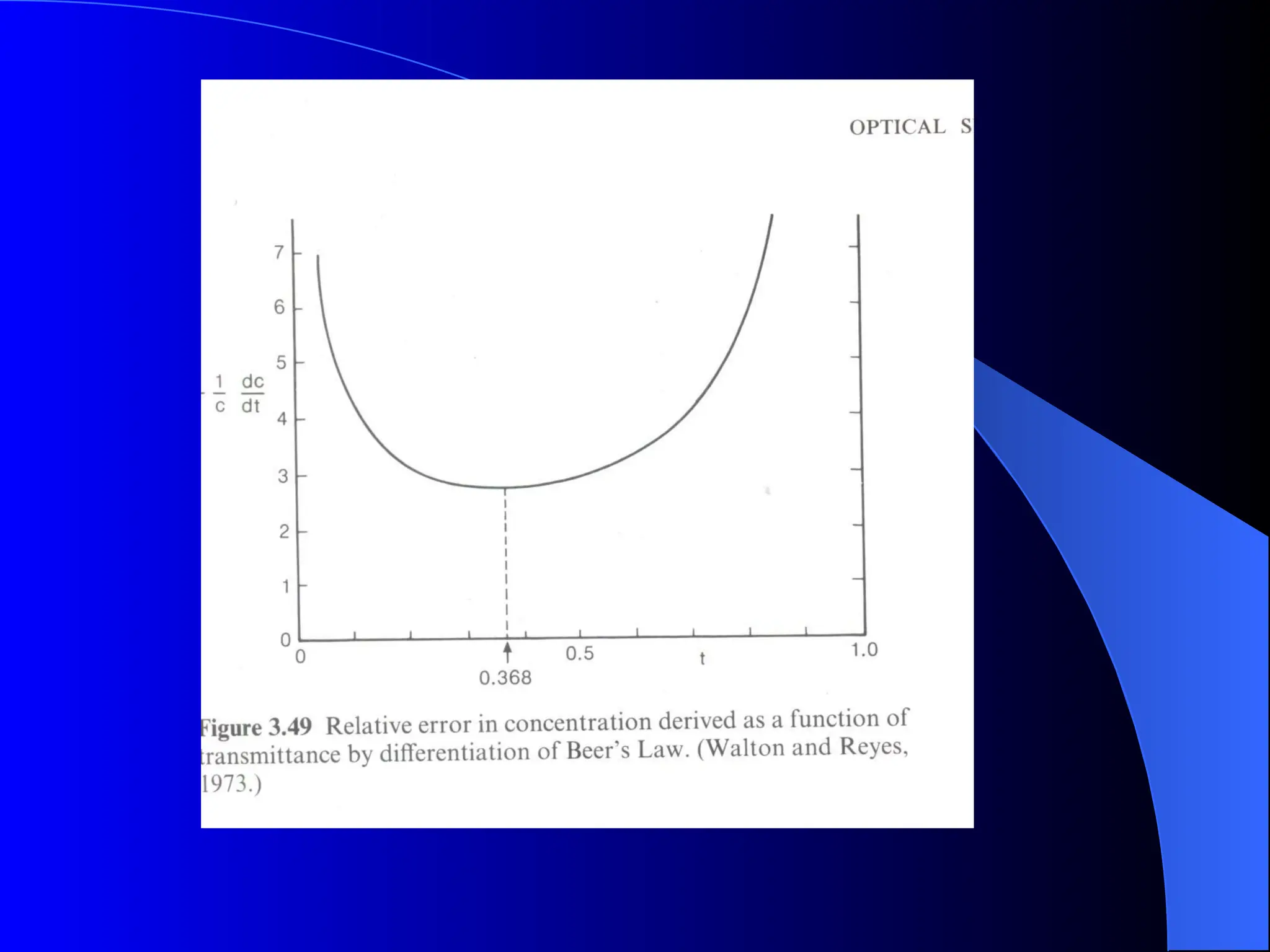
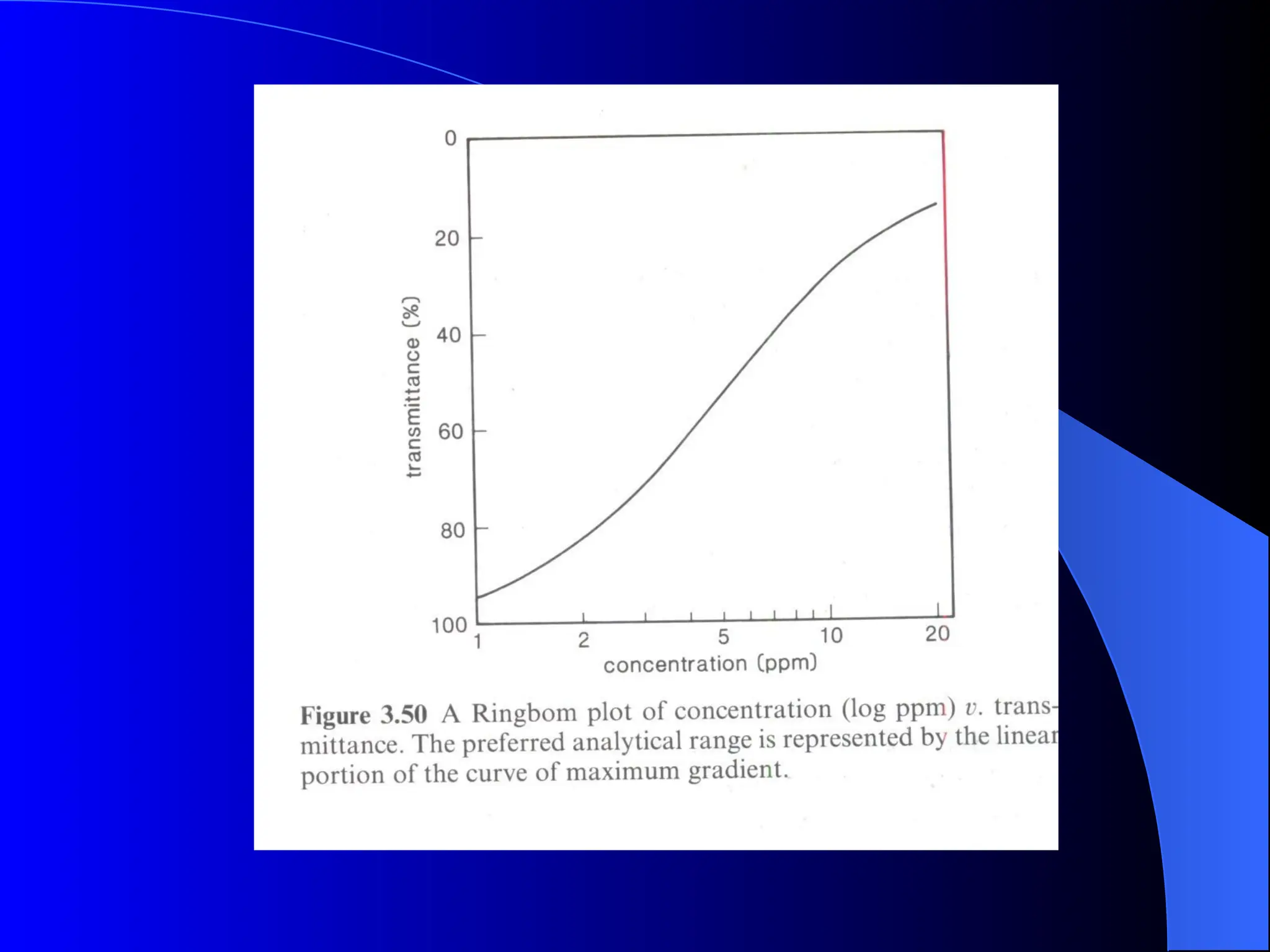
Error is more at high and low absorbance range
Self at high concentrations absorption is not linear
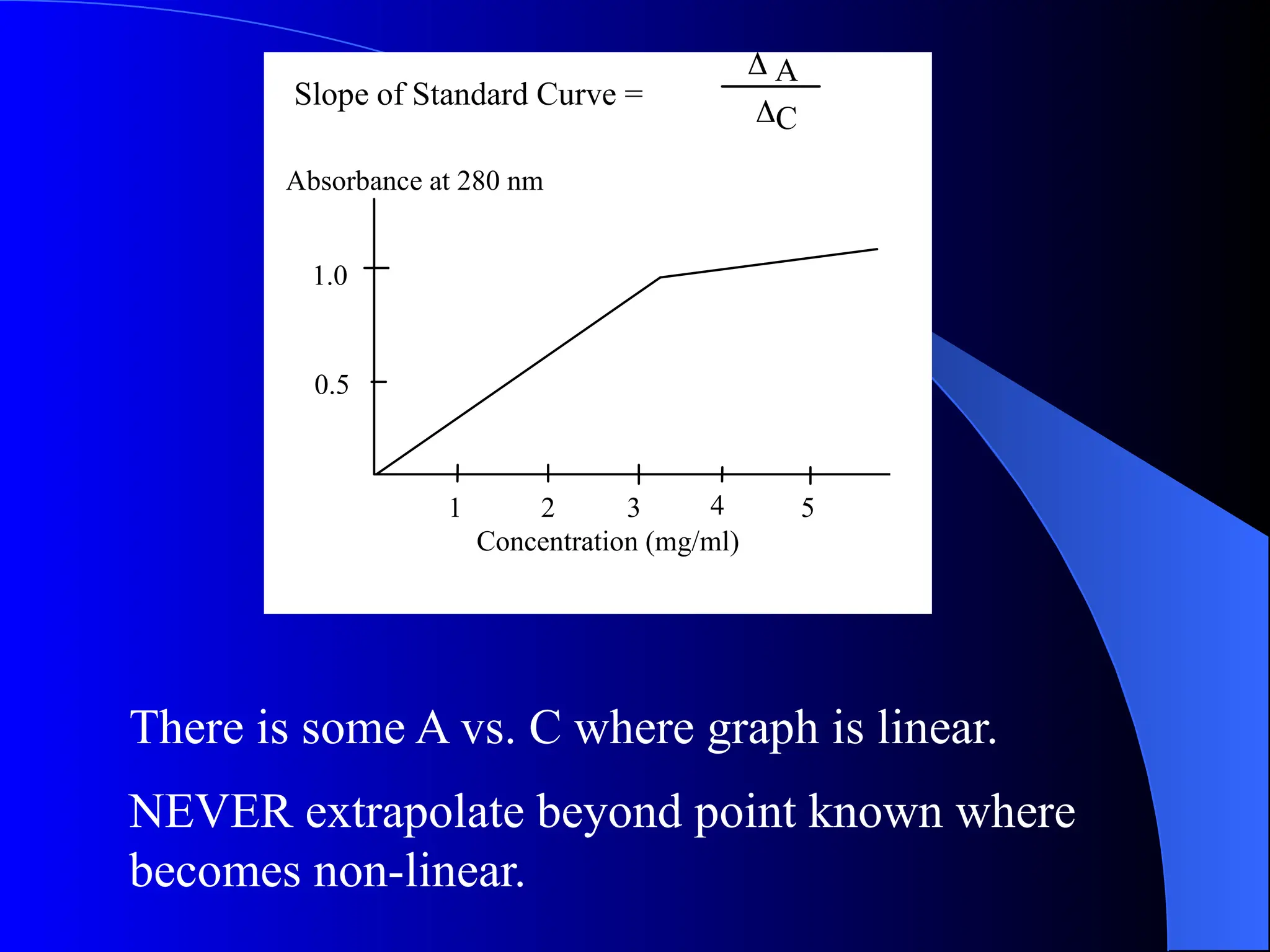
Slope of Standard Curve =
 A
C
1 2 3 4 5
1.0
0.5
Concentration (mg/ml)
Absorbance at 280 nm
There is some A vs. C where graph is linear.
NEVER extrapolate beyond point known where
becomes non-linear.
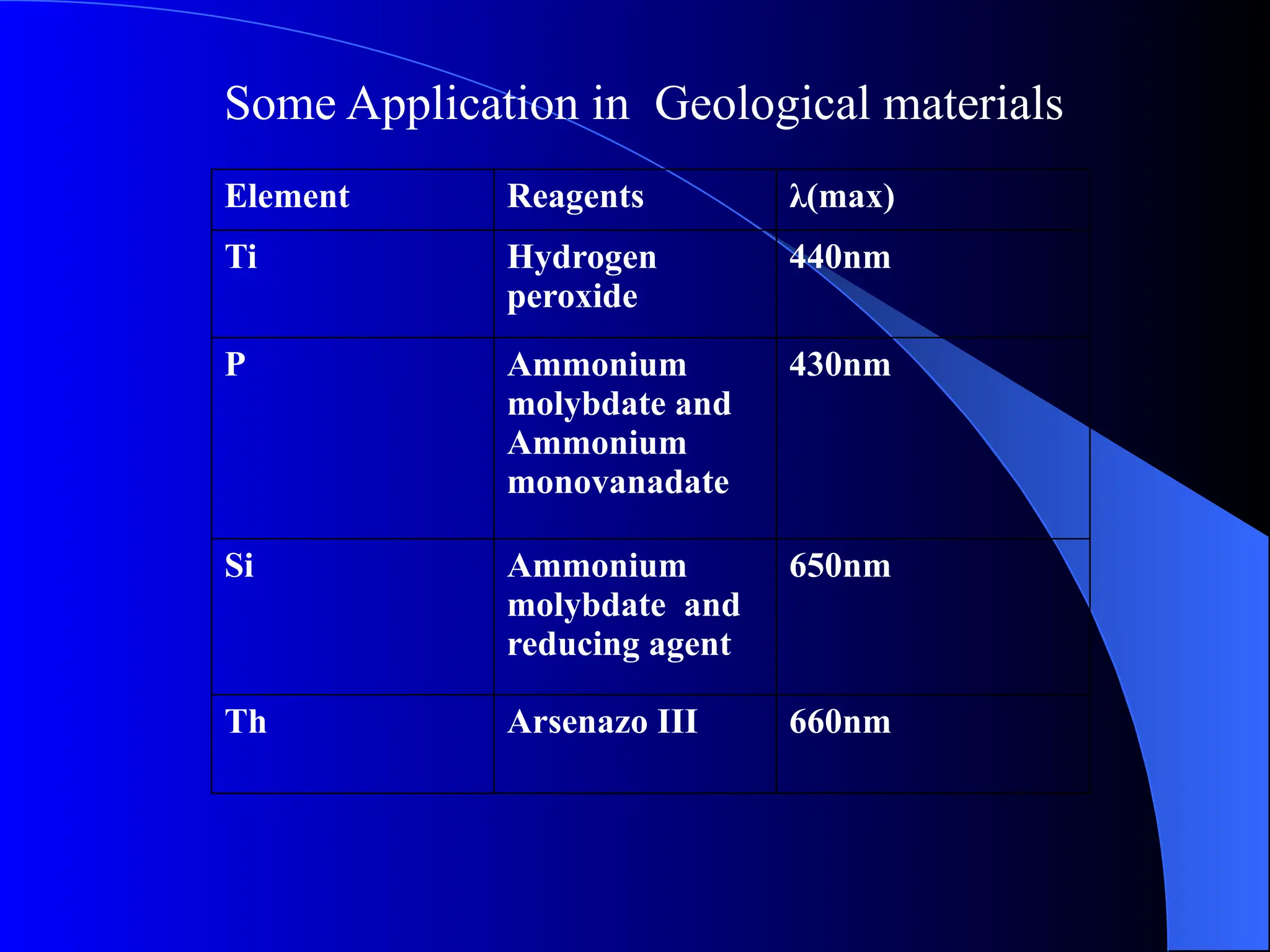
Element Reagents λ(max)
Ti Hydrogen
peroxide
440nm
P Ammonium
molybdate and
Ammonium
monovanadate
430nm
Si Ammonium
molybdate and
reducing agent
650nm
Th Arsenazo III 660nm
Some Application in Geological materials
CHEMICAL STRUCTURE & UV
ABSORPTION
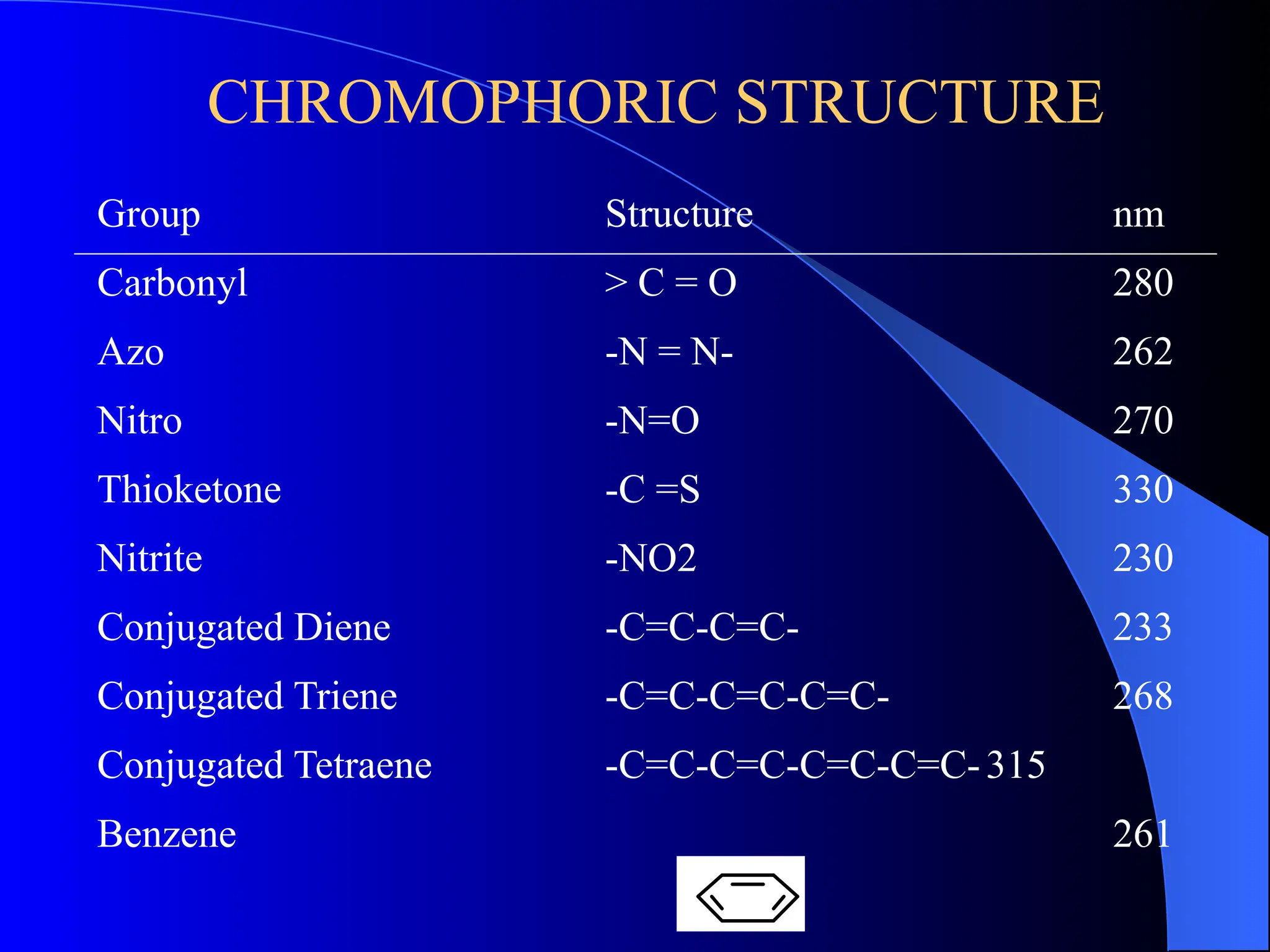
Chromophoric Group ---- The groupings of the
molecules which contain the electronic system which
is giving rise to absorption in the ultra-violet region.
CHROMOPHORIC STRUCTURE
Group Structure nm
Carbonyl > C = O 280
Azo -N = N- 262
Nitro -N=O 270
Thioketone -C =S 330
Nitrite -NO2 230
Conjugated Diene -C=C-C=C- 233
Conjugated Triene -C=C-C=C-C=C- 268
Conjugated Tetraene -C=C-C=C-C=C-C=C-315
Benzene 261
UV SPECTROMETER APPLICATION
Protein
Amino Acids (aromatic)
Pantothenic Acid
Glucose Determination
Enzyme Activity (Hexokinase)
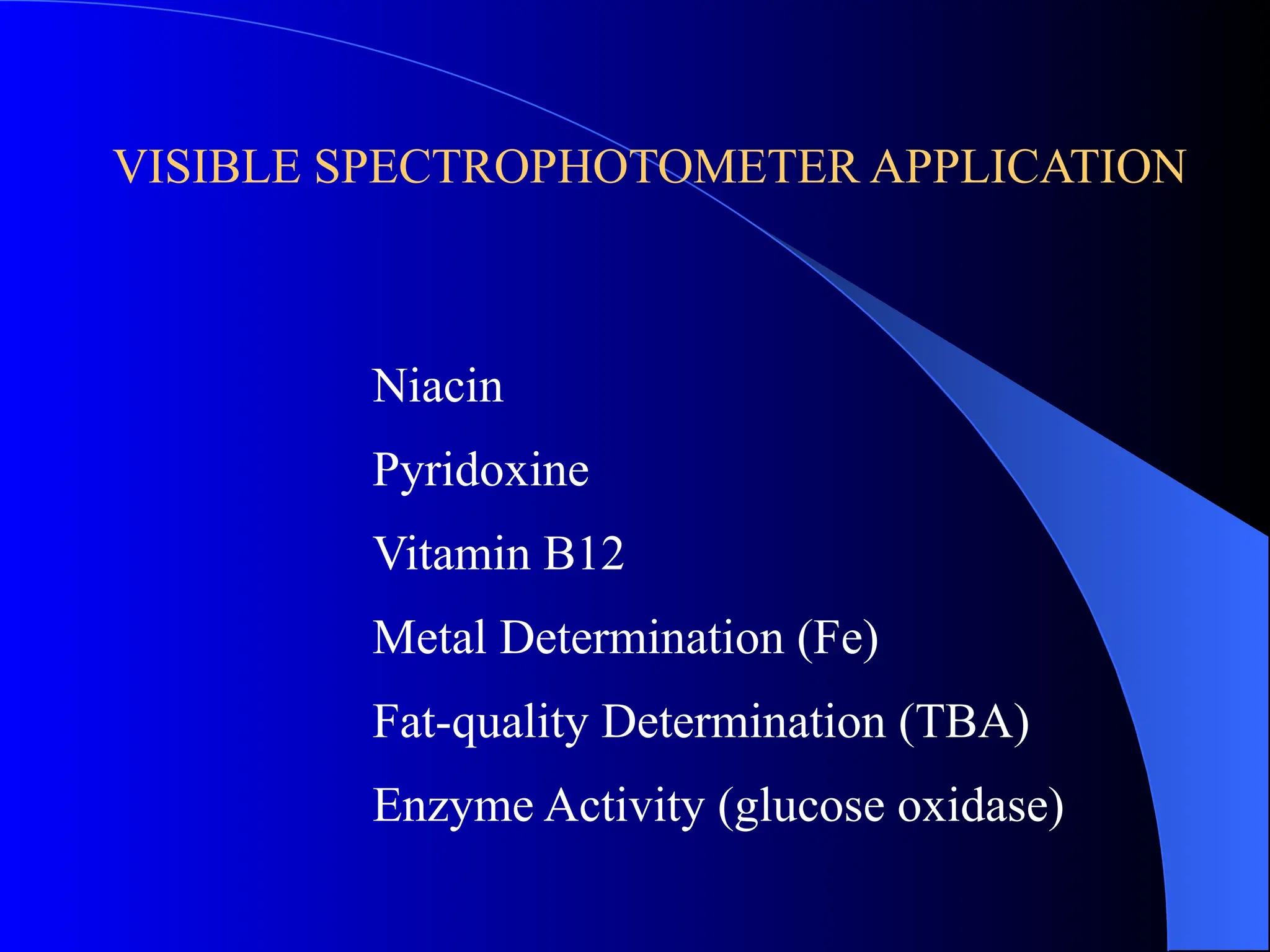
VISIBLE SPECTROPHOTOMETER APPLICATION
Niacin
Pyridoxine
Vitamin B12
Metal Determination (Fe)
Fat-quality Determination (TBA)
Enzyme Activity (glucose oxidase)
Thank you

Spectrophotometry slide show MSC analytical

  • 1.
    UV-Visible Molecular Absorption Spectrophotometry Theory,Instrumentation, Merits, Limitations, Applications By Ch.Krishna Analytical laboratory EPTRI, Hyderabad
  • 2.
    Property of matteris used Gravimetry - Weight Volumetry – precipitation, redox complexometric Light - matter - Absorb Reflect Transmits
  • 3.
    Why spectrophotometry ? Aneed to to analyse at trace quantities in the samples Gravimetry and volumetry fails at ppm and lower levels
  • 4.
    Electromagnetic Spectrum Spectral Distributionof Radiant Energy Wave Number (cycles/cm) X -Ra y UV V isib le IR M icro wa v e 2 0 0 n m 4 0 0 n m 8 0 0 n m W AV E L E NGT H(n m )
  • 6.
    V = WaveNumber (cm-1) l = Wave Length C = Velocity of Radiation (constant) = 3 x 1010 cm/sec. u = Frequency of Radiation (cycles/sec) The energy of photon: h (Planck's constant) = 6.62 x 10⁻²⁷ (Ergsec) V =  C    E = h = h C   C =   C = u
  • 8.
    LAMBERT LAW When amonochromatic light is allowed to pass through a transparent medium , the rate of decrease of intensity with the thickness of the medium is directly proportional to the intensity of the incident light . dIo / dt α Io dIo / dt = kt Io - Intensity of Incident light t - Thicknesss of the medium It = Io e-kt
  • 9.
    BEERS LAW The intensityof a beam of monochromatic light decreases exponentially with the increase in the concentration of the absorbing substance arithmetically It = Io e-kc c - concentration = Io e-kc
  • 10.
    It = Ioe-kct A = Log Io/It = kct A = Absorbance c = Concentration moles / litre t = thicknesss in cm k = ε = Molar absorption coefficient ( lit mole-1 cm -1) Beer-Lamberts Law
  • 13.
    Limitations of theBeer-Lambert law The linearity of the Beer-Lambert law is limited by chemical and instrumental factors. Causes of nonlinearity include: deviations in absorptivity coefficients at high concentrations (>0.01M) due to electrostatic interactions between molecules in close proximity scattering of light due to particulates in the sample fluoresecence or phosphorescence of the sample
  • 14.
    changes in refractiveindex at high analyte concentration shifts in chemical equilibria as a function of concentration non-monochromatic radiation, deviations can be minimized by using a relatively flat part of the absorption spectrum such as the maximum of an absorption band stray light
  • 15.
    T - Transmittance T= I0 - original light intensity I- transmitted light intensity % Transmittance = 100 x Absorbance (A) or optical density (OD) = Log = Log = 2 - Log%T Log is proportional to C (concentration of solution) and is also proportional to L (length of light path through the solution). I I0 I I0 I0 I 1 T I I0
  • 17.
    STEPS IN DEVELOPINGA SPECTROPHOTOMETRIC ANALYTICAL METHOD 1. Run the sample for spectrum 2. Obtain a monochromatic wavelength for the maximum absorption wavelength. 3. Calculate the concentration of your sample using Beer Lambert Equation: A = KCL
  • 18.
  • 19.
    Block diagram ofUV-visible Spectrophotometer
  • 21.
    Instruments for measuringthe absorption of U.V. or visible radiation are made up of the following components: Sources (UV and visible) Wavelength selector (monochromator) Sample containers Detector Signal processor and readout
  • 22.
    Sources of UVradiation The electrical excitation of deuterium or hydrogen at low pressure produces a continuous UV spectrum Both deuterium and hydrogen lamps emit radiation in the range 160 - 375 nm. Quartz windows must be used in these lamps, and quartz cuvettes must be used, because glass absorbs radiation of wavelengths less than 350 nm.
  • 23.
    Sources of visibleradiation The tungsten filament lamp is commonly employed as a source of visible light. This type of lamp is used in the wavelength range of 350 - 2500 nm. The energy emitted by a tungsten filament lamp is proportional to the fourth power of the operating voltage. This means that for the energy output to be stable, the voltage to the lamp must be very stable indeed. Electronic voltage regulators or constant-voltage transformers are used to ensure this stability.
  • 24.
  • 25.
    Cuvettes The containers forthe sample and reference solution must be transparent to the radiation which will pass through them. Quartz or fused silica cuvettes are required for spectroscopy in the UV region. These cells are also transparent in the visible region.
  • 26.
    Detectors The photomultiplier tubeis a commonly used detector in UV-Vis spectroscopy. photoemissive cathode (a cathode which emits electrons when struck by photons of radiation), dynodes (which emit several electrons for each electron striking them) and an anode. Each original photon produces 10-6 TO 10-7 electrons. The resulting current is amplified and measured. Photomultipliers are very sensitive to UV and visible radiation. They have fast response times. Intense light damages photomultipliers; they are limited to measuring low power radiation.
  • 27.
    Cross section ofa photomultiplier tube
  • 28.
    Advantages Very simple tohandle Determine elemental concentration at ppm levels It has good precision when compared to flame techniques Non-metals like S, P, F can be determined easily Some refractory elements like Th, Zr, ant Ti can be determined at ppm levels
  • 29.
    Limitations Long sample preparationtime Requires separation of interfering ion one or two elements can be determined at a time Error is more at high and low absorbance range Self at high concentrations absorption is not linear
  • 32.
    Slope of StandardCurve =  A C 1 2 3 4 5 1.0 0.5 Concentration (mg/ml) Absorbance at 280 nm There is some A vs. C where graph is linear. NEVER extrapolate beyond point known where becomes non-linear.
  • 33.
    Element Reagents λ(max) TiHydrogen peroxide 440nm P Ammonium molybdate and Ammonium monovanadate 430nm Si Ammonium molybdate and reducing agent 650nm Th Arsenazo III 660nm Some Application in Geological materials
  • 34.
    CHEMICAL STRUCTURE &UV ABSORPTION Chromophoric Group ---- The groupings of the molecules which contain the electronic system which is giving rise to absorption in the ultra-violet region.
  • 35.
    CHROMOPHORIC STRUCTURE Group Structurenm Carbonyl > C = O 280 Azo -N = N- 262 Nitro -N=O 270 Thioketone -C =S 330 Nitrite -NO2 230 Conjugated Diene -C=C-C=C- 233 Conjugated Triene -C=C-C=C-C=C- 268 Conjugated Tetraene -C=C-C=C-C=C-C=C-315 Benzene 261
  • 36.
    UV SPECTROMETER APPLICATION Protein AminoAcids (aromatic) Pantothenic Acid Glucose Determination Enzyme Activity (Hexokinase)
  • 37.
    VISIBLE SPECTROPHOTOMETER APPLICATION Niacin Pyridoxine VitaminB12 Metal Determination (Fe) Fat-quality Determination (TBA) Enzyme Activity (glucose oxidase)
  • 38.