Name: Sana Shaikh.
Roll no-3.
M.sc-Part one.
Specialization : Physical chemistry .
Subject: Analytical chemistry.
Topic : Sources.
Introduction to spectroscopy.
• Spectroscopy is the branch of science dealing
with the study of interaction of electromagnetic
radiation with matter.
• It is carried under the following heads.
 Atomic spectroscopy: This deals with of
interaction of electromagnetic radiation
with atoms.
 Molecular spectroscopy: This deals
with interaction of electromagnetic
radiation with molecules.
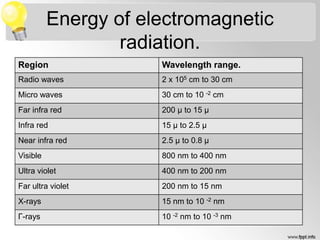
Energy of electromagnetic
radiation.
Region Wavelength range.
Radio waves 2 x 105 cm to 30 cm
Micro waves 30 cm to 10 -2 cm
Far infra red 200 µ to 15 µ
Infra red 15 µ to 2.5 µ
Near infra red 2.5 µ to 0.8 µ
Visible 800 nm to 400 nm
Ultra violet 400 nm to 200 nm
Far ultra violet 200 nm to 15 nm
X-rays 15 nm to 10 -2 nm
Γ-rays 10 -2 nm to 10 -3 nm
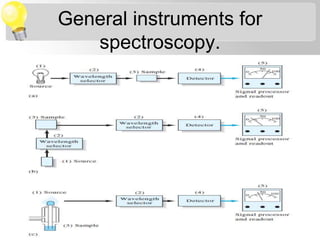
General instruments for
spectroscopy.
Sources of radiation .
• Properties :
• A source must generate a beam with
sufficient radiant power for easy detection
and measurement.
• Its output power should be stable for
reasonable periods.
• Intensity should not fluctuate over long
and short time intervals.
Types of radiation sources.
• Two types of radiation sources
• Continuum Sources
and
• Line Sources
Continuum Sources
• Emit radiation over a wide range of wavelengths
• Intensity of emission varies slowly as a function of wavelength
• Used for most molecular absorption and fluorescence
spectrometric instruments
• Examples
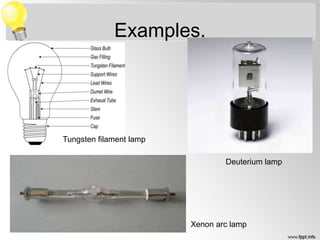
• Tungsten filament lamp (visible radiation)
• Deuterium lamp (UV radiation)
• High pressure Hg lamp (UV radiation)
• Xenon arc lamp (UV-VIS region)
• Heated solid ceramics (IR region)
• Heated wires (IR region)
Examples.
Tungsten filament lamp
Xenon arc lamp
Deuterium lamp
Line Sources
• - Emit only a few discrete wavelengths of light
• - Intensity is a function of wavelength
• - Used for molecular, atomic, and Raman spectroscopy
• Examples
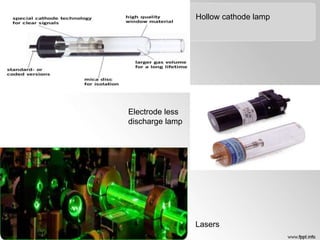
• Hollow cathode lamp (UV-VIS region)
• Electrodeless discharge lamp (UV-VIS region)
• Sodium vapor lamp (UV-VIS region)
• Mercury vapor lamp (UV-VIS region)
• Lasers (UV-VIS and IR regions)
Hollow cathode lamp
Electrode less
discharge lamp
Lasers
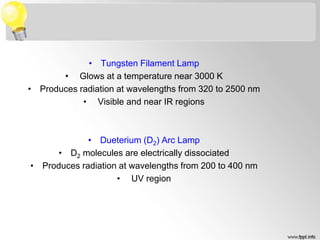
• Tungsten Filament Lamp
• Glows at a temperature near 3000 K
• Produces radiation at wavelengths from 320 to 2500 nm
• Visible and near IR regions
• Dueterium (D2) Arc Lamp
• D2 molecules are electrically dissociated
• Produces radiation at wavelengths from 200 to 400 nm
• UV region
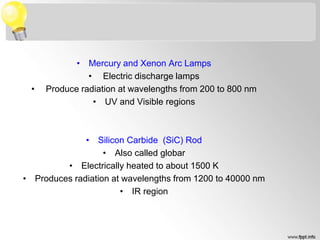
• Mercury and Xenon Arc Lamps
• Electric discharge lamps
• Produce radiation at wavelengths from 200 to 800 nm
• UV and Visible regions
• Silicon Carbide (SiC) Rod
• Also called globar
• Electrically heated to about 1500 K
• Produces radiation at wavelengths from 1200 to 40000 nm
• IR region
Laser
• Light Amplification by Stimulated Emission of
Radiation
• Produce specific spectral lines
• Used when high intensity line source is required
• Can be used for
• UV
• Visible
• FTIR
Why laser is better ?
• Incandesent lamp.
• Many wavelengths.
• Multidirectional.
• Incoherent.
• Laser light
• Monochromatic.
• Directional
• Coherent.
Types of laser.
• Solid state lasers.
• Gas lasers.
• Tunable lasers.
• Semiconductor lasers.
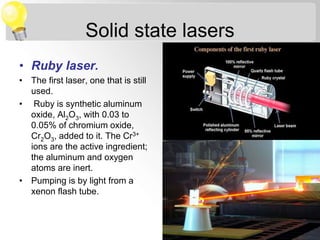
Solid state lasers
• Ruby laser.
• The first laser, one that is still
used.
• Ruby is synthetic aluminum
oxide, Al2O3, with 0.03 to
0.05% of chromium oxide,
Cr2O3, added to it. The Cr3+
ions are the active ingredient;
the aluminum and oxygen
atoms are inert.
• Pumping is by light from a
xenon flash tube.
Solid state lasers
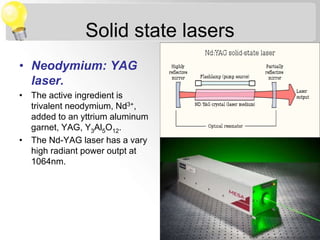
• Neodymium: YAG
laser.
• The active ingredient is
trivalent neodymium, Nd3+,
added to an yttrium aluminum
garnet, YAG, Y3Al5O12.
• The Nd-YAG laser has a vary
high radiant power outpt at
1064nm.
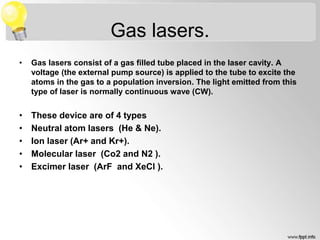
Gas lasers.
• Gas lasers consist of a gas filled tube placed in the laser cavity. A
voltage (the external pump source) is applied to the tube to excite the
atoms in the gas to a population inversion. The light emitted from this
type of laser is normally continuous wave (CW).
• These device are of 4 types
• Neutral atom lasers (He & Ne).
• Ion laser (Ar+ and Kr+).
• Molecular laser (Co2 and N2 ).
• Excimer laser (ArF and XeCl ).
Tunable lasers.
• dye lasers: first tunable lasers
• parametric oscillator:
 more compact  less expensive
 easier to operate  tuning range much wider
Color center lasers: tuned over wide bands in the UV, the visible, and
the IR.
free-electron laser:
 high powers of the order of megawatts
 very efficient
 tuned through a wide range of wavelengths.
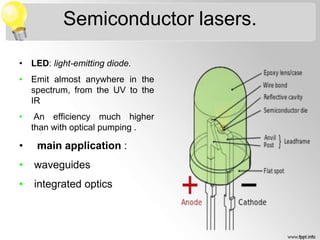
Semiconductor lasers.
• LED: light-emitting diode.
• Emit almost anywhere in the
spectrum, from the UV to the
IR
• An efficiency much higher
than with optical pumping .
• main application :
• waveguides
• integrated optics
Reference
• Principles of instrumental analysis by
skoog,holler and crouch (6th edition).
• Fundamentals of analytical chemistry
skoog,holler and crouch (9th edition).
• Image source:-
• www.google.com
THANK YOU

spectroscopy sources

  • 1.
    Name: Sana Shaikh. Rollno-3. M.sc-Part one. Specialization : Physical chemistry . Subject: Analytical chemistry. Topic : Sources.
  • 2.
    Introduction to spectroscopy. •Spectroscopy is the branch of science dealing with the study of interaction of electromagnetic radiation with matter. • It is carried under the following heads.  Atomic spectroscopy: This deals with of interaction of electromagnetic radiation with atoms.  Molecular spectroscopy: This deals with interaction of electromagnetic radiation with molecules.
  • 3.
    Energy of electromagnetic radiation. RegionWavelength range. Radio waves 2 x 105 cm to 30 cm Micro waves 30 cm to 10 -2 cm Far infra red 200 µ to 15 µ Infra red 15 µ to 2.5 µ Near infra red 2.5 µ to 0.8 µ Visible 800 nm to 400 nm Ultra violet 400 nm to 200 nm Far ultra violet 200 nm to 15 nm X-rays 15 nm to 10 -2 nm Γ-rays 10 -2 nm to 10 -3 nm
  • 4.
  • 5.
    Sources of radiation. • Properties : • A source must generate a beam with sufficient radiant power for easy detection and measurement. • Its output power should be stable for reasonable periods. • Intensity should not fluctuate over long and short time intervals.
  • 6.
    Types of radiationsources. • Two types of radiation sources • Continuum Sources and • Line Sources
  • 7.
    Continuum Sources • Emitradiation over a wide range of wavelengths • Intensity of emission varies slowly as a function of wavelength • Used for most molecular absorption and fluorescence spectrometric instruments • Examples • Tungsten filament lamp (visible radiation) • Deuterium lamp (UV radiation) • High pressure Hg lamp (UV radiation) • Xenon arc lamp (UV-VIS region) • Heated solid ceramics (IR region) • Heated wires (IR region)
  • 8.
  • 9.
    Line Sources • -Emit only a few discrete wavelengths of light • - Intensity is a function of wavelength • - Used for molecular, atomic, and Raman spectroscopy • Examples • Hollow cathode lamp (UV-VIS region) • Electrodeless discharge lamp (UV-VIS region) • Sodium vapor lamp (UV-VIS region) • Mercury vapor lamp (UV-VIS region) • Lasers (UV-VIS and IR regions)
  • 10.
    Hollow cathode lamp Electrodeless discharge lamp Lasers
  • 11.
    • Tungsten FilamentLamp • Glows at a temperature near 3000 K • Produces radiation at wavelengths from 320 to 2500 nm • Visible and near IR regions • Dueterium (D2) Arc Lamp • D2 molecules are electrically dissociated • Produces radiation at wavelengths from 200 to 400 nm • UV region
  • 12.
    • Mercury andXenon Arc Lamps • Electric discharge lamps • Produce radiation at wavelengths from 200 to 800 nm • UV and Visible regions • Silicon Carbide (SiC) Rod • Also called globar • Electrically heated to about 1500 K • Produces radiation at wavelengths from 1200 to 40000 nm • IR region
  • 13.
    Laser • Light Amplificationby Stimulated Emission of Radiation • Produce specific spectral lines • Used when high intensity line source is required • Can be used for • UV • Visible • FTIR
  • 14.
    Why laser isbetter ? • Incandesent lamp. • Many wavelengths. • Multidirectional. • Incoherent. • Laser light • Monochromatic. • Directional • Coherent.
  • 15.
    Types of laser. •Solid state lasers. • Gas lasers. • Tunable lasers. • Semiconductor lasers.
  • 16.
    Solid state lasers •Ruby laser. • The first laser, one that is still used. • Ruby is synthetic aluminum oxide, Al2O3, with 0.03 to 0.05% of chromium oxide, Cr2O3, added to it. The Cr3+ ions are the active ingredient; the aluminum and oxygen atoms are inert. • Pumping is by light from a xenon flash tube.
  • 17.
    Solid state lasers •Neodymium: YAG laser. • The active ingredient is trivalent neodymium, Nd3+, added to an yttrium aluminum garnet, YAG, Y3Al5O12. • The Nd-YAG laser has a vary high radiant power outpt at 1064nm.
  • 18.
    Gas lasers. • Gaslasers consist of a gas filled tube placed in the laser cavity. A voltage (the external pump source) is applied to the tube to excite the atoms in the gas to a population inversion. The light emitted from this type of laser is normally continuous wave (CW). • These device are of 4 types • Neutral atom lasers (He & Ne). • Ion laser (Ar+ and Kr+). • Molecular laser (Co2 and N2 ). • Excimer laser (ArF and XeCl ).
  • 19.
    Tunable lasers. • dyelasers: first tunable lasers • parametric oscillator:  more compact  less expensive  easier to operate  tuning range much wider Color center lasers: tuned over wide bands in the UV, the visible, and the IR. free-electron laser:  high powers of the order of megawatts  very efficient  tuned through a wide range of wavelengths.
  • 20.
    Semiconductor lasers. • LED:light-emitting diode. • Emit almost anywhere in the spectrum, from the UV to the IR • An efficiency much higher than with optical pumping . • main application : • waveguides • integrated optics
  • 21.
    Reference • Principles ofinstrumental analysis by skoog,holler and crouch (6th edition). • Fundamentals of analytical chemistry skoog,holler and crouch (9th edition). • Image source:- • www.google.com THANK YOU