Introduction to Molecular Spectroscopy By: M.Z.Iqbal Lecture # 3 Physical Properties of Polymers
Today Introduction to spectroscopy Classification of spectroscopic techniques Common types and their introduction Infra-Red spectroscopy: Fundamental concepts Vibrations in IR- Region and calculations of different vibrational energies in terms of frequencie.
Spectroscopy Definition: The study of the interaction between radiations and matter as a function of wavelength λ. Interactions with particle radiation or a response of a material to an alternating field or varying frequency ν. Spectrum: A plot of the response as a function of wavelength or more commonly frequency is referred to as a spectrum. Spectrometry: It is the measurement of these responses and an instrument which performs such measurements is a  spectrometer or spectrograph , although these terms are more limited in use to the original field of optics from which the concept sprang. Spectroscopy is often used in physical and analytical chemistry for the identification of substances through the spectrum emitted from or absorbed by them. Spectroscopy is also heavily used in astronomy and remote sensing. Most large telescopes have spectrometers, which are used either to measure the chemical composition and physical properties of astronomical objects or to measure their velocities from the Doppler Shift of their spectral lines.
Classification of Methods The type of spectroscopy depends on the physical quantity measured. Normally, the quantity that is measured is an intensity, either of energy absorbed or produced. Most spectroscopic methods are differentiated as either atomic or molecular based on whether or not they apply to atoms or molecules. Along with that distinction, they can be classified on the nature of their interaction: Absorption spectroscopy   It uses the range of the electromagnetic spectra in which a substance absorbs. This includes atomic absorption spectroscopy and various molecular techniques, such as infra-red spectroscopy in that region and Nuclear Magnetic resonance spectroscopy in the radio region.  Emission spectroscopy   It uses the range of electromagnetic spectra in which a substance radiates (emits). The substance first must absorb energy. This energy can be from a variety of sources, which determines the name of the subsequent emission, like luminescence. Molecular luminescence techniques include spectroflourimetry. Scattering spectroscopy   It measures the amount of light that a substance scatters at certain wavelengths, incident angles, and polarization angles. The scattering process is much faster than the absorption/emission process. One of the most useful applications of light scattering spectroscopy is Raman Spectroscopy.
Common types Fluorescence spectroscopy X-ray spectroscopy and crystallography Flame spectroscopy 1- Atomic emission spectroscopy 2- Atomic absorption spectroscopy 3-  Atomic fluorescence spectroscopy Plasma emission spectroscopy Spark or arc emission spectroscopy UV/VIS spectroscopy IR spectroscopy Raman spectroscopy NMR spectroscopy Photo thermal spectroscopy Thermal infra-red spectroscopy Mass Spectroscopy
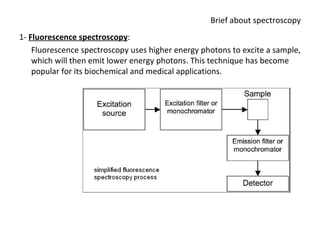
Brief about spectroscopy 1-  Fluorescence spectroscopy : Fluorescence spectroscopy uses higher energy photons to excite a sample, which will then emit lower energy photons. This technique has become popular for its biochemical and medical applications.
Cont’d 2-  X-ray spectroscopy: X-rays of sufficient frequencies interact with material and excite the atoms contained. Due to this excitation Auger Effect is produced and some  excitation radiations are absorbed or evolved if vice versa occurs.  X-ray absorption and emission spectroscopy is used in chemistry and material sciences to determine elemental composition and chemical bonding.  Very good and versatile technique but a little complex. It needs some scattering light detectors along with X-ray source. Overall X-ray diffraction technique is one that is used most widely for bond length and angle measurements.
Cont’d 3-  Flame Spectroscopy : Liquid solution samples are aspirated into a burner or nebulizer/burner combination, desolvated, atomized, and sometimes excited to a higher energy electronic state. The use of a flame during analysis requires fuel and oxidant, typically in the form of gases. Common fuel gases used are  acetylene  (ethyne) or  hydrogen . Common oxidant gases used are  oxygen ,  air , or  nitrous oxide . These methods are often capable of analyzing metallic element in the PPM, billion, or possibly lower concentration ranges. Light detectors are needed to detect light with the analysis information coming from the flame. -  Atomic absorption Spectroscopy - Atomic emission spectroscopy - Atomic fluorescence spectroscopy How would you differentiate in them?
4-  Spark or arc (emission) spectroscopy  : It is used for the analysis of metallic elements in solid samples.  For non-conductive materials, a sample is ground with graphite powder to make it conductive.  In traditional arc spectroscopy methods, Since the conditions producing the arc emission typically are not controlled quantitatively, the analysis for the elements is qualitative. Nowadays, the spark sources with controlled discharges under an argon atmosphere allow that this method can be considered eminently quantitative, and its use is widely expanded worldwide through production control laboratories of foundries and steel mills.
Cont’d 5-  UV/VIS spectroscopy : It basically involves the spectroscopy of photons and spectrophotometery. It uses light in the visible and adjacent near  ultraviolet  (UV) and near  infrared  (NIR) ranges. UV/Vis spectroscopy is routinely used in the  quantitative  determination of solutions of  transition metal  ions and highly  conjugated   organic compounds . For the quantitative measurements, Beer-Lambert law is followed. The Beer-Lambert Law is useful for characterizing many compounds but does not hold as a universal relationship for the concentration and absorption of all substances. A 2nd order polynomial relationship between absorption and concentration is sometimes encountered for very large, complex molecules such as organic dyes.
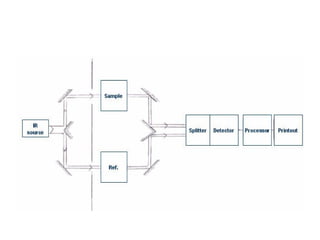
Cont’d 6-  Infra-red Spectroscopy: (IR spectroscopy) is the subset of  spectroscopy  that deals with the  infrared  region of the  electromagnetic spectrum . It covers a range of techniques, the most common being a form of  absorption spectroscopy . As with  all spectroscopic techniques , it can be used to identify compounds or investigate sample composition. Infrared spectroscopy offers the possibility to measure different types of inter atomic bond vibrations at different frequencies. Especially in  organic chemistry  the analysis of IR absorption spectra shows what type of bonds are present in the sample. Infrared spectroscopy exploits the fact that molecules have specific frequencies at which they rotate or vibrate corresponding to discrete energy levels.
 
Cont’d 7-  Raman Spectroscopy: It relies on  inelastic  scattering, or  Raman scattering  of monochromatic light, usually from a  laser  in the  visible ,  near infrared , or  near ultraviolet  range. The laser light interacts with  phonons  or other excitations in the system, resulting in the energy of the laser photons being shifted up or down. The shift in energy gives information about the phonon modes in the system. Spontaneous  Raman scattering  is typically very weak, and as a result the main difficulty of Raman spectroscopy is separating the weak inelastically scattered light from the intense Rayleigh scattered laser light. Raman  spectrometers  typically use holographic  diffraction gratings  and multiple dispersion stages to achieve a high degree of laser rejection.
Cont’d 8-  Nuclear magnetic resonance: Nuclear magnetic resonance spectroscopy analyzes the magnetic properties of certain atomic nuclei to determine different electronic local environments of  hydrogen ,  carbon , or other atoms in an  organic compound  or other  compound . This is used to help determine the  structure  of the compound. 9-  Photo thermal spectroscopy: It is a group of high sensitivity spectroscopy techniques used to measure optical absorption and thermal characteristics of a sample. The basis of photo-thermal spectroscopy is the change in thermal state of the sample resulting from the absorption of radiation. Light absorbed and not lost by emission results in heating. The heat raises temperature thereby influencing the sample thermodynamic properties. Measurement of the temperature, pressure, and/or density changes that occur due to optical absorption are ultimately the basis for the photo-thermal spectroscopic measurements.
Cont’d 10-  Thermal infrared spectroscopy  : TIR spectroscopy is the subset of IR spectroscopy that deals with radiation emitted in the infrared part of the e.m. spectrum. The emitted infrared radiation, though similar to blackbody radiation, is different in that the radiation is banded at characteristic vibrations in the material. The method measures the thermal IR radiation emitted (as opposed to being transmitted or reflected) from a volume or surface. This method is commonly used to identify the composition of surface by analyzing its spectrum and comparing it to previously measured materials. It is particularly suited to airborne and space borne applications.
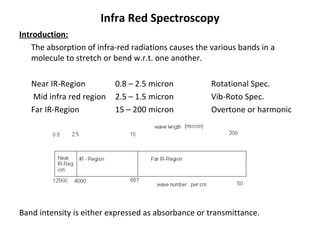
Infra Red Spectroscopy Introduction: The absorption of infra-red radiations causes the various bands in a molecule to stretch or bend w.r.t. one another. Near IR-Region 0.8 – 2.5 micron Rotational Spec.   Mid infra red region 2.5 – 1.5 micron Vib-Roto Spec. Far IR-Region 15 – 200 micron Overtone or harmonic Band intensity is either expressed as absorbance or transmittance.
Cont’d To establish the identity of two compounds (comparative study) To determine the structure of a new compound from its functional groups To determine the nature of contaminants in a sample For quantitative analysis of a component in the overall mixture For the quantitative analysis of contaminants in given sample Some advanced physical properties of the materials
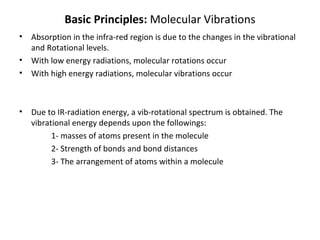
Basic Principles:  Molecular Vibrations Absorption in the infra-red region is due to the changes in the vibrational and Rotational levels. With low energy radiations, molecular rotations occur With high energy radiations, molecular vibrations occur  Due to IR-radiation energy, a vib-rotational spectrum is obtained. The vibrational energy depends upon the followings: 1- masses of atoms present in the molecule 2- Strength of bonds and bond distances 3- The arrangement of atoms within a molecule
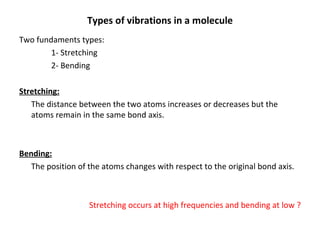
Types of vibrations in a molecule Two fundaments types: 1- Stretching 2- Bending Stretching: The distance between the two atoms increases or decreases but the atoms remain in the same bond axis. Bending: The position of the atoms changes with respect to the original bond axis. Stretching occurs at high frequencies and bending at low ?
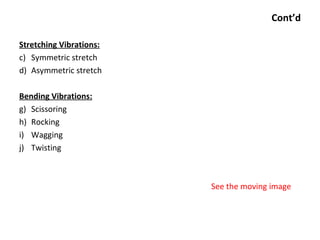
Cont’d Stretching Vibrations: Symmetric stretch Asymmetric stretch Bending Vibrations: Scissoring Rocking Wagging Twisting See the moving image
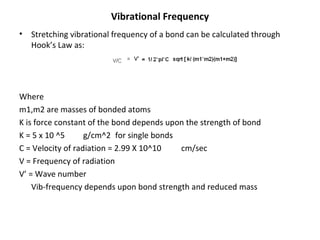
Vibrational Frequency Stretching vibrational frequency of a bond can be calculated through Hook’s Law as: Where  m1,m2 are masses of bonded atoms K is force constant of the bond depends upon the strength of bond K = 5 x 10 ^5 g/cm^2 for single bonds C = Velocity of radiation = 2.99 X 10^10  cm/sec V = Frequency of radiation V’ = Wave number  Vib-frequency depends upon bond strength and reduced mass
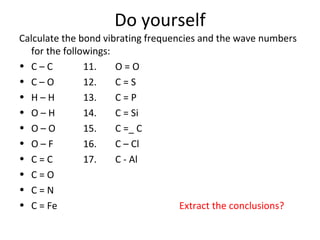
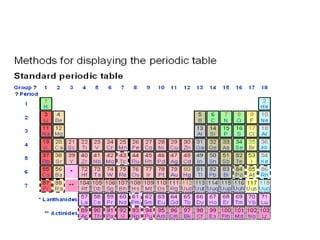
Do yourself Calculate the bond vibrating frequencies and the wave numbers for the followings: C – C 11.  O = O C – O 12. C = S H – H 13. C = P O – H 14.  C = Si O – O 15.  C =_ C O – F 16. C – Cl  C = C 17. C - Al C = O C = N C = Fe Extract the conclusions?


Introduction To Spectroscopy

  • 1.
    Introduction to MolecularSpectroscopy By: M.Z.Iqbal Lecture # 3 Physical Properties of Polymers
  • 2.
    Today Introduction tospectroscopy Classification of spectroscopic techniques Common types and their introduction Infra-Red spectroscopy: Fundamental concepts Vibrations in IR- Region and calculations of different vibrational energies in terms of frequencie.
  • 3.
    Spectroscopy Definition: Thestudy of the interaction between radiations and matter as a function of wavelength λ. Interactions with particle radiation or a response of a material to an alternating field or varying frequency ν. Spectrum: A plot of the response as a function of wavelength or more commonly frequency is referred to as a spectrum. Spectrometry: It is the measurement of these responses and an instrument which performs such measurements is a spectrometer or spectrograph , although these terms are more limited in use to the original field of optics from which the concept sprang. Spectroscopy is often used in physical and analytical chemistry for the identification of substances through the spectrum emitted from or absorbed by them. Spectroscopy is also heavily used in astronomy and remote sensing. Most large telescopes have spectrometers, which are used either to measure the chemical composition and physical properties of astronomical objects or to measure their velocities from the Doppler Shift of their spectral lines.
  • 4.
    Classification of MethodsThe type of spectroscopy depends on the physical quantity measured. Normally, the quantity that is measured is an intensity, either of energy absorbed or produced. Most spectroscopic methods are differentiated as either atomic or molecular based on whether or not they apply to atoms or molecules. Along with that distinction, they can be classified on the nature of their interaction: Absorption spectroscopy It uses the range of the electromagnetic spectra in which a substance absorbs. This includes atomic absorption spectroscopy and various molecular techniques, such as infra-red spectroscopy in that region and Nuclear Magnetic resonance spectroscopy in the radio region. Emission spectroscopy It uses the range of electromagnetic spectra in which a substance radiates (emits). The substance first must absorb energy. This energy can be from a variety of sources, which determines the name of the subsequent emission, like luminescence. Molecular luminescence techniques include spectroflourimetry. Scattering spectroscopy It measures the amount of light that a substance scatters at certain wavelengths, incident angles, and polarization angles. The scattering process is much faster than the absorption/emission process. One of the most useful applications of light scattering spectroscopy is Raman Spectroscopy.
  • 5.
    Common types Fluorescencespectroscopy X-ray spectroscopy and crystallography Flame spectroscopy 1- Atomic emission spectroscopy 2- Atomic absorption spectroscopy 3- Atomic fluorescence spectroscopy Plasma emission spectroscopy Spark or arc emission spectroscopy UV/VIS spectroscopy IR spectroscopy Raman spectroscopy NMR spectroscopy Photo thermal spectroscopy Thermal infra-red spectroscopy Mass Spectroscopy
  • 6.
    Brief about spectroscopy1- Fluorescence spectroscopy : Fluorescence spectroscopy uses higher energy photons to excite a sample, which will then emit lower energy photons. This technique has become popular for its biochemical and medical applications.
  • 7.
    Cont’d 2- X-ray spectroscopy: X-rays of sufficient frequencies interact with material and excite the atoms contained. Due to this excitation Auger Effect is produced and some excitation radiations are absorbed or evolved if vice versa occurs. X-ray absorption and emission spectroscopy is used in chemistry and material sciences to determine elemental composition and chemical bonding. Very good and versatile technique but a little complex. It needs some scattering light detectors along with X-ray source. Overall X-ray diffraction technique is one that is used most widely for bond length and angle measurements.
  • 8.
    Cont’d 3- Flame Spectroscopy : Liquid solution samples are aspirated into a burner or nebulizer/burner combination, desolvated, atomized, and sometimes excited to a higher energy electronic state. The use of a flame during analysis requires fuel and oxidant, typically in the form of gases. Common fuel gases used are acetylene (ethyne) or hydrogen . Common oxidant gases used are oxygen , air , or nitrous oxide . These methods are often capable of analyzing metallic element in the PPM, billion, or possibly lower concentration ranges. Light detectors are needed to detect light with the analysis information coming from the flame. - Atomic absorption Spectroscopy - Atomic emission spectroscopy - Atomic fluorescence spectroscopy How would you differentiate in them?
  • 9.
    4- Sparkor arc (emission) spectroscopy : It is used for the analysis of metallic elements in solid samples. For non-conductive materials, a sample is ground with graphite powder to make it conductive. In traditional arc spectroscopy methods, Since the conditions producing the arc emission typically are not controlled quantitatively, the analysis for the elements is qualitative. Nowadays, the spark sources with controlled discharges under an argon atmosphere allow that this method can be considered eminently quantitative, and its use is widely expanded worldwide through production control laboratories of foundries and steel mills.
  • 10.
    Cont’d 5- UV/VIS spectroscopy : It basically involves the spectroscopy of photons and spectrophotometery. It uses light in the visible and adjacent near ultraviolet (UV) and near infrared (NIR) ranges. UV/Vis spectroscopy is routinely used in the quantitative determination of solutions of transition metal ions and highly conjugated organic compounds . For the quantitative measurements, Beer-Lambert law is followed. The Beer-Lambert Law is useful for characterizing many compounds but does not hold as a universal relationship for the concentration and absorption of all substances. A 2nd order polynomial relationship between absorption and concentration is sometimes encountered for very large, complex molecules such as organic dyes.
  • 11.
    Cont’d 6- Infra-red Spectroscopy: (IR spectroscopy) is the subset of spectroscopy that deals with the infrared region of the electromagnetic spectrum . It covers a range of techniques, the most common being a form of absorption spectroscopy . As with all spectroscopic techniques , it can be used to identify compounds or investigate sample composition. Infrared spectroscopy offers the possibility to measure different types of inter atomic bond vibrations at different frequencies. Especially in organic chemistry the analysis of IR absorption spectra shows what type of bonds are present in the sample. Infrared spectroscopy exploits the fact that molecules have specific frequencies at which they rotate or vibrate corresponding to discrete energy levels.
  • 12.
  • 13.
    Cont’d 7- Raman Spectroscopy: It relies on inelastic scattering, or Raman scattering of monochromatic light, usually from a laser in the visible , near infrared , or near ultraviolet range. The laser light interacts with phonons or other excitations in the system, resulting in the energy of the laser photons being shifted up or down. The shift in energy gives information about the phonon modes in the system. Spontaneous Raman scattering is typically very weak, and as a result the main difficulty of Raman spectroscopy is separating the weak inelastically scattered light from the intense Rayleigh scattered laser light. Raman spectrometers typically use holographic diffraction gratings and multiple dispersion stages to achieve a high degree of laser rejection.
  • 14.
    Cont’d 8- Nuclear magnetic resonance: Nuclear magnetic resonance spectroscopy analyzes the magnetic properties of certain atomic nuclei to determine different electronic local environments of hydrogen , carbon , or other atoms in an organic compound or other compound . This is used to help determine the structure of the compound. 9- Photo thermal spectroscopy: It is a group of high sensitivity spectroscopy techniques used to measure optical absorption and thermal characteristics of a sample. The basis of photo-thermal spectroscopy is the change in thermal state of the sample resulting from the absorption of radiation. Light absorbed and not lost by emission results in heating. The heat raises temperature thereby influencing the sample thermodynamic properties. Measurement of the temperature, pressure, and/or density changes that occur due to optical absorption are ultimately the basis for the photo-thermal spectroscopic measurements.
  • 15.
    Cont’d 10- Thermal infrared spectroscopy : TIR spectroscopy is the subset of IR spectroscopy that deals with radiation emitted in the infrared part of the e.m. spectrum. The emitted infrared radiation, though similar to blackbody radiation, is different in that the radiation is banded at characteristic vibrations in the material. The method measures the thermal IR radiation emitted (as opposed to being transmitted or reflected) from a volume or surface. This method is commonly used to identify the composition of surface by analyzing its spectrum and comparing it to previously measured materials. It is particularly suited to airborne and space borne applications.
  • 16.
    Infra Red SpectroscopyIntroduction: The absorption of infra-red radiations causes the various bands in a molecule to stretch or bend w.r.t. one another. Near IR-Region 0.8 – 2.5 micron Rotational Spec. Mid infra red region 2.5 – 1.5 micron Vib-Roto Spec. Far IR-Region 15 – 200 micron Overtone or harmonic Band intensity is either expressed as absorbance or transmittance.
  • 17.
    Cont’d To establishthe identity of two compounds (comparative study) To determine the structure of a new compound from its functional groups To determine the nature of contaminants in a sample For quantitative analysis of a component in the overall mixture For the quantitative analysis of contaminants in given sample Some advanced physical properties of the materials
  • 18.
    Basic Principles: Molecular Vibrations Absorption in the infra-red region is due to the changes in the vibrational and Rotational levels. With low energy radiations, molecular rotations occur With high energy radiations, molecular vibrations occur Due to IR-radiation energy, a vib-rotational spectrum is obtained. The vibrational energy depends upon the followings: 1- masses of atoms present in the molecule 2- Strength of bonds and bond distances 3- The arrangement of atoms within a molecule
  • 19.
    Types of vibrationsin a molecule Two fundaments types: 1- Stretching 2- Bending Stretching: The distance between the two atoms increases or decreases but the atoms remain in the same bond axis. Bending: The position of the atoms changes with respect to the original bond axis. Stretching occurs at high frequencies and bending at low ?
  • 20.
    Cont’d Stretching Vibrations:Symmetric stretch Asymmetric stretch Bending Vibrations: Scissoring Rocking Wagging Twisting See the moving image
  • 21.
    Vibrational Frequency Stretchingvibrational frequency of a bond can be calculated through Hook’s Law as: Where m1,m2 are masses of bonded atoms K is force constant of the bond depends upon the strength of bond K = 5 x 10 ^5 g/cm^2 for single bonds C = Velocity of radiation = 2.99 X 10^10 cm/sec V = Frequency of radiation V’ = Wave number Vib-frequency depends upon bond strength and reduced mass
  • 22.
    Do yourself Calculatethe bond vibrating frequencies and the wave numbers for the followings: C – C 11. O = O C – O 12. C = S H – H 13. C = P O – H 14. C = Si O – O 15. C =_ C O – F 16. C – Cl C = C 17. C - Al C = O C = N C = Fe Extract the conclusions?
  • 23.
  • 24.