Prashant singh
paper-3
unit-1
Human mitochondrial genome
INTRODUCTION
 The Human genome, which is typical of the genomes of all multicellular
animals, consist of two distinct parts,
 Nuclear genome
 Mitochondrial genome
CONTINUE…
 Mitochondrial DNA (mtDNA or mDNA)[2] is the DNA located
in mitochondria, cellular organelles within eukaryotic
cells that convert chemical energy from food into a form
that cells can use, adenosine triphosphate (ATP).
 Mitochondrial DNA (mtDNA) is not transmitted through
nuclear DNA (nDNA). In humans, as in most multicellular
organisms, mitochondrial DNA is inherited only from the
mother's ovum.
HUMAN MITOCHONDRIAL GENOME
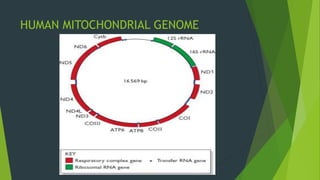
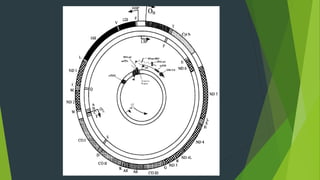
 human mitochondrial genome consist of 16 569 bp, it is
much smaller than the nuclear genome, and it contains
just 37 genes,encoding 13 polypeptide
 Thirteen of these genes code for proteins involved in the
respiratory complex,the main biochemical component of
the energy-generating mitochondria; the other 24 genes
specify non-coding RNA molecules that are required for
expression of the mitochondrial genome. The genes in this
genome are much more closely packed than in the nuclear
genome and they do not contain introns. In many
respects, the human mitochondrial genome is typical of
the mitochondrial genomes of other animals
 All mtDNA-encoded polypeptides are members of the
oxidative phosphorylation complexes (OXPHOS)
 These include seven subunits of complex I, one subunit of
complex III, three subunits of complex IV, and two of
complex V. Besides protein coding genes, mtDNA also
codes for 22 transfer RNAs (tRNAs) and two ribosomal
RNAs (12S and 16S rRNAs).
 The expression and maintenance of mtDNA depends on a
large number of nuclear-coded factors that are
synthesized in the cytosolic ribosomes as precursor
polypeptides and imported into the mitochondria via
specialized import pores.
 Although the catalytic subunits of the OXPHOS system are
encoded by the mtDNA, these enzyme complexes also
contain a large number of nuclear-coded subunit that are
necessary for their function.
 In contrast to Saccharomyces cerevisiae mtDNA, vertebrate
mtDNA are devoid of introns
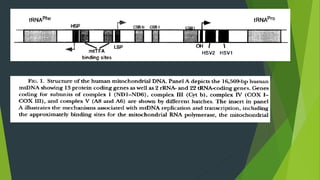
 There are very few noncoding intergenic regions, with the
exception of the regulatory region containing the promoters
and origin of heavy-strand replication
 The genetic information is so condensed that there is an
overlap in some coding sequences, and termination codons can
be generated by the addition of adenines to the transcript
during polyadenylation of mRNAs
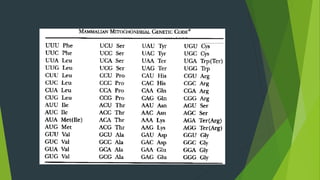
 The genetic code of mtDNA differs from the nuclear-
cytoplasmic code. Instead of being a termination codon, TGA
codes for tryptophan in vertebrate's mitochondria.
 ATA codes for methionine in mitochondria but isoleucinein
the cytosol. Finally, AGA or AGG in mitochondria code for a
stop codon instead of arginine
BIBLIOGRAPHY
 GENOME 3
 WIKIPEDIA
THANK YOU !!!!!!!

Mitochondrial genome

  • 1.
  • 2.
    INTRODUCTION  The Humangenome, which is typical of the genomes of all multicellular animals, consist of two distinct parts,  Nuclear genome  Mitochondrial genome
  • 3.
    CONTINUE…  Mitochondrial DNA(mtDNA or mDNA)[2] is the DNA located in mitochondria, cellular organelles within eukaryotic cells that convert chemical energy from food into a form that cells can use, adenosine triphosphate (ATP).  Mitochondrial DNA (mtDNA) is not transmitted through nuclear DNA (nDNA). In humans, as in most multicellular organisms, mitochondrial DNA is inherited only from the mother's ovum.
  • 4.
  • 5.
     human mitochondrialgenome consist of 16 569 bp, it is much smaller than the nuclear genome, and it contains just 37 genes,encoding 13 polypeptide  Thirteen of these genes code for proteins involved in the respiratory complex,the main biochemical component of the energy-generating mitochondria; the other 24 genes specify non-coding RNA molecules that are required for expression of the mitochondrial genome. The genes in this genome are much more closely packed than in the nuclear genome and they do not contain introns. In many respects, the human mitochondrial genome is typical of the mitochondrial genomes of other animals
  • 6.
     All mtDNA-encodedpolypeptides are members of the oxidative phosphorylation complexes (OXPHOS)  These include seven subunits of complex I, one subunit of complex III, three subunits of complex IV, and two of complex V. Besides protein coding genes, mtDNA also codes for 22 transfer RNAs (tRNAs) and two ribosomal RNAs (12S and 16S rRNAs).
  • 7.
     The expressionand maintenance of mtDNA depends on a large number of nuclear-coded factors that are synthesized in the cytosolic ribosomes as precursor polypeptides and imported into the mitochondria via specialized import pores.  Although the catalytic subunits of the OXPHOS system are encoded by the mtDNA, these enzyme complexes also contain a large number of nuclear-coded subunit that are necessary for their function.
  • 10.
     In contrastto Saccharomyces cerevisiae mtDNA, vertebrate mtDNA are devoid of introns  There are very few noncoding intergenic regions, with the exception of the regulatory region containing the promoters and origin of heavy-strand replication  The genetic information is so condensed that there is an overlap in some coding sequences, and termination codons can be generated by the addition of adenines to the transcript during polyadenylation of mRNAs
  • 11.
     The geneticcode of mtDNA differs from the nuclear- cytoplasmic code. Instead of being a termination codon, TGA codes for tryptophan in vertebrate's mitochondria.  ATA codes for methionine in mitochondria but isoleucinein the cytosol. Finally, AGA or AGG in mitochondria code for a stop codon instead of arginine
  • 13.
  • 14.