Chapter 19
  Spectrophotometry :
Instruments & Application
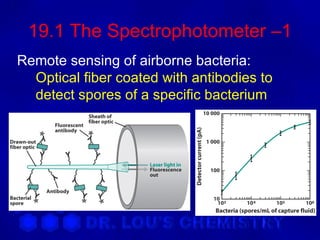
19.1 The Spectrophotometer –1
Remote sensing of airborne bacteria:
  Optical fiber coated with antibodies to
  detect spores of a specific bacterium
19.1 The Spectrophotometer -1
1) Spectrophotometer
b) Single-beam


e) Double-beam
19.1 The Spectrophotometer -2
19.1 The Spectrophotometer -3
19.1 The Spectrophotometer –4

• Light source
  – Tungsten lamp:
       Vis. near IR (320 nm~2500 nm)
  – Deuterium are lamp: UV (200~400 nm)
  – Electric discharge lamp + Hg(g) or Xenon:
       Vis & UV
  – Globar (silicon carbide rod):
       IR (5000~200 cm-1)
  – Laser: intense monochromatic sources.
19.1 The Spectrophotometer -5
19.1 The Spectrophotometer -6
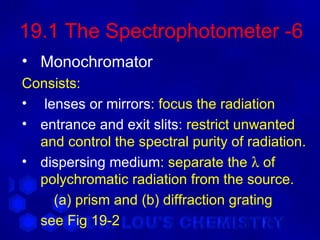
• Monochromator
Consists:
• lenses or mirrors: focus the radiation
• entrance and exit slits: restrict unwanted
  and control the spectral purity of radiation.
• dispersing medium: separate the λ of
  polychromatic radiation from the source.
    (a) prism and (b) diffraction grating
  see Fig 19-2
19.1 The Spectrophotometer -7
1) Monochromator
 a. entrance slit
 b. collimating
    mirror or lens
 c. a prism or
    grating
 d. focal plane
 e. exit slit
19.1 The Spectrophotometer -8
• Monochromator


   Interference of adjacent waves that are
    (a) 0°, (b) 90 °, and © 180 ° out of phase
19.1 The Spectrophotometer -9
• Monochromator


  nλ = a – b (n = ±1 first-order….)
  Grating equation : nλ = d (sinθ – sinφ )
 Filters: select a desired wavelength
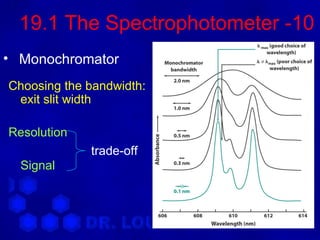
19.1 The Spectrophotometer -10
• Monochromator
Choosing the bandwidth:
 exit slit width

Resolution
             trade-off
  Signal
19.1 The Spectrophotometer -10
1) Detector
   Convert radiant energy (photons) into an
   electrical signal
    Ideal detector :
       high sensitivity,
       high signal/noise,
       constant response for λs,
       and fast response time.
19.1 The Spectrophotometer -11
 3) Detector


 Detector response depends on the λ of the
 incident photons.
19.1 The Spectrophotometer -12
Photomultiplier tube: very sensitive detector
19.1 The Spectrophotometer -13
Photodiode array spectrophotometer :
records the entire spectrum at once.
   vs. Dispersive spectrophotometer: one λ at a time

   •   speed (~1s/spetrum)
   •   excellent λ repeatability
   •   measure λs simultaneously
   •   relatively insensitive to errors from stray light
   •   relatively poor resolution (1~3 nm)
                                    vs 0.1nm
19.1 The Spectrophotometer -14
   diode array spectrophotometer
19.2 Analysis of a mixture -1
• Absorbance of a mixture :
  A = exb[X] + eyb[Y] + …
19.2 Analysis of a mixture -2
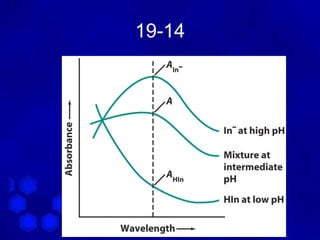
• Isosbestic points : for rxn: X → Y, every spectrum
   recorded during chemical reaction will cross at the same
   point. Good evidence for only two principle species in rxn.

              Ex: HIn  In- + H+
19.2 Analysis of a mixture -3
Why isosbestic point?
         A 465 = ε 465 [ HIn ]
                   HIn

                    [ ]
         A 465 = ε 465 In −
                   In −

       when [ HIn ] = [ In ] ⇒ ε
                               −      465
                                      HIn   = ε 465 = ε 465
                                                In −


   ∴ For a mixture :
               HIn               In −
                                       [ ]
     A 465 = ε 465 b [ HIn ] + ε 465 b In −
           = ε 465   b ( [ In ] + [ HIn ] )
                           −         −
19.3 Spectrophotometric Titrations -1
  apotransferrin + 2Fe3+  (Fe3+)2transferrin
    colorless                   red (465 nm)
19.3 Spectrophotometric Titrations-2


                 Ferric nitrilotriacetate
                 [used to avoid Fe(OH)3 ]
19.3 Spectrophotometric Titrations-3
 ex.at p.408
 Correcting A for the effect of dilution

  125 μL ferric nitrilotriancetate
   2 mL apotransferrin                     A = 0.260

     A corrected = ?
19.4 What happens when a molecule
     absorbs light ?
 1) Absorbing species :
    M + hν → M* (lifetime : 10-8 ~ 10-9 sec)

    Relaxation processes :
   • M* → M + heat (most common)
   • M* → new species (photochemical reaction)
   • M* → M + hν (fluorescence, phosphorescence)
19.4
• Geometry of
  formaldehyde
19.4 What happens when a molecule
     absorbs light ?
 • Types of absorbing electrons
     Consider formaldehyde: three types of
       molecular orbitals

                           • =σ
       H
           C      O        ×=π
       H
                           =n
19.4 What happens absorbs light ?
 MO of CH3CO
19.4 What happens when a molecule
     absorbs light ?

   Four types of electronic transitions

                                         σ*
                                         π*

      E                                  n
                            200~700 nm
                                         π
               150~250 nm
                                         σ
            < 125 nm
19.4 What happens when a molecule
     absorbs light ? -5
 1) Singlet / Triplet excited states


      ground            excited         excited
    singlet state     singlet (S1)     triplet (T1)

        E: T1 < S1
19.4 What happens when a molecule
     absorbs light ? -6
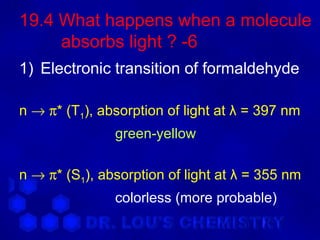
1) Electronic transition of formaldehyde

n → π* (T1), absorption of light at λ = 397 nm
               green-yellow

n → π* (S1), absorption of light at λ = 355 nm
               colorless (more probable)
19.4 What happens when absorbs
    light ?
•    Vibrational &
     Rotational
     states of
     CH3CO
    (IR and microwave
      radiation)
19.4 a molecule absorbs light
 1) What happens to absorbed energy
19.4 a molecule absorbs light
 7) Luminescence procedures : emission
  spectrum of M* provides information for
  qualitative or quantitative analysis.
  Photoluminescence :
   • Fluorescence : S1 → S0,
       no change in electron spin. (< 10-5 s)
   • Phosphorescence : T1 → S0,
       with a change in electron spin. (10-4~102 s)
 b. Chemiluminescence :
    Chemical reaction (not initiated by light) release
    energy in the form of light. ex : firefly.
19.4 a molecule absorbs light
 1) In which your class really shines ?


                                  emission
                                   spectrum
19.4 a molecule absorbs light
1) Absorption &
   Emission Spectra
19.5 Luminescence in
      analytical chemistry
1) Instrument


        • .hνout (photon)
        • heat
 hνin   • breaking a
          chemical bond
19.5 Luminescence

•   I = kPoC
          
        incident radiation
    sensitivity  by P0  or C 


6) more sensitive than Absorption
19.5 Luminescence
4) Fluorimetric Assay of Selenium in Brazil Nuts
  – Se is a trace element essential to life: destruct
    ROOH (free radical)

  – Derivatized:


  – Self-absorption: quench
19.5 Luminescence
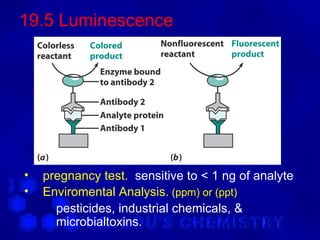
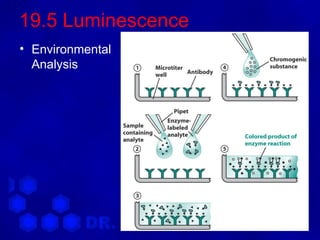
5) Immunoassarys
   employ anitbody
  to detect analyte.

  Ex: ELISA
19.5 Luminescence


•   pregnancy test. sensitive to < 1 ng of analyte
•   Enviromental Analysis. (ppm) or (ppt)
      pesticides, industrial chemicals, &
      microbialtoxins.
19.5 Luminescence
• Environmental
  Analysis
19-14
19-15
19-18
19-21
19-22

Chapter 19

  • 1.
    Chapter 19 Spectrophotometry : Instruments & Application
  • 2.
    19.1 The Spectrophotometer–1 Remote sensing of airborne bacteria: Optical fiber coated with antibodies to detect spores of a specific bacterium
  • 3.
    19.1 The Spectrophotometer-1 1) Spectrophotometer b) Single-beam e) Double-beam
  • 4.
  • 5.
  • 6.
    19.1 The Spectrophotometer–4 • Light source – Tungsten lamp: Vis. near IR (320 nm~2500 nm) – Deuterium are lamp: UV (200~400 nm) – Electric discharge lamp + Hg(g) or Xenon: Vis & UV – Globar (silicon carbide rod): IR (5000~200 cm-1) – Laser: intense monochromatic sources.
  • 7.
  • 8.
    19.1 The Spectrophotometer-6 • Monochromator Consists: • lenses or mirrors: focus the radiation • entrance and exit slits: restrict unwanted and control the spectral purity of radiation. • dispersing medium: separate the λ of polychromatic radiation from the source. (a) prism and (b) diffraction grating see Fig 19-2
  • 9.
    19.1 The Spectrophotometer-7 1) Monochromator a. entrance slit b. collimating mirror or lens c. a prism or grating d. focal plane e. exit slit
  • 10.
    19.1 The Spectrophotometer-8 • Monochromator Interference of adjacent waves that are (a) 0°, (b) 90 °, and © 180 ° out of phase
  • 11.
    19.1 The Spectrophotometer-9 • Monochromator nλ = a – b (n = ±1 first-order….) Grating equation : nλ = d (sinθ – sinφ ) Filters: select a desired wavelength
  • 12.
    19.1 The Spectrophotometer-10 • Monochromator Choosing the bandwidth: exit slit width Resolution trade-off Signal
  • 13.
    19.1 The Spectrophotometer-10 1) Detector Convert radiant energy (photons) into an electrical signal Ideal detector : high sensitivity, high signal/noise, constant response for λs, and fast response time.
  • 14.
    19.1 The Spectrophotometer-11 3) Detector Detector response depends on the λ of the incident photons.
  • 15.
    19.1 The Spectrophotometer-12 Photomultiplier tube: very sensitive detector
  • 16.
    19.1 The Spectrophotometer-13 Photodiode array spectrophotometer : records the entire spectrum at once. vs. Dispersive spectrophotometer: one λ at a time • speed (~1s/spetrum) • excellent λ repeatability • measure λs simultaneously • relatively insensitive to errors from stray light • relatively poor resolution (1~3 nm) vs 0.1nm
  • 17.
    19.1 The Spectrophotometer-14 diode array spectrophotometer
  • 18.
    19.2 Analysis ofa mixture -1 • Absorbance of a mixture : A = exb[X] + eyb[Y] + …
  • 19.
    19.2 Analysis ofa mixture -2 • Isosbestic points : for rxn: X → Y, every spectrum recorded during chemical reaction will cross at the same point. Good evidence for only two principle species in rxn. Ex: HIn  In- + H+
  • 20.
    19.2 Analysis ofa mixture -3 Why isosbestic point? A 465 = ε 465 [ HIn ] HIn [ ] A 465 = ε 465 In − In − when [ HIn ] = [ In ] ⇒ ε − 465 HIn = ε 465 = ε 465 In − ∴ For a mixture : HIn In − [ ] A 465 = ε 465 b [ HIn ] + ε 465 b In − = ε 465 b ( [ In ] + [ HIn ] ) − −
  • 21.
    19.3 Spectrophotometric Titrations-1 apotransferrin + 2Fe3+  (Fe3+)2transferrin colorless red (465 nm)
  • 22.
    19.3 Spectrophotometric Titrations-2 Ferric nitrilotriacetate [used to avoid Fe(OH)3 ]
  • 23.
    19.3 Spectrophotometric Titrations-3 ex.at p.408 Correcting A for the effect of dilution 125 μL ferric nitrilotriancetate 2 mL apotransferrin A = 0.260 A corrected = ?
  • 24.
    19.4 What happenswhen a molecule absorbs light ? 1) Absorbing species : M + hν → M* (lifetime : 10-8 ~ 10-9 sec) Relaxation processes : • M* → M + heat (most common) • M* → new species (photochemical reaction) • M* → M + hν (fluorescence, phosphorescence)
  • 25.
  • 26.
    19.4 What happenswhen a molecule absorbs light ? • Types of absorbing electrons Consider formaldehyde: three types of molecular orbitals • =σ H C O ×=π H =n
  • 27.
    19.4 What happensabsorbs light ? MO of CH3CO
  • 28.
    19.4 What happenswhen a molecule absorbs light ? Four types of electronic transitions σ* π* E n 200~700 nm π 150~250 nm σ < 125 nm
  • 29.
    19.4 What happenswhen a molecule absorbs light ? -5 1) Singlet / Triplet excited states ground excited excited singlet state singlet (S1) triplet (T1) E: T1 < S1
  • 30.
    19.4 What happenswhen a molecule absorbs light ? -6 1) Electronic transition of formaldehyde n → π* (T1), absorption of light at λ = 397 nm green-yellow n → π* (S1), absorption of light at λ = 355 nm colorless (more probable)
  • 31.
    19.4 What happenswhen absorbs light ? • Vibrational & Rotational states of CH3CO (IR and microwave radiation)
  • 32.
    19.4 a moleculeabsorbs light 1) What happens to absorbed energy
  • 33.
    19.4 a moleculeabsorbs light 7) Luminescence procedures : emission spectrum of M* provides information for qualitative or quantitative analysis.  Photoluminescence : • Fluorescence : S1 → S0, no change in electron spin. (< 10-5 s) • Phosphorescence : T1 → S0, with a change in electron spin. (10-4~102 s) b. Chemiluminescence : Chemical reaction (not initiated by light) release energy in the form of light. ex : firefly.
  • 34.
    19.4 a moleculeabsorbs light 1) In which your class really shines ? emission spectrum
  • 35.
    19.4 a moleculeabsorbs light 1) Absorption & Emission Spectra
  • 36.
    19.5 Luminescence in analytical chemistry 1) Instrument • .hνout (photon) • heat hνin • breaking a chemical bond
  • 37.
    19.5 Luminescence • I = kPoC  incident radiation sensitivity  by P0  or C  6) more sensitive than Absorption
  • 38.
    19.5 Luminescence 4) FluorimetricAssay of Selenium in Brazil Nuts – Se is a trace element essential to life: destruct ROOH (free radical) – Derivatized: – Self-absorption: quench
  • 39.
    19.5 Luminescence 5) Immunoassarys  employ anitbody to detect analyte. Ex: ELISA
  • 40.
    19.5 Luminescence • pregnancy test. sensitive to < 1 ng of analyte • Enviromental Analysis. (ppm) or (ppt) pesticides, industrial chemicals, & microbialtoxins.
  • 41.
  • 42.
  • 43.
  • 44.
  • 45.
  • 46.