ELECTRONSPRAY
IONIZATION(ESI)
AND ITS APPLICATION
Presented by:-
Shaikh Nisar Ali (M.Pharm)
Dept. Of Pharmacology
Guided by:- Dr. PSS
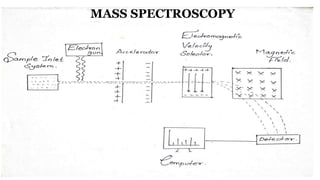
Mass Spectroscopy:-
• Mass spectrometry is an analytical tool useful for measuring
the mass-to-charge ratio of one or more molecules present in a
sample.
• Every Mass Spectrometer consists of at least these three
components:
1. Ionization Source
2. Mass Analyzer
3. Ion Detection System
Basics...
• Organic Molecules are bombarded with beam of Energetic electrons
(70 ev) in gaseous state.
• Converted into highly energetic positively charged ions.(Molecular ion
or Parent ion)
• Further breakup into smaller ions.(Fragmented or daughter ions).
• The formed ions are separated by deflection in Magnetic field
according to their MASS and CHARGE.
MASS SPECTROSCOPY
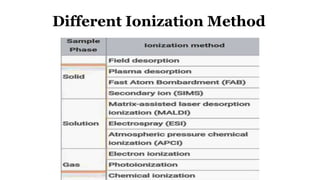
Different Ionization Method
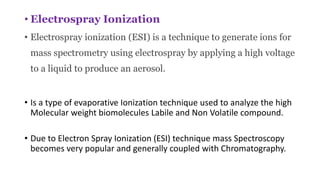
• Electrospray Ionization
• Electrospray ionization (ESI) is a technique to generate ions for
mass spectrometry using electrospray by applying a high voltage
to a liquid to produce an aerosol.
• Is a type of evaporative Ionization technique used to analyze the high
Molecular weight biomolecules Labile and Non Volatile compound.
• Due to Electron Spray Ionization (ESI) technique mass Spectroscopy
becomes very popular and generally coupled with Chromatography.
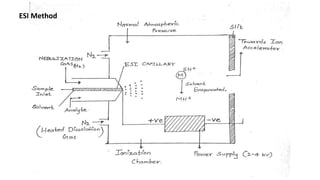
ESI Method
• A solution containing the sample molecule is sprayed through the
high voltage potential capillary by the help of nebulization gas.
• The sample comes to capillary tube and due to the nebulizing gas the
sample will be converted into sprayed droplets.
• And here we are supplying power.
• Due to the power supply here high voltage potential will be generated
at the tip of the capillary.
• Due to the high voltage potential that droplets becomes ionized.
• In next step the droplets comes to ionisation chamber and this
chamber is operated at normal atmospheric pressure.
• In this ionization chamber we are supplying heated dissolution gas
that is heated Nitrogen gas and due to that temperature of the
chamber becomes high.
• And at high temperature the sample is removed from the analyte
due to due to evaporation and it will converted in the form of
Molecular Ion.
• Heated desolvation gas will evaporate the solvent and it will produce
the molecular ion.
• For example --- If we have the molecule M and it is surrounded by
the Solvent S and this Solvent is Ionised like MSH+
• Now due to this heated dissolvation gas – Temp∆ Rises – And
evaporation takes place and it will converted into MH+
• Now this molecular Ion will go further towards ION accelerator
chamber and then to mass analyser.
Power is supplied.
Positive side is attached to capillary tube.
Negative side is attached to Ion accelerator chamber and it will
produce negative potential.
That negative potential will help this positive Ion to get the velocity
and ultimately it will move towards the mass analyzer.
It can also produce multiple charged ions along with the single
charged ions.
Uses :-
• Mass spectra is used in two general ways.
• 1. To prove the identity of two compounds.
• 2. To establish the structure of a new compound.
• It deals with the examination of the characteristics fragments (ions)
arising from the breakdown of organic molecules.
• Used to Ionised Proteins , Lipids , Olegosacchrides , Olegonucleotides,
Synthetic Polymer etc.
• It helps to establish the structure of a new compound in several ways
1. It can give the exact molecular mass.
2. It can give a molecular formula or it can reveal the presence of
certain structural units in a molecule.
• Trace gas analysis, respired gas monitors .
• Determining the isotopic compounds of elements within a sample .
• Pharmacokinetics, protein characterization.
• Glycan analysis and space exploration.
Applications:-
• It has both quantitative and qualitative uses.
• Helps in identification of unknown compounds.
• Determining the isotopic composition of elements in a molecule.
Quantifying the amount of compound in the sample.
• Determining the structure of a compound by observing fragmentation.
• Mass spectroscopy is now in very common use in analytical laboratories
that study physical, chemical or biological properties of a great variety of
compounds.
Thank you

Electron Spray Ionization (ESI) and its Applications

  • 1.
    ELECTRONSPRAY IONIZATION(ESI) AND ITS APPLICATION Presentedby:- Shaikh Nisar Ali (M.Pharm) Dept. Of Pharmacology Guided by:- Dr. PSS
  • 2.
    Mass Spectroscopy:- • Massspectrometry is an analytical tool useful for measuring the mass-to-charge ratio of one or more molecules present in a sample. • Every Mass Spectrometer consists of at least these three components: 1. Ionization Source 2. Mass Analyzer 3. Ion Detection System
  • 3.
    Basics... • Organic Moleculesare bombarded with beam of Energetic electrons (70 ev) in gaseous state. • Converted into highly energetic positively charged ions.(Molecular ion or Parent ion) • Further breakup into smaller ions.(Fragmented or daughter ions). • The formed ions are separated by deflection in Magnetic field according to their MASS and CHARGE.
  • 4.
  • 5.
  • 6.
    • Electrospray Ionization •Electrospray ionization (ESI) is a technique to generate ions for mass spectrometry using electrospray by applying a high voltage to a liquid to produce an aerosol. • Is a type of evaporative Ionization technique used to analyze the high Molecular weight biomolecules Labile and Non Volatile compound. • Due to Electron Spray Ionization (ESI) technique mass Spectroscopy becomes very popular and generally coupled with Chromatography.
  • 7.
  • 8.
    • A solutioncontaining the sample molecule is sprayed through the high voltage potential capillary by the help of nebulization gas. • The sample comes to capillary tube and due to the nebulizing gas the sample will be converted into sprayed droplets. • And here we are supplying power. • Due to the power supply here high voltage potential will be generated at the tip of the capillary. • Due to the high voltage potential that droplets becomes ionized. • In next step the droplets comes to ionisation chamber and this chamber is operated at normal atmospheric pressure. • In this ionization chamber we are supplying heated dissolution gas that is heated Nitrogen gas and due to that temperature of the chamber becomes high.
  • 9.
    • And athigh temperature the sample is removed from the analyte due to due to evaporation and it will converted in the form of Molecular Ion. • Heated desolvation gas will evaporate the solvent and it will produce the molecular ion. • For example --- If we have the molecule M and it is surrounded by the Solvent S and this Solvent is Ionised like MSH+ • Now due to this heated dissolvation gas – Temp∆ Rises – And evaporation takes place and it will converted into MH+ • Now this molecular Ion will go further towards ION accelerator chamber and then to mass analyser.
  • 10.
    Power is supplied. Positiveside is attached to capillary tube. Negative side is attached to Ion accelerator chamber and it will produce negative potential. That negative potential will help this positive Ion to get the velocity and ultimately it will move towards the mass analyzer. It can also produce multiple charged ions along with the single charged ions.
  • 11.
    Uses :- • Massspectra is used in two general ways. • 1. To prove the identity of two compounds. • 2. To establish the structure of a new compound. • It deals with the examination of the characteristics fragments (ions) arising from the breakdown of organic molecules. • Used to Ionised Proteins , Lipids , Olegosacchrides , Olegonucleotides, Synthetic Polymer etc.
  • 12.
    • It helpsto establish the structure of a new compound in several ways 1. It can give the exact molecular mass. 2. It can give a molecular formula or it can reveal the presence of certain structural units in a molecule. • Trace gas analysis, respired gas monitors . • Determining the isotopic compounds of elements within a sample . • Pharmacokinetics, protein characterization. • Glycan analysis and space exploration.
  • 13.
    Applications:- • It hasboth quantitative and qualitative uses. • Helps in identification of unknown compounds. • Determining the isotopic composition of elements in a molecule. Quantifying the amount of compound in the sample. • Determining the structure of a compound by observing fragmentation. • Mass spectroscopy is now in very common use in analytical laboratories that study physical, chemical or biological properties of a great variety of compounds.
  • 14.