UV-VIS Spectroscopy
PINSET
1
Introduction
 Utilize the sample source of light in the
UV or VIS region of spectrum
 Ultraviolet (UV) and visible (VIS)
spectroscopy
 This is the earliest method of molecular
spectroscopy.
 A phenomenon of interaction of
molecules with ultraviolet and visible
lights.
 Absorption of photon results in electronic
transition of a molecule, and electrons
are promoted from ground state to higher
electronic states.
2
Intro continued…
 These energy absorbed will then be used
to determine the presence of functional
molecules in a sample.
 Prediction of molecules in sample is then
done via UV-VIS spectroscopy.
 In structure determination : UV-VIS
spectroscopy is used to detect the
presence of chromophores like dienes,
aromatics, polyenes, and conjugated
ketones, etc.
3
Chromophores
 Term originated from Chromophorus (Greek
origin) which means color carrier
 Specific conjugated groups in the molecules
of sample under analysis is the factor that is
responsible for the absorption of specific i.e
UV radiation in the compounds
 Such groups responsible for specific
absorption of radiation are chromophores
 Initially it was used for groups imparting color
 Any functional group that absorbs
electromagnetic radiation
4
Energy of molecules
 There are different energies in a molecule
that affect the nature of absorbing radiations.
 Etotal=Eelec+Evib+Erot+Enucl
 Eelec: electronic transitions (UV, X-ray)
 Evib: vibrational transitions (Infrared)
 Erot: rotational transitions (Microwave)
 Enucl: nucleus spin (nuclear magnetic
resonance) or (MRI: magnetic resonance
imaging)
5
Auxochromes
 Groups that augment color imparting properties of
chromophore in the same molecule
 When present in combination with a chromophore
it Effects wavelength and intensity of absorption
 Nitro benzene group imparts light yellow colour to
compounds
 If NH2 is attached at Para position to nitro it
enhances its color
 Chromophore?
 Auxochrome?
6
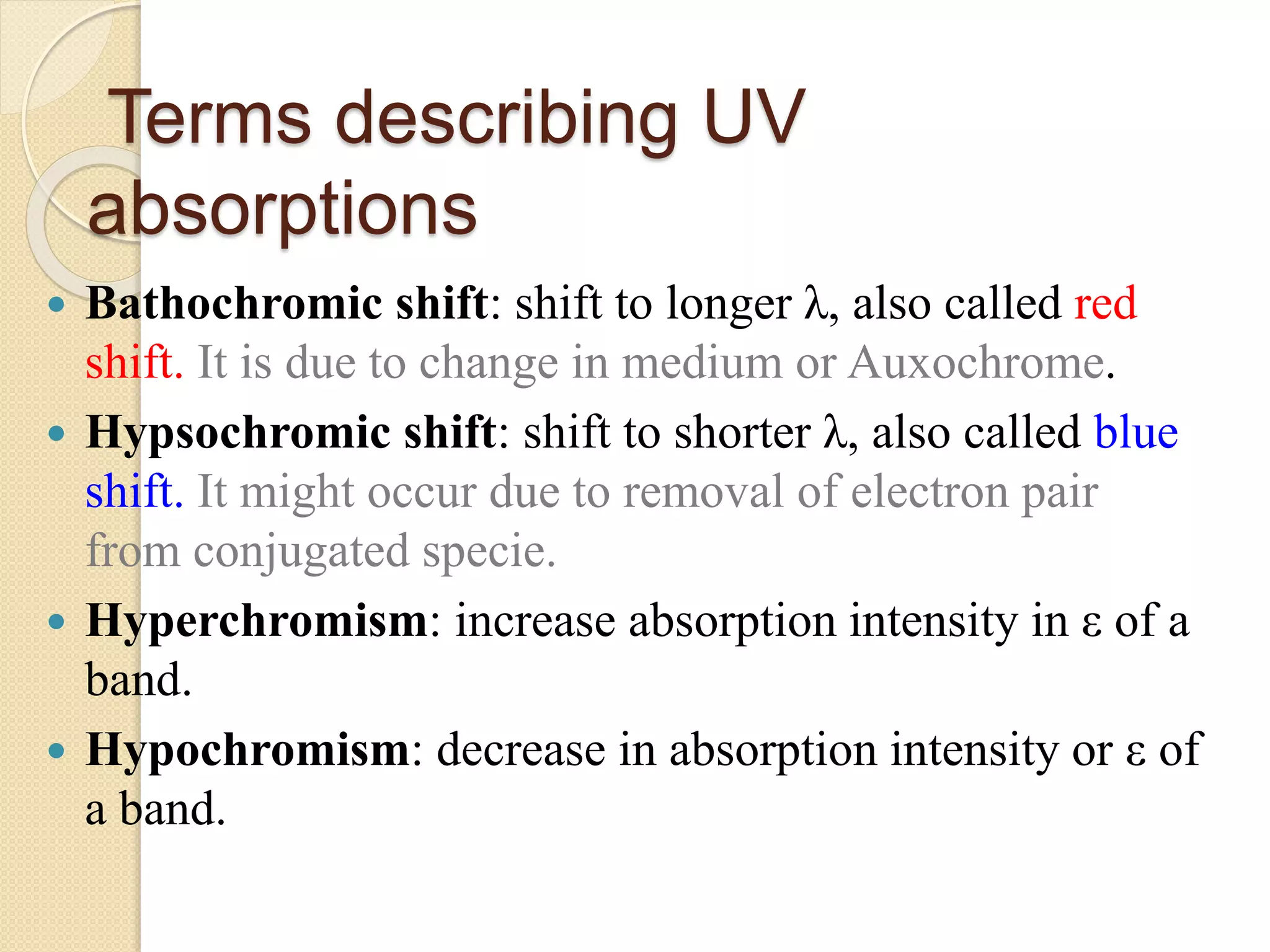
Terms describing UV
absorptions
 Bathochromic shift: shift to longer λ, also called red
shift. It is due to change in medium or Auxochrome.
 Hypsochromic shift: shift to shorter λ, also called blue
shift. It might occur due to removal of electron pair
from conjugated specie.
 Hyperchromism: increase absorption intensity in ε of a
band.
 Hypochromism: decrease in absorption intensity or ε of
a band.
Graphical representation of shifts
8
Interaction of light and sample
 Scattering of light
 Refraction at interfaces
 Scatter in solution
 Large molecules
 Air bubbles
 Normalized by comparison to reference cell
 Contains only solvent
 Measurement for transmittance is compared
to results from reference cell
9
Principle
 Beer lamberts law
 Is applicable for the clear solutions only with
chemical deformation and reformations
 Lamberts law is the relation between the total
absorption of light and the path length
through which the light traverse
 Beers law is the relation between the
absorption of light to the concentration of the
absorbing medium
10
Beer lambert’s law
 log10
𝐼.
𝐼 = e.c.l
 A = e.c.l
 A = log10
𝐼.
𝐼
 A= absorbance
 I.= intensity of the incident light
 I= intensity of the transmitted light
 e= molecular extinction constant
 c= concentration of solution in
mol/dm3
 l= path length of sample in cm 11
Path length
/ cm 0 0.2 0.4 0.6 0.8 1.0
%T 100 50 25 12.5 6.25 3.125
Absorbance 0 0.3 0.6 0.9 1.2 1.5
External Standard and the
Calibration Curve
Spectroscopic instrument
 Names of both 15
Single and Double Beam
Spectrometer
 Single-Beam: There is only one light beam or
optical path from the source through to the
detector.
 Double-Beam: The light from the source, after
passing through the monochromator, is split
into two separate beams-one for the sample
and the other for the reference.
UV-VIS spectrophotometer
Instrumentation
Light Source
 Deuterium Lamps-a truly continuous
spectrum in the ultraviolet region is produced
by electrical excitation of deuterium at low
pressure. (160nm~375nm)
 Tungsten Filament Lamps-the most
common source of visible and near infrared
radiation. Wavelength more than 375nm.
Sample cells
 Composition is silica
 Why silica?
 Transparency of material and passage of
light easy
 Glass cells are not used because absorbs
radiation above 300nm
 Path length 1cm
 0.1cm and 10cm cells are also there
 Path length of reference an sample cells are
kept same in double beam spectrometer
21
Monochromators
 Used as a filter: the monochromator
will select a narrow portion of the
spectrum (the bandpass) of a given
source
 Used in analysis: the monochromator
will sequentially select for the detector
to record the different components
(spectrum) of any source or sample
emitting light.
22
Monochromator
Czerny-Turner design
Grating
Detector
Barrier Layer/Photovoltaic
Principle of Barrier
Layer/Photovoltaic Detector
 This device measures the intensity of photons
by means of the voltage developed across the
semiconductor layer.
 Electrons, ejected by photons from the
semiconductor, are collected by the silver layer.
 The potential depends on the number of
photons hitting the detector.
Detector
Photomultiplier
Principle of Photomultiplier Detector
 The type is commonly used.
 The detector consists of a photo-emissive
cathode coupled with a series of electron-
multiplying dynode stages, and usually called
a photomultiplier.
 The primary electrons ejected from the photo-
cathode are accelerated by an electric field so
as to strike a small area on the first dynode.
Principle of Photomultiplier
Detector
 The impinging electrons strike with enough
energy to eject two to five secondary electrons,
which are accelerated to the second dynode to
eject still more electrons.
 A photomultiplier may have 9 to 16 stages,
and overall gain of 106~109 electrons per
incident photon.
Standard Addition Method
 Standard addition must be used whenever the
matrix of a sample changes the analytical
sensitivity of the method.
 In other words, the slope of the working
curve for standards made with distilled water
is different from the same working curve.
 So standards could be used for concentration
determination of similar samples
Prepare the Standards
The concentration and volume of the stock solution
added should be chosen to increase the
concentration of the unknown by about 30% in
each succeeding flask.
Calculation of concentrations
 You should now know the concentration
making numerical
 Via formula like C1V1=C2V2
 What would be the concentration of
chlorophyll pigment in sample solution of
plant extract. If the standard was 1uM
concentrated with chlorophyll in 1 mL.
calculate sample concentration in 1uL.
32
Limits to Beer’s Law
 Chemical Deviations
-absorbing undergo association,
dissociation or reaction with the solvent
 Instrumental Deviations
-non-monochromatic radiation
-stray light
Limits to Beer’s Law
Chemical Deviations
 high concentration-particles too close
 Average distance between ions and molecules
are diminished to the point.
 Affect the charge distribution and extent of
absorption.
 Cause deviations from linear relationship.
Limits to Beer’s Law
Chemical Deviations
 chemical interactions-monomer-dimer
equilibria, metal complexation equilibria,
acid/base equilibria and solvent-analyte
association equilibria
The extent of such departure can be predicted
from molar absorptivities and equilibrium
constant. (see p561 ex 21-3)
Limits to Beer’s Law
Instrumental Deviations
 non-monochromatic radiation
Limits to Beer’s Law
Instrumental Deviations
 Stray light
(Po' + Po")
Am = log --------------
(P' + P")
Applications of UV-VIS
 Wavelength range is 180nm ~400 nm
 Has limited applications though used in
identification of species in a sample
 Differentiation for the conjugated and
unconjugated species.
 Extent of conjugation
 Detection of chromospheres or
chromophores in a compound
 Detection of functional groups in a compound
 Detection of geometric isomers
40
Thanks 
41

UV-VIS Spectroscopy

  • 1.
  • 2.
    Introduction  Utilize thesample source of light in the UV or VIS region of spectrum  Ultraviolet (UV) and visible (VIS) spectroscopy  This is the earliest method of molecular spectroscopy.  A phenomenon of interaction of molecules with ultraviolet and visible lights.  Absorption of photon results in electronic transition of a molecule, and electrons are promoted from ground state to higher electronic states. 2
  • 3.
    Intro continued…  Theseenergy absorbed will then be used to determine the presence of functional molecules in a sample.  Prediction of molecules in sample is then done via UV-VIS spectroscopy.  In structure determination : UV-VIS spectroscopy is used to detect the presence of chromophores like dienes, aromatics, polyenes, and conjugated ketones, etc. 3
  • 4.
    Chromophores  Term originatedfrom Chromophorus (Greek origin) which means color carrier  Specific conjugated groups in the molecules of sample under analysis is the factor that is responsible for the absorption of specific i.e UV radiation in the compounds  Such groups responsible for specific absorption of radiation are chromophores  Initially it was used for groups imparting color  Any functional group that absorbs electromagnetic radiation 4
  • 5.
    Energy of molecules There are different energies in a molecule that affect the nature of absorbing radiations.  Etotal=Eelec+Evib+Erot+Enucl  Eelec: electronic transitions (UV, X-ray)  Evib: vibrational transitions (Infrared)  Erot: rotational transitions (Microwave)  Enucl: nucleus spin (nuclear magnetic resonance) or (MRI: magnetic resonance imaging) 5
  • 6.
    Auxochromes  Groups thataugment color imparting properties of chromophore in the same molecule  When present in combination with a chromophore it Effects wavelength and intensity of absorption  Nitro benzene group imparts light yellow colour to compounds  If NH2 is attached at Para position to nitro it enhances its color  Chromophore?  Auxochrome? 6
  • 7.
    Terms describing UV absorptions Bathochromic shift: shift to longer λ, also called red shift. It is due to change in medium or Auxochrome.  Hypsochromic shift: shift to shorter λ, also called blue shift. It might occur due to removal of electron pair from conjugated specie.  Hyperchromism: increase absorption intensity in ε of a band.  Hypochromism: decrease in absorption intensity or ε of a band.
  • 8.
  • 9.
    Interaction of lightand sample  Scattering of light  Refraction at interfaces  Scatter in solution  Large molecules  Air bubbles  Normalized by comparison to reference cell  Contains only solvent  Measurement for transmittance is compared to results from reference cell 9
  • 10.
    Principle  Beer lambertslaw  Is applicable for the clear solutions only with chemical deformation and reformations  Lamberts law is the relation between the total absorption of light and the path length through which the light traverse  Beers law is the relation between the absorption of light to the concentration of the absorbing medium 10
  • 11.
    Beer lambert’s law log10 𝐼. 𝐼 = e.c.l  A = e.c.l  A = log10 𝐼. 𝐼  A= absorbance  I.= intensity of the incident light  I= intensity of the transmitted light  e= molecular extinction constant  c= concentration of solution in mol/dm3  l= path length of sample in cm 11
  • 13.
    Path length / cm0 0.2 0.4 0.6 0.8 1.0 %T 100 50 25 12.5 6.25 3.125 Absorbance 0 0.3 0.6 0.9 1.2 1.5
  • 14.
    External Standard andthe Calibration Curve
  • 15.
  • 16.
    Single and DoubleBeam Spectrometer  Single-Beam: There is only one light beam or optical path from the source through to the detector.  Double-Beam: The light from the source, after passing through the monochromator, is split into two separate beams-one for the sample and the other for the reference.
  • 18.
  • 19.
  • 20.
    Light Source  DeuteriumLamps-a truly continuous spectrum in the ultraviolet region is produced by electrical excitation of deuterium at low pressure. (160nm~375nm)  Tungsten Filament Lamps-the most common source of visible and near infrared radiation. Wavelength more than 375nm.
  • 21.
    Sample cells  Compositionis silica  Why silica?  Transparency of material and passage of light easy  Glass cells are not used because absorbs radiation above 300nm  Path length 1cm  0.1cm and 10cm cells are also there  Path length of reference an sample cells are kept same in double beam spectrometer 21
  • 22.
    Monochromators  Used asa filter: the monochromator will select a narrow portion of the spectrum (the bandpass) of a given source  Used in analysis: the monochromator will sequentially select for the detector to record the different components (spectrum) of any source or sample emitting light. 22
  • 23.
  • 24.
  • 25.
  • 26.
    Principle of Barrier Layer/PhotovoltaicDetector  This device measures the intensity of photons by means of the voltage developed across the semiconductor layer.  Electrons, ejected by photons from the semiconductor, are collected by the silver layer.  The potential depends on the number of photons hitting the detector.
  • 27.
  • 28.
    Principle of PhotomultiplierDetector  The type is commonly used.  The detector consists of a photo-emissive cathode coupled with a series of electron- multiplying dynode stages, and usually called a photomultiplier.  The primary electrons ejected from the photo- cathode are accelerated by an electric field so as to strike a small area on the first dynode.
  • 29.
    Principle of Photomultiplier Detector The impinging electrons strike with enough energy to eject two to five secondary electrons, which are accelerated to the second dynode to eject still more electrons.  A photomultiplier may have 9 to 16 stages, and overall gain of 106~109 electrons per incident photon.
  • 30.
    Standard Addition Method Standard addition must be used whenever the matrix of a sample changes the analytical sensitivity of the method.  In other words, the slope of the working curve for standards made with distilled water is different from the same working curve.  So standards could be used for concentration determination of similar samples
  • 31.
    Prepare the Standards Theconcentration and volume of the stock solution added should be chosen to increase the concentration of the unknown by about 30% in each succeeding flask.
  • 32.
    Calculation of concentrations You should now know the concentration making numerical  Via formula like C1V1=C2V2  What would be the concentration of chlorophyll pigment in sample solution of plant extract. If the standard was 1uM concentrated with chlorophyll in 1 mL. calculate sample concentration in 1uL. 32
  • 34.
    Limits to Beer’sLaw  Chemical Deviations -absorbing undergo association, dissociation or reaction with the solvent  Instrumental Deviations -non-monochromatic radiation -stray light
  • 35.
    Limits to Beer’sLaw Chemical Deviations  high concentration-particles too close  Average distance between ions and molecules are diminished to the point.  Affect the charge distribution and extent of absorption.  Cause deviations from linear relationship.
  • 36.
    Limits to Beer’sLaw Chemical Deviations  chemical interactions-monomer-dimer equilibria, metal complexation equilibria, acid/base equilibria and solvent-analyte association equilibria The extent of such departure can be predicted from molar absorptivities and equilibrium constant. (see p561 ex 21-3)
  • 38.
    Limits to Beer’sLaw Instrumental Deviations  non-monochromatic radiation
  • 39.
    Limits to Beer’sLaw Instrumental Deviations  Stray light (Po' + Po") Am = log -------------- (P' + P")
  • 40.
    Applications of UV-VIS Wavelength range is 180nm ~400 nm  Has limited applications though used in identification of species in a sample  Differentiation for the conjugated and unconjugated species.  Extent of conjugation  Detection of chromospheres or chromophores in a compound  Detection of functional groups in a compound  Detection of geometric isomers 40
  • 41.