Real Time PCR
Naren Yadav
 What is Real time PCR ?
 A real-time polymerase chain reaction is
a laboratory technique of molecular biology based
on the polymerase chain reaction (PCR). It monitors
the amplification of a targeted DNA molecule during
the PCR, i.e. in real-time, and not at its end, as in
conventional PCR.
 qPCR
2 common detection methods
in Real time PCR :-
 (1) By using non-specific fluorescent dyes.
 (2) By using sequence-specific fluorescent
probes.
1) Non-specific fluorescent
dye
 dsDNA binding dyes :-
 SYBR green I
 SYBR green II
 EVA green
 LC green
 YO-PRO
 SYTO family
(SYBR green I):-
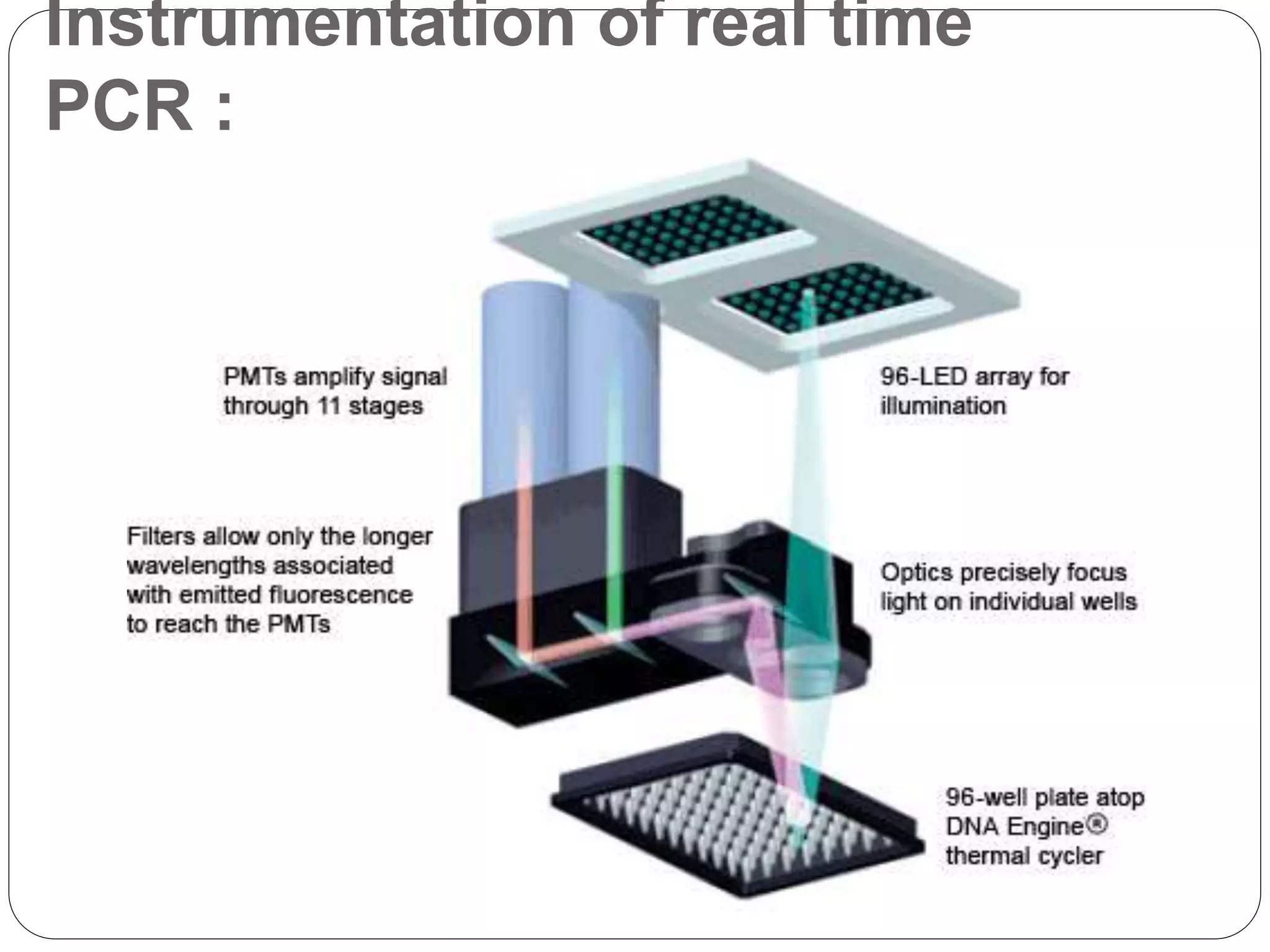
Instrumentation of real time
PCR :
Observation :-
SYBR green fluorescence chart produced in real-time PC
Threshold
Baseline
CT
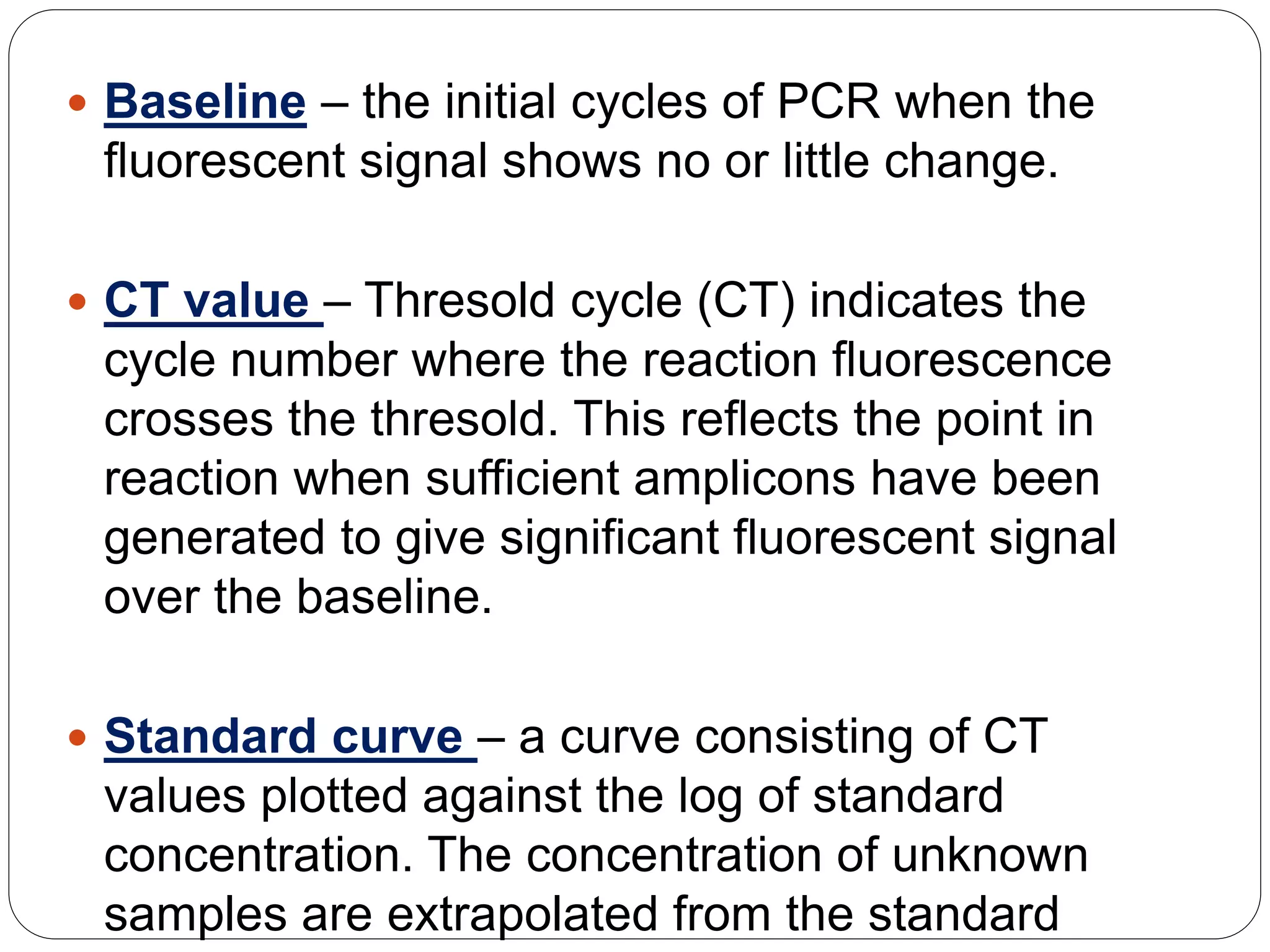
 Baseline – the initial cycles of PCR when the
fluorescent signal shows no or little change.
 CT value – Thresold cycle (CT) indicates the
cycle number where the reaction fluorescence
crosses the thresold. This reflects the point in
reaction when sufficient amplicons have been
generated to give significant fluorescent signal
over the baseline.
 Standard curve – a curve consisting of CT
values plotted against the log of standard
concentration. The concentration of unknown
samples are extrapolated from the standard
Melting curve produced at the end of real-time
PCR.
2) Sequence specific
Fluorescent probe method
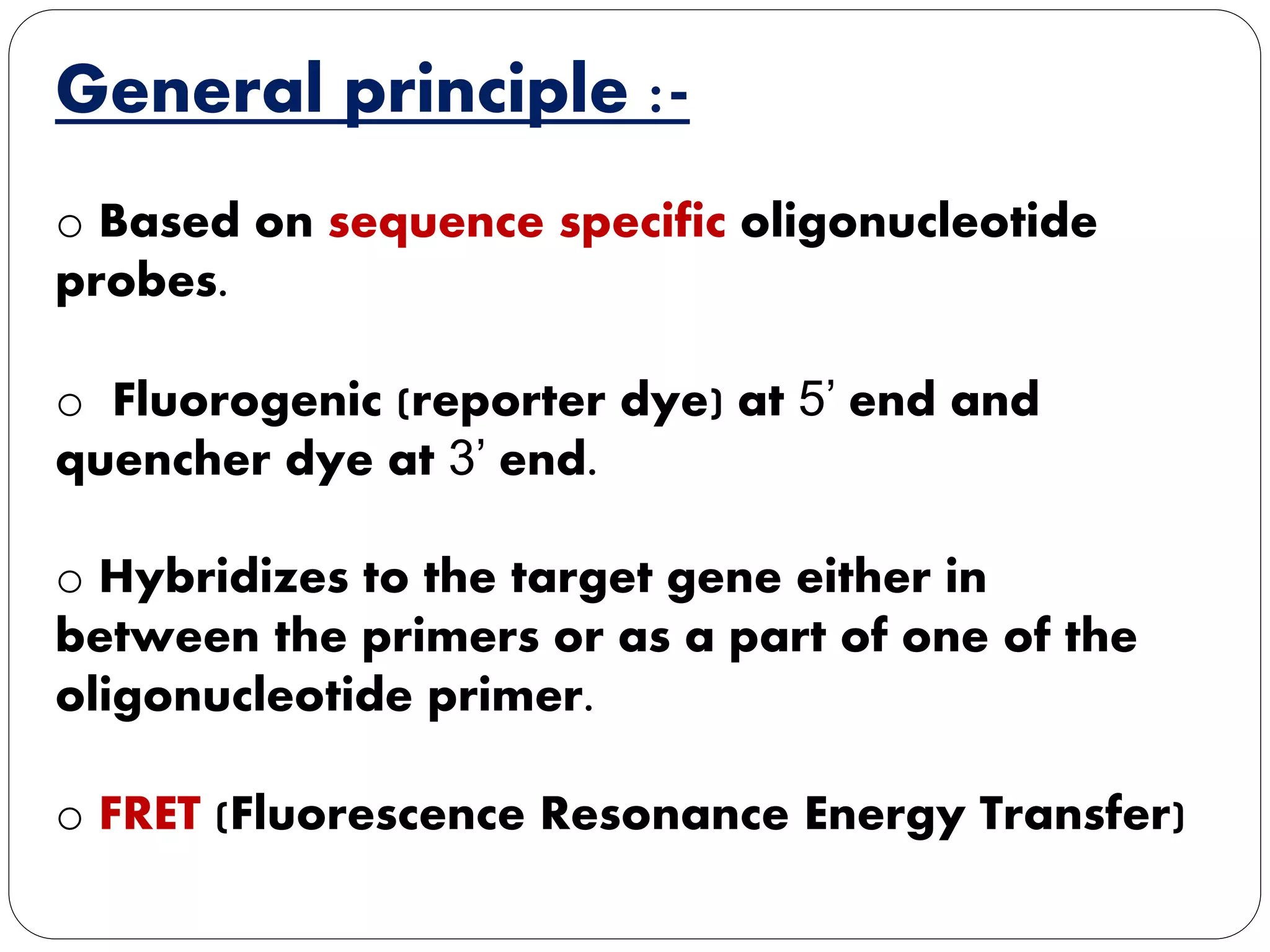
General principle :-
o Based on sequence specific oligonucleotide
probes.
o Fluorogenic (reporter dye) at 5’ end and
quencher dye at 3’ end.
o Hybridizes to the target gene either in
between the primers or as a part of one of the
oligonucleotide primer.
o FRET (Fluorescence Resonance Energy Transfer)
TaqMan probe :-
Haip pin probes - Scorpions :-
Applications of Real time PCR
:-
 Diagnostic uses – To diagnose infectious
diseases
 Microbiological uses - Used by microbiologists
in the fields of food safety, food spoilage and
fermentation and for the microbial risk
assessment of water quality.
 Uses in research - used to provide quantitative
measurements of gene transcription.
• Thank you

Real time PCR

  • 1.
  • 2.
     What isReal time PCR ?  A real-time polymerase chain reaction is a laboratory technique of molecular biology based on the polymerase chain reaction (PCR). It monitors the amplification of a targeted DNA molecule during the PCR, i.e. in real-time, and not at its end, as in conventional PCR.  qPCR
  • 3.
    2 common detectionmethods in Real time PCR :-  (1) By using non-specific fluorescent dyes.  (2) By using sequence-specific fluorescent probes.
  • 4.
  • 5.
     dsDNA bindingdyes :-  SYBR green I  SYBR green II  EVA green  LC green  YO-PRO  SYTO family
  • 6.
  • 7.
  • 8.
  • 9.
    SYBR green fluorescencechart produced in real-time PC Threshold Baseline CT
  • 10.
     Baseline –the initial cycles of PCR when the fluorescent signal shows no or little change.  CT value – Thresold cycle (CT) indicates the cycle number where the reaction fluorescence crosses the thresold. This reflects the point in reaction when sufficient amplicons have been generated to give significant fluorescent signal over the baseline.  Standard curve – a curve consisting of CT values plotted against the log of standard concentration. The concentration of unknown samples are extrapolated from the standard
  • 11.
    Melting curve producedat the end of real-time PCR.
  • 12.
  • 13.
    General principle :- oBased on sequence specific oligonucleotide probes. o Fluorogenic (reporter dye) at 5’ end and quencher dye at 3’ end. o Hybridizes to the target gene either in between the primers or as a part of one of the oligonucleotide primer. o FRET (Fluorescence Resonance Energy Transfer)
  • 14.
  • 15.
    Haip pin probes- Scorpions :-
  • 16.
    Applications of Realtime PCR :-  Diagnostic uses – To diagnose infectious diseases  Microbiological uses - Used by microbiologists in the fields of food safety, food spoilage and fermentation and for the microbial risk assessment of water quality.  Uses in research - used to provide quantitative measurements of gene transcription.
  • 17.