 Oxidation and Reduction
 Oxidizing and Reducing agent
 Process of Oxidation
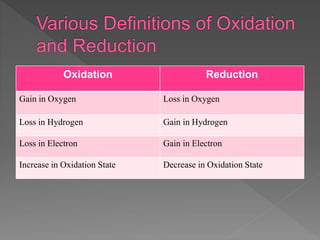
Oxidation Reduction
Gain in Oxygen Loss in Oxygen
Loss in Hydrogen Gain in Hydrogen
Loss in Electron Gain in Electron
Increase in Oxidation State Decrease in Oxidation State
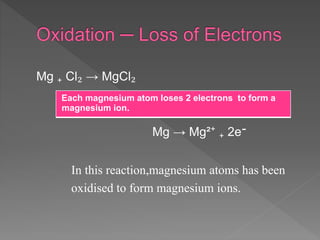
Mg ₊ Cl₂ → MgCl₂
Mg → Mg²⁺ ₊ 2e‫־‬
In this reaction,magnesium atoms has been
oxidised to form magnesium ions.
Each magnesium atom loses 2 electrons to form a
magnesium ion.
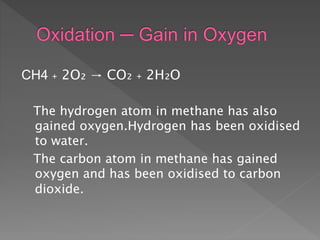
CH4 ₊ 2O₂ → CO₂ ₊ 2H₂O
The hydrogen atom in methane has also
gained oxygen.Hydrogen has been oxidised
to water.
The carbon atom in methane has gained
oxygen and has been oxidised to carbon
dioxide.
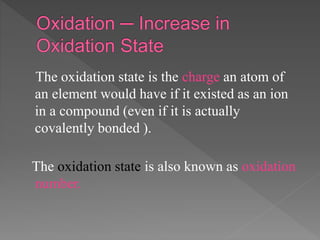
The oxidation state is the charge an atom of
an element would have if it existed as an ion
in a compound (even if it is actually
covalently bonded ).
The oxidation state is also known as oxidation
number.
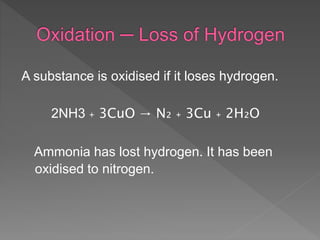
A substance is oxidised if it loses hydrogen.
2NH3 ₊ 3CuO → N₂ ₊ 3Cu ₊ 2H₂O
Ammonia has lost hydrogen. It has been
oxidised to nitrogen.
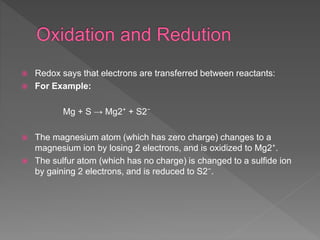
 Redox says that electrons are transferred between reactants:
 For Example:
Mg + S → Mg2⁺ + S2⁻
 The magnesium atom (which has zero charge) changes to a
magnesium ion by losing 2 electrons, and is oxidized to Mg2⁺.
 The sulfur atom (which has no charge) is changed to a sulfide ion
by gaining 2 electrons, and is reduced to S2⁻.
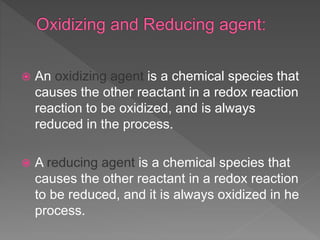
 An oxidizing agent is a chemical species that
causes the other reactant in a redox reaction
reaction to be oxidized, and is always
reduced in the process.
 A reducing agent is a chemical species that
causes the other reactant in a redox reaction
to be reduced, and it is always oxidized in he
process.
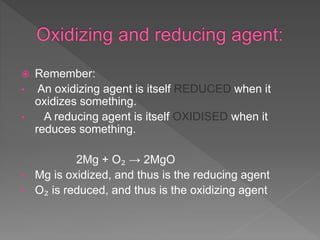
 Remember:
• An oxidizing agent is itself REDUCED when it
oxidizes something.
• A reducing agent is itself OXIDISED when it
reduces something.
2Mg + O₂ → 2MgO
• Mg is oxidized, and thus is the reducing agent
• O₂ is reduced, and thus is the oxidizing agent
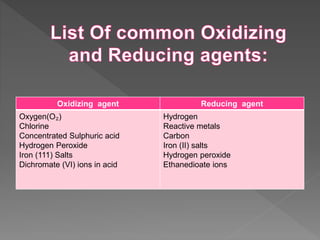
Oxidizing agent Reducing agent
Oxygen(O₂)
Chlorine
Concentrated Sulphuric acid
Hydrogen Peroxide
Iron (111) Salts
Dichromate (VI) ions in acid
Hydrogen
Reactive metals
Carbon
Iron (II) salts
Hydrogen peroxide
Ethanedioate ions
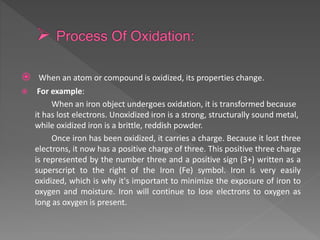
 When an atom or compound is oxidized, its properties change.
 For example:
When an iron object undergoes oxidation, it is transformed because
it has lost electrons. Unoxidized iron is a strong, structurally sound metal,
while oxidized iron is a brittle, reddish powder.
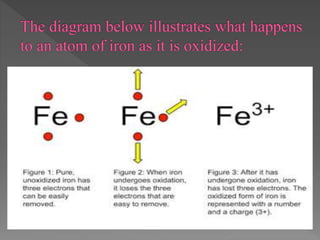
Once iron has been oxidized, it carries a charge. Because it lost three
electrons, it now has a positive charge of three. This positive three charge
is represented by the number three and a positive sign (3+) written as a
superscript to the right of the Iron (Fe) symbol. Iron is very easily
oxidized, which is why it's important to minimize the exposure of iron to
oxygen and moisture. Iron will continue to lose electrons to oxygen as
long as oxygen is present.
Thank You

Oxidation

  • 2.
     Oxidation andReduction  Oxidizing and Reducing agent  Process of Oxidation
  • 3.
    Oxidation Reduction Gain inOxygen Loss in Oxygen Loss in Hydrogen Gain in Hydrogen Loss in Electron Gain in Electron Increase in Oxidation State Decrease in Oxidation State
  • 4.
    Mg ₊ Cl₂→ MgCl₂ Mg → Mg²⁺ ₊ 2e‫־‬ In this reaction,magnesium atoms has been oxidised to form magnesium ions. Each magnesium atom loses 2 electrons to form a magnesium ion.
  • 5.
    CH4 ₊ 2O₂→ CO₂ ₊ 2H₂O The hydrogen atom in methane has also gained oxygen.Hydrogen has been oxidised to water. The carbon atom in methane has gained oxygen and has been oxidised to carbon dioxide.
  • 6.
    The oxidation stateis the charge an atom of an element would have if it existed as an ion in a compound (even if it is actually covalently bonded ). The oxidation state is also known as oxidation number.
  • 7.
    A substance isoxidised if it loses hydrogen. 2NH3 ₊ 3CuO → N₂ ₊ 3Cu ₊ 2H₂O Ammonia has lost hydrogen. It has been oxidised to nitrogen.
  • 8.
     Redox saysthat electrons are transferred between reactants:  For Example: Mg + S → Mg2⁺ + S2⁻  The magnesium atom (which has zero charge) changes to a magnesium ion by losing 2 electrons, and is oxidized to Mg2⁺.  The sulfur atom (which has no charge) is changed to a sulfide ion by gaining 2 electrons, and is reduced to S2⁻.
  • 9.
     An oxidizingagent is a chemical species that causes the other reactant in a redox reaction reaction to be oxidized, and is always reduced in the process.  A reducing agent is a chemical species that causes the other reactant in a redox reaction to be reduced, and it is always oxidized in he process.
  • 10.
     Remember: • Anoxidizing agent is itself REDUCED when it oxidizes something. • A reducing agent is itself OXIDISED when it reduces something. 2Mg + O₂ → 2MgO • Mg is oxidized, and thus is the reducing agent • O₂ is reduced, and thus is the oxidizing agent
  • 11.
    Oxidizing agent Reducingagent Oxygen(O₂) Chlorine Concentrated Sulphuric acid Hydrogen Peroxide Iron (111) Salts Dichromate (VI) ions in acid Hydrogen Reactive metals Carbon Iron (II) salts Hydrogen peroxide Ethanedioate ions
  • 12.
     When anatom or compound is oxidized, its properties change.  For example: When an iron object undergoes oxidation, it is transformed because it has lost electrons. Unoxidized iron is a strong, structurally sound metal, while oxidized iron is a brittle, reddish powder. Once iron has been oxidized, it carries a charge. Because it lost three electrons, it now has a positive charge of three. This positive three charge is represented by the number three and a positive sign (3+) written as a superscript to the right of the Iron (Fe) symbol. Iron is very easily oxidized, which is why it's important to minimize the exposure of iron to oxygen and moisture. Iron will continue to lose electrons to oxygen as long as oxygen is present.
  • 14.