OUTLINE
Main Purpose :
 Analyze two different types of Dickson Charge Pump Designs
 Offer a comparison between them
• Studying the usage and operation of Dickson Charge Pump
• Specifications for a charge pump design
• Understanding the effect of design parameters on performance
Presentation Track :
• Introduction to Dickson Charge Pump
• Specifications
• Effect of design parameters
• Analysis of two different charge pump designs
• Comparison comparison between these two designs
Introduction to Dickson Charge Pump
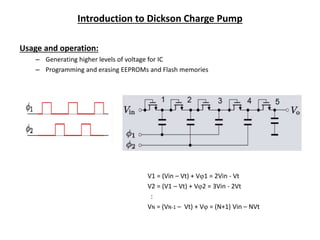
Usage and operation:
– Generating higher levels of voltage for IC
– Programming and erasing EEPROMs and Flash memories
V1 = (Vin – Vt) + V1 = 2Vin - Vt
V2 = (V1 – Vt) + V2 = 3Vin - 2Vt
:
VN = (VN-1 – Vt) + V = (N+1) Vin – NVt
Specifications of a Charge Pump
1. Output voltage : Vout = VN = (VN-1 – Vt) + V = (N+1)*Vin – N*Vt
> # of stages
> Vt
2. Current drivability : Iout
> Inversely proportional to Vout
Pout = Iout * Vout
> Capacitor size
> Transistor size
> Clock period
3. Power efficiency : Peff = Pout / Pin = (Iout * Vout) / (Iin * Vin)
> Clock period
Effects of Design Parameters
1. Output Voltage :
- # of stages
- Capacitor size
- Input voltage ( Vin )
2. Current Drivability :
- Capacitor size
- Transistor size
- Clock period
3. Power efficiency :
- Input voltage (Vin)
- Clock period
Bunlarla ilgili grafik eklemeye calıs
Analysis of Two Different Charge Pump Designs
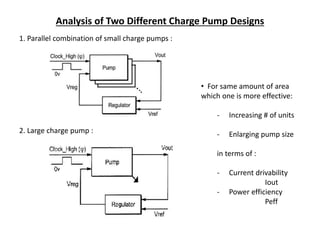
1. Parallel combination of small charge pumps :
2. Large charge pump :
• For same amount of area
which one is more effective:
- Increasing # of units
- Enlarging pump size
in terms of :
- Current drivability
Iout
- Power efficiency
Peff
Full Charge Pump Schematic
Schematic of the Small Charge Pump Unit
1. Results for Parallel Connection of Small Charge Pumps
• Vout vs Iout
• Vout vs Peff
• Tclk vs Iout
• Tclk vs Peff
• Vin vs Iout
• Vin vs Peff
• Vout vs Iout
• Vout vs Peff
• Tclk vs Iout
• Tclk vs Peff
• Vin vs Iout
• Vin vs Peff
2. Results for Enlarging Charge Pump Size
1. Results for Parallel Connection of Small Charge Pumps
• Vout vs Iout
1. Results for Parallel Connection of Small Charge Pumps
• Vout vs Peff
1. Results for Parallel Connection of Small Charge Pumps
• Tclk vs Iout
1. Results for Parallel Connection of Small Charge Pumps
• Tclk vs Peff
1. Results for Parallel Connection of Small Charge Pumps
• Vin vs Iout
1. Results for Parallel Connection of Small Charge Pumps
• Vin vs Peff
2. Results for Enlarging Charge Pump Size
• Vout vs Iout
2. Results for Enlarging Charge Pump Size
• Vout vs Peff
2. Results for Enlarging Charge Pump Size
• Tclk vs Iout
2. Results for Enlarging Charge Pump Size
• Tclk vs Peff
2. Results for Enlarging Charge Pump Size
• Vin vs Iout
2. Results for Enlarging Charge Pump Size
• Vin vs Peff
Comparison of Two Types of Charge Pumps
• Vout vs Iout
Comparison of Two Types of Charge Pumps
• Vout vs Peff
Comparison of Two Types of Charge Pumps
• Tclk vs Iout
Comparison of Two Types of Charge Pumps
• Tclk vs Peff
Comparison of Two Types of Charge Pumps
• Vin vs Iout
Comparison of Two Types of Charge Pumps
• Vin vs Peff
• > Vt = Vt0 +  [ √(s + VsB) - √(s) ]
> Parasitic capacitance
> Better to design required output
voltage ~75% of max output voltage capacity

Outline

  • 1.
    OUTLINE Main Purpose : Analyze two different types of Dickson Charge Pump Designs  Offer a comparison between them • Studying the usage and operation of Dickson Charge Pump • Specifications for a charge pump design • Understanding the effect of design parameters on performance Presentation Track : • Introduction to Dickson Charge Pump • Specifications • Effect of design parameters • Analysis of two different charge pump designs • Comparison comparison between these two designs
  • 2.
    Introduction to DicksonCharge Pump Usage and operation: – Generating higher levels of voltage for IC – Programming and erasing EEPROMs and Flash memories V1 = (Vin – Vt) + V1 = 2Vin - Vt V2 = (V1 – Vt) + V2 = 3Vin - 2Vt : VN = (VN-1 – Vt) + V = (N+1) Vin – NVt
  • 3.
    Specifications of aCharge Pump 1. Output voltage : Vout = VN = (VN-1 – Vt) + V = (N+1)*Vin – N*Vt > # of stages > Vt 2. Current drivability : Iout > Inversely proportional to Vout Pout = Iout * Vout > Capacitor size > Transistor size > Clock period 3. Power efficiency : Peff = Pout / Pin = (Iout * Vout) / (Iin * Vin) > Clock period
  • 4.
    Effects of DesignParameters 1. Output Voltage : - # of stages - Capacitor size - Input voltage ( Vin ) 2. Current Drivability : - Capacitor size - Transistor size - Clock period 3. Power efficiency : - Input voltage (Vin) - Clock period Bunlarla ilgili grafik eklemeye calıs
  • 6.
    Analysis of TwoDifferent Charge Pump Designs 1. Parallel combination of small charge pumps : 2. Large charge pump : • For same amount of area which one is more effective: - Increasing # of units - Enlarging pump size in terms of : - Current drivability Iout - Power efficiency Peff
  • 7.
  • 8.
    Schematic of theSmall Charge Pump Unit
  • 9.
    1. Results forParallel Connection of Small Charge Pumps • Vout vs Iout • Vout vs Peff • Tclk vs Iout • Tclk vs Peff • Vin vs Iout • Vin vs Peff • Vout vs Iout • Vout vs Peff • Tclk vs Iout • Tclk vs Peff • Vin vs Iout • Vin vs Peff 2. Results for Enlarging Charge Pump Size
  • 10.
    1. Results forParallel Connection of Small Charge Pumps • Vout vs Iout
  • 11.
    1. Results forParallel Connection of Small Charge Pumps • Vout vs Peff
  • 12.
    1. Results forParallel Connection of Small Charge Pumps • Tclk vs Iout
  • 13.
    1. Results forParallel Connection of Small Charge Pumps • Tclk vs Peff
  • 14.
    1. Results forParallel Connection of Small Charge Pumps • Vin vs Iout
  • 15.
    1. Results forParallel Connection of Small Charge Pumps • Vin vs Peff
  • 16.
    2. Results forEnlarging Charge Pump Size • Vout vs Iout
  • 17.
    2. Results forEnlarging Charge Pump Size • Vout vs Peff
  • 18.
    2. Results forEnlarging Charge Pump Size • Tclk vs Iout
  • 19.
    2. Results forEnlarging Charge Pump Size • Tclk vs Peff
  • 20.
    2. Results forEnlarging Charge Pump Size • Vin vs Iout
  • 21.
    2. Results forEnlarging Charge Pump Size • Vin vs Peff
  • 22.
    Comparison of TwoTypes of Charge Pumps • Vout vs Iout
  • 23.
    Comparison of TwoTypes of Charge Pumps • Vout vs Peff
  • 24.
    Comparison of TwoTypes of Charge Pumps • Tclk vs Iout
  • 25.
    Comparison of TwoTypes of Charge Pumps • Tclk vs Peff
  • 26.
    Comparison of TwoTypes of Charge Pumps • Vin vs Iout
  • 27.
    Comparison of TwoTypes of Charge Pumps • Vin vs Peff
  • 28.
    • > Vt= Vt0 +  [ √(s + VsB) - √(s) ] > Parasitic capacitance > Better to design required output voltage ~75% of max output voltage capacity