Welcome to
Chemistry class!
Learning objectives
Duration: 45 min Secondary School Grades: 8 IGCSE
Oxidizing & reducing
agents
Science – Grade 8
By Ms.Ngan
1. Key contents
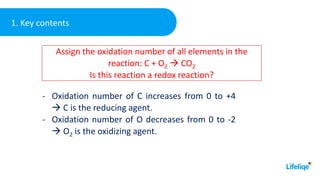
- Oxidation number of C increases from 0 to +4
 C is the reducing agent.
- Oxidation number of O decreases from 0 to -2
 O2 is the oxidizing agent.
Assign the oxidation number of all elements in the
reaction: C + O2  CO2
Is this reaction a redox reaction?
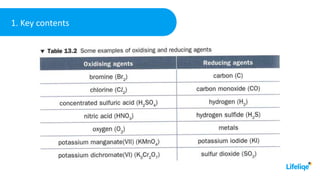
1. Key contents
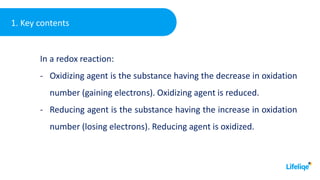
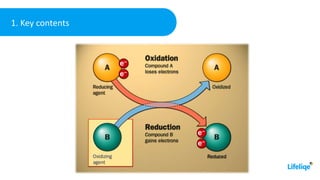
In a redox reaction:
- Oxidizing agent is the substance having the decrease in oxidation
number (gaining electrons). Oxidizing agent is reduced.
- Reducing agent is the substance having the increase in oxidation
number (losing electrons). Reducing agent is oxidized.
1. Key contents
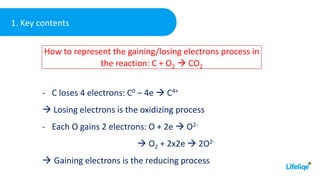
- C loses 4 electrons: C0 – 4e  C4+
 Losing electrons is the oxidizing process
- Each O gains 2 electrons: O + 2e  O2-
 O2 + 2x2e  2O2-
 Gaining electrons is the reducing process
How to represent the gaining/losing electrons process in
the reaction: C + O2  CO2
1. Key contents
1. Key contents
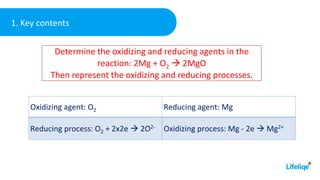
Determine the oxidizing and reducing agents in the
reaction: 2Mg + O2  2MgO
Then represent the oxidizing and reducing processes.
Oxidizing agent: O2 Reducing agent: Mg
Reducing process: O2 + 2x2e  2O2- Oxidizing process: Mg - 2e  Mg2+
1. Key contents
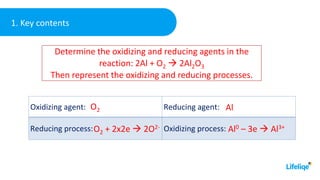
Determine the oxidizing and reducing agents in the
reaction: 2Al + O2  2Al2O3
Then represent the oxidizing and reducing processes.
Oxidizing agent: Reducing agent:
Reducing process: Oxidizing process:
O2 Al
Al0 – 3e  Al3+
O2 + 2x2e  2O2-
1. Key contents
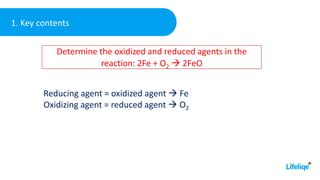
Determine the oxidized and reduced agents in the
reaction: 2Fe + O2  2FeO
Reducing agent = oxidized agent  Fe
Oxidizing agent = reduced agent  O2
1. Key contents
Determine the oxidizing and reducing agents in the
reaction: Fe + 2HCl  FeCl2 + H2
- Oxidation number of Fe increases from 0 to +2
 Fe is the reducing agent.
- Oxidation number of H2 decreases from +1 to 0
 H+ (HCl) is the oxidizing agent.
1. Key contents
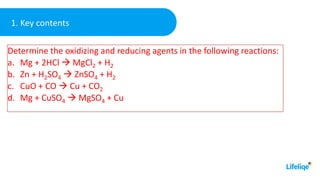
Determine the oxidizing and reducing agents in the following reactions:
a. Mg + 2HCl  MgCl2 + H2
b. Zn + H2SO4  ZnSO4 + H2
c. CuO + CO  Cu + CO2
d. Mg + CuSO4  MgSO4 + Cu
1. Key contents
1. Key contents
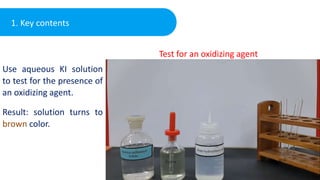
Test for an oxidizing agent
Use aqueous KI solution
to test for the presence of
an oxidizing agent.
Result: solution turns to
brown color.
1. Key contents
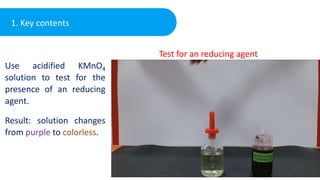
Test for an reducing agent
Use acidified KMnO4
solution to test for the
presence of an reducing
agent.
Result: solution changes
from purple to colorless.
2. Practice
Ex1:
Ex2:
2. Practice
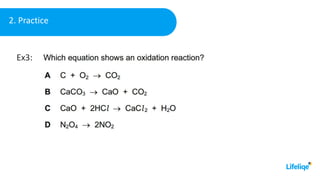
Ex3:
2. Practice
Ex4:
2. Practice
Ex5:
2. Practice
Ex6:
Thanks for using Lifeliqe's lesson plan!
Excite your students in learning science with 1,000+ more 3D models and lesson plans at online.lifeliqe.com

Oxidizing and reducing agents.pptx

  • 1.
  • 2.
    Duration: 45 minSecondary School Grades: 8 IGCSE Oxidizing & reducing agents Science – Grade 8 By Ms.Ngan
  • 3.
    1. Key contents -Oxidation number of C increases from 0 to +4  C is the reducing agent. - Oxidation number of O decreases from 0 to -2  O2 is the oxidizing agent. Assign the oxidation number of all elements in the reaction: C + O2  CO2 Is this reaction a redox reaction?
  • 4.
    1. Key contents Ina redox reaction: - Oxidizing agent is the substance having the decrease in oxidation number (gaining electrons). Oxidizing agent is reduced. - Reducing agent is the substance having the increase in oxidation number (losing electrons). Reducing agent is oxidized.
  • 5.
    1. Key contents -C loses 4 electrons: C0 – 4e  C4+  Losing electrons is the oxidizing process - Each O gains 2 electrons: O + 2e  O2-  O2 + 2x2e  2O2-  Gaining electrons is the reducing process How to represent the gaining/losing electrons process in the reaction: C + O2  CO2
  • 6.
  • 7.
    1. Key contents Determinethe oxidizing and reducing agents in the reaction: 2Mg + O2  2MgO Then represent the oxidizing and reducing processes. Oxidizing agent: O2 Reducing agent: Mg Reducing process: O2 + 2x2e  2O2- Oxidizing process: Mg - 2e  Mg2+
  • 8.
    1. Key contents Determinethe oxidizing and reducing agents in the reaction: 2Al + O2  2Al2O3 Then represent the oxidizing and reducing processes. Oxidizing agent: Reducing agent: Reducing process: Oxidizing process: O2 Al Al0 – 3e  Al3+ O2 + 2x2e  2O2-
  • 9.
    1. Key contents Determinethe oxidized and reduced agents in the reaction: 2Fe + O2  2FeO Reducing agent = oxidized agent  Fe Oxidizing agent = reduced agent  O2
  • 10.
    1. Key contents Determinethe oxidizing and reducing agents in the reaction: Fe + 2HCl  FeCl2 + H2 - Oxidation number of Fe increases from 0 to +2  Fe is the reducing agent. - Oxidation number of H2 decreases from +1 to 0  H+ (HCl) is the oxidizing agent.
  • 11.
    1. Key contents Determinethe oxidizing and reducing agents in the following reactions: a. Mg + 2HCl  MgCl2 + H2 b. Zn + H2SO4  ZnSO4 + H2 c. CuO + CO  Cu + CO2 d. Mg + CuSO4  MgSO4 + Cu
  • 12.
  • 13.
    1. Key contents Testfor an oxidizing agent Use aqueous KI solution to test for the presence of an oxidizing agent. Result: solution turns to brown color.
  • 14.
    1. Key contents Testfor an reducing agent Use acidified KMnO4 solution to test for the presence of an reducing agent. Result: solution changes from purple to colorless.
  • 15.
  • 16.
  • 17.
  • 18.
  • 19.
  • 20.
    Thanks for usingLifeliqe's lesson plan! Excite your students in learning science with 1,000+ more 3D models and lesson plans at online.lifeliqe.com