REDOX REACTIONS
A chemicalchange involves the formation of a new substance(s). Based on the way in which the change is brought
chemical reactions are categorised in to 4 types
1) Chemical combination 2) Chemical decomposition
3) Chemical displacement 4) Double decomposition
Based on the kind of change, the above types of reactions (except double decomposition) are also described otherwise
as
1) Combination redox reactions 2) Decomposition redox reactions
3) Displacement redox reactions
Reactions in which one substance undergoes oxidation and other substance undergoes reduction simultaneously are
called Redox reactions oxidation and reduction can be defined in terms of old views and modern views
2.
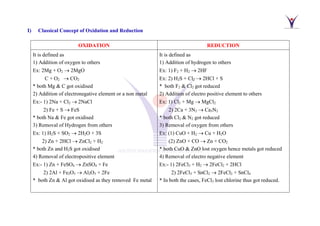
I) Classical Conceptof Oxidation and Reduction
OXIDATION REDUCTION
It is defined as
1) Addition of oxygen to others
Ex: 2Mg + O2 → 2MgO
C + O2 → CO2
* both Mg & C got oxidised
2) Addition of electronegative element or a non metal
Ex:- 1) 2Na + Cl2 → 2NaCl
2) Fe + S → FeS
* both Na & Fe got oxidised
3) Removal of Hydrogen from others
Ex: 1) H2S + SO2 → 2H2O + 3S
2) Zn + 2HCl → ZnCl2 + H2
* both Zn and H2S got oxidised
4) Removal of electropositive element
Ex:- 1) Zn + FeSO4 → ZnSO4 + Fe
2) 2Al + Fe2O3 → Al2O3 + 2Fe
* both Zn & Al got oxidised as they removed Fe metal
It is defined as
1) Addition of hydrogen to others
Ex: 1) F2 + H2 → 2HF
Ex: 2) H2S + Cl2 → 2HCl + S
* both F2 & Cl2 got reduced
2) Addition of electro positive element to others
Ex: 1) Cl2 + Mg → MgCl2
2) 2Ca + 3N2 → Ca3N2
* both Cl2 & N2 got reduced
3) Removal of oxygen from others
Ex: (1) CuO + H2 → Cu + H2O
(2) ZnO + CO → Zn + CO2
* both CuO & ZnO lost oxygen hence metals got reduced
4) Removal of electro negative element
Ex:- 1) 2FeCl3 + H2 → 2FeCl2 + 2HCl
2) 2FeCl3 + SnCl2 → 2FeCl2 + SnCl4
* In both the cases, FeCl3 lost chlorine thus got reduced.
3.
II.
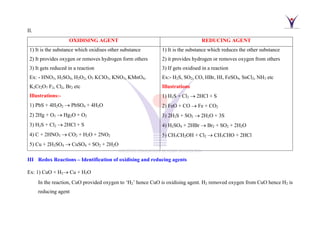
OXIDISING AGENT REDUCINGAGENT
1) It is the substance which oxidises other substance
2) It provides oxygen or removes hydrogen form others
3) It gets reduced in a reaction
Ex: - HNO3, H2SO4, H2O2, O3 KClO3, KNO3, KMnO4,
K2Cr2O7 F2, Cl2, Br2 etc
Illustrations:-
1) PbS + 4H2O2 → PbSO4 + 4H2O
2) 2Hg + O3 → Hg2O + O2
3) H2S + Cl2 → 2HCl + S
4) C + 2HNO3 → CO2 + H2O + 2NO2
5) Cu + 2H2SO4 → CuSO4 + SO2 + 2H2O
1) It is the substance which reduces the other substance
2) it provides hydrogen or removes oxygen from others
3) If gets oxidised in a reaction
Ex:- H2S, SO2, CO, HBr, HI, FeSO4, SnCl2, NH3 etc
Illustrations
1) H2S + Cl2 → 2HCl + S
2) FeO + CO → Fe + CO2
3) 2H2S + SO2 → 2H2O + 3S
4) H2SO4 + 2HBr → Br2 + SO2 + 2H2O
5) CH3CH2OH + Cl2 → CH3CHO + 2HCl
III Redox Reactions – Identification of oxidising and reducing agents
Ex: 1) CuO + H2→ Cu + H2O
In the reaction, CuO provided oxygen to ‘H2’ hence CuO is oxidising agent. H2 removed oxygen from CuO hence H2 is
reducing agent
4.
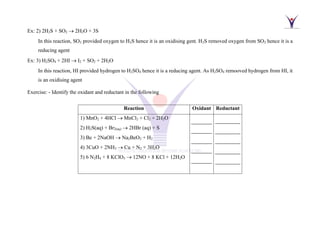
Ex: 2) 2H2S+ SO2 → 2H2O + 3S
In this reaction, SO2 provided oxygen to H2S hence it is an oxidising gent. H2S removed oxygen from SO2 hence it is a
reducing agent
Ex: 3) H2SO4 + 2HI → I2 + SO2 + 2H2O
In this reaction, HI provided hydrogen to H2SO4 hence it is a reducing agent. As H2SO4 remooved hydrogen from HI, it
is an oxidising agent
Exercise: - Identify the oxidant and reductant in the following
Reaction Oxidant Reductant
1) MnO2 + 4HCl → MnCl2 + Cl2 + 2H2O
2) H2S(aq) + Br2(aq) → 2HBr (aq) + S
3) Be + 2NaOH → Na2BeO2 + H2
4) 3CuO + 2NH3 → Cu + N2 + 3H2O
5) 6 N2H4 + 8 KClO3 → 12NO + 8 KCl + 12H2O
5.
II. ELECTRONIC CONCEPTOF OXIDATION AND REDUCTION
Based on the importance of electrons in the chemical reactions, Electronic concept of oxidation and reduction are
introduced to describe redox reactions
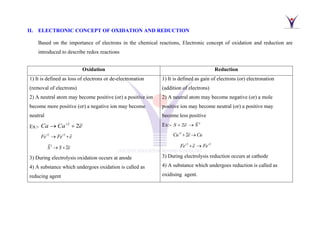
Oxidation Reduction
1) It is defined as loss of electrons or de-electronation
(removal of electrons)
2) A neutral atom may become positive (or) a positive ion
become more positive (or) a negative ion may become
neutral
Ex:-
2
2
Ca Ca e
+
→ +
2 3
Fe Fe e
+ +
→ +
2
2
S S e
→ +
3) During electrolysis oxidation occurs at anode
4) A substance which undergoes oxidation is called as
reducing agent
1) It is defined as gain of electrons (or) electronation
(addition of electrons)
2) A neutral atom may become negative (or) a mole
positive ion may become neutral (or) a positive may
become less positive
Ex:- 2
2
S e S
+ →
2
2
Cu e Cu
+
+ →
3 2
Fe e Fe
+ +
+ →
3) During electrolysis reduction occurs at cathode
4) A substance which undergoes reduction is called as
oxidising agent.
6.
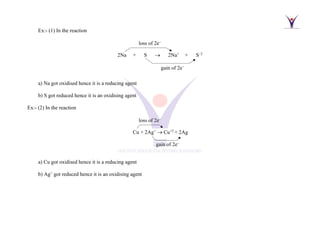
Ex:- (1) Inthe reaction
a) Na got oxidised hence it is a reducing agent
b) S got reduced hence it is an oxidising agent
Ex:- (2) In the reaction
a) Cu got oxidised hence it is a reducing agent
b) Ag+
got reduced hence it is an oxidising agent
2Na + S → 2Na+
+ S−2
loss of 2e−
gain of 2e−
Cu + 2Ag+
→ Cu+2
+ 2Ag
loss of 2e−
gain of 2e−
7.
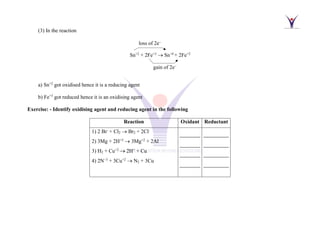
(3) In thereaction
a) Sn+2
got oxidised hence it is a reducing agent
b) Fe+3
got reduced hence it is an oxidising agent
Exercise: - Identify oxidising agent and reducing agent in the following
Reaction Oxidant Reductant
1) 2 Br-
+ Cl2 → Br2 + 2Cl-
2) 3Mg + 2H+3
→ 3Mg+2
+ 2Al
3) H2 + Cu+2
→ 2H+
+ Cu
4) 2N−3
+ 3Cu+2
→ N2 + 3Cu
Sn+2
+ 2Fe+3
→ Sn+4
+ 2Fe+2
loss of 2e−
gain of 2e−
8.
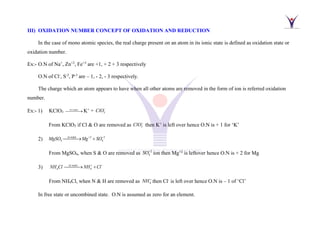
III) OXIDATION NUMBERCONCEPT OF OXIDATION AND REDUCTION
In the case of mono atomic species, the real charge present on an atom in its ionic state is defined as oxidation state or
oxidation number.
Ex:- O.N of Na+
, Zn+2
, Fe+3
are +1, + 2 + 3 respectively
O.N of Cl-
, S-2
, P-3
are – 1, - 2, - 3 respectively.
The charge which an atom appears to have when all other atoms are removed in the form of ion is referred oxidation
number.
Ex:- 1) KClO3
in water
⎯⎯⎯→ K+
+ 3
ClO−
From KClO3 if Cl & O are removed as 3
ClO−
then K+
is left over hence O.N is + 1 for ‘K’
2) in water 2 2
4 4
MgSO Mg SO
+ −
⎯⎯⎯
→ +
From MgSO4, when S & O are removed as 2
4
SO−
ion then Mg+2
is leftover hence O.N is + 2 for Mg
3) 4 4
in water
NH Cl NH Cl
+ −
⎯⎯⎯→ +
From NH4Cl, when N & H are removed as 4
NH+
then Cl-
is left over hence O.N is – 1 of ‘Cl’
In free state or uncombined state. O.N is assumed as zero for an element.
9.
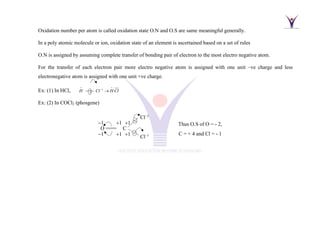
Oxidation number peratom is called oxidation state O.N and O.S are same meaningful generally.
In a poly atomic molecule or ion, oxidation state of an element is ascertained based on a set of rules
O.N is assigned by assuming complete transfer of bonding pair of electron to the most electro negative atom.
For the transfer of each electron pair more electro negative atom is assigned with one unit –ve charge and less
electronegative atom is assigned with one unit +ve charge.
Ex: (1) In HCl, 1
H Cl H Cl
+ +
−
−−−− →
Ex: (2) In COCl2 (phosgene)
O ==== C
−1
−1
+1
+1
+1
+1
Cl−1
Cl−1
Thus O.S of O = - 2,
C = + 4 and Cl = - 1
10.
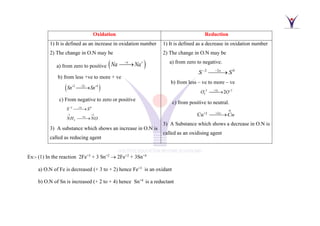
Oxidation Reduction
1) Itis defined as an increase in oxidation number
2) The change in O.N may be
a) from zero to positive ( )
e
Na Na
− +
⎯⎯
→
b) from less +ve to more + ve
( )
2
2 4
e
Sn Sn
−
+ +
⎯⎯→
c) From negative to zero or positive
2
2 0
3 2
5
3
e
e
S S
NH NO
−
−
− +
−
⎯⎯→
⎯⎯→
3) A substance which shows an increase in O.N is
called as reducing agent
1) It is defined as a decrease in oxidation number
2) The change in O.N may be
a) from zero to negative.
2
2 0
e
S S
−
−
⎯⎯→
b) from less – ve to more – ve
2
2 2
2 2
e
O O
+
− −
⎯⎯→
c) from positive to neutral.
Cu+2
0
2e
Cu
+
⎯⎯→
3) A Substance which shows a decrease in O.N is
called as an oxidising agent
Ex:- (1) In the reaction 2Fe+3
+ 3 Sn+2
→ 2Fe+2
+ 3Sn+4
a) O.N of Fe is decreased (+ 3 to + 2) hence Fe+3
is an oxidant
b) O.N of Sn is increased (+ 2 to + 4) hence Sn+4
is a reductant
11.
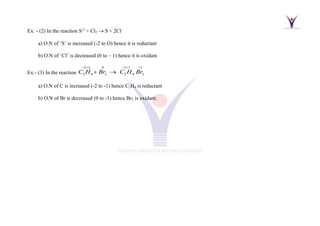
Ex: - (2)In the reaction S-2
+ Cl2 → S + 2Cl-
a) O.N of ‘S’ is increased (-2 to O) hence it is reductant
b) O.N of ‘Cl’ is decreased (0 to – 1) hence it is oxidant
Ex:- (3) In the reaction
2 1 0 1 1 1
2 4 2 2 4 2
C H Br C H Br
− + − + −
+ →
a) O.N of C is increased (-2 to -1) hence C2H4 is reductant
b) O.N of Br is decreased (0 to -1) hence Br2 is oxidant.
12.
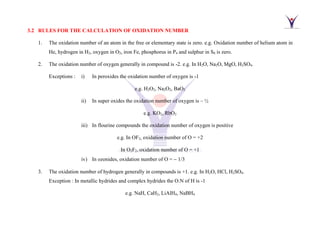
3.2 RULES FORTHE CALCULATION OF OXIDATION NUMBER
1. The oxidation number of an atom in the free or elementary state is zero. e.g. Oxidation number of helium atom in
He, hydrogen in H2, oxygen in O2, iron Fe, phosphorus in P4 and sulphur in S8 is zero.
2. The oxidation number of oxygen generally in compound is -2. e.g. In H2O, Na2O, MgO, H2SO4.
Exceptions : i) In peroxides the oxidation number of oxygen is -1
e.g. H2O2, Na2O2, BaO2
ii) In super oxides the oxidation number of oxygen is – ½
e.g. KO2, RbO2
iii) In flourine compounds the oxidation number of oxygen is positive
e.g. In OF2, oxidation number of O = +2
In O2F2, oxidation number of O = +1
iv) In ozonides, oxidation number of O = − 1/3
3. The oxidation number of hydrogen generally in compounds is +1. e.g. In H2O, HCl, H2SO4.
Exception : In metallic hydrides and complex hydrides the O.N of H is -1
e.g. NaH, CaH2, LiAlH4, NaBH4
13.
4. In compoundsO.N of F is always -1. e.g. HF, F2O, F2O2, NaF, ClF3
5. In compounds the O.N of alkali metals (IA group elements Li, Na, K, Rb, Cs Fr) is + 1.
6. In compounds the O.N of alkaline earth metals (II A group elements Be, Mg, Ca, Sr, Ba, Ra) is + 2.
7. In metallic halides the O.N of halogen is -1 e.g., In KBr, O.N of Br = -1
8. In metallic sulphides the O.N of sulphur is -2
e.g In ZnS, O.N of S = -2
9. The O.N of an element in a mono atomic ion is equal to charge present on it.
e.g. O.N of N in nitride ion N−
is −3.
10. The stun of O.N’s of all atoms in a polyatomic ion is equal to charge present on it.
e.g., In SO4
−
ion, (O.N of S) + (4 x O.N of O) = - 2
O.N of S = +6 and O = -2 [(+6) + 4(-2)] = - 2
11. The stun of O.N’s of all atoms in a molecule is equal to zero.
e.g., In HNO3, (O.N of H) + (O.N of N) + (3 x O.N of O) = 0
O.N of N = +5 and O = -2 H = + 1 [(+1) + (+5) + 3(-2)] = 0
12. In a metal carbonyl, the O.N of metal is zero
e.g. In Ni(CO)4, O.N of Ni = 0 . In Fe(CO)5, O.N of Fe = 0
14.
In Cr(CO)6, O.Nof Cr = 0
13. In CuH (Cu is -1) in metal carbonyls [Co(CO)4]-
and [Rh(CO)4]−
O.N of Co & Rh is – ve.
14. In metal amalgam like Na – Hg, Zn – Hg O.N of metal or Hg is taken as zero
15. Maximum O.N of an element = group no – 10 (except for O & F)
16. Minimum O.N of an element = group no – 18 (except for metals)
17. Variable O.N is mostly shown by transition metals and p-block elements
Ex:- 1) for ‘Mn’ +2, +3, +4, +5, +6, +7 O.N are possible 2) for ‘Bi’ + 3, +5 & Tl + 3, +1 O.N are possible
15.
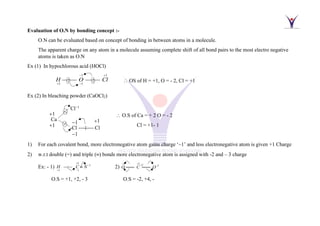
Evaluation of O.Nby bonding concept :-
O.N can be evaluated based on concept of bonding in between atoms in a molecule.
The apparent charge on any atom in a molecule assuming complete shift of all bond pairs to the most electro negative
atoms is taken as O.N
Ex (1) In hypochlorous acid (HOCl)
1
H
+
1
1
O
−
−
1
Cl
+
OS of H = +1, O = - 2, Cl = +1
Ex (2) In bleaching powder (CaOCl2)
O.S of Ca = + 2 O = - 2
Cl = +1- 1
1) For each covalent bond, more electronegative atom gains charge ‘–1’ and less electronegative atom is given +1 Charge
2) w.r.t double (=) and triple () bonds more electronegative atom is assigned with -2 and – 3 charge
Ex: - 1)
3
3
1 1
:
H C N
+
−
+ −
−−−− 2)
2 2 2 2
O C O
− + + −
==== ====
O.S = +1, +2, - 3 O.S = -2, +4, -
Ca
+1
+1
Cl−1
-Cl −−−−−− Cl
−1
−1
+1
16.
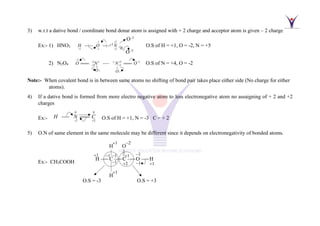
3) w.r.t adative bond / coordinate bond donar atom is assigned with + 2 charge and acceptor atom is given – 2 charge
Ex:- 1) HNO3
1 2
1 1 2
1
: :
H O N
− +
+ − +
+
−−−− −−−− O.S of H = +1, O = -2, N = +5
2) N2O4
2
2
2
2 2 2
2 2
o o
O O
O N N O
−
−
−
+ + −
+ +
==== −−
−− ==== O.S of N = +4, O = -2
Note:- When covalent bond is in between same atoms no shifting of bond pair takes place either side (No charge for either
atoms).
4) If a dative bond is formed from more electro negative atom to less electronegative atom no assaigning of + 2 and +2
charges
Ex:-
0 0
2 2
H N C
− +
−−
−− ==== O.S of H = +1, N = -3 C = + 2
5) O.N of same element in the same molecule may be different since it depends on electronegativity of bonded atoms.
Ex:- CH3COOH
O−
O−
H –−− C –−−C –−− –−−
−1 −1
−1
+1
+
+1
+
−1
−1
H
+1
H O
−
+1
O.S = -3 O.S = +3
17.
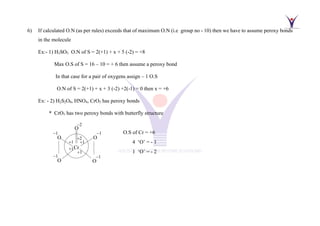
6) If calculatedO.N (as per rules) exceeds that of maximum O.N (i.e group no - 10) then we have to assume peroxy bonds
in the molecule
Ex:- 1) H2SO5 O.N of S = 2(+1) + x + 5 (-2) = +8
Max O.S of S = 16 – 10 = + 6 then assume a peroxy bond
In that case for a pair of oxygens assign – 1 O.S
O.N of S = 2(+1) + x + 3 (-2) +2(-1) = 0 then x = +6
Ex: - 2) H2S2O8, HNO4, CrO5 has peroxy bonds
* CrO5 has two peroxy bonds with butterfly structure
O.S of Cr = +6
4 ‘O’ = - 1
1 ‘O’ = - 2
−1
O
Cr
+1
−1
O
+1
+1
+1
−1
O
−1
O
O
+2
−2
18.
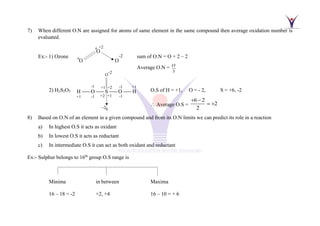
7) When differentO.N are assigned for atoms of same element in the same compound then average oxidation number is
evaluated.
Ex:- 1) Ozone sum of O.N = O + 2 – 2
Average O.N =
3
O
2) H2S2O3 O.S of H = +1, O = - 2, S = +6, -2
Average O.S =
6 2
2
2
+ −
= +
8) Based on O.N of an element in a given compound and from its O.N limits we can predict its role in a reaction
a) In highest O.S it acts as oxidant
b) In lowest O.S it acts as reductant
c) In intermediate O.S it can act as both oxidant and reductant
Ex:- Sulphur belongs to 16th
group O.S range is
Minima in between Maxima
16 – 18 = -2 +2, +4 16 – 10 = + 6
o
O
-2
O
O
+2
o
H −−− O −−− S −−− O −−− H
+1 -1
-1
+2
+1
+1
+2
-1
-1 +1
O
S
−2
−2
19.
Compound H2S SO2/ H2SO3 SO3 / H2SO4
O.S of S − 2 +4 +6
acts as Reductant Oxidant & reductant Oxidant
9) Maximum O.S of an element is + 8. It is shown by Os, Ru and Xe in their oxides (OsO4, RuO4, XeO4)
Exercise:-
Evaluate individual & average O.S of underlined in
Compound/ion Composition Structure Individual
O.S
Average
O.S
1) Magnetite Fe3O4 FeO + Fe2O3 +2, +3, +3 + 8/3
2) Red Lead Pb3O4 2 PbO + PbO2 +2 + 2 +4 + 8/3
3) Tribromo octaxide Br3O8 O O O
O O O
|| || ||
|| || ||
O Br Br Br O
= − − =
+6, +4 +6 + 16/3
4) Tri iodide ion 3
I −
[I – I – I]−
0, 0, −1 −1/3
5) Tetra thionate ion 2
4 6
S O− O O
O O
|| ||
|| ||
O S S S S O
−
−
= − − − −
+5, 0, 0, +5 10
4
+
20.
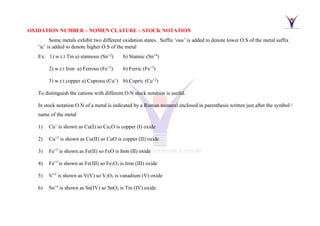
OXIDATION NUMBER –NOMEN CLATURE – STOCK NOTATION
Some metals exhibit two different oxidation states. Suffix ‘ous’ is added to denote lower O.S of the metal suffix
‘ic’ is added to denote higher O.S of the metal
Ex: 1) w.r.t Tin a) stannous (Sn+2
) b) Stannic (Sn+4
)
2) w.r.t Iron a) Ferrous (Fe+2
) b) Ferric (Fe+3
)
3) w.r.t copper a) Cuprous (Cu+
) b) Cupric (Cu+2
)
To distinguish the cations with different O.N stock notation is useful.
In stock notation O.N of a metal is indicated by a Roman numeral enclosed in parenthesis written just after the symbol /
name of the metal
1) Cu+
is shown as Cu(I) so Cu2O is copper (I) oxide
2) Cu+2
is shown as Cu(II) so CuO is copper (II) oxide
3) Fe+2
is shown as Fe(II) so FeO is Iron (II) oxide
4) Fe+3
is shown as Fe(III) so Fe2O3 is Iron (III) oxide
5) V+5
is shown as V(V) so V2O5 is vanadium (V) oxide
6) Sn+4
is shown as Sn(IV) so SnO2 is Tin (IV) oxide
21.
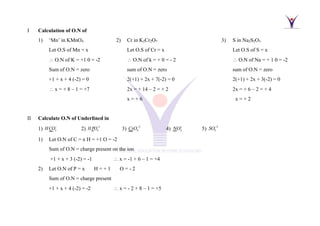
I Calculation ofO.N of
1) ‘Mn’ in KMnO4 2) Cr in K2Cr2O7 3) S in Na2S2O3
Let O.S of Mn = x Let O.S of Cr = x Let O.S of S = x
O.N of K = +1 0 = -2 O.N of k = + 0 = - 2 O.N of Na = + 1 0 = -2
Sum of O.N = zero sum of O.N = zero sum of O.N = zero
+1 + x + 4 (-2) = 0 2(+1) + 2x + 7(-2) = 0 2(+1) + 2x + 3(-2) = 0
x = + 8 – 1 = +7 2x = + 14 – 2 = + 2 2x = + 6 – 2 = + 4
x = + 6 x = + 2
II Calculate O.N of Underlined in
1) 3
HCO−
2) 2
4
HPO−
3) 2
4
CrO−
4) 2
NO+
5) 2
5
SO−
1) Let O.N of C = x H = +1 O = -2
Sum of O.N = charge present on the ion
+1 + x + 3 (-2) = -1 x = -1 + 6 – 1 = +4
2) Let O.N of P = x H = + 1 O = - 2
Sum of O.N = charge present
+1 + x + 4 (-2) = -2 x = - 2 + 8 – 1 = +5
22.
3) Let O.Nof Cr = x then
x + 4 (-2) = - 2 x = - 2 + 8 = + 6
4) Let O.N of N = x
x + 2 (-2) = + 1 x = +1 + 4 = +5
5) Let O.N of S = x
As per rules x + 5 (-2) = - 2 x = - 2 + 10 = + 8
+ 8 O.N is wrong because max O.N for S = + 6
[Report max O.S if calculated O.N exceeds group no – 10]
III Calculate O.N of underlined in
1) N in (NH4)2SO4 2) P in Ca3(PO4)2 3) C in (CH3)2SO
1) Sulphate is a bivalent radical =
2
4
SO−
Each ‘NH4’ should be with ‘+1’ charge i.e 4
NH+
x + 4(+1) = +1
x = 1 – 4 = - 3
ON of N = - 3
Note: - in R-‘NH2’ and NH3 ON of N = - 3 always
23.
2) Phosphate isa trivalent radical i.e 3
4
PO−
. Then
x + 4 (-2) = - 3 x = + 5
or Ca3(PO4)2 = Ca3P2O8 = 3(+2) + 2x + 8 (-2) = 0
+ 6 + 2x – 16 = 0
2x = + 10 x = + 5
3) (CH3)2SO =
1 2
3
CH SO
+ −
Sum O.N of ‘CH3’ = + 1 & IN SO−2
O.N of ‘S’ = x + (-2) = - 2
X = 0 i.e S = O
IV Calculate O.N of underlined species in complexes
1) Fe in K4[Fe(CN)6] 2) Co in K3[Co(C2O4)3]
3) Cu in [Cu(NH3)4]SO4 4) Cr in [Cr(H2O)6]Cl3
1) Fe is bonded to six cyanides. Each cyanide ion is mononegative radical
4(+1) + x + 6 (-1) = 0
x = + 6 – 4 = + 2
2) Cobalt is bonded to three oxalate units. Each oxalate ion is dinegative radical
3(+1) + x + 3 (-2) = 0
x = + 6 – 3 = + 3
24.
3) Cu isbonded to four ‘NH3’ units. Each NH3 is neutral molecule but 2
4
SO−
is di negative radical
x + 4 (0) + 1(-2) = 0 x = + 2
4) Cr is bonded to six ‘H2O’ (neutral) units. But ‘Cl’ is mono negative radical
x + 6 (0) + 3 (-1) = 0 x = + 3
V Calculate O.N of underlined in
1) Cl in NOClO4 2) Fe in Na2[Fe(CN)5NO]
Note:- NO exists as NO+
in its compounds
1) NO+
is with + 1 then 4
ClO−
is – 1
x + 4 (-2) = - 1 x = + 7
2) NO is with + 1 and CN is with – 1 then
2 (+1) + x + 5 (-1) + 1 (+ 1) = 0
x = + 5 – 3 = + 2
25.
VALENCY AND OXIDATIONNUMBER
Valency and the oxidation number of an element are not the same [In some cases they are the same] the differences are
listed below
Valency Oxidation number
1) It is the combining capacity of an element. It is only a
number with no + or – sign
2) Valency of an element is usually fixed [In few elements
it may vary]
3) It is always a whole number
1) It is the real or imaginary charge of an atom in its
combined state. It may have + or – sign.
2) O.N may be different for an element in different
compounds.
3) It may be zero or fractional or + ve or – ve.
Types of Reactions:
Based on change or no change in O.N, reactions are of two types.
1) Redox reactions 2) Non Redox reactions
1) Reaction in which reactants shows a change in O.N (decrease or increase) are called Redox reactions.
Ex (1)
1
1
2 2 2
o o
H C l H Cl
+
−
+ ⎯⎯
→ (2) 2 KClO3 → 2KCl + 3O2
(3)
1 1 2 1
2 2
2
o o
Z n H Cl ZnCl H
+ − + −
+ ⎯⎯
→ + (4)
4 1 4 2 1 2
4 2 2 2
2 2
o
CH O CO H O
− + + − + −
+ ⎯⎯
→ +
26.
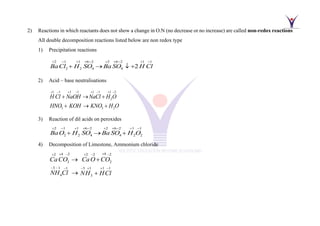
2) Reactions inwhich reactants does not show a change in O.N (no decrease or no increase) are called non-redox reactions
All double decomposition reactions listed below are non redox type
1) Precipitation reactions
2 1 1 6 2 2 6 2 1 1
2 2 4 4 2
BaCl H SO Ba SO H Cl
+ − + + − + + − + −
+ → +
2) Acid – base neutralisations
1 1 1 1 1 1 1 2
2
3 3 2
H Cl NaOH NaCl H O
HNO KOH KNO H O
+ − + − + − + −
+ → +
+ → +
3) Reaction of dil acids on peroxides
2 1 1 6 2 2 6 2 1 1
2 2 4 4 2 2
BaO H SO Ba SO H O
+ − + + − + + − + −
+ → +
4) Decomposition of Limestone, Ammonium chloride
4
2
4 2
2 2 2
3 2
3 1 1 3 1 1 1
4 3
CaCO CaO CO
NH Cl NH HCl
+
−
+ −
+ + −
− − − − + + −
→ +
→ +
![4. In compounds O.N of F is always -1. e.g. HF, F2O, F2O2, NaF, ClF3
5. In compounds the O.N of alkali metals (IA group elements Li, Na, K, Rb, Cs Fr) is + 1.
6. In compounds the O.N of alkaline earth metals (II A group elements Be, Mg, Ca, Sr, Ba, Ra) is + 2.
7. In metallic halides the O.N of halogen is -1 e.g., In KBr, O.N of Br = -1
8. In metallic sulphides the O.N of sulphur is -2
e.g In ZnS, O.N of S = -2
9. The O.N of an element in a mono atomic ion is equal to charge present on it.
e.g. O.N of N in nitride ion N−
is −3.
10. The stun of O.N’s of all atoms in a polyatomic ion is equal to charge present on it.
e.g., In SO4
−
ion, (O.N of S) + (4 x O.N of O) = - 2
O.N of S = +6 and O = -2 [(+6) + 4(-2)] = - 2
11. The stun of O.N’s of all atoms in a molecule is equal to zero.
e.g., In HNO3, (O.N of H) + (O.N of N) + (3 x O.N of O) = 0
O.N of N = +5 and O = -2 H = + 1 [(+1) + (+5) + 3(-2)] = 0
12. In a metal carbonyl, the O.N of metal is zero
e.g. In Ni(CO)4, O.N of Ni = 0 . In Fe(CO)5, O.N of Fe = 0](https://image.slidesharecdn.com/redoxreactions1-260107163406-d844bf6e/85/Redox-reactions-1-pdf-13-320.jpg)
![In Cr(CO)6, O.N of Cr = 0
13. In CuH (Cu is -1) in metal carbonyls [Co(CO)4]-
and [Rh(CO)4]−
O.N of Co & Rh is – ve.
14. In metal amalgam like Na – Hg, Zn – Hg O.N of metal or Hg is taken as zero
15. Maximum O.N of an element = group no – 10 (except for O & F)
16. Minimum O.N of an element = group no – 18 (except for metals)
17. Variable O.N is mostly shown by transition metals and p-block elements
Ex:- 1) for ‘Mn’ +2, +3, +4, +5, +6, +7 O.N are possible 2) for ‘Bi’ + 3, +5 & Tl + 3, +1 O.N are possible](https://image.slidesharecdn.com/redoxreactions1-260107163406-d844bf6e/85/Redox-reactions-1-pdf-14-320.jpg)
![Compound H2S SO2 / H2SO3 SO3 / H2SO4
O.S of S − 2 +4 +6
acts as Reductant Oxidant & reductant Oxidant
9) Maximum O.S of an element is + 8. It is shown by Os, Ru and Xe in their oxides (OsO4, RuO4, XeO4)
Exercise:-
Evaluate individual & average O.S of underlined in
Compound/ion Composition Structure Individual
O.S
Average
O.S
1) Magnetite Fe3O4 FeO + Fe2O3 +2, +3, +3 + 8/3
2) Red Lead Pb3O4 2 PbO + PbO2 +2 + 2 +4 + 8/3
3) Tribromo octaxide Br3O8 O O O
O O O
|| || ||
|| || ||
O Br Br Br O
= − − =
+6, +4 +6 + 16/3
4) Tri iodide ion 3
I −
[I – I – I]−
0, 0, −1 −1/3
5) Tetra thionate ion 2
4 6
S O− O O
O O
|| ||
|| ||
O S S S S O
−
−
= − − − −
+5, 0, 0, +5 10
4
+](https://image.slidesharecdn.com/redoxreactions1-260107163406-d844bf6e/85/Redox-reactions-1-pdf-19-320.jpg)
![3) Let O.N of Cr = x then
x + 4 (-2) = - 2 x = - 2 + 8 = + 6
4) Let O.N of N = x
x + 2 (-2) = + 1 x = +1 + 4 = +5
5) Let O.N of S = x
As per rules x + 5 (-2) = - 2 x = - 2 + 10 = + 8
+ 8 O.N is wrong because max O.N for S = + 6
[Report max O.S if calculated O.N exceeds group no – 10]
III Calculate O.N of underlined in
1) N in (NH4)2SO4 2) P in Ca3(PO4)2 3) C in (CH3)2SO
1) Sulphate is a bivalent radical =
2
4
SO−
Each ‘NH4’ should be with ‘+1’ charge i.e 4
NH+
x + 4(+1) = +1
x = 1 – 4 = - 3
ON of N = - 3
Note: - in R-‘NH2’ and NH3 ON of N = - 3 always](https://image.slidesharecdn.com/redoxreactions1-260107163406-d844bf6e/85/Redox-reactions-1-pdf-22-320.jpg)
![2) Phosphate is a trivalent radical i.e 3
4
PO−
. Then
x + 4 (-2) = - 3 x = + 5
or Ca3(PO4)2 = Ca3P2O8 = 3(+2) + 2x + 8 (-2) = 0
+ 6 + 2x – 16 = 0
2x = + 10 x = + 5
3) (CH3)2SO =
1 2
3
CH SO
+ −
Sum O.N of ‘CH3’ = + 1 & IN SO−2
O.N of ‘S’ = x + (-2) = - 2
X = 0 i.e S = O
IV Calculate O.N of underlined species in complexes
1) Fe in K4[Fe(CN)6] 2) Co in K3[Co(C2O4)3]
3) Cu in [Cu(NH3)4]SO4 4) Cr in [Cr(H2O)6]Cl3
1) Fe is bonded to six cyanides. Each cyanide ion is mononegative radical
4(+1) + x + 6 (-1) = 0
x = + 6 – 4 = + 2
2) Cobalt is bonded to three oxalate units. Each oxalate ion is dinegative radical
3(+1) + x + 3 (-2) = 0
x = + 6 – 3 = + 3](https://image.slidesharecdn.com/redoxreactions1-260107163406-d844bf6e/85/Redox-reactions-1-pdf-23-320.jpg)
![3) Cu is bonded to four ‘NH3’ units. Each NH3 is neutral molecule but 2
4
SO−
is di negative radical
x + 4 (0) + 1(-2) = 0 x = + 2
4) Cr is bonded to six ‘H2O’ (neutral) units. But ‘Cl’ is mono negative radical
x + 6 (0) + 3 (-1) = 0 x = + 3
V Calculate O.N of underlined in
1) Cl in NOClO4 2) Fe in Na2[Fe(CN)5NO]
Note:- NO exists as NO+
in its compounds
1) NO+
is with + 1 then 4
ClO−
is – 1
x + 4 (-2) = - 1 x = + 7
2) NO is with + 1 and CN is with – 1 then
2 (+1) + x + 5 (-1) + 1 (+ 1) = 0
x = + 5 – 3 = + 2](https://image.slidesharecdn.com/redoxreactions1-260107163406-d844bf6e/85/Redox-reactions-1-pdf-24-320.jpg)
![VALENCY AND OXIDATION NUMBER
Valency and the oxidation number of an element are not the same [In some cases they are the same] the differences are
listed below
Valency Oxidation number
1) It is the combining capacity of an element. It is only a
number with no + or – sign
2) Valency of an element is usually fixed [In few elements
it may vary]
3) It is always a whole number
1) It is the real or imaginary charge of an atom in its
combined state. It may have + or – sign.
2) O.N may be different for an element in different
compounds.
3) It may be zero or fractional or + ve or – ve.
Types of Reactions:
Based on change or no change in O.N, reactions are of two types.
1) Redox reactions 2) Non Redox reactions
1) Reaction in which reactants shows a change in O.N (decrease or increase) are called Redox reactions.
Ex (1)
1
1
2 2 2
o o
H C l H Cl
+
−
+ ⎯⎯
→ (2) 2 KClO3 → 2KCl + 3O2
(3)
1 1 2 1
2 2
2
o o
Z n H Cl ZnCl H
+ − + −
+ ⎯⎯
→ + (4)
4 1 4 2 1 2
4 2 2 2
2 2
o
CH O CO H O
− + + − + −
+ ⎯⎯
→ +](https://image.slidesharecdn.com/redoxreactions1-260107163406-d844bf6e/85/Redox-reactions-1-pdf-25-320.jpg)