Mg 2+ O 2- KMnO 4
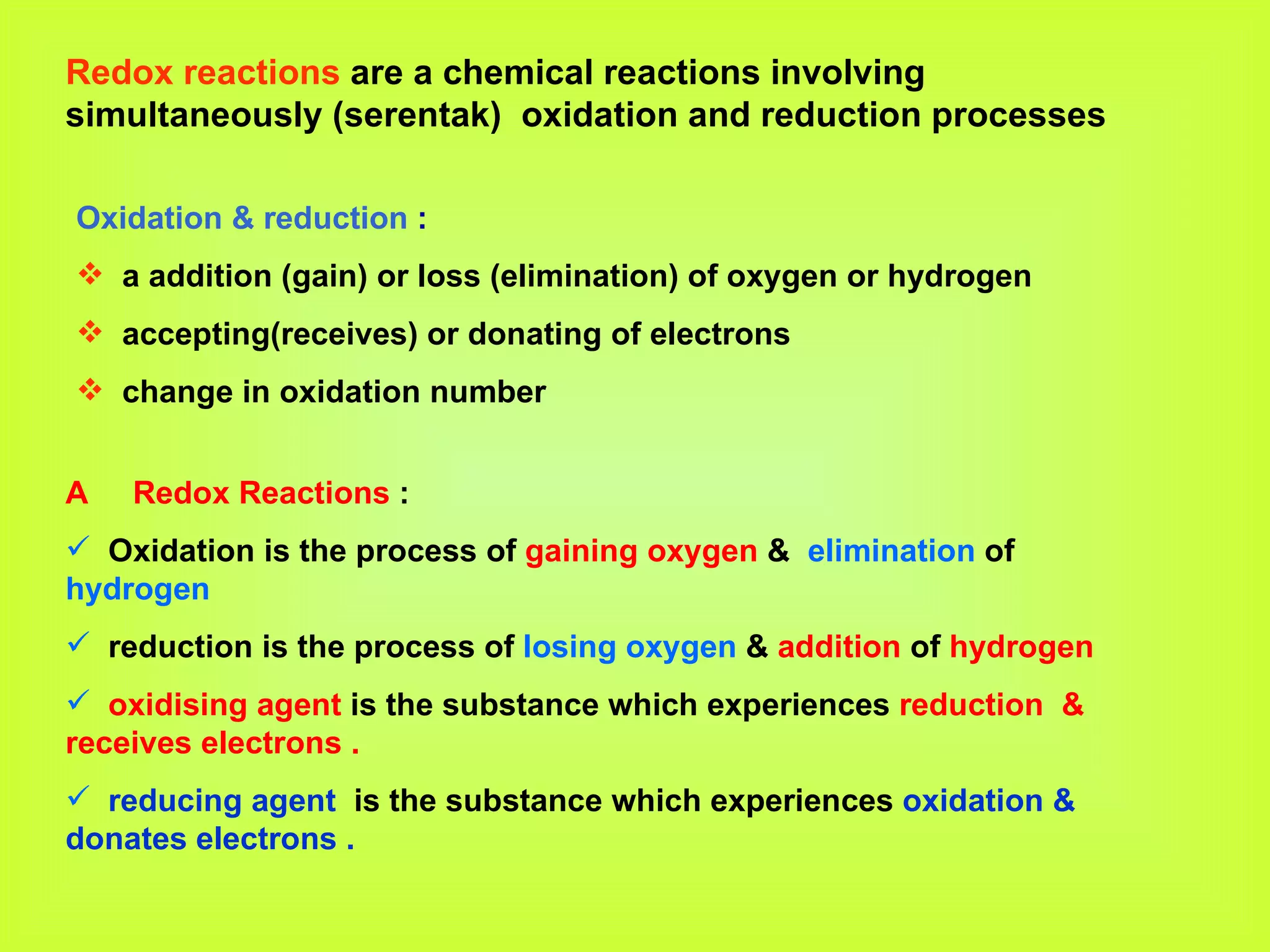
Redox reactions   are a chemical reactions involving simultaneously (serentak)  oxidation and reduction processes  Oxidation & reduction  :  a addition (gain) or loss (elimination) of oxygen or hydrogen accepting(receives) or donating of electrons change in oxidation number   A  Redox Reactions  : Oxidation is the process of  gaining oxygen  &  elimination  of  hydrogen  reduction is the process of  losing oxygen  &  addition  of  hydrogen oxidising agent  is the substance which experiences  reduction  &  receives electrons . reducing agent   is the substance which experiences  oxidation & donates electrons .
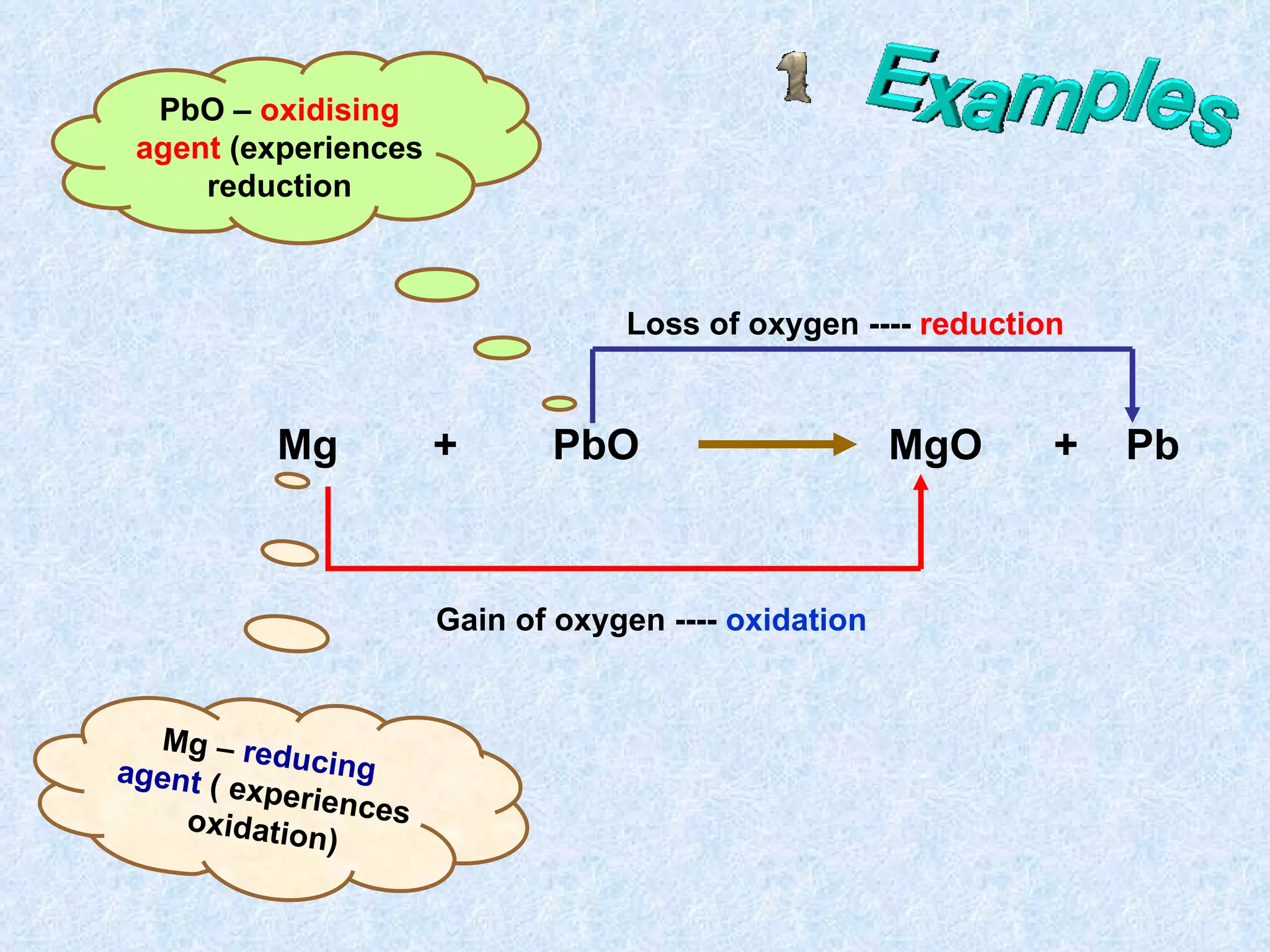
PbO –  oxidising agent  (experiences reduction Mg –  reducing agent  ( experiences  oxidation) Mg  +  PbO  MgO  +  Pb  Gain of oxygen ----  oxidation Loss of oxygen ----  reduction
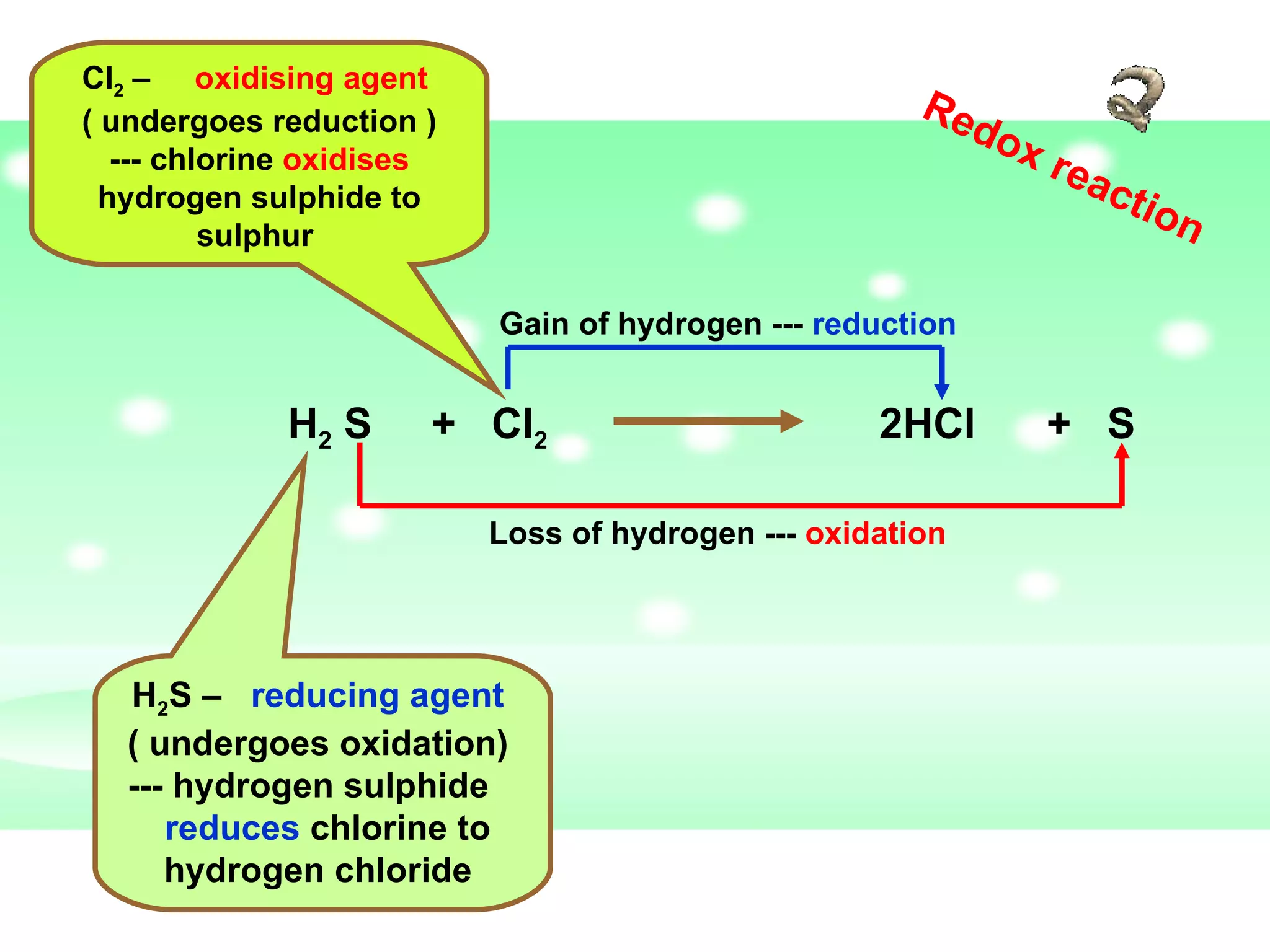
Cl 2  –  oxidising agent  ( undergoes reduction ) --- chlorine  oxidises  hydrogen sulphide to sulphur  H 2 S –  reducing agent   ( undergoes oxidation)   --- hydrogen sulphide  reduces  chlorine to hydrogen chloride  Redox reaction  H 2  S  +  Cl 2   2HCl  +  S Loss of hydrogen ---  oxidation Gain of hydrogen ---  reduction
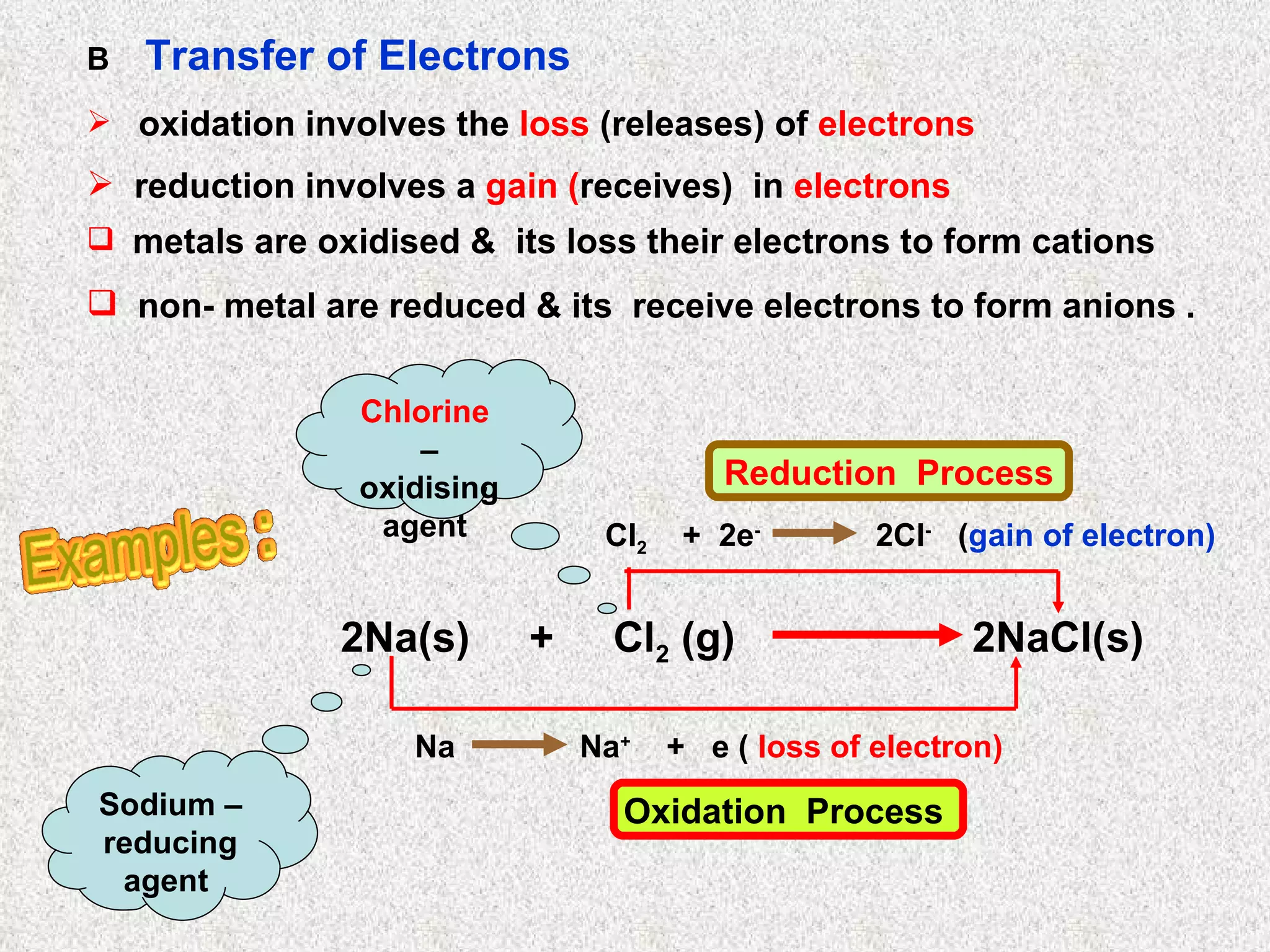
B  Transfer of Electrons   oxidation involves the  loss  (releases) of  electrons   reduction involves a  gain ( receives)  in  electrons   Chlorine   –  oxidising agent  Sodium – reducing agent  metals are oxidised &  its loss their electrons to form cations  non- metal are reduced & its  receive electrons to form anions .  2Na(s)  +  Cl 2  (g)  2NaCl(s) Na  Na +   +  e (  loss of electron) Cl 2   +  2e -   2Cl -   ( gain of electron) Oxidation  Process  Reduction  Process
 
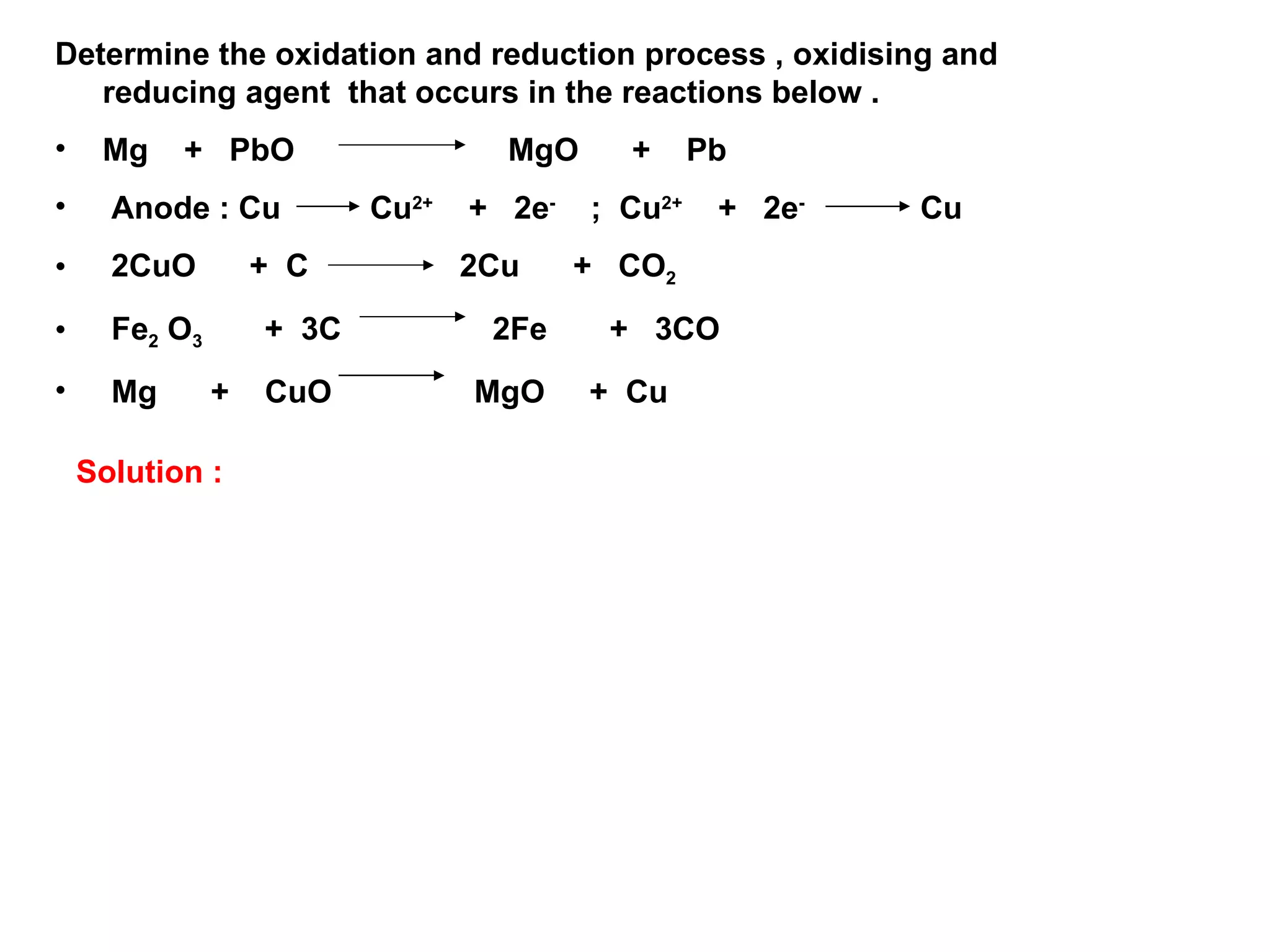
Solution :  Determine the oxidation and reduction process , oxidising and reducing agent  that occurs in the reactions below . Mg  +  PbO  MgO  +  Pb Anode : Cu  Cu 2+   +  2e -   ;  Cu 2+   +  2e -   Cu 2CuO  +  C  2Cu  +  CO 2 Fe 2  O 3   +  3C  2Fe  +  3CO Mg  +  CuO  MgO  +  Cu
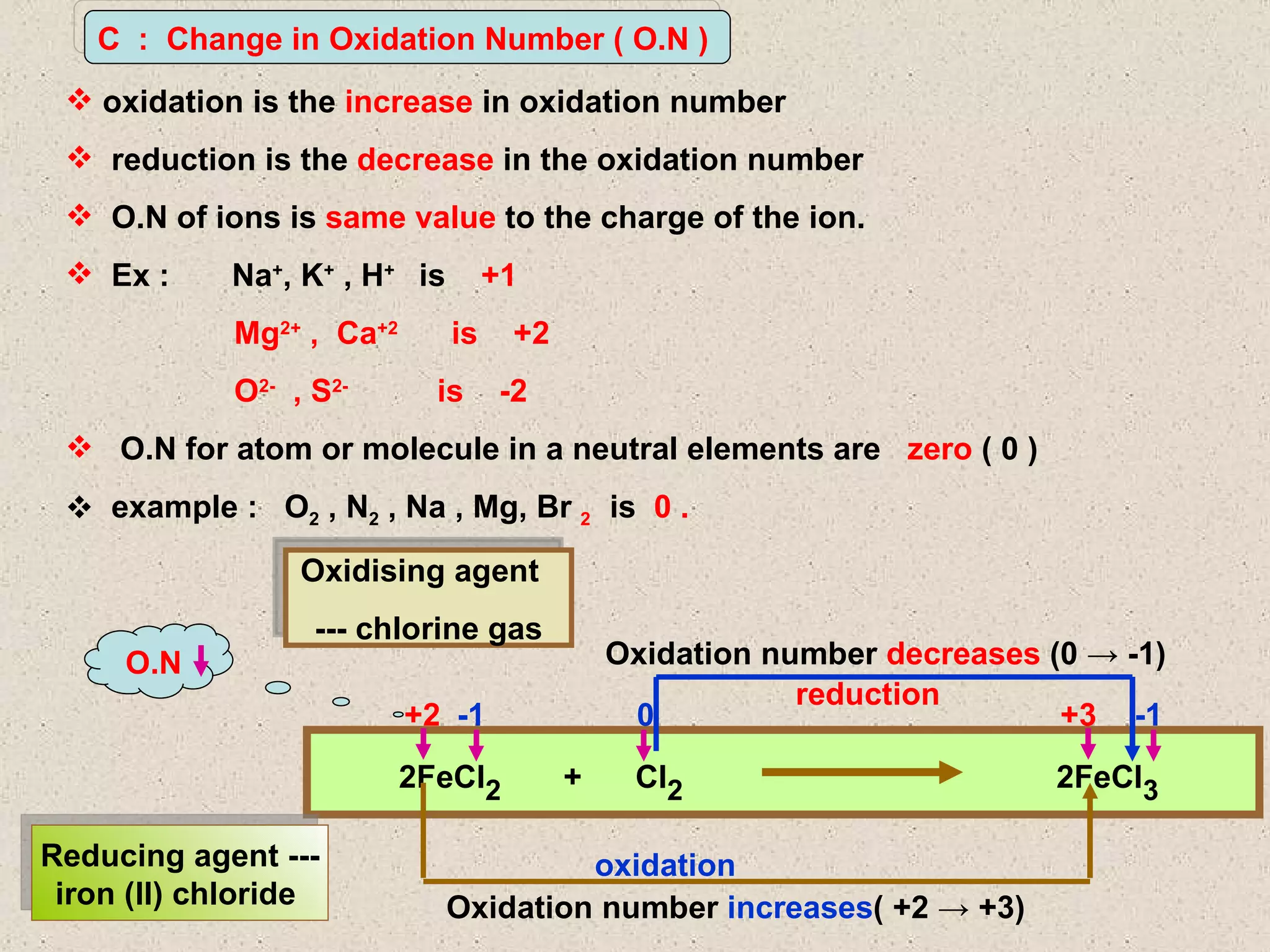
oxidation is the  increase  in oxidation number  reduction is the  decrease  in the oxidation number  O.N of ions is  same value  to the charge of the ion. Ex :  Na + , K +  , H +  is  +1 Mg 2+  ,  Ca +2   is  +2  O 2-   , S 2-   is  -2  O.N for atom or molecule in a neutral elements are  zero  ( 0 ) example :  O 2  , N 2  , Na , Mg, Br   2  is  0 . O.N Reducing agent --- iron (II) chloride  Oxidising agent  --- chlorine gas C  :  Change in Oxidation Number ( O.N )  2FeCl 2   +  Cl 2   2FeCl 3   Oxidation number  decreases  (0  -> -1)  Oxidation number  increases ( +2  -> +3) reduction oxidation +2 +3 -1 0 -1
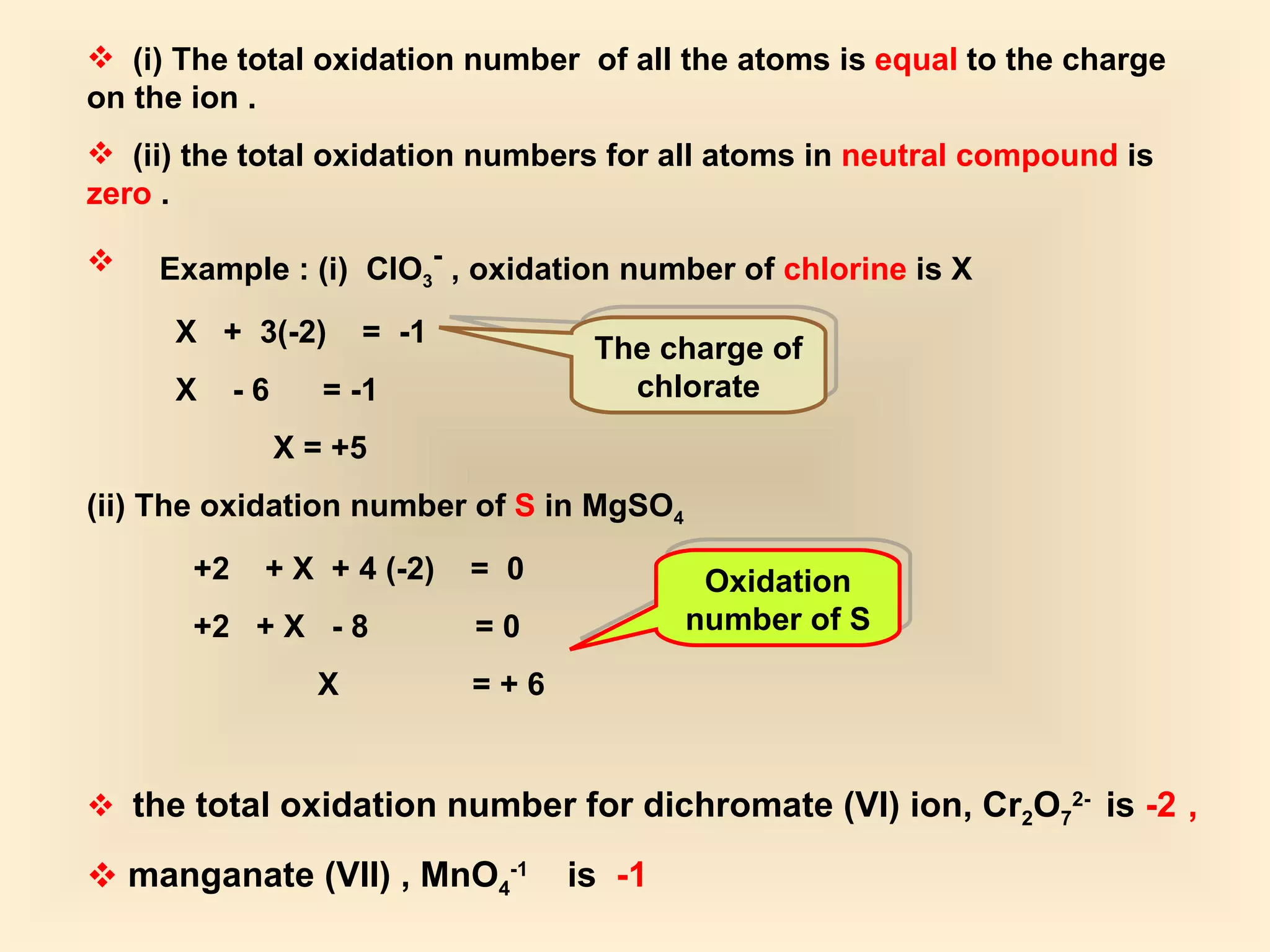
(i)   The total oxidation number  of all the atoms is  equal  to the charge on the ion . (ii) the total oxidation numbers for all atoms in  neutral compound  is  zero  . Example : (i)  ClO 3 -  , oxidation number of  chlorine  is X X  +  3(-2)  =  -1 X  - 6  = -1 X = +5 (ii) The oxidation number of  S  in MgSO 4 +2  + X  + 4 (-2)  =  0 +2  + X  - 8  = 0 X  = + 6 the total oxidation number for dichromate (VI) ion, Cr 2 O 7 2-  is  -2   , manganate (VII) , MnO 4 -1   is  -1 The charge of chlorate Oxidation number of S
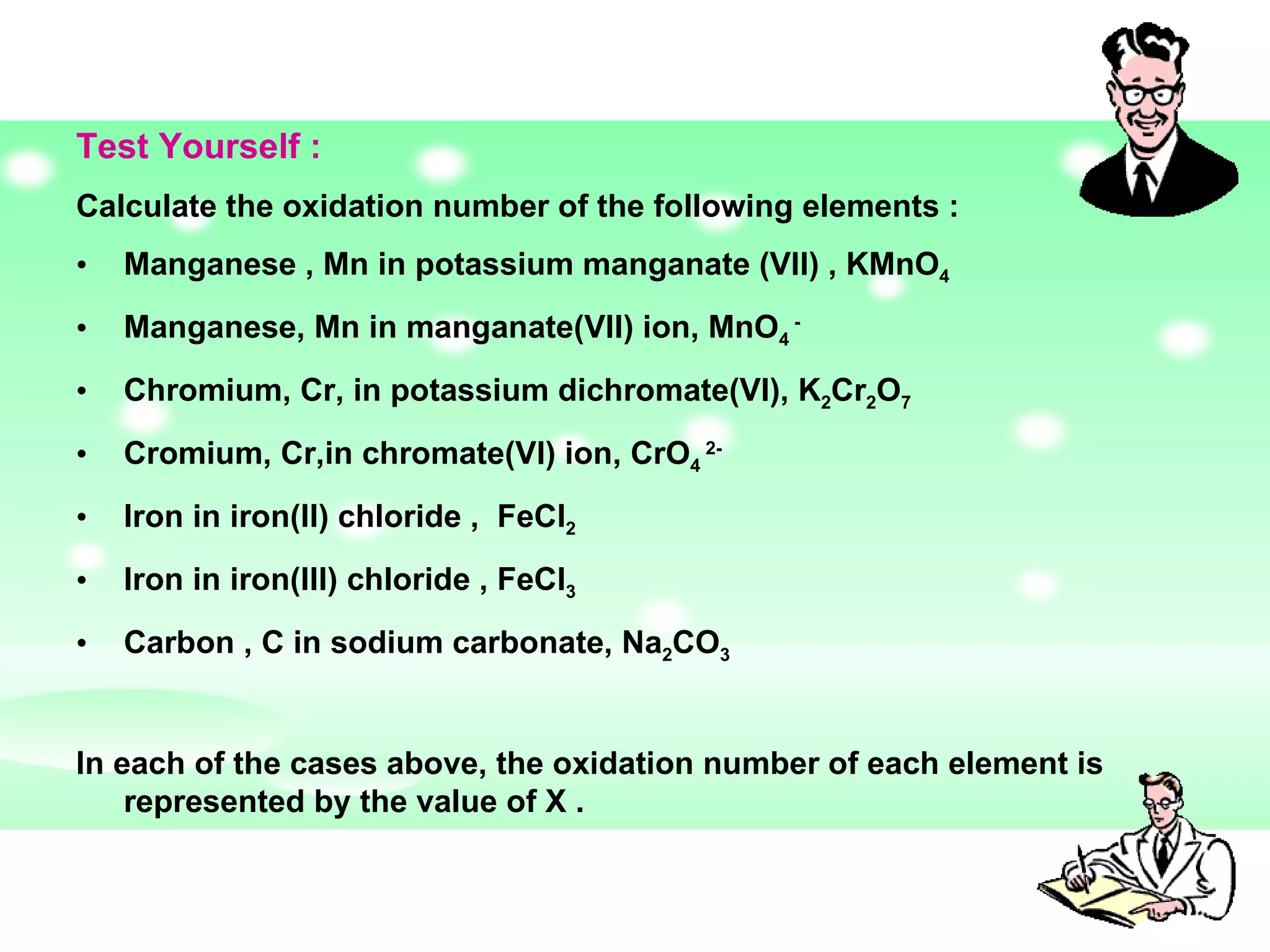
Test Yourself :  Calculate the oxidation number of the following elements :  Manganese , Mn in potassium manganate (VII) , KMnO 4   Manganese, Mn in manganate(VII) ion, MnO 4  - Chromium, Cr, in potassium dichromate(VI), K 2 Cr 2 O 7   Cromium, Cr,in chromate(VI) ion, CrO 4  2- Iron in iron(II) chloride ,  FeCl 2 Iron in iron(III) chloride , FeCl 3 Carbon , C in sodium carbonate, Na 2 CO 3 In each of the cases above, the oxidation number of each element is represented by the value of X .
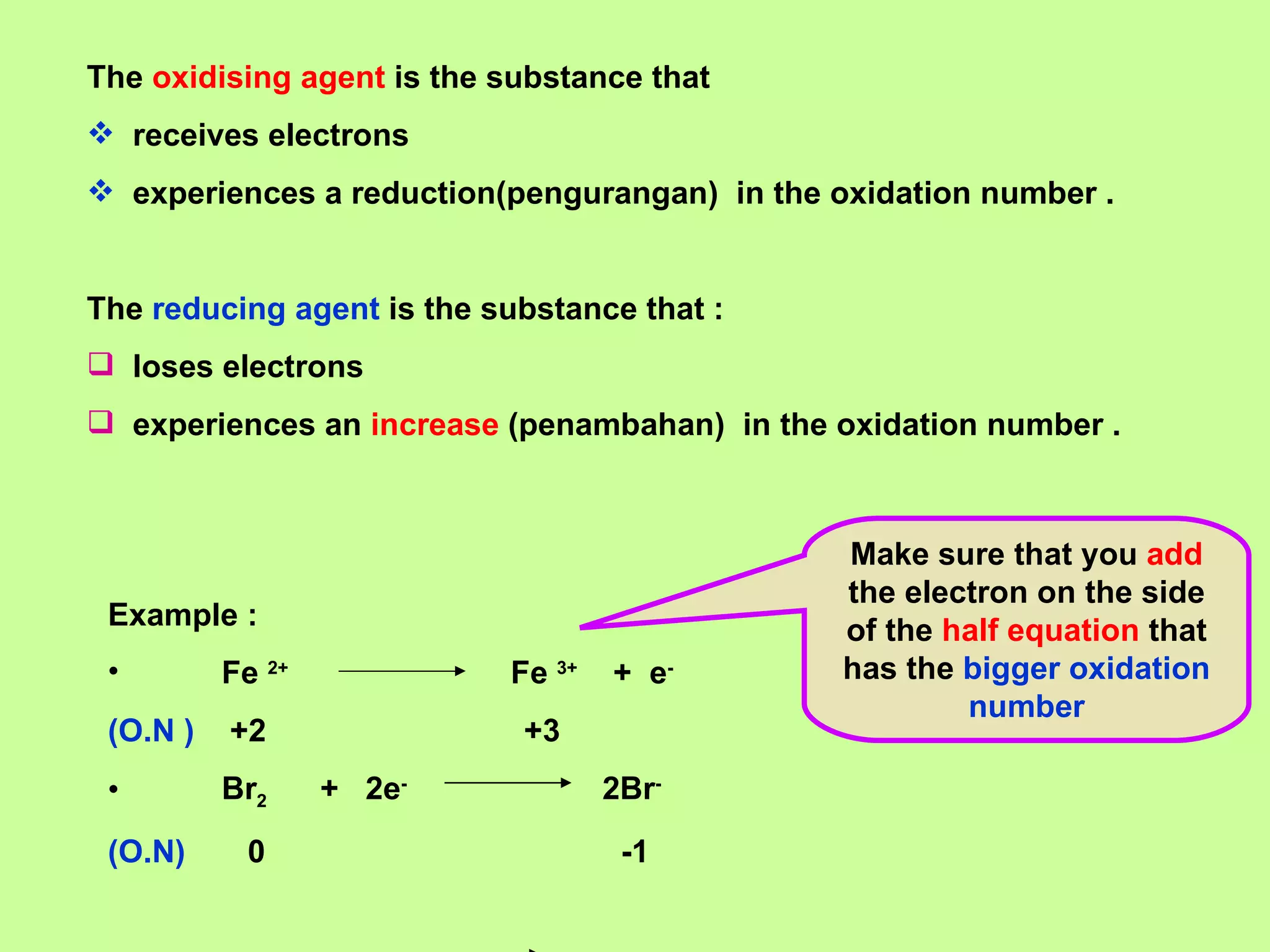
The  oxidising agent  is the substance that  receives electrons experiences a reduction(pengurangan)  in the oxidation number . The  reducing agent  is the substance that : loses electrons experiences an  increase  (penambahan)  in the oxidation number . Example : Fe  2+   Fe  3+   +  e - (O.N )   +2  +3 Br 2   +  2e -   2Br - (O.N)   0  -1 Make sure that you  add  the electron on the side of the  half equation  that has the  bigger oxidation number
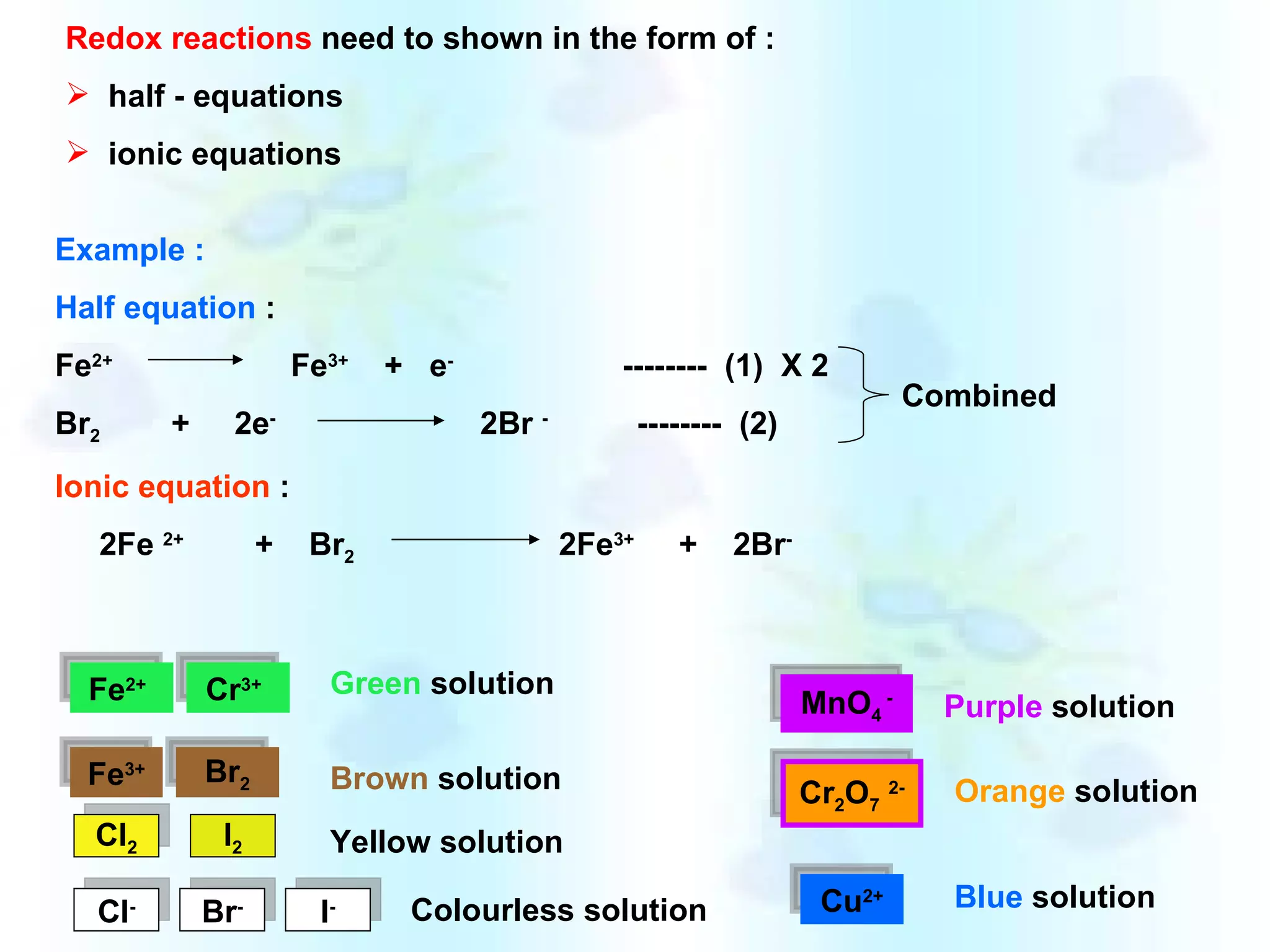
Redox reactions  need to shown in the form of :  half - equations  ionic equations Fe 2+   Fe 3+ Cl - Cl 2 Br - I - Br 2 Green  solution Brown  solution  Yellow solution  Colourless solution  MnO 4  - Purple  solution  Cr 2 O 7   2- Cu 2+ Orange  solution  Blue  solution  Cr 3+   I 2 Example : Half equation  : Fe 2+   Fe 3+   +  e -   --------  (1)  X 2  Br 2   +  2e -   2Br  -   --------  (2) Ionic equation  : 2Fe  2+   +  Br 2   2Fe 3+   +  2Br - Combined
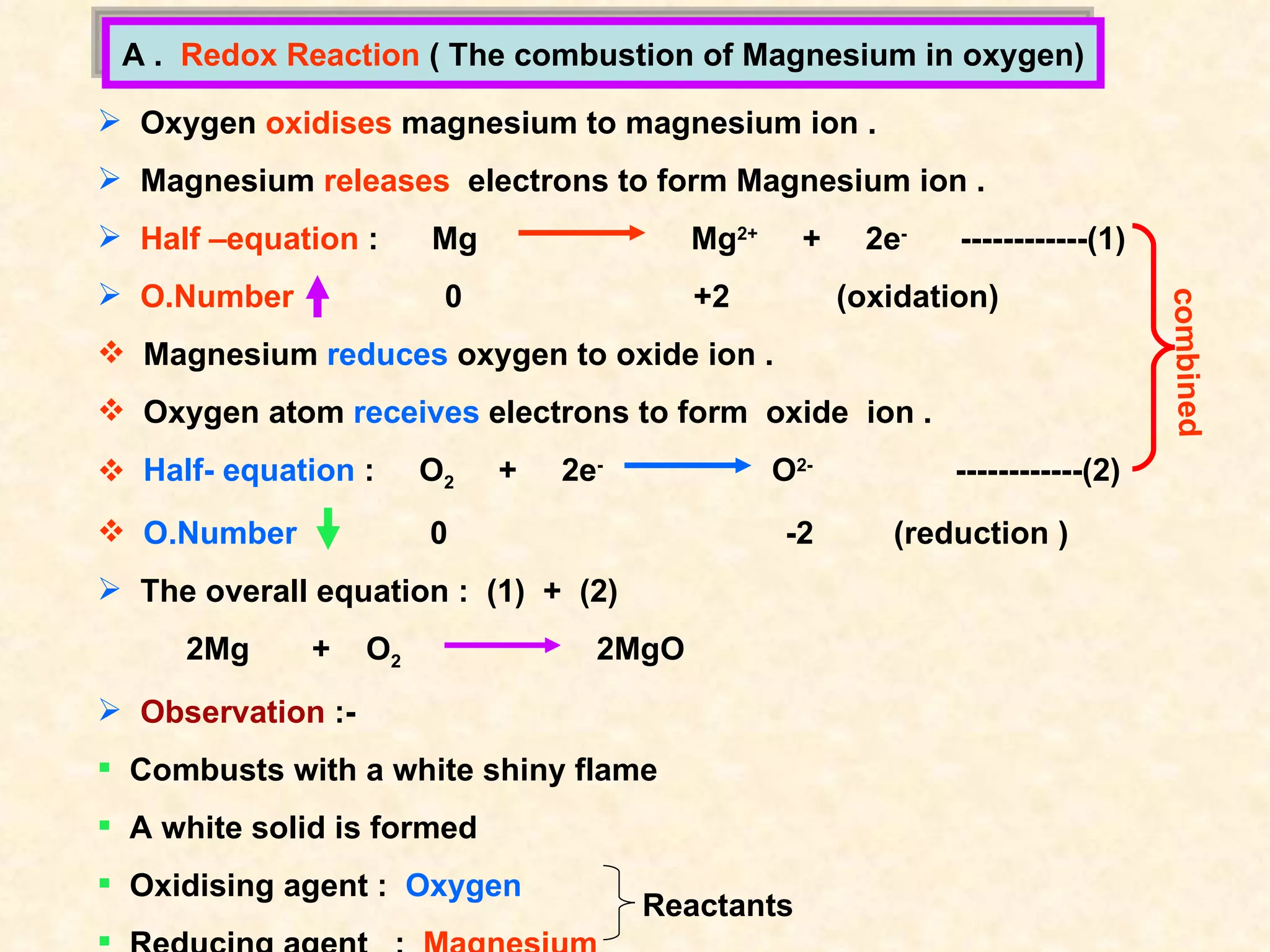
A .  Redox Reaction  ( The combustion of Magnesium in oxygen) Oxygen  oxidises  magnesium to magnesium ion . Magnesium  releases  electrons to form Magnesium ion . Half –equation  :  Mg  Mg 2+   +  2e -   ------------(1) O.Number   0  +2  (oxidation) Magnesium  reduces  oxygen to oxide ion . Oxygen atom  receives  electrons to form  oxide  ion . Half- equation  :  O 2   +  2e -   O 2-   ------------(2) O.Number  0  -2  (reduction ) The overall equation :  (1)  +  (2) 2Mg  +  O 2   2MgO Observation  :- Combusts with a white shiny flame A white solid is formed  Oxidising agent :  Oxygen Reducing agent  :  Magnesium combined  Reactants
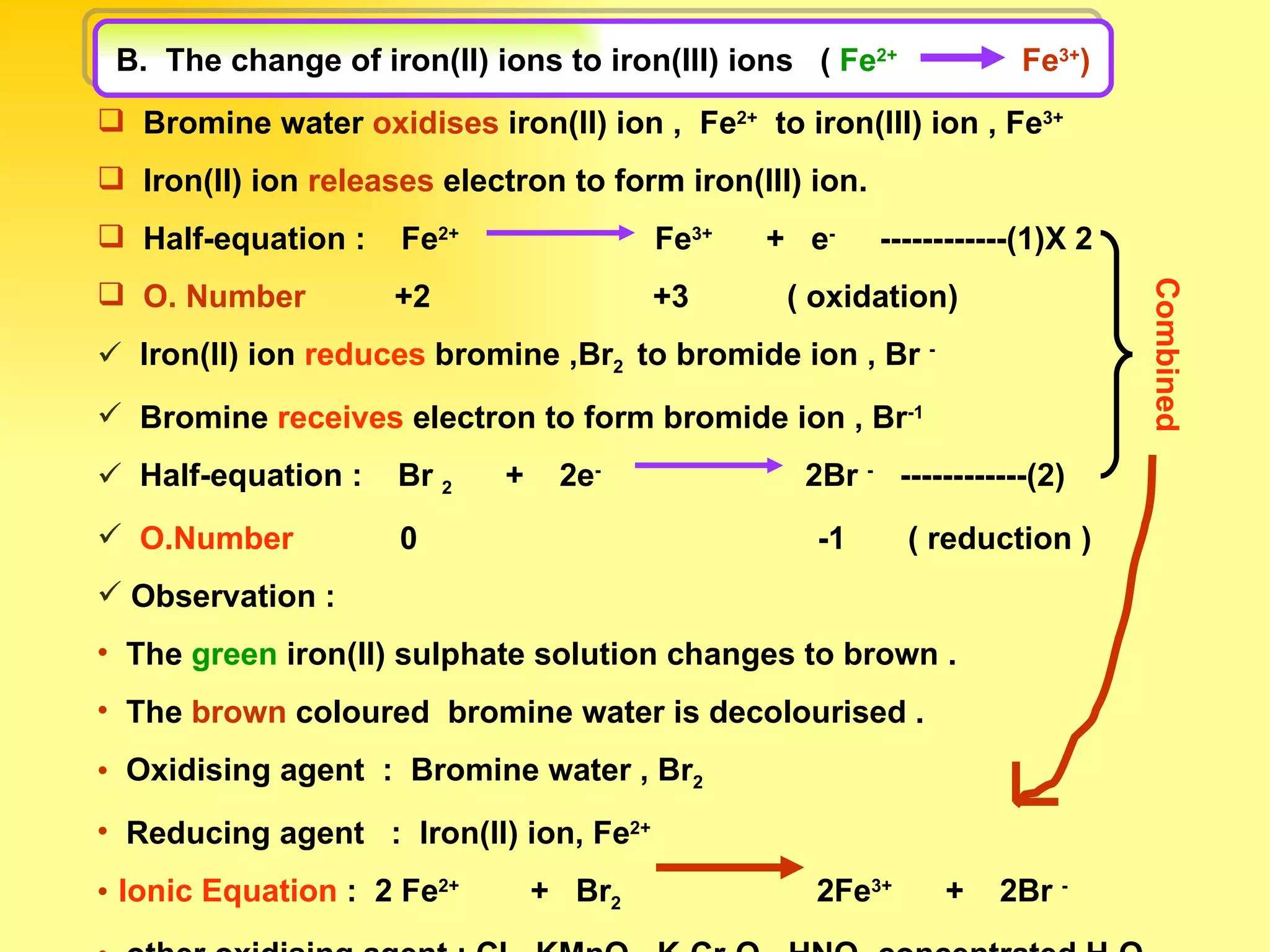
Bromine water  oxidises  iron(II) ion ,  Fe 2+   to iron(III) ion , Fe 3+ Iron(II) ion  releases  electron to form iron(III) ion. Half-equation :  Fe 2+   Fe 3+   +  e -   ------------(1)X 2 O. Number   +2  +3  ( oxidation)  Iron(II) ion  reduces  bromine ,Br 2  to bromide ion , Br  - Bromine  receives  electron to form bromide ion , Br -1   Half-equation :  Br  2   +  2e -   2Br  -   ------------(2)  O.Number  0  -1  ( reduction ) Observation : The  green  iron(II) sulphate solution changes to brown . The  brown  coloured  bromine water is decolourised . Oxidising agent  :  Bromine water , Br 2 Reducing agent  :  Iron(II) ion, Fe 2+ Ionic Equation  :  2 Fe 2+   +  Br 2   2Fe 3+   +  2Br  - other oxidising agent : Cl 2  ,KMnO 4  ,K 2 Cr 2 O 7  ,HNO 3  concentrated,H 2 O 2   Combined   B.  The change of iron(II) ions to iron(III) ions  (  Fe 2+   Fe 3+ )
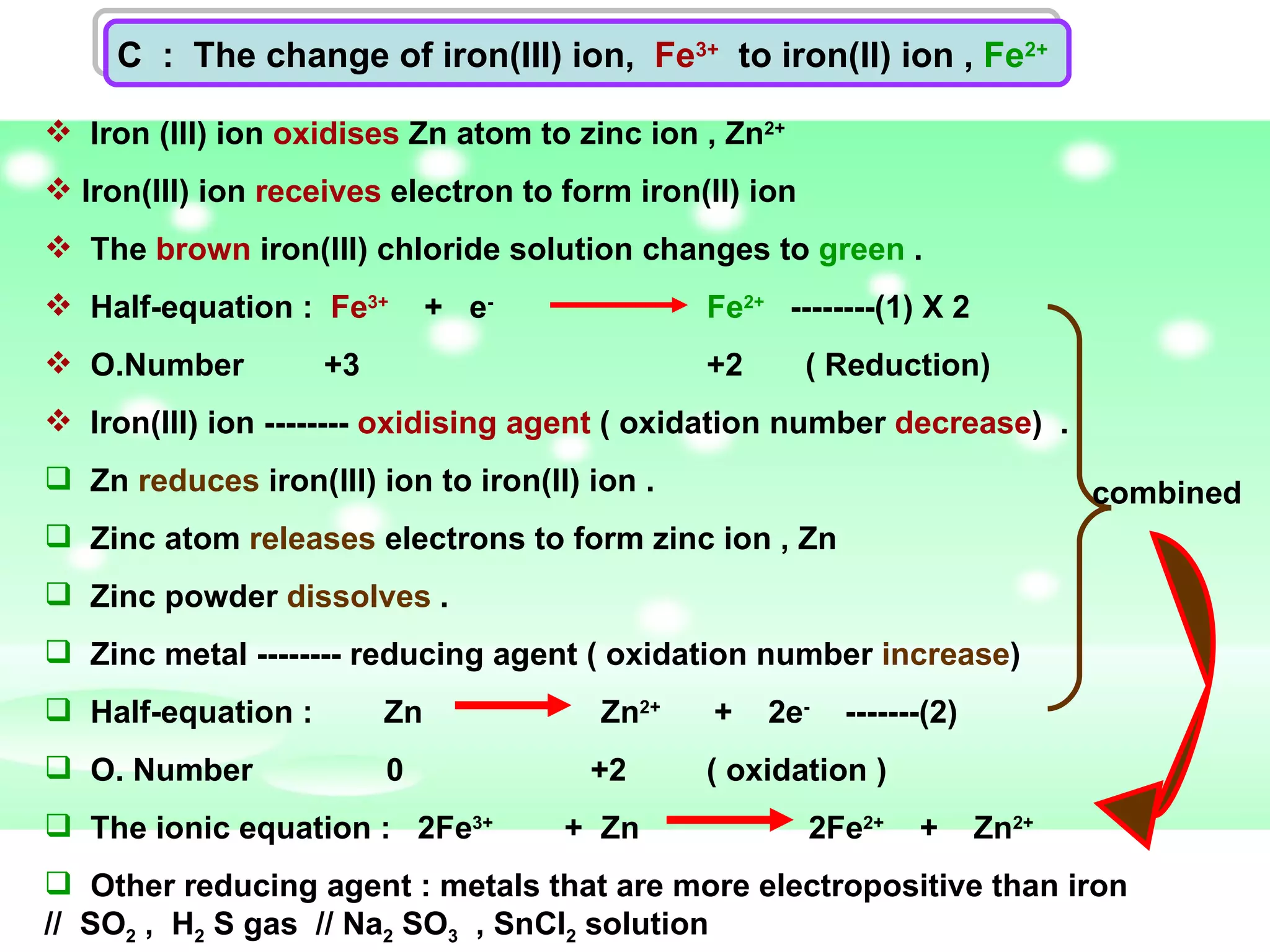
C  :  The change of iron(III) ion,  Fe 3+   to iron(II) ion ,  Fe 2+   Iron (III) ion  oxidises  Zn atom to zinc ion , Zn 2+ Iron(III) ion  receives  electron to form iron(II) ion  The  brown  iron(III) chloride solution changes to  green  . Half-equation :  Fe 3+   +  e -   Fe 2+   --------(1) X 2 O.Number  +3  +2  ( Reduction) Iron(III) ion --------  oxidising agent  ( oxidation number  decrease )  . Zn  reduces  iron(III) ion to iron(II) ion . Zinc atom  releases  electrons to form zinc ion , Zn Zinc powder  dissolves  . Zinc metal -------- reducing agent ( oxidation number  increase ) Half-equation :  Zn  Zn 2+   +  2e -   -------(2) O. Number  0  +2  ( oxidation ) The ionic equation :  2Fe 3+   +  Zn  2Fe 2+   +  Zn 2+ Other reducing agent : metals that are more electropositive than iron  //  SO 2  ,  H 2  S gas  // Na 2  SO 3   , SnCl 2  solution  combined
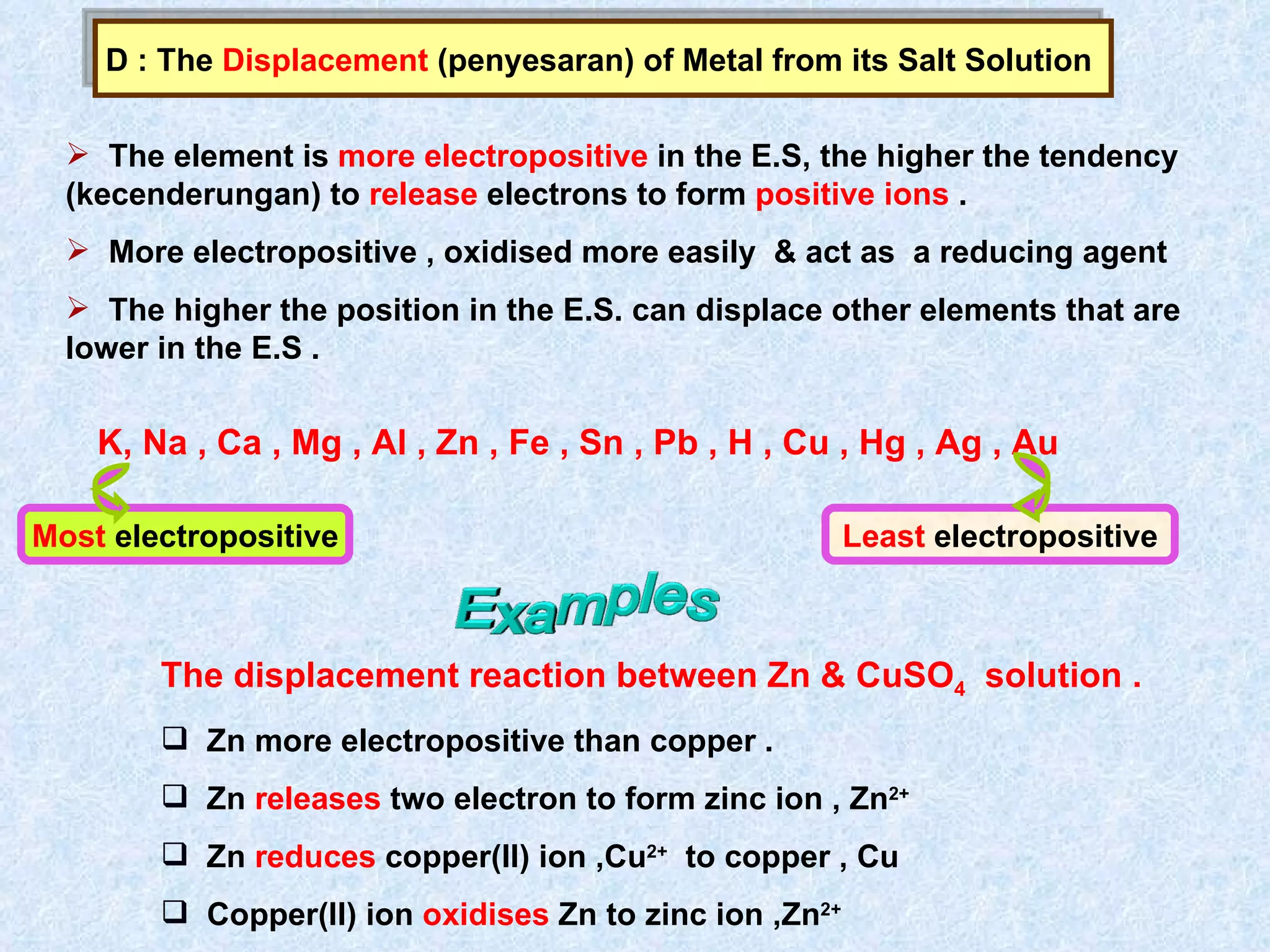
D : The  Displacement  (penyesaran) of Metal from its Salt Solution  The element is  more electropositive  in the E.S, the higher the tendency (kecenderungan) to  release  electrons to form  positive ions  . More electropositive , oxidised more easily  & act as  a reducing agent  The higher the position in the E.S. can displace other elements that are lower in the E.S . The displacement reaction between Zn & CuSO 4   solution . Zn more electropositive than copper . Zn  releases  two electron to form zinc ion , Zn 2+  Zn  reduces  copper(II) ion ,Cu 2+   to copper , Cu Copper(II) ion  oxidises  Zn to zinc ion ,Zn 2+ K, Na , Ca , Mg , Al , Zn , Fe , Sn , Pb , H , Cu , Hg , Ag , Au Most  electropositive Least  electropositive
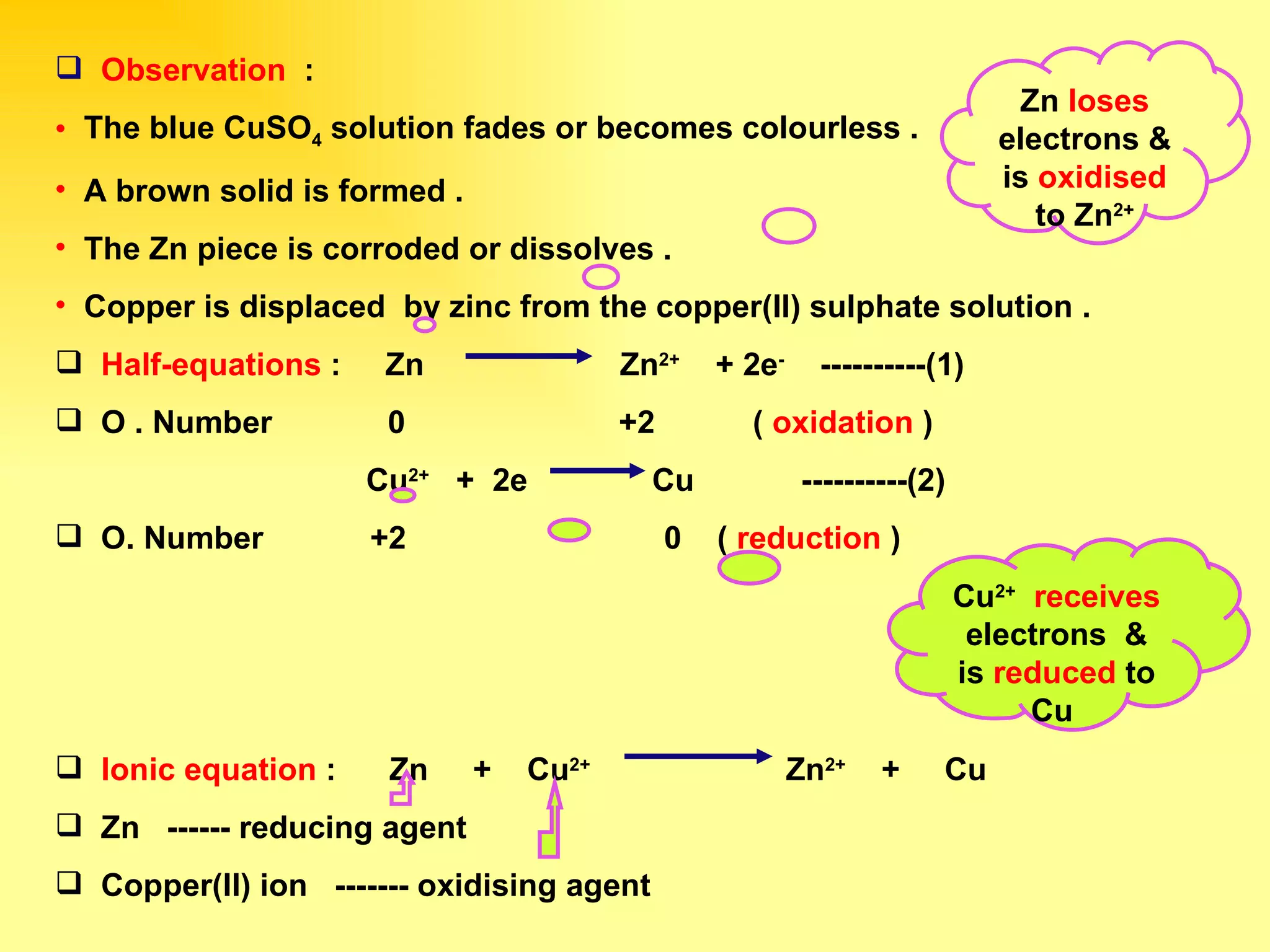
Observation   :  The blue CuSO 4  solution fades or becomes colourless . A brown solid is formed . The Zn piece is corroded or dissolves . Copper is displaced  by zinc from the copper(II) sulphate solution . Half-equations  :  Zn  Zn 2+   + 2e -   ----------(1) O . Number  0  +2  (  oxidation  ) Cu 2+   +  2e  Cu  ----------(2) O. Number  +2  0  (  reduction  ) Ionic equation  :  Zn  +  Cu 2+   Zn 2+   +  Cu  Zn  ------ reducing agent Copper(II) ion  ------- oxidising agent Zn  loses  electrons & is  oxidised  to Zn 2+ Cu 2+   receives  electrons  & is  reduced  to Cu

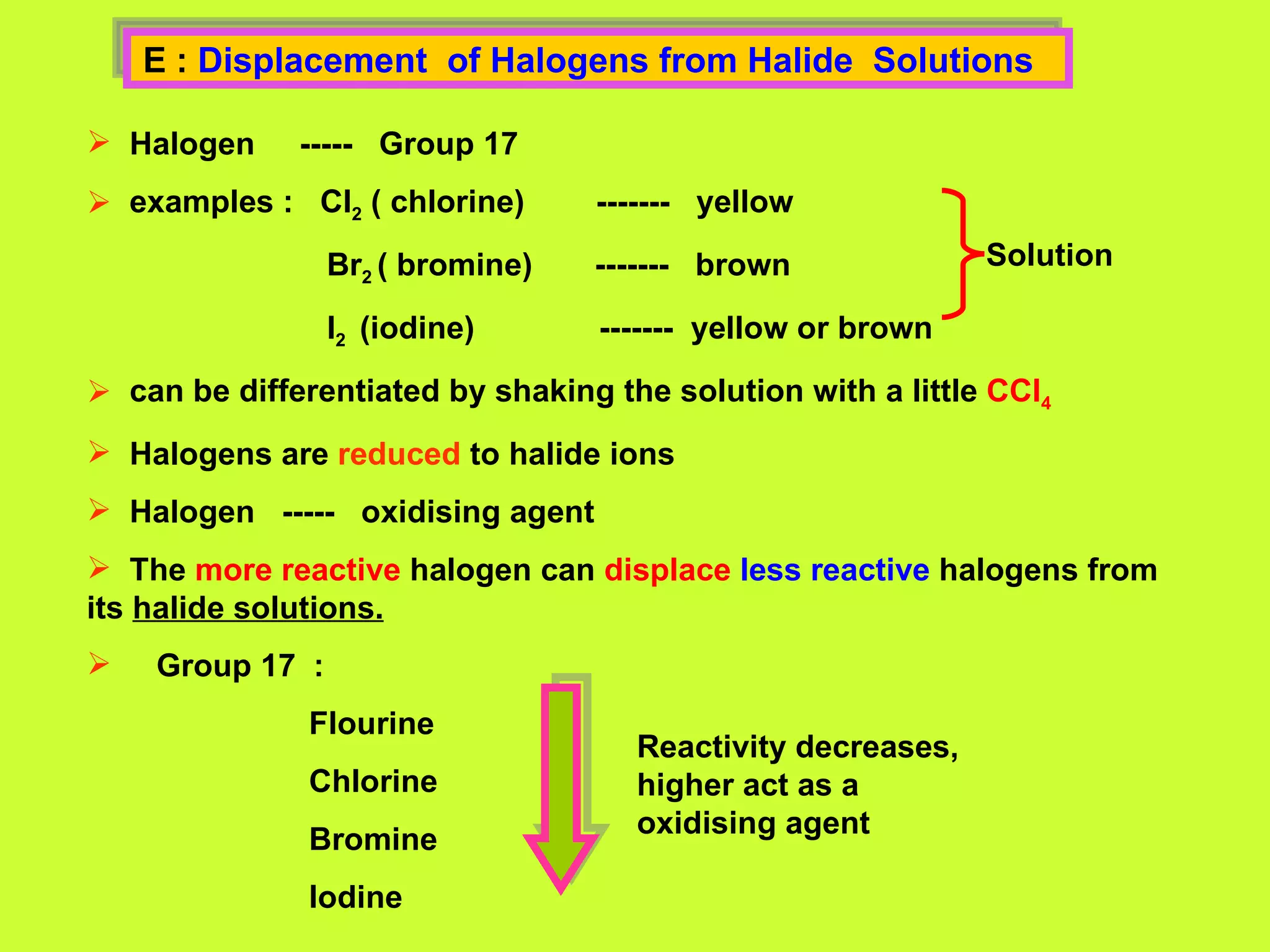
E :  Displacement  of Halogens from Halide  Solutions  Halogen  -----  Group 17 examples :  Cl 2  ( chlorine)  -------  yellow Br 2  ( bromine)  -------  brown I 2  (iodine)  -------  yellow or brown can be differentiated by shaking the solution with a little  CCl 4 Halogens are  reduced  to halide ions  Halogen  -----  oxidising agent The  more reactive  halogen can  displace   less reactive  halogens from its  halide solutions. Group 17  : Flourine Chlorine Bromine  Iodine  Solution   Reactivity decreases, higher act as a oxidising agent
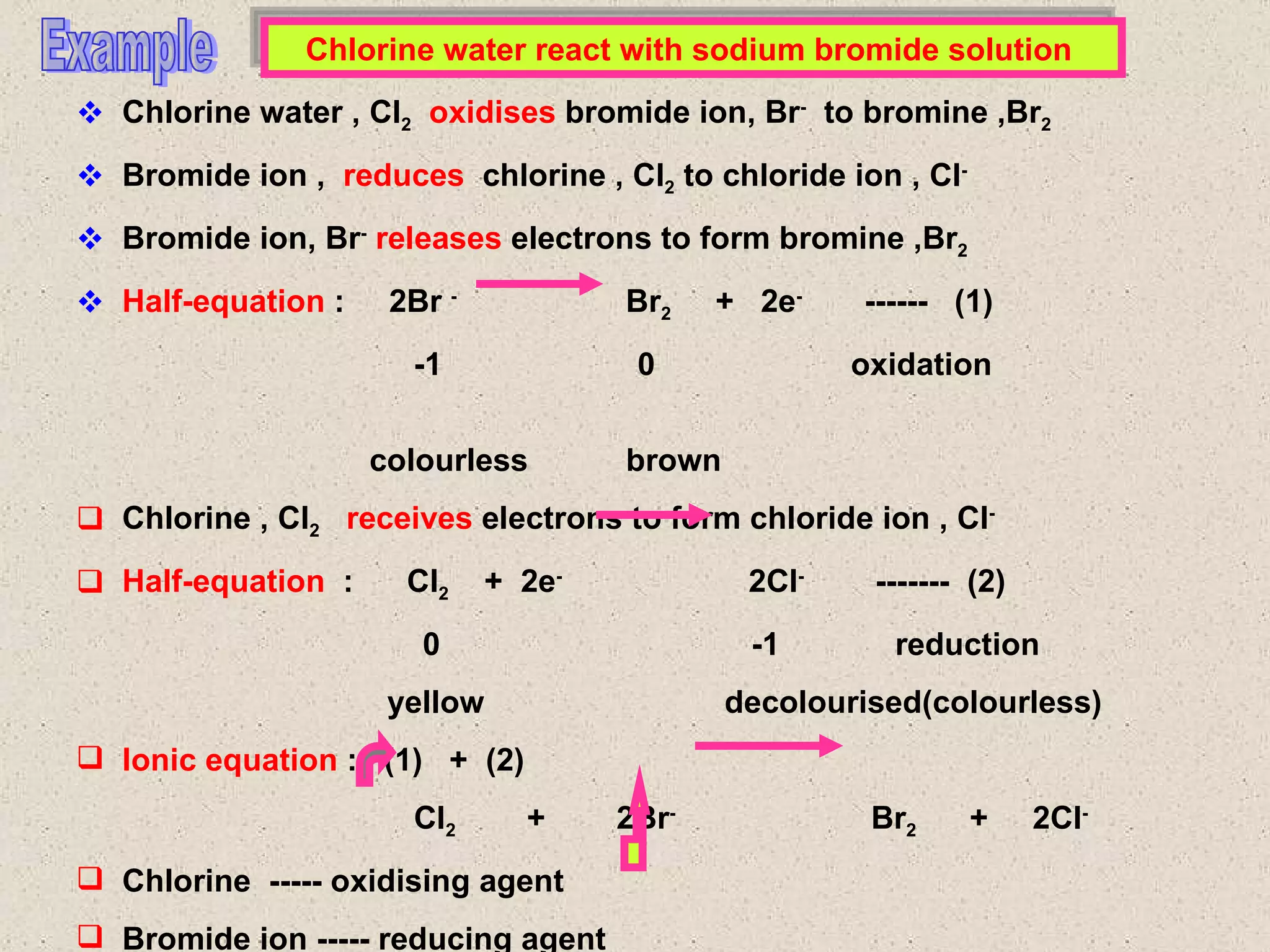
Example Chlorine water react with sodium bromide solution  Chlorine water , Cl 2   oxidises  bromide ion, Br -   to bromine ,Br 2 Bromide ion ,  reduces  chlorine , Cl 2  to chloride ion , Cl - Bromide ion, Br -   releases  electrons to form bromine ,Br 2 Half-equation  :  2Br  -   Br 2   +  2e -   ------  (1) -1  0  oxidation  colourless  brown Chlorine , Cl 2   receives  electrons to form chloride ion , Cl - Half-equation  :  Cl 2   +  2e -   2Cl -   -------  (2) 0  -1  reduction yellow  decolourised(colourless) Ionic equation  :  (1)  +  (2) Cl 2   +  2Br -   Br 2   +  2Cl - Chlorine  ----- oxidising agent Bromide ion ----- reducing agent Chlorine  displaces  bromine from the sodium bromide solution.
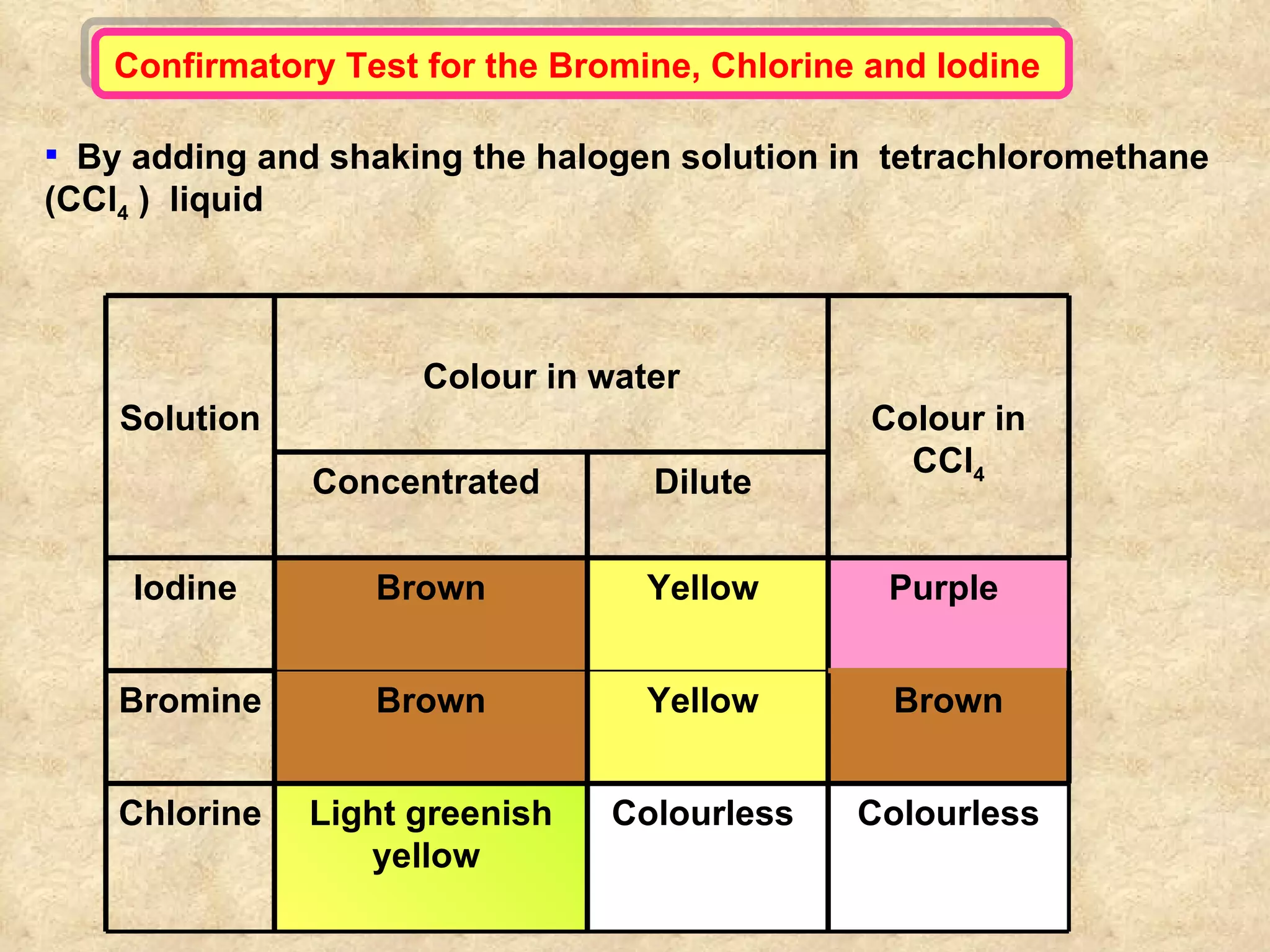
Confirmatory Test for the Bromine, Chlorine and Iodine  By adding and shaking the halogen solution in  tetrachloromethane (CCl 4  )  liquid Solution Colour in water Colour in CCl 4 Concentrated  Dilute  Iodine  Brown Yellow  Purple  Bromine Brown Yellow  Brown Chlorine  Light greenish yellow  Colourless  Colourless
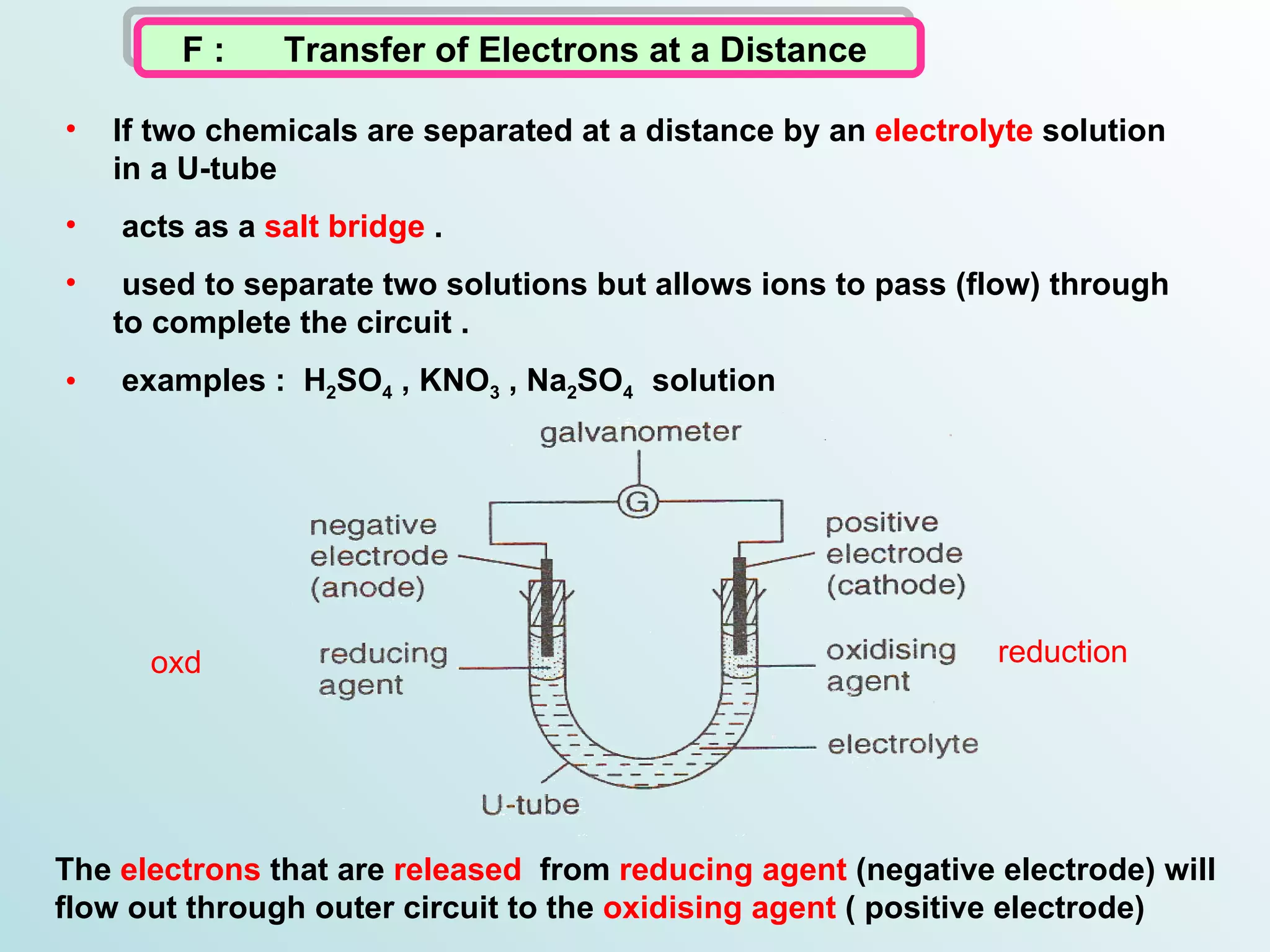
F :  Transfer of Electrons at a Distance   If two chemicals are separated at a distance by an  electrolyte  solution in a U-tube  acts as a  salt bridge  . used to separate two solutions but allows ions to pass (flow) through to complete the circuit . examples :  H 2 SO 4  , KNO 3  , Na 2 SO 4  solution The  electrons  that are  released   from  reducing agent  (negative electrode) will flow out through outer circuit to the  oxidising agent  ( positive electrode)  reduction oxd
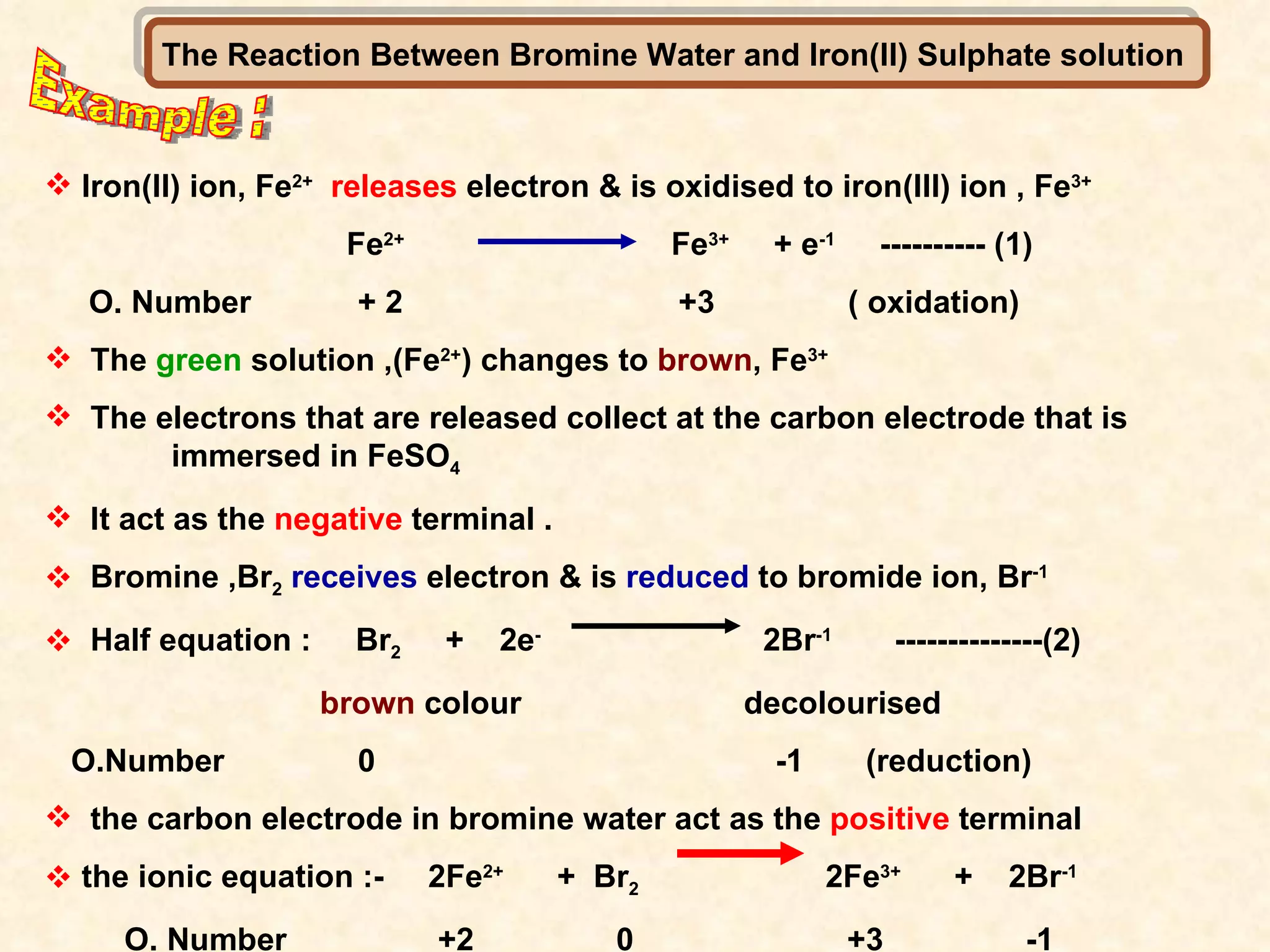
Example : The Reaction Between Bromine Water and Iron(II) Sulphate solution  Iron(II) ion, Fe 2+   releases  electron & is oxidised to iron(III) ion , Fe 3+ Fe 2+   Fe 3+   + e -1   ---------- (1) O. Number  + 2  +3  ( oxidation) The  green  solution ,(Fe 2+ ) changes to  brown , Fe 3+   The electrons that are released collect at the carbon electrode that is  immersed in FeSO 4   It act as the  negative  terminal . Bromine ,Br 2   receives  electron & is  reduced  to bromide ion, Br -1 Half equation :  Br 2   +  2e -   2Br -1   --------------(2) brown  colour  decolourised  O.Number  0  -1  (reduction) the carbon electrode in bromine water act as the  positive  terminal the ionic equation :-  2Fe 2+   +  Br 2   2Fe 3+   +  2Br -1   O. Number  +2  0  +3  -1
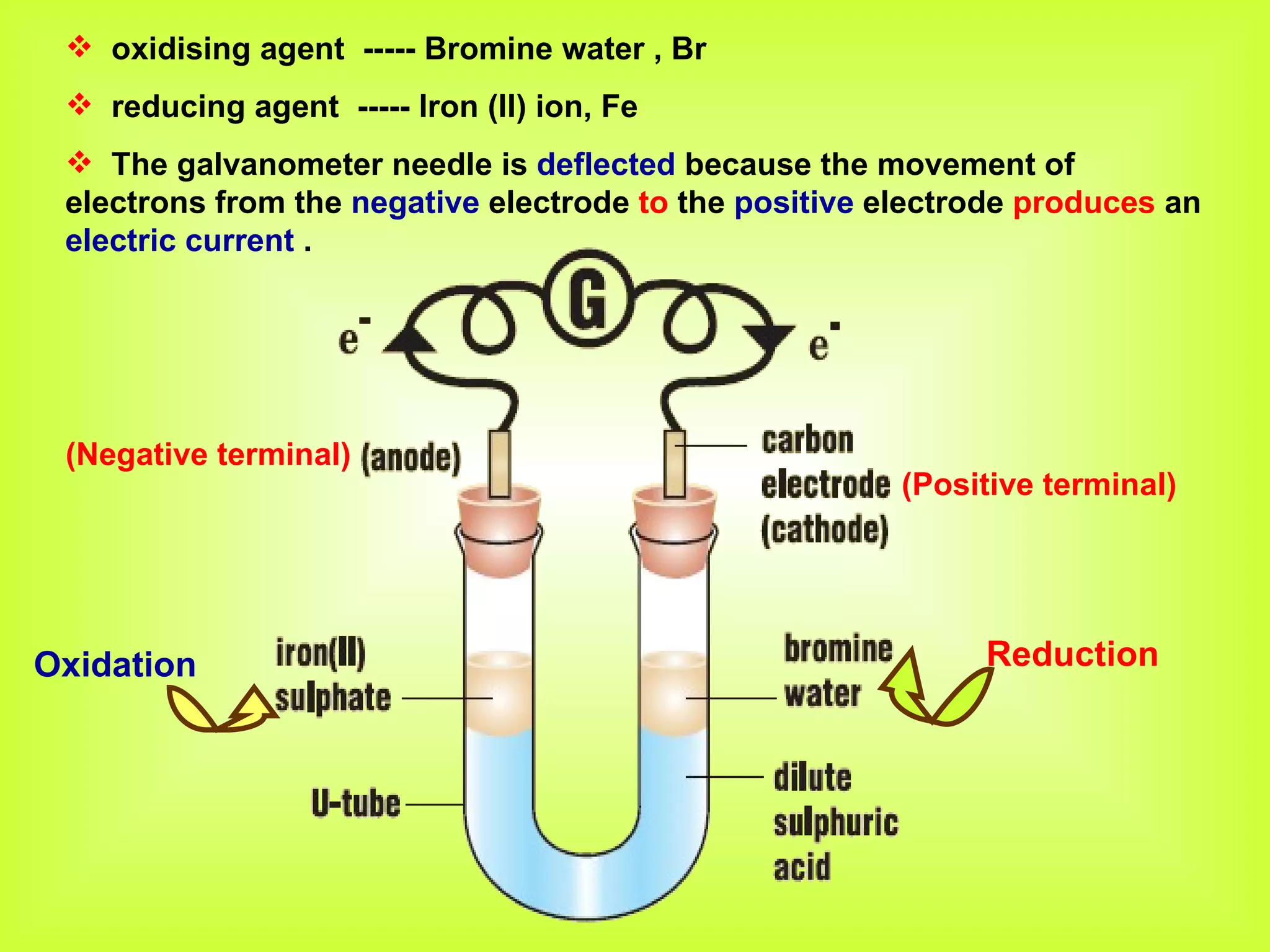
oxidising agent  ----- Bromine water , Br reducing agent  ----- Iron (II) ion, Fe The galvanometer needle is  deflected  because the movement of electrons from the  negative  electrode  to  the  positive  electrode  produces  an  electric current  . Reduction   Oxidation  (Positive terminal) (Negative terminal)
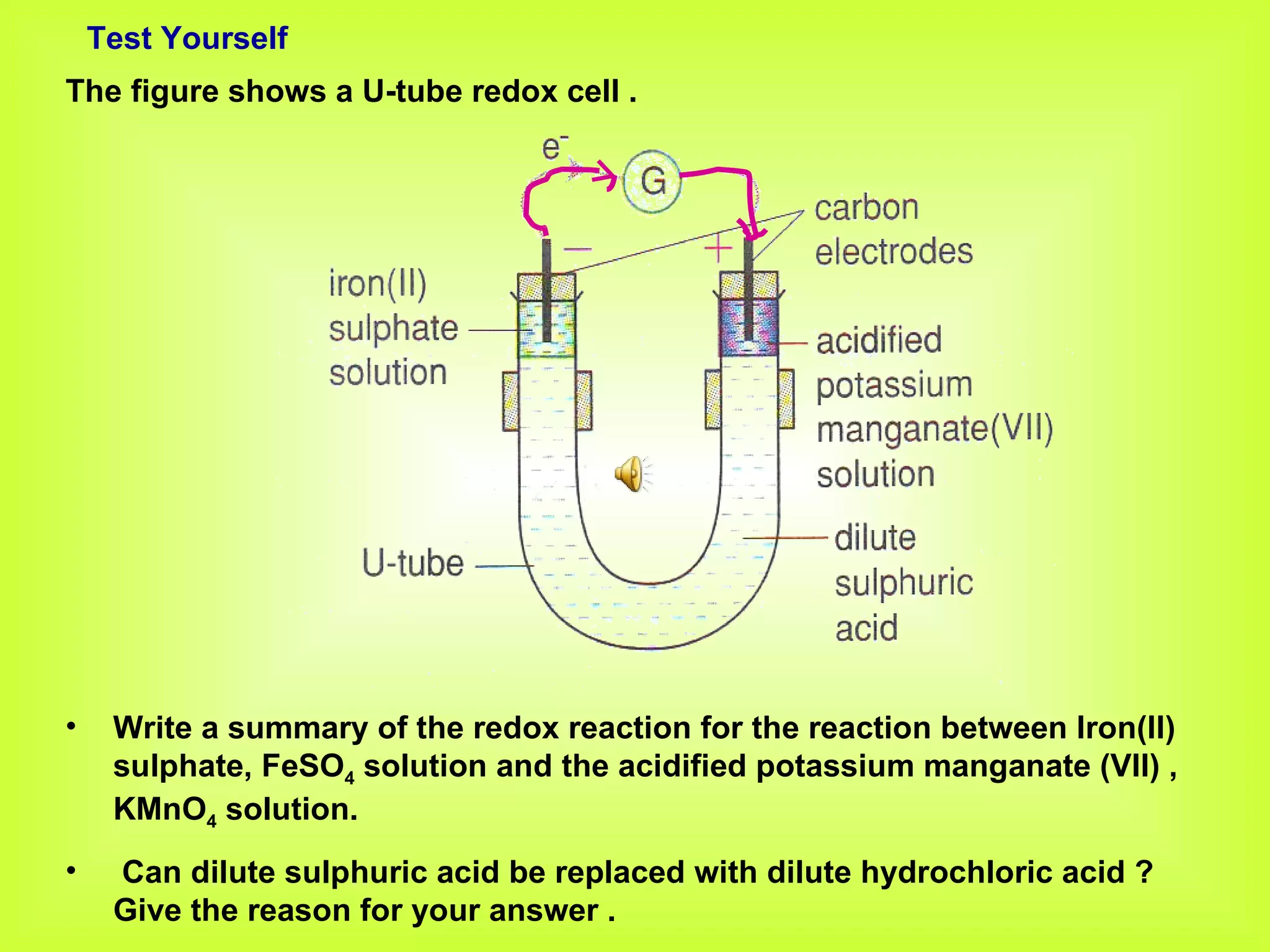
Test Yourself  The figure shows a U-tube redox cell . Write a summary of the redox reaction for the reaction between Iron(II) sulphate, FeSO 4  solution and the acidified potassium manganate (VII) , KMnO 4  solution. Can dilute sulphuric acid be replaced with dilute hydrochloric acid ?  Give the reason for your answer .
 
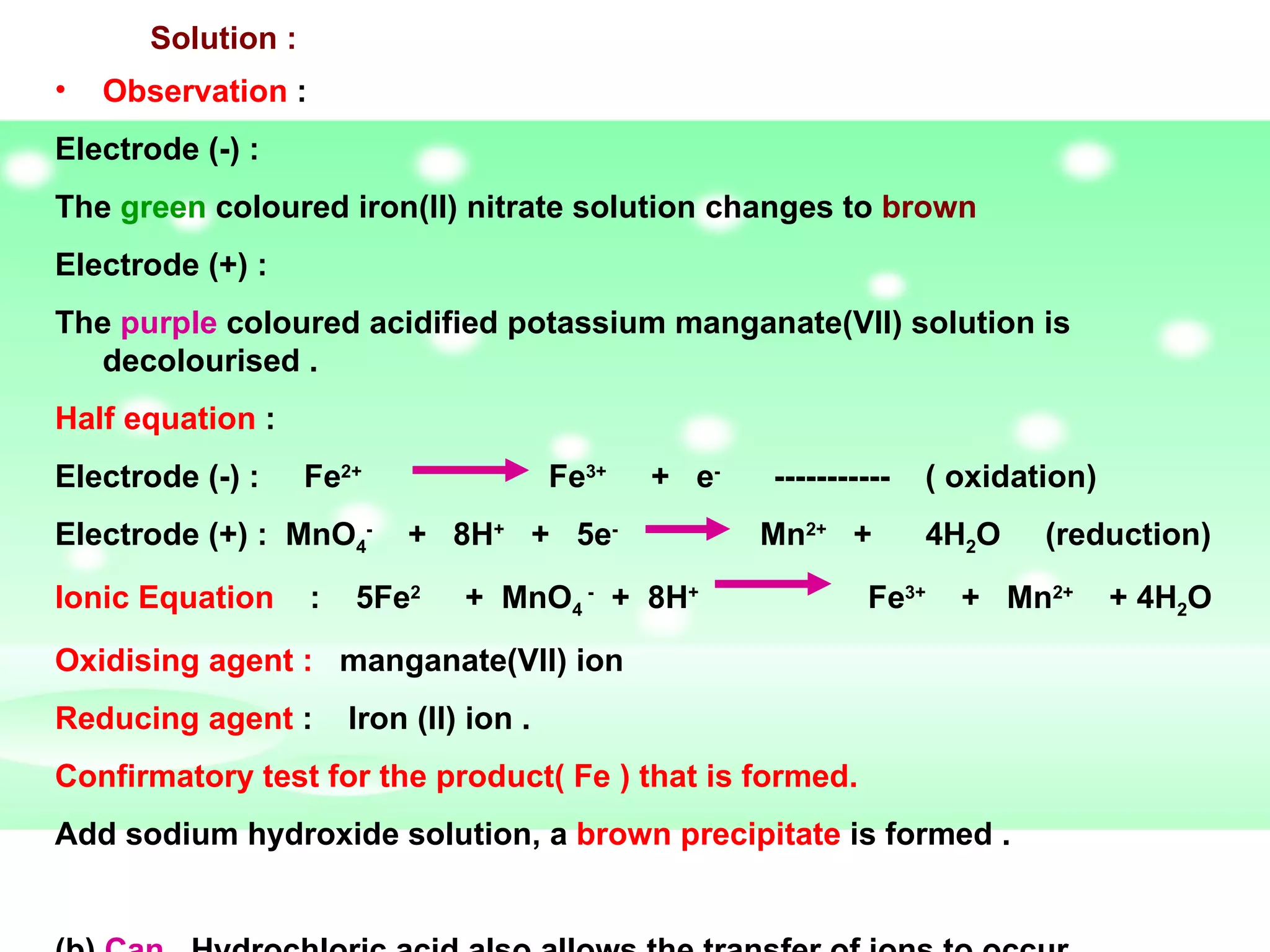
Observation   : Electrode (-) : The  green  coloured iron(II) nitrate solution changes to  brown Electrode (+) : The  purple  coloured acidified potassium manganate(VII) solution is decolourised . Half equation  : Electrode (-) :  Fe 2+   Fe 3+   +  e -   -----------  ( oxidation) Electrode (+) :  MnO 4 -   +  8H +   +  5e -   Mn 2+   +  4H 2 O  (reduction) Ionic Equation   :  5Fe 2   +  MnO 4  -   +  8H +   Fe 3+   +  Mn 2+   + 4H 2 O Oxidising agent :  manganate(VII) ion  Reducing agent  :  Iron (II) ion . Confirmatory test for the product( Fe ) that is formed. Add sodium hydroxide solution, a  brown precipitate  is formed . (b)  Can .  Hydrochloric acid also allows the transfer of ions to occur . Solution :
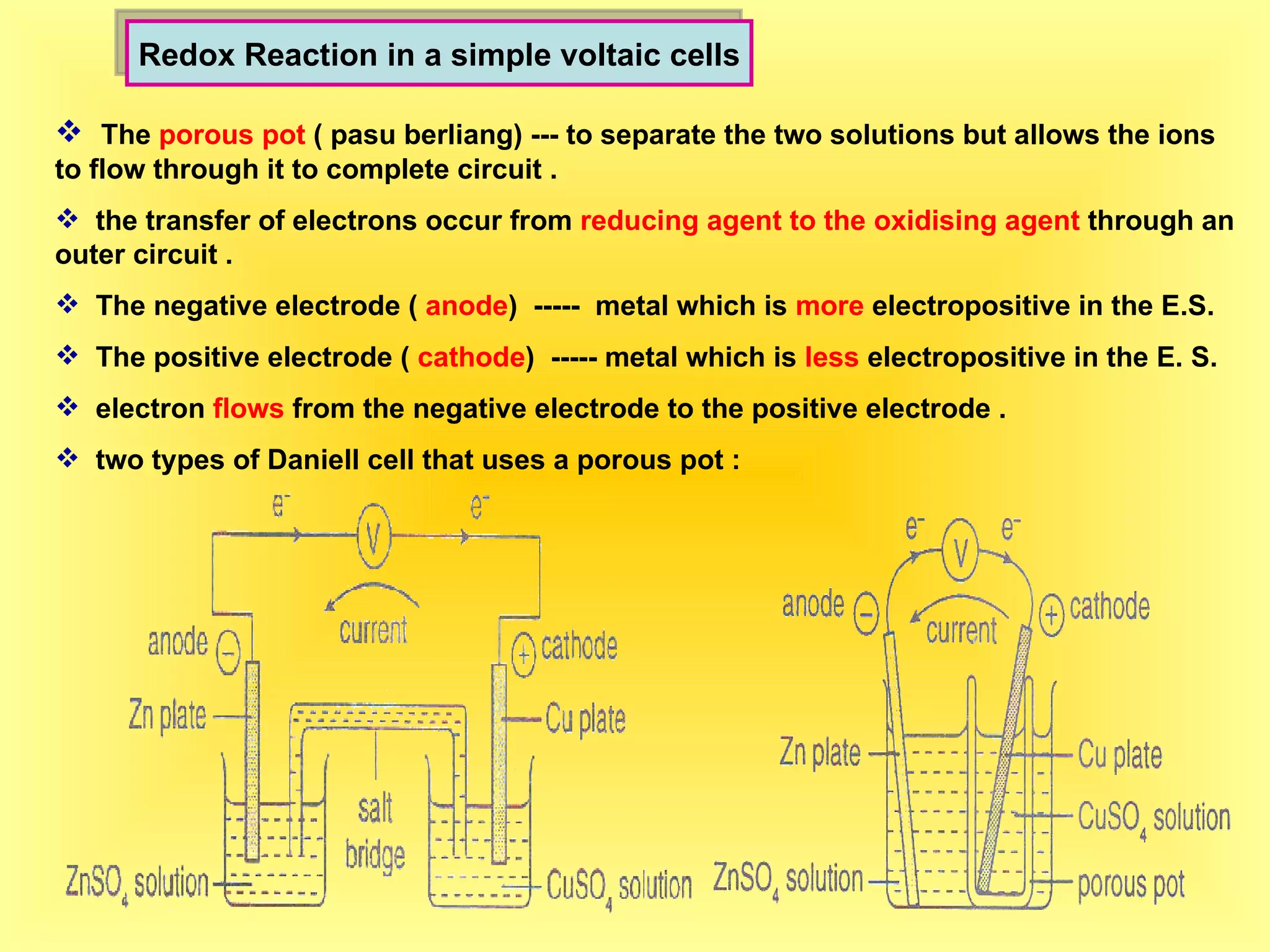
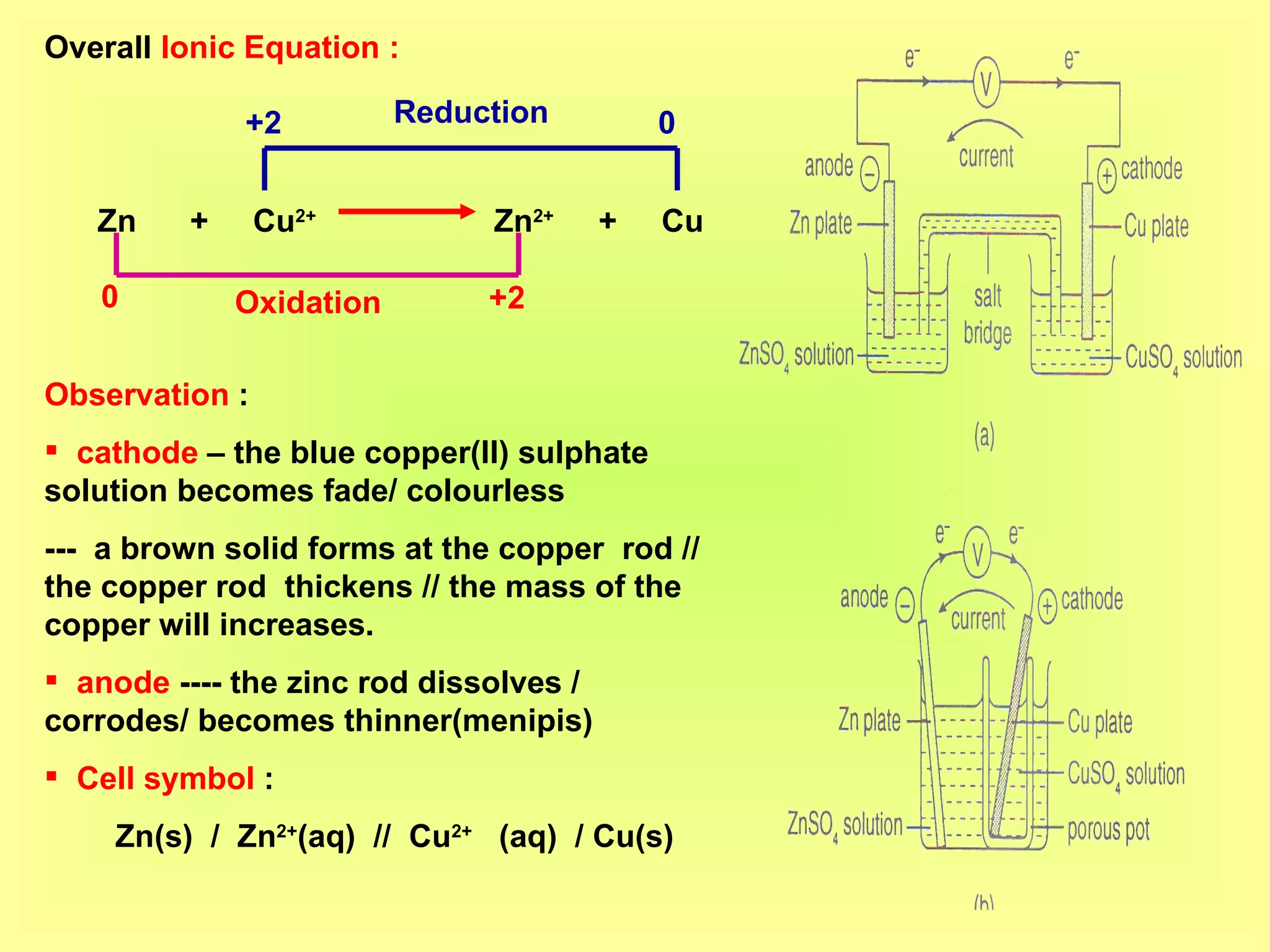
Redox Reaction in a simple voltaic cells The  porous pot  ( pasu berliang) --- to separate the two solutions but allows the ions to flow through it to complete circuit . the transfer of electrons occur from  reducing agent to the oxidising agent  through an outer circuit . The negative electrode (  anode )  -----  metal which is  more  electropositive in the E.S. The positive electrode (  cathode )  ----- metal which is  less  electropositive in the E. S. electron  flows  from the negative electrode to the positive electrode . two types of Daniell cell that uses a porous pot :
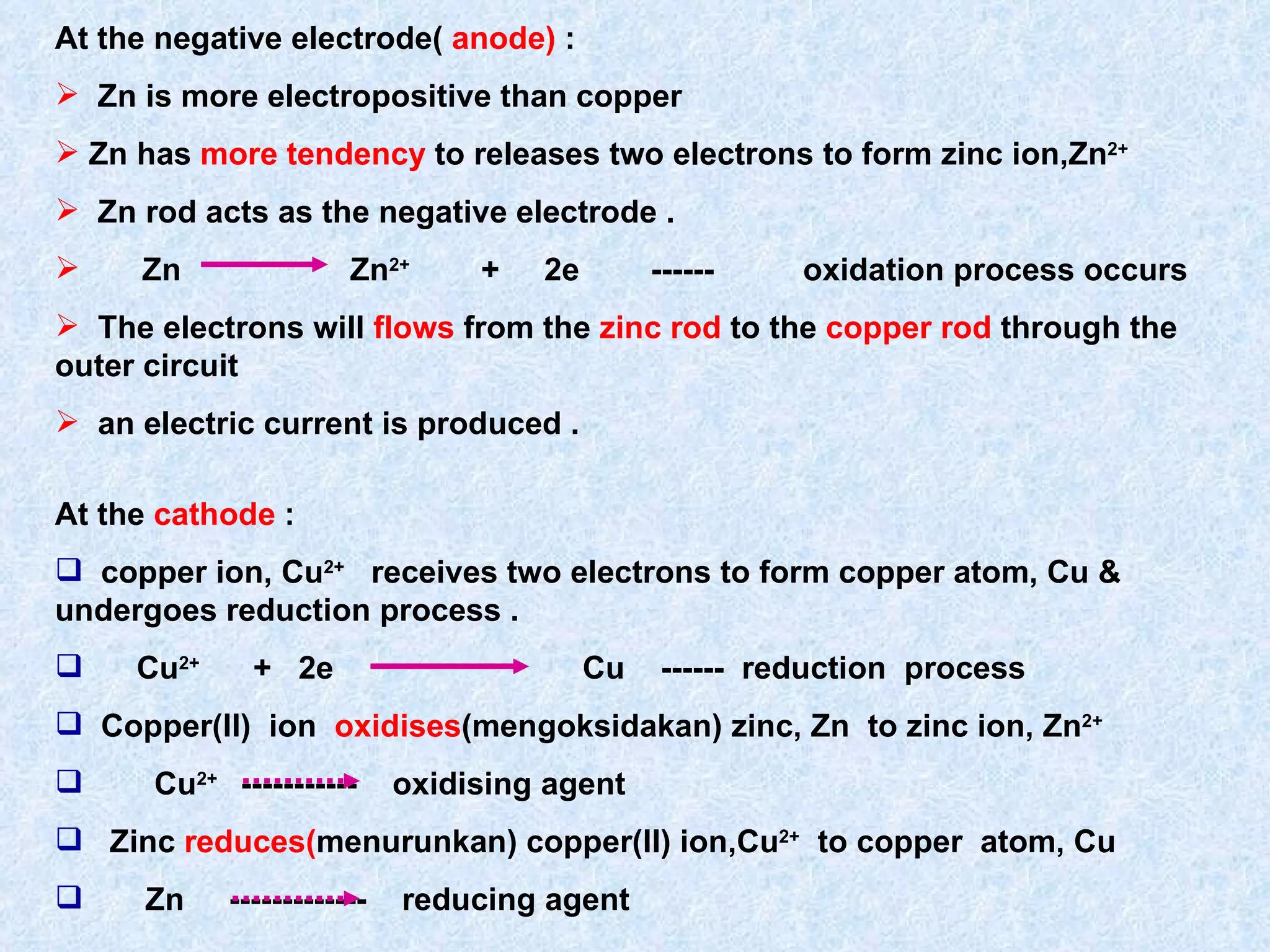
At the negative electrode(  anode)  : Zn is more electropositive than copper  Zn has  more tendency  to releases two electrons to form zinc ion,Zn 2+ Zn rod acts as the negative electrode . Zn  Zn 2+   +  2e  ------  oxidation process occurs  The electrons will  flows  from the  zinc rod  to the  copper rod  through the outer circuit  an electric current is produced . At the  cathode  : copper ion, Cu 2+   receives two electrons to form copper atom, Cu & undergoes reduction process . Cu 2+   +  2e  Cu  ------  reduction  process  Copper(II)  ion  oxidises (mengoksidakan) zinc, Zn  to zinc ion, Zn 2+   Cu 2+  -----------  oxidising agent  Zinc  reduces( menurunkan) copper(II) ion,Cu 2+   to copper  atom, Cu Zn  -------------  reducing agent
Overall  Ionic Equation : Zn  +  Cu 2+   Zn 2+   +  Cu Observation  :  cathode  – the blue copper(II) sulphate solution becomes fade/ colourless  ---  a brown solid forms at the copper  rod // the copper rod  thickens // the mass of the copper will increases. anode  ---- the zinc rod dissolves / corrodes/ becomes thinner(menipis) Cell symbol  : Zn(s)  /  Zn 2+ (aq)  //  Cu 2+   (aq)  / Cu(s) 0 +2 +2 0 Oxidation  Reduction
 
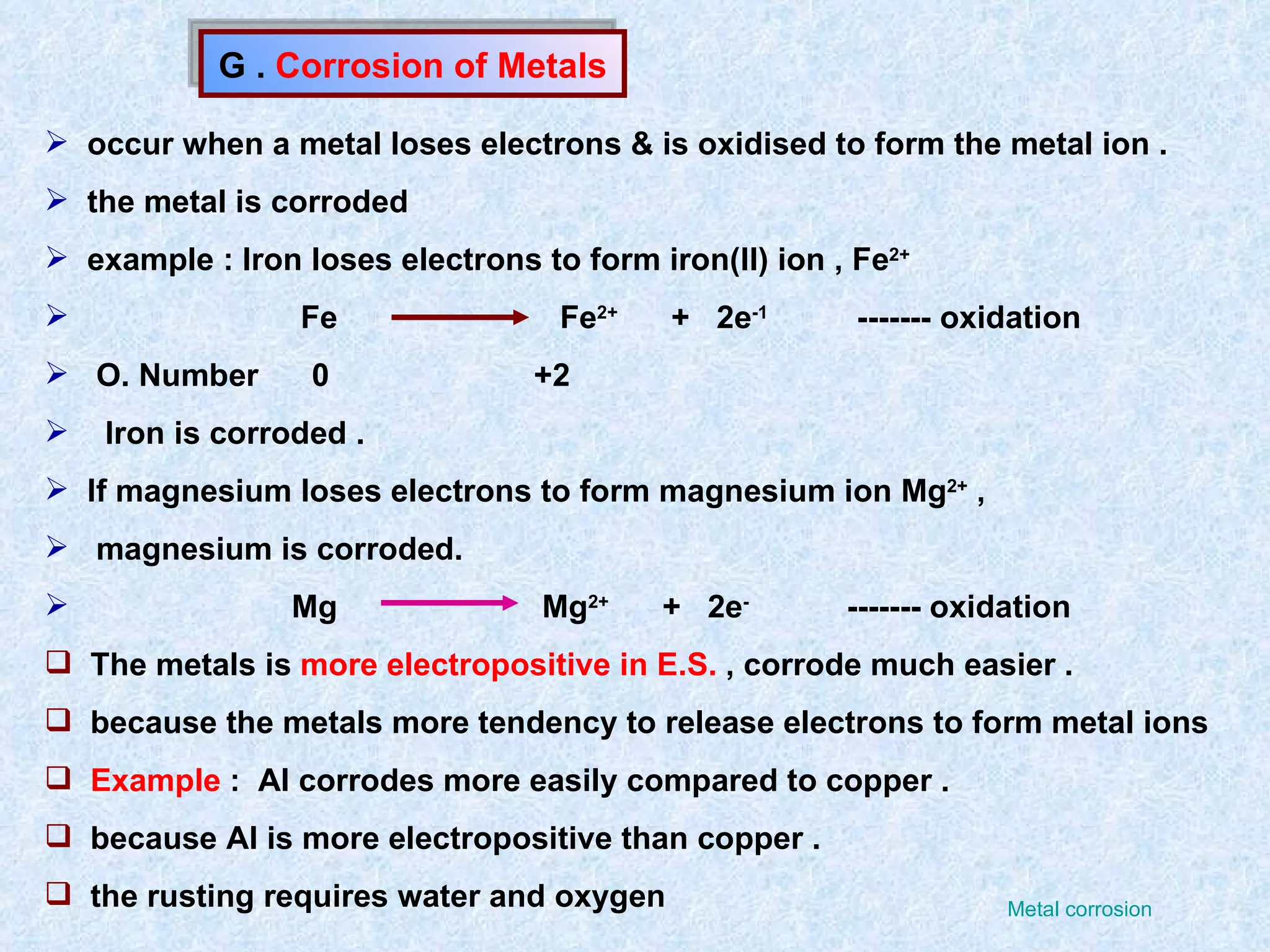
G .  Corrosion of Metals occur when a metal loses electrons & is oxidised to form the metal ion . the metal is corroded example : Iron loses electrons to form iron(II) ion , Fe 2+   Fe  Fe 2+   +  2e -1   ------- oxidation O. Number  0  +2 Iron is corroded . If magnesium loses electrons to form magnesium ion Mg 2+  ,  magnesium is corroded. Mg  Mg 2+   +  2e -   ------- oxidation The metals is  more electropositive in E.S.  , corrode much easier . because the metals more tendency to release electrons to form metal ions  Example  :  Al corrodes more easily compared to copper . because Al is more electropositive than copper . the rusting requires water and oxygen  Metal corrosion
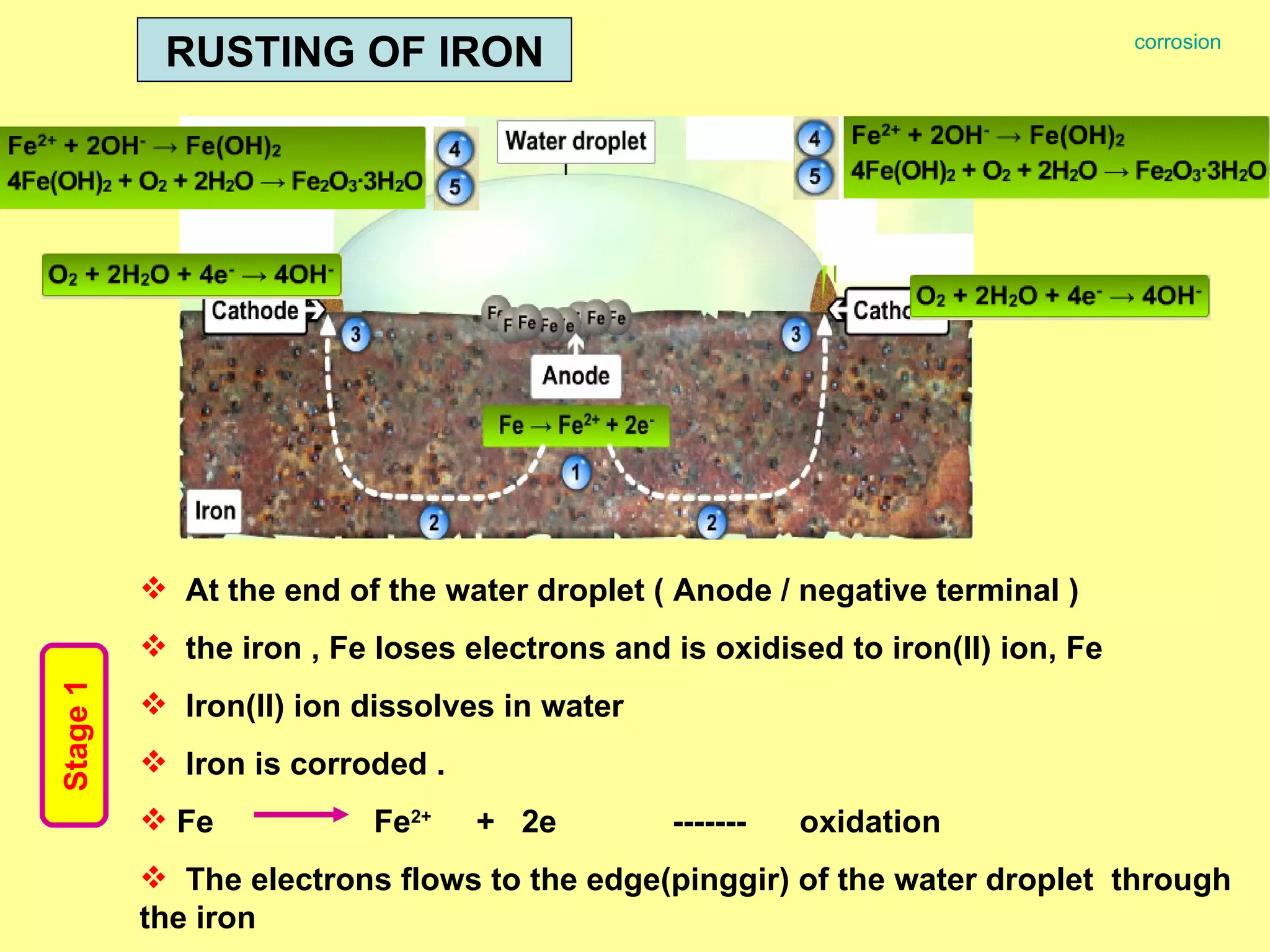
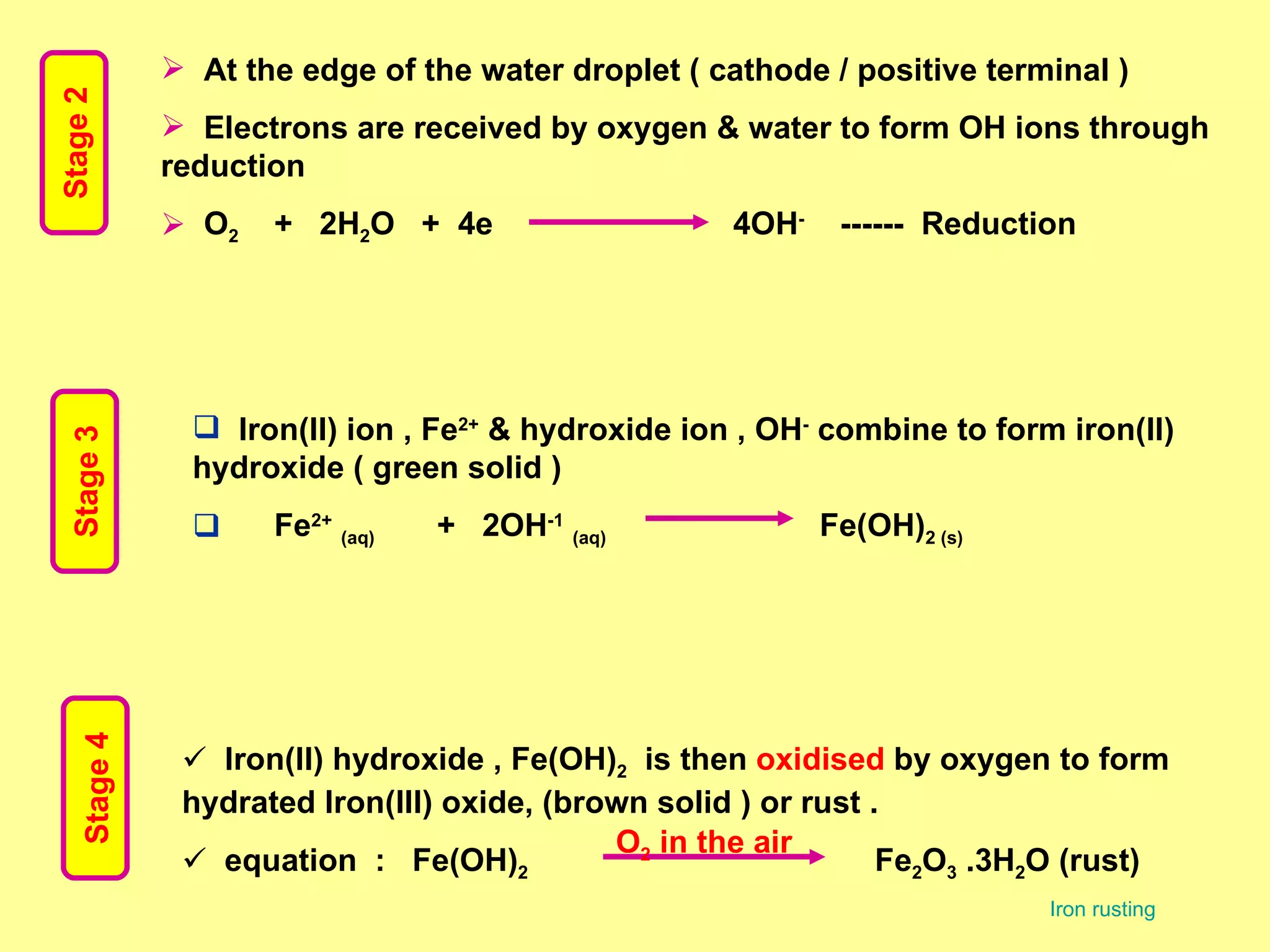
RUSTING OF IRON At the end of the water droplet ( Anode / negative terminal ) the iron , Fe loses electrons and is oxidised to iron(II) ion, Fe  Iron(II) ion dissolves in water Iron is corroded . Fe  Fe 2+   +  2e  -------  oxidation  The electrons flows to the edge(pinggir) of the water droplet  through the iron  Stage 1 corrosion
Iron(II) hydroxide , Fe(OH) 2   is then  oxidised  by oxygen to form hydrated Iron(III) oxide, (brown solid ) or rust . equation  :  Fe(OH) 2   Fe 2 O 3  .3H 2 O (rust) O 2  in the air   Stage 4 Iron(II) ion , Fe 2+  & hydroxide ion , OH -  combine to form iron(II) hydroxide ( green solid ) Fe 2+   (aq)   +  2OH -1   (aq)   Fe(OH) 2 (s) Stage 3 At the edge of the water droplet ( cathode / positive terminal ) Electrons are received by oxygen & water to form OH ions through reduction  O 2   +  2H 2 O  +  4e  4OH -   ------  Reduction Stage 2 Iron rusting
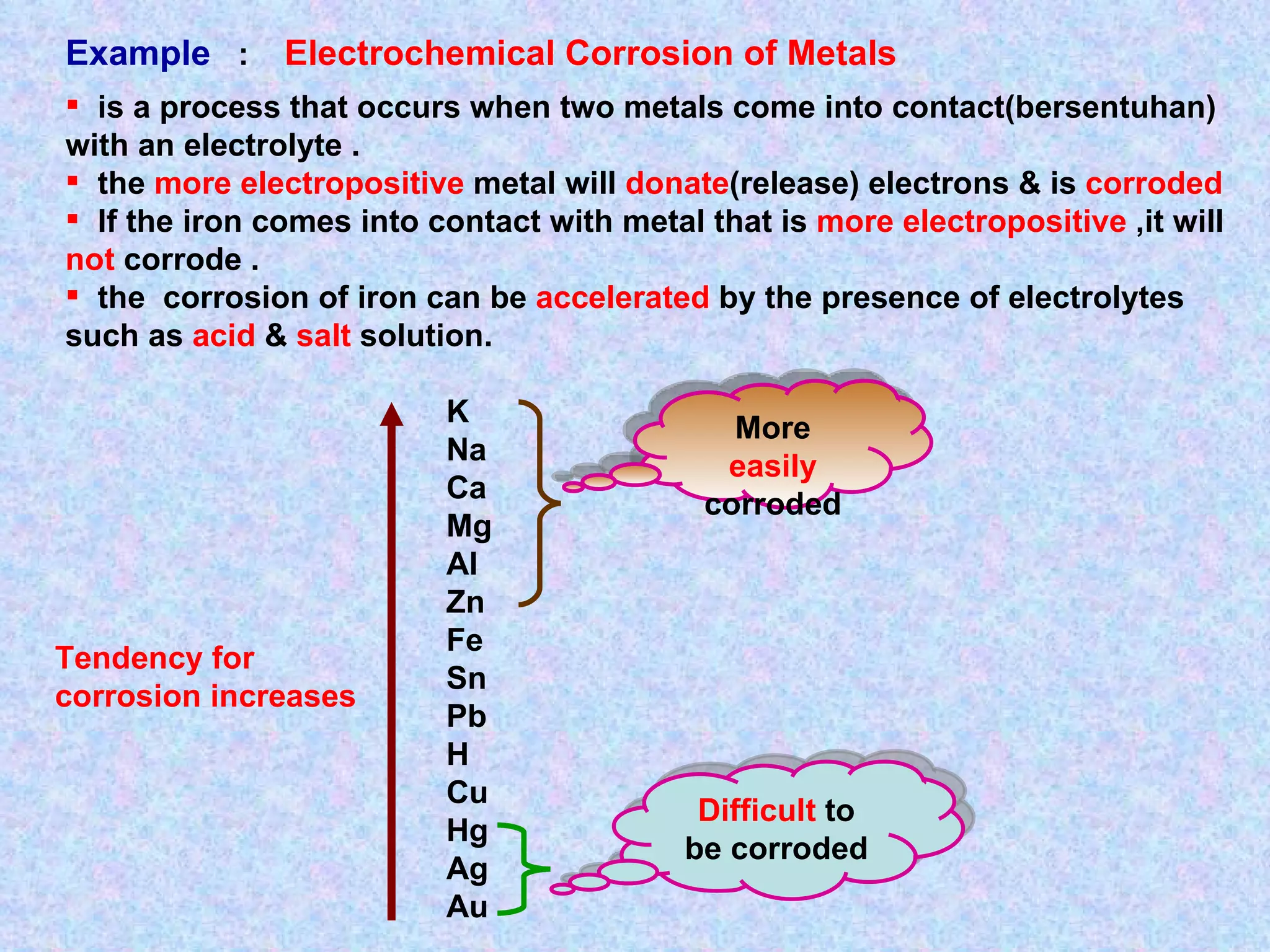
is a process that occurs when two metals come into contact(bersentuhan) with an electrolyte . the  more electropositive  metal will  donate (release) electrons & is  corroded If the iron comes into contact with metal that is  more electropositive  ,it will  not  corrode . the  corrosion of iron can be  accelerated  by the presence of electrolytes such as  acid  &  salt  solution. K Na Ca Mg Al  Zn Fe Sn Pb H Cu Hg Ag Au Example  :  Electrochemical Corrosion of Metals More  easily  corroded Difficult  to be corroded Tendency for corrosion increases
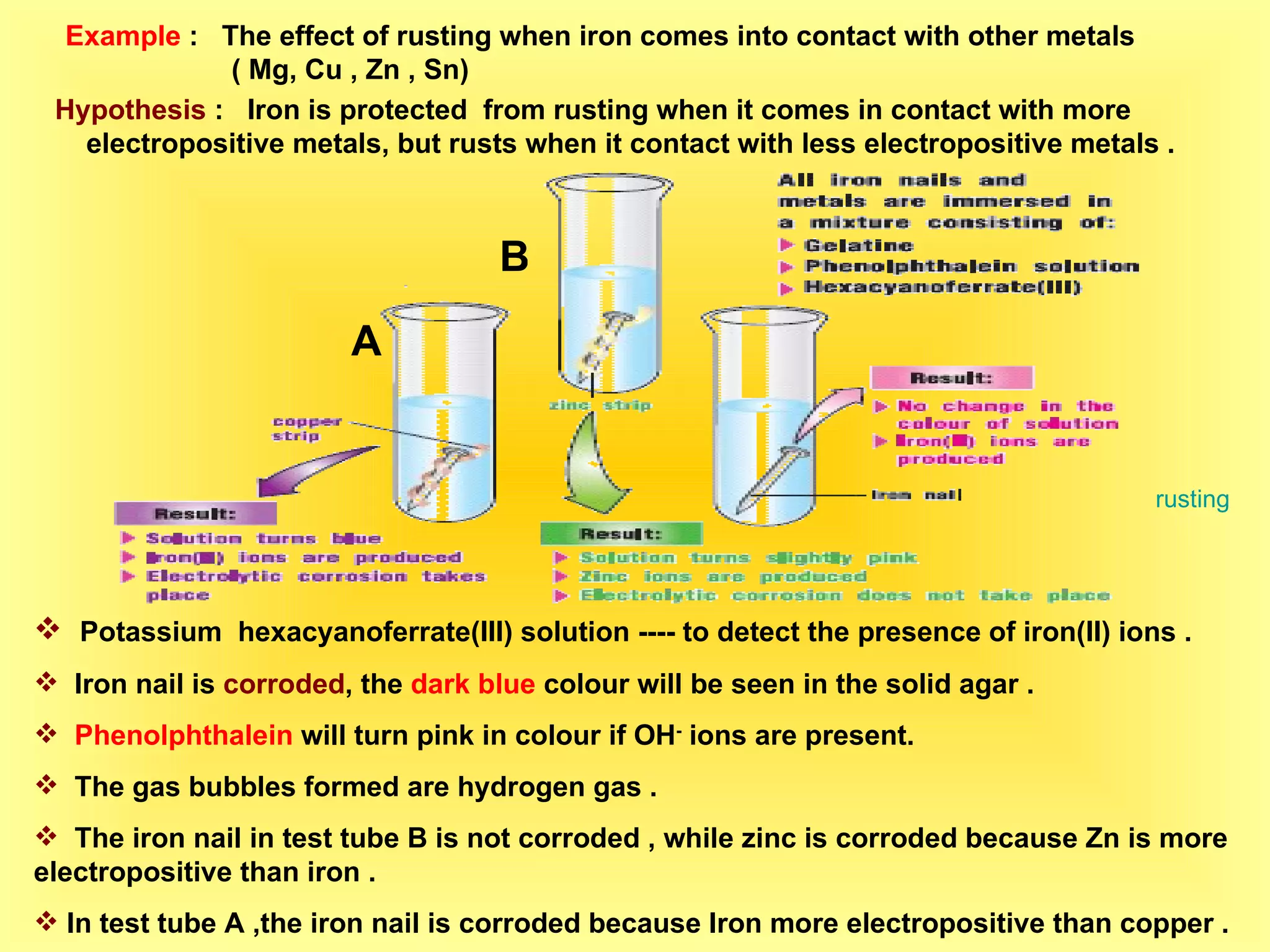
Example  :  The effect of rusting when iron comes into contact with other metals    ( Mg, Cu , Zn , Sn) Hypothesis  :  Iron is protected  from rusting when it comes in contact with more    electropositive metals, but rusts when it contact with less electropositive metals .  Potassium  hexacyanoferrate(III) solution ---- to detect the presence of iron(II) ions . Iron nail is  corroded , the  dark blue  colour will be seen in the solid agar . Phenolphthalein  will turn pink in colour if OH -  ions are present. The gas bubbles formed are hydrogen gas . The iron nail in test tube B is not corroded , while zinc is corroded because Zn is more electropositive than iron . In test tube A ,the iron nail is corroded because Iron more electropositive than copper . B A rusting
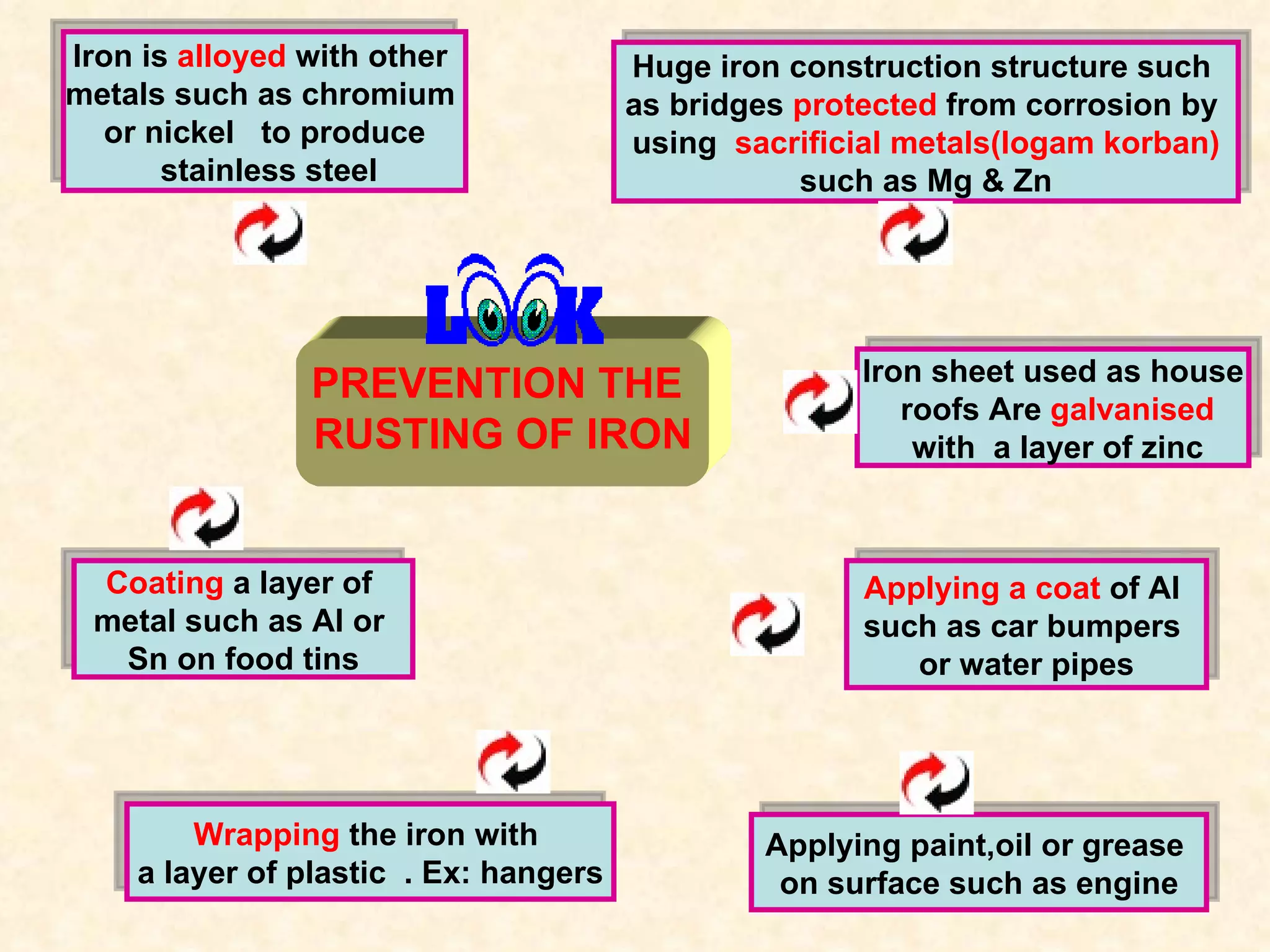
PREVENTION THE  RUSTING OF IRON Coating  a layer of  metal such as Al or  Sn on food tins Applying paint,oil or grease  on surface such as engine Wrapping  the iron with  a layer of plastic  . Ex: hangers Applying a coat  of Al  such as car bumpers  or water pipes Iron sheet used as house roofs Are  galvanised with  a layer of zinc Iron is  alloyed  with other  metals such as chromium  or nickel  to produce stainless steel Huge iron construction structure such  as bridges  protected  from corrosion by  using  sacrificial metals(logam korban) such as Mg & Zn
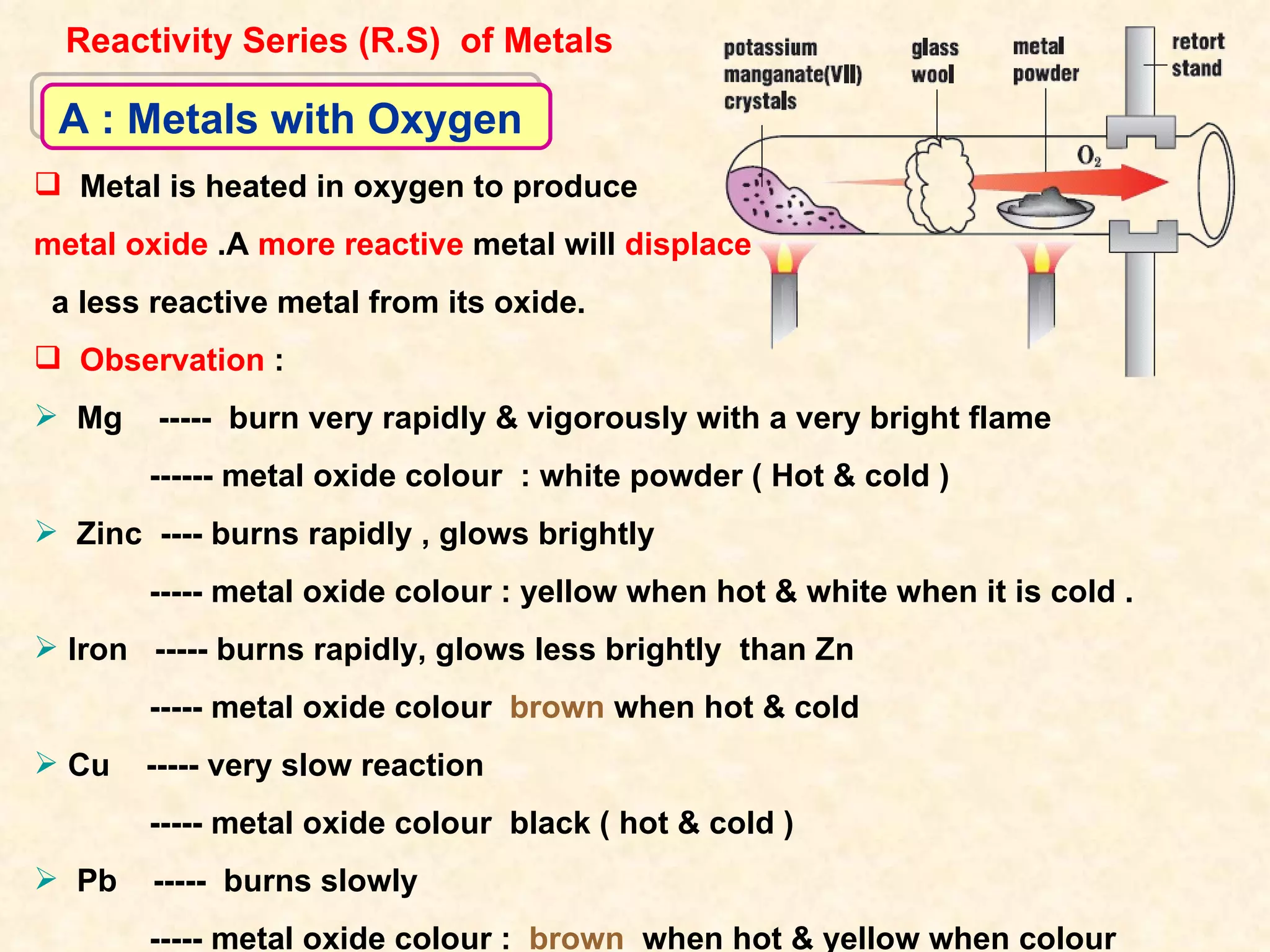
Reactivity Series (R.S)  of Metals  A : Metals with Oxygen  Metal is heated in oxygen to produce  metal oxide  .A  more reactive  metal will  displace a less reactive metal from its oxide. Observation  : Mg  -----  burn very rapidly & vigorously with a very bright flame ------ metal oxide colour  : white powder ( Hot & cold ) Zinc  ---- burns rapidly , glows brightly  ----- metal oxide colour : yellow when hot & white when it is cold . Iron  ----- burns rapidly, glows less brightly  than Zn  ----- metal oxide colour  brown  when hot & cold Cu  ----- very slow reaction ----- metal oxide colour  black ( hot & cold ) Pb  -----  burns slowly  ----- metal oxide colour :  brown  when hot & yellow when colour
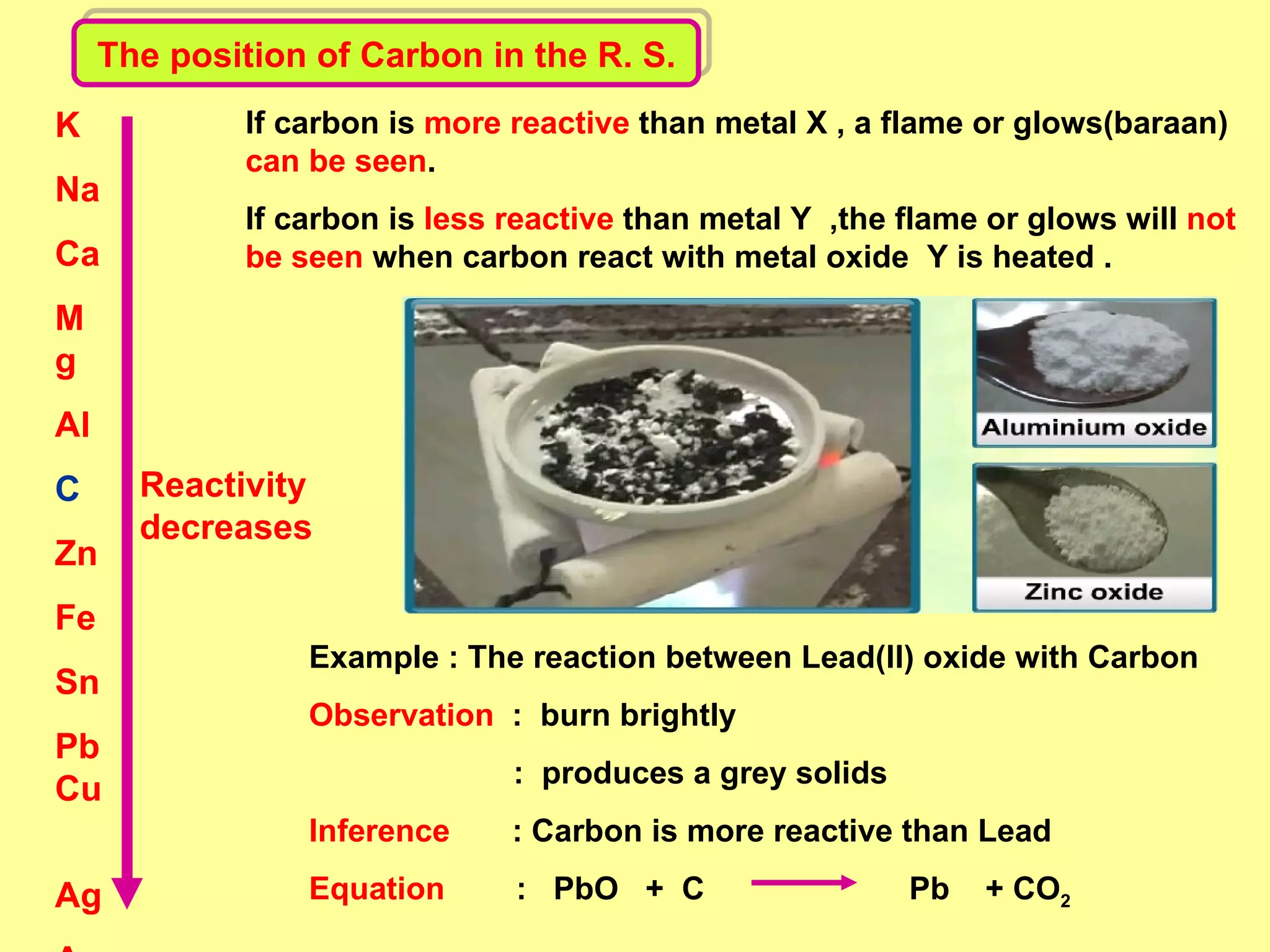
K Na Ca Mg Al C Zn Fe Sn Pb Cu  Ag Au  Reactivity decreases Example : The reaction between Lead(II) oxide with Carbon Observation   :  burn brightly  :  produces a grey solids  Inference   : Carbon is more reactive than Lead  Equation  :  PbO  +  C  Pb  + CO 2 If carbon is  more reactive  than metal X , a flame or glows(baraan)  can be seen . If carbon is  less reactive  than metal Y  ,the flame or glows will  not be seen  when carbon react with metal oxide  Y is heated . The position of Carbon in the R. S.
 
PREPARED BY PN ZAINAB BINTI AYUB 22 JULY 2008

Oxidation & reduction

  • 1.
    Mg 2+ O2- KMnO 4
  • 2.
    Redox reactions are a chemical reactions involving simultaneously (serentak) oxidation and reduction processes Oxidation & reduction : a addition (gain) or loss (elimination) of oxygen or hydrogen accepting(receives) or donating of electrons change in oxidation number A Redox Reactions : Oxidation is the process of gaining oxygen & elimination of hydrogen reduction is the process of losing oxygen & addition of hydrogen oxidising agent is the substance which experiences reduction & receives electrons . reducing agent is the substance which experiences oxidation & donates electrons .
  • 3.
    PbO – oxidising agent (experiences reduction Mg – reducing agent ( experiences oxidation) Mg + PbO MgO + Pb Gain of oxygen ---- oxidation Loss of oxygen ---- reduction
  • 4.
    Cl 2 – oxidising agent ( undergoes reduction ) --- chlorine oxidises hydrogen sulphide to sulphur H 2 S – reducing agent ( undergoes oxidation) --- hydrogen sulphide reduces chlorine to hydrogen chloride Redox reaction H 2 S + Cl 2 2HCl + S Loss of hydrogen --- oxidation Gain of hydrogen --- reduction
  • 5.
    B Transferof Electrons oxidation involves the loss (releases) of electrons reduction involves a gain ( receives) in electrons Chlorine – oxidising agent Sodium – reducing agent metals are oxidised & its loss their electrons to form cations non- metal are reduced & its receive electrons to form anions . 2Na(s) + Cl 2 (g) 2NaCl(s) Na Na + + e ( loss of electron) Cl 2 + 2e - 2Cl - ( gain of electron) Oxidation Process Reduction Process
  • 6.
  • 7.
    Solution : Determine the oxidation and reduction process , oxidising and reducing agent that occurs in the reactions below . Mg + PbO MgO + Pb Anode : Cu Cu 2+ + 2e - ; Cu 2+ + 2e - Cu 2CuO + C 2Cu + CO 2 Fe 2 O 3 + 3C 2Fe + 3CO Mg + CuO MgO + Cu
  • 8.
    oxidation is the increase in oxidation number reduction is the decrease in the oxidation number O.N of ions is same value to the charge of the ion. Ex : Na + , K + , H + is +1 Mg 2+ , Ca +2 is +2 O 2- , S 2- is -2 O.N for atom or molecule in a neutral elements are zero ( 0 ) example : O 2 , N 2 , Na , Mg, Br 2 is 0 . O.N Reducing agent --- iron (II) chloride Oxidising agent --- chlorine gas C : Change in Oxidation Number ( O.N ) 2FeCl 2 + Cl 2 2FeCl 3 Oxidation number decreases (0 -> -1) Oxidation number increases ( +2 -> +3) reduction oxidation +2 +3 -1 0 -1
  • 9.
    (i) The total oxidation number of all the atoms is equal to the charge on the ion . (ii) the total oxidation numbers for all atoms in neutral compound is zero . Example : (i) ClO 3 - , oxidation number of chlorine is X X + 3(-2) = -1 X - 6 = -1 X = +5 (ii) The oxidation number of S in MgSO 4 +2 + X + 4 (-2) = 0 +2 + X - 8 = 0 X = + 6 the total oxidation number for dichromate (VI) ion, Cr 2 O 7 2- is -2 , manganate (VII) , MnO 4 -1 is -1 The charge of chlorate Oxidation number of S
  • 10.
    Test Yourself : Calculate the oxidation number of the following elements : Manganese , Mn in potassium manganate (VII) , KMnO 4 Manganese, Mn in manganate(VII) ion, MnO 4 - Chromium, Cr, in potassium dichromate(VI), K 2 Cr 2 O 7 Cromium, Cr,in chromate(VI) ion, CrO 4 2- Iron in iron(II) chloride , FeCl 2 Iron in iron(III) chloride , FeCl 3 Carbon , C in sodium carbonate, Na 2 CO 3 In each of the cases above, the oxidation number of each element is represented by the value of X .
  • 11.
    The oxidisingagent is the substance that receives electrons experiences a reduction(pengurangan) in the oxidation number . The reducing agent is the substance that : loses electrons experiences an increase (penambahan) in the oxidation number . Example : Fe 2+ Fe 3+ + e - (O.N ) +2 +3 Br 2 + 2e - 2Br - (O.N) 0 -1 Make sure that you add the electron on the side of the half equation that has the bigger oxidation number
  • 12.
    Redox reactions need to shown in the form of : half - equations ionic equations Fe 2+ Fe 3+ Cl - Cl 2 Br - I - Br 2 Green solution Brown solution Yellow solution Colourless solution MnO 4 - Purple solution Cr 2 O 7 2- Cu 2+ Orange solution Blue solution Cr 3+ I 2 Example : Half equation : Fe 2+ Fe 3+ + e - -------- (1) X 2 Br 2 + 2e - 2Br - -------- (2) Ionic equation : 2Fe 2+ + Br 2 2Fe 3+ + 2Br - Combined
  • 13.
    A . Redox Reaction ( The combustion of Magnesium in oxygen) Oxygen oxidises magnesium to magnesium ion . Magnesium releases electrons to form Magnesium ion . Half –equation : Mg Mg 2+ + 2e - ------------(1) O.Number 0 +2 (oxidation) Magnesium reduces oxygen to oxide ion . Oxygen atom receives electrons to form oxide ion . Half- equation : O 2 + 2e - O 2- ------------(2) O.Number 0 -2 (reduction ) The overall equation : (1) + (2) 2Mg + O 2 2MgO Observation :- Combusts with a white shiny flame A white solid is formed Oxidising agent : Oxygen Reducing agent : Magnesium combined Reactants
  • 14.
    Bromine water oxidises iron(II) ion , Fe 2+ to iron(III) ion , Fe 3+ Iron(II) ion releases electron to form iron(III) ion. Half-equation : Fe 2+ Fe 3+ + e - ------------(1)X 2 O. Number +2 +3 ( oxidation) Iron(II) ion reduces bromine ,Br 2 to bromide ion , Br - Bromine receives electron to form bromide ion , Br -1 Half-equation : Br 2 + 2e - 2Br - ------------(2) O.Number 0 -1 ( reduction ) Observation : The green iron(II) sulphate solution changes to brown . The brown coloured bromine water is decolourised . Oxidising agent : Bromine water , Br 2 Reducing agent : Iron(II) ion, Fe 2+ Ionic Equation : 2 Fe 2+ + Br 2 2Fe 3+ + 2Br - other oxidising agent : Cl 2 ,KMnO 4 ,K 2 Cr 2 O 7 ,HNO 3 concentrated,H 2 O 2 Combined B. The change of iron(II) ions to iron(III) ions ( Fe 2+ Fe 3+ )
  • 15.
    C : The change of iron(III) ion, Fe 3+ to iron(II) ion , Fe 2+ Iron (III) ion oxidises Zn atom to zinc ion , Zn 2+ Iron(III) ion receives electron to form iron(II) ion The brown iron(III) chloride solution changes to green . Half-equation : Fe 3+ + e - Fe 2+ --------(1) X 2 O.Number +3 +2 ( Reduction) Iron(III) ion -------- oxidising agent ( oxidation number decrease ) . Zn reduces iron(III) ion to iron(II) ion . Zinc atom releases electrons to form zinc ion , Zn Zinc powder dissolves . Zinc metal -------- reducing agent ( oxidation number increase ) Half-equation : Zn Zn 2+ + 2e - -------(2) O. Number 0 +2 ( oxidation ) The ionic equation : 2Fe 3+ + Zn 2Fe 2+ + Zn 2+ Other reducing agent : metals that are more electropositive than iron // SO 2 , H 2 S gas // Na 2 SO 3 , SnCl 2 solution combined
  • 16.
    D : The Displacement (penyesaran) of Metal from its Salt Solution The element is more electropositive in the E.S, the higher the tendency (kecenderungan) to release electrons to form positive ions . More electropositive , oxidised more easily & act as a reducing agent The higher the position in the E.S. can displace other elements that are lower in the E.S . The displacement reaction between Zn & CuSO 4 solution . Zn more electropositive than copper . Zn releases two electron to form zinc ion , Zn 2+ Zn reduces copper(II) ion ,Cu 2+ to copper , Cu Copper(II) ion oxidises Zn to zinc ion ,Zn 2+ K, Na , Ca , Mg , Al , Zn , Fe , Sn , Pb , H , Cu , Hg , Ag , Au Most electropositive Least electropositive
  • 17.
    Observation : The blue CuSO 4 solution fades or becomes colourless . A brown solid is formed . The Zn piece is corroded or dissolves . Copper is displaced by zinc from the copper(II) sulphate solution . Half-equations : Zn Zn 2+ + 2e - ----------(1) O . Number 0 +2 ( oxidation ) Cu 2+ + 2e Cu ----------(2) O. Number +2 0 ( reduction ) Ionic equation : Zn + Cu 2+ Zn 2+ + Cu Zn ------ reducing agent Copper(II) ion ------- oxidising agent Zn loses electrons & is oxidised to Zn 2+ Cu 2+ receives electrons & is reduced to Cu
  • 18.
    E : Displacement of Halogens from Halide Solutions Halogen ----- Group 17 examples : Cl 2 ( chlorine) ------- yellow Br 2 ( bromine) ------- brown I 2 (iodine) ------- yellow or brown can be differentiated by shaking the solution with a little CCl 4 Halogens are reduced to halide ions Halogen ----- oxidising agent The more reactive halogen can displace less reactive halogens from its halide solutions. Group 17 : Flourine Chlorine Bromine Iodine Solution Reactivity decreases, higher act as a oxidising agent
  • 19.
    Example Chlorine waterreact with sodium bromide solution Chlorine water , Cl 2 oxidises bromide ion, Br - to bromine ,Br 2 Bromide ion , reduces chlorine , Cl 2 to chloride ion , Cl - Bromide ion, Br - releases electrons to form bromine ,Br 2 Half-equation : 2Br - Br 2 + 2e - ------ (1) -1 0 oxidation colourless brown Chlorine , Cl 2 receives electrons to form chloride ion , Cl - Half-equation : Cl 2 + 2e - 2Cl - ------- (2) 0 -1 reduction yellow decolourised(colourless) Ionic equation : (1) + (2) Cl 2 + 2Br - Br 2 + 2Cl - Chlorine ----- oxidising agent Bromide ion ----- reducing agent Chlorine displaces bromine from the sodium bromide solution.
  • 20.
    Confirmatory Test forthe Bromine, Chlorine and Iodine By adding and shaking the halogen solution in tetrachloromethane (CCl 4 ) liquid Solution Colour in water Colour in CCl 4 Concentrated Dilute Iodine Brown Yellow Purple Bromine Brown Yellow Brown Chlorine Light greenish yellow Colourless Colourless
  • 21.
    F : Transfer of Electrons at a Distance If two chemicals are separated at a distance by an electrolyte solution in a U-tube acts as a salt bridge . used to separate two solutions but allows ions to pass (flow) through to complete the circuit . examples : H 2 SO 4 , KNO 3 , Na 2 SO 4 solution The electrons that are released from reducing agent (negative electrode) will flow out through outer circuit to the oxidising agent ( positive electrode) reduction oxd
  • 22.
    Example : TheReaction Between Bromine Water and Iron(II) Sulphate solution Iron(II) ion, Fe 2+ releases electron & is oxidised to iron(III) ion , Fe 3+ Fe 2+ Fe 3+ + e -1 ---------- (1) O. Number + 2 +3 ( oxidation) The green solution ,(Fe 2+ ) changes to brown , Fe 3+ The electrons that are released collect at the carbon electrode that is immersed in FeSO 4 It act as the negative terminal . Bromine ,Br 2 receives electron & is reduced to bromide ion, Br -1 Half equation : Br 2 + 2e - 2Br -1 --------------(2) brown colour decolourised O.Number 0 -1 (reduction) the carbon electrode in bromine water act as the positive terminal the ionic equation :- 2Fe 2+ + Br 2 2Fe 3+ + 2Br -1 O. Number +2 0 +3 -1
  • 23.
    oxidising agent ----- Bromine water , Br reducing agent ----- Iron (II) ion, Fe The galvanometer needle is deflected because the movement of electrons from the negative electrode to the positive electrode produces an electric current . Reduction Oxidation (Positive terminal) (Negative terminal)
  • 24.
    Test Yourself The figure shows a U-tube redox cell . Write a summary of the redox reaction for the reaction between Iron(II) sulphate, FeSO 4 solution and the acidified potassium manganate (VII) , KMnO 4 solution. Can dilute sulphuric acid be replaced with dilute hydrochloric acid ? Give the reason for your answer .
  • 25.
  • 26.
    Observation : Electrode (-) : The green coloured iron(II) nitrate solution changes to brown Electrode (+) : The purple coloured acidified potassium manganate(VII) solution is decolourised . Half equation : Electrode (-) : Fe 2+ Fe 3+ + e - ----------- ( oxidation) Electrode (+) : MnO 4 - + 8H + + 5e - Mn 2+ + 4H 2 O (reduction) Ionic Equation : 5Fe 2 + MnO 4 - + 8H + Fe 3+ + Mn 2+ + 4H 2 O Oxidising agent : manganate(VII) ion Reducing agent : Iron (II) ion . Confirmatory test for the product( Fe ) that is formed. Add sodium hydroxide solution, a brown precipitate is formed . (b) Can . Hydrochloric acid also allows the transfer of ions to occur . Solution :
  • 27.
    Redox Reaction ina simple voltaic cells The porous pot ( pasu berliang) --- to separate the two solutions but allows the ions to flow through it to complete circuit . the transfer of electrons occur from reducing agent to the oxidising agent through an outer circuit . The negative electrode ( anode ) ----- metal which is more electropositive in the E.S. The positive electrode ( cathode ) ----- metal which is less electropositive in the E. S. electron flows from the negative electrode to the positive electrode . two types of Daniell cell that uses a porous pot :
  • 28.
    At the negativeelectrode( anode) : Zn is more electropositive than copper Zn has more tendency to releases two electrons to form zinc ion,Zn 2+ Zn rod acts as the negative electrode . Zn Zn 2+ + 2e ------ oxidation process occurs The electrons will flows from the zinc rod to the copper rod through the outer circuit an electric current is produced . At the cathode : copper ion, Cu 2+ receives two electrons to form copper atom, Cu & undergoes reduction process . Cu 2+ + 2e Cu ------ reduction process Copper(II) ion oxidises (mengoksidakan) zinc, Zn to zinc ion, Zn 2+ Cu 2+ ----------- oxidising agent Zinc reduces( menurunkan) copper(II) ion,Cu 2+ to copper atom, Cu Zn ------------- reducing agent
  • 29.
    Overall IonicEquation : Zn + Cu 2+ Zn 2+ + Cu Observation : cathode – the blue copper(II) sulphate solution becomes fade/ colourless --- a brown solid forms at the copper rod // the copper rod thickens // the mass of the copper will increases. anode ---- the zinc rod dissolves / corrodes/ becomes thinner(menipis) Cell symbol : Zn(s) / Zn 2+ (aq) // Cu 2+ (aq) / Cu(s) 0 +2 +2 0 Oxidation Reduction
  • 30.
  • 31.
    G . Corrosion of Metals occur when a metal loses electrons & is oxidised to form the metal ion . the metal is corroded example : Iron loses electrons to form iron(II) ion , Fe 2+ Fe Fe 2+ + 2e -1 ------- oxidation O. Number 0 +2 Iron is corroded . If magnesium loses electrons to form magnesium ion Mg 2+ , magnesium is corroded. Mg Mg 2+ + 2e - ------- oxidation The metals is more electropositive in E.S. , corrode much easier . because the metals more tendency to release electrons to form metal ions Example : Al corrodes more easily compared to copper . because Al is more electropositive than copper . the rusting requires water and oxygen Metal corrosion
  • 32.
    RUSTING OF IRONAt the end of the water droplet ( Anode / negative terminal ) the iron , Fe loses electrons and is oxidised to iron(II) ion, Fe Iron(II) ion dissolves in water Iron is corroded . Fe Fe 2+ + 2e ------- oxidation The electrons flows to the edge(pinggir) of the water droplet through the iron Stage 1 corrosion
  • 33.
    Iron(II) hydroxide ,Fe(OH) 2 is then oxidised by oxygen to form hydrated Iron(III) oxide, (brown solid ) or rust . equation : Fe(OH) 2 Fe 2 O 3 .3H 2 O (rust) O 2 in the air Stage 4 Iron(II) ion , Fe 2+ & hydroxide ion , OH - combine to form iron(II) hydroxide ( green solid ) Fe 2+ (aq) + 2OH -1 (aq) Fe(OH) 2 (s) Stage 3 At the edge of the water droplet ( cathode / positive terminal ) Electrons are received by oxygen & water to form OH ions through reduction O 2 + 2H 2 O + 4e 4OH - ------ Reduction Stage 2 Iron rusting
  • 34.
    is a processthat occurs when two metals come into contact(bersentuhan) with an electrolyte . the more electropositive metal will donate (release) electrons & is corroded If the iron comes into contact with metal that is more electropositive ,it will not corrode . the corrosion of iron can be accelerated by the presence of electrolytes such as acid & salt solution. K Na Ca Mg Al Zn Fe Sn Pb H Cu Hg Ag Au Example : Electrochemical Corrosion of Metals More easily corroded Difficult to be corroded Tendency for corrosion increases
  • 35.
    Example : The effect of rusting when iron comes into contact with other metals ( Mg, Cu , Zn , Sn) Hypothesis : Iron is protected from rusting when it comes in contact with more electropositive metals, but rusts when it contact with less electropositive metals . Potassium hexacyanoferrate(III) solution ---- to detect the presence of iron(II) ions . Iron nail is corroded , the dark blue colour will be seen in the solid agar . Phenolphthalein will turn pink in colour if OH - ions are present. The gas bubbles formed are hydrogen gas . The iron nail in test tube B is not corroded , while zinc is corroded because Zn is more electropositive than iron . In test tube A ,the iron nail is corroded because Iron more electropositive than copper . B A rusting
  • 36.
    PREVENTION THE RUSTING OF IRON Coating a layer of metal such as Al or Sn on food tins Applying paint,oil or grease on surface such as engine Wrapping the iron with a layer of plastic . Ex: hangers Applying a coat of Al such as car bumpers or water pipes Iron sheet used as house roofs Are galvanised with a layer of zinc Iron is alloyed with other metals such as chromium or nickel to produce stainless steel Huge iron construction structure such as bridges protected from corrosion by using sacrificial metals(logam korban) such as Mg & Zn
  • 37.
    Reactivity Series (R.S) of Metals A : Metals with Oxygen Metal is heated in oxygen to produce metal oxide .A more reactive metal will displace a less reactive metal from its oxide. Observation : Mg ----- burn very rapidly & vigorously with a very bright flame ------ metal oxide colour : white powder ( Hot & cold ) Zinc ---- burns rapidly , glows brightly ----- metal oxide colour : yellow when hot & white when it is cold . Iron ----- burns rapidly, glows less brightly than Zn ----- metal oxide colour brown when hot & cold Cu ----- very slow reaction ----- metal oxide colour black ( hot & cold ) Pb ----- burns slowly ----- metal oxide colour : brown when hot & yellow when colour
  • 38.
    K Na CaMg Al C Zn Fe Sn Pb Cu Ag Au Reactivity decreases Example : The reaction between Lead(II) oxide with Carbon Observation : burn brightly : produces a grey solids Inference : Carbon is more reactive than Lead Equation : PbO + C Pb + CO 2 If carbon is more reactive than metal X , a flame or glows(baraan) can be seen . If carbon is less reactive than metal Y ,the flame or glows will not be seen when carbon react with metal oxide Y is heated . The position of Carbon in the R. S.
  • 39.
  • 40.
    PREPARED BY PNZAINAB BINTI AYUB 22 JULY 2008