Pelletization and Granulation
Presenters
Usama Waheed
Ahmed Amdad
Amar Saleem
Hamza khan
 Pelletization is a form of tumble growth
agglomeration, whereby material fines are “grown”
through a tumbling motion and the addition of water
or a binding agent.
 This process is a non-pressure method of
agglomeration, and instead of pressure, uses a binder
(or simply water) to help material adhere to itself
Pelletization
 Faster nutrient delivery: The less dense pellets
created in pelletizing can withstand handling, but can
still quickly break down upon application, an ideal
characteristic for soil amendments, fertilizers, and
other applications that benefit from fast material
breakdown.
 Less dust and fines are produced compared to
compaction: Since pellets are round, there are no
edges to break off and create dust.
Advantages
 Binders can serve as beneficial additives –
Pelletization offers the opportunity to control
formulation, through the addition of specially
formulated binders, in order to create optimum pellet
characteristics
Advantages
 Higher Processing Costs: The use of a binder, and the
required drying step results in higher processing costs
when compared to compaction granulation, though the
pelletization method often requires a lower capital
investment.
 A Skilled Operator is Required: Pelletizing (on a disc
pelletizer) requires a well-trained and skilled operator to
produce a pellet with desired quality and characteristics,
and to keep the process running smoothly
Disadvantages
 Pelletization is used throughout a variety of industries,
with new applications developing all the time. Some of the
most commonly pelletized materials include:
 EAF Dusts
 Chemical Powders
 Limestone
 Gypsum
 Coal
 Fly Ash
 Minerals and Ores
Common Pelletized material in
Industries
 While there are innumerable factors that can affect the
pelletizing process and the resulting end product, the most
common variables include:
 Binder formulation
 Binder feed rate
 Material feed rate
 Pan speed
 Pan angle
 Liquid addition rate and location
Factors affecting Pelletization
 Pelletizing is carried out using either a disc pelletizer
or rotary drum,
 With disc pelletizers being the most common choice,
and drums being more suited to specific applications
such as heap leaching.
Equipments used in pelletization
 Material fines are first conditioned in a pin mixer or
paddle mixer. Not all processes utilize a pre-
conditioning step, but those that do see many
benefits as a result:
 Material feed and binder can be thoroughly mixed
prior to entering the disc pelletizer. This creates a
homogenous mixture and evenly distributes the
binder.
Benefits of mixer in pelletization
 The majority of the moisture required for pellet formation
can be added (in the form of the binder) during mixing, so
it need not be done on the pelletizer, a process which can
be lengthy. In many cases, the use of a mixer prior to the
disc pelletizer often increases production rates because of
this.
 Material that is pre-conditioned is densified through the
motion imparted by the mixer. Because this densification is
achieved through mixing, less binder is required to create
the same densification, resulting in reduced binder cost.
Benefits of mixer in pelletization
 Once material has been conditioned, it moves on to pelletizing. For
processes that do not use a pre-conditioning step, this is where the
process begins. Here, material is fed onto a disc pelletizer at a
continuous rate, where binder is continually added. The material
fines are tacky as a result of the binder, and as they tumble against
themselves while the pan rotates, they pick up more fines, growing
in similar fashion to a snowball.
 Once pellets have reached the desired size, they exit the disc
pelletizer, and are carried via a conveyor belt or steep incline
conveyor to a dryer.
 The dryer “cures” the pellets, removing any moisture, and
“polishing” them into their final form. Drying is commonly carried
out using a rotary dryer, with fluid bed dryers being the alternate
choice.
Process of Pelletization
Process of pelletization
 Raw Feed
 Paddle/Pin Mixer
 Binder Feed
 Spray Rate
 Disc Pelletizer
 Feed Onto Pelletizer
 Binder Feed
 Liquid Spray System
 Transfer Conveyor
 Rotary Dryer
 Vibrating Screen
 Oversize Mill
 Recycle
 Surge Hopper
Process of Pelletization
 Granulation is the process in which powder particles
are made to adhere to form larger particles called
granules for the production of tablets or capsules so a
uniform distribution of all ingredients will be
achieved..
Granulation
 To prevent segregation of the constituents in the
powder mix…
 To improve the flow properties of the mix…
 To improve the compression characteristics of the
mix…
 To increase the uniformity of drug distribution in the
product.
 Other reasons. Reduce toxic dusts, can be used for
hygroscopic & deliquescent powders, reduce air
entrapment, less volume
Reasons Of Granulation
Wet Granulation.
Dry Granulation.
Method of Granulation
 It involves the massing of the powder mix using a solvent.
The solvents used must be volatile, so that they can be
removed by drying and non-toxic.
 solvents include water, ethanol and isopropanol either
alone or in combination.
 solvent may contain dissolved adhesives
 The advantage of water is that it is non flammable also not
expensive and no safety precautions would be required.
 Organic solvents are used when water-sensitive drugs
are processed, as an alternative to dry granulation, or when
a rapid drying time is required.
Wet Granulation
The Disadvantages are:
its long duration.
the need for several pieces of
equipment.
high material losses which can be in
because of the transfer stages.
Advantages are:
the process is not very sensitive to
changes in the characteristics of the
granule ingredients.
the end-point of the massing process can
often be determined by inspection.
Shear Granulator
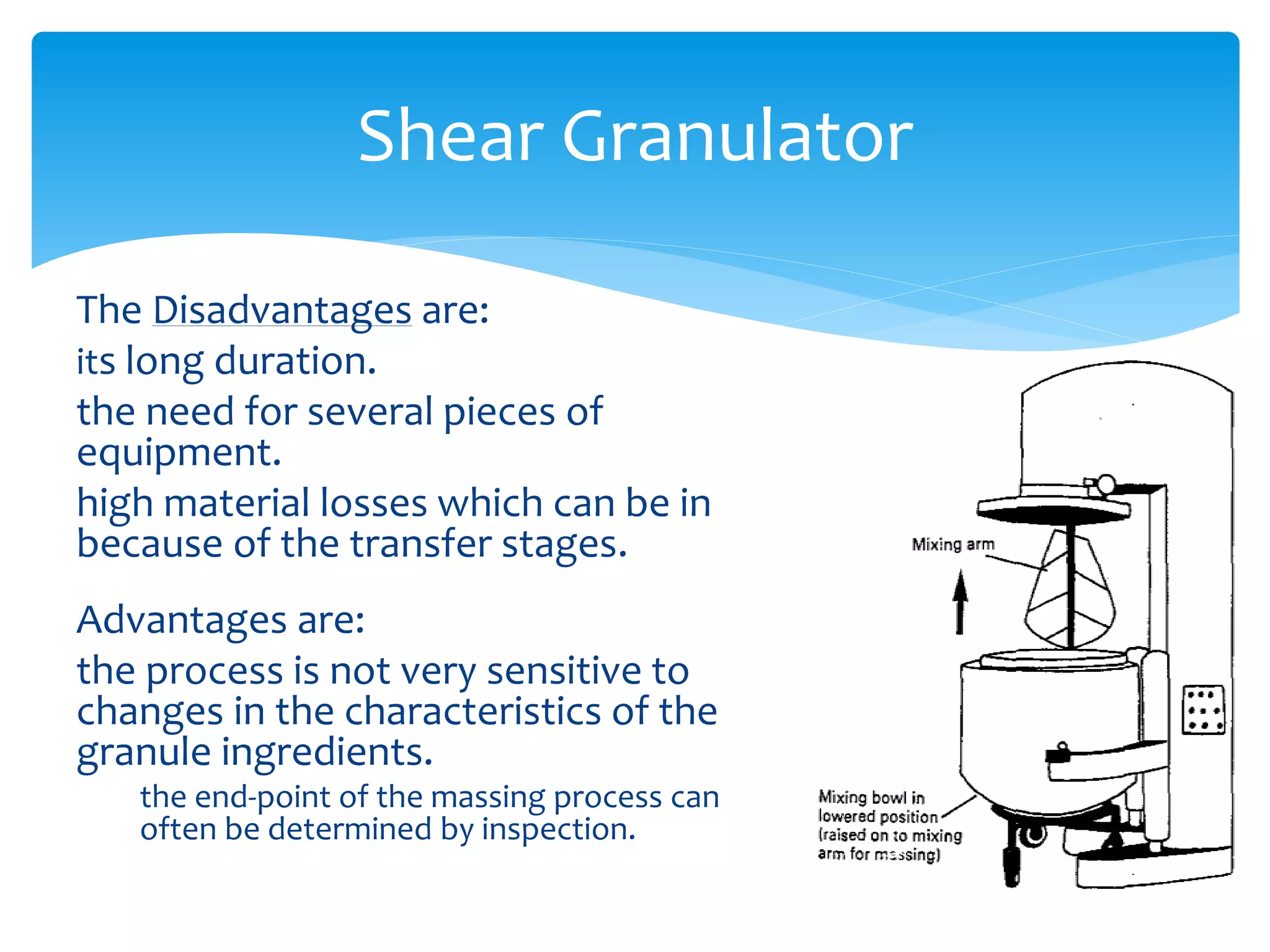
The machines have a stainless steel mixing bowl
containing a three-bladed impeller which revolves
in the horizontal plane and a three-bladed auxiliary
chopper which revolves in the vertical plane.
 Advantage:
1.mixing, massing and granulation are all performed in a short
period in the same piece of equipment.
2.Granulation progresses so rapidly that a usable granule can
be transformed very quickly into an unusable, over-massed
system.
High Speed mixer/Granulator
 Disadvantages:
 it is often necessary to use a
suitable monitoring system to
indicate the end of the granulation
process.
 The process is also sensitive to
variations in raw materials but this
may be minimized by using a
suitable end-point monitor.
High speed mixer/Granulator
 The fluidization of powder particles in a stream of air, is
utilized for granulation in equipment of this type.
 Heated air is blown or sucked through a bed of unmixed
powders to fluidize the particles and mix the powders.
 Granulating liquid is pumped through a spray nozzle over
the particles and this liquid causes them to adhere when
they collide.
 Escape of material from the granulation chamber is
prevented by exhaust filters which are periodically agitated
to reintroduce the collected material into the fluidized bed.
 Sufficient liquid is added to produce granules of the
required size which are then dried in the heated fluidizing air
Stream.
Fluidizied Bed Granulator
 A suspension of drug and excipients in adhesive solution can
be dried in a spray drier.
 The resultant granules are free-flowing hollow spheres and
the distribution of adhesive in such granules results in good
compression properties.
 This process can be used to make tablet granules or when
suitable - granules cannot be produced by the other
methods.
Spray Driers
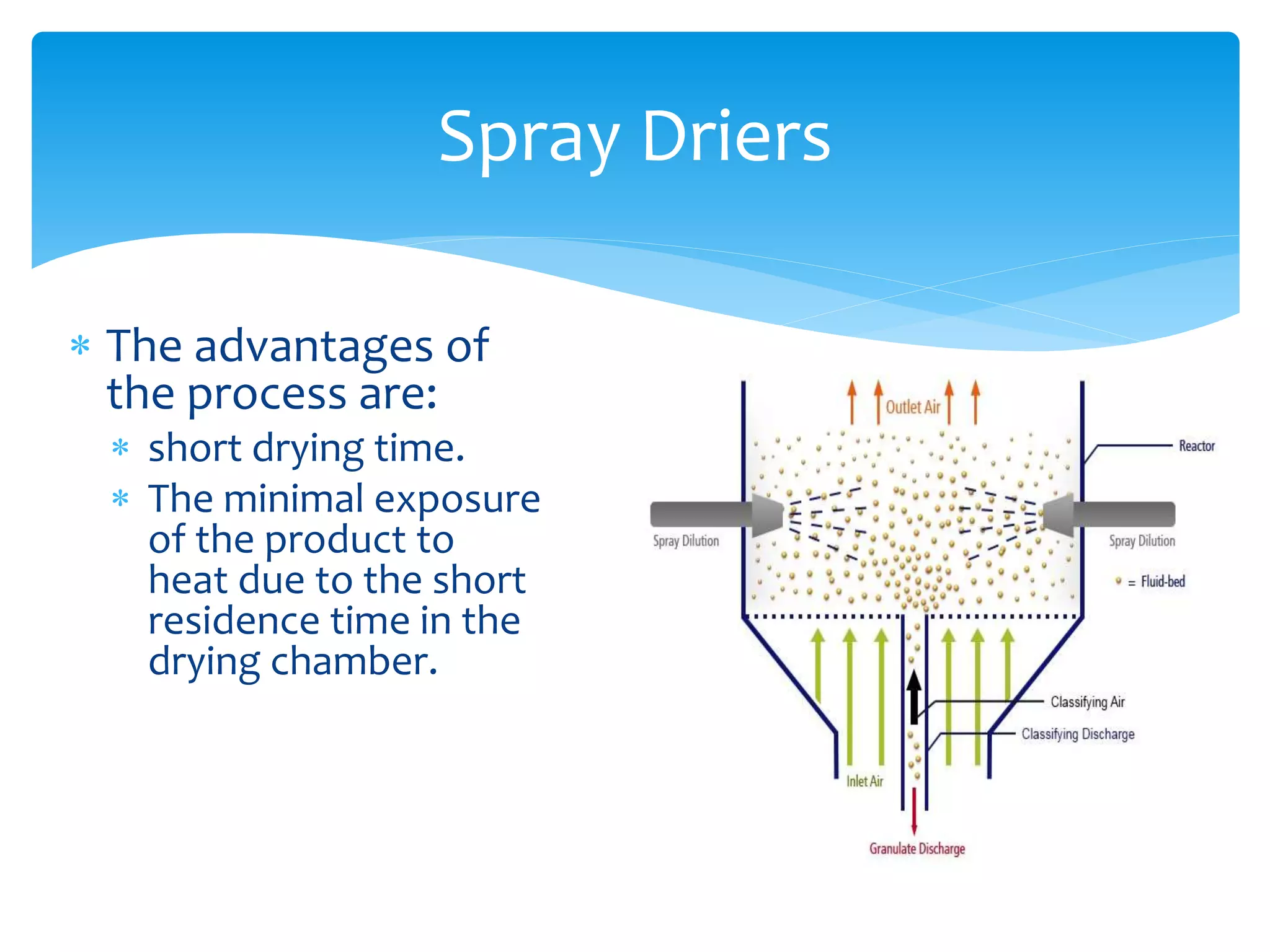
 The advantages of
the process are:
 short drying time.
 The minimal exposure
of the product to
heat due to the short
residence time in the
drying chamber.
Spray Driers
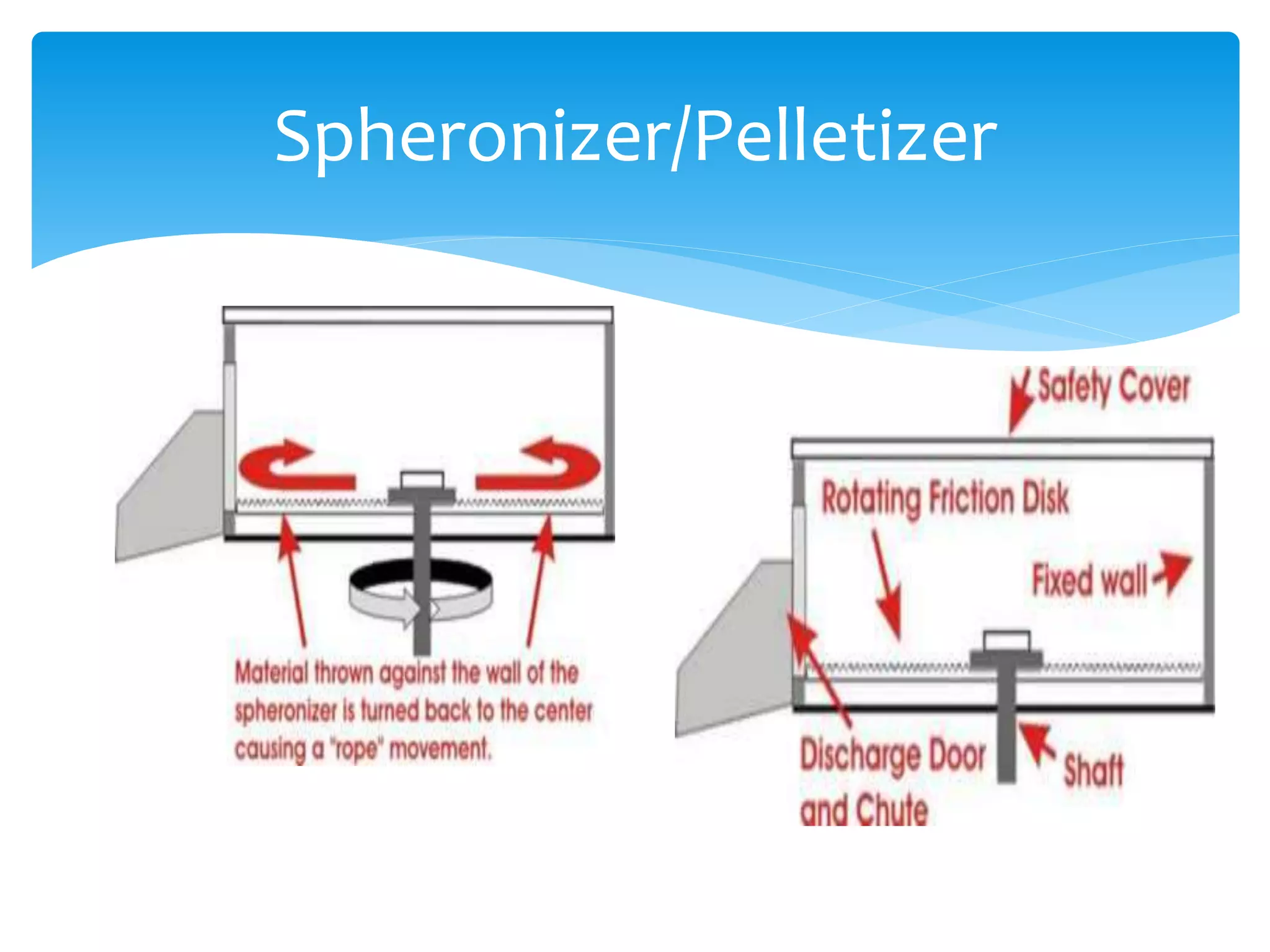
They are used when it is desirable to have a dense,
spherical pellet of the type difficult to produce with
the equipment above.
Using this technique it is possible to coat the pellets
by spraying coating solution on to the rotating pellets
and layered pellets can be produced by using the
pellets as nuclei in a second granulation with a
powder mix of the coating ingredients.
The rotating base plate is a common feature of
spheronizing equipment but some utilize a feed of
pregranulated material which has been massed and
extruded into short strings.
Spheronizer/Pelletizer
 Powder particles are aggregated using high pressure
using 2 processes.
 They are used for liquid sensitive material.
 First machine for processing the dry powders and
second a mill for breaking the compacts.
 Types of Dry granulators:
There are mainly two types
1) Sluggers:
2) Roller compactors:
Dry Granulators
Sluggers:
 The dry powders can be compressed using a tablet
machine or, if higher pressures are required, a
heavy duty rotary press can be used.
 This process is often known as ‘slugging’, the tablet
made in the process being termed a ‘slug’.
Roller compactors:
 the powder mix being fed between rollers to form
a compressed sheet.
Dry Granulators
Pelletization and granulation

Pelletization and granulation

  • 1.
    Pelletization and Granulation Presenters UsamaWaheed Ahmed Amdad Amar Saleem Hamza khan
  • 2.
     Pelletization isa form of tumble growth agglomeration, whereby material fines are “grown” through a tumbling motion and the addition of water or a binding agent.  This process is a non-pressure method of agglomeration, and instead of pressure, uses a binder (or simply water) to help material adhere to itself Pelletization
  • 3.
     Faster nutrientdelivery: The less dense pellets created in pelletizing can withstand handling, but can still quickly break down upon application, an ideal characteristic for soil amendments, fertilizers, and other applications that benefit from fast material breakdown.  Less dust and fines are produced compared to compaction: Since pellets are round, there are no edges to break off and create dust. Advantages
  • 4.
     Binders canserve as beneficial additives – Pelletization offers the opportunity to control formulation, through the addition of specially formulated binders, in order to create optimum pellet characteristics Advantages
  • 5.
     Higher ProcessingCosts: The use of a binder, and the required drying step results in higher processing costs when compared to compaction granulation, though the pelletization method often requires a lower capital investment.  A Skilled Operator is Required: Pelletizing (on a disc pelletizer) requires a well-trained and skilled operator to produce a pellet with desired quality and characteristics, and to keep the process running smoothly Disadvantages
  • 6.
     Pelletization isused throughout a variety of industries, with new applications developing all the time. Some of the most commonly pelletized materials include:  EAF Dusts  Chemical Powders  Limestone  Gypsum  Coal  Fly Ash  Minerals and Ores Common Pelletized material in Industries
  • 7.
     While thereare innumerable factors that can affect the pelletizing process and the resulting end product, the most common variables include:  Binder formulation  Binder feed rate  Material feed rate  Pan speed  Pan angle  Liquid addition rate and location Factors affecting Pelletization
  • 8.
     Pelletizing iscarried out using either a disc pelletizer or rotary drum,  With disc pelletizers being the most common choice, and drums being more suited to specific applications such as heap leaching. Equipments used in pelletization
  • 9.
     Material finesare first conditioned in a pin mixer or paddle mixer. Not all processes utilize a pre- conditioning step, but those that do see many benefits as a result:  Material feed and binder can be thoroughly mixed prior to entering the disc pelletizer. This creates a homogenous mixture and evenly distributes the binder. Benefits of mixer in pelletization
  • 10.
     The majorityof the moisture required for pellet formation can be added (in the form of the binder) during mixing, so it need not be done on the pelletizer, a process which can be lengthy. In many cases, the use of a mixer prior to the disc pelletizer often increases production rates because of this.  Material that is pre-conditioned is densified through the motion imparted by the mixer. Because this densification is achieved through mixing, less binder is required to create the same densification, resulting in reduced binder cost. Benefits of mixer in pelletization
  • 11.
     Once materialhas been conditioned, it moves on to pelletizing. For processes that do not use a pre-conditioning step, this is where the process begins. Here, material is fed onto a disc pelletizer at a continuous rate, where binder is continually added. The material fines are tacky as a result of the binder, and as they tumble against themselves while the pan rotates, they pick up more fines, growing in similar fashion to a snowball.  Once pellets have reached the desired size, they exit the disc pelletizer, and are carried via a conveyor belt or steep incline conveyor to a dryer.  The dryer “cures” the pellets, removing any moisture, and “polishing” them into their final form. Drying is commonly carried out using a rotary dryer, with fluid bed dryers being the alternate choice. Process of Pelletization
  • 12.
  • 13.
     Raw Feed Paddle/Pin Mixer  Binder Feed  Spray Rate  Disc Pelletizer  Feed Onto Pelletizer  Binder Feed  Liquid Spray System  Transfer Conveyor  Rotary Dryer  Vibrating Screen  Oversize Mill  Recycle  Surge Hopper Process of Pelletization
  • 14.
     Granulation isthe process in which powder particles are made to adhere to form larger particles called granules for the production of tablets or capsules so a uniform distribution of all ingredients will be achieved.. Granulation
  • 15.
     To preventsegregation of the constituents in the powder mix…  To improve the flow properties of the mix…  To improve the compression characteristics of the mix…  To increase the uniformity of drug distribution in the product.  Other reasons. Reduce toxic dusts, can be used for hygroscopic & deliquescent powders, reduce air entrapment, less volume Reasons Of Granulation
  • 16.
  • 17.
     It involvesthe massing of the powder mix using a solvent. The solvents used must be volatile, so that they can be removed by drying and non-toxic.  solvents include water, ethanol and isopropanol either alone or in combination.  solvent may contain dissolved adhesives  The advantage of water is that it is non flammable also not expensive and no safety precautions would be required.  Organic solvents are used when water-sensitive drugs are processed, as an alternative to dry granulation, or when a rapid drying time is required. Wet Granulation
  • 18.
    The Disadvantages are: itslong duration. the need for several pieces of equipment. high material losses which can be in because of the transfer stages. Advantages are: the process is not very sensitive to changes in the characteristics of the granule ingredients. the end-point of the massing process can often be determined by inspection. Shear Granulator
  • 19.
    The machines havea stainless steel mixing bowl containing a three-bladed impeller which revolves in the horizontal plane and a three-bladed auxiliary chopper which revolves in the vertical plane.  Advantage: 1.mixing, massing and granulation are all performed in a short period in the same piece of equipment. 2.Granulation progresses so rapidly that a usable granule can be transformed very quickly into an unusable, over-massed system. High Speed mixer/Granulator
  • 20.
     Disadvantages:  itis often necessary to use a suitable monitoring system to indicate the end of the granulation process.  The process is also sensitive to variations in raw materials but this may be minimized by using a suitable end-point monitor. High speed mixer/Granulator
  • 21.
     The fluidizationof powder particles in a stream of air, is utilized for granulation in equipment of this type.  Heated air is blown or sucked through a bed of unmixed powders to fluidize the particles and mix the powders.  Granulating liquid is pumped through a spray nozzle over the particles and this liquid causes them to adhere when they collide.  Escape of material from the granulation chamber is prevented by exhaust filters which are periodically agitated to reintroduce the collected material into the fluidized bed.  Sufficient liquid is added to produce granules of the required size which are then dried in the heated fluidizing air Stream. Fluidizied Bed Granulator
  • 22.
  • 23.
     A suspensionof drug and excipients in adhesive solution can be dried in a spray drier.  The resultant granules are free-flowing hollow spheres and the distribution of adhesive in such granules results in good compression properties.  This process can be used to make tablet granules or when suitable - granules cannot be produced by the other methods. Spray Driers
  • 24.
     The advantagesof the process are:  short drying time.  The minimal exposure of the product to heat due to the short residence time in the drying chamber. Spray Driers
  • 25.
    They are usedwhen it is desirable to have a dense, spherical pellet of the type difficult to produce with the equipment above. Using this technique it is possible to coat the pellets by spraying coating solution on to the rotating pellets and layered pellets can be produced by using the pellets as nuclei in a second granulation with a powder mix of the coating ingredients. The rotating base plate is a common feature of spheronizing equipment but some utilize a feed of pregranulated material which has been massed and extruded into short strings. Spheronizer/Pelletizer
  • 26.
  • 27.
     Powder particlesare aggregated using high pressure using 2 processes.  They are used for liquid sensitive material.  First machine for processing the dry powders and second a mill for breaking the compacts.  Types of Dry granulators: There are mainly two types 1) Sluggers: 2) Roller compactors: Dry Granulators
  • 28.
    Sluggers:  The drypowders can be compressed using a tablet machine or, if higher pressures are required, a heavy duty rotary press can be used.  This process is often known as ‘slugging’, the tablet made in the process being termed a ‘slug’. Roller compactors:  the powder mix being fed between rollers to form a compressed sheet. Dry Granulators