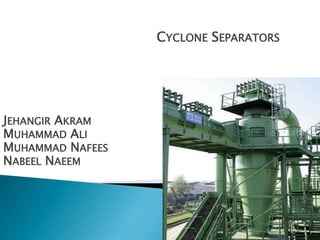
CYCLONE SEPARATORS
JEHANGIR AKRAM
MUHAMMAD ALI
MUHAMMAD NAFEES
NABEEL NAEEM
1
Cyclonic separation is a method of
removing particulates from an air, gas or liquid
stream, without the use of filters,
through vortex separation. When removing
particulate matter from liquids, a hydrocyclone is
used; while from gas, a gas cyclone is used.
Rotational effects and gravity are used to separate
mixtures of solids and fluids. The method can
also be used to separate fine droplets of liquid
from a gaseous stream.
2
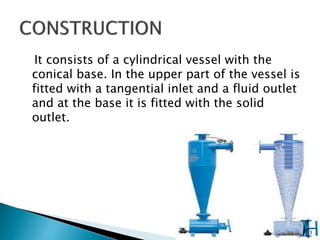
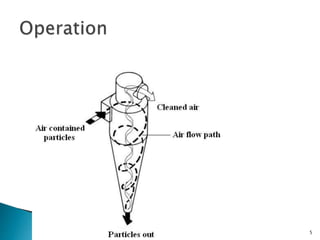
It consists of a cylindrical vessel with the
conical base. In the upper part of the vessel is
fitted with a tangential inlet and a fluid outlet
and at the base it is fitted with the solid
outlet.
3
Cyclone separators operate by incorporating
centrifugal, gravitational, and inertial forces to
remove fine particles suspended in air or gas.
These types of separators use cyclonic action to
separate particulates from a gas stream.
Typically, particulate matter enters the cyclone
separator at an angle and is then spun rapidly. A
centrifugal force is created by the circular
airflow that throws the particulate towards the
wall of the cyclone. Once the particulate matter
hits the wall, it falls into a hopper below.
“Clean” exhaust is then either blown through or
recirculated to be filtered again.
4
5
Based on the construction and orientation of the
inlet and outlet cyclones can be classified as:
1. Reverse flow Cyclones
2. Uniflow Cyclones
Based on types based on the body size cyclones can
be classified as:
1. High efficiency designs
2. High rate designs
6
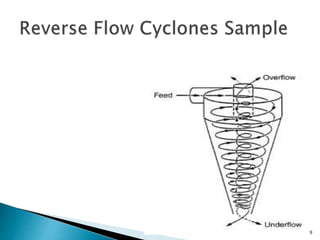
1. In reverse flow (seen in Figure 1 above), the
gas enters through a tangential inlet at the
top of the cyclone body, shaped to create a
confined vortex gas flow. The clean gas exits
through a central pipe also at the top of the
body.
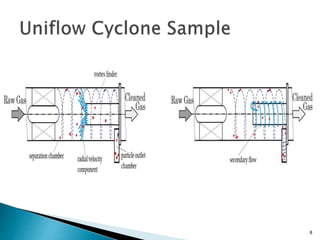
2. In uniflow or “straight through” cyclones, the
gas enters at one end of the body and leaves
at the other end; this type is less frequently
used in industry because it is a much less
practical design in most cases.
7
8
9
 High efficiency designs are characterized by
long bodies in addition to small openings.
This construction allows for high recovery
rates at higher pressure drops.
 High rate designs are characterized by
shorter bodies in addition to larger openings,
which allow for a larger volume with lower
capture rates or pressure drops.
10
Process conditions are the characteristics
surrounding a cyclone’s operation. These
include the air conditions and the
particulate/dust conditions that are essential
to finding or designing an appropriate
cyclone for a given system. When having a
cyclone custom built, these conditions are
requested from the cyclone manufacturer.
11
Air conditions include the pressure,
temperature, and moisture content at the
inlet of the cyclone. Solids collection becomes
more difficult as humidity rises because the
moisture tends to cause PM to adhere to the
cyclone walls.
12
Dust conditions at the inlet of the cyclone
can include material type, specific gravity,
bulk density, dust load ,and particle size
distribution. Sizing, densities, and loads are
needed to determine the required capacity
and design specifications for sufficient
capture. It is also important to specify any
unique characteristics of the particulate
matter that may lead to corrosion or
degradation of certain construction materials.
13
 Large scale cyclones are used in sawmills to
remove sawdust from extracted air.
 Cyclones are also used in oil refineries to
separate oils and gases, and in
the cement industry as components
of kiln preheaters.
 Cyclones are increasingly used in the household,
as the core technology in bagless types of
portable vacuum cleaners and central vacuum
cleaners.
 Cyclones are also used in industrial and
professional kitchen ventilation for separating
the grease from the exhaust air in extraction
hoods.
14
 Smaller cyclones are used to separate airborne
particles for analysis. Some are small enough to
be worn clipped to clothing, and are used to
separate respirable particles for later analysis.
 Similar separators are used in the oil
refining industry to achieve fast separation of
the catalyst particles from the reacting gases and
vapors.
 Analogous devices for separating particles or
solids from liquids are called hydrocyclones or
hydroclones. These may be used to separate
solid waste from water in wastewater and sewage
treatment.
15
 Particle Size
When Particle Size Increases, efficiency increases.
 Particle density
When Particle Density Increases, efficiency
increases.
 Dust loading
When Dust Loading increases, efficiency increases.
 Inlet gas velocity
When Inlet gas velocity increases, efficiency
increases.
16
 Cyclone body diameter
Increasing body diameter decreases efficiency.
 Ratio of cyclone body length to diameter
Increasing length to diameter ratio, increases
efficiency
 Smoothness of cyclone inner wall
Increasing smoothness of cyclone’s inner wall
increases efficiency.
 Gas viscosity
Increasing gas viscosity, decreases efficiency.
17
 Gas density
Increasing gas density, decreases efficiency.
 Gas inlet duct area
Increasing inlet gas duct area , decreases
efficiency.
 Gas exit pipe diameter
Increasing diameter of gas exit pipe, decreases
efficiency.
18
A hydrocyclone is a device to classify,
separate or sort particles in a liquid
suspension based on the ratio of their
centripetal force to fluid resistance. This ratio
is high for dense and coarse particles, and
low for light and fine particles. Also used in
the separation of liquids of different
densities.
19
A hydrocyclone is a classifier that has two
exits on the axis: one on the bottom
(underflow or reject) and one at the top
(overflow or accept). The underflow is
generally the denser or coarser fraction, while
the overflow is the lighter or finer fraction.
20
Hydrocyclone
21
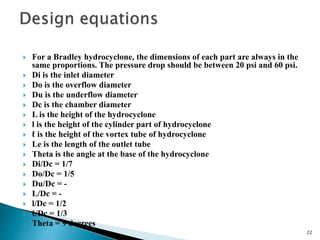
 For a Bradley hydrocyclone, the dimensions of each part are always in the
same proportions. The pressure drop should be between 20 psi and 60 psi.
 Di is the inlet diameter
 Do is the overflow diameter
 Du is the underflow diameter
 Dc is the chamber diameter
 L is the height of the hydrocyclone
 l is the height of the cylinder part of hydrocyclone
 ℓ is the height of the vortex tube of hydrocyclone
 Le is the length of the outlet tube
 Theta is the angle at the base of the hydrocyclone
 Di/Dc = 1/7
 Do/Dc = 1/5
 Du/Dc = -
 L/Dc = -
 l/Dc = 1/2
 ℓ/Dc = 1/3
 Theta = 9 degrees
22
 Forward hydrocyclones remove particles that are
denser than the surrounding fluid,
 Reverse hydrocyclones remove particles that are less
dense than the surrounding fluid. In a reverse
hydrocyclone the overflow is at the apex and the
underflow at the base.
 There are also parallel-flow hydrocyclones where both
the accept and reject are removed at the apex. Parallel-
flow hydrocyclones remove particles that are lighter
than the surrounding fluid.
23
Hydrocyclones can be made
of metal , ceramic or plastic. Metal or ceramic
hydrocyclones are used for situations requiring
more strength, or durability in terms of heat or
pressure. When there is an occurrence of
much abrasion polyurethane performs better
than metals or ceramics. Metal lined with
polyurethane is used in cases of combined
abrasion and high pressure.
24
 In the potato, cassava, wheat and corn starch industry
for both concentration and washing of the crude starch
milk. Hydrocyclone replace separators as a more price
efficient separation technique.
 In pulp and paper mills to remove sand, staples, plastic
particles and other contaminants.
 In the drilling industry to separate sand from the
expensive clay that is used for lubrication during the
drilling.
 In oil industry to separate oil from water or vice versa.
25
 In metal working to separate metal particles from
cooling liquid.
 In French fries and potato chips plants for in-line starch
recovery from cutting water and from waste water.
 In mineral processing, hydrocyclones are used
extensively both to classify particles for recirculation
in grinding circuits and to differentiate between
the economic mineral and gangue.
 To remove sand and silt particles from irrigation water
for drip irrigation purposes.
26
 Low capital cost.
 Ability to operate at high temperatures.
 Can handle liquid mists or dry materials.
 Low maintenance requirements (no moving parts).
 Small footprint - requires relatively small space.
27
 High operating costs (due to pressure drop).
 Low efficiencies (particularly for small particles).
 Unable to process "sticky" materials.
28
Paying
Heed
FOR
THANKS
29

Cyclone separator

  • 1.
    CYCLONE SEPARATORS JEHANGIR AKRAM MUHAMMADALI MUHAMMAD NAFEES NABEEL NAEEM 1
  • 2.
    Cyclonic separation isa method of removing particulates from an air, gas or liquid stream, without the use of filters, through vortex separation. When removing particulate matter from liquids, a hydrocyclone is used; while from gas, a gas cyclone is used. Rotational effects and gravity are used to separate mixtures of solids and fluids. The method can also be used to separate fine droplets of liquid from a gaseous stream. 2
  • 3.
    It consists ofa cylindrical vessel with the conical base. In the upper part of the vessel is fitted with a tangential inlet and a fluid outlet and at the base it is fitted with the solid outlet. 3
  • 4.
    Cyclone separators operateby incorporating centrifugal, gravitational, and inertial forces to remove fine particles suspended in air or gas. These types of separators use cyclonic action to separate particulates from a gas stream. Typically, particulate matter enters the cyclone separator at an angle and is then spun rapidly. A centrifugal force is created by the circular airflow that throws the particulate towards the wall of the cyclone. Once the particulate matter hits the wall, it falls into a hopper below. “Clean” exhaust is then either blown through or recirculated to be filtered again. 4
  • 5.
  • 6.
    Based on theconstruction and orientation of the inlet and outlet cyclones can be classified as: 1. Reverse flow Cyclones 2. Uniflow Cyclones Based on types based on the body size cyclones can be classified as: 1. High efficiency designs 2. High rate designs 6
  • 7.
    1. In reverseflow (seen in Figure 1 above), the gas enters through a tangential inlet at the top of the cyclone body, shaped to create a confined vortex gas flow. The clean gas exits through a central pipe also at the top of the body. 2. In uniflow or “straight through” cyclones, the gas enters at one end of the body and leaves at the other end; this type is less frequently used in industry because it is a much less practical design in most cases. 7
  • 8.
  • 9.
  • 10.
     High efficiencydesigns are characterized by long bodies in addition to small openings. This construction allows for high recovery rates at higher pressure drops.  High rate designs are characterized by shorter bodies in addition to larger openings, which allow for a larger volume with lower capture rates or pressure drops. 10
  • 11.
    Process conditions arethe characteristics surrounding a cyclone’s operation. These include the air conditions and the particulate/dust conditions that are essential to finding or designing an appropriate cyclone for a given system. When having a cyclone custom built, these conditions are requested from the cyclone manufacturer. 11
  • 12.
    Air conditions includethe pressure, temperature, and moisture content at the inlet of the cyclone. Solids collection becomes more difficult as humidity rises because the moisture tends to cause PM to adhere to the cyclone walls. 12
  • 13.
    Dust conditions atthe inlet of the cyclone can include material type, specific gravity, bulk density, dust load ,and particle size distribution. Sizing, densities, and loads are needed to determine the required capacity and design specifications for sufficient capture. It is also important to specify any unique characteristics of the particulate matter that may lead to corrosion or degradation of certain construction materials. 13
  • 14.
     Large scalecyclones are used in sawmills to remove sawdust from extracted air.  Cyclones are also used in oil refineries to separate oils and gases, and in the cement industry as components of kiln preheaters.  Cyclones are increasingly used in the household, as the core technology in bagless types of portable vacuum cleaners and central vacuum cleaners.  Cyclones are also used in industrial and professional kitchen ventilation for separating the grease from the exhaust air in extraction hoods. 14
  • 15.
     Smaller cyclonesare used to separate airborne particles for analysis. Some are small enough to be worn clipped to clothing, and are used to separate respirable particles for later analysis.  Similar separators are used in the oil refining industry to achieve fast separation of the catalyst particles from the reacting gases and vapors.  Analogous devices for separating particles or solids from liquids are called hydrocyclones or hydroclones. These may be used to separate solid waste from water in wastewater and sewage treatment. 15
  • 16.
     Particle Size WhenParticle Size Increases, efficiency increases.  Particle density When Particle Density Increases, efficiency increases.  Dust loading When Dust Loading increases, efficiency increases.  Inlet gas velocity When Inlet gas velocity increases, efficiency increases. 16
  • 17.
     Cyclone bodydiameter Increasing body diameter decreases efficiency.  Ratio of cyclone body length to diameter Increasing length to diameter ratio, increases efficiency  Smoothness of cyclone inner wall Increasing smoothness of cyclone’s inner wall increases efficiency.  Gas viscosity Increasing gas viscosity, decreases efficiency. 17
  • 18.
     Gas density Increasinggas density, decreases efficiency.  Gas inlet duct area Increasing inlet gas duct area , decreases efficiency.  Gas exit pipe diameter Increasing diameter of gas exit pipe, decreases efficiency. 18
  • 19.
    A hydrocyclone isa device to classify, separate or sort particles in a liquid suspension based on the ratio of their centripetal force to fluid resistance. This ratio is high for dense and coarse particles, and low for light and fine particles. Also used in the separation of liquids of different densities. 19
  • 20.
    A hydrocyclone isa classifier that has two exits on the axis: one on the bottom (underflow or reject) and one at the top (overflow or accept). The underflow is generally the denser or coarser fraction, while the overflow is the lighter or finer fraction. 20
  • 21.
  • 22.
     For aBradley hydrocyclone, the dimensions of each part are always in the same proportions. The pressure drop should be between 20 psi and 60 psi.  Di is the inlet diameter  Do is the overflow diameter  Du is the underflow diameter  Dc is the chamber diameter  L is the height of the hydrocyclone  l is the height of the cylinder part of hydrocyclone  ℓ is the height of the vortex tube of hydrocyclone  Le is the length of the outlet tube  Theta is the angle at the base of the hydrocyclone  Di/Dc = 1/7  Do/Dc = 1/5  Du/Dc = -  L/Dc = -  l/Dc = 1/2  ℓ/Dc = 1/3  Theta = 9 degrees 22
  • 23.
     Forward hydrocyclonesremove particles that are denser than the surrounding fluid,  Reverse hydrocyclones remove particles that are less dense than the surrounding fluid. In a reverse hydrocyclone the overflow is at the apex and the underflow at the base.  There are also parallel-flow hydrocyclones where both the accept and reject are removed at the apex. Parallel- flow hydrocyclones remove particles that are lighter than the surrounding fluid. 23
  • 24.
    Hydrocyclones can bemade of metal , ceramic or plastic. Metal or ceramic hydrocyclones are used for situations requiring more strength, or durability in terms of heat or pressure. When there is an occurrence of much abrasion polyurethane performs better than metals or ceramics. Metal lined with polyurethane is used in cases of combined abrasion and high pressure. 24
  • 25.
     In thepotato, cassava, wheat and corn starch industry for both concentration and washing of the crude starch milk. Hydrocyclone replace separators as a more price efficient separation technique.  In pulp and paper mills to remove sand, staples, plastic particles and other contaminants.  In the drilling industry to separate sand from the expensive clay that is used for lubrication during the drilling.  In oil industry to separate oil from water or vice versa. 25
  • 26.
     In metalworking to separate metal particles from cooling liquid.  In French fries and potato chips plants for in-line starch recovery from cutting water and from waste water.  In mineral processing, hydrocyclones are used extensively both to classify particles for recirculation in grinding circuits and to differentiate between the economic mineral and gangue.  To remove sand and silt particles from irrigation water for drip irrigation purposes. 26
  • 27.
     Low capitalcost.  Ability to operate at high temperatures.  Can handle liquid mists or dry materials.  Low maintenance requirements (no moving parts).  Small footprint - requires relatively small space. 27
  • 28.
     High operatingcosts (due to pressure drop).  Low efficiencies (particularly for small particles).  Unable to process "sticky" materials. 28
  • 29.