s & p BLOCK
ELEMENTS
CHAPTER 13 CHEMISTRY
XII FDC
SIDRA JAVED
Atomic Properties of
Period 3 Elements
■ Electronic Structure
In Period 3 of the Periodic Table, the 3s and 3p orbitals are
filling with electrons. Just as a reminder, the shortened
versions of the electronic structures for the eight
elements are:
Sodium Na
1s2 2s2 2p6 3s1
Or [Ne] 3s1
Magnesium
Mg
[Ne] 3s2
Aluminium Al
[Ne] 3s2 3px1
Silicon Si
[Ne] 3s2 3px1 3py1
Phosphorous
P
[Ne] 3s2 3px1 3py1 3pz1
Sulphur S
[Ne] 3s2 3px2 3py1 3pz1
Chlorine Cl
[Ne] 3s2 3px2 3py2 3pz1
Argon Ar
[Ne] 3s2 3px2 3py2 3pz2
1. Trends in Atomic Radius
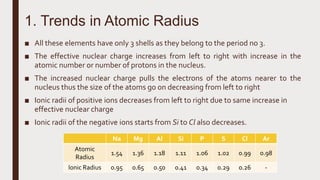
■ All these elements have only 3 shells as they belong to the period no 3.
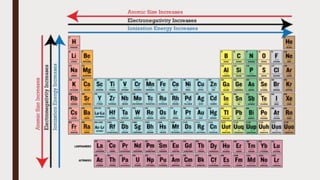
■ The effective nuclear charge increases from left to right with increase in the
atomic number or number of protons in the nucleus.
■ The increased nuclear charge pulls the electrons of the atoms nearer to the
nucleus thus the size of the atoms go on decreasing from left to right
■ Ionic radii of positive ions decreases from left to right due to same increase in
effective nuclear charge
■ Ionic radii of the negative ions starts from Si to Cl also decreases.
Na Mg Al Si P S Cl Ar
Atomic
Radius
1.54 1.36 1.18 1.11 1.06 1.02 0.99 0.98
Ionic Radius 0.95 0.65 0.50 0.41 0.34 0.29 0.26 -
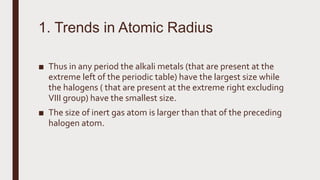
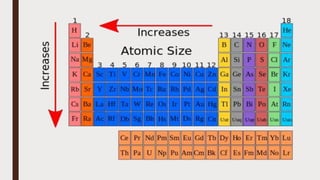
■ Thus in any period the alkali metals (that are present at the
extreme left of the periodic table) have the largest size while
the halogens ( that are present at the extreme right excluding
VIII group) have the smallest size.
■ The size of inert gas atom is larger than that of the preceding
halogen atom.
1. Trends in Atomic Radius
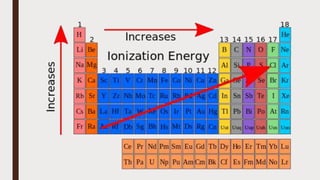
2.Trends in First Ionization Energy
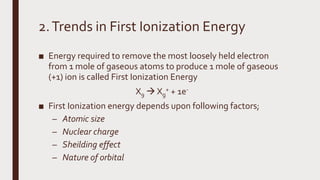
■ Energy required to remove the most loosely held electron
from 1 mole of gaseous atoms to produce 1 mole of gaseous
(+1) ion is called First Ionization Energy
X9  Xg
+ + 1e-
■ First Ionization energy depends upon following factors;
– Atomic size
– Nuclear charge
– Sheilding effect
– Nature of orbital
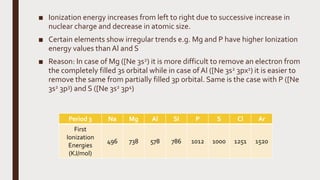
■ Ionization energy increases from left to right due to successive increase in
nuclear charge and decrease in atomic size.
■ Certain elements show irregular trends e.g. Mg and P have higher Ionization
energy values than Al and S
■ Reason: In case of Mg ([Ne 3s2) it is more difficult to remove an electron from
the completely filled 3s orbital while in case of Al ([Ne 3s2 3px1) it is easier to
remove the same from partially filled 3p orbital. Same is the case with P ([Ne
3s2 3p3) and S ([Ne 3s2 3p4)
Period 3 Na Mg Al SI P S Cl Ar
First
Ionization
Energies
(KJ/mol)
496 738 578 786 1012 1000 1251 1520
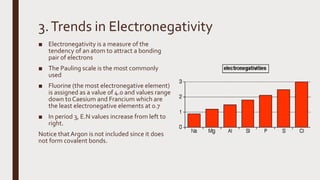
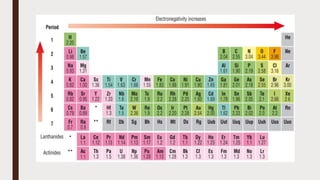
3.Trends in Electronegativity
■ Electronegativity is a measure of the
tendency of an atom to attract a bonding
pair of electrons
■ The Pauling scale is the most commonly
used
■ Fluorine (the most electronegative element)
is assigned as a value of 4.0 and values range
down to Caesium and Francium which are
the least electronegative elements at 0.7
■ In period 3, E.N values increase from left to
right.
Notice that Argon is not included since it does
not form covalent bonds.
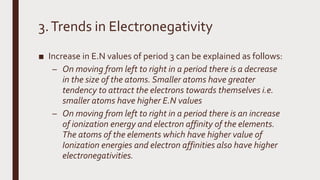
■ Increase in E.N values of period 3 can be explained as follows:
– On moving from left to right in a period there is a decrease
in the size of the atoms. Smaller atoms have greater
tendency to attract the electrons towards themselves i.e.
smaller atoms have higher E.N values
– On moving from left to right in a period there is an increase
of ionization energy and electron affinity of the elements.
The atoms of the elements which have higher value of
Ionization energies and electron affinities also have higher
electronegativities.
3.Trends in Electronegativity
Physical Properties of Period 3 elements
■ Structures of the elements
– The structures of elements change as you go across the
period.
– Na, Mg, Al  Metallic solids
– Si  Giant Covalent solid
– P, S, Cl, Ar  Molecular solids
Three Metallic Structures – Na, Mg,Al
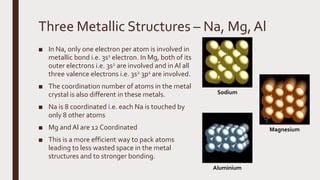
■ In Na, only one electron per atom is involved in
metallic bond i.e. 3s1 electron. In Mg, both of its
outer electrons i.e. 3s2 are involved and in Al all
three valence electrons i.e. 3s2 3p1 are involved.
■ The coordination number of atoms in the metal
crystal is also different in these metals.
■ Na is 8 coordinated i.e. each Na is touched by
only 8 other atoms
■ Mg and Al are 12 Coordinated
■ This is a more efficient way to pack atoms
leading to less wasted space in the metal
structures and to stronger bonding.
Sodium
Aluminium
Magnesium
A Giant Covalent Structure – Si
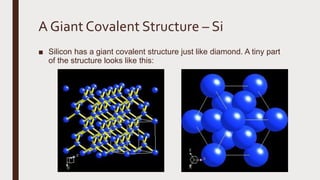
■ Silicon has a giant covalent structure just like diamond. A tiny part
of the structure looks like this:
Four Simple Molecular Structures – P, S,
Cl, Ar
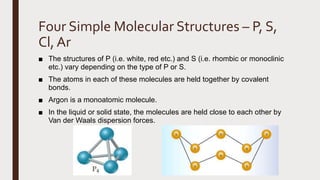
■ The structures of P (i.e. white, red etc.) and S (i.e. rhombic or monoclinic
etc.) vary depending on the type of P or S.
■ The atoms in each of these molecules are held together by covalent
bonds.
■ Argon is a monoatomic molecule.
■ In the liquid or solid state, the molecules are held close to each other by
Van der Waals dispersion forces.
4.Trends in Electrical Conductivity
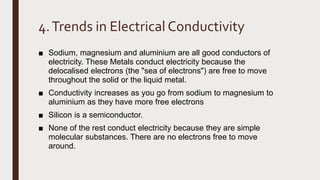
■ Sodium, magnesium and aluminium are all good conductors of
electricity. These Metals conduct electricity because the
delocalised electrons (the "sea of electrons") are free to move
throughout the solid or the liquid metal.
■ Conductivity increases as you go from sodium to magnesium to
aluminium as they have more free electrons
■ Silicon is a semiconductor.
■ None of the rest conduct electricity because they are simple
molecular substances. There are no electrons free to move
around.
5.Trends in Melting and Boiling Points
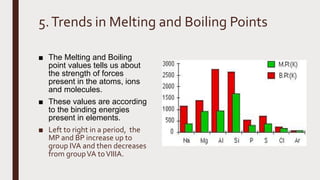
■ The Melting and Boiling
point values tells us about
the strength of forces
present in the atoms, ions
and molecules.
■ These values are according
to the binding energies
present in elements.
■ Left to right in a period, the
MP and BP increase up to
group IVA and then decreases
from groupVA toVIIIA.
5.Trend in Melting and Boiling Point
■ Trend in MP and BP can be explained as follows:
– The MP and BP are governed entirely by the size of the molecules and
intermolecular forces i.e. binding electrons present in the shell.
– The MP and BP are high up to group IVA because these elements
contain increasing number of binding electron from I to IV and also
have giant covalent structure.
– The MP and BP are lo from P to Ar because these elements exist in the
form of diatomic molecules and have weak intermolecular forces up to
Ar
CHEMICAL
REACTIONS OF
PERIOD 3
ELEMENTS
Reaction with water
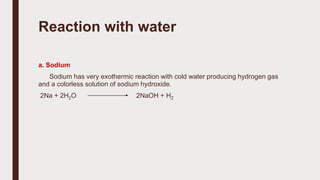
a. Sodium
Sodium has very exothermic reaction with cold water producing hydrogen gas
and a colorless solution of sodium hydroxide.
2Na + 2H2O 2NaOH + H2
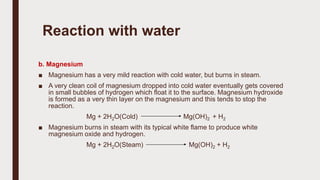
b. Magnesium
■ Magnesium has a very mild reaction with cold water, but burns in steam.
■ A very clean coil of magnesium dropped into cold water eventually gets covered
in small bubbles of hydrogen which float it to the surface. Magnesium hydroxide
is formed as a very thin layer on the magnesium and this tends to stop the
reaction.
Mg + 2H2O(Cold) Mg(OH)2 + H2
■ Magnesium burns in steam with its typical white flame to produce white
magnesium oxide and hydrogen.
Mg + 2H2O(Steam) Mg(OH)2 + H2
Reaction with water
Reaction with water
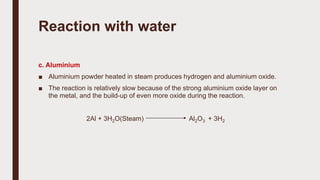
c. Aluminium
■ Aluminium powder heated in steam produces hydrogen and aluminium oxide.
■ The reaction is relatively slow because of the strong aluminium oxide layer on
the metal, and the build-up of even more oxide during the reaction.
2Al + 3H2O(Steam) Al2O3 + 3H2
Reaction with water
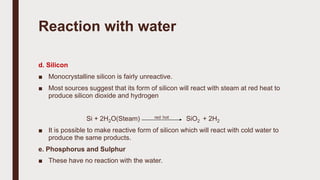
d. Silicon
■ Monocrystalline silicon is fairly unreactive.
■ Most sources suggest that its form of silicon will react with steam at red heat to
produce silicon dioxide and hydrogen
Si + 2H2O(Steam) red hot SiO2 + 2H2
■ It is possible to make reactive form of silicon which will react with cold water to
produce the same products.
e. Phosphorus and Sulphur
■ These have no reaction with the water.
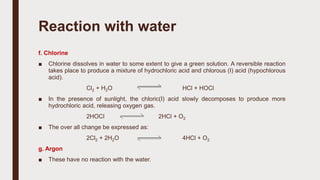
f. Chlorine
■ Chlorine dissolves in water to some extent to give a green solution. A reversible reaction
takes place to produce a mixture of hydrochloric acid and chlorous (I) acid (hypochlorous
acid).
Cl2 + H2O HCl + HOCl
■ In the presence of sunlight, the chloric(I) acid slowly decomposes to produce more
hydrochloric acid, releasing oxygen gas.
2HOCl 2HCl + O2
■ The over all change be expressed as:
2Cl2 + 2H2O 4HCl + O2
g. Argon
■ These have no reaction with the water.
Reaction with water
Reaction with Oxygen
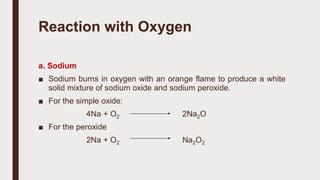
a. Sodium
■ Sodium burns in oxygen with an orange flame to produce a white
solid mixture of sodium oxide and sodium peroxide.
■ For the simple oxide:
4Na + O2 2Na2O
■ For the peroxide
2Na + O2 Na2O2
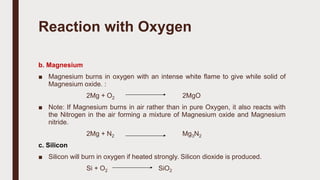
b. Magnesium
■ Magnesium burns in oxygen with an intense white flame to give while solid of
Magnesium oxide. :
2Mg + O2 2MgO
■ Note: If Magnesium burns in air rather than in pure Oxygen, it also reacts with
the Nitrogen in the air forming a mixture of Magnesium oxide and Magnesium
nitride.
2Mg + N2 Mg3N2
c. Silicon
■ Silicon will burn in oxygen if heated strongly. Silicon dioxide is produced.
Si + O2 SiO2
Reaction with Oxygen
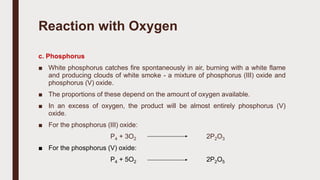
c. Phosphorus
■ White phosphorus catches fire spontaneously in air, burning with a white flame
and producing clouds of white smoke - a mixture of phosphorus (III) oxide and
phosphorus (V) oxide.
■ The proportions of these depend on the amount of oxygen available.
■ In an excess of oxygen, the product will be almost entirely phosphorus (V)
oxide.
■ For the phosphorus (III) oxide:
P4 + 3O2 2P2O3
■ For the phosphorus (V) oxide:
P4 + 5O2 2P2O5
Reaction with Oxygen
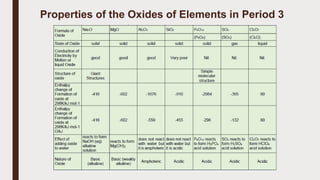
Properties of the Oxides of Elements in Period 3
Reaction with Chlorine
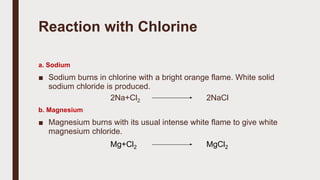
a. Sodium
■ Sodium burns in chlorine with a bright orange flame. White solid
sodium chloride is produced.
2Na+Cl2 2NaCl
b. Magnesium
■ Magnesium burns with its usual intense white flame to give white
magnesium chloride.
Mg+Cl2 MgCl2
Reaction with Chlorine
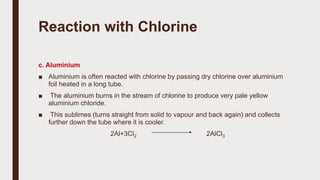
c. Aluminium
■ Aluminium is often reacted with chlorine by passing dry chlorine over aluminium
foil heated in a long tube.
■ The aluminium burns in the stream of chlorine to produce very pale yellow
aluminium chloride.
■ This sublimes (turns straight from solid to vapour and back again) and collects
further down the tube where it is cooler.
2Al+3Cl2 2AlCl3
Reaction with Chlorine
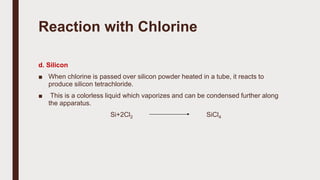
d. Silicon
■ When chlorine is passed over silicon powder heated in a tube, it reacts to
produce silicon tetrachloride.
■ This is a colorless liquid which vaporizes and can be condensed further along
the apparatus.
Si+2Cl2 SiCl4
Reaction with Chlorine
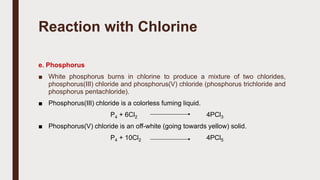
e. Phosphorus
■ White phosphorus burns in chlorine to produce a mixture of two chlorides,
phosphorus(III) chloride and phosphorus(V) chloride (phosphorus trichloride and
phosphorus pentachloride).
■ Phosphorus(III) chloride is a colorless fuming liquid.
P4 + 6Cl2 4PCl3
■ Phosphorus(V) chloride is an off-white (going towards yellow) solid.
P4 + 10Cl2 4PCl5
Reaction with Chlorine
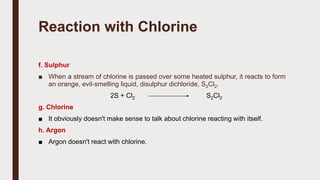
f. Sulphur
■ When a stream of chlorine is passed over some heated sulphur, it reacts to form
an orange, evil-smelling liquid, disulphur dichloride, S2Cl2.
2S + Cl2 S2Cl2
g. Chlorine
■ It obviously doesn't make sense to talk about chlorine reacting with itself.
h. Argon
■ Argon doesn't react with chlorine.
END OF LESSON
sidra.javedali@gmail.com

S & p block elements

  • 1.
    s & pBLOCK ELEMENTS CHAPTER 13 CHEMISTRY XII FDC SIDRA JAVED
  • 3.
    Atomic Properties of Period3 Elements ■ Electronic Structure In Period 3 of the Periodic Table, the 3s and 3p orbitals are filling with electrons. Just as a reminder, the shortened versions of the electronic structures for the eight elements are:
  • 4.
    Sodium Na 1s2 2s22p6 3s1 Or [Ne] 3s1
  • 5.
  • 6.
  • 7.
  • 8.
  • 9.
    Sulphur S [Ne] 3s23px2 3py1 3pz1
  • 10.
    Chlorine Cl [Ne] 3s23px2 3py2 3pz1
  • 11.
    Argon Ar [Ne] 3s23px2 3py2 3pz2
  • 12.
    1. Trends inAtomic Radius ■ All these elements have only 3 shells as they belong to the period no 3. ■ The effective nuclear charge increases from left to right with increase in the atomic number or number of protons in the nucleus. ■ The increased nuclear charge pulls the electrons of the atoms nearer to the nucleus thus the size of the atoms go on decreasing from left to right ■ Ionic radii of positive ions decreases from left to right due to same increase in effective nuclear charge ■ Ionic radii of the negative ions starts from Si to Cl also decreases. Na Mg Al Si P S Cl Ar Atomic Radius 1.54 1.36 1.18 1.11 1.06 1.02 0.99 0.98 Ionic Radius 0.95 0.65 0.50 0.41 0.34 0.29 0.26 -
  • 13.
    ■ Thus inany period the alkali metals (that are present at the extreme left of the periodic table) have the largest size while the halogens ( that are present at the extreme right excluding VIII group) have the smallest size. ■ The size of inert gas atom is larger than that of the preceding halogen atom. 1. Trends in Atomic Radius
  • 15.
    2.Trends in FirstIonization Energy ■ Energy required to remove the most loosely held electron from 1 mole of gaseous atoms to produce 1 mole of gaseous (+1) ion is called First Ionization Energy X9  Xg + + 1e- ■ First Ionization energy depends upon following factors; – Atomic size – Nuclear charge – Sheilding effect – Nature of orbital
  • 16.
    ■ Ionization energyincreases from left to right due to successive increase in nuclear charge and decrease in atomic size. ■ Certain elements show irregular trends e.g. Mg and P have higher Ionization energy values than Al and S ■ Reason: In case of Mg ([Ne 3s2) it is more difficult to remove an electron from the completely filled 3s orbital while in case of Al ([Ne 3s2 3px1) it is easier to remove the same from partially filled 3p orbital. Same is the case with P ([Ne 3s2 3p3) and S ([Ne 3s2 3p4) Period 3 Na Mg Al SI P S Cl Ar First Ionization Energies (KJ/mol) 496 738 578 786 1012 1000 1251 1520
  • 18.
    3.Trends in Electronegativity ■Electronegativity is a measure of the tendency of an atom to attract a bonding pair of electrons ■ The Pauling scale is the most commonly used ■ Fluorine (the most electronegative element) is assigned as a value of 4.0 and values range down to Caesium and Francium which are the least electronegative elements at 0.7 ■ In period 3, E.N values increase from left to right. Notice that Argon is not included since it does not form covalent bonds.
  • 19.
    ■ Increase inE.N values of period 3 can be explained as follows: – On moving from left to right in a period there is a decrease in the size of the atoms. Smaller atoms have greater tendency to attract the electrons towards themselves i.e. smaller atoms have higher E.N values – On moving from left to right in a period there is an increase of ionization energy and electron affinity of the elements. The atoms of the elements which have higher value of Ionization energies and electron affinities also have higher electronegativities. 3.Trends in Electronegativity
  • 22.
    Physical Properties ofPeriod 3 elements ■ Structures of the elements – The structures of elements change as you go across the period. – Na, Mg, Al  Metallic solids – Si  Giant Covalent solid – P, S, Cl, Ar  Molecular solids
  • 23.
    Three Metallic Structures– Na, Mg,Al ■ In Na, only one electron per atom is involved in metallic bond i.e. 3s1 electron. In Mg, both of its outer electrons i.e. 3s2 are involved and in Al all three valence electrons i.e. 3s2 3p1 are involved. ■ The coordination number of atoms in the metal crystal is also different in these metals. ■ Na is 8 coordinated i.e. each Na is touched by only 8 other atoms ■ Mg and Al are 12 Coordinated ■ This is a more efficient way to pack atoms leading to less wasted space in the metal structures and to stronger bonding. Sodium Aluminium Magnesium
  • 24.
    A Giant CovalentStructure – Si ■ Silicon has a giant covalent structure just like diamond. A tiny part of the structure looks like this:
  • 25.
    Four Simple MolecularStructures – P, S, Cl, Ar ■ The structures of P (i.e. white, red etc.) and S (i.e. rhombic or monoclinic etc.) vary depending on the type of P or S. ■ The atoms in each of these molecules are held together by covalent bonds. ■ Argon is a monoatomic molecule. ■ In the liquid or solid state, the molecules are held close to each other by Van der Waals dispersion forces.
  • 26.
    4.Trends in ElectricalConductivity ■ Sodium, magnesium and aluminium are all good conductors of electricity. These Metals conduct electricity because the delocalised electrons (the "sea of electrons") are free to move throughout the solid or the liquid metal. ■ Conductivity increases as you go from sodium to magnesium to aluminium as they have more free electrons ■ Silicon is a semiconductor. ■ None of the rest conduct electricity because they are simple molecular substances. There are no electrons free to move around.
  • 27.
    5.Trends in Meltingand Boiling Points ■ The Melting and Boiling point values tells us about the strength of forces present in the atoms, ions and molecules. ■ These values are according to the binding energies present in elements. ■ Left to right in a period, the MP and BP increase up to group IVA and then decreases from groupVA toVIIIA.
  • 28.
    5.Trend in Meltingand Boiling Point ■ Trend in MP and BP can be explained as follows: – The MP and BP are governed entirely by the size of the molecules and intermolecular forces i.e. binding electrons present in the shell. – The MP and BP are high up to group IVA because these elements contain increasing number of binding electron from I to IV and also have giant covalent structure. – The MP and BP are lo from P to Ar because these elements exist in the form of diatomic molecules and have weak intermolecular forces up to Ar
  • 29.
  • 30.
    Reaction with water a.Sodium Sodium has very exothermic reaction with cold water producing hydrogen gas and a colorless solution of sodium hydroxide. 2Na + 2H2O 2NaOH + H2
  • 31.
    b. Magnesium ■ Magnesiumhas a very mild reaction with cold water, but burns in steam. ■ A very clean coil of magnesium dropped into cold water eventually gets covered in small bubbles of hydrogen which float it to the surface. Magnesium hydroxide is formed as a very thin layer on the magnesium and this tends to stop the reaction. Mg + 2H2O(Cold) Mg(OH)2 + H2 ■ Magnesium burns in steam with its typical white flame to produce white magnesium oxide and hydrogen. Mg + 2H2O(Steam) Mg(OH)2 + H2 Reaction with water
  • 32.
    Reaction with water c.Aluminium ■ Aluminium powder heated in steam produces hydrogen and aluminium oxide. ■ The reaction is relatively slow because of the strong aluminium oxide layer on the metal, and the build-up of even more oxide during the reaction. 2Al + 3H2O(Steam) Al2O3 + 3H2
  • 33.
    Reaction with water d.Silicon ■ Monocrystalline silicon is fairly unreactive. ■ Most sources suggest that its form of silicon will react with steam at red heat to produce silicon dioxide and hydrogen Si + 2H2O(Steam) red hot SiO2 + 2H2 ■ It is possible to make reactive form of silicon which will react with cold water to produce the same products. e. Phosphorus and Sulphur ■ These have no reaction with the water.
  • 34.
    f. Chlorine ■ Chlorinedissolves in water to some extent to give a green solution. A reversible reaction takes place to produce a mixture of hydrochloric acid and chlorous (I) acid (hypochlorous acid). Cl2 + H2O HCl + HOCl ■ In the presence of sunlight, the chloric(I) acid slowly decomposes to produce more hydrochloric acid, releasing oxygen gas. 2HOCl 2HCl + O2 ■ The over all change be expressed as: 2Cl2 + 2H2O 4HCl + O2 g. Argon ■ These have no reaction with the water. Reaction with water
  • 35.
    Reaction with Oxygen a.Sodium ■ Sodium burns in oxygen with an orange flame to produce a white solid mixture of sodium oxide and sodium peroxide. ■ For the simple oxide: 4Na + O2 2Na2O ■ For the peroxide 2Na + O2 Na2O2
  • 36.
    b. Magnesium ■ Magnesiumburns in oxygen with an intense white flame to give while solid of Magnesium oxide. : 2Mg + O2 2MgO ■ Note: If Magnesium burns in air rather than in pure Oxygen, it also reacts with the Nitrogen in the air forming a mixture of Magnesium oxide and Magnesium nitride. 2Mg + N2 Mg3N2 c. Silicon ■ Silicon will burn in oxygen if heated strongly. Silicon dioxide is produced. Si + O2 SiO2 Reaction with Oxygen
  • 37.
    c. Phosphorus ■ Whitephosphorus catches fire spontaneously in air, burning with a white flame and producing clouds of white smoke - a mixture of phosphorus (III) oxide and phosphorus (V) oxide. ■ The proportions of these depend on the amount of oxygen available. ■ In an excess of oxygen, the product will be almost entirely phosphorus (V) oxide. ■ For the phosphorus (III) oxide: P4 + 3O2 2P2O3 ■ For the phosphorus (V) oxide: P4 + 5O2 2P2O5 Reaction with Oxygen
  • 38.
    Properties of theOxides of Elements in Period 3
  • 39.
    Reaction with Chlorine a.Sodium ■ Sodium burns in chlorine with a bright orange flame. White solid sodium chloride is produced. 2Na+Cl2 2NaCl b. Magnesium ■ Magnesium burns with its usual intense white flame to give white magnesium chloride. Mg+Cl2 MgCl2
  • 40.
    Reaction with Chlorine c.Aluminium ■ Aluminium is often reacted with chlorine by passing dry chlorine over aluminium foil heated in a long tube. ■ The aluminium burns in the stream of chlorine to produce very pale yellow aluminium chloride. ■ This sublimes (turns straight from solid to vapour and back again) and collects further down the tube where it is cooler. 2Al+3Cl2 2AlCl3
  • 41.
    Reaction with Chlorine d.Silicon ■ When chlorine is passed over silicon powder heated in a tube, it reacts to produce silicon tetrachloride. ■ This is a colorless liquid which vaporizes and can be condensed further along the apparatus. Si+2Cl2 SiCl4
  • 42.
    Reaction with Chlorine e.Phosphorus ■ White phosphorus burns in chlorine to produce a mixture of two chlorides, phosphorus(III) chloride and phosphorus(V) chloride (phosphorus trichloride and phosphorus pentachloride). ■ Phosphorus(III) chloride is a colorless fuming liquid. P4 + 6Cl2 4PCl3 ■ Phosphorus(V) chloride is an off-white (going towards yellow) solid. P4 + 10Cl2 4PCl5
  • 43.
    Reaction with Chlorine f.Sulphur ■ When a stream of chlorine is passed over some heated sulphur, it reacts to form an orange, evil-smelling liquid, disulphur dichloride, S2Cl2. 2S + Cl2 S2Cl2 g. Chlorine ■ It obviously doesn't make sense to talk about chlorine reacting with itself. h. Argon ■ Argon doesn't react with chlorine.
  • 44.