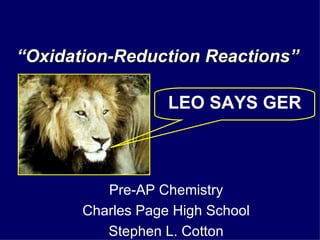
“ Oxidation-Reduction Reactions” LEO SAYS GER Pre-AP Chemistry Charles Page High School Stephen L. Cotton
The Meaning of Oxidation and Reduction (called “redox”) OBJECTIVES Define  oxidation and reduction in terms of the loss or gain of oxygen, and the loss or gain of electrons.
OBJECTIVES State  the characteristics of a redox reaction and  identify  the oxidizing agent and reducing agent.
Oxidation and Reduction (Redox) Early chemists saw “ oxidation ” reactions only as the  combination of a material with oxygen  to produce an oxide. For example, when methane burns in air, it oxidizes and forms oxides of carbon and hydrogen,
Oxidation and Reduction (Redox) But, not all oxidation processes that use oxygen involve burning: Elemental iron slowly oxidizes to compounds such as iron (III) oxide, commonly called “rust” Bleaching stains in fabrics Hydrogen peroxide also releases oxygen when it decomposes
Oxidation and Reduction (Redox) A process called “ reduction ” is the opposite of oxidation, and originally meant the loss of oxygen from a compound Oxidation and reduction  always occur simultaneously The substance gaining oxygen (or losing electrons) is  oxidized , while the substance losing oxygen (or gaining electrons) is  reduced .
Oxidation and Reduction (Redox) Today, many of these reactions may not even involve oxygen Redox currently says that electrons are  transferred between reactants
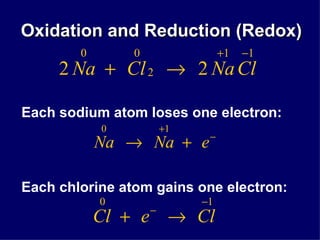
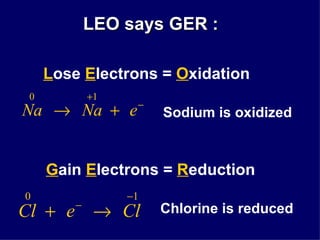
Oxidation and Reduction (Redox) Each sodium atom loses one electron: Each chlorine atom gains one electron:
LEO says GER : L ose  E lectrons =  O xidation Sodium is oxidized G ain  E lectrons =  R eduction Chlorine is reduced
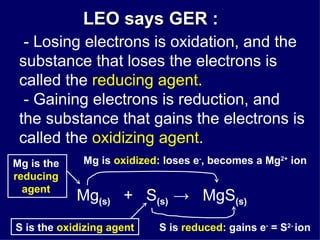
LEO says GER : - Losing electrons is oxidation, and the substance that loses the electrons is called the  reducing agent . - Gaining electrons is reduction, and the substance that gains the electrons is called the  oxidizing agent . Mg (s)   +  S (s)  ->  MgS (s) Mg is  oxidized : loses e - , becomes a Mg 2+  ion S is  reduced : gains e -  = S 2-  ion Mg is the  reducing agent S is the  oxidizing agent
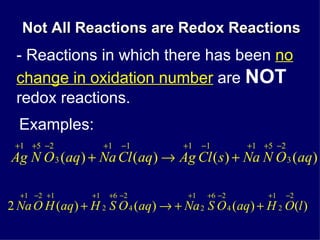
Not All Reactions are Redox Reactions - Reactions in which there has been  no change in oxidation number  are  NOT  redox reactions. Examples:
Corrosion Damage done to metal is costly to prevent and repair Iron , a common construction metal often used in forming steel alloys, corrodes by being oxidized to ions of iron by oxygen. This corrosion is even faster in the presence of  salts  and  acids , because these materials make  electrically conductive solutions  that make electron transfer easy
Corrosion Luckily, not all metals corrode easily Gold and platinum  are called  noble metals  because they are resistant to losing their electrons by corrosion Other metals may lose their electrons easily, but are protected from corrosion by the oxide coating on their surface, such as  aluminum  –  Iron has an oxide coating, but it is not tightly packed, so water and air can penetrate it easily
Corrosion Serious problems can result if bridges, storage tanks, or hulls of ships corrode Can be prevented by a coating of oil, paint, plastic, or another metal If this surface is scratched or worn away, the protection is lost Other methods of prevention involve the “ sacrifice ” of one metal to save the second Magnesium, chromium, or even zinc (called galvanized) coatings can be applied
Oxidation Numbers OBJECTIVES Determine  the oxidation number of an atom of any element in a pure substance.
Assigning Oxidation Numbers An “ oxidation number ” is a positive or negative number assigned to an atom to indicate its degree of oxidation or reduction. Generally, a bonded atom’s oxidation number is the charge it would have if the electrons in the bond were assigned to the atom of the more electronegative element
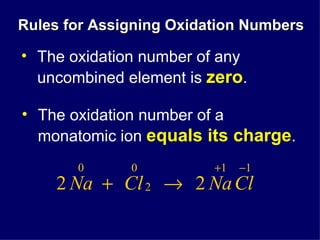
Rules for Assigning Oxidation Numbers The oxidation number of any uncombined element is  zero . The oxidation number of a monatomic ion  equals its charge .
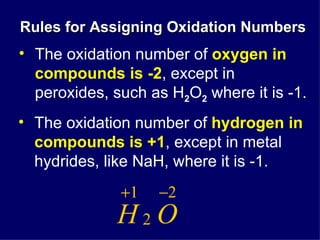
Rules for Assigning Oxidation Numbers The oxidation number of  oxygen in compounds is -2 , except in peroxides, such as H 2 O 2  where it is -1. The oxidation number of  hydrogen in compounds is +1 , except in metal hydrides, like NaH, where it is -1.
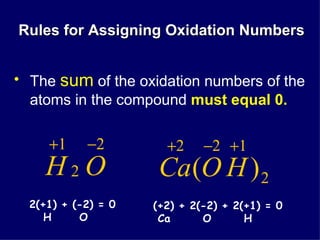
Rules for Assigning Oxidation Numbers   The  sum  of the oxidation numbers of the atoms in the compound  must equal 0. 2(+1) + (-2) = 0 H  O  (+2) + 2(-2) + 2(+1) = 0 Ca  O  H
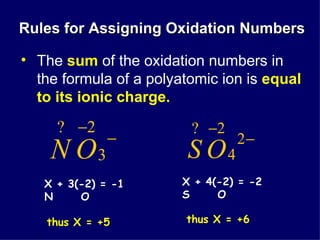
Rules for Assigning Oxidation Numbers The  sum  of the oxidation numbers in the formula of a polyatomic ion is  equal to its ionic charge. X + 3(-2) = -1 N  O  thus X = +5 thus X = +6 X + 4(-2) = -2 S  O
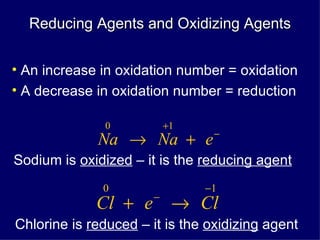
Reducing Agents and Oxidizing Agents An increase in oxidation number = oxidation A decrease in oxidation number = reduction Sodium is  oxidized  – it is the  reducing agent Chlorine is  reduced  – it is the  oxidizing  agent
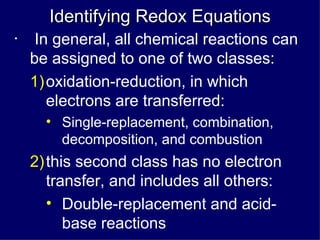
Identifying Redox Equations In general, all chemical reactions can be assigned to one of two classes: oxidation-reduction, in which electrons are transferred: Single-replacement, combination, decomposition, and combustion this second class has no electron transfer, and includes all others: Double-replacement and acid-base reactions
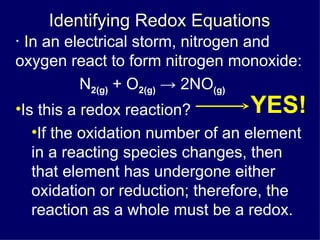
Identifying Redox Equations In an electrical storm, nitrogen and oxygen react to form nitrogen monoxide: N 2(g)  + O 2(g)   -> 2NO (g) Is this a redox reaction? If the oxidation number of an element in a reacting species changes, then that element has undergone either oxidation or reduction; therefore, the reaction as a whole must be a redox. YES!
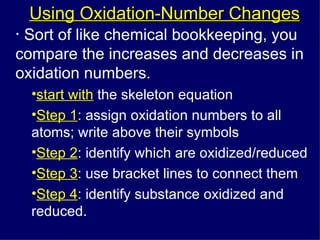
Using Oxidation-Number Changes Sort of like chemical bookkeeping, you compare the increases and decreases in oxidation numbers. start with  the skeleton equation Step 1 : assign oxidation numbers to all atoms; write above their symbols Step 2 : identify which are oxidized/reduced Step 3 : use bracket lines to connect them Step 4 : identify substance oxidized and reduced.

Oxidation reduction reactions

  • 1.
    “ Oxidation-Reduction Reactions”LEO SAYS GER Pre-AP Chemistry Charles Page High School Stephen L. Cotton
  • 2.
    The Meaning ofOxidation and Reduction (called “redox”) OBJECTIVES Define oxidation and reduction in terms of the loss or gain of oxygen, and the loss or gain of electrons.
  • 3.
    OBJECTIVES State the characteristics of a redox reaction and identify the oxidizing agent and reducing agent.
  • 4.
    Oxidation and Reduction(Redox) Early chemists saw “ oxidation ” reactions only as the combination of a material with oxygen to produce an oxide. For example, when methane burns in air, it oxidizes and forms oxides of carbon and hydrogen,
  • 5.
    Oxidation and Reduction(Redox) But, not all oxidation processes that use oxygen involve burning: Elemental iron slowly oxidizes to compounds such as iron (III) oxide, commonly called “rust” Bleaching stains in fabrics Hydrogen peroxide also releases oxygen when it decomposes
  • 6.
    Oxidation and Reduction(Redox) A process called “ reduction ” is the opposite of oxidation, and originally meant the loss of oxygen from a compound Oxidation and reduction always occur simultaneously The substance gaining oxygen (or losing electrons) is oxidized , while the substance losing oxygen (or gaining electrons) is reduced .
  • 7.
    Oxidation and Reduction(Redox) Today, many of these reactions may not even involve oxygen Redox currently says that electrons are transferred between reactants
  • 8.
    Oxidation and Reduction(Redox) Each sodium atom loses one electron: Each chlorine atom gains one electron:
  • 9.
    LEO says GER: L ose E lectrons = O xidation Sodium is oxidized G ain E lectrons = R eduction Chlorine is reduced
  • 10.
    LEO says GER: - Losing electrons is oxidation, and the substance that loses the electrons is called the reducing agent . - Gaining electrons is reduction, and the substance that gains the electrons is called the oxidizing agent . Mg (s) + S (s) -> MgS (s) Mg is oxidized : loses e - , becomes a Mg 2+ ion S is reduced : gains e - = S 2- ion Mg is the reducing agent S is the oxidizing agent
  • 11.
    Not All Reactionsare Redox Reactions - Reactions in which there has been no change in oxidation number are NOT redox reactions. Examples:
  • 12.
    Corrosion Damage doneto metal is costly to prevent and repair Iron , a common construction metal often used in forming steel alloys, corrodes by being oxidized to ions of iron by oxygen. This corrosion is even faster in the presence of salts and acids , because these materials make electrically conductive solutions that make electron transfer easy
  • 13.
    Corrosion Luckily, notall metals corrode easily Gold and platinum are called noble metals because they are resistant to losing their electrons by corrosion Other metals may lose their electrons easily, but are protected from corrosion by the oxide coating on their surface, such as aluminum – Iron has an oxide coating, but it is not tightly packed, so water and air can penetrate it easily
  • 14.
    Corrosion Serious problemscan result if bridges, storage tanks, or hulls of ships corrode Can be prevented by a coating of oil, paint, plastic, or another metal If this surface is scratched or worn away, the protection is lost Other methods of prevention involve the “ sacrifice ” of one metal to save the second Magnesium, chromium, or even zinc (called galvanized) coatings can be applied
  • 15.
    Oxidation Numbers OBJECTIVESDetermine the oxidation number of an atom of any element in a pure substance.
  • 16.
    Assigning Oxidation NumbersAn “ oxidation number ” is a positive or negative number assigned to an atom to indicate its degree of oxidation or reduction. Generally, a bonded atom’s oxidation number is the charge it would have if the electrons in the bond were assigned to the atom of the more electronegative element
  • 17.
    Rules for AssigningOxidation Numbers The oxidation number of any uncombined element is zero . The oxidation number of a monatomic ion equals its charge .
  • 18.
    Rules for AssigningOxidation Numbers The oxidation number of oxygen in compounds is -2 , except in peroxides, such as H 2 O 2 where it is -1. The oxidation number of hydrogen in compounds is +1 , except in metal hydrides, like NaH, where it is -1.
  • 19.
    Rules for AssigningOxidation Numbers The sum of the oxidation numbers of the atoms in the compound must equal 0. 2(+1) + (-2) = 0 H O (+2) + 2(-2) + 2(+1) = 0 Ca O H
  • 20.
    Rules for AssigningOxidation Numbers The sum of the oxidation numbers in the formula of a polyatomic ion is equal to its ionic charge. X + 3(-2) = -1 N O thus X = +5 thus X = +6 X + 4(-2) = -2 S O
  • 21.
    Reducing Agents andOxidizing Agents An increase in oxidation number = oxidation A decrease in oxidation number = reduction Sodium is oxidized – it is the reducing agent Chlorine is reduced – it is the oxidizing agent
  • 22.
    Identifying Redox EquationsIn general, all chemical reactions can be assigned to one of two classes: oxidation-reduction, in which electrons are transferred: Single-replacement, combination, decomposition, and combustion this second class has no electron transfer, and includes all others: Double-replacement and acid-base reactions
  • 23.
    Identifying Redox EquationsIn an electrical storm, nitrogen and oxygen react to form nitrogen monoxide: N 2(g) + O 2(g) -> 2NO (g) Is this a redox reaction? If the oxidation number of an element in a reacting species changes, then that element has undergone either oxidation or reduction; therefore, the reaction as a whole must be a redox. YES!
  • 24.
    Using Oxidation-Number ChangesSort of like chemical bookkeeping, you compare the increases and decreases in oxidation numbers. start with the skeleton equation Step 1 : assign oxidation numbers to all atoms; write above their symbols Step 2 : identify which are oxidized/reduced Step 3 : use bracket lines to connect them Step 4 : identify substance oxidized and reduced.