Chapter 9
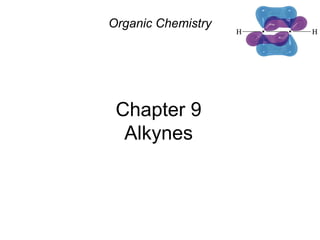
Alkynes
Organic Chemistry
Chapter 9 2
Introduction
• Alkynes contain a triple bond.
• General formula is CnH2n-2
• Two elements of unsaturation for each
triple bond.
• Some reactions are like alkenes:
addition and oxidation.
• Some reactions are specific to alkynes.
=>
Chapter 9 3
Nomenclature: IUPAC
• Find the longest chain containing the
triple bond.
• Change -ane ending to -yne.
• Number the chain, starting at the end
closest to the triple bond.
• Give branches or other substituents a
number to locate their position.
=>
Chapter 9 4
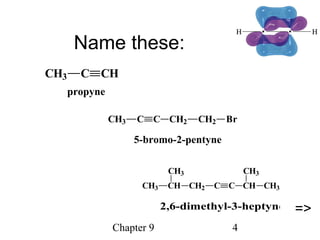
Name these:
CH3 CH
CH3
CH2 C C CH
CH3
CH3
CH3 C C CH2 CH2 Br
CH3 C CH
propyne
5-bromo-2-pentyne
2,6-dimethyl-3-heptyne =>
Chapter 9 5
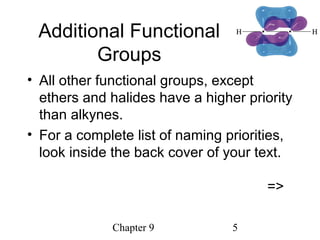
Additional Functional
Groups
• All other functional groups, except
ethers and halides have a higher priority
than alkynes.
• For a complete list of naming priorities,
look inside the back cover of your text.
=>
Chapter 9 6
Examples
CH2 CH CH2 CH
CH3
C CH
4-methyl-1-hexen-5-yne
CH3 C C CH2 CH
OH
CH3
4-hexyn-2-ol
=>
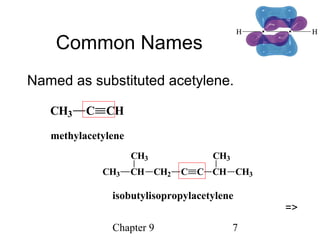
Chapter 9 7
Common Names
Named as substituted acetylene.
CH3 C CH
methylacetylene
CH3 CH
CH3
CH2 C C CH
CH3
CH3
isobutylisopropylacetylene
=>
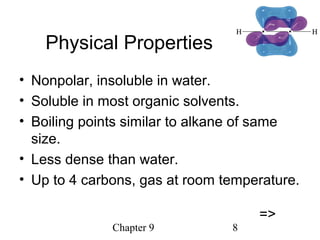
Chapter 9 8
Physical Properties
• Nonpolar, insoluble in water.
• Soluble in most organic solvents.
• Boiling points similar to alkane of same
size.
• Less dense than water.
• Up to 4 carbons, gas at room temperature.
=>
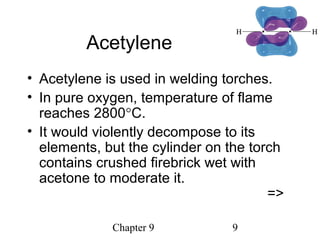
Chapter 9 9
Acetylene
• Acetylene is used in welding torches.
• In pure oxygen, temperature of flame
reaches 2800°C.
• It would violently decompose to its
elements, but the cylinder on the torch
contains crushed firebrick wet with
acetone to moderate it.
=>
Chapter 9 10
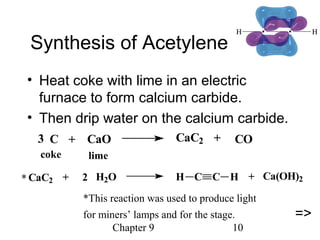
Synthesis of Acetylene
• Heat coke with lime in an electric
furnace to form calcium carbide.
• Then drip water on the calcium carbide.
H C C H Ca(OH)2CaC2 + 2 H2O +
C CaO3 + +CaC2 CO
coke lime
*This reaction was used to produce light
for miners’ lamps and for the stage. =>
*
Chapter 9 11
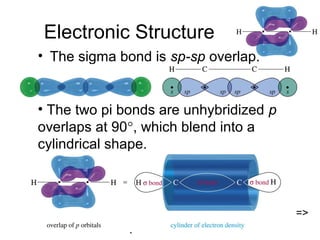
Electronic Structure
• The sigma bond is sp-sp overlap.
• The two pi bonds are unhybridized p
overlaps at 90°, which blend into a
cylindrical shape.
=>
Chapter 9 12
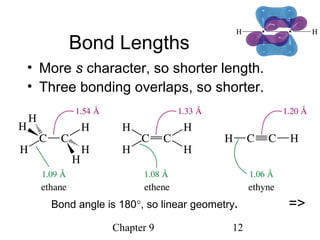
Bond Lengths
• More s character, so shorter length.
• Three bonding overlaps, so shorter.
Bond angle is 180°, so linear geometry. =>
Chapter 9 13
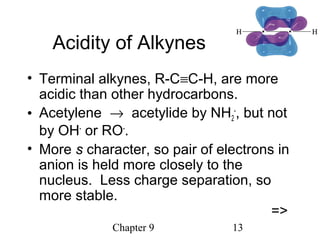
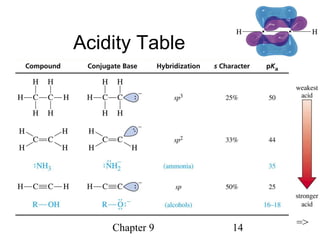
Acidity of Alkynes
• Terminal alkynes, R-C≡C-H, are more
acidic than other hydrocarbons.
• Acetylene → acetylide by NH2
-
, but not
by OH-
or RO-
.
• More s character, so pair of electrons in
anion is held more closely to the
nucleus. Less charge separation, so
more stable.
=>
Chapter 9 14
Acidity Table
=>
Chapter 9 15
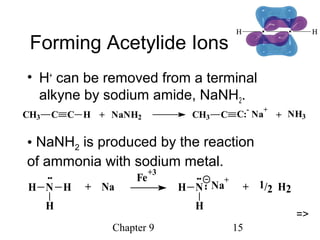
Forming Acetylide Ions
• H+
can be removed from a terminal
alkyne by sodium amide, NaNH2.
CH3 C C H + NaNH2 CH3 C C:
-
Na
+
+ NH3
• NaNH2 is produced by the reaction
of ammonia with sodium metal.
N H
H
H + Na
Fe
+3
+ 1/2 H2N
H
H Na
+
=>
Chapter 9 16
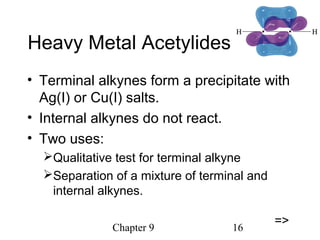
Heavy Metal Acetylides
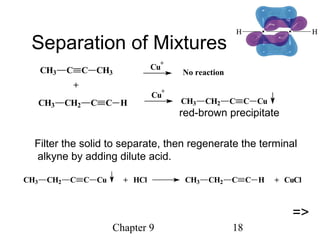
• Terminal alkynes form a precipitate with
Ag(I) or Cu(I) salts.
• Internal alkynes do not react.
• Two uses:
Qualitative test for terminal alkyne
Separation of a mixture of terminal and
internal alkynes.
=>
Chapter 9 17
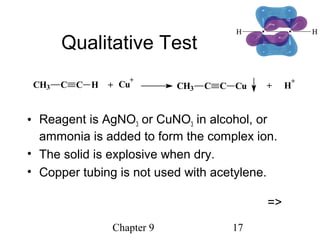
Qualitative Test
• Reagent is AgNO3 or CuNO3 in alcohol, or
ammonia is added to form the complex ion.
• The solid is explosive when dry.
• Copper tubing is not used with acetylene.
=>
CH3 C C H + Cu
+
CH3 C C Cu + H
+
Chapter 9 18
Separation of Mixtures
CH3 C C CH3
+
CH3 CH2 C C H
Cu
+
Cu
+
No reaction
CH3 CH2 C C Cu
red-brown precipitate
Filter the solid to separate, then regenerate the terminal
alkyne by adding dilute acid.
+ +CH3 CH2 C C Cu HCl CH3 CH2 C C H CuCl
=>
Chapter 9 19
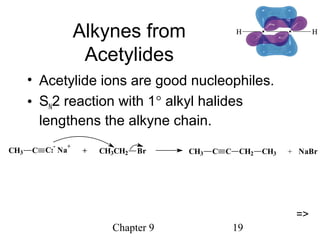
Alkynes from
Acetylides
• Acetylide ions are good nucleophiles.
• SN2 reaction with 1° alkyl halides
lengthens the alkyne chain.
++CH3 C C:
-
Na
+
CH3CH2 Br CH3 C C CH2 CH3 NaBr
=>
Chapter 9 20
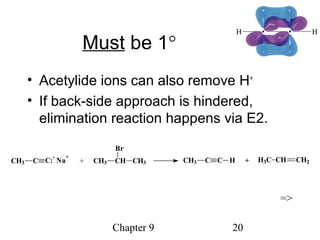
Must be 1°
• Acetylide ions can also remove H+
• If back-side approach is hindered,
elimination reaction happens via E2.
CH3 C C:
-
Na
+
+ CH3 CH
Br
CH3 CH3 C C H H3C CH CH2+
=>
Chapter 9 21
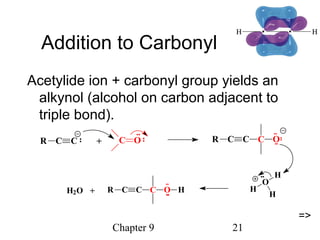
Addition to Carbonyl
Acetylide ion + carbonyl group yields an
alkynol (alcohol on carbon adjacent to
triple bond).
+H2O
O
H
H
HR C C C O H
=>
C O+R C C R C C C O
Chapter 9 22
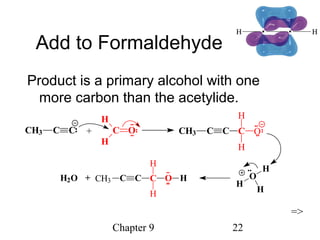
Add to Formaldehyde
Product is a primary alcohol with one
more carbon than the acetylide.
+ C O
H
H
CH3 C C CH3 C C C
H
H
O
=>
+H2O O
H
H
H
CH3 C C C O H
H
H
Chapter 9 23
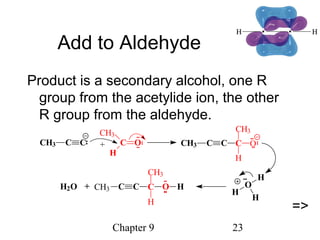
Add to Aldehyde
Product is a secondary alcohol, one R
group from the acetylide ion, the other
R group from the aldehyde.
+ C O
CH3
H
CH3 C C CH3 C C C
CH3
H
O
=>
+H2O O
H
H
H
CH3 C C C O H
CH3
H
Chapter 9 24
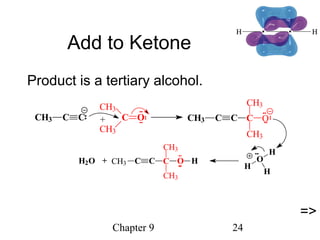
Add to Ketone
Product is a tertiary alcohol.
+ C O
CH3
CH3
CH3 C C CH3 C C C
CH3
CH3
O
=>
+H2O O
H
H
H
CH3 C C C O H
CH3
CH3
Chapter 9 25
Synthesis by
Elimination
• Removal of two molecules of HX from a
vicinal or geminal dihalide produces an
alkyne.
• First step (-HX) is easy, forms vinyl
halide.
• Second step, removal of HX from the
vinyl halide requires very strong base
and high temperatures.
=>
Chapter 9 26
Reagents for
Elimination
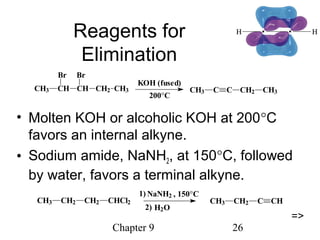
• Molten KOH or alcoholic KOH at 200°C
favors an internal alkyne.
• Sodium amide, NaNH2, at 150°C, followed
by water, favors a terminal alkyne.
CH3 C C CH2 CH3
200°C
KOH (fused)
CH3 CH CH CH2 CH3
Br Br
=>
, 150°C
CH3 CH2 C CH
H2O2)
NaNH21)
CH3 CH2 CH2 CHCl2
Chapter 9 27
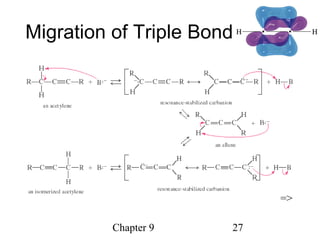
Migration of Triple Bond
=>
Chapter 9 28
Addition Reactions
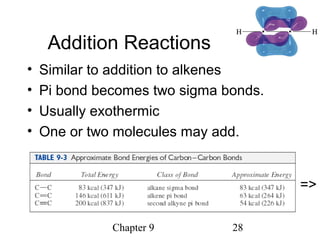
• Similar to addition to alkenes
• Pi bond becomes two sigma bonds.
• Usually exothermic
• One or two molecules may add.
=>
Chapter 9 29
Addition of Hydrogen
• Three reactions:
• Add lots of H2 with metal catalyst (Pd,
Pt, or Ni) to reduce alkyne to alkane,
completely saturated.
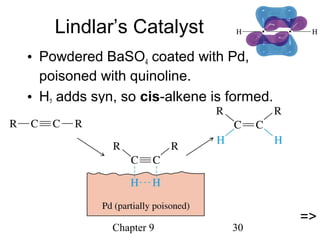
• Use a special catalyst, Lindlar’s catalyst
to convert an alkyne to a cis-alkene.
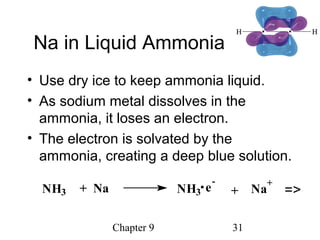
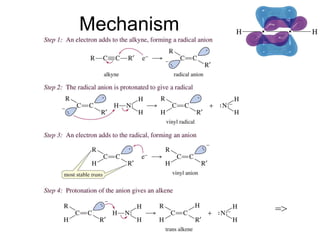
• React the alkyne with sodium in liquid
ammonia to form a trans-alkene.
=>
Chapter 9 30
Lindlar’s Catalyst
• Powdered BaSO4 coated with Pd,
poisoned with quinoline.
• H2 adds syn, so cis-alkene is formed.
=>
Chapter 9 31
Na in Liquid Ammonia
• Use dry ice to keep ammonia liquid.
• As sodium metal dissolves in the
ammonia, it loses an electron.
• The electron is solvated by the
ammonia, creating a deep blue solution.
NH3 + Na + Na
+
NH3 e
-
=>
Chapter 9 32
Mechanism
=>
Chapter 9 33
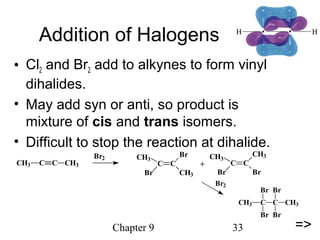
Addition of Halogens
• Cl2 and Br2 add to alkynes to form vinyl
dihalides.
• May add syn or anti, so product is
mixture of cis and trans isomers.
• Difficult to stop the reaction at dihalide.
CH3 C C CH3
Br2 CH3
C
Br
C
Br
CH3
+
CH3
C
Br
C
CH3
Br
Br2
CH3 C
Br
Br
C
Br
Br
CH3
=>
Chapter 9 34
Addition of HX
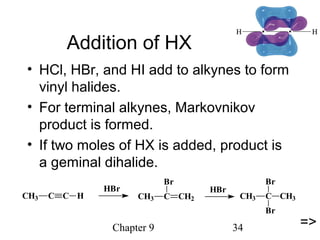
• HCl, HBr, and HI add to alkynes to form
vinyl halides.
• For terminal alkynes, Markovnikov
product is formed.
• If two moles of HX is added, product is
a geminal dihalide.
CH3 C C H CH3 C CH2
Br
HBr HBr
CH3 C CH3
Br
Br
=>
Chapter 9 35
HBr with Peroxides
Anti-Markovnikov product is formed with a
terminal alkyne.
CH3 C C H CH3 C C
H H
Br
HBr
ROOR
HBr
CH3 C C
H
H
H
Br
Br
ROOR
=>
Chapter 9 36
Hydration of Alkynes
• Mercuric sulfate in aqueous sulfuric
acid adds H-OH to one pi bond with a
Markovnikov orientation, forming a vinyl
alcohol (enol) that rearranges to a
ketone.
• Hydroboration-oxidation adds H-OH
with an anti-Markovnikov orientation,
and rearranges to an aldehyde.
=>
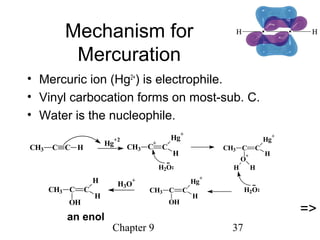
Chapter 9 37
Mechanism for
Mercuration
• Mercuric ion (Hg2+
) is electrophile.
• Vinyl carbocation forms on most-sub. C.
• Water is the nucleophile.
CH3 C C H CH3 C
+
C
Hg
+
H
Hg
+2
H2O
CH3 C
H
Hg
+
C
O
+
H H
H2OCH3 C
H
Hg
+
C
OH
H3O
+
CH3 C
H
H
C
OH
an enol
=>
Chapter 9 38
Enol to Keto (in Acid)
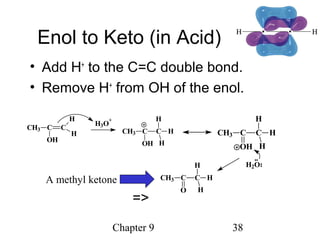
• Add H+
to the C=C double bond.
• Remove H+
from OH of the enol.
CH3 C C
OH
H
H
H
H2O
CH3 C C
O
H
H
H
CH3 C
H
H
C
OH
H3O
+
CH3 C C
OH
H
H
H
A methyl ketone
=>
Chapter 9 39
Hydroboration Reagent
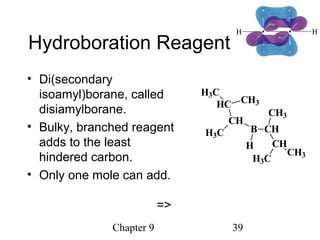
• Di(secondary
isoamyl)borane, called
disiamylborane.
• Bulky, branched reagent
adds to the least
hindered carbon.
• Only one mole can add.
=>
B
CH
CH
H
CH3
CH
CH3
H3C
H3C
HC CH3
H3C
Chapter 9 40
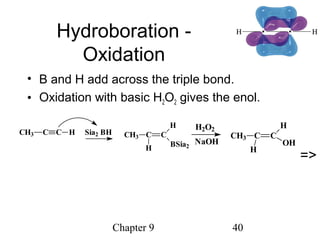
Hydroboration -
Oxidation
• B and H add across the triple bond.
• Oxidation with basic H2O2 gives the enol.
CH3 C C H CH3 C
H
C
H BSia2
Sia2 BH CH3 C
OH
H
C
H
H2O2
NaOH
=>
Chapter 9 41
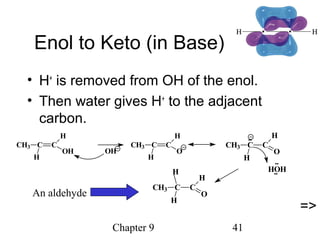
Enol to Keto (in Base)
• H+
is removed from OH of the enol.
• Then water gives H+
to the adjacent
carbon.
CH3 C
O
H
C
H
HOH
CH3 C
O
H
C
H
H
OH
CH3 C
OH
H
C
H
CH3 C
O
H
C
H
An aldehyde
=>
Chapter 9 42
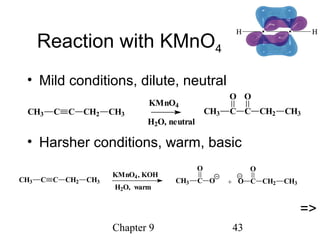
Oxidation of Alkynes
• Similar to oxidation of alkenes.
• Dilute, neutral solution of KMnO4
oxidizes alkynes to a diketone.
• Warm, basic KMnO4 cleaves the triple
bond.
• Ozonolysis, followed by hydrolysis,
cleaves the triple bond.
=>
Chapter 9 43
Reaction with KMnO4
• Mild conditions, dilute, neutral
• Harsher conditions, warm, basic
CH3 C
O
C
O
CH2 CH3
H2O, neutral
KMnO4
CH3 C C CH2 CH3
O C
O
CH2 CH3CH3 C
O
O +
H2O, warm
, KOHKMnO4
CH3 C C CH2 CH3
=>
Chapter 9 44
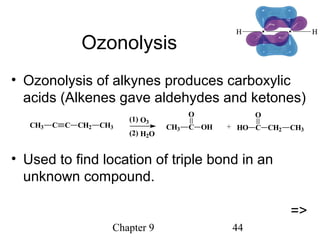
Ozonolysis
• Ozonolysis of alkynes produces carboxylic
acids (Alkenes gave aldehydes and ketones)
• Used to find location of triple bond in an
unknown compound.
=>
HO C
O
CH2 CH3CH3 C
O
OH
H2O(2)
O3(1)
CH3 C C CH2 CH3 +
Chapter 9 45
End of Chapter 9

Alkyne

  • 1.
  • 2.
    Chapter 9 2 Introduction •Alkynes contain a triple bond. • General formula is CnH2n-2 • Two elements of unsaturation for each triple bond. • Some reactions are like alkenes: addition and oxidation. • Some reactions are specific to alkynes. =>
  • 3.
    Chapter 9 3 Nomenclature:IUPAC • Find the longest chain containing the triple bond. • Change -ane ending to -yne. • Number the chain, starting at the end closest to the triple bond. • Give branches or other substituents a number to locate their position. =>
  • 4.
    Chapter 9 4 Namethese: CH3 CH CH3 CH2 C C CH CH3 CH3 CH3 C C CH2 CH2 Br CH3 C CH propyne 5-bromo-2-pentyne 2,6-dimethyl-3-heptyne =>
  • 5.
    Chapter 9 5 AdditionalFunctional Groups • All other functional groups, except ethers and halides have a higher priority than alkynes. • For a complete list of naming priorities, look inside the back cover of your text. =>
  • 6.
    Chapter 9 6 Examples CH2CH CH2 CH CH3 C CH 4-methyl-1-hexen-5-yne CH3 C C CH2 CH OH CH3 4-hexyn-2-ol =>
  • 7.
    Chapter 9 7 CommonNames Named as substituted acetylene. CH3 C CH methylacetylene CH3 CH CH3 CH2 C C CH CH3 CH3 isobutylisopropylacetylene =>
  • 8.
    Chapter 9 8 PhysicalProperties • Nonpolar, insoluble in water. • Soluble in most organic solvents. • Boiling points similar to alkane of same size. • Less dense than water. • Up to 4 carbons, gas at room temperature. =>
  • 9.
    Chapter 9 9 Acetylene •Acetylene is used in welding torches. • In pure oxygen, temperature of flame reaches 2800°C. • It would violently decompose to its elements, but the cylinder on the torch contains crushed firebrick wet with acetone to moderate it. =>
  • 10.
    Chapter 9 10 Synthesisof Acetylene • Heat coke with lime in an electric furnace to form calcium carbide. • Then drip water on the calcium carbide. H C C H Ca(OH)2CaC2 + 2 H2O + C CaO3 + +CaC2 CO coke lime *This reaction was used to produce light for miners’ lamps and for the stage. => *
  • 11.
    Chapter 9 11 ElectronicStructure • The sigma bond is sp-sp overlap. • The two pi bonds are unhybridized p overlaps at 90°, which blend into a cylindrical shape. =>
  • 12.
    Chapter 9 12 BondLengths • More s character, so shorter length. • Three bonding overlaps, so shorter. Bond angle is 180°, so linear geometry. =>
  • 13.
    Chapter 9 13 Acidityof Alkynes • Terminal alkynes, R-C≡C-H, are more acidic than other hydrocarbons. • Acetylene → acetylide by NH2 - , but not by OH- or RO- . • More s character, so pair of electrons in anion is held more closely to the nucleus. Less charge separation, so more stable. =>
  • 14.
  • 15.
    Chapter 9 15 FormingAcetylide Ions • H+ can be removed from a terminal alkyne by sodium amide, NaNH2. CH3 C C H + NaNH2 CH3 C C: - Na + + NH3 • NaNH2 is produced by the reaction of ammonia with sodium metal. N H H H + Na Fe +3 + 1/2 H2N H H Na + =>
  • 16.
    Chapter 9 16 HeavyMetal Acetylides • Terminal alkynes form a precipitate with Ag(I) or Cu(I) salts. • Internal alkynes do not react. • Two uses: Qualitative test for terminal alkyne Separation of a mixture of terminal and internal alkynes. =>
  • 17.
    Chapter 9 17 QualitativeTest • Reagent is AgNO3 or CuNO3 in alcohol, or ammonia is added to form the complex ion. • The solid is explosive when dry. • Copper tubing is not used with acetylene. => CH3 C C H + Cu + CH3 C C Cu + H +
  • 18.
    Chapter 9 18 Separationof Mixtures CH3 C C CH3 + CH3 CH2 C C H Cu + Cu + No reaction CH3 CH2 C C Cu red-brown precipitate Filter the solid to separate, then regenerate the terminal alkyne by adding dilute acid. + +CH3 CH2 C C Cu HCl CH3 CH2 C C H CuCl =>
  • 19.
    Chapter 9 19 Alkynesfrom Acetylides • Acetylide ions are good nucleophiles. • SN2 reaction with 1° alkyl halides lengthens the alkyne chain. ++CH3 C C: - Na + CH3CH2 Br CH3 C C CH2 CH3 NaBr =>
  • 20.
    Chapter 9 20 Mustbe 1° • Acetylide ions can also remove H+ • If back-side approach is hindered, elimination reaction happens via E2. CH3 C C: - Na + + CH3 CH Br CH3 CH3 C C H H3C CH CH2+ =>
  • 21.
    Chapter 9 21 Additionto Carbonyl Acetylide ion + carbonyl group yields an alkynol (alcohol on carbon adjacent to triple bond). +H2O O H H HR C C C O H => C O+R C C R C C C O
  • 22.
    Chapter 9 22 Addto Formaldehyde Product is a primary alcohol with one more carbon than the acetylide. + C O H H CH3 C C CH3 C C C H H O => +H2O O H H H CH3 C C C O H H H
  • 23.
    Chapter 9 23 Addto Aldehyde Product is a secondary alcohol, one R group from the acetylide ion, the other R group from the aldehyde. + C O CH3 H CH3 C C CH3 C C C CH3 H O => +H2O O H H H CH3 C C C O H CH3 H
  • 24.
    Chapter 9 24 Addto Ketone Product is a tertiary alcohol. + C O CH3 CH3 CH3 C C CH3 C C C CH3 CH3 O => +H2O O H H H CH3 C C C O H CH3 CH3
  • 25.
    Chapter 9 25 Synthesisby Elimination • Removal of two molecules of HX from a vicinal or geminal dihalide produces an alkyne. • First step (-HX) is easy, forms vinyl halide. • Second step, removal of HX from the vinyl halide requires very strong base and high temperatures. =>
  • 26.
    Chapter 9 26 Reagentsfor Elimination • Molten KOH or alcoholic KOH at 200°C favors an internal alkyne. • Sodium amide, NaNH2, at 150°C, followed by water, favors a terminal alkyne. CH3 C C CH2 CH3 200°C KOH (fused) CH3 CH CH CH2 CH3 Br Br => , 150°C CH3 CH2 C CH H2O2) NaNH21) CH3 CH2 CH2 CHCl2
  • 27.
    Chapter 9 27 Migrationof Triple Bond =>
  • 28.
    Chapter 9 28 AdditionReactions • Similar to addition to alkenes • Pi bond becomes two sigma bonds. • Usually exothermic • One or two molecules may add. =>
  • 29.
    Chapter 9 29 Additionof Hydrogen • Three reactions: • Add lots of H2 with metal catalyst (Pd, Pt, or Ni) to reduce alkyne to alkane, completely saturated. • Use a special catalyst, Lindlar’s catalyst to convert an alkyne to a cis-alkene. • React the alkyne with sodium in liquid ammonia to form a trans-alkene. =>
  • 30.
    Chapter 9 30 Lindlar’sCatalyst • Powdered BaSO4 coated with Pd, poisoned with quinoline. • H2 adds syn, so cis-alkene is formed. =>
  • 31.
    Chapter 9 31 Nain Liquid Ammonia • Use dry ice to keep ammonia liquid. • As sodium metal dissolves in the ammonia, it loses an electron. • The electron is solvated by the ammonia, creating a deep blue solution. NH3 + Na + Na + NH3 e - =>
  • 32.
  • 33.
    Chapter 9 33 Additionof Halogens • Cl2 and Br2 add to alkynes to form vinyl dihalides. • May add syn or anti, so product is mixture of cis and trans isomers. • Difficult to stop the reaction at dihalide. CH3 C C CH3 Br2 CH3 C Br C Br CH3 + CH3 C Br C CH3 Br Br2 CH3 C Br Br C Br Br CH3 =>
  • 34.
    Chapter 9 34 Additionof HX • HCl, HBr, and HI add to alkynes to form vinyl halides. • For terminal alkynes, Markovnikov product is formed. • If two moles of HX is added, product is a geminal dihalide. CH3 C C H CH3 C CH2 Br HBr HBr CH3 C CH3 Br Br =>
  • 35.
    Chapter 9 35 HBrwith Peroxides Anti-Markovnikov product is formed with a terminal alkyne. CH3 C C H CH3 C C H H Br HBr ROOR HBr CH3 C C H H H Br Br ROOR =>
  • 36.
    Chapter 9 36 Hydrationof Alkynes • Mercuric sulfate in aqueous sulfuric acid adds H-OH to one pi bond with a Markovnikov orientation, forming a vinyl alcohol (enol) that rearranges to a ketone. • Hydroboration-oxidation adds H-OH with an anti-Markovnikov orientation, and rearranges to an aldehyde. =>
  • 37.
    Chapter 9 37 Mechanismfor Mercuration • Mercuric ion (Hg2+ ) is electrophile. • Vinyl carbocation forms on most-sub. C. • Water is the nucleophile. CH3 C C H CH3 C + C Hg + H Hg +2 H2O CH3 C H Hg + C O + H H H2OCH3 C H Hg + C OH H3O + CH3 C H H C OH an enol =>
  • 38.
    Chapter 9 38 Enolto Keto (in Acid) • Add H+ to the C=C double bond. • Remove H+ from OH of the enol. CH3 C C OH H H H H2O CH3 C C O H H H CH3 C H H C OH H3O + CH3 C C OH H H H A methyl ketone =>
  • 39.
    Chapter 9 39 HydroborationReagent • Di(secondary isoamyl)borane, called disiamylborane. • Bulky, branched reagent adds to the least hindered carbon. • Only one mole can add. => B CH CH H CH3 CH CH3 H3C H3C HC CH3 H3C
  • 40.
    Chapter 9 40 Hydroboration- Oxidation • B and H add across the triple bond. • Oxidation with basic H2O2 gives the enol. CH3 C C H CH3 C H C H BSia2 Sia2 BH CH3 C OH H C H H2O2 NaOH =>
  • 41.
    Chapter 9 41 Enolto Keto (in Base) • H+ is removed from OH of the enol. • Then water gives H+ to the adjacent carbon. CH3 C O H C H HOH CH3 C O H C H H OH CH3 C OH H C H CH3 C O H C H An aldehyde =>
  • 42.
    Chapter 9 42 Oxidationof Alkynes • Similar to oxidation of alkenes. • Dilute, neutral solution of KMnO4 oxidizes alkynes to a diketone. • Warm, basic KMnO4 cleaves the triple bond. • Ozonolysis, followed by hydrolysis, cleaves the triple bond. =>
  • 43.
    Chapter 9 43 Reactionwith KMnO4 • Mild conditions, dilute, neutral • Harsher conditions, warm, basic CH3 C O C O CH2 CH3 H2O, neutral KMnO4 CH3 C C CH2 CH3 O C O CH2 CH3CH3 C O O + H2O, warm , KOHKMnO4 CH3 C C CH2 CH3 =>
  • 44.
    Chapter 9 44 Ozonolysis •Ozonolysis of alkynes produces carboxylic acids (Alkenes gave aldehydes and ketones) • Used to find location of triple bond in an unknown compound. => HO C O CH2 CH3CH3 C O OH H2O(2) O3(1) CH3 C C CH2 CH3 +
  • 45.
    Chapter 9 45 Endof Chapter 9