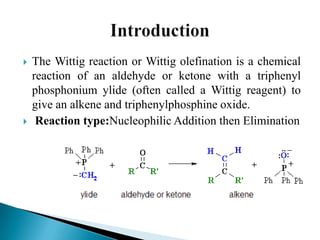
 The Wittig reaction or Wittig olefination is a chemical
reaction of an aldehyde or ketone with a triphenyl
phosphonium ylide (often called a Wittig reagent) to
give an alkene and triphenylphosphine oxide.
 Reaction type:Nucleophilic Addition then Elimination
 Alkene formation from carbonyl compounds and
phosphonium ylides, proceeding primarily through the
proposed betaine and/or oxaphosphetane intermediates. The
stereoselectivity can be controlled by the choice of ylide,
carbonyl compound, and reaction conditions.
 When the ylide is replaced with a phosphine oxide
carbanion, the reaction is referred to as the Horner
reaction.
 When the ylide is replaced with a phosphonate carbanion,
the reaction is referred to as the Horner-Emmons-
Wadsworth reaction.
 The “Wittig Reaction” is one of the premier methods
for the synthesis of alkenes.
 It uses a carbonyl compound as an electrophile, which
is attacked by a “phosphorus ylide”.
 The Wittig reaction is nicely complementary to the
aldol condensation, in which carbonyl compounds are
attacked not by a phosphorus ylide but by an enolate.
Aldol condensations always result in “enones”, alkenes
with a carbonyl attached.
 Wittig reactions are more general in that the product
carbonyl does not need to have an attached carbonyl.
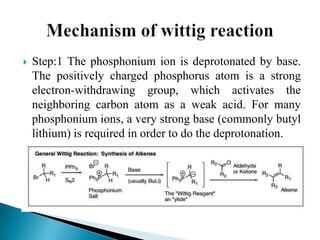
 Step:1 The phosphonium ion is deprotonated by base.
The positively charged phosphorus atom is a strong
electron-withdrawing group, which activates the
neighboring carbon atom as a weak acid. For many
phosphonium ions, a very strong base (commonly butyl
lithium) is required in order to do the deprotonation.
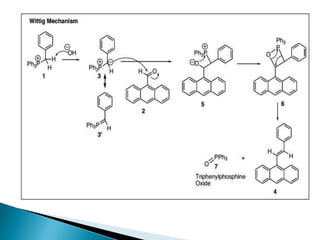
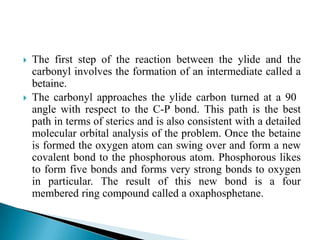
 The first step of the reaction between the ylide and the
carbonyl involves the formation of an intermediate called a
betaine.
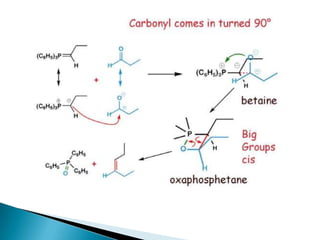
 The carbonyl approaches the ylide carbon turned at a 90
angle with respect to the C-P bond. This path is the best
path in terms of sterics and is also consistent with a detailed
molecular orbital analysis of the problem. Once the betaine
is formed the oxygen atom can swing over and form a new
covalent bond to the phosphorous atom. Phosphorous likes
to form five bonds and forms very strong bonds to oxygen
in particular. The result of this new bond is a four
membered ring compound called a oxaphosphetane.
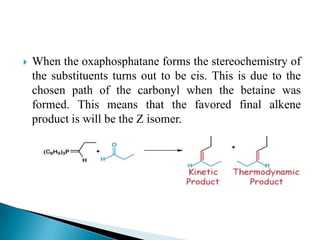
 When the oxaphosphatane forms the stereochemistry of
the substituents turns out to be cis. This is due to the
chosen path of the carbonyl when the betaine was
formed. This means that the favored final alkene
product is will be the Z isomer.
 The Wittig reaction is an important method for the
formation of alkenes.
 The double bond forms specifically at the location of the
original aldehyde or ketone.
 Ylides are neutral molecules but have +ve and -ve centers
on adjacent atoms that are connected by a s bond.
 The ylide is prepared via a two step process:
 preparation of a phosphorous ylide.
 An SN2 reaction between triphenyl phosphine and an alkyl
halide followed by treatment with a strong base such as an
organolithium reagent.

Wittig reaction

  • 2.
     The Wittigreaction or Wittig olefination is a chemical reaction of an aldehyde or ketone with a triphenyl phosphonium ylide (often called a Wittig reagent) to give an alkene and triphenylphosphine oxide.  Reaction type:Nucleophilic Addition then Elimination
  • 3.
     Alkene formationfrom carbonyl compounds and phosphonium ylides, proceeding primarily through the proposed betaine and/or oxaphosphetane intermediates. The stereoselectivity can be controlled by the choice of ylide, carbonyl compound, and reaction conditions.  When the ylide is replaced with a phosphine oxide carbanion, the reaction is referred to as the Horner reaction.  When the ylide is replaced with a phosphonate carbanion, the reaction is referred to as the Horner-Emmons- Wadsworth reaction.
  • 4.
     The “WittigReaction” is one of the premier methods for the synthesis of alkenes.  It uses a carbonyl compound as an electrophile, which is attacked by a “phosphorus ylide”.  The Wittig reaction is nicely complementary to the aldol condensation, in which carbonyl compounds are attacked not by a phosphorus ylide but by an enolate. Aldol condensations always result in “enones”, alkenes with a carbonyl attached.  Wittig reactions are more general in that the product carbonyl does not need to have an attached carbonyl.
  • 5.
     Step:1 Thephosphonium ion is deprotonated by base. The positively charged phosphorus atom is a strong electron-withdrawing group, which activates the neighboring carbon atom as a weak acid. For many phosphonium ions, a very strong base (commonly butyl lithium) is required in order to do the deprotonation.
  • 7.
     The firststep of the reaction between the ylide and the carbonyl involves the formation of an intermediate called a betaine.  The carbonyl approaches the ylide carbon turned at a 90 angle with respect to the C-P bond. This path is the best path in terms of sterics and is also consistent with a detailed molecular orbital analysis of the problem. Once the betaine is formed the oxygen atom can swing over and form a new covalent bond to the phosphorous atom. Phosphorous likes to form five bonds and forms very strong bonds to oxygen in particular. The result of this new bond is a four membered ring compound called a oxaphosphetane.
  • 9.
     When theoxaphosphatane forms the stereochemistry of the substituents turns out to be cis. This is due to the chosen path of the carbonyl when the betaine was formed. This means that the favored final alkene product is will be the Z isomer.
  • 10.
     The Wittigreaction is an important method for the formation of alkenes.  The double bond forms specifically at the location of the original aldehyde or ketone.  Ylides are neutral molecules but have +ve and -ve centers on adjacent atoms that are connected by a s bond.  The ylide is prepared via a two step process:  preparation of a phosphorous ylide.  An SN2 reaction between triphenyl phosphine and an alkyl halide followed by treatment with a strong base such as an organolithium reagent.