2/12/2013   By Mohd Anzar Sakharkar   1
Hydrolysis
 Hydrolysis usually means the cleavage of
  chemical bonds by the addition of water.


2/12/2013          By Mohd Anzar Sakharkar   2
Ester Hydrolysis
The splitting of an ester into the component acid and alcohol is
known as ester hydrolysis.
In principle, these reactions are reversible, and both reactions can
be catalysed either by acids or bases.


 2/12/2013                 By Mohd Anzar Sakharkar                 3
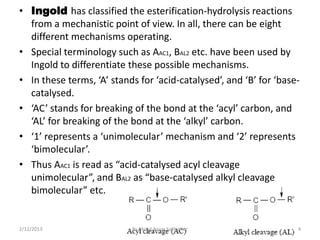
• Ingold has classified the esterification-hydrolysis reactions
  from a mechanistic point of view. In all, there can be eight
  different mechanisms operating.
• Special terminology such as AAC1, BAL2 etc. have been used by
  Ingold to differentiate these possible mechanisms.
• In these terms, ‘A’ stands for ‘acid-catalysed’, and ‘B’ for ‘base-
  catalysed.
• ‘AC’ stands for breaking of the bond at the ‘acyl’ carbon, and
  ‘AL’ for breaking of the bond at the ‘alkyl’ carbon.
• ‘1’ represents a ‘unimolecular’ mechanism and ‘2’ represents
  ‘bimolecular’.
• Thus AAC1 is read as “acid-catalysed acyl cleavage
  unimolecular”, and BAL2 as “base-catalysed alkyl cleavage
  bimolecular” etc.


2/12/2013                  By Mohd Anzar Sakharkar                  4
• When hydrolysis is carried out using H2O18
  (oxygen-labelled water), the O18 appears in the
   acid part of the product and not in the
   alcohol.


2/12/2013          By Mohd Anzar Sakharkar      5
2/12/2013   By Mohd Anzar Sakharkar   6
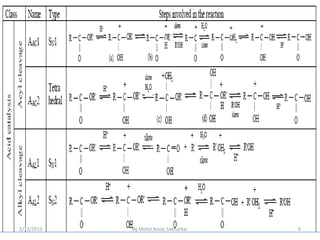
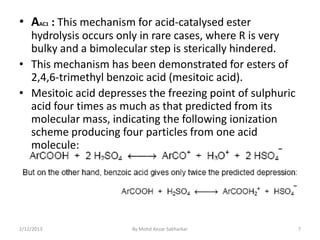
• AAC1 : This mechanism for acid-catalysed ester
  hydrolysis occurs only in rare cases, where R is very
  bulky and a bimolecular step is sterically hindered.
• This mechanism has been demonstrated for esters of
  2,4,6-trimethyl benzoic acid (mesitoic acid).
• Mesitoic acid depresses the freezing point of sulphuric
  acid four times as much as that predicted from its
  molecular mass, indicating the following ionization
  scheme producing four particles from one acid
  molecule:


2/12/2013              By Mohd Anzar Sakharkar              7
• This indicates the formation of the acyl
  carbonium ion in the case of mesitoic acid, but
  not for benzoic acid.
• Another proof is provided by the observation
  that mesitoic acid is formed when a solution
  of methyl mesitoate in sulphuric acid is
  poured into water, but benzoic acid is not
  obtained from methyl benzoate under similar
  conditions.


2/12/2013          By Mohd Anzar Sakharkar      8
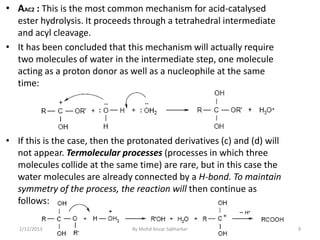
• AAC2 : This is the most common mechanism for acid-catalysed
  ester hydrolysis. It proceeds through a tetrahedral intermediate
  and acyl cleavage.
• It has been concluded that this mechanism will actually require
  two molecules of water in the intermediate step, one molecule
  acting as a proton donor as well as a nucleophile at the same
  time:


• If this is the case, then the protonated derivatives (c) and (d) will
  not appear. Termolecular processes (processes in which three
  molecules collide at the same time) are rare, but in this case the
  water molecules are already connected by a H-bond. To maintain
  symmetry of the process, the reaction will then continue as
  follows:

   2/12/2013                    By Mohd Anzar Sakharkar                   9
• AAL1 : This mechanism occurs very readily when R’ easily comes
  off as a stable carbonium ion, ie., whenR’ is tertiary alkyl, allyl,
  benzyl etc. This is the common mechanism for acid hydrolysis of
  esters of tertiary alcohols.
• This mechanism has been confirmed by kinetic studies, O18
  labeling and isomerisation in R’.
• Secondary and benzylic acetates hydrolyse by the AAC2
  mechanism in dilute sulfuric acid, but the mechanism is AAL1 in
  concentrated acid.
• AAL2 : This mechanism has not actually been observed in ester
  hydrolysis. This is probably because it requires water to act as a
  nucleophile in an SN2 process, and is quite unlikely to happen.


   2/12/2013                  By Mohd Anzar Sakharkar               10
2/12/2013   By Mohd Anzar Sakharkar   11
• BAC1 : This mechanism has also not actually
  been observed in ester hydrolysis. This may be
  because it is an SN1 mechanism in which OR’
  acts as a leaving group, which is extremely
  unlikely.
• BAC2 : This is the most common mechanism for
  base-catalysed ester hydrolysis, and proceeds
  through a tetrahedral intermediate with acyl
  cleavage.


2/12/2013           By Mohd Anzar Sakharkar        12
• BAL1 : This mechanism also occurs very readily when R’
  easily comes off as a stable carbonium ion as in the case of
  AAL1 mechanism.
• This mechanism occurs only in neutral or weakly basic
  solutions, where the rate of attack by OH¯ is so slow such
  that the normally unlikely unimolecular mechanism takes
  over.
• Under such conditions, this mechanism has been confirmed
  by kinetic studies, O18 labeling and isomerisation in R’.
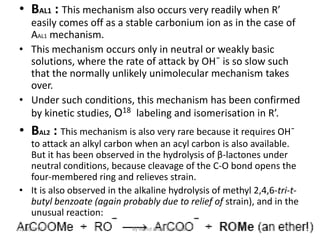
• BAL2 : This mechanism is also very rare because it requires OH¯
  to attack an alkyl carbon when an acyl carbon is also available.
  But it has been observed in the hydrolysis of β-lactones under
  neutral conditions, because cleavage of the C-O bond opens the
  four-membered ring and relieves strain.
• It is also observed in the alkaline hydrolysis of methyl 2,4,6-tri-t-
  butyl benzoate (again probably due to relief of strain), and in the
  unusual reaction:
2/12/2013                   By Mohd Anzar Sakharkar                   13
BIBILIOGRAPHY
• Ref: Jerry March, “Advanced Organic
  Chemistry: Reactions, Mechanisms, and
  Structure”, 2nd edn.,McGraw-Hill, 1977, p
  349-53


2/12/2013          By Mohd Anzar Sakharkar    14

acid base catalysed Ester hydrolysis

  • 1.
    2/12/2013 By Mohd Anzar Sakharkar 1
  • 2.
    Hydrolysis Hydrolysis usuallymeans the cleavage of chemical bonds by the addition of water. 2/12/2013 By Mohd Anzar Sakharkar 2
  • 3.
    Ester Hydrolysis The splittingof an ester into the component acid and alcohol is known as ester hydrolysis. In principle, these reactions are reversible, and both reactions can be catalysed either by acids or bases. 2/12/2013 By Mohd Anzar Sakharkar 3
  • 4.
    • Ingold hasclassified the esterification-hydrolysis reactions from a mechanistic point of view. In all, there can be eight different mechanisms operating. • Special terminology such as AAC1, BAL2 etc. have been used by Ingold to differentiate these possible mechanisms. • In these terms, ‘A’ stands for ‘acid-catalysed’, and ‘B’ for ‘base- catalysed. • ‘AC’ stands for breaking of the bond at the ‘acyl’ carbon, and ‘AL’ for breaking of the bond at the ‘alkyl’ carbon. • ‘1’ represents a ‘unimolecular’ mechanism and ‘2’ represents ‘bimolecular’. • Thus AAC1 is read as “acid-catalysed acyl cleavage unimolecular”, and BAL2 as “base-catalysed alkyl cleavage bimolecular” etc. 2/12/2013 By Mohd Anzar Sakharkar 4
  • 5.
    • When hydrolysisis carried out using H2O18 (oxygen-labelled water), the O18 appears in the acid part of the product and not in the alcohol. 2/12/2013 By Mohd Anzar Sakharkar 5
  • 6.
    2/12/2013 By Mohd Anzar Sakharkar 6
  • 7.
    • AAC1 :This mechanism for acid-catalysed ester hydrolysis occurs only in rare cases, where R is very bulky and a bimolecular step is sterically hindered. • This mechanism has been demonstrated for esters of 2,4,6-trimethyl benzoic acid (mesitoic acid). • Mesitoic acid depresses the freezing point of sulphuric acid four times as much as that predicted from its molecular mass, indicating the following ionization scheme producing four particles from one acid molecule: 2/12/2013 By Mohd Anzar Sakharkar 7
  • 8.
    • This indicatesthe formation of the acyl carbonium ion in the case of mesitoic acid, but not for benzoic acid. • Another proof is provided by the observation that mesitoic acid is formed when a solution of methyl mesitoate in sulphuric acid is poured into water, but benzoic acid is not obtained from methyl benzoate under similar conditions. 2/12/2013 By Mohd Anzar Sakharkar 8
  • 9.
    • AAC2 :This is the most common mechanism for acid-catalysed ester hydrolysis. It proceeds through a tetrahedral intermediate and acyl cleavage. • It has been concluded that this mechanism will actually require two molecules of water in the intermediate step, one molecule acting as a proton donor as well as a nucleophile at the same time: • If this is the case, then the protonated derivatives (c) and (d) will not appear. Termolecular processes (processes in which three molecules collide at the same time) are rare, but in this case the water molecules are already connected by a H-bond. To maintain symmetry of the process, the reaction will then continue as follows: 2/12/2013 By Mohd Anzar Sakharkar 9
  • 10.
    • AAL1 :This mechanism occurs very readily when R’ easily comes off as a stable carbonium ion, ie., whenR’ is tertiary alkyl, allyl, benzyl etc. This is the common mechanism for acid hydrolysis of esters of tertiary alcohols. • This mechanism has been confirmed by kinetic studies, O18 labeling and isomerisation in R’. • Secondary and benzylic acetates hydrolyse by the AAC2 mechanism in dilute sulfuric acid, but the mechanism is AAL1 in concentrated acid. • AAL2 : This mechanism has not actually been observed in ester hydrolysis. This is probably because it requires water to act as a nucleophile in an SN2 process, and is quite unlikely to happen. 2/12/2013 By Mohd Anzar Sakharkar 10
  • 11.
    2/12/2013 By Mohd Anzar Sakharkar 11
  • 12.
    • BAC1 :This mechanism has also not actually been observed in ester hydrolysis. This may be because it is an SN1 mechanism in which OR’ acts as a leaving group, which is extremely unlikely. • BAC2 : This is the most common mechanism for base-catalysed ester hydrolysis, and proceeds through a tetrahedral intermediate with acyl cleavage. 2/12/2013 By Mohd Anzar Sakharkar 12
  • 13.
    • BAL1 :This mechanism also occurs very readily when R’ easily comes off as a stable carbonium ion as in the case of AAL1 mechanism. • This mechanism occurs only in neutral or weakly basic solutions, where the rate of attack by OH¯ is so slow such that the normally unlikely unimolecular mechanism takes over. • Under such conditions, this mechanism has been confirmed by kinetic studies, O18 labeling and isomerisation in R’. • BAL2 : This mechanism is also very rare because it requires OH¯ to attack an alkyl carbon when an acyl carbon is also available. But it has been observed in the hydrolysis of β-lactones under neutral conditions, because cleavage of the C-O bond opens the four-membered ring and relieves strain. • It is also observed in the alkaline hydrolysis of methyl 2,4,6-tri-t- butyl benzoate (again probably due to relief of strain), and in the unusual reaction: 2/12/2013 By Mohd Anzar Sakharkar 13
  • 14.
    BIBILIOGRAPHY • Ref: JerryMarch, “Advanced Organic Chemistry: Reactions, Mechanisms, and Structure”, 2nd edn.,McGraw-Hill, 1977, p 349-53 2/12/2013 By Mohd Anzar Sakharkar 14