Retrosynthetic Analysis of Organic Synthesis Introduction Synthetic Methods Total Synthesis by Retrosynthetic Analysis
  Retrosynthetic (or antisynthetic) analysis is a problem-solving technique for transforming the structure of a synthetic target (TG) molecule to a sequence of progressively simpler structures along a pathway which ultimately leads to simple or commercially available starting materials for a chemical synthesis. The transformation of a molecule to a synthetic processor is accomplished by the application of a transform, the extract reverse of a synthetic reactions. E. J. Corey, 1989
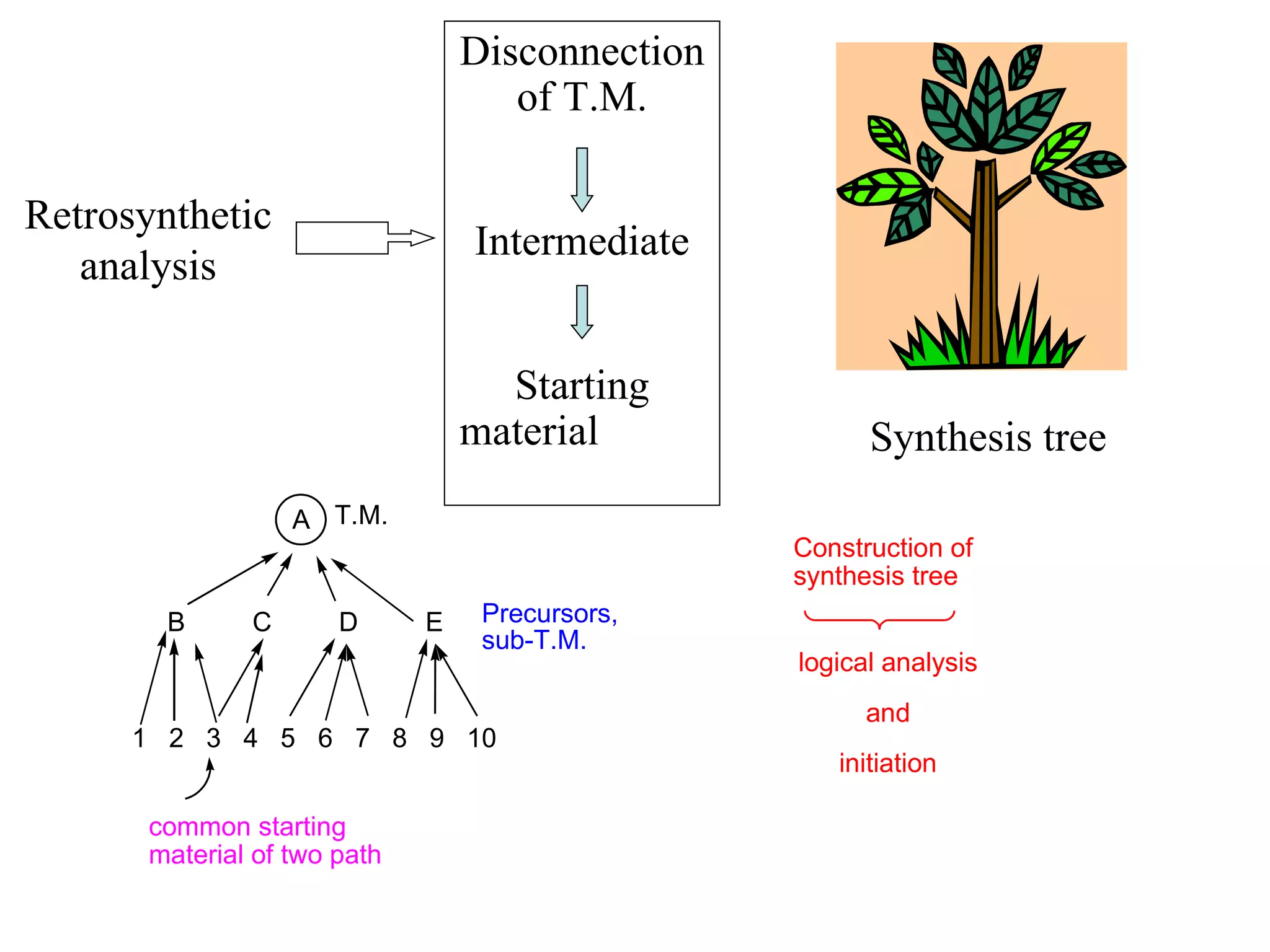
Retrosynthetic analysis Disconnection of T.M. Intermediate Starting material  Synthesis tree
3.2 Common terms in retrosynthetic analysis FGI ( functional group interconversion) disconnection : ~~~~ position ;  process synthons: fragments from disconnection synthetic equivalents: reagents as synthons
Factors in Design of Synthesis Cheapest starting material Least number of steps High Yield In commercial syntheses, costs of starting materials and economy of operations play a dominant role, whereas in many syntheses carried out for research purposes, the dispatch with which a compound can be obtained is more important.
Reactions involved in Synthesis Skeleton construction- construction from smaller units called synthons Functional alteration- interconversion of the functional groups on the skeleton .
Major Ionic Reactions for Carbon
Pericyclic Reactions Diels-Alder Reaction [2+2] Cycloaddition Reaction Cope and Claisen Rearrangements
Rearrangements Useful in Synthesis
Criteria for Evaluating Synthetic Methods Convergent Synthesis- two or more fragments of the molecule are assembled separately and are then brought together at a late stage in the synthesis Linear Synthesis – the molecule is constructed in a stepwise fashion.
Key Points in Designing Synthesis The relationship between functional groups in a target molecule may reveal disconnections in the retrosynthetic analysis. Other disconnections may be revealed by functional group interconversions. The identification of particular rings may suggest specific strategies A convergent synthesis has significant advantages over a linear synthesis.
Grignard and related organometallic reagents Grignard reagents (RMgX)   Organozinc reagents Alkyl- and aryl-lithium compounds Organocopper reagents Organopalladium reagents
Organometallic and Ylide Methods of Carbon-Carbon Bond Formation
Stereochemistry  of Grignard Addition
Orthometallation Cross Coupling (Suzuki Rxn 1,4-Addition
Acetylides and Nitriles
Wittig Reaction
Carbonyl Activation and Enolate Chemistry in Carbon-Carbon Bond Formation
 
Regiospecificity in Enol Ether Formation
Carbanion Generators
Alkylation of Carbanion CH 3 -OSO 2 F methyl fluorosulfonate oxirane (epoxide) CH 3 -OSO 2 O-CH 3 dimethyl sulfate (R-OTs) toluene-p-sulfonates (or tosylates) R-OSO 2 CH 3 (R-OMs) methanesulfnates (or mesylates) R-X alkyl halide Structure Alkylating agent
Enolate Anions in Carbonyl Addition Reactions Aldol Condensation-the electron-deficient carbon is an aldehyde or ketone and the product is a   -hydroxy ketone or an   ,  -unsaturated ketone Claisen Condensation- the electron-deficient carbon is an ester carbon and the product is a 1,3-diketone or   -keto ester. Michael Condensation (addition)- the electron-deficient carbon is the b-carbon of an   ,  -unsaturated ketone and the product is a 1,5-diketone.
Aldol Condensation
Claisen Condensation
Michael Addition
4. Robinson annulation - a special class of Michael additions which lead to one six-membered ring fused to another
Functional Group Interconversion Dehydrogenation Rxn- Sulfur, Selenium, DDQ, Chloranil Oxidation of Alcohols- Chromium (VI), Swern Oxidation, Dess-Martin periodinane oxidation Oxidation of alkenes-Epoxidation, O3, OsO4 Bayer-Villiger Oxidation
General Pattern of Reduction
Reductions with Hydride Reagents
Carbocations in Synthesis Friedel-Craft Alkylation, Acylation Prins Reaction- alkene (aromatic) + H 2 CO, conc. HCl, ZnCl 2 Mannich Reaction- H 2 CO, N(CH 3 ) 2 , Ketone ( generate   ,  -unsaturated ketone )
Free Radical and Pericyclic Reactions Benzoyl peroxide, AIBN (azobisisobutyronitrile) – Polymerization AIBN/Bu 3 SnH – cyclization reaction Carbene Formation- CH 2 I 2 , Zn/Cu (Simon-Smith Rxn)
Alkene Metathesis Grubb’s Catalyst- using this catalyst, the reaction between two alkenes, a=b and c=d, the bonding partners are interchanged to give  a=c and b=d.
Protection Groups 1. Protection of alcohol a. Methylethers (allyl ether, benzyl ether, triphenylmethyl ether, methoxymethyl ether b. Silyl ethers (trimethyl silyl, triethylsilyl, TBDMS c. Protection of Carboxylic Acids 2. Protection of Carboxylic Acids 2,2,2-trichloroethyl ester  -(trimethylsilyl)ethoxymethyl ester 3. Protection of Carbonyl  Groups Formation of 1,3-dioxolanes from ethane-1,2-diol (provide selectivity for compounds containing two carbonyl groups Formation of thioacetals from ethane-1,2-dithioacetal (needs Hg or Cd salts) Amino Groups N-terminal – Cbz or Z (benzyloxycarbonyl), Boc (t-butoxycarbonyl) – stable to basic condition 9-fluorenylmethoxycarbonyl (Fmoc)- acid stable but base labile C-terminal- activation with DCC (Dicyclohexylcarbodiimide
Retrosynthesis
Synthesis


Organic Synthesis

  • 1.
    Retrosynthetic Analysis ofOrganic Synthesis Introduction Synthetic Methods Total Synthesis by Retrosynthetic Analysis
  • 2.
    Retrosynthetic(or antisynthetic) analysis is a problem-solving technique for transforming the structure of a synthetic target (TG) molecule to a sequence of progressively simpler structures along a pathway which ultimately leads to simple or commercially available starting materials for a chemical synthesis. The transformation of a molecule to a synthetic processor is accomplished by the application of a transform, the extract reverse of a synthetic reactions. E. J. Corey, 1989
  • 3.
    Retrosynthetic analysis Disconnectionof T.M. Intermediate Starting material Synthesis tree
  • 4.
    3.2 Common termsin retrosynthetic analysis FGI ( functional group interconversion) disconnection : ~~~~ position ;  process synthons: fragments from disconnection synthetic equivalents: reagents as synthons
  • 5.
    Factors in Designof Synthesis Cheapest starting material Least number of steps High Yield In commercial syntheses, costs of starting materials and economy of operations play a dominant role, whereas in many syntheses carried out for research purposes, the dispatch with which a compound can be obtained is more important.
  • 6.
    Reactions involved inSynthesis Skeleton construction- construction from smaller units called synthons Functional alteration- interconversion of the functional groups on the skeleton .
  • 7.
  • 8.
    Pericyclic Reactions Diels-AlderReaction [2+2] Cycloaddition Reaction Cope and Claisen Rearrangements
  • 9.
  • 10.
    Criteria for EvaluatingSynthetic Methods Convergent Synthesis- two or more fragments of the molecule are assembled separately and are then brought together at a late stage in the synthesis Linear Synthesis – the molecule is constructed in a stepwise fashion.
  • 11.
    Key Points inDesigning Synthesis The relationship between functional groups in a target molecule may reveal disconnections in the retrosynthetic analysis. Other disconnections may be revealed by functional group interconversions. The identification of particular rings may suggest specific strategies A convergent synthesis has significant advantages over a linear synthesis.
  • 12.
    Grignard and relatedorganometallic reagents Grignard reagents (RMgX) Organozinc reagents Alkyl- and aryl-lithium compounds Organocopper reagents Organopalladium reagents
  • 13.
    Organometallic and YlideMethods of Carbon-Carbon Bond Formation
  • 14.
    Stereochemistry ofGrignard Addition
  • 15.
    Orthometallation Cross Coupling(Suzuki Rxn 1,4-Addition
  • 16.
  • 17.
  • 18.
    Carbonyl Activation andEnolate Chemistry in Carbon-Carbon Bond Formation
  • 19.
  • 20.
    Regiospecificity in EnolEther Formation
  • 21.
  • 22.
    Alkylation of CarbanionCH 3 -OSO 2 F methyl fluorosulfonate oxirane (epoxide) CH 3 -OSO 2 O-CH 3 dimethyl sulfate (R-OTs) toluene-p-sulfonates (or tosylates) R-OSO 2 CH 3 (R-OMs) methanesulfnates (or mesylates) R-X alkyl halide Structure Alkylating agent
  • 23.
    Enolate Anions inCarbonyl Addition Reactions Aldol Condensation-the electron-deficient carbon is an aldehyde or ketone and the product is a  -hydroxy ketone or an  ,  -unsaturated ketone Claisen Condensation- the electron-deficient carbon is an ester carbon and the product is a 1,3-diketone or  -keto ester. Michael Condensation (addition)- the electron-deficient carbon is the b-carbon of an  ,  -unsaturated ketone and the product is a 1,5-diketone.
  • 24.
  • 25.
  • 26.
  • 27.
    4. Robinson annulation- a special class of Michael additions which lead to one six-membered ring fused to another
  • 28.
    Functional Group InterconversionDehydrogenation Rxn- Sulfur, Selenium, DDQ, Chloranil Oxidation of Alcohols- Chromium (VI), Swern Oxidation, Dess-Martin periodinane oxidation Oxidation of alkenes-Epoxidation, O3, OsO4 Bayer-Villiger Oxidation
  • 29.
  • 30.
  • 31.
    Carbocations in SynthesisFriedel-Craft Alkylation, Acylation Prins Reaction- alkene (aromatic) + H 2 CO, conc. HCl, ZnCl 2 Mannich Reaction- H 2 CO, N(CH 3 ) 2 , Ketone ( generate  ,  -unsaturated ketone )
  • 32.
    Free Radical andPericyclic Reactions Benzoyl peroxide, AIBN (azobisisobutyronitrile) – Polymerization AIBN/Bu 3 SnH – cyclization reaction Carbene Formation- CH 2 I 2 , Zn/Cu (Simon-Smith Rxn)
  • 33.
    Alkene Metathesis Grubb’sCatalyst- using this catalyst, the reaction between two alkenes, a=b and c=d, the bonding partners are interchanged to give a=c and b=d.
  • 34.
    Protection Groups 1.Protection of alcohol a. Methylethers (allyl ether, benzyl ether, triphenylmethyl ether, methoxymethyl ether b. Silyl ethers (trimethyl silyl, triethylsilyl, TBDMS c. Protection of Carboxylic Acids 2. Protection of Carboxylic Acids 2,2,2-trichloroethyl ester  -(trimethylsilyl)ethoxymethyl ester 3. Protection of Carbonyl Groups Formation of 1,3-dioxolanes from ethane-1,2-diol (provide selectivity for compounds containing two carbonyl groups Formation of thioacetals from ethane-1,2-dithioacetal (needs Hg or Cd salts) Amino Groups N-terminal – Cbz or Z (benzyloxycarbonyl), Boc (t-butoxycarbonyl) – stable to basic condition 9-fluorenylmethoxycarbonyl (Fmoc)- acid stable but base labile C-terminal- activation with DCC (Dicyclohexylcarbodiimide
  • 35.
  • 36.
  • 37.
  • 38.
  • 39.
  • 40.
  • 41.
  • 42.
  • 43.
  • 44.