Chapter 20.3 and 4Saturated and Unsaturated Hydrocarbons
Objectives:Distinguish among the structures of alkanes, alkenes, alkynes, and aromatic hydrocarbonsWrite structural formulas and names for alkanes, alkenes, and alkynesRelate properties of different types of hydrocarbons to their structures.
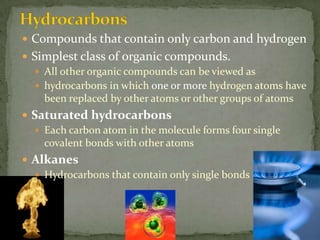
HydrocarbonsCompounds that contain only carbon and hydrogenSimplest class of organic compounds.All other organic compounds can be viewed ashydrocarbons in which one or more hydrogen atoms have been replaced by other atoms or other groups of atomsSaturated hydrocarbonsEach carbon atom in the molecule forms four single covalent bonds with other atomsAlkanesHydrocarbons that contain only single bonds
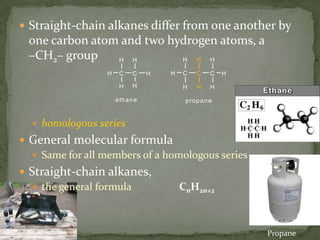
Straight-chain alkanes differ from one another by one carbon atom and two hydrogen atoms, a –CH2– grouphomologous seriesGeneral molecular formula Same for all members of a homologous seriesStraight-chain alkanes, the general formula                  CnH2n+2Propane
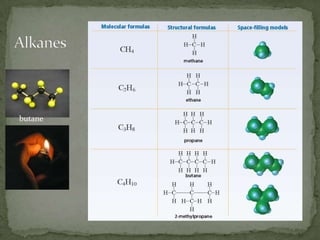
Alkanesbutane
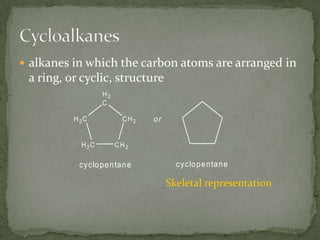
alkanes in which the carbon atoms are arranged in a ring, or cyclic, structureCycloalkanesSkeletal representation
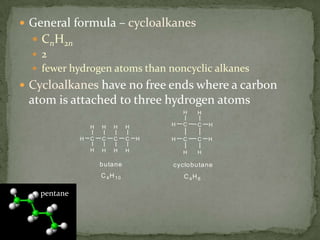
General formula – cycloalkanesCnH2n2 fewer hydrogen atoms than noncyclic alkanesCycloalkanes have no free ends where a carbon atom is attached to three hydrogen atomspentane
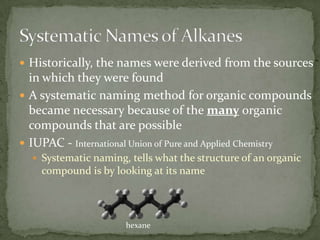
Historically, the names were derived from the sources in which they were foundA systematic naming method for organic compounds became necessary because of the many organic compounds that are possibleIUPAC - International Union of Pure and Applied ChemistrySystematic naming, tells what the structure of an organic compound is by looking at its nameSystematic Names of Alkaneshexane
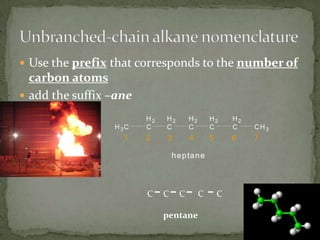
Use the prefix that corresponds to the number of carbon atomsadd the suffix –aneUnbranched-chain alkane nomenclatureCCCCCpentane
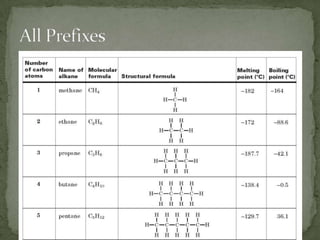
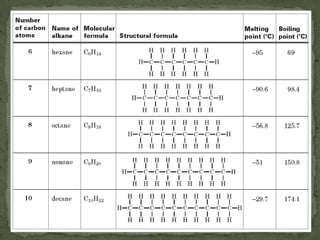
All Prefixes
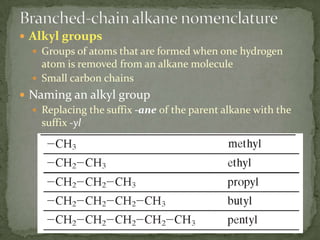
Branched-chain alkane nomenclatureAlkyl groupsGroups of atoms that are formed when one hydrogen atom is removed from an alkane moleculeSmall carbon chainsNaming an alkyl groupReplacing the suffix -aneof the parent alkane with the suffix -yl
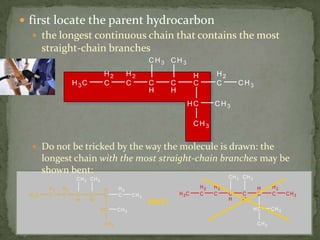
first locate the parent hydrocarbon the longest continuous chain that contains the most straight-chain branchesDo not be tricked by the way the molecule is drawn: the longest chain with the most straight-chain branches may be shown bent:not:
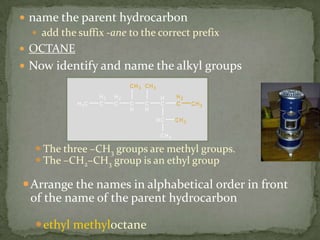
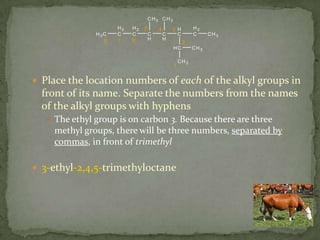
name the parent hydrocarbonadd the suffix -ane to the correct prefixOCTANENow identify and name the alkyl groupsThe three –CH3 groups are methyl groups. The –CH2–CH3 group is an ethyl groupArrange the names in alphabetical order in front of the name of the parent hydrocarbonethyl methyloctane
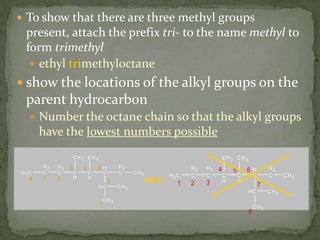
To show that there are three methyl groups present, attach the prefix tri- to the name methyl to form trimethylethyl trimethyloctaneshow the locations of the alkyl groups on the parent hydrocarbonNumber the octane chain so that the alkyl groups have the lowest numbers possiblenot:
Place the location numbers of each of the alkyl groups in front of its name. Separate the numbers from the names of the alkyl groups with hyphensThe ethyl group is on carbon 3. Because there are three methyl groups, there will be three numbers, separated by commas, in front of trimethyl3-ethyl-2,4,5-trimethyloctane
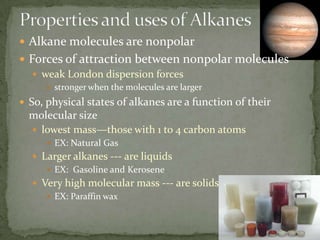
Properties and uses of AlkanesAlkane molecules are nonpolarForces of attraction between nonpolar moleculesweak London dispersion forcesstronger when the molecules are largerSo, physical states of alkanes are a function of their molecular sizelowest mass—those with 1 to 4 carbon atomsEX: Natural GasLarger alkanes --- are liquidsEX:  Gasoline and KeroseneVery high molecular mass --- are solidsEX: Paraffin wax
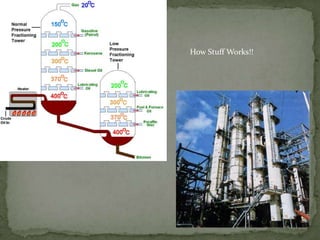
Boiling points of alkanes increase with molecular massAs London dispersion forces increasemore energy is required to pull the molecules apartThis property is used in the separation of petroleum, a major source of alkanesPetroleumcomplex mixture of different hydrocarbons that varies greatly in compositionHydrocarbon molecules in petroleum contain from 1 to more than 50 carbon atomsThis range allows the separation of petroleum into different portions using different boiling point rangesFractional distillationcomponents of a mixture are separated on the basis of boiling point, by condensation of vapor in a fractionating column.
How Stuff Works!!
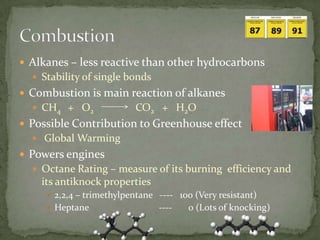
Alkanes – less reactive than other hydrocarbonsStability of single bondsCombustion is main reaction of alkanesCH4   +   O2                CO2   +   H2OPossible Contribution to Greenhouse effect Global WarmingPowers enginesOctane Rating – measure of its burning  efficiency and its antiknock properties2,2,4 – trimethylpentane   ----   100 (Very resistant)Heptane                              ----       0 (Lots of knocking)Combustion
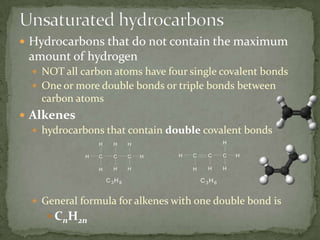
Unsaturated hydrocarbonsHydrocarbons that do not contain the maximum amount of hydrogenNOT all carbon atoms have four single covalent bondsOne or more double bonds or triple bonds between carbon atomsAlkeneshydrocarbons that contain double covalent bondsGeneral formula for alkenes with one double bond isCnH2n
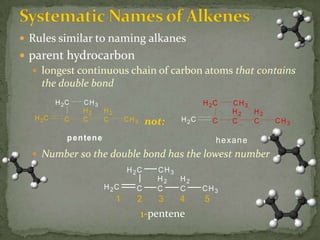
Systematic Names of AlkenesRules similar to naming alkanesparent hydrocarbon longest continuous chain of carbon atoms that contains the double bondNumber so the double bond has the lowest numbernot:1-pentene
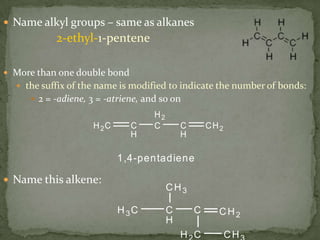
Name alkyl groups – same as alkanes             2-ethyl-1-penteneMore than one double bondthe suffix of the name is modified to indicate the number of bonds: 2 = -adiene, 3 = -atriene, and so onName this alkene:
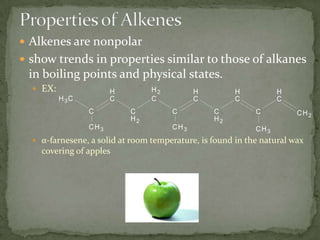
Properties of AlkenesAlkenes are nonpolar show trends in properties similar to those of alkanes in boiling points and physical states.EX:α-farnesene, a solid at room temperature, is found in the natural wax covering of apples
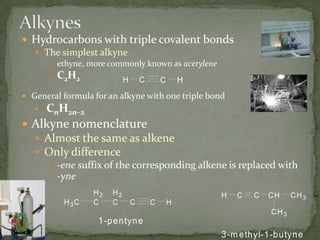
AlkynesHydrocarbons with triple covalent bondsThe simplest alkyneethyne, more commonly known as acetyleneC2H2General formula for an alkyne with one triple bondCnH2n–2Alkyne nomenclature Almost the same as alkeneOnly difference-enesuffix of the corresponding alkene is replaced with -yne
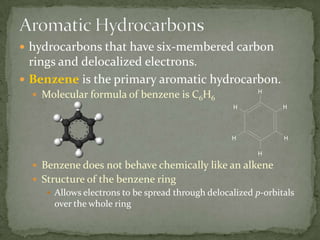
Aromatic Hydrocarbonshydrocarbons that have six-membered carbon rings and delocalized electrons.Benzene is the primary aromatic hydrocarbon.Molecular formula of benzene is C6H6Benzene does not behave chemically like an alkeneStructure of the benzene ringAllows electrons to be spread through delocalized p-orbitals over the whole ring
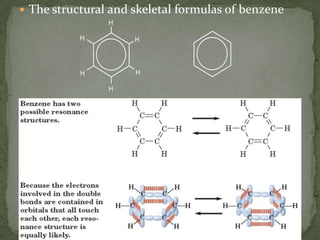
The structural and skeletal formulas of benzene

Chapter 20.3 : Saturated and Unsaturated Hydrocarbons

  • 1.
    Chapter 20.3 and4Saturated and Unsaturated Hydrocarbons
  • 2.
    Objectives:Distinguish among thestructures of alkanes, alkenes, alkynes, and aromatic hydrocarbonsWrite structural formulas and names for alkanes, alkenes, and alkynesRelate properties of different types of hydrocarbons to their structures.
  • 3.
    HydrocarbonsCompounds that containonly carbon and hydrogenSimplest class of organic compounds.All other organic compounds can be viewed ashydrocarbons in which one or more hydrogen atoms have been replaced by other atoms or other groups of atomsSaturated hydrocarbonsEach carbon atom in the molecule forms four single covalent bonds with other atomsAlkanesHydrocarbons that contain only single bonds
  • 4.
    Straight-chain alkanes differfrom one another by one carbon atom and two hydrogen atoms, a –CH2– grouphomologous seriesGeneral molecular formula Same for all members of a homologous seriesStraight-chain alkanes, the general formula CnH2n+2Propane
  • 5.
  • 6.
    alkanes in whichthe carbon atoms are arranged in a ring, or cyclic, structureCycloalkanesSkeletal representation
  • 7.
    General formula –cycloalkanesCnH2n2 fewer hydrogen atoms than noncyclic alkanesCycloalkanes have no free ends where a carbon atom is attached to three hydrogen atomspentane
  • 8.
    Historically, the nameswere derived from the sources in which they were foundA systematic naming method for organic compounds became necessary because of the many organic compounds that are possibleIUPAC - International Union of Pure and Applied ChemistrySystematic naming, tells what the structure of an organic compound is by looking at its nameSystematic Names of Alkaneshexane
  • 9.
    Use the prefixthat corresponds to the number of carbon atomsadd the suffix –aneUnbranched-chain alkane nomenclatureCCCCCpentane
  • 10.
  • 12.
    Branched-chain alkane nomenclatureAlkylgroupsGroups of atoms that are formed when one hydrogen atom is removed from an alkane moleculeSmall carbon chainsNaming an alkyl groupReplacing the suffix -aneof the parent alkane with the suffix -yl
  • 13.
    first locate theparent hydrocarbon the longest continuous chain that contains the most straight-chain branchesDo not be tricked by the way the molecule is drawn: the longest chain with the most straight-chain branches may be shown bent:not:
  • 14.
    name the parenthydrocarbonadd the suffix -ane to the correct prefixOCTANENow identify and name the alkyl groupsThe three –CH3 groups are methyl groups. The –CH2–CH3 group is an ethyl groupArrange the names in alphabetical order in front of the name of the parent hydrocarbonethyl methyloctane
  • 15.
    To show thatthere are three methyl groups present, attach the prefix tri- to the name methyl to form trimethylethyl trimethyloctaneshow the locations of the alkyl groups on the parent hydrocarbonNumber the octane chain so that the alkyl groups have the lowest numbers possiblenot:
  • 16.
    Place the locationnumbers of each of the alkyl groups in front of its name. Separate the numbers from the names of the alkyl groups with hyphensThe ethyl group is on carbon 3. Because there are three methyl groups, there will be three numbers, separated by commas, in front of trimethyl3-ethyl-2,4,5-trimethyloctane
  • 17.
    Properties and usesof AlkanesAlkane molecules are nonpolarForces of attraction between nonpolar moleculesweak London dispersion forcesstronger when the molecules are largerSo, physical states of alkanes are a function of their molecular sizelowest mass—those with 1 to 4 carbon atomsEX: Natural GasLarger alkanes --- are liquidsEX: Gasoline and KeroseneVery high molecular mass --- are solidsEX: Paraffin wax
  • 18.
    Boiling points ofalkanes increase with molecular massAs London dispersion forces increasemore energy is required to pull the molecules apartThis property is used in the separation of petroleum, a major source of alkanesPetroleumcomplex mixture of different hydrocarbons that varies greatly in compositionHydrocarbon molecules in petroleum contain from 1 to more than 50 carbon atomsThis range allows the separation of petroleum into different portions using different boiling point rangesFractional distillationcomponents of a mixture are separated on the basis of boiling point, by condensation of vapor in a fractionating column.
  • 19.
  • 20.
    Alkanes – lessreactive than other hydrocarbonsStability of single bondsCombustion is main reaction of alkanesCH4 + O2 CO2 + H2OPossible Contribution to Greenhouse effect Global WarmingPowers enginesOctane Rating – measure of its burning efficiency and its antiknock properties2,2,4 – trimethylpentane ---- 100 (Very resistant)Heptane ---- 0 (Lots of knocking)Combustion
  • 21.
    Unsaturated hydrocarbonsHydrocarbons thatdo not contain the maximum amount of hydrogenNOT all carbon atoms have four single covalent bondsOne or more double bonds or triple bonds between carbon atomsAlkeneshydrocarbons that contain double covalent bondsGeneral formula for alkenes with one double bond isCnH2n
  • 22.
    Systematic Names ofAlkenesRules similar to naming alkanesparent hydrocarbon longest continuous chain of carbon atoms that contains the double bondNumber so the double bond has the lowest numbernot:1-pentene
  • 23.
    Name alkyl groups– same as alkanes 2-ethyl-1-penteneMore than one double bondthe suffix of the name is modified to indicate the number of bonds: 2 = -adiene, 3 = -atriene, and so onName this alkene:
  • 24.
    Properties of AlkenesAlkenesare nonpolar show trends in properties similar to those of alkanes in boiling points and physical states.EX:α-farnesene, a solid at room temperature, is found in the natural wax covering of apples
  • 25.
    AlkynesHydrocarbons with triplecovalent bondsThe simplest alkyneethyne, more commonly known as acetyleneC2H2General formula for an alkyne with one triple bondCnH2n–2Alkyne nomenclature Almost the same as alkeneOnly difference-enesuffix of the corresponding alkene is replaced with -yne
  • 26.
    Aromatic Hydrocarbonshydrocarbons thathave six-membered carbon rings and delocalized electrons.Benzene is the primary aromatic hydrocarbon.Molecular formula of benzene is C6H6Benzene does not behave chemically like an alkeneStructure of the benzene ringAllows electrons to be spread through delocalized p-orbitals over the whole ring
  • 27.
    The structural andskeletal formulas of benzene