A Presentation On 
Precipitation Titration 
Dept. Of Pharmacy
Precipitation Titration 
A special type of titremetric procedure 
involves the formation of precipitates during 
the course of titration. The titrant react with 
the analyte forming an insoluble material and 
the titration continues till the very last amount 
of analyte is consumed. The first drop of 
titrant in excess will react with an indicator 
resulting in a color change and announcing 
the termination of the titration. 
Example : AgNO3+ NaCl  AgCl + NaNO3
Characteristics of Precipitation Titration 
 They are fast and the stoichiometry is known and 
reproducibile, (no secondary reactions of interference.) 
 They are complete or can be quantified depending 
on the amount of solubility product (in general a 
precipitation titration is considered complete when Kps 
< 10-8) 
 An indicator can be used to find the equivalence 
point or titration end point which, for this type of 
titration, corresponds to when precipitation of the 
analyte under analysis is complete.
Principle of Precipitation Titration 
The main principle of the precipitation 
titrations is that the quantity of the added 
precipitating reagent or precipitant is 
equivalent to the substance being 
precipitated.
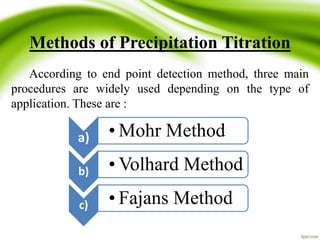
Methods of Precipitation Titration 
According to end point detection method, three main 
procedures are widely used depending on the type of 
application. These are : 
a) • Mohr Method 
b) •Volhard Method 
c) • Fajans Method
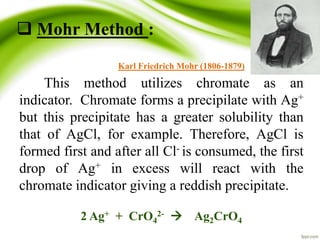
 Mohr Method : 
Karl Friedrich Mohr (1806-1879) 
This method utilizes chromate as an 
indicator. Chromate forms a precipilate with Ag+ 
but this precipitate has a greater solubility than 
that of AgCl, for example. Therefore, AgCl is 
formed first and after all Cl- is consumed, the first 
drop of Ag+ in excess will react with the 
chromate indicator giving a reddish precipitate. 
2-  Ag2CrO4 
2 Ag+ + CrO4
 In this method, neutral medium should be used 
since, in alkaline solutions, silver will react with 
the hydroxide ions forming AgOH. In acidic 
solutions, chromate will be converted to 
dichromate. Therefore, the pH of solution should 
be kept at about 7. There is always some error in 
this method because a dilule chromate solution is 
used due to the intense color of the indicator. 
This will require additional amount of Ag+ for 
the Ag2CrO4 to form.
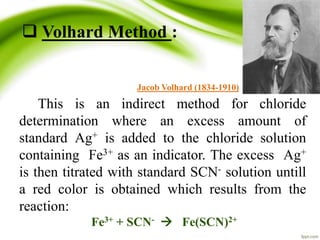
 Volhard Method : 
Jacob Volhard (1834-1910) 
This is an indirect method for chloride 
determination where an excess amount of 
standard Ag+ is added to the chloride solution 
containing Fe3+ as an indicator. The excess Ag+ 
is then titrated with standard SCN- solution untill 
a red color is obtained which results from the 
reaction: 
Fe3+ + SCN-  Fe(SCN)2+
 The indicator system is very sensitive and 
usually good results are obtained. The medium 
should be acidic to avoid the formation of Fe(OH)3 
However, the use of acidic medium together 
with added SCN- titrant increase the solubility of 
the precipitate leading to significant errors. This 
problem had been overcome by two main 
procedures.
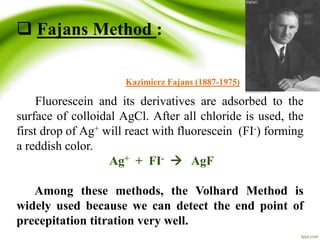
 Fajans Method : 
Kazimierz Fajans (1887-1975) 
Fluorescein and its derivatives are adsorbed to the 
surface of colloidal AgCl. After all chloride is used, the 
first drop of Ag+ will react with fluorescein (FI-) forming 
a reddish color. 
Ag+ + FI-  AgF 
Among these methods, the Volhard Method is 
widely used because we can detect the end point of 
precepitation titration very well.
Limitations of Precipitation Titration 
 A few number of ions such as halide ions 
(Cl-, Br-, l-) can be titrated by precipitation 
method. 
 Co-precipitation may be occurred. 
 It is very difficult to detect the end point.
How to overcome the problems of 
precipitation Titration? 
 In the assay of substances which react with nitrate but which can’t 
be determined by direct titration with silver nitrate solution. 
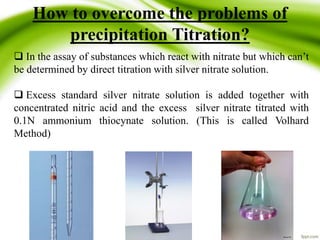
 Excess standard silver nitrate solution is added together with 
concentrated nitric acid and the excess silver nitrate titrated with 
0.1N ammonium thiocynate solution. (This is called Volhard 
Method)
 In the case of chlorides it is usually filtering off the 
AgCl or to coagulate the precipitate by means of 
nitrobenzene, which is non-toxic, because AgCl reacts 
slowly with ammonium thiocyanate. 
This makes the end points rather that since 
involves the production of red iron 
(III).Thiocyanate complex with the thiocyanate 
ions.
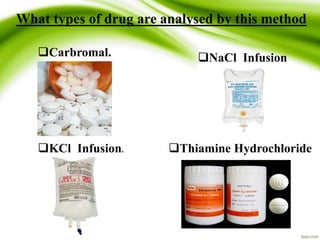
What types of drug are analysed by this method 
Carbromal. 
KCl Infusion. 
NaCl Infusion 
Thiamine Hydrochloride
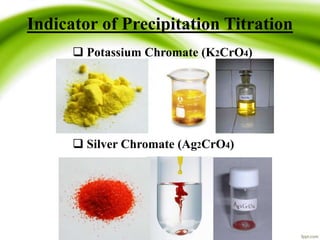
Indicator of Precipitation Titration 
 Potassium Chromate (K2CrO4) 
 Silver Chromate (Ag2CrO4)
The End

Precipitation Titration

  • 1.
    A Presentation On Precipitation Titration Dept. Of Pharmacy
  • 2.
    Precipitation Titration Aspecial type of titremetric procedure involves the formation of precipitates during the course of titration. The titrant react with the analyte forming an insoluble material and the titration continues till the very last amount of analyte is consumed. The first drop of titrant in excess will react with an indicator resulting in a color change and announcing the termination of the titration. Example : AgNO3+ NaCl  AgCl + NaNO3
  • 3.
    Characteristics of PrecipitationTitration  They are fast and the stoichiometry is known and reproducibile, (no secondary reactions of interference.)  They are complete or can be quantified depending on the amount of solubility product (in general a precipitation titration is considered complete when Kps < 10-8)  An indicator can be used to find the equivalence point or titration end point which, for this type of titration, corresponds to when precipitation of the analyte under analysis is complete.
  • 4.
    Principle of PrecipitationTitration The main principle of the precipitation titrations is that the quantity of the added precipitating reagent or precipitant is equivalent to the substance being precipitated.
  • 5.
    Methods of PrecipitationTitration According to end point detection method, three main procedures are widely used depending on the type of application. These are : a) • Mohr Method b) •Volhard Method c) • Fajans Method
  • 6.
     Mohr Method: Karl Friedrich Mohr (1806-1879) This method utilizes chromate as an indicator. Chromate forms a precipilate with Ag+ but this precipitate has a greater solubility than that of AgCl, for example. Therefore, AgCl is formed first and after all Cl- is consumed, the first drop of Ag+ in excess will react with the chromate indicator giving a reddish precipitate. 2-  Ag2CrO4 2 Ag+ + CrO4
  • 7.
     In thismethod, neutral medium should be used since, in alkaline solutions, silver will react with the hydroxide ions forming AgOH. In acidic solutions, chromate will be converted to dichromate. Therefore, the pH of solution should be kept at about 7. There is always some error in this method because a dilule chromate solution is used due to the intense color of the indicator. This will require additional amount of Ag+ for the Ag2CrO4 to form.
  • 8.
     Volhard Method: Jacob Volhard (1834-1910) This is an indirect method for chloride determination where an excess amount of standard Ag+ is added to the chloride solution containing Fe3+ as an indicator. The excess Ag+ is then titrated with standard SCN- solution untill a red color is obtained which results from the reaction: Fe3+ + SCN-  Fe(SCN)2+
  • 9.
     The indicatorsystem is very sensitive and usually good results are obtained. The medium should be acidic to avoid the formation of Fe(OH)3 However, the use of acidic medium together with added SCN- titrant increase the solubility of the precipitate leading to significant errors. This problem had been overcome by two main procedures.
  • 10.
     Fajans Method: Kazimierz Fajans (1887-1975) Fluorescein and its derivatives are adsorbed to the surface of colloidal AgCl. After all chloride is used, the first drop of Ag+ will react with fluorescein (FI-) forming a reddish color. Ag+ + FI-  AgF Among these methods, the Volhard Method is widely used because we can detect the end point of precepitation titration very well.
  • 11.
    Limitations of PrecipitationTitration  A few number of ions such as halide ions (Cl-, Br-, l-) can be titrated by precipitation method.  Co-precipitation may be occurred.  It is very difficult to detect the end point.
  • 12.
    How to overcomethe problems of precipitation Titration?  In the assay of substances which react with nitrate but which can’t be determined by direct titration with silver nitrate solution.  Excess standard silver nitrate solution is added together with concentrated nitric acid and the excess silver nitrate titrated with 0.1N ammonium thiocynate solution. (This is called Volhard Method)
  • 13.
     In thecase of chlorides it is usually filtering off the AgCl or to coagulate the precipitate by means of nitrobenzene, which is non-toxic, because AgCl reacts slowly with ammonium thiocyanate. This makes the end points rather that since involves the production of red iron (III).Thiocyanate complex with the thiocyanate ions.
  • 14.
    What types ofdrug are analysed by this method Carbromal. KCl Infusion. NaCl Infusion Thiamine Hydrochloride
  • 15.
    Indicator of PrecipitationTitration  Potassium Chromate (K2CrO4)  Silver Chromate (Ag2CrO4)
  • 16.