Mg ribbon burns with a very
bright white flame when held
in the bunsen flame with a
pair of tongs to form a white
powder.
We say the magnesium has
been oxidised.
2Mg + O2 → 2MgO or
2Mg + O2 → 2Mg2+ + 2O2-
Each Mg loses 2ē & each O gains 2 ē. This is ē transfer.
We say the Mg has been oxidized while the O has been
reduced to form MgO. This is a redox reaction.
Mg Mg2+ + 2ē
O + 2ē O
2-
Oxidation
Reduction
Oxidation is the loss of ē, while
Reduction is the gain of ē.
Remember: Oilrig
In a redox reaction there must be an oxidising agent
and a reducing agent.
The reducing agent is the substance oxidised while
the oxidising agent is the substance reduced.
2Mg + O2 → 2 MgO
Mg is being oxidised & is thus the reducing agent.
O is being reduced & is thus the oxidising agent.
Mg has lost ē, while O has gained ē.
In redox reactions ē are transferred, while in acid-
base reactions H+ are transferred.
Redox reactions can be written in 2 parts.
These are called half-reactions & show the
oxidation half-reaction and the reduction half-
reaction as 2 separate half-reactions.
The MgO reaction can be written as follows:
2Mg → 2Mg + 4ē Oxidation half reaction – loss of ē
O2 + 4ē → 2O2- Reduction half reaction – gain of ē
Mg is the reducing agent & O is the oxidising agent.
There will always be a reducing & an oxidising half-
reaction in every redox reaction.
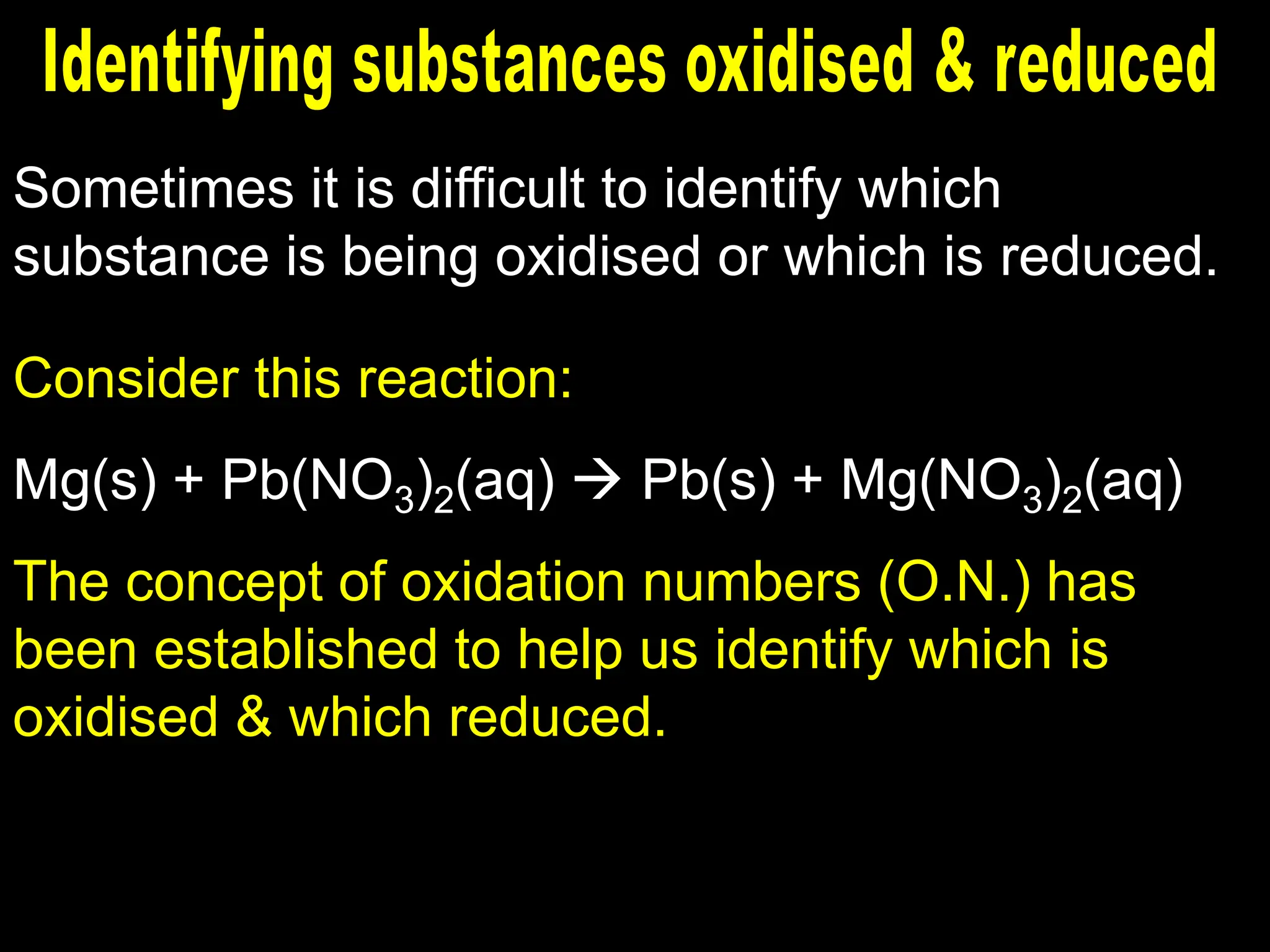
Sometimes it is difficult to identify which
substance is being oxidised or which is reduced.
Consider this reaction:
Mg(s) + Pb(NO3)2(aq) → Pb(s) + Mg(NO3)2(aq)
The concept of oxidation numbers (O.N.) has
been established to help us identify which is
oxidised & which reduced.
The oxidation number (O.N.) indicates how many ē
have been lost/gained in a redox reaction.
If the number is negative (–) means the atom gained ē
If + this means the atom lost ē
O.N. may then be used to identify the respective
oxidation and reduction half-reactions.
Oxidation numbers
Look at the following oxidation reaction:
Zn → Zn2+ + 2e-
Oxidation numbers: 0 +2
Look at the following reduction reaction:
Cu2+ + 2e- → Cu
Oxidation numbers: +2 0
Oxidation Numbers
Oxidation is associated with an increase in
oxidation number.
Reduction is associated with a decrease in
oxidation number.
How do we determine oxidation numbers?
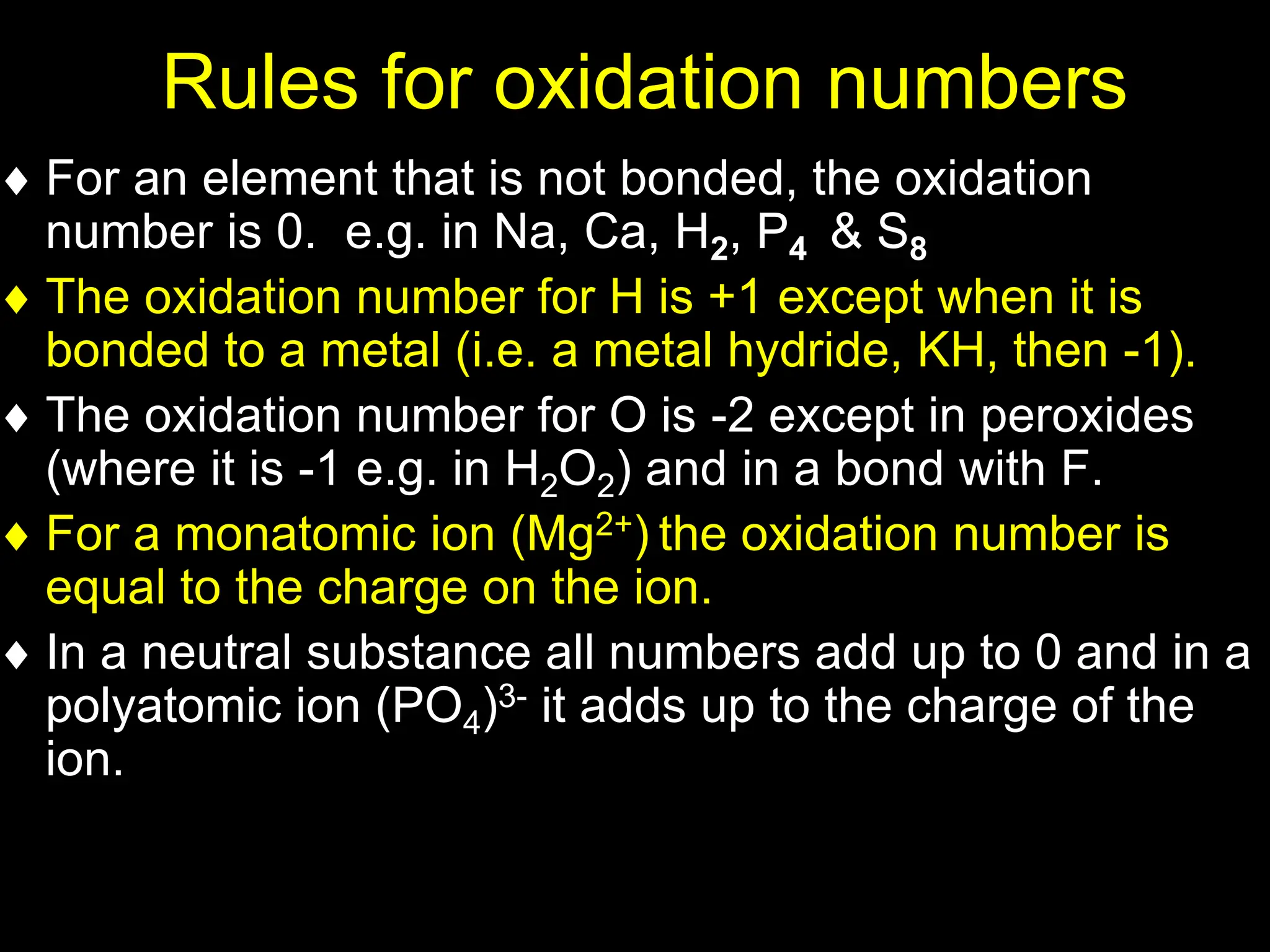
Rules for oxidation numbers
 For an element that is not bonded, the oxidation
number is 0. e.g. in Na, Ca, H2, P4 & S8
 The oxidation number for H is +1 except when it is
bonded to a metal (i.e. a metal hydride, KH, then -1).
 The oxidation number for O is -2 except in peroxides
(where it is -1 e.g. in H2O2) and in a bond with F.
 For a monatomic ion (Mg2+) the oxidation number is
equal to the charge on the ion.
 In a neutral substance all numbers add up to 0 and in a
polyatomic ion (PO4)3- it adds up to the charge of the
ion.
Examples
1. Determine the oxidation number of C in
H2CO3
2(+1) + ox. num. (C) + 3x(-2) = 0
Oxidation number of C = +4
2. Determine the oxidation number of N in
NO3
-
ox. num. (N) + 3x(-2) = -1
Oxidation number of N = +5
Examples
Identify the oxidizing and reducing agent in
the following reaction:
2MnO4
- + 5SO2 + 2H2O → 2Mn2+ + 5SO4
2- + 4H+
There are no peroxides or hydrides in the
reaction, so all H’s are +1 and all O’s are -2.
The rest are awarded as follows:
2MnO4
- + 5SO2 + 2H2O → 2Mn2+ + 5SO4
2- + 4H+
+7 +4 +2 +6
Manganese: decreases from +7 to +2 - MnO4
- is
the oxidizing agent.
Sulphur: increases from +4 to +6 - SO2 is
the reducing agent.
Elements such as S, N, P, Cu, C & Fe can have more
than one O.N.
Find the O.N. of the underlined element in each of
the following compounds/substances:
H2S, SO3, SO2, NH3, N, NO2, NO, K2Cr2O7
-2 +6 +4 -3 0 +4 +2 +6
Names of compounds in which there are elements
that have several O.N. are usually indicated with the
O.N. indicated between the words in Roman
numerals.
FeCl3 is iron (Ⅲ) chloride
Cu2O is copper (Ⅱ) oxide
However, when it is a non-metal that has different
O.N. then we can use a prefix instead:
NO2 is nitrogen dioxide OR nitrogen (lV) oxide
SO3 is sulphur trioxide OR sulphur (Vl) oxide.

Redox reactions.pdf : Acids and Bases su

  • 1.
    Mg ribbon burnswith a very bright white flame when held in the bunsen flame with a pair of tongs to form a white powder. We say the magnesium has been oxidised. 2Mg + O2 → 2MgO or 2Mg + O2 → 2Mg2+ + 2O2- Each Mg loses 2ē & each O gains 2 ē. This is ē transfer. We say the Mg has been oxidized while the O has been reduced to form MgO. This is a redox reaction.
  • 2.
    Mg Mg2+ +2ē O + 2ē O 2- Oxidation Reduction Oxidation is the loss of ē, while Reduction is the gain of ē. Remember: Oilrig
  • 3.
    In a redoxreaction there must be an oxidising agent and a reducing agent. The reducing agent is the substance oxidised while the oxidising agent is the substance reduced. 2Mg + O2 → 2 MgO Mg is being oxidised & is thus the reducing agent. O is being reduced & is thus the oxidising agent. Mg has lost ē, while O has gained ē. In redox reactions ē are transferred, while in acid- base reactions H+ are transferred.
  • 4.
    Redox reactions canbe written in 2 parts. These are called half-reactions & show the oxidation half-reaction and the reduction half- reaction as 2 separate half-reactions. The MgO reaction can be written as follows: 2Mg → 2Mg + 4ē Oxidation half reaction – loss of ē O2 + 4ē → 2O2- Reduction half reaction – gain of ē Mg is the reducing agent & O is the oxidising agent. There will always be a reducing & an oxidising half- reaction in every redox reaction.
  • 5.
    Sometimes it isdifficult to identify which substance is being oxidised or which is reduced. Consider this reaction: Mg(s) + Pb(NO3)2(aq) → Pb(s) + Mg(NO3)2(aq) The concept of oxidation numbers (O.N.) has been established to help us identify which is oxidised & which reduced.
  • 6.
    The oxidation number(O.N.) indicates how many ē have been lost/gained in a redox reaction. If the number is negative (–) means the atom gained ē If + this means the atom lost ē O.N. may then be used to identify the respective oxidation and reduction half-reactions.
  • 7.
    Oxidation numbers Look atthe following oxidation reaction: Zn → Zn2+ + 2e- Oxidation numbers: 0 +2 Look at the following reduction reaction: Cu2+ + 2e- → Cu Oxidation numbers: +2 0
  • 8.
    Oxidation Numbers Oxidation isassociated with an increase in oxidation number. Reduction is associated with a decrease in oxidation number. How do we determine oxidation numbers?
  • 9.
    Rules for oxidationnumbers  For an element that is not bonded, the oxidation number is 0. e.g. in Na, Ca, H2, P4 & S8  The oxidation number for H is +1 except when it is bonded to a metal (i.e. a metal hydride, KH, then -1).  The oxidation number for O is -2 except in peroxides (where it is -1 e.g. in H2O2) and in a bond with F.  For a monatomic ion (Mg2+) the oxidation number is equal to the charge on the ion.  In a neutral substance all numbers add up to 0 and in a polyatomic ion (PO4)3- it adds up to the charge of the ion.
  • 10.
    Examples 1. Determine theoxidation number of C in H2CO3 2(+1) + ox. num. (C) + 3x(-2) = 0 Oxidation number of C = +4 2. Determine the oxidation number of N in NO3 - ox. num. (N) + 3x(-2) = -1 Oxidation number of N = +5
  • 11.
    Examples Identify the oxidizingand reducing agent in the following reaction: 2MnO4 - + 5SO2 + 2H2O → 2Mn2+ + 5SO4 2- + 4H+ There are no peroxides or hydrides in the reaction, so all H’s are +1 and all O’s are -2. The rest are awarded as follows: 2MnO4 - + 5SO2 + 2H2O → 2Mn2+ + 5SO4 2- + 4H+ +7 +4 +2 +6 Manganese: decreases from +7 to +2 - MnO4 - is the oxidizing agent. Sulphur: increases from +4 to +6 - SO2 is the reducing agent.
  • 12.
    Elements such asS, N, P, Cu, C & Fe can have more than one O.N. Find the O.N. of the underlined element in each of the following compounds/substances: H2S, SO3, SO2, NH3, N, NO2, NO, K2Cr2O7 -2 +6 +4 -3 0 +4 +2 +6
  • 13.
    Names of compoundsin which there are elements that have several O.N. are usually indicated with the O.N. indicated between the words in Roman numerals. FeCl3 is iron (Ⅲ) chloride Cu2O is copper (Ⅱ) oxide However, when it is a non-metal that has different O.N. then we can use a prefix instead: NO2 is nitrogen dioxide OR nitrogen (lV) oxide SO3 is sulphur trioxide OR sulphur (Vl) oxide.