CONTENT
 Introduction.
 Baeyer-Villiger Reaction.
 Mechanism(Baeyer-Villiger Reaction).
 Migrating Aptitude.
 Application(Baeyer-Villiger Reaction).
 Dakin Reaction.
 Mechanism(Dakin Reaction).
 Application(Dakin Reaction).
INTRODUCTION
What is oxidation?
Oxidation is nothing but a process in which either;
 Addition of oxygen.
 Removal of hydrogen.
 Loss of an electron.
 Increase in oxidation number takes place.
EXAMPLE
 Ethanol can be oxidized to ethanal:
CH3CH2OH CH3CH2O
Oxidation by loss of hydrogen
• We would need to use an oxidizing agent to remove the hydrogen
from ethanol.
• The commonly used oxidizing agent is Potassium Dichromate(VI)
Solution acified with dil.H2SO4.
BAEYER-VILLIGER OXIDATION
 The transformation for ketones into esters and
cyclic ketones into lactones or hydroxy acid by
peroxy acid was discovered as early as 1899 by
A.Baeyer and Villiger.
 A wide range of oxidizing agents can be used to
perform the Baeyer-Villiger oxidations.
 Reagents typically used to carryout this
rearrangement are m-CPBA,peraceticacids,etc.
 Reactive or strained ketones react with hydrogen
peroxide to form lactones.
MECHANISM
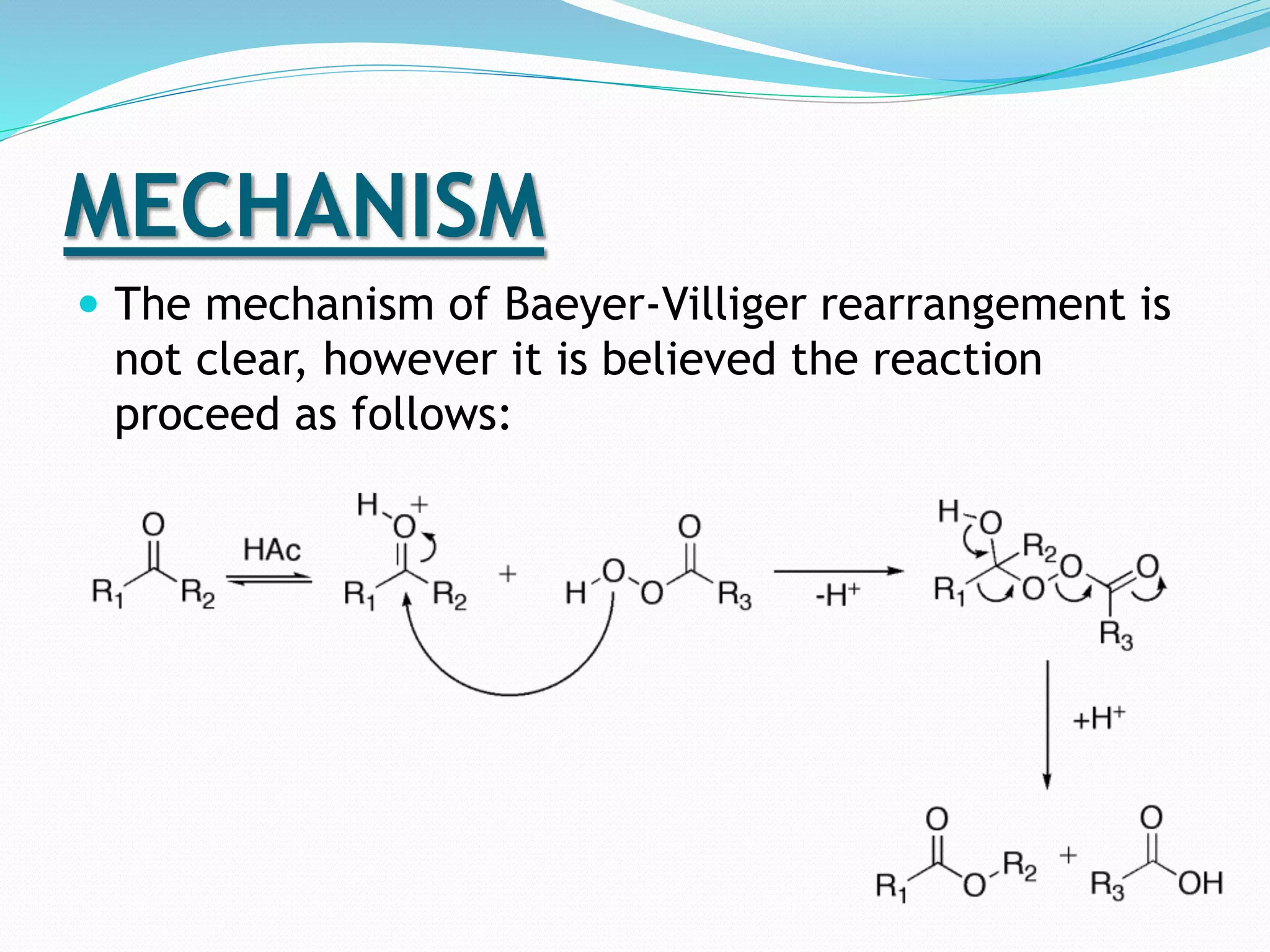
 The mechanism of Baeyer-Villiger rearrangement is
not clear, however it is believed the reaction
proceed as follows:
 Initial protonation of the carbonyl oxygen is
followed by addition of peracid to yield an adduct
which undergoes rearrangement where the R group
migrates to the electron deficient oxygen. This is
followed by deprotonation.
 Salient points are retention of stereochemistry by
the migrating group, migration concerted with
departure of leaving group and increased migratory
aptitude of groups possessing greater electron
donating power.
 Retention of stereochemistry by the migrating group.
 Migration is concerted with the departure of the
leaving group. The concerted step is rate
determining.
 Migrating groups with greater electron donating power
have correspondingly greater migratory aptitude
because of the increased ability to stabilize a positive
charge in the transition state. This renders
stereoselectivity to the oxidation of unsymmetrical
ketones.
 Migration is favored when the migrating group is
antiperiplanar to the O-O bond of the leaving group;
this is known as the primary stereoelectronic effect.
MIGRATING APTITUDE
 The order of preference for migration among alkyl
group is, Tertiary > Secondary > Primary > Methyl.
 Aryl group migrates in preference to methyl and
primary alkyl groups.
 In aryl series, migration is facilitated by electron
para position.
APPLICATION
 Baeyer-Villiger oxidation has great synthesis utility
as it permits the transformation of ketones into
esters. An oxygen atom is inserted next to the
carbonyl group. This reaction is applicable to both
acyclic ketones and cyclic ketones. Oxidation of
cyclic ketones occurs with ring expansion and form
lactones as illustrated in the conversion of
Cyclohexanone to lactone by this method.
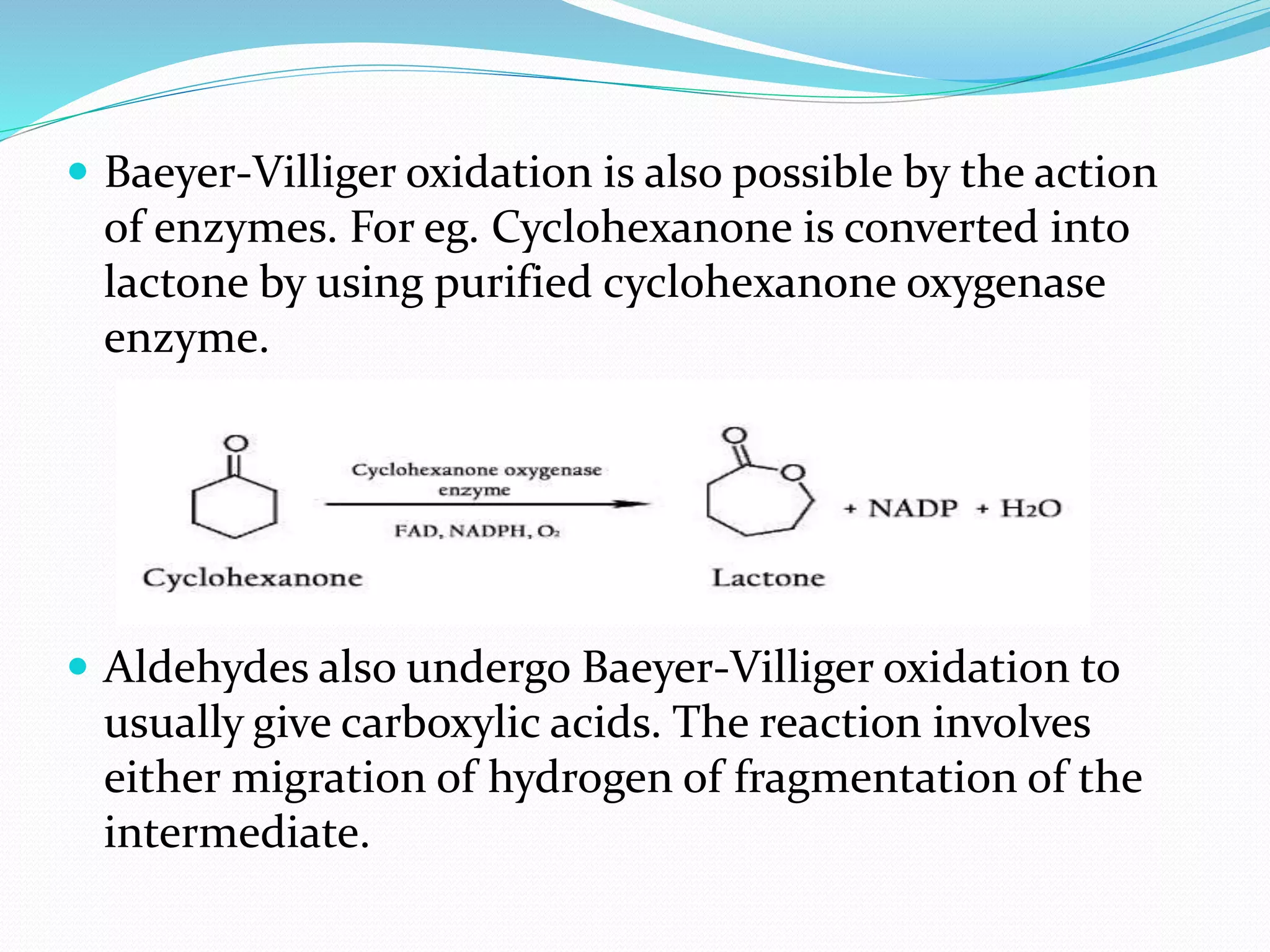
 Baeyer-Villiger oxidation is also possible by the action
of enzymes. For eg. Cyclohexanone is converted into
lactone by using purified cyclohexanone oxygenase
enzyme.
 Aldehydes also undergo Baeyer-Villiger oxidation to
usually give carboxylic acids. The reaction involves
either migration of hydrogen of fragmentation of the
intermediate.
DAKIN REACTION
 The oxidation of aldehydes and ketones to the
corresponding phenols is known as Dakin reaction.
 The reaction works best if the aromatic aldehyde or
ketone is electron rich.
 The reagents used in Dakin reaction are;
Alkaline H2O2, Acidic H2O2, Peroxybenzoic
acid(C7H6O3), Peroxyacetic acid(C2H4O3), Sodium
percarbonate, 30% H2O2 with aryl selenium
compounds as activators and Urea-H2O2 adduct.
MECHANISM
 The mechanism of Dakin reaction is very much
similar to the mechanism of Baeyer-Villiger
reaction.
 The mechanism of Dakin reaction is not certain.
However, a mechanism analogous to Baeyer-Villiger
oxidation is suggested. The carbonyl carbon is
attacked by the hydroperoxide anion. The resulting
tetrahedral intermediate undergoes migration of aryl
group with subsequent elimination of hydroxide ion
to give an ester. An electron-releasing group is
necessary for efficient migration of aryl group. The
intermediate ester has been isolated and converted
into catechol on hydrolysis under aqueous alkaline
conditions of the reaction.
APPLICATION
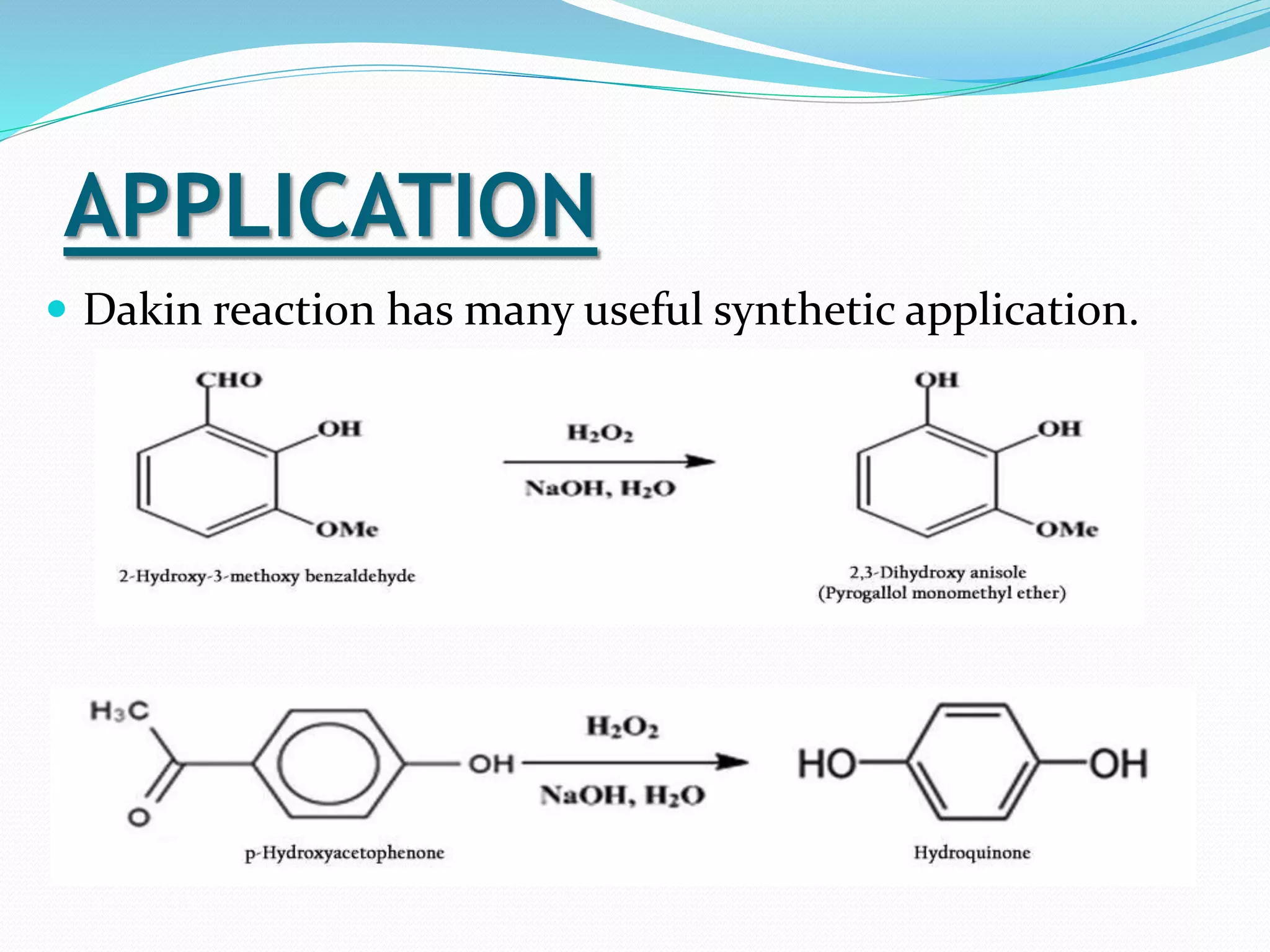
 Dakin reaction has many useful synthetic application.
 The Dakin oxidation is most commonly used to
synthesize benzenediols and alkoxyphenols.
 Catechol, for example, is synthesized from o-hydroxy
and o-alkoxy phenyl aldehydes and ketones and is used
as the starting material for synthesis of several
compounds, including the catecholamines,
catecholamine derivatives and 1,4-tertbutlycatechol a
common antioxidant and polymerization inhibitor.
 Other synthetically useful products of the Dakin
reaction include guaiacol, a precursor of several
flavorants.
 Hydroquinone, a common photograph-developing agent;
and 2-tertbutyl-4-hydrooxyanisole and 3-tertbutyl-4-
hydrooxyanisole,two antioxidants commonly used to
preserve packaged food.
REFRENCES
 March’s Advanced Organic Chemistry: Reactions, Mechanisms and Structure
Michael B. Smith
Jerry March
(SIXTH EDITION)
Baeyer –villiger reaction is on page 1617
Dakin reaction is on page 1747
-THANK YOU

Oxidation

  • 2.
    CONTENT  Introduction.  Baeyer-VilligerReaction.  Mechanism(Baeyer-Villiger Reaction).  Migrating Aptitude.  Application(Baeyer-Villiger Reaction).  Dakin Reaction.  Mechanism(Dakin Reaction).  Application(Dakin Reaction).
  • 3.
    INTRODUCTION What is oxidation? Oxidationis nothing but a process in which either;  Addition of oxygen.  Removal of hydrogen.  Loss of an electron.  Increase in oxidation number takes place.
  • 4.
    EXAMPLE  Ethanol canbe oxidized to ethanal: CH3CH2OH CH3CH2O Oxidation by loss of hydrogen • We would need to use an oxidizing agent to remove the hydrogen from ethanol. • The commonly used oxidizing agent is Potassium Dichromate(VI) Solution acified with dil.H2SO4.
  • 5.
    BAEYER-VILLIGER OXIDATION  Thetransformation for ketones into esters and cyclic ketones into lactones or hydroxy acid by peroxy acid was discovered as early as 1899 by A.Baeyer and Villiger.  A wide range of oxidizing agents can be used to perform the Baeyer-Villiger oxidations.  Reagents typically used to carryout this rearrangement are m-CPBA,peraceticacids,etc.  Reactive or strained ketones react with hydrogen peroxide to form lactones.
  • 6.
    MECHANISM  The mechanismof Baeyer-Villiger rearrangement is not clear, however it is believed the reaction proceed as follows:
  • 7.
     Initial protonationof the carbonyl oxygen is followed by addition of peracid to yield an adduct which undergoes rearrangement where the R group migrates to the electron deficient oxygen. This is followed by deprotonation.  Salient points are retention of stereochemistry by the migrating group, migration concerted with departure of leaving group and increased migratory aptitude of groups possessing greater electron donating power.
  • 8.
     Retention ofstereochemistry by the migrating group.  Migration is concerted with the departure of the leaving group. The concerted step is rate determining.  Migrating groups with greater electron donating power have correspondingly greater migratory aptitude because of the increased ability to stabilize a positive charge in the transition state. This renders stereoselectivity to the oxidation of unsymmetrical ketones.  Migration is favored when the migrating group is antiperiplanar to the O-O bond of the leaving group; this is known as the primary stereoelectronic effect.
  • 9.
    MIGRATING APTITUDE  Theorder of preference for migration among alkyl group is, Tertiary > Secondary > Primary > Methyl.  Aryl group migrates in preference to methyl and primary alkyl groups.  In aryl series, migration is facilitated by electron para position.
  • 10.
    APPLICATION  Baeyer-Villiger oxidationhas great synthesis utility as it permits the transformation of ketones into esters. An oxygen atom is inserted next to the carbonyl group. This reaction is applicable to both acyclic ketones and cyclic ketones. Oxidation of cyclic ketones occurs with ring expansion and form lactones as illustrated in the conversion of Cyclohexanone to lactone by this method.
  • 11.
     Baeyer-Villiger oxidationis also possible by the action of enzymes. For eg. Cyclohexanone is converted into lactone by using purified cyclohexanone oxygenase enzyme.  Aldehydes also undergo Baeyer-Villiger oxidation to usually give carboxylic acids. The reaction involves either migration of hydrogen of fragmentation of the intermediate.
  • 12.
    DAKIN REACTION  Theoxidation of aldehydes and ketones to the corresponding phenols is known as Dakin reaction.  The reaction works best if the aromatic aldehyde or ketone is electron rich.  The reagents used in Dakin reaction are; Alkaline H2O2, Acidic H2O2, Peroxybenzoic acid(C7H6O3), Peroxyacetic acid(C2H4O3), Sodium percarbonate, 30% H2O2 with aryl selenium compounds as activators and Urea-H2O2 adduct.
  • 13.
    MECHANISM  The mechanismof Dakin reaction is very much similar to the mechanism of Baeyer-Villiger reaction.
  • 14.
     The mechanismof Dakin reaction is not certain. However, a mechanism analogous to Baeyer-Villiger oxidation is suggested. The carbonyl carbon is attacked by the hydroperoxide anion. The resulting tetrahedral intermediate undergoes migration of aryl group with subsequent elimination of hydroxide ion to give an ester. An electron-releasing group is necessary for efficient migration of aryl group. The intermediate ester has been isolated and converted into catechol on hydrolysis under aqueous alkaline conditions of the reaction.
  • 15.
    APPLICATION  Dakin reactionhas many useful synthetic application.
  • 16.
     The Dakinoxidation is most commonly used to synthesize benzenediols and alkoxyphenols.  Catechol, for example, is synthesized from o-hydroxy and o-alkoxy phenyl aldehydes and ketones and is used as the starting material for synthesis of several compounds, including the catecholamines, catecholamine derivatives and 1,4-tertbutlycatechol a common antioxidant and polymerization inhibitor.  Other synthetically useful products of the Dakin reaction include guaiacol, a precursor of several flavorants.  Hydroquinone, a common photograph-developing agent; and 2-tertbutyl-4-hydrooxyanisole and 3-tertbutyl-4- hydrooxyanisole,two antioxidants commonly used to preserve packaged food.
  • 17.
    REFRENCES  March’s AdvancedOrganic Chemistry: Reactions, Mechanisms and Structure Michael B. Smith Jerry March (SIXTH EDITION) Baeyer –villiger reaction is on page 1617 Dakin reaction is on page 1747 -THANK YOU