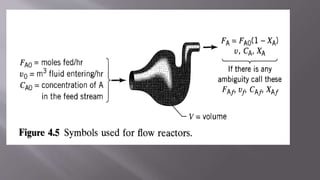
Chemical reaction engineering is at the heart of virtually every
chemical process. It separates the chemical engineer from other
engineers.
Chemical Reaction Engineering (CRE) is the field that studies
the rates and mechanisms of chemical reactions and the design
of the reactors in which they take place.
 In Majority of cases, reactor do three things, it provides
I. Residence Time
II. Transfer Heat
III. Agitates or mix phases
Principle Factors Involved in the design of Reactor:
The principle factors which must be considered in the design
of the reactor are:
 The Phase involved
 Temperature Range
 Operating Pressure
 Residence Time or Space Velocity
 Corrosiveness
 Heat Transfer
 Temperature Control
 Agitation for uniformity or temperature control
 Batch or Continuous operation
 Production rate
4 Types of Reactors
 1.. Batch Reactors
 2..Continuous Stirred Tank Reactors (CSTR)
 3..Tubular Reactors (PFR)
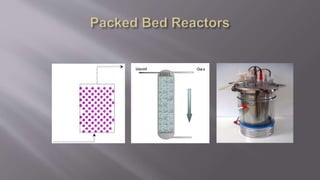
 4..Packed Bed Reactors (PBR)
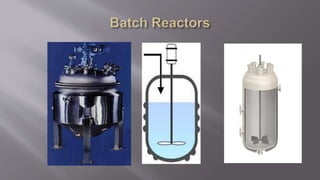
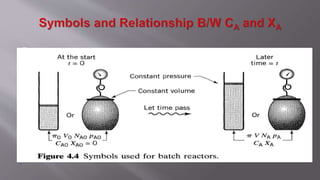
 A batch reactor has neither inflow nor outflow of reactants or
products while the reaction is being carried out.
 In such extend of reaction and properties of reaction mixture
very with time.
 Thus composition changes with time.
 For gas phases batch reactor may be constant volume or constant
pressure.
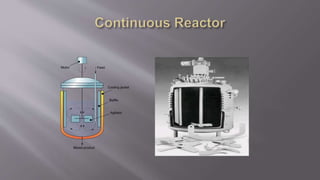
 The reactants are continuously fed and product are also
continuously removed from the reactor.
 In such reactor the extend of reaction may vary with position in
reactor not with time.
 Thus composition at any point is not changed with time(They
may be continuous-stirred tank or Tubular Reactor)
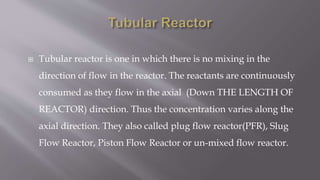
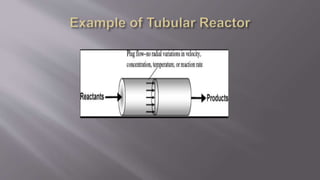
 Tubular reactor is one in which there is no mixing in the
direction of flow in the reactor. The reactants are continuously
consumed as they flow in the axial (Down THE LENGTH OF
REACTOR) direction. Thus the concentration varies along the
axial direction. They also called plug flow reactor(PFR), Slug
Flow Reactor, Piston Flow Reactor or un-mixed flow reactor.
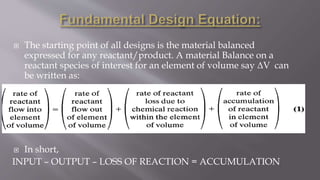
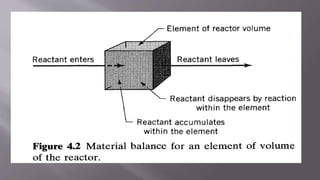
 The starting point of all designs is the material balanced
expressed for any reactant/product. A material Balance on a
reactant species of interest for an element of volume say ΔV can
be written as:
 In short,
INPUT – OUTPUT – LOSS OF REACTION = ACCUMULATION
 When the composition within the reactor is uniform (Independent of
position), we will consider the whole reactor of material balance.
 On the other hand when the composition within the reactor is not uniform,
it must be made over a differential element of volume and then integrated
across the whole reactor for the appropriate flow and concentration
condition (For Tubular Flow Reactor).
 For the batch reactor the first two terms are zero.
 For continuous flow reactors operating at steady –state, the accumulation
terms is omitted.
 Where for unsteady state condition are involved, it will be necessary to
integrate over time as well as over volume in order to determine the
performance characteristics of the reactor.
 Since rate of chemical reactions is normally strongly temperature
dependent, it’s essential to know the temperature at each point in the
reactor in order to be able to utilize the material balance properly.
 When there are temperature gradients with in the reactor, it is necessary
to utilize an energy balance in conjunction with the material balance in
order to determine the temperature and composition at each point in the
reactor at a particular time.
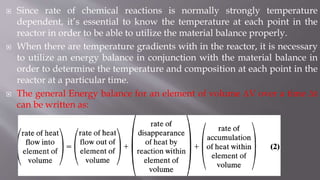
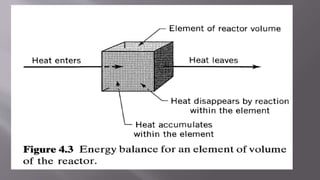
 The general Energy balance for an element of volume ΔV over a time Δt
can be written as:
 For completeness, the term corresponding to the entry (In) of
material to the volume element and out, therefore must
contain in addition to the ordinary enthalpy of the material,
its kinetic and potential energy.
 However in chemical reactors, only the enthalpy term is
significant.
 Although the heat effects in chemical reactors are significant,
shaft work effects are usually negligible.
 The first, second and fourth terms reflect differences in
temperature and or in composition of the entering and
leaving streams.
 The energy effects associated with composition changes are a
direct reflection of enthalpy change associated with the
reaction (i.e heat of reaction)
From the summary we can write in short:
Heat In – Heat Out – Disappearance by reaction = accumulation
 For the stirred tank reactor contents are uniform in
temperature and composition throughout and it is possible to
write the energy balance over the entire reactor.
 In the case of batch reactor, first and second terms are not
there.
 For continuous flow systems operating at steady state, the
accumulation term disappears.
 For adiabatic operation in the absence of shaft work effects
the energy transfer/disappear term will be omitted/zero.
 For Tubular Flow Reactors, neither the composition nor the
temperature need to be independent of position and the
energy balance must be written on a differential element of
reactor volume.
 The resultant differential equation then must be solved in
conjunction with the differential equation describing the
material balance on the differential element.
 The Purpose of the energy balance is to describe the
temperature at each point in the reactor ( or at each time for
Batch Reactor) so that the proper rate may be assigned to that
point.

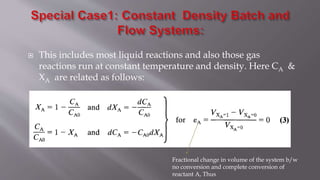
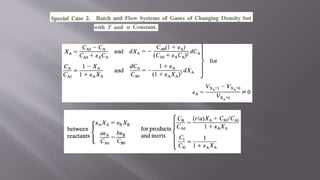
 This includes most liquid reactions and also those gas
reactions run at constant temperature and density. Here CA &
XA are related as follows:
Fractional change in volume of the system b/w
no conversion and complete conversion of
reactant A, Thus
Cre ppt
Cre ppt
Cre ppt
Cre ppt
Cre ppt
Cre ppt
Cre ppt

Cre ppt

  • 2.
    Chemical reaction engineeringis at the heart of virtually every chemical process. It separates the chemical engineer from other engineers. Chemical Reaction Engineering (CRE) is the field that studies the rates and mechanisms of chemical reactions and the design of the reactors in which they take place.
  • 3.
     In Majorityof cases, reactor do three things, it provides I. Residence Time II. Transfer Heat III. Agitates or mix phases Principle Factors Involved in the design of Reactor: The principle factors which must be considered in the design of the reactor are:  The Phase involved  Temperature Range  Operating Pressure  Residence Time or Space Velocity
  • 4.
     Corrosiveness  HeatTransfer  Temperature Control  Agitation for uniformity or temperature control  Batch or Continuous operation  Production rate
  • 5.
    4 Types ofReactors  1.. Batch Reactors  2..Continuous Stirred Tank Reactors (CSTR)  3..Tubular Reactors (PFR)  4..Packed Bed Reactors (PBR)
  • 6.
     A batchreactor has neither inflow nor outflow of reactants or products while the reaction is being carried out.  In such extend of reaction and properties of reaction mixture very with time.  Thus composition changes with time.  For gas phases batch reactor may be constant volume or constant pressure.
  • 8.
     The reactantsare continuously fed and product are also continuously removed from the reactor.  In such reactor the extend of reaction may vary with position in reactor not with time.  Thus composition at any point is not changed with time(They may be continuous-stirred tank or Tubular Reactor)
  • 10.
     Tubular reactoris one in which there is no mixing in the direction of flow in the reactor. The reactants are continuously consumed as they flow in the axial (Down THE LENGTH OF REACTOR) direction. Thus the concentration varies along the axial direction. They also called plug flow reactor(PFR), Slug Flow Reactor, Piston Flow Reactor or un-mixed flow reactor.
  • 13.
     The startingpoint of all designs is the material balanced expressed for any reactant/product. A material Balance on a reactant species of interest for an element of volume say ΔV can be written as:  In short, INPUT – OUTPUT – LOSS OF REACTION = ACCUMULATION
  • 15.
     When thecomposition within the reactor is uniform (Independent of position), we will consider the whole reactor of material balance.  On the other hand when the composition within the reactor is not uniform, it must be made over a differential element of volume and then integrated across the whole reactor for the appropriate flow and concentration condition (For Tubular Flow Reactor).  For the batch reactor the first two terms are zero.  For continuous flow reactors operating at steady –state, the accumulation terms is omitted.  Where for unsteady state condition are involved, it will be necessary to integrate over time as well as over volume in order to determine the performance characteristics of the reactor.
  • 16.
     Since rateof chemical reactions is normally strongly temperature dependent, it’s essential to know the temperature at each point in the reactor in order to be able to utilize the material balance properly.  When there are temperature gradients with in the reactor, it is necessary to utilize an energy balance in conjunction with the material balance in order to determine the temperature and composition at each point in the reactor at a particular time.  The general Energy balance for an element of volume ΔV over a time Δt can be written as:
  • 17.
     For completeness,the term corresponding to the entry (In) of material to the volume element and out, therefore must contain in addition to the ordinary enthalpy of the material, its kinetic and potential energy.  However in chemical reactors, only the enthalpy term is significant.  Although the heat effects in chemical reactors are significant, shaft work effects are usually negligible.
  • 18.
     The first,second and fourth terms reflect differences in temperature and or in composition of the entering and leaving streams.  The energy effects associated with composition changes are a direct reflection of enthalpy change associated with the reaction (i.e heat of reaction) From the summary we can write in short: Heat In – Heat Out – Disappearance by reaction = accumulation
  • 19.
     For thestirred tank reactor contents are uniform in temperature and composition throughout and it is possible to write the energy balance over the entire reactor.  In the case of batch reactor, first and second terms are not there.  For continuous flow systems operating at steady state, the accumulation term disappears.  For adiabatic operation in the absence of shaft work effects the energy transfer/disappear term will be omitted/zero.
  • 20.
     For TubularFlow Reactors, neither the composition nor the temperature need to be independent of position and the energy balance must be written on a differential element of reactor volume.  The resultant differential equation then must be solved in conjunction with the differential equation describing the material balance on the differential element.  The Purpose of the energy balance is to describe the temperature at each point in the reactor ( or at each time for Batch Reactor) so that the proper rate may be assigned to that point.
  • 22.
  • 24.
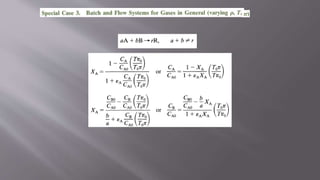
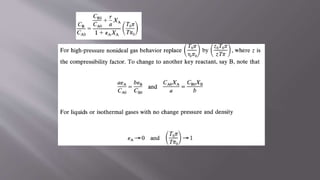
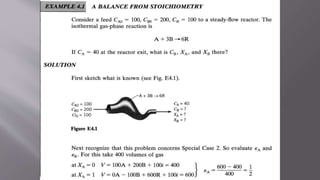
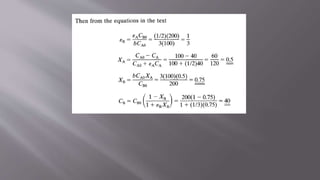
     This includesmost liquid reactions and also those gas reactions run at constant temperature and density. Here CA & XA are related as follows: Fractional change in volume of the system b/w no conversion and complete conversion of reactant A, Thus

Editor's Notes

  • #23 Π = Total Pressure PA = Partial Pressure NA = No. of moles “A”