Equal Spacing: Newton’s Forward and Backward
Difference Interpolation
Dr. Varun Kumar
Dr. Varun Kumar (IIIT Surat) Unit 2 / Lecture-3 1 / 9
Outlines
1 Equal Spacing: Newton’s Forward Difference Formulation
Example
2 Equal Spacing: Newton’s Backward Difference Formulation
Example
Dr. Varun Kumar (IIIT Surat) Unit 2 / Lecture-3 2 / 9
Equal Spacing: Newton’s Forward Difference Formula
Important points
⇒ As per the Newton’s divide difference interpolation formula
f (x)= f0 + (x − x0)f [x0, x1] + (x − x0)(x − x1)f [x0, x1, x2] + ...+
(x − x0)(x − x1)....(x − xn−1)f [x0, ..., xn]
(1)
or
f [x0, ...., xk] =
f [x1, ....., xk] − f [x0, ...., xk−1]
xk − x0
⇒ Above expression is valid for arbitrarily spaced nodes.
⇒ In most of the practical experimentation, it can be adopted.
⇒ For some instances, the interval may be equi-spaced, i.e,
x0, x1 = x0 + h, x2 = x0 + 2h, ....., xn = x0 + nh (2)
Dr. Varun Kumar (IIIT Surat) Unit 2 / Lecture-3 3 / 9
Continued–
⇒ First forward difference of f at xj by
4fj = fj+1 − fj
⇒ Second forward difference of f at xj by
42
fj = 4fj+1 − 4fj
⇒ The kth forward difference of f at xj by
4k
fj = 4k−1
fj+1 − 4k−1
fj ∀ k = 1, 2, ...
⇒ In case of regular spacing in input (x), then
f [x0, x1, ....., xk] =
1
k!hk
4k
f0 (3)
Dr. Varun Kumar (IIIT Surat) Unit 2 / Lecture-3 4 / 9
Continued–
⇒ For k = 1, from (3)
f [x0, x1] =
f1 − f0
x1 − x0
=
1
h
(f1 − f0) =
1
1!h
4f0 (4)
⇒ Let xk+1 = x0 + (k + 1)h
f [x0, ......, xk+1] =
f [x1, ..., xk+1] − f [x0, ..., xk]
xk+1 − x0
=
1
(k + 1)h
h 1
k!hk
4k
f1 −
1
k!hk
4k
f0
i
=
1
(k + 1)!hk+1
4k+1
f0
(5)
Dr. Varun Kumar (IIIT Surat) Unit 2 / Lecture-3 5 / 9
Continued–
⇒ Applying Newton’s forward difference interpolation formula
f (x) ≈ pn(x) = f0 + r4f0 +
r(r − 1)
2!
42
f0 + ...+
r(r − 1)...(r − n + 1)
n!
4n
f0
(6)
where r = x−x0
h
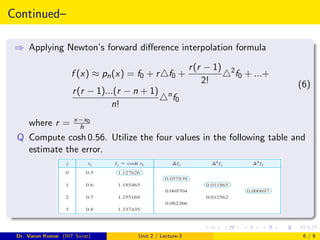
Q Compute cosh 0.56. Utilize the four values in the following table and
estimate the error.
Dr. Varun Kumar (IIIT Surat) Unit 2 / Lecture-3 6 / 9
Equal Spacing: Newton’s Backward Difference Formulation
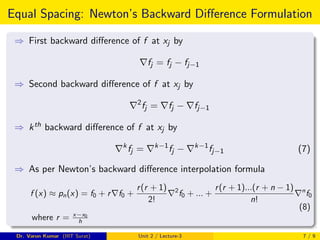
⇒ First backward difference of f at xj by
∇fj = fj − fj−1
⇒ Second backward difference of f at xj by
∇2
fj = ∇fj − ∇fj−1
⇒ kth backward difference of f at xj by
∇k
fj = ∇k−1
fj − ∇k−1
fj−1 (7)
⇒ As per Newton’s backward difference interpolation formula
f (x) ≈ pn(x) = f0 + r∇f0 +
r(r + 1)
2!
∇2
f0 + ... +
r(r + 1)...(r + n − 1)
n!
∇n
f0
(8)
where r = x−x0
h
Dr. Varun Kumar (IIIT Surat) Unit 2 / Lecture-3 7 / 9
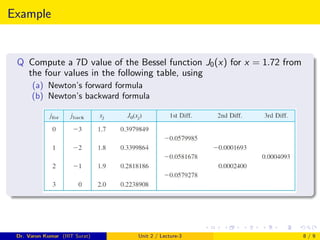
Example
Q Compute a 7D value of the Bessel function J0(x) for x = 1.72 from
the four values in the following table, using
(a) Newton’s forward formula
(b) Newton’s backward formula
Dr. Varun Kumar (IIIT Surat) Unit 2 / Lecture-3 8 / 9
Exercise Problem
1 Calculate the Lagrange polynomial p2(x) for the values
Γ(1.00) = 1.0000, Γ(1.02) = 0.9888, Γ(1.04) = 0.9784 of the gamma
function and from it approximate Γ(1.01) and Γ(1.03).
2 Find e−0.25 and e−0.75 by linear interpolation of e−x with x0 = 0,
x1 = 0.5, and x0 = 0.5, x1 = 0, respectively. Then find p2(x) by
quadratic interpolation of e−x with x0 = 0, x1 = 0.5, and x2 = 1 and
from it e−0.25 and e−0.75 compare the errors.
3 Solve the above problem using Newton’s divide and difference
interpolation method.
Dr. Varun Kumar (IIIT Surat) Unit 2 / Lecture-3 9 / 9

Newton's Forward/Backward Difference Interpolation

  • 1.
    Equal Spacing: Newton’sForward and Backward Difference Interpolation Dr. Varun Kumar Dr. Varun Kumar (IIIT Surat) Unit 2 / Lecture-3 1 / 9
  • 2.
    Outlines 1 Equal Spacing:Newton’s Forward Difference Formulation Example 2 Equal Spacing: Newton’s Backward Difference Formulation Example Dr. Varun Kumar (IIIT Surat) Unit 2 / Lecture-3 2 / 9
  • 3.
    Equal Spacing: Newton’sForward Difference Formula Important points ⇒ As per the Newton’s divide difference interpolation formula f (x)= f0 + (x − x0)f [x0, x1] + (x − x0)(x − x1)f [x0, x1, x2] + ...+ (x − x0)(x − x1)....(x − xn−1)f [x0, ..., xn] (1) or f [x0, ...., xk] = f [x1, ....., xk] − f [x0, ...., xk−1] xk − x0 ⇒ Above expression is valid for arbitrarily spaced nodes. ⇒ In most of the practical experimentation, it can be adopted. ⇒ For some instances, the interval may be equi-spaced, i.e, x0, x1 = x0 + h, x2 = x0 + 2h, ....., xn = x0 + nh (2) Dr. Varun Kumar (IIIT Surat) Unit 2 / Lecture-3 3 / 9
  • 4.
    Continued– ⇒ First forwarddifference of f at xj by 4fj = fj+1 − fj ⇒ Second forward difference of f at xj by 42 fj = 4fj+1 − 4fj ⇒ The kth forward difference of f at xj by 4k fj = 4k−1 fj+1 − 4k−1 fj ∀ k = 1, 2, ... ⇒ In case of regular spacing in input (x), then f [x0, x1, ....., xk] = 1 k!hk 4k f0 (3) Dr. Varun Kumar (IIIT Surat) Unit 2 / Lecture-3 4 / 9
  • 5.
    Continued– ⇒ For k= 1, from (3) f [x0, x1] = f1 − f0 x1 − x0 = 1 h (f1 − f0) = 1 1!h 4f0 (4) ⇒ Let xk+1 = x0 + (k + 1)h f [x0, ......, xk+1] = f [x1, ..., xk+1] − f [x0, ..., xk] xk+1 − x0 = 1 (k + 1)h h 1 k!hk 4k f1 − 1 k!hk 4k f0 i = 1 (k + 1)!hk+1 4k+1 f0 (5) Dr. Varun Kumar (IIIT Surat) Unit 2 / Lecture-3 5 / 9
  • 6.
    Continued– ⇒ Applying Newton’sforward difference interpolation formula f (x) ≈ pn(x) = f0 + r4f0 + r(r − 1) 2! 42 f0 + ...+ r(r − 1)...(r − n + 1) n! 4n f0 (6) where r = x−x0 h Q Compute cosh 0.56. Utilize the four values in the following table and estimate the error. Dr. Varun Kumar (IIIT Surat) Unit 2 / Lecture-3 6 / 9
  • 7.
    Equal Spacing: Newton’sBackward Difference Formulation ⇒ First backward difference of f at xj by ∇fj = fj − fj−1 ⇒ Second backward difference of f at xj by ∇2 fj = ∇fj − ∇fj−1 ⇒ kth backward difference of f at xj by ∇k fj = ∇k−1 fj − ∇k−1 fj−1 (7) ⇒ As per Newton’s backward difference interpolation formula f (x) ≈ pn(x) = f0 + r∇f0 + r(r + 1) 2! ∇2 f0 + ... + r(r + 1)...(r + n − 1) n! ∇n f0 (8) where r = x−x0 h Dr. Varun Kumar (IIIT Surat) Unit 2 / Lecture-3 7 / 9
  • 8.
    Example Q Compute a7D value of the Bessel function J0(x) for x = 1.72 from the four values in the following table, using (a) Newton’s forward formula (b) Newton’s backward formula Dr. Varun Kumar (IIIT Surat) Unit 2 / Lecture-3 8 / 9
  • 9.
    Exercise Problem 1 Calculatethe Lagrange polynomial p2(x) for the values Γ(1.00) = 1.0000, Γ(1.02) = 0.9888, Γ(1.04) = 0.9784 of the gamma function and from it approximate Γ(1.01) and Γ(1.03). 2 Find e−0.25 and e−0.75 by linear interpolation of e−x with x0 = 0, x1 = 0.5, and x0 = 0.5, x1 = 0, respectively. Then find p2(x) by quadratic interpolation of e−x with x0 = 0, x1 = 0.5, and x2 = 1 and from it e−0.25 and e−0.75 compare the errors. 3 Solve the above problem using Newton’s divide and difference interpolation method. Dr. Varun Kumar (IIIT Surat) Unit 2 / Lecture-3 9 / 9