Numerical Analysis
Newton’s Backward
Interpolation Formula
Presented By:
Muhammad Usman Ikram (F2018266065)
What is Interpolation ?
2
“Interpolation is a type of
estimation, a method of
constructing new data points within
the range of a discrete set of known
data points.
Example
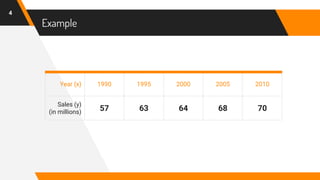
Year (x) 1990 1995 2000 2005 2010
Sales (y)
(in millions) 57 63 64 68 70
4
History
5
History
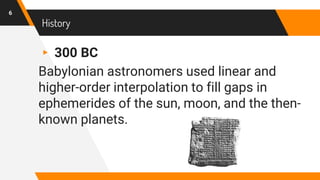
▸ 300 BC
Babylonian astronomers used linear and
higher-order interpolation to fill gaps in
ephemerides of the sun, moon, and the then-
known planets.
6
History
▸ 1000 A.D
The Arabian scientist Al-Biruni writes his
major work Al-Qanun'l-Mas'udi , in which he
describes a method for second-order
interpolation.
7
Types of Interpolation (For equally-spaced data)
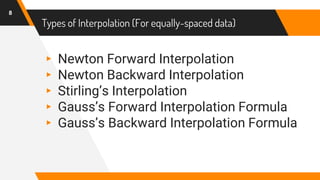
▸ Newton Forward Interpolation
▸ Newton Backward Interpolation
▸ Stirling’s Interpolation
▸ Gauss’s Forward Interpolation Formula
▸ Gauss’s Backward Interpolation Formula
8
Newton’s Backward
Interpolation
9
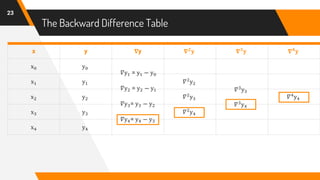
The Backward Difference Table
10
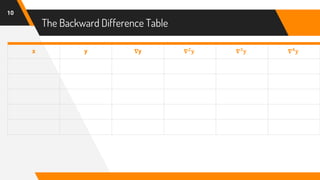
x y 𝛁y 𝛁 𝟐
𝐲 𝛁 𝟑
𝐲 𝛁 𝟒
𝐲
The Backward Difference Table
11
x y 𝛁y 𝛁 𝟐
𝐲 𝛁 𝟑
𝐲 𝛁 𝟒
𝐲
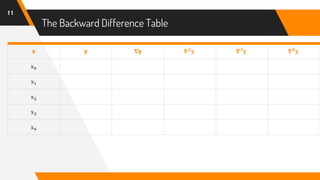
x0
x1
x2
x3
x4
The Backward Difference Table
12
x y 𝛁y 𝛁 𝟐
𝐲 𝛁 𝟑
𝐲 𝛁 𝟒
𝐲
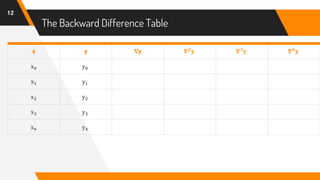
x0 y0
x1 y1
x2 y2
x3 y3
x4 y4
The Backward Difference Table
13
x y 𝛁y 𝛁 𝟐
𝐲 𝛁 𝟑
𝐲 𝛁 𝟒
𝐲
x0 y0
x1 y1
x2 y2
x3 y3
x4 y4
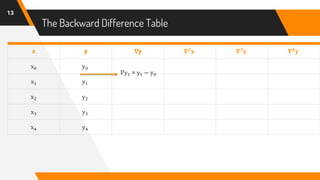
𝛻y1 = y1 − y0
The Backward Difference Table
14
x y 𝛁y 𝛁 𝟐
𝐲 𝛁 𝟑
𝐲 𝛁 𝟒
𝐲
x0 y0
x1 y1
x2 y2
x3 y3
x4 y4
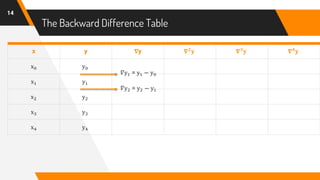
𝛻y1 = y1 − y0
𝛻y2 = y2 − y1
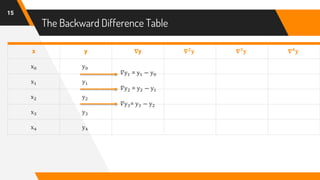
The Backward Difference Table
15
x y 𝛁y 𝛁 𝟐
𝐲 𝛁 𝟑
𝐲 𝛁 𝟒
𝐲
x0 y0
x1 y1
x2 y2
x3 y3
x4 y4
𝛻y1 = y1 − y0
𝛻y2 = y2 − y1
𝛻y3= y3 − y2
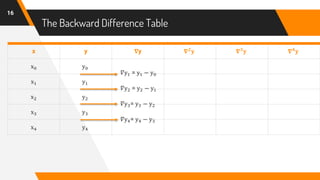
The Backward Difference Table
16
x y 𝛁y 𝛁 𝟐
𝐲 𝛁 𝟑
𝐲 𝛁 𝟒
𝐲
x0 y0
x1 y1
x2 y2
x3 y3
x4 y4
𝛻y1 = y1 − y0
𝛻y2 = y2 − y1
𝛻y3= y3 − y2
𝛻y4= y4 − y3
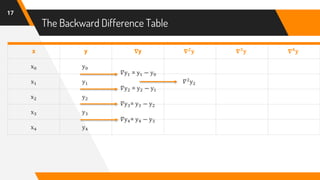
The Backward Difference Table
17
x y 𝛁y 𝛁 𝟐
𝐲 𝛁 𝟑
𝐲 𝛁 𝟒
𝐲
x0 y0
x1 y1 𝛻2
y2
x2 y2
x3 y3
x4 y4
𝛻y1 = y1 − y0
𝛻y2 = y2 − y1
𝛻y3= y3 − y2
𝛻y4= y4 − y3
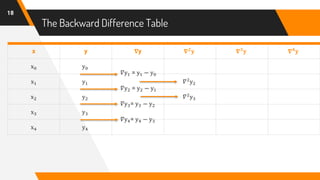
The Backward Difference Table
18
x y 𝛁y 𝛁 𝟐
𝐲 𝛁 𝟑
𝐲 𝛁 𝟒
𝐲
x0 y0
x1 y1 𝛻2
y2
x2 y2 𝛻2
y3
x3 y3
x4 y4
𝛻y1 = y1 − y0
𝛻y2 = y2 − y1
𝛻y3= y3 − y2
𝛻y4= y4 − y3
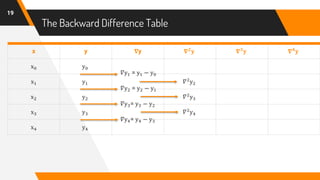
The Backward Difference Table
19
x y 𝛁y 𝛁 𝟐
𝐲 𝛁 𝟑
𝐲 𝛁 𝟒
𝐲
x0 y0
x1 y1 𝛻2
y2
x2 y2 𝛻2
y3
x3 y3 𝛻2
y4
x4 y4
𝛻y1 = y1 − y0
𝛻y2 = y2 − y1
𝛻y3= y3 − y2
𝛻y4= y4 − y3
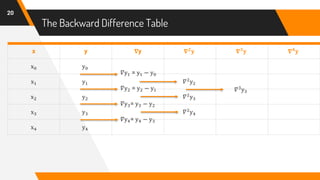
The Backward Difference Table
20
x y 𝛁y 𝛁 𝟐
𝐲 𝛁 𝟑
𝐲 𝛁 𝟒
𝐲
x0 y0
x1 y1 𝛻2
y2
x2 y2 𝛻2
y3
x3 y3 𝛻2
y4
x4 y4
𝛻y1 = y1 − y0
𝛻y2 = y2 − y1
𝛻y3= y3 − y2
𝛻y4= y4 − y3
𝛻3
y3
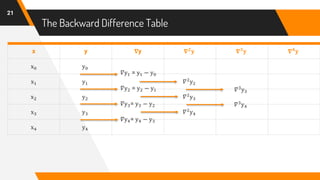
The Backward Difference Table
21
x y 𝛁y 𝛁 𝟐
𝐲 𝛁 𝟑
𝐲 𝛁 𝟒
𝐲
x0 y0
x1 y1 𝛻2
y2
x2 y2 𝛻2
y3
x3 y3 𝛻2
y4
x4 y4
𝛻y1 = y1 − y0
𝛻y2 = y2 − y1
𝛻y3= y3 − y2
𝛻y4= y4 − y3
𝛻3
y4
𝛻3
y3
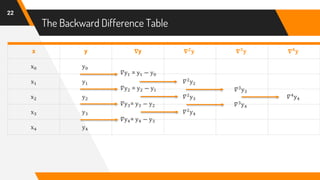
The Backward Difference Table
22
x y 𝛁y 𝛁 𝟐
𝐲 𝛁 𝟑
𝐲 𝛁 𝟒
𝐲
x0 y0
x1 y1 𝛻2
y2
x2 y2 𝛻2
y3 𝛻4
y4
x3 y3 𝛻2
y4
x4 y4
𝛻y1 = y1 − y0
𝛻y2 = y2 − y1
𝛻y3= y3 − y2
𝛻y4= y4 − y3
𝛻3
y4
𝛻3
y3
The Backward Difference Table
23
x y 𝛁y 𝛁 𝟐
𝐲 𝛁 𝟑
𝐲 𝛁 𝟒
𝐲
x0 y0
x1 y1 𝛻2
y2
x2 y2 𝛻2
y3 𝛻4
y4
x3 y3 𝛻2
y4
x4 y4
𝛻y1 = y1 − y0
𝛻y2 = y2 − y1
𝛻y3= y3 − y2
𝛻y4= y4 − y3
𝛻3
y4
𝛻3
y3
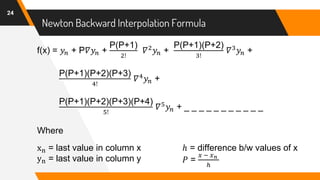
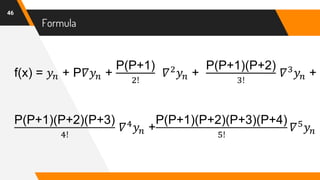
Newton Backward Interpolation Formula
24
f(x) = 𝑦𝑛 + P𝛻𝑦𝑛 +
P(P+1)
2!
𝛻2
𝑦𝑛 +
P(P+1)(P+2)
3!
𝛻3
𝑦𝑛 +
P(P+1)(P+2)(P+3)
4!
𝛻4 𝑦𝑛 +
P(P+1)(P+2)(P+3)(P+4)
5!
𝛻5 𝑦𝑛 + _ _ _ _ _ _ _ _ _ _ _
Where
xn = last value in column x
yn = last value in column y
ℎ = difference b/w values of x
𝑃 =
𝑥 − 𝑥 𝑛
ℎ
Example Question
25
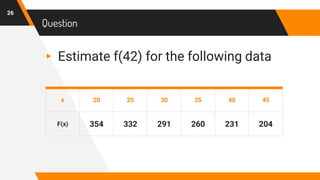
Question
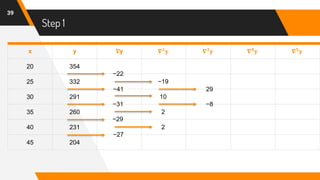
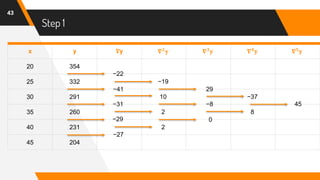
x 20 25 30 35 40 45
F(x) 354 332 291 260 231 204
26
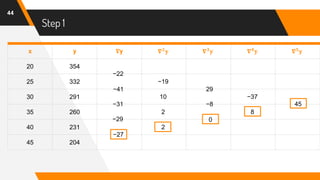
▸ Estimate f(42) for the following data
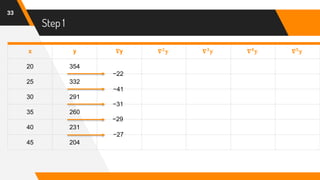
Step 1
27
x y 𝛁y 𝛁 𝟐
𝐲 𝛁 𝟑
𝐲 𝛁 𝟒
𝐲 𝛁 𝟓
𝐲
20
25
30
35
40
45
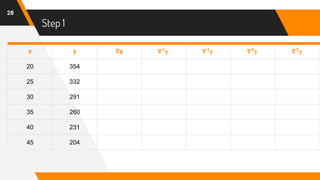
Step 1
28
x y 𝛁y 𝛁 𝟐
𝐲 𝛁 𝟑
𝐲 𝛁 𝟒
𝐲 𝛁 𝟓
𝐲
20 354
25 332
30 291
35 260
40 231
45 204
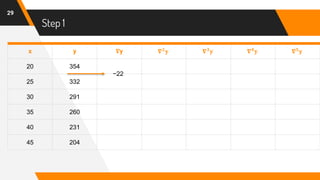
Step 1
29
x y 𝛁y 𝛁 𝟐
𝐲 𝛁 𝟑
𝐲 𝛁 𝟒
𝐲 𝛁 𝟓
𝐲
20 354
25 332
30 291
35 260
40 231
45 204
−22
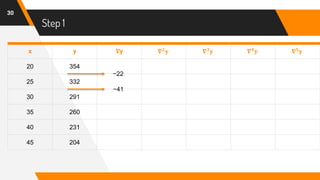
Step 1
30
x y 𝛁y 𝛁 𝟐
𝐲 𝛁 𝟑
𝐲 𝛁 𝟒
𝐲 𝛁 𝟓
𝐲
20 354
25 332
30 291
35 260
40 231
45 204
−41
−22
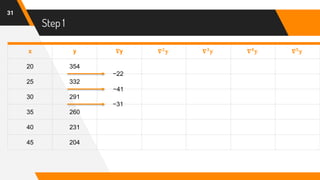
Step 1
31
x y 𝛁y 𝛁 𝟐
𝐲 𝛁 𝟑
𝐲 𝛁 𝟒
𝐲 𝛁 𝟓
𝐲
20 354
25 332
30 291
35 260
40 231
45 204
−31
−41
−22
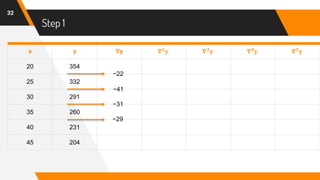
Step 1
32
x y 𝛁y 𝛁 𝟐
𝐲 𝛁 𝟑
𝐲 𝛁 𝟒
𝐲 𝛁 𝟓
𝐲
20 354
25 332
30 291
35 260
40 231
45 204
−29
−31
−41
−22
Step 1
33
x y 𝛁y 𝛁 𝟐
𝐲 𝛁 𝟑
𝐲 𝛁 𝟒
𝐲 𝛁 𝟓
𝐲
20 354
25 332
30 291
35 260
40 231
45 204
−27
−29
−31
−41
−22
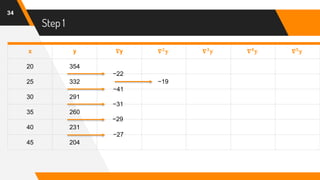
Step 1
34
x y 𝛁y 𝛁 𝟐
𝐲 𝛁 𝟑
𝐲 𝛁 𝟒
𝐲 𝛁 𝟓
𝐲
20 354
25 332 −19
30 291
35 260
40 231
45 204
−27
−29
−31
−41
−22
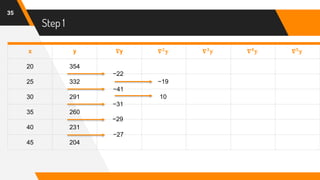
Step 1
35
x y 𝛁y 𝛁 𝟐
𝐲 𝛁 𝟑
𝐲 𝛁 𝟒
𝐲 𝛁 𝟓
𝐲
20 354
25 332 −19
30 291 10
35 260
40 231
45 204
−27
−29
−31
−41
−22
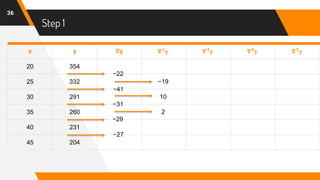
Step 1
36
x y 𝛁y 𝛁 𝟐
𝐲 𝛁 𝟑
𝐲 𝛁 𝟒
𝐲 𝛁 𝟓
𝐲
20 354
25 332 −19
30 291 10
35 260 2
40 231
45 204
−27
−29
−31
−41
−22
Step 1
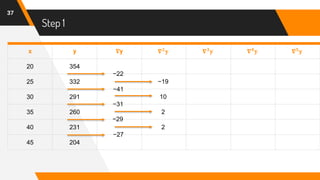
37
x y 𝛁y 𝛁 𝟐
𝐲 𝛁 𝟑
𝐲 𝛁 𝟒
𝐲 𝛁 𝟓
𝐲
20 354
25 332 −19
30 291 10
35 260 2
40 231 2
45 204
−27
−29
−31
−41
−22
Step 1
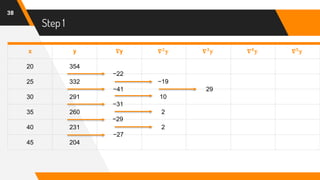
38
x y 𝛁y 𝛁 𝟐
𝐲 𝛁 𝟑
𝐲 𝛁 𝟒
𝐲 𝛁 𝟓
𝐲
20 354
25 332 −19
30 291 10
35 260 2
40 231 2
45 204
−27
−29
−31
−41
−22
29
Step 1
39
x y 𝛁y 𝛁 𝟐
𝐲 𝛁 𝟑
𝐲 𝛁 𝟒
𝐲 𝛁 𝟓
𝐲
20 354
25 332 −19
30 291 10
35 260 2
40 231 2
45 204
−27
−29
−31
−41
−22
−8
29
Step 1
40
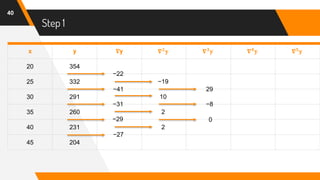
x y 𝛁y 𝛁 𝟐
𝐲 𝛁 𝟑
𝐲 𝛁 𝟒
𝐲 𝛁 𝟓
𝐲
20 354
25 332 −19
30 291 10
35 260 2
40 231 2
45 204
−27
−29
−31
−41
−22
0
−8
29
Step 1
41
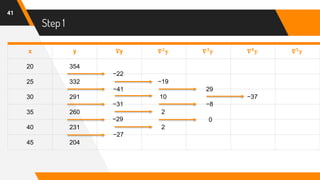
x y 𝛁y 𝛁 𝟐
𝐲 𝛁 𝟑
𝐲 𝛁 𝟒
𝐲 𝛁 𝟓
𝐲
20 354
25 332 −19
30 291 10 −37
35 260 2
40 231 2
45 204
−27
−29
−31
−41
−22
0
−8
29
Step 1
42
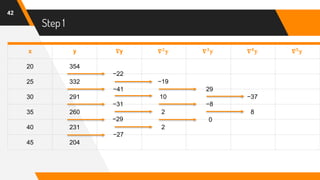
x y 𝛁y 𝛁 𝟐
𝐲 𝛁 𝟑
𝐲 𝛁 𝟒
𝐲 𝛁 𝟓
𝐲
20 354
25 332 −19
30 291 10 −37
35 260 2 8
40 231 2
45 204
−27
−29
−31
−41
−22
0
−8
29
Step 1
43
x y 𝛁y 𝛁 𝟐
𝐲 𝛁 𝟑
𝐲 𝛁 𝟒
𝐲 𝛁 𝟓
𝐲
20 354
25 332 −19
30 291 10 −37
35 260 2 8
40 231 2
45 204
−27
−29
−31
−41
−22
0
−8
29
45
Step 1
44
x y 𝛁y 𝛁 𝟐
𝐲 𝛁 𝟑
𝐲 𝛁 𝟒
𝐲 𝛁 𝟓
𝐲
20 354
25 332 −19
30 291 10 −37
35 260 2 8
40 231 2
45 204
−27
−29
−31
−41
−22
0
−8
29
45
Step 2
45
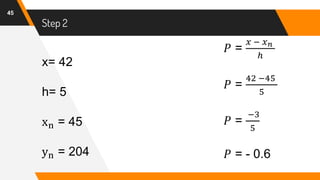
x= 42
h= 5
xn = 45
yn = 204
𝑃 =
𝑥 − 𝑥 𝑛
ℎ
𝑃 =
42 −45
5
𝑃 =
−3
5
𝑃 = - 0.6
Formula
46
f(x) = 𝑦𝑛 + P𝛻𝑦𝑛 +
P(P+1)
2!
𝛻2
𝑦𝑛 +
P(P+1)(P+2)
3!
𝛻3
𝑦𝑛 +
P(P+1)(P+2)(P+3)
4!
𝛻4
𝑦𝑛 +
P(P+1)(P+2)(P+3)(P+4)
5!
𝛻5
𝑦𝑛
Putting Values in Formula
47
f(42) = 204 + (-0.6)(-27) +
(−0.6)[(−0.6)+1]
2
(2)+
(−0.6)[(−0.6)+1][(−0.6)+2]
6
(0) +
(−0.6)[(−0.6)+1][(−0.6)+2][(−0.6)+3]
24
(8) +
(−0.6)[(−0.6)+1][(−0.6)+2][(−0.6)+3][(−0.6)+4]
120
(45)
= 204 + 16.2 + (−0.24) + 0 + (−0.26) + (−1.02)
f(42) = 216.68
Advantages and
Disadvantages
48
Advantages
▸ Helpful in estimation between given set of data.
▸ Simple and intuitive.
▸ Quick and easy.
▸ Helpful in images enhancing (image resizing)
▸ Helpful in Digital Signal Processing.
49
Disadvantages
50
▸ Not always precise.
▸ Sometimes due to the fault in program used, image
after resizing are blurry.
Applications in
Computer Sciences
51
Applications in Computer Sciences
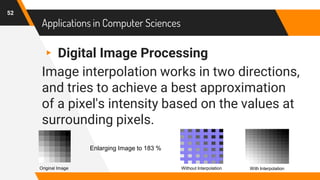
▸ Digital Image Processing
Image interpolation works in two directions,
and tries to achieve a best approximation
of a pixel's intensity based on the values at
surrounding pixels.
52
Original Image
Enlarging Image to 183 %
With InterpolationWithout Interpolation
Applications in Computer Sciences
▸ Game Development and Graphics
Linear interpolation (commonly known as
'lerp') is a really handy function for creative
coding, game development and generative
art.
It ensures the smooth movement of objects
in games.
53
Sources Cited
▸ Interpolation - https://en.wikipedia.org/wiki/Interpolation
▸ A Chronology of Interpolation: From Ancient Astronomy to Modern Signal and
Image Processing -
http://bigwww.epfl.ch/publications/meijering0201.pdf
▸ Resizing Images - https://sisu.ut.ee/imageprocessing/book/3
▸ Digital Image Interpolation - https://www.cambridgeincolour.com/tutorials/image-
interpolation.htm
▸ A Brief Introduction to Lerp -
https://www.gamedev.net/tutorials/programming/general-and-gameplay-
programming/a-brief-introduction-to-lerp-r4954
▸ Linear interpolation - https://en.wikipedia.org/wiki/Linear_interpolation
54
55
JazakAllah

Newton's Backward Interpolation Formula with Example

  • 1.
    Numerical Analysis Newton’s Backward InterpolationFormula Presented By: Muhammad Usman Ikram (F2018266065)
  • 2.
  • 3.
    “Interpolation is atype of estimation, a method of constructing new data points within the range of a discrete set of known data points.
  • 4.
    Example Year (x) 19901995 2000 2005 2010 Sales (y) (in millions) 57 63 64 68 70 4
  • 5.
  • 6.
    History ▸ 300 BC Babylonianastronomers used linear and higher-order interpolation to fill gaps in ephemerides of the sun, moon, and the then- known planets. 6
  • 7.
    History ▸ 1000 A.D TheArabian scientist Al-Biruni writes his major work Al-Qanun'l-Mas'udi , in which he describes a method for second-order interpolation. 7
  • 8.
    Types of Interpolation(For equally-spaced data) ▸ Newton Forward Interpolation ▸ Newton Backward Interpolation ▸ Stirling’s Interpolation ▸ Gauss’s Forward Interpolation Formula ▸ Gauss’s Backward Interpolation Formula 8
  • 9.
  • 10.
    The Backward DifferenceTable 10 x y 𝛁y 𝛁 𝟐 𝐲 𝛁 𝟑 𝐲 𝛁 𝟒 𝐲
  • 11.
    The Backward DifferenceTable 11 x y 𝛁y 𝛁 𝟐 𝐲 𝛁 𝟑 𝐲 𝛁 𝟒 𝐲 x0 x1 x2 x3 x4
  • 12.
    The Backward DifferenceTable 12 x y 𝛁y 𝛁 𝟐 𝐲 𝛁 𝟑 𝐲 𝛁 𝟒 𝐲 x0 y0 x1 y1 x2 y2 x3 y3 x4 y4
  • 13.
    The Backward DifferenceTable 13 x y 𝛁y 𝛁 𝟐 𝐲 𝛁 𝟑 𝐲 𝛁 𝟒 𝐲 x0 y0 x1 y1 x2 y2 x3 y3 x4 y4 𝛻y1 = y1 − y0
  • 14.
    The Backward DifferenceTable 14 x y 𝛁y 𝛁 𝟐 𝐲 𝛁 𝟑 𝐲 𝛁 𝟒 𝐲 x0 y0 x1 y1 x2 y2 x3 y3 x4 y4 𝛻y1 = y1 − y0 𝛻y2 = y2 − y1
  • 15.
    The Backward DifferenceTable 15 x y 𝛁y 𝛁 𝟐 𝐲 𝛁 𝟑 𝐲 𝛁 𝟒 𝐲 x0 y0 x1 y1 x2 y2 x3 y3 x4 y4 𝛻y1 = y1 − y0 𝛻y2 = y2 − y1 𝛻y3= y3 − y2
  • 16.
    The Backward DifferenceTable 16 x y 𝛁y 𝛁 𝟐 𝐲 𝛁 𝟑 𝐲 𝛁 𝟒 𝐲 x0 y0 x1 y1 x2 y2 x3 y3 x4 y4 𝛻y1 = y1 − y0 𝛻y2 = y2 − y1 𝛻y3= y3 − y2 𝛻y4= y4 − y3
  • 17.
    The Backward DifferenceTable 17 x y 𝛁y 𝛁 𝟐 𝐲 𝛁 𝟑 𝐲 𝛁 𝟒 𝐲 x0 y0 x1 y1 𝛻2 y2 x2 y2 x3 y3 x4 y4 𝛻y1 = y1 − y0 𝛻y2 = y2 − y1 𝛻y3= y3 − y2 𝛻y4= y4 − y3
  • 18.
    The Backward DifferenceTable 18 x y 𝛁y 𝛁 𝟐 𝐲 𝛁 𝟑 𝐲 𝛁 𝟒 𝐲 x0 y0 x1 y1 𝛻2 y2 x2 y2 𝛻2 y3 x3 y3 x4 y4 𝛻y1 = y1 − y0 𝛻y2 = y2 − y1 𝛻y3= y3 − y2 𝛻y4= y4 − y3
  • 19.
    The Backward DifferenceTable 19 x y 𝛁y 𝛁 𝟐 𝐲 𝛁 𝟑 𝐲 𝛁 𝟒 𝐲 x0 y0 x1 y1 𝛻2 y2 x2 y2 𝛻2 y3 x3 y3 𝛻2 y4 x4 y4 𝛻y1 = y1 − y0 𝛻y2 = y2 − y1 𝛻y3= y3 − y2 𝛻y4= y4 − y3
  • 20.
    The Backward DifferenceTable 20 x y 𝛁y 𝛁 𝟐 𝐲 𝛁 𝟑 𝐲 𝛁 𝟒 𝐲 x0 y0 x1 y1 𝛻2 y2 x2 y2 𝛻2 y3 x3 y3 𝛻2 y4 x4 y4 𝛻y1 = y1 − y0 𝛻y2 = y2 − y1 𝛻y3= y3 − y2 𝛻y4= y4 − y3 𝛻3 y3
  • 21.
    The Backward DifferenceTable 21 x y 𝛁y 𝛁 𝟐 𝐲 𝛁 𝟑 𝐲 𝛁 𝟒 𝐲 x0 y0 x1 y1 𝛻2 y2 x2 y2 𝛻2 y3 x3 y3 𝛻2 y4 x4 y4 𝛻y1 = y1 − y0 𝛻y2 = y2 − y1 𝛻y3= y3 − y2 𝛻y4= y4 − y3 𝛻3 y4 𝛻3 y3
  • 22.
    The Backward DifferenceTable 22 x y 𝛁y 𝛁 𝟐 𝐲 𝛁 𝟑 𝐲 𝛁 𝟒 𝐲 x0 y0 x1 y1 𝛻2 y2 x2 y2 𝛻2 y3 𝛻4 y4 x3 y3 𝛻2 y4 x4 y4 𝛻y1 = y1 − y0 𝛻y2 = y2 − y1 𝛻y3= y3 − y2 𝛻y4= y4 − y3 𝛻3 y4 𝛻3 y3
  • 23.
    The Backward DifferenceTable 23 x y 𝛁y 𝛁 𝟐 𝐲 𝛁 𝟑 𝐲 𝛁 𝟒 𝐲 x0 y0 x1 y1 𝛻2 y2 x2 y2 𝛻2 y3 𝛻4 y4 x3 y3 𝛻2 y4 x4 y4 𝛻y1 = y1 − y0 𝛻y2 = y2 − y1 𝛻y3= y3 − y2 𝛻y4= y4 − y3 𝛻3 y4 𝛻3 y3
  • 24.
    Newton Backward InterpolationFormula 24 f(x) = 𝑦𝑛 + P𝛻𝑦𝑛 + P(P+1) 2! 𝛻2 𝑦𝑛 + P(P+1)(P+2) 3! 𝛻3 𝑦𝑛 + P(P+1)(P+2)(P+3) 4! 𝛻4 𝑦𝑛 + P(P+1)(P+2)(P+3)(P+4) 5! 𝛻5 𝑦𝑛 + _ _ _ _ _ _ _ _ _ _ _ Where xn = last value in column x yn = last value in column y ℎ = difference b/w values of x 𝑃 = 𝑥 − 𝑥 𝑛 ℎ
  • 25.
  • 26.
    Question x 20 2530 35 40 45 F(x) 354 332 291 260 231 204 26 ▸ Estimate f(42) for the following data
  • 27.
    Step 1 27 x y𝛁y 𝛁 𝟐 𝐲 𝛁 𝟑 𝐲 𝛁 𝟒 𝐲 𝛁 𝟓 𝐲 20 25 30 35 40 45
  • 28.
    Step 1 28 x y𝛁y 𝛁 𝟐 𝐲 𝛁 𝟑 𝐲 𝛁 𝟒 𝐲 𝛁 𝟓 𝐲 20 354 25 332 30 291 35 260 40 231 45 204
  • 29.
    Step 1 29 x y𝛁y 𝛁 𝟐 𝐲 𝛁 𝟑 𝐲 𝛁 𝟒 𝐲 𝛁 𝟓 𝐲 20 354 25 332 30 291 35 260 40 231 45 204 −22
  • 30.
    Step 1 30 x y𝛁y 𝛁 𝟐 𝐲 𝛁 𝟑 𝐲 𝛁 𝟒 𝐲 𝛁 𝟓 𝐲 20 354 25 332 30 291 35 260 40 231 45 204 −41 −22
  • 31.
    Step 1 31 x y𝛁y 𝛁 𝟐 𝐲 𝛁 𝟑 𝐲 𝛁 𝟒 𝐲 𝛁 𝟓 𝐲 20 354 25 332 30 291 35 260 40 231 45 204 −31 −41 −22
  • 32.
    Step 1 32 x y𝛁y 𝛁 𝟐 𝐲 𝛁 𝟑 𝐲 𝛁 𝟒 𝐲 𝛁 𝟓 𝐲 20 354 25 332 30 291 35 260 40 231 45 204 −29 −31 −41 −22
  • 33.
    Step 1 33 x y𝛁y 𝛁 𝟐 𝐲 𝛁 𝟑 𝐲 𝛁 𝟒 𝐲 𝛁 𝟓 𝐲 20 354 25 332 30 291 35 260 40 231 45 204 −27 −29 −31 −41 −22
  • 34.
    Step 1 34 x y𝛁y 𝛁 𝟐 𝐲 𝛁 𝟑 𝐲 𝛁 𝟒 𝐲 𝛁 𝟓 𝐲 20 354 25 332 −19 30 291 35 260 40 231 45 204 −27 −29 −31 −41 −22
  • 35.
    Step 1 35 x y𝛁y 𝛁 𝟐 𝐲 𝛁 𝟑 𝐲 𝛁 𝟒 𝐲 𝛁 𝟓 𝐲 20 354 25 332 −19 30 291 10 35 260 40 231 45 204 −27 −29 −31 −41 −22
  • 36.
    Step 1 36 x y𝛁y 𝛁 𝟐 𝐲 𝛁 𝟑 𝐲 𝛁 𝟒 𝐲 𝛁 𝟓 𝐲 20 354 25 332 −19 30 291 10 35 260 2 40 231 45 204 −27 −29 −31 −41 −22
  • 37.
    Step 1 37 x y𝛁y 𝛁 𝟐 𝐲 𝛁 𝟑 𝐲 𝛁 𝟒 𝐲 𝛁 𝟓 𝐲 20 354 25 332 −19 30 291 10 35 260 2 40 231 2 45 204 −27 −29 −31 −41 −22
  • 38.
    Step 1 38 x y𝛁y 𝛁 𝟐 𝐲 𝛁 𝟑 𝐲 𝛁 𝟒 𝐲 𝛁 𝟓 𝐲 20 354 25 332 −19 30 291 10 35 260 2 40 231 2 45 204 −27 −29 −31 −41 −22 29
  • 39.
    Step 1 39 x y𝛁y 𝛁 𝟐 𝐲 𝛁 𝟑 𝐲 𝛁 𝟒 𝐲 𝛁 𝟓 𝐲 20 354 25 332 −19 30 291 10 35 260 2 40 231 2 45 204 −27 −29 −31 −41 −22 −8 29
  • 40.
    Step 1 40 x y𝛁y 𝛁 𝟐 𝐲 𝛁 𝟑 𝐲 𝛁 𝟒 𝐲 𝛁 𝟓 𝐲 20 354 25 332 −19 30 291 10 35 260 2 40 231 2 45 204 −27 −29 −31 −41 −22 0 −8 29
  • 41.
    Step 1 41 x y𝛁y 𝛁 𝟐 𝐲 𝛁 𝟑 𝐲 𝛁 𝟒 𝐲 𝛁 𝟓 𝐲 20 354 25 332 −19 30 291 10 −37 35 260 2 40 231 2 45 204 −27 −29 −31 −41 −22 0 −8 29
  • 42.
    Step 1 42 x y𝛁y 𝛁 𝟐 𝐲 𝛁 𝟑 𝐲 𝛁 𝟒 𝐲 𝛁 𝟓 𝐲 20 354 25 332 −19 30 291 10 −37 35 260 2 8 40 231 2 45 204 −27 −29 −31 −41 −22 0 −8 29
  • 43.
    Step 1 43 x y𝛁y 𝛁 𝟐 𝐲 𝛁 𝟑 𝐲 𝛁 𝟒 𝐲 𝛁 𝟓 𝐲 20 354 25 332 −19 30 291 10 −37 35 260 2 8 40 231 2 45 204 −27 −29 −31 −41 −22 0 −8 29 45
  • 44.
    Step 1 44 x y𝛁y 𝛁 𝟐 𝐲 𝛁 𝟑 𝐲 𝛁 𝟒 𝐲 𝛁 𝟓 𝐲 20 354 25 332 −19 30 291 10 −37 35 260 2 8 40 231 2 45 204 −27 −29 −31 −41 −22 0 −8 29 45
  • 45.
    Step 2 45 x= 42 h=5 xn = 45 yn = 204 𝑃 = 𝑥 − 𝑥 𝑛 ℎ 𝑃 = 42 −45 5 𝑃 = −3 5 𝑃 = - 0.6
  • 46.
    Formula 46 f(x) = 𝑦𝑛+ P𝛻𝑦𝑛 + P(P+1) 2! 𝛻2 𝑦𝑛 + P(P+1)(P+2) 3! 𝛻3 𝑦𝑛 + P(P+1)(P+2)(P+3) 4! 𝛻4 𝑦𝑛 + P(P+1)(P+2)(P+3)(P+4) 5! 𝛻5 𝑦𝑛
  • 47.
    Putting Values inFormula 47 f(42) = 204 + (-0.6)(-27) + (−0.6)[(−0.6)+1] 2 (2)+ (−0.6)[(−0.6)+1][(−0.6)+2] 6 (0) + (−0.6)[(−0.6)+1][(−0.6)+2][(−0.6)+3] 24 (8) + (−0.6)[(−0.6)+1][(−0.6)+2][(−0.6)+3][(−0.6)+4] 120 (45) = 204 + 16.2 + (−0.24) + 0 + (−0.26) + (−1.02) f(42) = 216.68
  • 48.
  • 49.
    Advantages ▸ Helpful inestimation between given set of data. ▸ Simple and intuitive. ▸ Quick and easy. ▸ Helpful in images enhancing (image resizing) ▸ Helpful in Digital Signal Processing. 49
  • 50.
    Disadvantages 50 ▸ Not alwaysprecise. ▸ Sometimes due to the fault in program used, image after resizing are blurry.
  • 51.
  • 52.
    Applications in ComputerSciences ▸ Digital Image Processing Image interpolation works in two directions, and tries to achieve a best approximation of a pixel's intensity based on the values at surrounding pixels. 52 Original Image Enlarging Image to 183 % With InterpolationWithout Interpolation
  • 53.
    Applications in ComputerSciences ▸ Game Development and Graphics Linear interpolation (commonly known as 'lerp') is a really handy function for creative coding, game development and generative art. It ensures the smooth movement of objects in games. 53
  • 54.
    Sources Cited ▸ Interpolation- https://en.wikipedia.org/wiki/Interpolation ▸ A Chronology of Interpolation: From Ancient Astronomy to Modern Signal and Image Processing - http://bigwww.epfl.ch/publications/meijering0201.pdf ▸ Resizing Images - https://sisu.ut.ee/imageprocessing/book/3 ▸ Digital Image Interpolation - https://www.cambridgeincolour.com/tutorials/image- interpolation.htm ▸ A Brief Introduction to Lerp - https://www.gamedev.net/tutorials/programming/general-and-gameplay- programming/a-brief-introduction-to-lerp-r4954 ▸ Linear interpolation - https://en.wikipedia.org/wiki/Linear_interpolation 54
  • 55.