1
Fourier Transform
Z. Aliyazicioglu
Electrical & Computer Engineering Dept.
Cal Poly Pomona
ECE 307
Fourier Transform
The Fourier transform (FT) is the extension of the Fourier series to
nonperiodic signals. The Fourier transform of a signal exist if
satisfies the following condition.
The Fourier transform
The inverse Fourier transform (IFT) of X(ω) is x(t)and given by
2
( )
x t dt
∞
−∞
< ∞
∫
( ) ( ) j t
X x t e dt
ω
ω
∞
−
−∞
= ∫
1
( ) ( )
2
j t
x t X e d
ω
ω ω
π
∞
−∞
= ∫
2
Fourier Transform
Also, The Fourier transform can be defined in terms of frequency of
Hertz as
and corresponding inverse Fourier transform is
2
( ) ( ) j ft
X f x t e dt
π
∞
−
−∞
= ∫
2
( ) ( ) j ft
x t X f e df
π
∞
−∞
= ∫
Fourier Transform
Determine the Fourier transform of a rectangular pulse
shown in the following figure
Example:
-a/2 a/2
h
t
x(t)
/ 2
2 2
/ 2
( )
sin( )
2 2
sin( )
2
2
sinc
2
a a a
j j
j t
a
h
X he dt e e
j
a
h a
ha
a
a
ha
ω ω
ω
ω
ω
ω
ω
ω
ω
ω
π
−
−
−
 
= = −
 
−  
= =
 
=  
 
∫
3
Fourier Transform
Example: To find in frequency domain,
( )
/ 2 2 2
2 2 2
/ 2
( )
2
sin( )
sin( )
sinc
a fa fa
j j
j ft
a
h
X f he dt e e
j f
h fa
fa ha
f fa
ha fa
π π
π
π
π
π
π π
−
−
−
 
= = −
 
−  
= =
=
∫
>> h=1;
>> a=1;
>> f=-3.5:0.01:3.5;
>> w=2*pi*f;
>> x=h*a*sinc(w*a/(2*pi));
>> plot (w,x)
>> title ('X(omega)')
>> xlabel('omega');
>>
1,
1
( ) 2sinc
2
h
a
X
ω
ω
π
=
=
 
=  
 
Fourier Transform
1,
2
2
( ) 2sinc
2
h
a
X
ω
ω
π
=
=
 
=  
 
>> h=1;
>> a=1;
>> f=-3.5:0.01:3.5;
>> w=2*pi*f;
>> x=abs(h*a*sinc(w*a/(2*pi)));
>> subplot (2,1,1)
>> plot (w,x)
>> title ('|X(omega)|')
>> xlabel('omega')
>> xp=phase(h*a*sinc(w*a/(2*pi)));
>> subplot (2,1,2)
>> plot (w,xp)
>> title ('phase X(omega)')
>> xlabel('omega')
4
Fourier Transform
Determine the Fourier transform of the Delta function δ(t)
Example
0
( ) ( ) 1
j t j
X t e dt e
ω ω
ω δ
∞
− −
−∞
= = =
∫
1
X(ω)
ω
Fourier Transform
Properties of the Fourier Transform
We summarize several important properties of the Fourier Transform as follows.
1. Linearity (Superposition)
1 1
( ) ( )
x t X ω
⇔ 2 2
( ) ( )
x t X ω
⇔
1 1 2 2 1 1 2 2
( ) ( ) ( ) ( )
a x t a x t a X a X
ω ω
+ ⇔ +
Then,
If and
Proof:
[ ]
1 1 2 2 1 1 2 2
1 1 2 2
( ) ( ) ( ) ( )
( ) ( )
j t j t j t
a x t a x t e dt a x t e dt a x t e dt
a X a X
ω ω ω
ω ω
∞ ∞ ∞
− − −
−∞ −∞ −∞
+ = +
= +
∫ ∫ ∫
5
Fourier Transform
Properties of the Fourier Transform
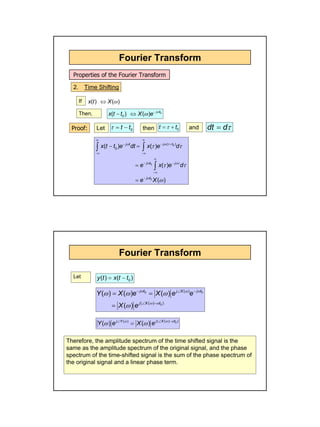
2. Time Shifting
Then,
If
Proof:
( ) ( )
x t X ω
⇔
0
0
( ) ( ) j t
x t t X e ω
ω −
− ⇔
0
t t
τ = − 0
t t
τ
= + dt dτ
=
0
0
0
( )
0
( ) ( )
( )
( )
j t
j t
j t j
j t
x t t e dt x e d
e x e d
e X
ω τ
ω
ω ωτ
ω
τ τ
τ τ
ω
∞ ∞
− +
−
−∞ −∞
∞
− −
−∞
−
− =
=
=
∫ ∫
∫
Let then and
Fourier Transform
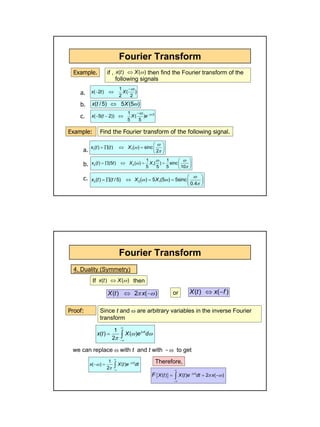
Let
0
( ) ( )
y t x t t
= −
0 0
0
( )
( ( ) )
( ) ( ) ( )
( )
j t j t
j X
j X t
Y X e X e e
X e
ω ω
ω
ω ω
ω ω ω
ω
− −
∠
∠ −
= =
=
0
( ( ) )
( )
( ) ( ) j X t
j Y
Y e X e ω ω
ω
ω ω ∠ −
∠
=
Therefore, the amplitude spectrum of the time shifted signal is the
same as the amplitude spectrum of the original signal, and the phase
spectrum of the time-shifted signal is the sum of the phase spectrum of
the original signal and a linear phase term.
6
Fourier Transform
Example: Determine the Fourier transform of the following time
shifted rectangular pulse.
0 a
h
t
x(t)
2
( ) sinc
2
a
j
a
X ha e
ω
ω
ω
π
−
 
=  
 
>> h=1;
>> a=1;
>> f=-3.5:0.01:3.5;
>> w=2*pi*f;
>> x=abs(h*a*sinc(w*a/(2*pi)).*exp(-
j*w*1/2));
>> subplot (2,1,1)
>> plot (w,x)
>> title ('|X(omega)|')
>> xlabel('omega')
>> xp=phase(h*a*sinc(w*a/(2*pi)).*exp(-
j*w.*1/2));
>> subplot (2,1,2)
>> plot (w,xp)
>> xlabel('omega')
>> title ('phaseX(omega)')
Fourier Transform
3. Time Scaling
then
Proof:
If , a>0 then
( ) ( )
x t X ω
⇔
If
1
( ) ( )
x at X
a a
ω
⇔
at
τ = /
t a
τ
= (1/ )
dt a dτ
=
Let then and
1
( ) ( )
1
( )
j
j t a
x at e dt x e d
a
X
a a
ω
τ
ω
τ τ
ω
∞ ∞
−
−
−∞ −∞
=
=
∫ ∫
If , a<0 then
1
( ) ( )
1 1
( ) ( )
j
j t a
j
a
x at e dt x e d
a
x e d X
a a a
ω
τ
ω
ω
τ
τ τ
ω
τ τ
∞ ∞
−
−
−∞ −∞
∞
−
−∞
=
= =
∫ ∫
∫
7
Fourier Transform
Example. if , then find the Fourier transform of the
following signals
1
( 2 ) ( )
2 2
x t X
ω
−
− ⇔
( /5) 5 (5 )
x t X ω
⇔
2
1
( 5( 2)) ( )
5 5
j
x t X e ω
ω −
−
− − ⇔
( ) ( )
x t X ω
⇔
a.
b.
c.
Example: Find the Fourier transform of the following signal.
1 1
( ) ( ) ( ) sinc
2
x t t X
ω
ω
π
 
= ∏ ⇔ =  
 
2 2 1
1 1
( ) (5 ) ( ) ( ) sinc
5 5 5 10
x t t X X
ω ω
ω
π
 
= ∏ ⇔ = =  
 
3 3 1
( ) ( /5) ( ) 5 (5 ) 5sinc
0.4
x t t X X
ω
ω ω
π
 
= ∏ ⇔ = =  
 
a.
b.
c.
Fourier Transform
4. Duality (Symmetry)
If then
( ) ( )
x t X ω
⇔
( ) 2 ( )
X t x
π ω
⇔ − ( ) ( )
X t x f
⇔ −
or
Proof: Since t and ω are arbitrary variables in the inverse Fourier
transform
1
( ) ( )
2
j t
x t X e d
ω
ω ω
π
∞
−∞
= ∫
we can replace ω with t and t with - ω to get
1
( ) ( )
2
j t
x X t e dt
ω
ω
π
∞
−
−∞
− = ∫
{ }
( ) ( ) 2 ( )
j t
X t X t e dt x
F ω
π ω
∞
−
−∞
= = −
∫
Therefore,
8
Fourier Transform
Similarly, if we can replace f with t and t with -f in the inverse
Fourier transform
2
( ) ( ) j ft
x t X f e df
π
∞
−∞
= ∫
2
( ) ( ) j ft
x f X t e df
π
∞
−
−∞
− = ∫
{ }
( ) ( )
X t x f
F = −
to get
Therefore,
then
Let
Fourier Transform
Example: Applying symmetry property,
( ) ( ) ( ) 1
x t t X
δ ω
= ⇔ =
( ) 1 ( ) 2 ( ) 2 ( )
x t X ω πδ ω πδ ω
= ⇔ = − = ( is even function)
( )
δ ω
( ) 1 ( ) ( ) ( )
x t X f f f
δ δ
= ⇔ = − =
or
Example:
( ) ( ) sinc
2
t a
x t rect X a
a
ω
ω
π
   
= ⇔ =
   
   
( ) sinc ( ) 2 2
2
ta
x t a X rect rect
a a
ω ω
ω π π
π
−
     
= ⇔ = =
     
     
2
a
c
π
= 2
a c
π
=
( )
1
( ) sinc ( ) 2
2 2
x t a ct X rect rect
c c c
ω ω
ω π
π π
   
= ⇔ = =
   
   
9
Fourier Transform
Time Reversal
If then
( ) ( )
x t X ω
⇔
( ) ( )
x t X ω
− ⇔ −
Proof: Let . Then and
t τ
− = t τ
= − dt dτ
= −
( )
( ) ( ) ( )
j t j
x t e dt x e d X
ω ω τ
τ τ ω
∞ ∞
− − −
−∞ −∞
− = − = −
∫ ∫
Fourier Transform
Frequency Shifting
If then
( ) ( )
x t X ω
⇔
( ) ( )
c
j t
c
x t e X
ω
ω ω
−
⇔ −
( )
( ) ( ) ( )
c c
j t j t
j t
c
x t e e dt x t e dt X
ω ω ω
ω
ω ω
∞ ∞
− −
−
−∞ −∞
= = −
∫ ∫
Proof:
10
Fourier Transform
Determine the Fourier transform of and
Example: cos ct
ω sin ct
ω
[ ]
1 1
( ) cos ( ) ( ) ( )
2 2
c c
j t j t
c c c
x t t e e X
ω ω
ω ω π δ ω ω δ ω ω
−
= = + ⇔ = − + +
[ ]
1 1 1
( ) cos ( ) ( ) ( )
2 2 2
c c
j t j t
c c c
x t t e e X f f f f f
ω ω
ω δ δ
−
= = + ⇔ = − + +
or
f
1/2
fc
-fc
The phase spectrum is zero everywhere.
X(f)
Fourier Transform
[ ]
1 1
( ) sin ( ) ( ) ( )
2 2
c c
j t j t
c c c
x t t e e X j
j j
ω ω
ω ω π δ ω ω δ ω ω
−
= = − ⇔ = − − − +
[ ]
1 1
( ) sin ( ) ( ) ( )
2 2 2
c c
j t j t
c c c
j
x t t e e X f f f f f
j j
ω ω
ω δ δ
− −
= = − ⇔ = − − +
f
π/2
-fc
fc
-π/2
f
1/2
fc
-fc
|X(f)|
θ(f)
11
Fourier Transform
7. Modulation
If then
Proof:
( ) ( )
x t X ω
⇔
[ ]
1
( )cos( ) ( ) ( )
2
c c c
x t t X X
ω ω ω ω ω
⇔ − + +
[ ]
( ) ( )
1
( )cos( ) ( )
2
1
( ) ( )
2
1
( ) ( )
2
c c
c c
j t j t
j t j t
c
j t j t
c c
x t t e dt x t e e e dt
x t e dt x t e dt
X X
ω ω
ω ω
ω ω ω ω
ω
ω ω ω ω
∞ ∞
− −
−∞ −∞
∞ ∞
− − − +
−∞ −∞
 
= +
 
 
= +
 
 
= − + +
∫ ∫
∫ ∫
Fourier Transform
8. Time Differentiation:
If then
Proof:
( ) ( )
x t X ω
⇔
( )
( )
dx t
j X
dt
ω ω
⇔
( )
( ) ( )
n
n
n
d x t
j X
dt
ω ω
⇔
General case
Taking the derivative of the inverse Fourier transform
1
( ) ( )
2
j t
x t X e d
ω
ω ω
π
∞
−∞
= ∫
( ) 1
( )
2
j t
dx t
j X e d
dt
ω
ω ω ω
π
∞
−∞
= ∫
( )
( )
dx t
j X
dt
ω ω
⇔
we obtain
Therefore
12
Fourier Transform
9. Time Differentiation:
If then
Proof:
( ) ( )
x t X ω
⇔ General case
Taking derivative of Fourier Transform
( )
( )
dX j
tx t j
d
ω
ω
⇔
( )
( )
n
n n
n
d X
t x t j
d
ω
ω
⇔
( ) ( ) j t
X x t e dt
ω
ω
∞
−
−∞
= ∫
( )
( ) ( ) j t
dX
jt x t e dt
d
ω
ω
ω
∞
−
−∞
= −
∫
with respect to ω, we obtain
( )
( )
dX j
tx t j
d
ω
ω
⇔
Therefore
Fourier Transform
10 Conjugate
If then
Proof:
( ) ( )
x t X ω
⇔
If x(t) is real so that
* *
( ) ( )
x t X ω
⇔ −
*
* ( ) *
( ) ( ) ( )
j t j t
x t e dt x t e dt X
ω ω
ω
∞ ∞
− − −
−∞ −∞
 
= = −
 
 
∫ ∫
*
( ) ( )
x t x t
= *
( ) ( )
X X
ω ω
= −
13
Fourier Transform
11. Convolution
Proof:
Interchanging the order of integration, we obtain
If , , and
( ) ( )
x t X ω
⇔ ( ) ( )
h t H ω
⇔ ( ) ( )
y t Y ω
⇔
( ) ( ) * ( ) ( ) ( )
y t h t x t h x t d
τ τ τ
∞
−∞
= = −
∫
( ) ( ) ( )
Y H X
ω ω ω
=
( ) ( ) ( ) j t
Y h x t d e dt
ω
ω τ τ τ
∞ ∞
−
−∞ −∞
 
= −
 
 
∫ ∫
( ) ( ) ( ) j t
Y h x t e dt d
ω
ω τ τ τ
∞ ∞
−
−∞ −∞
 
= −
 
 
∫ ∫
( ) ( ) ( ) ( ) ( )
( ) ( )
j j
Y h X e d X h e d
X H
ωτ ωτ
ω τ ω τ ω τ τ
ω ω
∞ ∞
− −
−∞ −∞
= =
=
∫ ∫
Fourier Transform
12. Multiplication
or
If , and
1 2 1 2 1 2
1 1
( ) ( ) ( ) * ( ) ( ) ( )
2 2
x t x t X X X v X v dv
ω ω ω
π π
∞
−∞
⇔ = −
∫
1 1
( ) ( )
x t X ω
⇔ 2 2
( ) ( )
x t X ω
⇔
1 2 1 2 1 2
( ) ( ) ( ) * ( ) ( ) ( )
x t x t X f X f X v X f v dv
∞
−∞
⇔ = −
∫
14
Fourier Transform
13. Parseval’s Theorem
Proof
If , then total normalized(based on one ohms
resistor) energy E of and x(t) is given by
1 1
( ) ( )
x t X ω
⇔
2 2 2
1
( ) ( ) ( )
2
E x t dt X d X f df
ω ω
π
∞ ∞ ∞
−∞ −∞ −∞
= = =
∫ ∫ ∫
2 * *
1
( ) ( ) ( ) ( ) ( )
2
j t
x t dt x t x t dt x t X e d dt
ω
ω ω
π
∞ ∞ ∞ ∞
−
−∞ −∞ −∞ −∞
 
= =  
 
∫ ∫ ∫ ∫
Interchanging the order of integration, we obtain
Fourier Transform
2 *
*
2
1
( ) ( ) ( )
2
1
( ) ( )
2
1
( )
2
j t
x t dt X x t e dt d
X X d
X d
ω
ω ω
π
ω ω ω
π
ω ω
π
∞ ∞ ∞
−
−∞ −∞ −∞
∞
−∞
∞
−∞
 
=  
 
=
=
∫ ∫ ∫
∫
∫
Proof (cont)

Fourier transform

  • 1.
    1 Fourier Transform Z. Aliyazicioglu Electrical& Computer Engineering Dept. Cal Poly Pomona ECE 307 Fourier Transform The Fourier transform (FT) is the extension of the Fourier series to nonperiodic signals. The Fourier transform of a signal exist if satisfies the following condition. The Fourier transform The inverse Fourier transform (IFT) of X(ω) is x(t)and given by 2 ( ) x t dt ∞ −∞ < ∞ ∫ ( ) ( ) j t X x t e dt ω ω ∞ − −∞ = ∫ 1 ( ) ( ) 2 j t x t X e d ω ω ω π ∞ −∞ = ∫
  • 2.
    2 Fourier Transform Also, TheFourier transform can be defined in terms of frequency of Hertz as and corresponding inverse Fourier transform is 2 ( ) ( ) j ft X f x t e dt π ∞ − −∞ = ∫ 2 ( ) ( ) j ft x t X f e df π ∞ −∞ = ∫ Fourier Transform Determine the Fourier transform of a rectangular pulse shown in the following figure Example: -a/2 a/2 h t x(t) / 2 2 2 / 2 ( ) sin( ) 2 2 sin( ) 2 2 sinc 2 a a a j j j t a h X he dt e e j a h a ha a a ha ω ω ω ω ω ω ω ω ω ω π − − −   = = −   −   = =   =     ∫
  • 3.
    3 Fourier Transform Example: Tofind in frequency domain, ( ) / 2 2 2 2 2 2 / 2 ( ) 2 sin( ) sin( ) sinc a fa fa j j j ft a h X f he dt e e j f h fa fa ha f fa ha fa π π π π π π π π − − −   = = −   −   = = = ∫ >> h=1; >> a=1; >> f=-3.5:0.01:3.5; >> w=2*pi*f; >> x=h*a*sinc(w*a/(2*pi)); >> plot (w,x) >> title ('X(omega)') >> xlabel('omega'); >> 1, 1 ( ) 2sinc 2 h a X ω ω π = =   =     Fourier Transform 1, 2 2 ( ) 2sinc 2 h a X ω ω π = =   =     >> h=1; >> a=1; >> f=-3.5:0.01:3.5; >> w=2*pi*f; >> x=abs(h*a*sinc(w*a/(2*pi))); >> subplot (2,1,1) >> plot (w,x) >> title ('|X(omega)|') >> xlabel('omega') >> xp=phase(h*a*sinc(w*a/(2*pi))); >> subplot (2,1,2) >> plot (w,xp) >> title ('phase X(omega)') >> xlabel('omega')
  • 4.
    4 Fourier Transform Determine theFourier transform of the Delta function δ(t) Example 0 ( ) ( ) 1 j t j X t e dt e ω ω ω δ ∞ − − −∞ = = = ∫ 1 X(ω) ω Fourier Transform Properties of the Fourier Transform We summarize several important properties of the Fourier Transform as follows. 1. Linearity (Superposition) 1 1 ( ) ( ) x t X ω ⇔ 2 2 ( ) ( ) x t X ω ⇔ 1 1 2 2 1 1 2 2 ( ) ( ) ( ) ( ) a x t a x t a X a X ω ω + ⇔ + Then, If and Proof: [ ] 1 1 2 2 1 1 2 2 1 1 2 2 ( ) ( ) ( ) ( ) ( ) ( ) j t j t j t a x t a x t e dt a x t e dt a x t e dt a X a X ω ω ω ω ω ∞ ∞ ∞ − − − −∞ −∞ −∞ + = + = + ∫ ∫ ∫
  • 5.
    5 Fourier Transform Properties ofthe Fourier Transform 2. Time Shifting Then, If Proof: ( ) ( ) x t X ω ⇔ 0 0 ( ) ( ) j t x t t X e ω ω − − ⇔ 0 t t τ = − 0 t t τ = + dt dτ = 0 0 0 ( ) 0 ( ) ( ) ( ) ( ) j t j t j t j j t x t t e dt x e d e x e d e X ω τ ω ω ωτ ω τ τ τ τ ω ∞ ∞ − + − −∞ −∞ ∞ − − −∞ − − = = = ∫ ∫ ∫ Let then and Fourier Transform Let 0 ( ) ( ) y t x t t = − 0 0 0 ( ) ( ( ) ) ( ) ( ) ( ) ( ) j t j t j X j X t Y X e X e e X e ω ω ω ω ω ω ω ω ω − − ∠ ∠ − = = = 0 ( ( ) ) ( ) ( ) ( ) j X t j Y Y e X e ω ω ω ω ω ∠ − ∠ = Therefore, the amplitude spectrum of the time shifted signal is the same as the amplitude spectrum of the original signal, and the phase spectrum of the time-shifted signal is the sum of the phase spectrum of the original signal and a linear phase term.
  • 6.
    6 Fourier Transform Example: Determinethe Fourier transform of the following time shifted rectangular pulse. 0 a h t x(t) 2 ( ) sinc 2 a j a X ha e ω ω ω π −   =     >> h=1; >> a=1; >> f=-3.5:0.01:3.5; >> w=2*pi*f; >> x=abs(h*a*sinc(w*a/(2*pi)).*exp(- j*w*1/2)); >> subplot (2,1,1) >> plot (w,x) >> title ('|X(omega)|') >> xlabel('omega') >> xp=phase(h*a*sinc(w*a/(2*pi)).*exp(- j*w.*1/2)); >> subplot (2,1,2) >> plot (w,xp) >> xlabel('omega') >> title ('phaseX(omega)') Fourier Transform 3. Time Scaling then Proof: If , a>0 then ( ) ( ) x t X ω ⇔ If 1 ( ) ( ) x at X a a ω ⇔ at τ = / t a τ = (1/ ) dt a dτ = Let then and 1 ( ) ( ) 1 ( ) j j t a x at e dt x e d a X a a ω τ ω τ τ ω ∞ ∞ − − −∞ −∞ = = ∫ ∫ If , a<0 then 1 ( ) ( ) 1 1 ( ) ( ) j j t a j a x at e dt x e d a x e d X a a a ω τ ω ω τ τ τ ω τ τ ∞ ∞ − − −∞ −∞ ∞ − −∞ = = = ∫ ∫ ∫
  • 7.
    7 Fourier Transform Example. if, then find the Fourier transform of the following signals 1 ( 2 ) ( ) 2 2 x t X ω − − ⇔ ( /5) 5 (5 ) x t X ω ⇔ 2 1 ( 5( 2)) ( ) 5 5 j x t X e ω ω − − − − ⇔ ( ) ( ) x t X ω ⇔ a. b. c. Example: Find the Fourier transform of the following signal. 1 1 ( ) ( ) ( ) sinc 2 x t t X ω ω π   = ∏ ⇔ =     2 2 1 1 1 ( ) (5 ) ( ) ( ) sinc 5 5 5 10 x t t X X ω ω ω π   = ∏ ⇔ = =     3 3 1 ( ) ( /5) ( ) 5 (5 ) 5sinc 0.4 x t t X X ω ω ω π   = ∏ ⇔ = =     a. b. c. Fourier Transform 4. Duality (Symmetry) If then ( ) ( ) x t X ω ⇔ ( ) 2 ( ) X t x π ω ⇔ − ( ) ( ) X t x f ⇔ − or Proof: Since t and ω are arbitrary variables in the inverse Fourier transform 1 ( ) ( ) 2 j t x t X e d ω ω ω π ∞ −∞ = ∫ we can replace ω with t and t with - ω to get 1 ( ) ( ) 2 j t x X t e dt ω ω π ∞ − −∞ − = ∫ { } ( ) ( ) 2 ( ) j t X t X t e dt x F ω π ω ∞ − −∞ = = − ∫ Therefore,
  • 8.
    8 Fourier Transform Similarly, ifwe can replace f with t and t with -f in the inverse Fourier transform 2 ( ) ( ) j ft x t X f e df π ∞ −∞ = ∫ 2 ( ) ( ) j ft x f X t e df π ∞ − −∞ − = ∫ { } ( ) ( ) X t x f F = − to get Therefore, then Let Fourier Transform Example: Applying symmetry property, ( ) ( ) ( ) 1 x t t X δ ω = ⇔ = ( ) 1 ( ) 2 ( ) 2 ( ) x t X ω πδ ω πδ ω = ⇔ = − = ( is even function) ( ) δ ω ( ) 1 ( ) ( ) ( ) x t X f f f δ δ = ⇔ = − = or Example: ( ) ( ) sinc 2 t a x t rect X a a ω ω π     = ⇔ =         ( ) sinc ( ) 2 2 2 ta x t a X rect rect a a ω ω ω π π π −       = ⇔ = =             2 a c π = 2 a c π = ( ) 1 ( ) sinc ( ) 2 2 2 x t a ct X rect rect c c c ω ω ω π π π     = ⇔ = =        
  • 9.
    9 Fourier Transform Time Reversal Ifthen ( ) ( ) x t X ω ⇔ ( ) ( ) x t X ω − ⇔ − Proof: Let . Then and t τ − = t τ = − dt dτ = − ( ) ( ) ( ) ( ) j t j x t e dt x e d X ω ω τ τ τ ω ∞ ∞ − − − −∞ −∞ − = − = − ∫ ∫ Fourier Transform Frequency Shifting If then ( ) ( ) x t X ω ⇔ ( ) ( ) c j t c x t e X ω ω ω − ⇔ − ( ) ( ) ( ) ( ) c c j t j t j t c x t e e dt x t e dt X ω ω ω ω ω ω ∞ ∞ − − − −∞ −∞ = = − ∫ ∫ Proof:
  • 10.
    10 Fourier Transform Determine theFourier transform of and Example: cos ct ω sin ct ω [ ] 1 1 ( ) cos ( ) ( ) ( ) 2 2 c c j t j t c c c x t t e e X ω ω ω ω π δ ω ω δ ω ω − = = + ⇔ = − + + [ ] 1 1 1 ( ) cos ( ) ( ) ( ) 2 2 2 c c j t j t c c c x t t e e X f f f f f ω ω ω δ δ − = = + ⇔ = − + + or f 1/2 fc -fc The phase spectrum is zero everywhere. X(f) Fourier Transform [ ] 1 1 ( ) sin ( ) ( ) ( ) 2 2 c c j t j t c c c x t t e e X j j j ω ω ω ω π δ ω ω δ ω ω − = = − ⇔ = − − − + [ ] 1 1 ( ) sin ( ) ( ) ( ) 2 2 2 c c j t j t c c c j x t t e e X f f f f f j j ω ω ω δ δ − − = = − ⇔ = − − + f π/2 -fc fc -π/2 f 1/2 fc -fc |X(f)| θ(f)
  • 11.
    11 Fourier Transform 7. Modulation Ifthen Proof: ( ) ( ) x t X ω ⇔ [ ] 1 ( )cos( ) ( ) ( ) 2 c c c x t t X X ω ω ω ω ω ⇔ − + + [ ] ( ) ( ) 1 ( )cos( ) ( ) 2 1 ( ) ( ) 2 1 ( ) ( ) 2 c c c c j t j t j t j t c j t j t c c x t t e dt x t e e e dt x t e dt x t e dt X X ω ω ω ω ω ω ω ω ω ω ω ω ω ∞ ∞ − − −∞ −∞ ∞ ∞ − − − + −∞ −∞   = +     = +     = − + + ∫ ∫ ∫ ∫ Fourier Transform 8. Time Differentiation: If then Proof: ( ) ( ) x t X ω ⇔ ( ) ( ) dx t j X dt ω ω ⇔ ( ) ( ) ( ) n n n d x t j X dt ω ω ⇔ General case Taking the derivative of the inverse Fourier transform 1 ( ) ( ) 2 j t x t X e d ω ω ω π ∞ −∞ = ∫ ( ) 1 ( ) 2 j t dx t j X e d dt ω ω ω ω π ∞ −∞ = ∫ ( ) ( ) dx t j X dt ω ω ⇔ we obtain Therefore
  • 12.
    12 Fourier Transform 9. TimeDifferentiation: If then Proof: ( ) ( ) x t X ω ⇔ General case Taking derivative of Fourier Transform ( ) ( ) dX j tx t j d ω ω ⇔ ( ) ( ) n n n n d X t x t j d ω ω ⇔ ( ) ( ) j t X x t e dt ω ω ∞ − −∞ = ∫ ( ) ( ) ( ) j t dX jt x t e dt d ω ω ω ∞ − −∞ = − ∫ with respect to ω, we obtain ( ) ( ) dX j tx t j d ω ω ⇔ Therefore Fourier Transform 10 Conjugate If then Proof: ( ) ( ) x t X ω ⇔ If x(t) is real so that * * ( ) ( ) x t X ω ⇔ − * * ( ) * ( ) ( ) ( ) j t j t x t e dt x t e dt X ω ω ω ∞ ∞ − − − −∞ −∞   = = −     ∫ ∫ * ( ) ( ) x t x t = * ( ) ( ) X X ω ω = −
  • 13.
    13 Fourier Transform 11. Convolution Proof: Interchangingthe order of integration, we obtain If , , and ( ) ( ) x t X ω ⇔ ( ) ( ) h t H ω ⇔ ( ) ( ) y t Y ω ⇔ ( ) ( ) * ( ) ( ) ( ) y t h t x t h x t d τ τ τ ∞ −∞ = = − ∫ ( ) ( ) ( ) Y H X ω ω ω = ( ) ( ) ( ) j t Y h x t d e dt ω ω τ τ τ ∞ ∞ − −∞ −∞   = −     ∫ ∫ ( ) ( ) ( ) j t Y h x t e dt d ω ω τ τ τ ∞ ∞ − −∞ −∞   = −     ∫ ∫ ( ) ( ) ( ) ( ) ( ) ( ) ( ) j j Y h X e d X h e d X H ωτ ωτ ω τ ω τ ω τ τ ω ω ∞ ∞ − − −∞ −∞ = = = ∫ ∫ Fourier Transform 12. Multiplication or If , and 1 2 1 2 1 2 1 1 ( ) ( ) ( ) * ( ) ( ) ( ) 2 2 x t x t X X X v X v dv ω ω ω π π ∞ −∞ ⇔ = − ∫ 1 1 ( ) ( ) x t X ω ⇔ 2 2 ( ) ( ) x t X ω ⇔ 1 2 1 2 1 2 ( ) ( ) ( ) * ( ) ( ) ( ) x t x t X f X f X v X f v dv ∞ −∞ ⇔ = − ∫
  • 14.
    14 Fourier Transform 13. Parseval’sTheorem Proof If , then total normalized(based on one ohms resistor) energy E of and x(t) is given by 1 1 ( ) ( ) x t X ω ⇔ 2 2 2 1 ( ) ( ) ( ) 2 E x t dt X d X f df ω ω π ∞ ∞ ∞ −∞ −∞ −∞ = = = ∫ ∫ ∫ 2 * * 1 ( ) ( ) ( ) ( ) ( ) 2 j t x t dt x t x t dt x t X e d dt ω ω ω π ∞ ∞ ∞ ∞ − −∞ −∞ −∞ −∞   = =     ∫ ∫ ∫ ∫ Interchanging the order of integration, we obtain Fourier Transform 2 * * 2 1 ( ) ( ) ( ) 2 1 ( ) ( ) 2 1 ( ) 2 j t x t dt X x t e dt d X X d X d ω ω ω π ω ω ω π ω ω π ∞ ∞ ∞ − −∞ −∞ −∞ ∞ −∞ ∞ −∞   =     = = ∫ ∫ ∫ ∫ ∫ Proof (cont)