Copyright Vs Patent and Trade Secrecy Law
Dr. Varun Kumar
Dr. Varun Kumar (IIIT Surat) Lecture-23 1 / 8
Outlines
1 Copyright versus Patent Laws
2 Trade Secrecy Laws
3 Patent Protection
Dr. Varun Kumar (IIIT Surat) Lecture-23 2 / 8
Copyright versus Patent Laws
⇒ Consider the Bingo scenario where by PPOS copies BOS and sells it
for cheaper.
⇒ PPOS is able to do that because its development costs were lower.
⇒ It also seems unfair that PPOS used BOS without paying.
Q What is the solution to this problem?
⇒ Bingo should take a legal action.
Exclusive right to its software→ Copyright and Patent law
⇒ There are currently three mechanisms to deal with such scenarios
1 Copyright
2 Trade secrecy
3 Patent
Dr. Varun Kumar (IIIT Surat) Lecture-23 3 / 8
Copyright
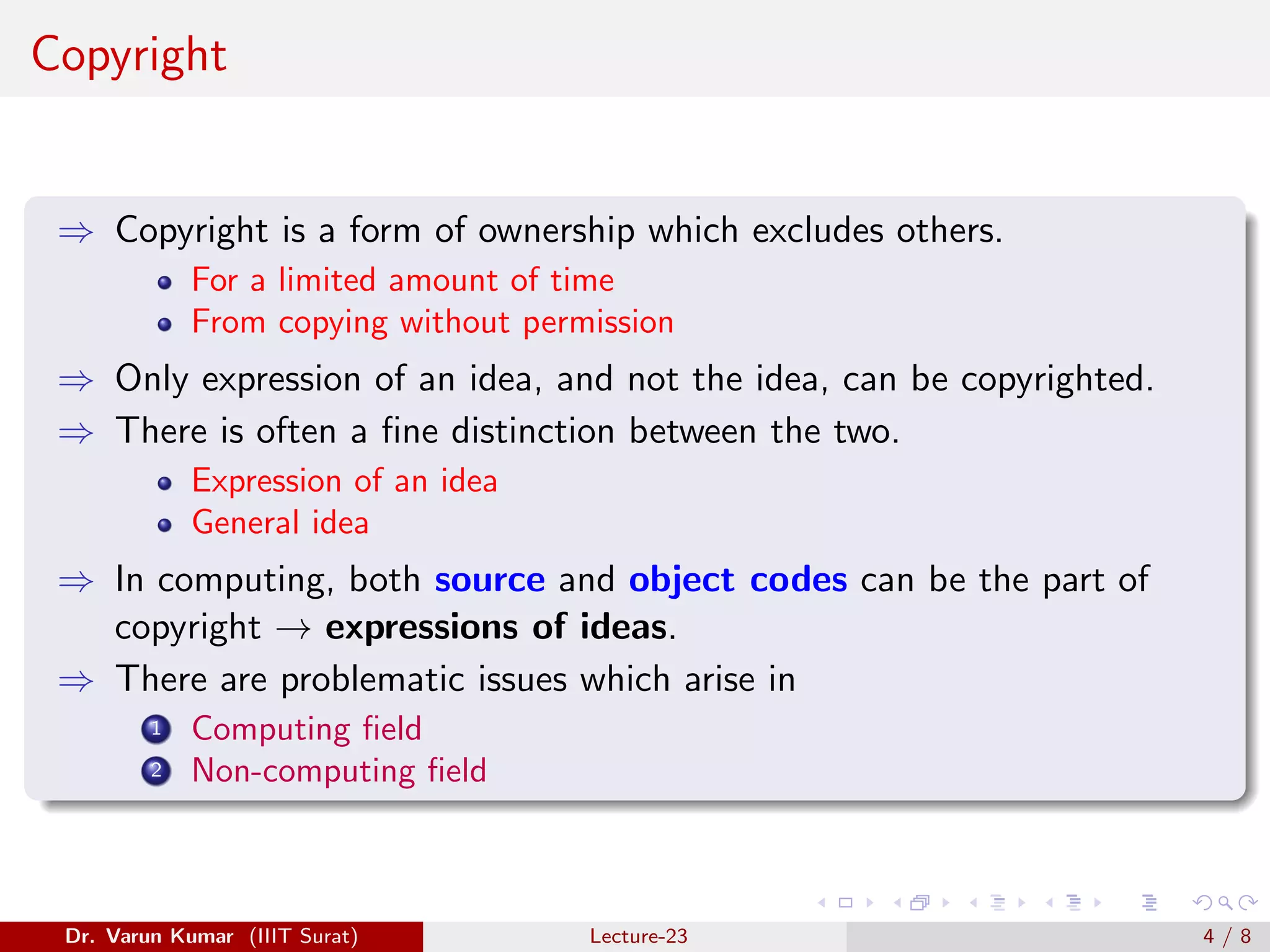
⇒ Copyright is a form of ownership which excludes others.
For a limited amount of time
From copying without permission
⇒ Only expression of an idea, and not the idea, can be copyrighted.
⇒ There is often a fine distinction between the two.
Expression of an idea
General idea
⇒ In computing, both source and object codes can be the part of
copyright → expressions of ideas.
⇒ There are problematic issues which arise in
1 Computing field
2 Non-computing field
Dr. Varun Kumar (IIIT Surat) Lecture-23 4 / 8
Continued–
Inflamable questions related to copyright
⇒ It is relatively simple to make minor change
To a piece of software → Making it into a new application.
⇒ The copyright addresses ????
Only apply to the old version
New version that contains the old code?
⇒ Are copyright owner required to re-apply every time a new piece of
code is added?
⇒ This has lead to many course cases.
⇒ It has been suggested that the literary analogy is not suitable for
dealing with software copyright.
Dr. Varun Kumar (IIIT Surat) Lecture-23 5 / 8
Trade Secrecy Laws
⇒ Laws governing trade secrecy vary from country to country.
⇒ The central idea is to grant companies the right to keep certain kinds
of information secret.
⇒ The aim is for allowing them to keep a competitive edge.
⇒ The laws were not designed with computer technology in mind.
Piece of information to be considered trade secret
⇒ It is novel.
⇒ Represents an economic investment to the claimant.
⇒ Have involved some effort in development.
⇒ The claimant has made some effort to keep it secret.
Dr. Varun Kumar (IIIT Surat) Lecture-23 6 / 8
Continued–
⇒ Trade secrecy laws can be applied to software.
⇒ This is usually done using non-disclosure clauses.
⇒ Employees sign an agreement
Not reveal secrets learned at work even after they have left.
⇒ The agreement does not apply to generic information in the area.
⇒ Another application of this trade secrecy law → licensing agreements.
⇒ Software is licensed out and not sold
(a) Only the object code is given to the user.
(b) Source code is not given to the user.
⇒ The software company can do all the modification to suit the client
and still retain control.
⇒ The source code is in effect a trade secret.
Dr. Varun Kumar (IIIT Surat) Lecture-23 7 / 8
Continued–
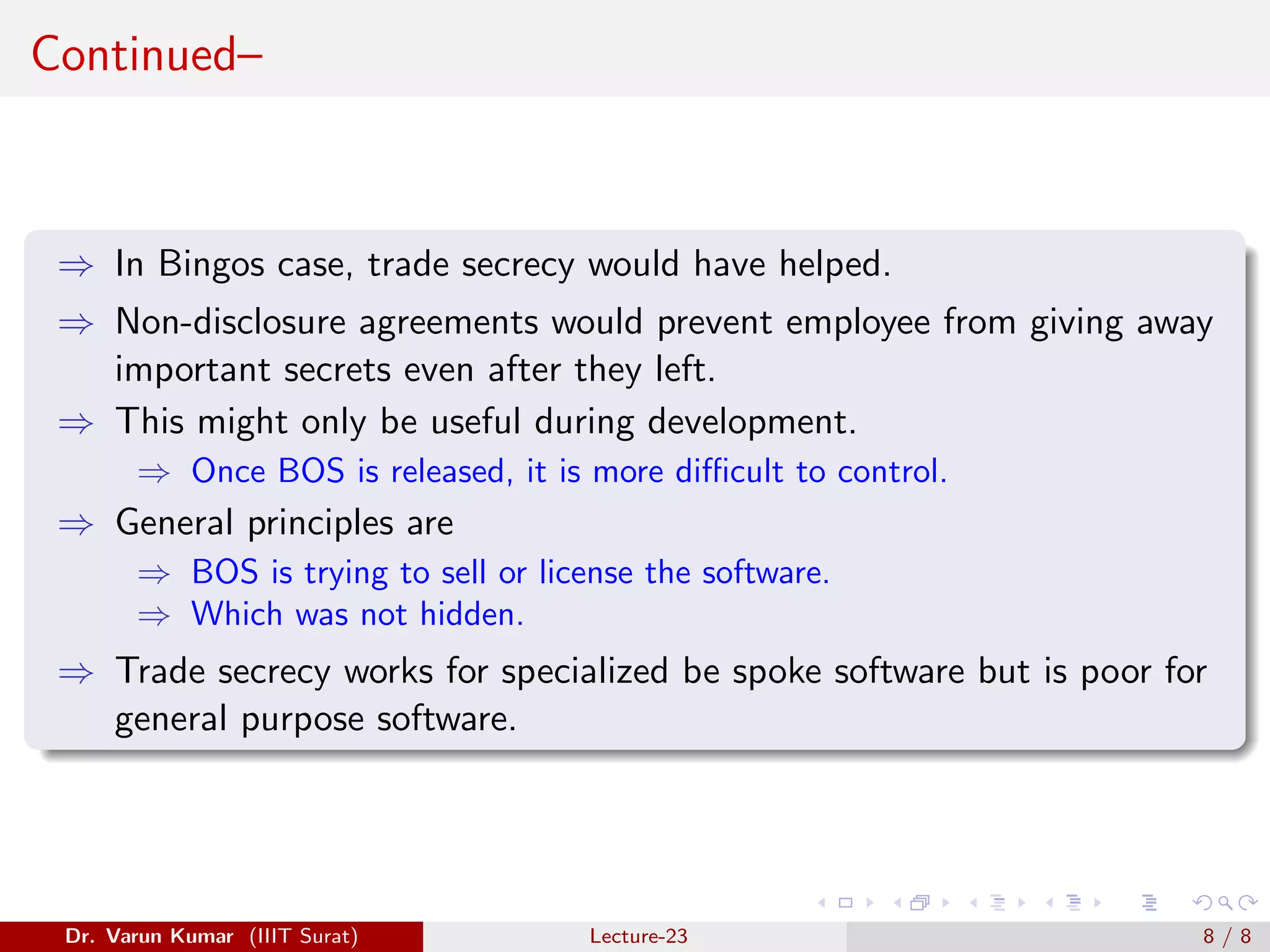
⇒ In Bingos case, trade secrecy would have helped.
⇒ Non-disclosure agreements would prevent employee from giving away
important secrets even after they left.
⇒ This might only be useful during development.
⇒ Once BOS is released, it is more difficult to control.
⇒ General principles are
⇒ BOS is trying to sell or license the software.
⇒ Which was not hidden.
⇒ Trade secrecy works for specialized be spoke software but is poor for
general purpose software.
Dr. Varun Kumar (IIIT Surat) Lecture-23 8 / 8

Copyright Vs Patent and Trade Secrecy Law

  • 1.
    Copyright Vs Patentand Trade Secrecy Law Dr. Varun Kumar Dr. Varun Kumar (IIIT Surat) Lecture-23 1 / 8
  • 2.
    Outlines 1 Copyright versusPatent Laws 2 Trade Secrecy Laws 3 Patent Protection Dr. Varun Kumar (IIIT Surat) Lecture-23 2 / 8
  • 3.
    Copyright versus PatentLaws Copyright versus Patent Laws ⇒ Consider the Bingo scenario where by PPOS copies BOS and sells it for cheaper. ⇒ PPOS is able to do that because its development costs were lower. ⇒ It also seems unfair that PPOS used BOS without paying. Q What is the solution to this problem? ⇒ Bingo should take a legal action. Exclusive right to its software→ Copyright and Patent law ⇒ There are currently three mechanisms to deal with such scenarios 1 Copyright 2 Trade secrecy 3 Patent Dr. Varun Kumar (IIIT Surat) Lecture-23 3 / 8
  • 4.
    Copyright ⇒ Copyright isa form of ownership which excludes others. For a limited amount of time From copying without permission ⇒ Only expression of an idea, and not the idea, can be copyrighted. ⇒ There is often a fine distinction between the two. Expression of an idea General idea ⇒ In computing, both source and object codes can be the part of copyright → expressions of ideas. ⇒ There are problematic issues which arise in 1 Computing field 2 Non-computing field Dr. Varun Kumar (IIIT Surat) Lecture-23 4 / 8
  • 5.
    Continued– Inflamable questions relatedto copyright ⇒ It is relatively simple to make minor change To a piece of software → Making it into a new application. ⇒ The copyright addresses ???? Only apply to the old version New version that contains the old code? ⇒ Are copyright owner required to re-apply every time a new piece of code is added? ⇒ This has lead to many course cases. ⇒ It has been suggested that the literary analogy is not suitable for dealing with software copyright. Dr. Varun Kumar (IIIT Surat) Lecture-23 5 / 8
  • 6.
    Trade Secrecy Laws ⇒Laws governing trade secrecy vary from country to country. ⇒ The central idea is to grant companies the right to keep certain kinds of information secret. ⇒ The aim is for allowing them to keep a competitive edge. ⇒ The laws were not designed with computer technology in mind. Piece of information to be considered trade secret ⇒ It is novel. ⇒ Represents an economic investment to the claimant. ⇒ Have involved some effort in development. ⇒ The claimant has made some effort to keep it secret. Dr. Varun Kumar (IIIT Surat) Lecture-23 6 / 8
  • 7.
    Continued– ⇒ Trade secrecylaws can be applied to software. ⇒ This is usually done using non-disclosure clauses. ⇒ Employees sign an agreement Not reveal secrets learned at work even after they have left. ⇒ The agreement does not apply to generic information in the area. ⇒ Another application of this trade secrecy law → licensing agreements. ⇒ Software is licensed out and not sold (a) Only the object code is given to the user. (b) Source code is not given to the user. ⇒ The software company can do all the modification to suit the client and still retain control. ⇒ The source code is in effect a trade secret. Dr. Varun Kumar (IIIT Surat) Lecture-23 7 / 8
  • 8.
    Continued– ⇒ In Bingoscase, trade secrecy would have helped. ⇒ Non-disclosure agreements would prevent employee from giving away important secrets even after they left. ⇒ This might only be useful during development. ⇒ Once BOS is released, it is more difficult to control. ⇒ General principles are ⇒ BOS is trying to sell or license the software. ⇒ Which was not hidden. ⇒ Trade secrecy works for specialized be spoke software but is poor for general purpose software. Dr. Varun Kumar (IIIT Surat) Lecture-23 8 / 8