

Nuclear Power
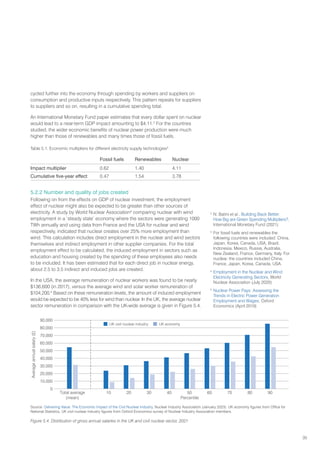
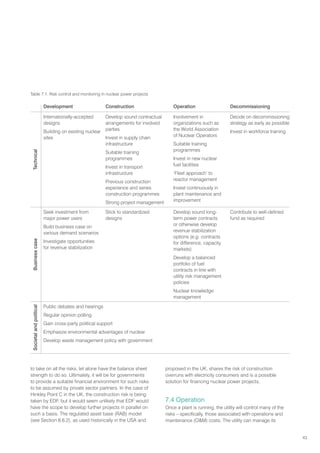
Economics and
Structuring
2024 Edition
Title: Nuclear Power Economics and
Structuring - 2024 Edition
Produced by: World Nuclear Association
Published: April 2024
Report No. 2024/001
© 2024 World Nuclear Association.
Registered in England and Wales,
company number 01215741
This report reflects the views
of industry experts but does not
necessarily represent those
of World Nuclear Association’s
individual member organizations.
1
Executive Summary 3
1. Introduction 5
2. Economics of Current Plants 7
2.1 Plant performance 7
2.2 Generating 8
2.2.1 US nuclear fleet costs 8
		 2.2.2 Operating cost factors 10
2.3 Capacity uprates 10
2.4 Licence extensions 10
2.5 Political risk 11
2.6 Market risk 11
2.7 Security of supply 14
3. Market Potential for Nuclear Generation 15
3.1 The position of nuclear power 15
3.2 Emerging non-electric applications 18
3.3 Outlook for nuclear 19
4. Economics of New Plant Construction 20
4.1 Capital costs and cost of financing 20
4.2 Capital cost escalation 21
4.3 Construction period 25
4.4 Small modular reactors 25
4.5 Operating costs 26
4.6 Nuclear competitiveness 27
4.7 LCOE and system costs 28
4.8 Electricity market regulation 30
5. Environmental and Social Implications 32
5.1 Climate mitigation and market reform 32
		 5.1.1 Broader health and environmental goals 33
5.2 Socio-economic benefits of nuclear 34
		 5.2.1 Economic value 34
		 5.2.2 Number and quality of jobs created 35
5.3 Nuclear energy and sustainable development 36
Contents
2
6. Risks of Nuclear Projects 37
6.1 Electricity market regulation and revenue predictability 38
6.2 Nuclear safety regulation 38
6.3 Design harmonization 39
6.4 Operations 39
6.5 Decommissioning and waste management 40
6.6 Accident insurance 40
6.7 Political and public acceptance risk 41
7. Project Structuring and Risk Allocation 42
7.1 Development 42
7.2 Stakeholder involvement 42
7.3 Construction 42
7.4 Operation 43
7.4.1 Operational financial risks in deregulated markets 44
7.5 Government support and regulatory framework 44
		 7.5.1 Energy policy 44
		 7.5.2 Power markets 44
		 7.5.3 Climate change 45
		 7.5.4 Regulation 46
		 7.5.5 Decommissioning and waste management 46
		 7.5.6 Nuclear liability 46
8. Financing 47
8.1 Nuclear and the cost of capital 47
8.2 Debt versus equity 47
8.3 Government and corporate finance 48
8.3.1 Cooperative financing 48
8.4 Limited versus full-recourse financing 48
8.5 Encouraging investment: reducing revenue risk 48
8.6 Encouraging investment: capping investor exposure 50
		 8.6.1 Loan guarantees 50
		 8.6.2 Regulated asset base model 50
8.7 Sustainable finance 51
		 8.7.1 Nuclear energy in the EU taxonomy 51
9. Conclusions and Recommendations 52
3
Nuclear power provides a reliable supply of low-carbon electricity, and it is
widely recognized that its role will need to grow to reduce carbon dioxide
emissions to mitigate climate change. Not only has it been demonstrated to
have the lowest carbon and accident impacts compared to any other energy
technology, but it also provides a major economic and employment boost while
fulfilling key United Nations Sustainable Development Goals. Similar to the oil
shocks in the 1970s, the energy crisis in the 2020s confirmed that the volatility
of fossil fuel prices is detrimental to economies while nuclear energy is largely
independent of such events.
Since the publication of the previous edition of this report in 2017 there have
been several developments affecting the economics and prospects of the
energy sector.
In the former edition, the levelized cost of electricity (LCOE) from nuclear was
demonstrated to be competitive when compared with all other sources, in
particular the low-carbon ones. It was also shown how nuclear profitability was
adversely affected in markets with a growing share of subsidized renewables.
Since then, the LCOE from renewables has significantly decreased, but
limitations associated with the growth of this sector have also become
increasingly clear.
Overall, nuclear power not only remains a competitive source of low-carbon
generation, but also its environmental and energy security advantages are being
increasingly recognized.
System costs
Although nuclear remains competitive on a traditional LCOE basis, the LCOE
no longer provides a full picture of the true costs of low-carbon generation.
With a growing share of intermittent sources in electricity systems, it has been
shown that system costs – balancing, backup, storage, grid extension and
interconnection – are rapidly increasing and therefore offset the benefits of the
lower LCOE for onshore wind and solar PV.
In deregulated electricity markets, certain subsidies for intermittent renewable
generation have a large impact on the economics of base-load plants such as
nuclear. Having to provide flexible generation results in a reduction in capacity
factor, which in turn reduces profitability if inadequate compensation is provided
for flexibility services. Market failure is being caused by neither fully internalizing
the system costs of renewables nor properly valuing the benefits of nuclear
(reliability, supply security, zero emissions, low system costs). In the absence of
a low-carbon source such as hydropower and nuclear energy, some countries
are encouraging the use of gas to complement the intermittency of renewables,
leading to high exposure to gas prices and dependency on imports.
As shown in numerous studies, where markets are designed to allow nuclear to
compete on equal terms with renewables, the system costs of the whole power
supply sector are reduced, making electricity more affordable while increasing
security of supply. It is difficult to see a universal and sustainable solution to the
challenge of reducing greenhouse gas emissions to ‘net zero’ without nuclear.
Essentially, a system with nuclear is always less costly than a system without it.
Executive Summary
4
Risk allocation and financing
The economics of new nuclear plants are highly dependent on the cost of
capital as well as the duration of the construction period. The recent escalation
of nuclear capital costs in some OECD countries has been largely due to a loss
of competency resulting from the low number of nuclear construction projects
combined with the introduction of new designs. In countries where continuous
development programmes have been maintained, capital costs have been
contained and, in some cases, even reduced.
Once a nuclear plant has been constructed, the production cost of electricity is
low and predictably stable. However, there remain a number of economic risks
due to a range of factors, including: the regulation of electricity markets and
the existence of competitor technologies that are subsidized or fail to account
for external costs; nuclear safety regulation; project construction performance;
operational performance; and political risk. Some of these risks can be managed
by the utility, but others are outside the control of the industry.
In practice, most nuclear investment is undertaken in broadly regulated markets
largely via utility balance sheet financing where the operator can offset the
risks of any given generating technology against those of other assets in its
portfolio. It is still the case that globally most electricity markets are regulated and
characterized by dominant state-owned companies.
In nominally deregulated electricity markets, it is increasingly becoming accepted
that government has an essential role to play in order to facilitate the low-carbon
transition. One avenue is to provide all low-carbon technologies with access to
low-cost financing. Since the start of this century, intermittent technologies have
benefitted worldwide from guaranteed revenues that attracted pension funds and
other low-cost financing. Provided that the nuclear industry can build new plants
on time and on budget, the appropriate allocation of risk between investors and
government would allow nuclear projects to access similar low-cost financing.
Just transition and nuclear
A ‘just transition’, where the benefits of an expected ‘green’ economy are shared
across society – locally and/or nationwide – is only possible if the transition is
affordable and sustainable for the wider society.
In this context, nuclear power is one of the most effective enablers to the
United Nations Sustainable Development Goals (SDGs), in particular: SDG 7
(ensure access to affordable, reliable, sustainable and modern energy for all);
SDG 8 (promote sustained, inclusive and sustainable economic growth, full
and productive employment and decent work for all); and SDG 13 (take urgent
action to combat climate change and its impacts).
5
1 Introduction
This 2024 edition of Nuclear Power Economics and Structuring updates the
previous edition published in 2017 (as Nuclear Power Economics and Project
Structuring), which itself drew on work in earlier reports. The principal changes in
this report include: additional material on nuclear capital costs of construction,
in particular the impacts of competitor technologies, notably renewables and
gas-fired generation; the challenges that deregulated electricity markets pose to
financing new nuclear; and the economic benefits for host countries arising from
nuclear generation.
There are two main aims of this report: firstly, to highlight that new nuclear build
is justified in many countries on the strength of today’s economic criteria; and
secondly, to identify the key risks associated with a nuclear power project and
how these may be managed to support a business case for nuclear investment.
Several developments since the publication of the 2017 edition of this report have
affected the economics and prospects of all power generation technologies.
Firstly, the Covid-19 lockdowns temporarily reduced energy demand, but also
interrupted both supply chains and normal ways of working. Secondly, a global
energy crisis brought about by a scarcity in natural gas – later exacerbated by the
Russian invasion of Ukraine – reinforced to governments the importance of energy
security and the vulnerability of just-in-time energy imports. This crisis occurred
alongside a spike in global interest rates and in the price of mineral commodities,
both of which had an impact on the economics of all energy technologies.
The longer-term trend of the sustainable energy transition has continued, with an
increasing number of policies and industry initiatives directed towards this. Both
the USA and European Union have put in place (or are putting in place) major
policy packages designed to update the existing electricity market rules and
encourage new low-carbon energy sources and enabling technologies onto the
system. In the USA the main package of note is the Inflation Reduction Act. In
the EU there are a suite of sustainability policies including the EU taxonomy for
sustainable activities and the proposed Net-Zero Industry Act.
Recent United Nations climate change conferences have concluded that
investment in low-carbon generation must be accelerated if the increase in global
temperatures is to be limited to 2 °C above 1990 levels. Large sectors of industry,
transport and housing can be decarbonized using electricity from nuclear and
renewables, hence the demand for low-carbon sources of electricity is expected
to grow at a much higher rate than previously believed.
Many countries recognize the substantial role which nuclear power plays in
satisfying various energy policy objectives, including security of supply, reducing
import dependence and lowering greenhouse gas and other emissions.
However, in liberalized or deregulated power markets, these advantages of
nuclear power are not fully accounted for or properly valued, and efforts are
being made by policymakers in a number of countries to place a monetary value
on these policy objectives in a way that can support nuclear power along with
other low-carbon energy sources.
From the late 1980s, a number of governments moved away from direct regulation
in electricity markets (e.g. government utilities or investor-owned utilities subject
to rate-of-return controls) to various deregulated electricity industry approaches
that typically include a competitive market-based generation sector. There are
6
significant differences in the level and nature of regulation between countries but
most are characterized by high levels of regulation, either explicitly or implicitly.
With nuclear energy’s high capital cost and long development and construction
period, investors focus on ways in which risks can be managed and risk
allocations optimized. The business case for nuclear ultimately depends on the
structure of risk allocation between operators, investors, government, suppliers
and customers.
Although new nuclear power plants require large capital investment, this is hardly
unique by the standards of the wider energy industry and they should be viewed
as long-term infrastructure. Projects of similar magnitude can be found in the
building of new roads, bridges and other elements of infrastructure such as water
collection and distribution, and the removal of sewage. Many of the risk control
and project management techniques developed for these projects can also be
applied to building nuclear power stations.
Risks that are specific to nuclear plants include those surrounding the
management of radioactive waste and used fuel and the possibility of nuclear
accidents. As with many other industrial sectors, public authorities must be
involved in setting the regulatory framework. The combined goal for policymakers
seeking to incentivize nuclear power must be ensuring public safety while also
creating the stable policy environment necessary for investment.
To be successful, nuclear projects should be structured to reduce and share
risks amongst key stakeholders in a way that is both equitable and encourages
each project participant to fulfil its responsibilities.
Today’s advanced reactor designs including small modular reactors (SMRs)
potentially offer a new paradigm for nuclear deployment, should it be easier and
faster to finance and build them. In addition, these designs could be used for
new applications for electricity and heat on smaller grids and in replacing coal
usage in industry.
The information in this report is presented as follows:
Chapter 2 highlights the good economic performance of current nuclear plants.
Chapter 3 demonstrates the need for substantial new nuclear capacity worldwide.
Chapter 4 examines the economic competitiveness of new nuclear plants.
Chapter 5 looks at the environmental and social benefits of nuclear energy.
Chapter 6 identifies the key risks of nuclear projects and how they may be
mitigated.
Chapter 7 considers project structuring, including the role of government, and
the different ways of allocating risk.
Chapter 8 examines the role of financing for major electricity infrastructure.
7
2 Economics of Current Plants
Low-cost base-load electricity supply has been a critical enabler of economic
and social development, and nuclear power has played a key role in delivering
such supply in many countries for decades. The economics of nuclear are
characterized by low and stable operating costs, resulting from the low
proportion of fuel cost in the total cost structure. Once built and commissioned,
nuclear power plants are able to supply large amounts of reliable, competitive
and low-carbon base-load power over the long term.
In addition, nuclear power plants are able to follow the fluctuating demand of
systems that have a high share of intermittent electricity sources. The French
reactor fleet regularly load-follows according to the daily variation in demand and
the intermittency of wind and solar.
2.1 Plant performance
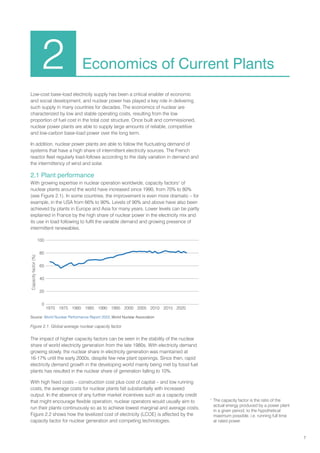
With growing expertise in nuclear operation worldwide, capacity factors1
of
nuclear plants around the world have increased since 1990, from 70% to 80%
(see Figure 2.1). In some countries, the improvement is even more dramatic – for
example, in the USA from 66% to 90%. Levels of 90% and above have also been
achieved by plants in Europe and Asia for many years. Lower levels can be partly
explained in France by the high share of nuclear power in the electricity mix and
its use in load following to fulfil the variable demand and growing presence of
intermittent renewables.
1
The capacity factor is the ratio of the
actual energy produced by a power plant
in a given period, to the hypothetical
maximum possible, i.e. running full time
at rated power.
Figure 2.1. Global average nuclear capacity factor
The impact of higher capacity factors can be seen in the stability of the nuclear
share of world electricity generation from the late 1980s. With electricity demand
growing slowly, the nuclear share in electricity generation was maintained at
16-17% until the early 2000s, despite few new plant openings. Since then, rapid
electricity demand growth in the developing world mainly being met by fossil fuel
plants has resulted in the nuclear share of generation falling to 10%.
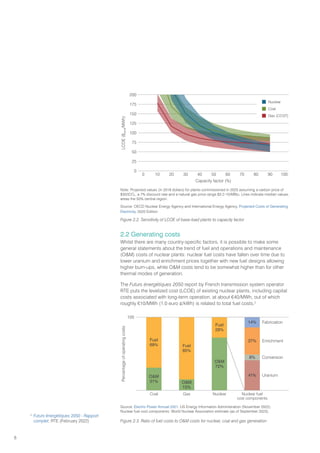
With high fixed costs – construction cost plus cost of capital – and low running
costs, the average costs for nuclear plants fall substantially with increased
output. In the absence of any further market incentives such as a capacity credit
that might encourage flexible operation, nuclear operators would usually aim to
run their plants continuously so as to achieve lowest marginal and average costs.
Figure 2.2 shows how the levelized cost of electricity (LCOE) is affected by the
capacity factor for nuclear generation and competing technologies.
Capacity
factor
(%)
100
80
60
40
20
0
1970 1975 1980 1990
1985 2000
1995 2010
2005 2015 2020
Source: World Nuclear Performance Report 2023, World Nuclear Association
8
2.2 Generating costs
Whilst there are many country-specific factors, it is possible to make some
general statements about the trend of fuel and operations and maintenance
(OM) costs of nuclear plants: nuclear fuel costs have fallen over time due to
lower uranium and enrichment prices together with new fuel designs allowing
higher burn-ups, while OM costs tend to be somewhat higher than for other
thermal modes of generation.
The Futurs énergétiques 2050 report by French transmission system operator
RTE puts the levelized cost (LCOE) of existing nuclear plants, including capital
costs associated with long-term operation, at about €40/MWh, out of which
roughly €10/MWh (1.0 euro ¢/kWh) is related to total fuel costs.2
LCOE
($
2018
/MWh)
200
175
150
125
100
75
50
25
0
0 10 20 40
30 90
80
60
50
Capacity factor (%)
70 100
 Nuclear
 Coal
 Gas (CCGT)
Note: Projected values (in 2018 dollars) for plants commissioned in 2025 assuming a carbon price of
$30/tCO2, a 7% discount rate and a natural gas price range $3.2-10/MBtu. Lines indicate median values,
areas the 50% central region.
Source: OECD Nuclear Energy Agency and International Energy Agency, Projected Costs of Generating
Electricity, 2020 Edition
Figure 2.2. Sensitivity of LCOE of base-load plants to capacity factor
Source: Electric Power Annual 2021, US Energy Information Administration (November 2022).
Nuclear fuel cost components: World Nuclear Association estimate (as of September 2023).
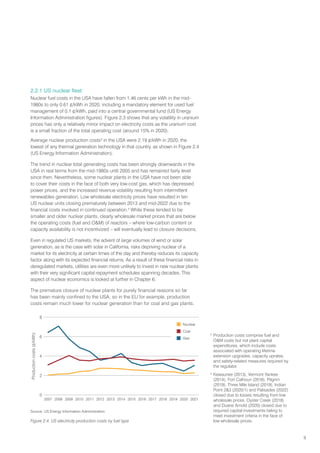
Figure 2.3. Ratio of fuel costs to OM costs for nuclear, coal and gas generation
Percentage
of
operating
costs
100
Gas
Coal Nuclear Nuclear fuel
cost components
41%
37%
14%
8%
Fabrication
Enrichment
Conversion
Uranium
OM
72%
Fuel
28%
Fuel
85%
OM
15%
Fuel
69%
OM
31%
2
Futurs énergétiques 2050 - Rapport
complet, RTE (February 2022)
9
2.2.1 US nuclear fleet
Nuclear fuel costs in the USA have fallen from 1.46 cents per kWh in the mid-
1980s to only 0.61 ¢/kWh in 2020, including a mandatory element for used fuel
management of 0.1 ¢/kWh, paid into a central governmental fund (US Energy
Information Administration figures). Figure 2.3 shows that any volatility in uranium
prices has only a relatively minor impact on electricity costs as the uranium cost
is a small fraction of the total operating cost (around 15% in 2020).
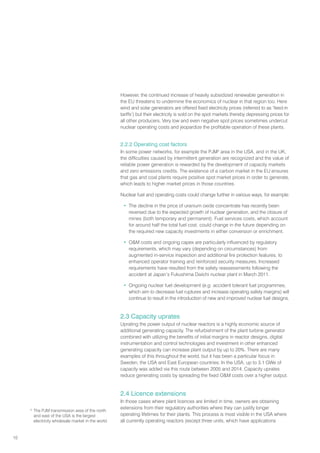
Average nuclear production costs3
in the USA were 2.19 ¢/kWh in 2020, the
lowest of any thermal generation technology in that country, as shown in Figure 2.4
(US Energy Information Administration).
The trend in nuclear total generating costs has been strongly downwards in the
USA in real terms from the mid-1980s until 2005 and has remained fairly level
since then. Nevertheless, some nuclear plants in the USA have not been able
to cover their costs in the face of both very low-cost gas, which has depressed
power prices, and the increased revenue volatility resulting from intermittent
renewables generation. Low wholesale electricity prices have resulted in ten
US nuclear units closing prematurely between 2013 and mid-2022 due to the
financial costs involved in continued operation.4
While these tended to be
smaller and older nuclear plants, clearly wholesale market prices that are below
the operating costs (fuel and OM) of reactors – where low-carbon content or
capacity availability is not incentivized – will eventually lead to closure decisions.
Even in regulated US markets, the advent of large volumes of wind or solar
generation, as is the case with solar in California, risks depriving nuclear of a
market for its electricity at certain times of the day and thereby reduces its capacity
factor along with its expected financial returns. As a result of these financial risks in
deregulated markets, utilities are even more unlikely to invest in new nuclear plants
with their very significant capital repayment schedules spanning decades. This
aspect of nuclear economics is looked at further in Chapter 6.
The premature closure of nuclear plants for purely financial reasons so far
has been mainly confined to the USA, so in the EU for example, production
costs remain much lower for nuclear generation than for coal and gas plants.
3
Production costs comprise fuel and
OM costs but not plant capital
expenditures, which include costs
associated with operating lifetime
extension upgrades, capacity uprates,
and safety-related measures required by
the regulator.
4
Kewaunee (2013), Vermont Yankee
(2014), Fort Calhoun (2016), Pilgrim
(2019), Three Mile Island (2019), Indian
Point 23 (2020/1) and Palisades (2022)
closed due to losses resulting from low
wholesale prices. Oyster Creek (2018)
and Duane Arnold (2020) closed due to
required capital investments failing to
meet investment criteria in the face of
low wholesale prices.
Production
costs
(¢/kWh)
8
6
4
2
0
2007 2008 2009 2011
2010 2016 2017 2018 2019 2020
2015
2013
2012 2014 2021
 Nuclear
 Coal
 Gas
Source: US Energy Information Administration
Figure 2.4. US electricity production costs by fuel type
10
However, the continued increase of heavily subsidized renewable generation in
the EU threatens to undermine the economics of nuclear in that region too. Here
wind and solar generators are offered fixed electricity prices (referred to as ‘feed-in
tariffs’) but their electricity is sold on the spot markets thereby depressing prices for
all other producers. Very low and even negative spot prices sometimes undercut
nuclear operating costs and jeopardize the profitable operation of these plants.
2.2.2 Operating cost factors
In some power networks, for example the PJM5
area in the USA, and in the UK,
the difficulties caused by intermittent generation are recognized and the value of
reliable power generation is rewarded by the development of capacity markets
and zero emissions credits. The existence of a carbon market in the EU ensures
that gas and coal plants require positive spot market prices in order to generate,
which leads to higher market prices in those countries.
Nuclear fuel and operating costs could change further in various ways, for example:
• The decline in the price of uranium oxide concentrate has recently been
reversed due to the expected growth of nuclear generation, and the closure of
mines (both temporary and permanent). Fuel services costs, which account
for around half the total fuel cost, could change in the future depending on
the required new capacity investments in either conversion or enrichment.
• OM costs and ongoing capex are particularly influenced by regulatory
requirements, which may vary (depending on circumstances) from
augmented in-service inspection and additional fire protection features, to
enhanced operator training and reinforced security measures. Increased
requirements have resulted from the safety reassessments following the
accident at Japan’s Fukushima Daiichi nuclear plant in March 2011.
• Ongoing nuclear fuel development (e.g. accident tolerant fuel programmes,
which aim to decrease fuel ruptures and increase operating safety margins) will
continue to result in the introduction of new and improved nuclear fuel designs.
2.3 Capacity uprates
Uprating the power output of nuclear reactors is a highly economic source of
additional generating capacity. The refurbishment of the plant turbine generator
combined with utilizing the benefits of initial margins in reactor designs, digital
instrumentation and control technologies and investment in other enhanced
generating capacity can increase plant output by up to 20%. There are many
examples of this throughout the world, but it has been a particular focus in
Sweden, the USA and East European countries. In the USA, up to 3.1 GWe of
capacity was added via this route between 2005 and 2014. Capacity uprates
reduce generating costs by spreading the fixed OM costs over a higher output.
2.4 Licence extensions
In those cases where plant licences are limited in time, owners are obtaining
extensions from their regulatory authorities where they can justify longer
operating lifetimes for their plants. This process is most visible in the USA where
all currently operating reactors (except three units, which have applications
5
The PJM transmission area of the north
and east of the USA is the largest
electricity wholesale market in the world.
11
pending) have received 20-year licence extensions, allowing them to operate
for 60 years; six of these have been granted subsequent operating licences,
allowing them to operate for up to 80 years.
The licence extension process has proven to be predictable and relatively
inexpensive. Nevertheless, the substantial capital expenditure associated with
longer operating lifetimes may still force closure on some current nuclear plants
that cannot justify the upfront costs involved – especially for the smaller, older
and inherently less efficient units. But in general, extension of the operating
lifetimes of nuclear plants is economically attractive, so long as the political
environment is supportive. For example, in Canada, Bruce Power is extending
the operating lifetimes of six of its reactors by 30-35 years at a cost of $13 billion,
which compares favourably to the cost of alternative generation possibilities. For
companies in the private sector, extending the lifetime of plants may also allow
them to spread decommissioning charges over a longer period than originally
planned and further improve profitability.
In France, a figure for the 56 operating nuclear units of up to €10 billion has
been announced to deploy post-Fukushima modifications and comply with the
requirements of the safety authority. However, these costs should be seen in the
context of the need to invest heavily anyway to extend the operating lifetimes
of these units beyond 40 years. The total cost of this work is estimated at €50
billion, including the €10 billion for post-Fukushima modifications, and will have
only a minimal impact on the levelized cost of nuclear electricity over the next 20
years of operation. Extending the operating lifetimes of the existing reactors has
been judged by the national audit body as the most economical way to continue
the long history of low power prices in France.
The cost effectiveness of nuclear plant long-term operation (LTO) is recognized
by the International Energy Agency, which estimates it to be the least cost way of
generating electricity on an LCOE basis, beating even onshore wind.6
2.5 Political risk
A significant threat to the costs of operating reactors in some countries comes from
the imposition of additional taxes on nuclear generation, purportedly to penalize
the perceived excessive profits supposedly earned by their owners. For example,
in 2012 there were nuclear-specific taxes of €5/MWh in Belgium, €6.7/MWh in
Sweden and €145/g of fissile fuel (equivalent to €15/MWh) in Germany. The effect
of these taxes has been to advance the closure dates of reactors in Germany
(Grafenrheinfeld), Spain (Garoña) and Sweden (Oskarshamn 12 and Ringhals
12). In countries where the threat of such additional nuclear-specific taxes is
significant, this will negatively affect investor appetite for new nuclear plants and
even for operating lifetime extensions.
Political risk can take a number of forms apart from nuclear taxation. For
example, in Japan the restart of the reactors that were taken offline following
the 2011 Fukushima accident is subject to decisions by the Japanese courts.
In France the premature retirement of the Fessenheim reactors in 2020 resulted
from negotiations between political parties. And in Germany the decision to
advance the phase-out of nuclear soon after the Fukushima accident was
influenced by pressure from anti-nuclear federal states.
6
Projected Costs of Generating Electricity,
International Energy Agency and OECD
Nuclear Energy Agency (December 2020)
12
2.6 Market risk
As noted earlier, wholesale electricity price levels and volatility in deregulated
markets are essentially unknowable, in particular for generators with expected
operating lifespans in excess of 60 years. Wholesale energy price forecasting
has a woeful track record, even over quite short periods of time, and forward
markets exist only for periods of a few years. Market participants are effectively
unwilling to bet on prices or subsidies and taxes (such as tax credits or carbon
taxes) to a degree that is material for financing a nuclear power plant.
Recent construction periods alone in OECD countries may be in excess of
ten years and finance needs to be agreed before construction starts. In any
deregulated market, the expectations for future wholesale prices are critical
for the decision to invest and the terms upon which finance is made available.
The less predictable and the more volatile the market, the greater the risk to the
financiers and thus the higher the required rate of return to cover the financial
risks involved. These considerations will always disadvantage generation
technologies with high capital costs and long lifetimes.
Energy markets have historically been less predictable than other markets and
nuclear projects have struggled to attract finance in these markets. Indeed, there
are few existing nuclear plants that have been financed in deregulated markets.
Despite the fact that the ex-post financial returns from these plants have often
been very high, the ex-ante expectations are always sufficiently uncertain, and
the timescale over which returns might be forthcoming sufficiently distant, that
private sector investors have avoided the nuclear sector. Only when plants have
been developed and are operating successfully have private investors with a
long-term outlook been prepared to invest, and then only where there is a degree
of price regulation.7
The decision of a plant management whether to generate or not depends on the
short-run marginal cost (SRMC) of operating the plant. Where these costs are
more than the market price, electricity generation will lose money for the plant.
The historical experience of electricity markets has been that operating costs
(and therefore the SRMC) are relatively high as fossil fuel plants have fuel costs
that constitute the main element of operating cost. The presence of fossil fuel
plants as the marginal producer has usually resulted in sufficiently high electricity
prices to allow nuclear plants to cover their SRMCs and therefore function as
base-load generators. Coal-fired generation costs have essentially acted as
a floor under which the electricity price is unlikely to fall. The gap between the
SRMC of a nuclear plant (effectively zero) and the spot price in a deregulated
market has provided nuclear operators with a sufficient financial surplus to pay
for capital and fixed operating costs and deliver a profit. This deregulated market
environment has been challenging for nuclear when fossil fuel costs are very low
for long periods of time.
The whole basis of short-term wholesale clearing markets (spot markets) in
electricity is rendered intractable by the existence of significant levels of wind and
solar capacity. The existence of a spot market with positive prices is underpinned
by suppliers with some level of SRMCs and the ability to deliver as required.
Intermittent renewables have effectively zero SRMCs and an inability to supply on
demand. The prospect is of a spot market that has an over-supply of zero-cost
electricity during periods of benign meteorological conditions, coupled with a great
7
In Canada, Bruce Power has attracted
investment from pension funds.
13
undersupply of electricity when meteorological conditions do not suit generation
requirements (i.e. during periods of low and very high winds, and at night).
No non-renewable operator will be able to run a profitable business, or even
cover their costs, in such a situation. As a result, the ability of deregulated
markets to incentivize non-renewable electricity, which was already low due to
fossil fuel price uncertainty, is rendered non-existent. The exception might be
for flexible oil or gas turbines able to respond to short periods of the very high
electricity prices when wind and solar plants cannot generate. These would be
expensive to operate as their capacity factors will be low, as they spend much of
their time idle.
Indeed, such a market is unable to supply a sufficient revenue to wind and
solar generators, which are the cause of the instability, given the very low or
negative wholesale prices. There is a high production correlation when similar
meteorological conditions are found in a given supply area between both wind
generation and solar generation; for example, if wind speeds are low in the
south of England they are also likely to be low in the north of England. Wind and
solar generators have had their financial viability guaranteed by feed-in tariffs or
equivalent non-market payments that have been mandated by government.
Fortunately, regulated markets and the traditional utility model typify most OECD
countries’ electricity supply and are likely to become even more typical over
the coming decades. Nuclear power plants will need to be viewed as long-term
infrastructure to be financed based on a predictable long-term revenue stream
that is likely to be regulated and guaranteed by government.8
Regulated markets
can encourage nuclear generation where operators are offered guaranteed
electricity prices, such as the contract for difference that underlies the financing
of Hinkley Point C in the UK, or the ability to effect cost recovery, as with the
regulated asset base model that characterizes many parts of the USA.
Alternatively, the traditional utility model where the operator has pricing control
via a vertically-integrated and monopolistic supply industry would allow the
development of nuclear power. Indeed, the majority of existing nuclear plants
have been constructed by such utilities. Under this regime, the operator is
able to charge an electricity tariff that is sufficient to cover the average costs
of its entire portfolio of generating assets. As a result, investors can have high
confidence that the generator will be able to cover the high fixed costs that typify
both nuclear and renewable generation. The traditional utility model enables the
operator to pass revenue and completion risks onto the consumer but in return
the operator may invest in technologies, including nuclear, that promise lower
electricity prices in the long term. This situation can be seen across the EU where
countries that have invested in nuclear power, above all France, have enjoyed
low electricity tariffs in recent decades relative to those countries that did not
make such investments.
The traditional utility model also allows for much greater ease of incorporating
societal considerations into electricity markets. Currently, the most important
societal issue facing the industry is climate change and the imperative to reduce
greenhouse gas emissions. Utilities in such a regime may invest in low emissions
technologies, such as nuclear, without existential financial stress, whereas
8
Such predictable long-term revenue
streams can be provided via power
production agreements with private
sector entities, such as happens in
Finland where some long-term intensive
energy users have ownership stakes
in power generating companies, but
such circumstances are not likely to be
frequently encountered.
14
generators in a deregulated market face a competitive battle to reduce emissions
through instruments such as carbon pricing, with financial stress and even
bankruptcies forcing compliance.
2.7 Security of supply
Uranium has characteristics that can strengthen a country’s supply security when
nuclear is part of its energy mix. Uranium is a uniquely concentrated source of
energy, and so the quantities required are very much less than for coal or oil;
a 1 GWe power plant requires around 20-30 tonnes of fabricated nuclear fuel
annually compared with over 3 million tonnes of coal. The energy density of
uranium means that it is an intrinsically portable and tradeable commodity, and
allows for the establishment of strategic inventories, with fuel supply for up to two
years typically stored at nuclear power plants.
Uranium is also relatively abundant, with fuel supplies for nuclear reactors
spread among politically diverse countries, reducing the risk of supply
disruptions. Existing and under development uranium mining capacity can
meet projected demand over the short and medium term. For the longer term,
more exploration and development of new mines is needed, which should be
considered alongside plans for the deployment of new nuclear units worldwide.
As future uranium production is heavily dependent on demand, both the
continuation of existing production and the development of new supply requires
suppliers to secure customers for their production at prices that provide an
incentive to produce.9
Nuclear power plants operate predictably, with high average capacity factors
achieved consistently across the world. They are resilient infrastructure, designed
to withstand and continue operating in extreme weather, and because the
electricity they produce is reliable, they can directly displace fossil fuels from a
country’s electricity mix, reducing its import dependency. Nuclear power plants
also contribute to the security and stability of the electricity system, providing
essential ancillary services such as flexible operation to aid frequency control
and provision of grid inertia.
9
The Nuclear Fuel Report: Global Scenarios
for Demand and Supply Availability
2023-2040, ISBN 9780993101991, World
Nuclear Association (September 2023)
15
The United Nations (UN) estimates that the world’s population will grow from 8.0
billion in 2022 to 9.7 billion by 2050. The process of urbanization – which currently
adds a city the size of Shanghai to the world’s urban population every four months or
so – will result in approximately two-thirds of the world’s people living in urban areas
by 2050, up from 55% in 2018. Without extreme policy measures to substantially
increase energy use and efficiency measures, this growth in population and
urbanization would result in a large rise in energy demand over the coming years.
The proportion of electricity, in particular cleanly-generated electricity, in the
energy mix is also set to increase, mainly due to the electrification of end-uses
– such as transport, space cooling, large appliances, and information and
communications technology.
3.1 The position of nuclear power
In 2021, world total energy supply came to 624 EJ according to the 2022 edition
of the International Energy Agency’s (IEA’s) World Energy Outlook (WEO 2022).1
Under its Announced Pledges Scenario (APS), total energy supply is projected to
remain at a similar level (629 EJ) by 2050. Meanwhile, total electricity production is
projected to double from 28.3 PWh in 2021 to 61.3 PWh in 2050 in the APS. Nuclear
generation accounted for 2776 TWh (9.8%) of 2021 electricity production from 413
GWe (gross) of capacity. Although this increases to 5103 TWh in 2050 from 716 GWe
of capacity in the APS, nuclear’s share of total electricity generation falls to 8.3%.
The APS is an explorative scenario that takes account of the climate commitments
made by governments around the world, including longer-term ‘net zero’ targets,
and assumes that they will be met in full and on time.
World Nuclear Association projections for nuclear power are published in its
biennial Nuclear Fuel Report. Three scenarios are prepared, referred to as the
Reference, Upper and Lower Scenarios, which project future nuclear generating
capacity from the current situation taking into account different expectations of
deployment from stated national nuclear energy policies and plans.
In the 2023 edition of The Nuclear Fuel Report, the Reference Scenario shows
nuclear capacity rising from 366 GWe (net) in 2022 to 686 GWe in 2040. In the
Upper Scenario, nuclear capacity reaches 931 GWe in 2040, whereas in the
Lower Scenario only 486 GWe is projected by then.2
In the 2023 edition of its Reference Data Series No.1, the International Atomic
Energy Agency’s (IAEA’s) projections for nuclear capacity in 2040 are more
pessimistic, ranging from 434 GWe in the low case to 681 GWe in the high case.
The IAEA projections go to 2050, with nuclear capacity ranging between 458
GWe (low case) and 890 GWe (high case) in that year.3
These World Nuclear Association and IAEA projections are explorative scenarios,
based on expert evaluation of the current trends and outlook.
The IEA’s Net Zero Emissions by 2050 Scenario (NZE) is a normative scenario
where a specific outcome is achieved – in this case, net zero carbon emissions
by 2050. The NZE relies heavily on energy efficiency measures – to the extent
that world energy supply decreases from 632 EJ in 2022 to 541 EJ in 2050. At the
same time, electricity production increases substantially in the NZE, from 29.0
PWh in 2022 to 76.8 PWh in 2050, i.e. by over 160%.4
3 Market Potential for Nuclear
Generation
1
World Energy Outlook 2022 (WEO 2022),
International Energy Agency, Revised
version (November 2022)
2
The Nuclear Fuel Report: Global Scenarios
for Demand and Supply Availability
2023-2040, ISBN 9780993101991, World
Nuclear Association (September 2023)
3
Energy, Electricity and Nuclear Power
Estimates for the Period up to 2050,
Reference Data Series No. 1, 2023
Edition, International Atomic Energy
Agency (September 2023)
4
Net Zero Roadmap: A Global Pathway
to Keep the 1.5 °C Goal in Reach, 2023
Update, International Energy Agency
(September 2023)
16
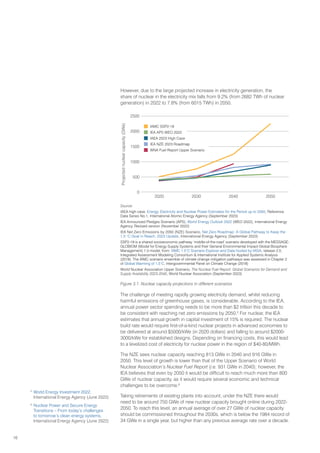
Figure 3.1. Nuclear capacity projections in different scenarios
The challenge of meeting rapidly growing electricity demand, whilst reducing
harmful emissions of greenhouse gases, is considerable. According to the IEA,
annual power sector spending needs to be more than $2 trillion this decade to
be consistent with reaching net zero emissions by 2050.5
For nuclear, the IEA
estimates that annual growth in capital investment of 15% is required. The nuclear
build rate would require first-of-a-kind nuclear projects in advanced economies to
be delivered at around $5000/kWe (in 2020 dollars) and falling to around $2000-
3000/kWe for established designs. Depending on financing costs, this would lead
to a levelized cost of electricity for nuclear power in the region of $40-80/MWh.
The NZE sees nuclear capacity reaching 813 GWe in 2040 and 916 GWe in
2050. This level of growth is lower than that of the Upper Scenario of World
Nuclear Association’s Nuclear Fuel Report (i.e. 931 GWe in 2040); however, the
IEA believes that even by 2050 it would be difficult to reach much more than 800
GWe of nuclear capacity, as it would require several economic and technical
challenges to be overcome.6
Taking retirements of existing plants into account, under the NZE there would
need to be around 750 GWe of new nuclear capacity brought online during 2022-
2050. To reach this level, an annual average of over 27 GWe of nuclear capacity
should be commissioned throughout the 2030s, which is below the 1984 record of
34 GWe in a single year, but higher than any previous average rate over a decade.
5
World Energy Investment 2022,
International Energy Agency (June 2022)
6
Nuclear Power and Secure Energy
Transitions – From today’s challenges
to tomorrow’s clean energy systems,
International Energy Agency (June 2022)
Source:
IAEA high case, Energy, Electricity and Nuclear Power Estimates for the Period up to 2050, Reference Data Series No.1,
International Atomic Energy Agency (September 2023)
IEA Announced Pledges Scenario (APS), World Energy Outlook 2022 (WEO 2022), International Energy Agency, Revised
version (November 2022)
IEA Net Zero Emissions by 2050 (NZE) Scenario, Net Zero Roadmap: A Global Pathway to Keep the 1.5 °C Goal in Reach,
2023 Update, International Energy Agency (September 2023)
SSP2-19 is a shared socioeconomic pathway ‘middle-of-the-road’ scenario developed with the MESSAGE-GLOBIOM
(Model for Energy Supply Systems and their General Environmental Impact-Global Biosphere Management) 1.0 model,
from: IAMC 1.5°C Scenario Explorer and Data hosted by IIASA, release 2.0, Integrated Assessment Modeling Consortium
 International Institute for Applied Systems Analysis (2019). The IAMC scenario ensemble of climate change mitigation
pathways was assessed in Chapter 2 of the Special Report on Global Warming of 1.5°C, Intergovernmental Panel on
Climate Change (2018)
World Nuclear Association Upper Scenario, The Nuclear Fuel Report: Global Scenarios for Demand and Supply Availability
2023-2040, World Nuclear Association (September 2023)
Projected
nuclear
capacity
(GWe)
2500
2000
1500
1000
500
0
2030
2020 2040 2050
 IAMC SSP2-19
 IEA APS WEO 2022
 IAEA 2023 High Case
 IEA NZE 2023 Roadmap
 WNA Fuel Report Upper Scenario
However, due to the large projected increase in electricity generation, the
share of nuclear in the electricity mix falls from 9.2% (from 2682 TWh of nuclear
generation) in 2022 to 7.8% (from 6015 TWh) in 2050.
Source:
IAEA high case, Energy, Electricity and Nuclear Power Estimates for the Period up to 2050, Reference
Data Series No.1, International Atomic Energy Agency (September 2023)
IEA Announced Pledges Scenario (APS), World Energy Outlook 2022 (WEO 2022), International Energy
Agency, Revised version (November 2022)
IEA Net Zero Emissions by 2050 (NZE) Scenario, Net Zero Roadmap: A Global Pathway to Keep the
1.5 °C Goal in Reach, 2023 Update, International Energy Agency (September 2023)
SSP2-19 is a shared socioeconomic pathway ‘middle-of-the-road’ scenario developed with the MESSAGE-
GLOBIOM (Model for Energy Supply Systems and their General Environmental Impact-Global Biosphere
Management) 1.0 model, from: IAMC 1.5°C Scenario Explorer and Data hosted by IIASA, release 2.0,
Integrated Assessment Modeling Consortium  International Institute for Applied Systems Analysis
(2019). The IAMC scenario ensemble of climate change mitigation pathways was assessed in Chapter 2
of Global Warming of 1.5°C, Intergovernmental Panel on Climate Change (2018)
World Nuclear Association Upper Scenario, The Nuclear Fuel Report: Global Scenarios for Demand and
Supply Availability 2023-2040, World Nuclear Association (September 2023)
17
The IEA scenarios derive from a model that assumes that the costs of renewable
power sources tend to fall as the technologies mature, whereas the costs of
nuclear power, which is already a mature technology, continue to rise. These
assumptions are questionable, especially in countries where most of the
deployment of new nuclear plants is expected, for example in Asia where the
ability to build on time and on budget and to take advantage of fleet economies
has been demonstrated.
In addition, most scenarios, including those of the IEA, assume large volumes
of renewables without considering the risks and their level of readiness, or
the public acceptance issues with large deployments of renewables and their
associated grid development. As shown in Chapter 4, the system costs of
different electricity sources should be included in LCOE calculations, which
should be used to inform these scenarios.
The IEA scenarios are not predictions, but rather possible versions of the future
and the most likely actions required to achieve them. One development is that
the IEA, which was previously over-pessimistic about extending the operating
lifetimes of nuclear reactors, now recognizes that they are generally performing
very well in economic terms and are likely to have operating lifetime extensions,
unless there are political impositions on this process (as in Germany).
The Intergovernmental Panel on Climate Change (IPCC) Global Warming of 1.5°C
report presents a range of mitigation strategies that can achieve the net emissions
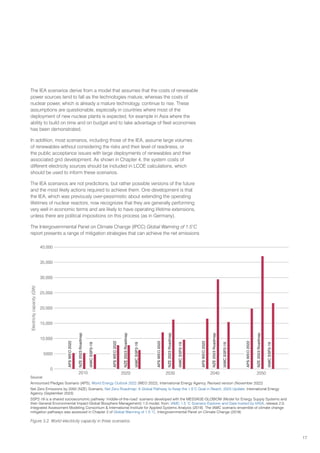
Figure 3.2. World electricity capacity in three scenarios
2020 2030 2040
40,000
35,000
30,000
25,000
20,000
15,000
10,000
5000
0
Electricity
capacity
(GW)
2010
APS
WEO
2022
NZE
2023
Roadmap
IAMC
SSP2-19
APS
WEO
2022
NZE
2023
Roadmap
IAMC
SSP2-19
APS
WEO
2022
NZE
2023
Roadmap
IAMC
SSP2-19
APS
WEO
2022
NZE
2023
Roadmap
IAMC
SSP2-19
2050
APS
WEO
2022
NZE
2023
Roadmap
IAMC
SSP2-19
Source:
Announced Pledges Scenario (APS), World Energy Outlook 2022 (WEO 2022), International Energy Agency, Revised version (November 2022)
Net Zero Emissions by 2050 (NZE) Scenario, Net Zero Roadmap: A Global Pathway to Keep the 1.5°C Goal in Reach, 2023 Update, International Energy
Agency (September 2023)
SSP2-19 is a shared socioeconomic pathway ‘middle-of-the-road’ scenario developed with the MESSAGE-GLOBIOM (Model for Energy Supply Systems and
their General Environmental Impact-Global Biosphere Management) 1.0 model, from: IAMC 1.5 °C Scenario Explorer and Data hosted by IIASA, release 2.0,
Integrated Assessment Modeling Consortium  International Institute for Applied Systems Analysis (2019). The IAMC scenario ensemble of climate change
mitigation pathways was assessed in Chapter 2 of Global Warming of 1.5 °C, Intergovernmental Panel on Climate Change (2018)
18
reductions needed to limit global warming to 1.5°C above pre-industrial levels.7
The SSP2-19 shared socioeconomic pathway – one of the ensemble of ‘middle-
of-the-road’ climate change mitigation pathways assessed in Chapter 2 of the
report – relies on a higher nuclear component in the future energy mix than the
scenarios discussed above. In this normative scenario, nuclear capacity increases
from 511 GWe in 2020 to 2244 GWe in 2050. Note that the scenario’s 2020 figure
for nuclear capacity is substantially higher than the actual figure of 415 GWe.8
The nuclear capacity projections of the scenarios discussed in this section and
the total electricity capacity projections in the WEO 2022 APS, the NZE, and the
SSP2-19 scenario are compared in Figures 3.1 and 3.2, respectively.
3.2 Emerging non-electric applications
Revenue from nuclear plants essentially comes from the sale of electricity. While
some plants produce useful radioisotopes and others have served some residual
heat for either industry/agricultural purposes or district heating networks, the
number of plants adapted for these purposes is low and the revenue generated
is not significant.
However, the wider energy market is changing as countries set net-zero goals
that require all sectors – including electricity, but also heat, transport and industry
– to decarbonize. Increased electrification along with the decarbonization of
electricity supply is expected to make a significant contribution, but innovative
solutions are required to decarbonize a number of hard-to-abate sectors.
Hydrogen is one such innovation that could substitute some energy uses of oil
and gas, but nevertheless it has to be economic to produce it through low-
carbon means. It is even considered as a potential vector to turn overcapacities in
wind and solar into electricity storage – but with a round-trip efficiency of 20-40%
as well as the low capacity factors associated with intermittent renewables, the
economics of such storage are far from being proven. The carbon emissions
associated with hydrogen that is produced via electrolysis will vary depending on
the electricity source. Legislation has been introduced in some countries aimed
at lowering carbon emissions in hydrogen production.
Non-fossil heat sources are also needed for certain heavy industries such as
pulp and steel works. The need for desalination can also be expected to increase
as coastal cities grow and higher average global temperatures stress municipal
water supplies.
Nuclear plants produce both heat and electricity, which opens the potential for
high temperature hydrogen production and desalination methods. Nuclear plants
also operate at high capacity factors, an important consideration for maximizing
the return on capital-intensive electrolysers or ensuring continuous operation of
industrial heat applications.
While large reactors can be used for the production of heat and hydrogen,
there is a much greater expectation for small modular reactors (SMRs) to
serve these markets, since they can be deployed at a greater number of sites
and their outputs meet the typical load requirements of industrial applications
compared with gigawatt-scale reactors. Many SMR designs are being optimized
for the provision of both saleable heat and electricity. Russia’s floating Akademik
7
Global Warming of 1.5°C, An IPCC
Special Report on the impacts of global
warming of 1.5°C above pre-industrial
levels and related global greenhouse
gas emission pathways, in the context
of strengthening the global response to
the threat of climate change, sustainable
development, and efforts to eradicate
poverty, Intergovernmental Panel on
Climate Change (2018)
8
Global nuclear power capacity in the Net
Zero Scenario, 2005-2050, International
Energy Agency
19
Lomonosov nuclear plant provides both heat and power to the town of Pevek in the
far northeast of Siberia. Other SMRs are being developed for bespoke applications
such as the pool-type heating reactors intended for use in northern Chinese
provinces. Many advanced non-water-cooled reactor designs under development
also offer the promise of high quality heat (high-temperature reactors) and
energy storage (molten salt reactors and some fast reactors). This opens up the
possibility of further applications and revenue streams for these nuclear plants.
3.3 Outlook for nuclear
Nuclear energy has a crucial role to play in mitigating climate change while
guaranteeing security of energy supply. However, this is unlikely to happen
without policy intervention. Nations should take action to implement robust
policies aimed at accelerating the deployment of innovative nuclear technologies.
Without sources of large quantities of reliable low-carbon energy, such as
nuclear, it is unlikely that carbon neutrality can be achieved.
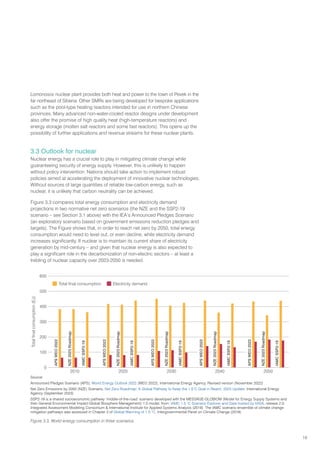
Figure 3.3 compares total energy consumption and electricity demand
projections in two normative net zero scenarios (the NZE and the SSP2-19
scenario – see Section 3.1 above) with the IEA’s Announced Pledges Scenario
(an exploratory scenario based on government emissions reduction pledges and
targets). The Figure shows that, in order to reach net zero by 2050, total energy
consumption would need to level out, or even decline, while electricity demand
increases significantly. If nuclear is to maintain its current share of electricity
generation by mid-century – and given that nuclear energy is also expected to
play a significant role in the decarbonization of non-electric sectors – at least a
trebling of nuclear capacity over 2023-2050 is needed.
Total
final
consumption
(EJ)
2010 2020 2030 2040 2050
600
500
400
300
200
100
0
APS
WEO
2022
NZE
2023
Roadmap
IAMC
SSP2-19
APS
WEO
2022
NZE
2023
Roadmap
IAMC
SSP2-19
APS
WEO
2022
NZE
2023
Roadmap
IAMC
SSP2-19
APS
WEO
2022
NZE
2023
Roadmap
IAMC
SSP2-19
APS
WEO
2022
NZE
2023
Roadmap
IAMC
SSP2-19
 Total final consumption  Electricity demand
Figure 3.3. World energy consumption in three scenarios
Source:
Announced Pledges Scenario (APS), World Energy Outlook 2022 (WEO 2022), International Energy Agency, Revised version (November 2022)
Net Zero Emissions by 2050 (NZE) Scenario, Net Zero Roadmap: A Global Pathway to Keep the 1.5°C Goal in Reach, 2023 Update, International Energy
Agency (September 2023)
SSP2-19 is a shared socioeconomic pathway ‘middle-of-the-road’ scenario developed with the MESSAGE-GLOBIOM (Model for Energy Supply Systems and
their General Environmental Impact-Global Biosphere Management) 1.0 model, from: IAMC 1.5 °C Scenario Explorer and Data hosted by IIASA, release 2.0,
Integrated Assessment Modeling Consortium  International Institute for Applied Systems Analysis (2019). The IAMC scenario ensemble of climate change
mitigation pathways was assessed in Chapter 2 of Global Warming of 1.5 °C, Intergovernmental Panel on Climate Change (2018)
20
4.1 Capital costs and cost of financing
For any electricity generating new investment, capital costs are incurred while the
generating plant is under construction and include expenditure on equipment,
engineering and labour. These are often quoted as ‘overnight’ costs, which
are exclusive of interest accruing during the construction period.1
They include
engineering, procurement and construction (EPC) costs, owner’s costs and
various contingencies.
In direct relation to the capital costs are the costs that are required to finance
both the equity and debt providers for the project. Those financing costs
comprise the interest accruing during the construction (IDC), interest to be paid
on the project’s debt and the equity remuneration.
Once the plant is completed and electricity sales begin, the plant owner begins
to repay the full investment cost, i.e. the sum of the overnight cost and accrued
interest charges. The price charged by the plant must cover not only these costs,
but also fuel and operations and maintenance (OM) costs. A periodic charge
for the eventual decommissioning of the plant should also be made, provided
over the operating lifetime of the plant.
The overall economics of new nuclear plants are dominated by their capital costs
and financing costs. In the assessment of new capacity, the studies quoted
below show that capital costs including accrued interest account for around 65-
85% of the levelized cost of a new nuclear plant.2
For combined cycle gas turbine
(CCGT) plants, usually around 20% of the levelized costs are accounted for by
plant capital requirements, with most of the remainder being fuel requirements.
For renewable electricity projects, the capital cost element can be as high as
90% because there is no fuel cost to using wind or sunlight as energy sources.
4 Economics of New Plant
Construction
 Fuel cycle costs
 OM costs
 Overnight construction cost
 Financing costs
0
20
40
60
80
100
120
140
0% 1% 2% 3% 4% 5% 6% 7% 8% 9% 10% 11% 12%
LCOE
($/MWh)
Weighted average cost of capital
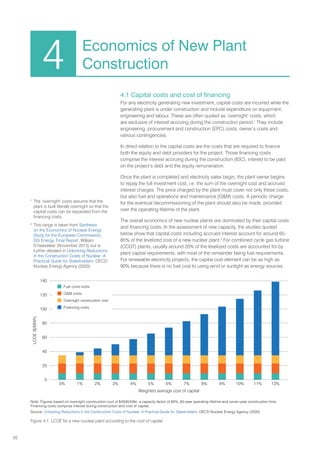
Figure 4.1. LCOE for a new nuclear plant according to the cost of capital
1
The ‘overnight’ costs assume that the
plant is built literally overnight so that the
capital costs can be separated from the
financing costs.
2
This range is taken from Synthesis
on the Economics of Nuclear Energy:
Study for the European Commission,
DG Energy, Final Report, William
D’haeseleer (November 2013) but is
further detailed in Unlocking Reductions
in the Construction Costs of Nuclear: A
Practical Guide for Stakeholders, OECD
Nuclear Energy Agency (2020).
Note: Figures based on overnight construction cost of $4500/kWe, a capacity factor of 85%, 60-year operating lifetime and seven-year construction time.
Financing costs comprise interest during construction and cost of capital.
Source: Unlocking Reductions in the Construction Costs of Nuclear: A Practical Guide for Stakeholders, OECD Nuclear Energy Agency (2020)
21
Figure 4.1 shows the impact of different costs of capital for a nuclear project. The
levelized cost of electricity (LCOE) resulting from a project with a weighted average
cost of capital (WACC) of 9% – which is typical for a privately-financed project – is
approximately double that for one with a WACC of around 4% – a level typical of a
project that benefits from government guarantees and subsidies.
The importance of the very different cost schedules rises with the rate of interest
levied. When interest rates are high, projects with high initial capital costs, such
as nuclear, are at a disadvantage in comparative financial appraisals. Once
capital-intensive power plants are completed, the capital costs and accrued
interest must be recovered through a long operating lifetime with fuel and OM
costs well below the prevailing electricity price. This has been the general
experience with nuclear plants.
About 80% of nuclear plant overnight construction costs comprise engineering,
procurement and construction (EPC) costs, with about 70% of these consisting
of direct (physical plant equipment with labour and materials) and 30% indirect
(supervisory engineering and support labour costs and some materials). The
remaining 20% of overnight costs are contingencies and owner’s costs (essentially
the cost of testing systems and training staff). In addition, first-of-a-kind (FOAK)
costs are a fixed cost of a particular design of reactor and can amount to very
significant investments. The way in which these are added to overnight costs
depends on how the vendor wishes to allocate these across its reactor sales.
4.2 Capital cost escalation
With relatively few nuclear plants constructed in North America and Western
Europe over the past two decades, the amount of information on the costs of
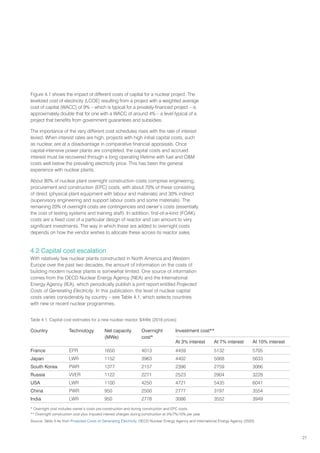
building modern nuclear plants is somewhat limited. One source of information
comes from the OECD Nuclear Energy Agency (NEA) and the International
Energy Agency (IEA), which periodically publish a joint report entitled Projected
Costs of Generating Electricity. In this publication, the level of nuclear capital
costs varies considerably by country – see Table 4.1, which selects countries
with new or recent nuclear programmes.
Table 4.1. Capital cost estimates for a new nuclear reactor, $/kWe (2018 prices)
Country Technology Net capacity
(MWe)
Overnight
cost*
Investment cost**
At 3% interest At 7% interest At 10% interest
France EPR 1650 4013 4459 5132 5705
Japan LWR 1152 3963 4402 5068 5633
South Korea PWR 1377 2157 2396 2759 3066
Russia VVER 1122 2271 2523 2904 3228
USA LWR 1100 4250 4721 5435 6041
China PWR 950 2500 2777 3197 3554
India LWR 950 2778 3086 3552 3949
* Overnight cost includes owner’s costs pre-construction and during construction and EPC costs.
** Overnight construction cost plus imputed interest charges during construction at 3%/7%/10% per year.
Source: Table 3.4a from Projected Costs of Generating Electricity, OECD Nuclear Energy Agency and International Energy Agency (2020)
22
The French nuclear programme provides some further useful data on capital
costs. The Cour des Comptes3
has said that the cost of building nuclear
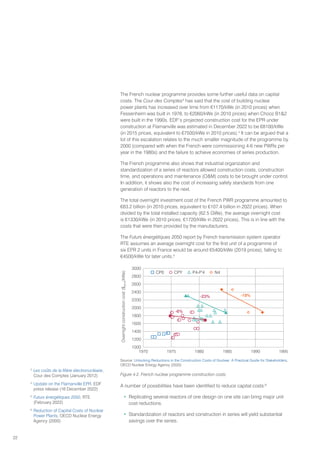
power plants has increased over time from €1170/kWe (in 2010 prices) when
Fessenheim was built in 1978, to €2060/kWe (in 2010 prices) when Chooz B12
were built in the 1990s. EDF’s projected construction cost for the EPR under
construction at Flamanville was estimated in December 2022 to be €8100/kWe
(in 2015 prices, equivalent to €7500/kWe in 2010 prices).4
It can be argued that a
lot of this escalation relates to the much smaller magnitude of the programme by
2000 (compared with when the French were commissioning 4-6 new PWRs per
year in the 1980s) and the failure to achieve economies of series production.
The French programme also shows that industrial organization and
standardization of a series of reactors allowed construction costs, construction
time, and operations and maintenance (OM) costs to be brought under control.
In addition, it shows also the cost of increasing safety standards from one
generation of reactors to the next.
The total overnight investment cost of the French PWR programme amounted to
€83.2 billion (in 2010 prices, equivalent to €107.4 billion in 2022 prices). When
divided by the total installed capacity (62.5 GWe), the average overnight cost
is €1330/kWe (in 2010 prices; €1720/kWe in 2022 prices). This is in line with the
costs that were then provided by the manufacturers.
The Futurs énergétiques 2050 report by French transmission system operator
RTE assumes an average overnight cost for the first unit of a programme of
six EPR 2 units in France would be around €5400/kWe (2019 prices), falling to
€4500/kWe for later units.5
3
Les coûts de la filière électronucléaire,
Cour des Comptes (January 2012)
4
Update on the Flamanville EPR, EDF
press release (16 December 2022)
5
Futurs énergétiques 2050, RTE
(February 2022)
6
Reduction of Capital Costs of Nuclear
Power Plants, OECD Nuclear Energy
Agency (2000)
Overnight
construction
cost
($
2010
/kWe)
3000
2800
2600
2400
2200
2000
1800
1600
1400
1200
1000
1970 1975 1980 1990
1985 1995
-6%
-23% -19%
CP0 CPY N4
P4-P'4
Source: Unlocking Reductions in the Construction Costs of Nuclear: A Practical Guide for Stakeholders,
OECD Nuclear Energy Agency (2020)
Figure 4.2. French nuclear programme construction costs
A number of possibilities have been identified to reduce capital costs:6
• Replicating several reactors of one design on one site can bring major unit
cost reductions.
• Standardization of reactors and construction in series will yield substantial
savings over the series.
23
• Learning-by-doing is regarded as a potentially significant way of reducing
capital costs, both through replication at the factory for components and at
the construction site for installation.
• Larger unit capacities can provide economies of scale.
• Simpler designs, possibly incorporating passive safety systems, can also
yield savings, as can improved construction methods. In any case, detailed
design should be complete prior to construction.
• A predictable and consistent licensing process should result in substantial
savings.
• Avoiding construction delays and commencing power generation at the
earliest date possible to generate revenues.
The economics of nuclear power are much improved if a number of standard
models can be ordered. The economies of series production then come into
effect and the fixed overhead costs of design and permitting involved in the
supply of nuclear grade components and systems can be spread over a large
number of units. Possibly of equal importance is the reduction of construction
and permitting risk that is associated with building numerous standardized units
– which allows greater predictability and reduced timelines for the development
of additional plants.
The experience in Asia, particularly China and South Korea, has reinforced
the idea that series construction and standardization can reap significant
benefits in lowering capital costs. In both of these countries there has been
a programme of construction since 1998 and it is of note that cost escalation
did not apply to China and South Korea. In 2020, the OECD Nuclear Energy
Agency published a report that investigated the reasons for nuclear delivery
issues.7
The report reinforces the observations above that slow project delivery
is not a universal problem.
Construction delays and cost escalations … are not
present in countries that have been building plants
continuously. In those countries, with their experienced
project organizations and well-established supply chains,
nuclear projects are being executed cost- and time-
effectively. This suggests that the challenges experienced
by many FOAK projects are not inherent to the nuclear
technology itself but rather depend on the conditions in
which projects are being delivered and on the interactions
among the various project participants involved.
The report concluded that two factors are responsible for most of the
construction cost escalation: design instability and lack of series construction.
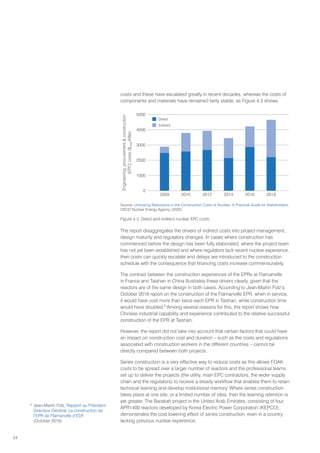
Engineering, procurement and construction (EPC) costs are a significant element
of a plant’s capital costs and many of these costs are indirect. Design, planning,
support services and installation expenses are important elements of indirect
7
Unlocking Reductions in the
Construction Costs of Nuclear:
A Practical Guide for Stakeholders,
OECD Nuclear Energy Agency (2020)
24
The report disaggregates the drivers of indirect costs into project management,
design maturity and regulatory changes. In cases where construction has
commenced before the design has been fully elaborated, where the project team
has not yet been established and where regulators lack recent nuclear experience,
then costs can quickly escalate and delays are introduced to the construction
schedule with the consequence that financing costs increase commensurately.
The contrast between the construction experiences of the EPRs at Flamanville
in France and Taishan in China illustrates these drivers clearly, given that the
reactors are of the same design in both cases. According to Jean-Martin Folz’s
October 2019 report on the construction of the Flamanville EPR, when in service,
it would have cost more than twice each EPR in Taishan, while construction time
would have doubled.8
Among several reasons for this, the report shows how
Chinese industrial capability and experience contributed to the relative successful
construction of the EPR at Taishan.
However, the report did not take into account that certain factors that could have
an impact on construction cost and duration – such as the costs and regulations
associated with construction workers in the different countries – cannot be
directly compared between both projects.
Series construction is a very effective way to reduce costs as this allows FOAK
costs to be spread over a larger number of reactors and the professional teams
set up to deliver the projects (the utility, main EPC contractors, the wider supply
chain and the regulators) to receive a steady workflow that enables them to retain
technical learning and develop institutional memory. Where series construction
takes place at one site, or a limited number of sites, then the learning retention is
yet greater. The Barakah project in the United Arab Emirates, consisting of four
APR1400 reactors developed by Korea Electric Power Corporation (KEPCO),
demonstrates the cost lowering effect of series construction, even in a country
lacking previous nuclear experience.
8
Jean-Martin Folz, Rapport au Président
Directeur Général, La construction de
l’EPR de Flamanville d’EDF
(October 2019)
Source: Unlocking Reductions in the Construction Costs of Nuclear: A Practical Guide for Stakeholders,
OECD Nuclear Energy Agency (2020)
Figure 4.3. Direct and indirect nuclear EPC costs
2009 2018
2016
2014
2012
2010
5000
4000
3000
2000
1000
0
Engineering,
procurement

construction
(EPC)
costs
($
2020
/kWe)
 Direct
 Indirect
costs and these have escalated greatly in recent decades, whereas the costs of
components and materials have remained fairly stable, as Figure 4.3 shows.
25
4.3 Construction period
The construction time of a nuclear power plant is usually
taken as the duration between pouring the first nuclear
concrete and grid connection. In advance of construction
start, a substantial amount of time and effort is involved in
planning and gaining approvals and licensing for the facility.
The median time taken to construct nuclear power plants
has not varied significantly over the last 20 years (see
Figure 4.4); however, this is the result of the successful
adherence to initial construction schedules in East Asia
balancing the increasing construction times in developed
economies. The hiatus on nuclear construction in many
countries following the March 2011 accident at Japan’s
Fukushima Daiichi nuclear plant and the completion of
six FOAK reactor designs in China has resulted in a slight
increase in median construction times in recent years but
construction periods should decrease as the effect of these
factors recedes.
4.4 Small modular reactors
Small modular reactors (SMRs) are typically characterized
by electrical capacities of less than 300 MWe and designs
that allow for modular construction. In recent years there
has been a revival of interest in SMRs in the light of the
limited economies of scale realized for large reactors. SMRs
promise faster construction and quicker delivery of series
economies that could offset their higher per kWe capital
costs and thereby deliver levelized costs that could be at
least in line with or lower than those for larger reactors.
Savings could come from:
• Harmonized regulations. Savings would come from
having a standard design that can be replicated in
multiple jurisdictions.
• Construction should be more rapid as a result of
the use of factory-produced modules that can be
transported relatively easily to the site and ‘plugged in’
to other modules, leading to lower site costs.
• Quality control should be improved as a result
of factory construction, thereby leading to less
construction, permitting and operating risk.
• The production of larger numbers of reactors should
allow series economies to be delivered more quickly
and with greater certainty, so the ‘learning-by-doing’
cost reductions should be realized more rapidly.
• Lower total plant capital requirements that could result in
lower utility borrowing and thus lower rates on utility debt.
• While large-scale plants can create many regional and
national jobs, prefabrication could result in savings on
labour costs.
Median
construction
time
(months)
120
108
96
84
72
60
48
36
24
12
0
1986-1990
1991-1995
2001-2005
1996-2000
1981-1985
2022
2021
2020
2018
2017
2016
2011-2015
2006-2010
2019
89
88
84
117
103
58
74
66
76
58
120
81
92
84
Figure 4.4. Nuclear reactor median construction times
Source: World Nuclear Performance Report 2023, World Nuclear Association
26
The ability to demonstrate and achieve these savings will be key for the successful
deployment of any SMR model at a large scale. Upfront investment for both the
supply chain and the fuel cycle will be required and would have to be supported
by the developer’s government and/or that of the hosting countries.
Due to the lower capital cost per unit, the risk to a utility from an SMR investment
is very much lower than for a large reactor. Moreover, the SMR site is likely to
allow subsequent additions of capacity in a manner more closely calibrated to
demand increases whilst simultaneously delivering further series economies
resulting from the construction of multiple reactors on a single site.
The characteristics of SMRs might also lead to revenue enhancement as a result of:
• Greater opportunities to use process heat resulting from the ability to site
reactors closer to communities or commercial activities (SMRs feature a
higher level of passive safety than large reactors).
• Greater ability to match output to the demand volatility that is expected from
the increased use of intermittent renewables.
To date, SMRs are being licensed or are under construction in many countries,
and are currently envisaged to be employed in isolated locations, such as the
northern regions of Russia, and for co-production, such as water desalination in
Saudi Arabia. In isolated regions, SMRs could be competitive on performance,
cost, and environmental criteria compared with the fossil solutions that have
prevailed so far.
According to World Nuclear Association, SMRs are likely to play a major role
in the decarbonization of many sectors; however, SMR deployment at a scale
that would make a significant contribution to climate change mitigation is only
likely from the late 2030s. In the meantime, there remains a need for large-scale
reactors, which are based on proven commercialized technologies that can be
deployed at the scale and timing needed to meet the Paris Agreement goals.9
4.5 Operating costs
The operating costs of nuclear plants are typically low (see Chapter 2). It should
be noted that, when evaluating nuclear plants using new designs, fuel use
should be more economical than for older plants, for example by allowing higher
burn-ups.
Nuclear used fuel management and disposal costs are accounted for in the
overall costs of operation, providing a good level of predictability of long-term
costs. Financial contributions are usually made over the economic lifetime of a
nuclear plant towards plant dismantling and eventual site restoration. Given that
plants are expected to have long operating lifetimes, the level of contributions is
not significant (usually accounting for less than 1% of the total levelized costs of
generation).
As noted in Chapter 2, OM costs vary between countries; however, as lessons
learned through improvements in plant operating practices are implemented
across the sector, together with higher capacity factors, the competitiveness of
many nuclear plants should improve.
9
The need for large and small nuclear,
today and tomorrow, World Nuclear
Association (September 2020)
10
Coal 2022: Analysis and forecast to 2025,
International Energy Agency
(December 2022)
27
4.6 Nuclear competitiveness
As nuclear plants have relatively high capital costs but
low operating costs, it is important for plants to operate
at very high capacity factors, supplying the demand for
base-load electricity. Although renewable energy sources
are taking an increasing share of incremental electricity
supply in several markets, it is still expected that in many
countries incremental and replacement plants to satisfy
the base-load demand will use fossil fuels (coal or gas)
or nuclear.10
There have been several studies carried out that assess
the relative electricity generating costs for new plants
utilizing different technologies. The OECD Nuclear Energy
Agency and the International Energy Agency’s Projected
Costs of Generating Electricity joint report – a standardized
levelized cost assessment of a wide range of generating
technologies in different countries – is published at roughly
five-year intervals. The 2020 edition points to the decline in
nuclear costs in many countries since the previous report
in 2015. A summary of the results (see Figure 4.5) shows
that, at a 7% discount rate, nuclear is the cheapest base-
load option in many countries. For all countries, the report
assumes a cost of carbon dioxide of $30 per tonne. The
2020 report includes estimates based on a 3% discount
rate; at this level, nuclear is the lowest cost base-load
generation technology. This discount rate can be seen
as representative of the cost of capital in a number of
countries where state-owned enterprises can borrow on
similar terms to government.
The main conclusions for nuclear of the 2020 edition are:
• Long-term operation of nuclear plants is one of the
most cost-competitive options to generate low-carbon
dispatchable electricity in many regions, with a LCOE
of $30-50/MWh.
• More active government intervention in risk allocation
and mitigation strategies for new nuclear projects will
have a significant impact on financing costs, which can
represent 80% of the total investment costs.
• Small modular reactors (SMRs) offer cost and risk
reductions with factory-built construction and higher
affordability of the projects – though these benefits
still need to be proven. SMRs can target specific
markets and applications that could accelerate the
decarbonization of hard-to-abate sectors.
Levelized
cost
of
electricity
($
2018
/
MWh)
Lignite
Coal
Gas
(CCGT)
Nuclear
Nuclear
(LTO)
Onshore
wind
(≥
1
MW)
Offshore
wind
Solar
PV
(utility
scale)
Solar
PV
(commercial)
Solar
PV
(residential)
Solar
thermal
(CSP)
Hydro
(reservoir,
≥
5
MW)
Hydro
(run
of
river,
≥
5
MW)
Geothermal
Biomass
Lignite
(CCUS)
Coal
(CCUS)
Gas
(CCGT,
CCUS)
Fossil fuel
technologies Low-carbon technologies
250
200
150
100
50
0
Note: Values at 7% discount rate. Box plots indicate maximum, median and minimum values. The boxes indicate the central 50% of values, i.e. the second and
the third quartile.
Source: Projected Costs of Generating Electricity, OECD Nuclear Energy Agency and International Energy Agency (2020)
Figure 4.5. LCOE by technology
28
4.7 LCOE and system costs
In order to provide reliable electricity supply, provision must be made for backup
generation at times when generating plant is offline. Provision must also be made
to transmit the electricity from where it is generated to where it is needed. The costs
incurred in providing backup and transmission/distribution facilities are known as
system costs and these costs vary greatly between different generating technologies.
For nuclear and fossil fuel generators, system costs relate mainly to the need for
reserve capacity to cover periodic outages, whether planned or unplanned. The
system costs associated with intermittent renewable generation relate to their
inability to generate electricity without the required weather conditions and their
generally dispersed locations from centres of demand; these system costs are
far higher for intermittent renewables than they are for dispatchable generators.
As the penetration of renewables rises, which is the objective of policymakers
in many countries, their system costs increase. Adding the system costs of
intermittent renewables to their plant-level costs greatly increases the overall
costs of reliable supply.
The future competitiveness of intermittent renewables depends very much on
the resolution of a number of current uncertainties which could moderate their
system costs, including the success of ‘smart’ demand management, the
volatility-reducing effects of increased interconnection and the development of
electrical storage solutions.
The overall cost-competitiveness of nuclear on the other hand, as measured on
a levelized basis, is much enhanced by its modest system costs. However, the
impact of intermittent electricity supply on wholesale markets has a profound
effect on the economics of base-load generators, including nuclear, that is not
captured in the levelized cost estimates given in studies such as the Projected
Costs of Generating Electricity. The negligible marginal operating costs and
priority grid access of wind and solar mean that, when climatic conditions allow
generation from these sources, they undercut all other electricity producers.
Base case 10% VRE 30% VRE 50% VRE 75% VRE
140
120
100
80
60
40
20
0
Total
costs
of
generation
($/MWh)
 Generation costs
 System costs
Figure 4.6. Effect of penetration of intermittent renewables on generation cost
Note: Figure shows total generation costs for five main scenarios characterized by different levels of
electricity generation from variable renewable energy (0%, 10%, 30%, 50% and 75%) for a region with
an annual electricity demand of 537 TWh, corresponding to the expected demand of a country the
size of France in 2050. Around 80% of electricity generation in the base case (0% VRE) is from nuclear,
progressively decreasing to 0% nuclear generation in the 75% VRE case. Costs are in 2013 currency.
Source: The Costs of Decarbonisation: System Costs with High Shares of Nuclear and Renewables,
OECD Nuclear Energy Agency (2019)
29
At high levels of renewable generation, e.g. as implied by the EU’s 32% renewable
energy penetration target by 2030, nuclear capacity factors are reduced and the
volatility of wholesale prices is greatly increased whilst the average wholesale price
falls. The increased penetration of intermittent renewables thereby reduces the financial
viability of nuclear generation (and other base-load generators – see Figure 4.6).11
The integration of intermittent renewables with conventional base-load generation
is a major challenge facing policymakers in the EU and certain states in the USA
and until this challenge is resolved, e.g. by the introduction of long-term capacity
markets or power purchase agreements, investment in base-load generation
capacity in these markets is likely to remain insufficient.
A 2016 Massachusetts Institute of Technology study focused on specific regions.
For the ERCOT (Electric Reliability Council of Texas) area (see Figure 4.7), the
following conclusions were drawn:
• The more intermittent renewables there are in the system, the higher the
overall cost of electricity generation.
• The lower the carbon content of the electricity generation mix, the higher the cost
– especially when there is a high share of intermittent renewable generation.
• Without nuclear, the cost of reducing the carbon content increases exponentially;
the final steps towards zero carbon being extremely expensive.
$/MWh
Emissions constraint (gCO2/kWh) Pathway
Average
price
($/MWh)
11
The impact of intermittent renewables
on other generators has often been
overlooked in the literature reviewing
system costs. An exception is L. Hirth,
F. Ueckerdt, O. Edenhofer, Integration
costs revisited – An economic
framework for wind and solar variability,
Renewable Energy 74 (2015), 925-939.
Figure 4.7. Electricity price as a function of pathways and emissions intensity targets in the
ERCOT system
Note: Effect of carbon emissions targets (400, 300, 200, 100, 50, 15, 1 gCO2
/kWh) on eight pathways for
the Electric Reliability Council of Texas (ERCOT) power system.
RNS: Gas, Solar and Wind Generation, Pumped Hydro and Battery Storage; +DMS 1: Addition of
Demand Side Management; +DR 1: Addition of Demand Response; RNSLWR: Gas, Solar and Wind
Generation, Pumped Hydro and Battery Storage, and Nuclear Generation; +DMS 2: Addition of Demand
Side Management; +DR 2: Addition of Demand Response; +CHP: Addition of Heat Storage; +NACC:
Addition of Advanced Nuclear.
Source: N. A. Sepulveda, Decarbonization of Power Systems: Analyzing Different Technological Pathways,
Massachusetts Institute of Technology (September 2016)
30
4.8 Electricity market regulation
The electricity market and its regulation will influence a utility’s choice of
generation technology. Electrical power generation, including nuclear, was largely
developed by public bodies in a regulatory environment that facilitated long-
term investment. In some countries, nuclear plants were built primarily to ensure
national security of supply. Reducing the dependence on imported fossil fuels
continues to be an important factor in many countries.
The expected long-term stability in costs was also a key consideration favouring
nuclear and it remains a strong argument today. Government-owned or rate-
of-return regulated utilities have an overall objective of meeting demand at an
agreed level of reliability at a low long-term cost of electricity. In such a system
there is no significant wholesale market setting prices for those utilities. Critically,
the system allows the total costs of all units in the portfolio, including nuclear, to
be recovered. This ‘traditional’ utility model of electricity supply had the virtue of
delivering a high level of supply reliability but at an economic cost (potentially as
a result of over-investment) that has persuaded many countries to liberalize or
deregulate the power market.
The move to a market-based electricity industry approach changes the above
state of affairs. Short-term electricity market spot prices (and expectations of
future spot prices) are expected to provide economic signals for power plant
investments. Spot prices are intended to reflect the marginal cost of electricity in
each trading period. The market operator selects the lowest price bids received
from generators in order to meet demand for each trading period and the price of
the last bid sets the wholesale spot price for that period. A generating unit will be
dispatched in this system by a market operator based on short-run marginal cost
(i.e. the change in costs resulting from small and temporary changes in plant
System costs versus VALCOE
System costs have been analysed in depth in 2016 by the Massachusetts
Institute of Technology (MIT)12
and in 2019 by the OECD-NEA.13
Those
costs encompass profile, balancing costs and grid costs (distribution and
interconnection). In parallel, the 2018 edition of the IEA’s World Energy
Outlook (WEO) introduced the value-adjusted LCOE (VALCOE) concept.14
The system cost quantifies system effects by comparing a scenario using a
given mix of technologies or the same share of generation. System effects
can then be attributed to a given generation technology.
The VALCOE approach attempts to value the contribution to the system
by individual technologies. For instance, it was intended to showcase the
value of CCGT in future electricity mixes with higher shares of intermittent
renewables without considering the role of flexible nuclear capacity.
– System LCOE: long-term optimized least cost electricity mix.
– VALCOE: short-term and policy driven brownfield electricity mix.
While the system cost involves more significant modelling work for an energy
planner, it provides for a much better long-term cost of the system.
12
N. A. Sepulveda, Decarbonization of
Power Systems: Analyzing Different
Technological Pathways, Massachusetts
Institute of Technology (September 2016)
13
The Costs of Decarbonisation: System
Costs with High Shares of Nuclear and
Renewables, OECD Nuclear Energy
Agency (2019)
14
World Energy Outlook 2018, International
Energy Agency (November 2018)
31
output), sometimes referred to as ‘avoidable’ costs. As described in Chapter 2,
for a nuclear power plant, such short-run costs are very low compared with other
thermal generators as most plant costs relate to ‘unavoidable’ or fixed costs,
namely operations and maintenance (OM) costs, some fuel costs (including
costs for the management and disposal of used fuel), recovery of construction
costs, and plant decommissioning costs. In an electricity market based on short-
run marginal costs, a nuclear plant is likely to be dispatched almost all of the time
regardless of the wholesale market price.
In the electricity supply systems of the past, marginal producers had been
relatively high operating cost fossil fuel plants. The prices achieved in such
systems were sufficient to cover the fixed costs of nuclear albeit with a great
degree of uncertainty relating to the amount of revenue that would be earned.
Since the start of the millennium this expectation has been upset by two
developments. Firstly, the exploitation of unconventional gas in some markets
(mostly North America) has lowered the cost of gas-fired electricity, which in
some locations has resulted in very low wholesale electricity prices. Secondly, the
promotion of renewables with almost zero marginal costs has in some locations
and at certain times also reduced wholesale prices to extremely low levels.15
These two developments have greatly reduced revenues for nuclear plants
selling electricity into these markets.
Where such competing technologies exist in deregulated markets, as the
US experience shows, it can be difficult for nuclear power plants to be
financially viable although it is possible to design support arrangements that
recognize the benefits that nuclear power brings (e.g. through long-term power
contracts, capacity payments, and carbon pricing). Examples of such support
arrangements in the USA include the fixed-term power purchase agreements
entered into by new owners during the divestment and purchase of plants in the
early 2000s and more recently the zero emissions credit payments received by
plants in New York, New Jersey, Illinois, Connecticut and Ohio.16
The competitiveness of nuclear energy depends mainly on the capital required
to build the plant, the construction time, together with the service charge on
that capital (which is represented in levelized cost calculations by the discount
rate). If a discount rate of 4-8% is used, then nuclear is usually competitive
with other generating technologies assuming overnight capital costs in current
typical ranges for a number of countries. Once a number of plants of the same
design are successfully completed on time, the cost of financing further plants
should decrease.
When system costs are added to the plant levelized costs of different generation
technologies, nuclear energy’s competitiveness as a low-carbon energy source
is increased further. However, the impact of subsidized intermittent renewables
and ‘un-carbon-costed’ gas are depressing wholesale prices in deregulated
markets and the advantages of nuclear will not be realized fully until these
fundamental market design problems are addressed by policymakers.
New nuclear plants generate electricity at predictable, low and stable costs for
at least 60 years of operating life. Their system and external costs in normal
operation are also both low. Investment in nuclear should therefore be attractive
to industrialized countries which require significant base-load amounts of low-
cost power over the long-term.
15
Low wholesale prices do not however
equate to low prices for consumers; the
variability of new renewables has to be
managed either by back-up generation,
additional grid capacity or by storage,
the costs of which will be passed onto
consumers.
16
Edward Kee, Market Failure: Market-
Based Electricity is Killing Nuclear Power
(January 2021)
32
The environmental and socio-economic impacts of
different generating technologies vary greatly. Where the
costs associated with these impacts are not covered by
the electricity consumer, but by the community generally,
these are referred to as ‘external’ costs. Negative effects
beyond the system itself (i.e. negative externalities) related
to electricity generation – most notably the emissions of
greenhouse gases – represent a social cost that may impact
the true affordability of different electricity supply options.
Some energy sources dispose of wastes to the environment
or have health effects which are not costed into the product.
The quantification of these external costs is necessary to
enable rational choices between energy sources. Nuclear
energy provides for its waste management, disposal and
decommissioning costs in the actual cost of electricity (i.e. it
has internalized them), so that external costs are minimized.
In addition, the economic impacts of a given energy project
should not only include the negative externalities, but
also the positive externalities which may result – such as
economic growth and job creation.
This chapter focuses on the environmental and socio-
economic impacts of nuclear energy compared to other
sources such as fossil fuels and intermittent renewables,
and the economic implications of this. It also describes
how governments are assessing the value of those impacts
depending on their national situations, policies and
objectives, and seeking to incentivize investment.
5.1 Climate mitigation and market reform
Nuclear energy is a proven low-carbon energy source
that has played a major role in avoiding carbon dioxide
emissions. Over the past 50 years, the use of nuclear
energy has reduced global carbon dioxide emissions
by about 70 gigatonnes (see Figure 5.1). The countries
that have so far achieved significant decarbonization of
electricity (notably France and Sweden) have primarily done
so through mixtures of hydropower and nuclear energy.
In recent years, more and more countries have signed up
to aggressive zero or net-zero climate emissions targets,
especially in the developed world. This has increased the
pressure to achieve total decarbonization of the electricity
system, and through electrification to also partially achieve
decarbonization of heat, transport and industry. Carbon dioxide
emissions from each of these sectors in recent years are shown
in Figure 5.2. While it is possible to progressively decarbonize
an economy through the addition of variable renewables,
the substitution of coal for gas plants, and increased
efficiency and demand side measures, these all have limits.
Countries can take a ‘carrot’ or ‘stick’ approach towards
incentivizing low-carbon generation. Using the stick
approach, several states, countries and regions have tried
to put a cost on carbon emissions. As fossil fuel generators
begin to incur costs associated with their impact on
the climate, through carbon taxes or emissions trading
regimes, the competitiveness of new nuclear plants and
renewable options improve.
5 Environmental and Social
Implications
Actual emissions
Power
sector,
actual
and
avoided
emissions
(Gt
CO
2
)
Avoided emissions,
by technology
Cumulative avoided
emissions,
1971–2018
Share
of
low
carbon
electricity
 Nuclear
 Hydro
 Biofuels and waste
 Solar
 Wind
 Other renewables
1970 1975 1980 1985 1990 1995 2000 2005 2010 2015
15
10
5
0
-5
-10
100%
75%
50%
25%
0%
All others
Hydro
Nuclear
15 Gt
98 Gt
74 Gt
Source: Figure 9, Climate Change and Nuclear Power 2020, International Atomic Energy Agency (September 2020)
Figure 5.1. Global power sector avoided carbon emissions
33
The carrot approach has traditionally involved feed-in-tariffs
for renewable energy sources, but many countries are now
making more profound changes to their energy market
frameworks so as to incentivize low-carbon energy additions
in a way that meets a broad spectrum of policy goals.
In the USA for example, the Inflation Reduction Act (IRA)
introduced in 2022 is intended to mobilize private capital
into the energy transition. Nuclear energy will benefit from
many of the IRA provisions, which include a $15 per MWh
production tax credit for existing nuclear plants, and the
choice of either a $25/MWh production tax credit for new
nuclear technologies (for the first ten years of operation),
or a 30% investment tax credit. Both of these can be
increased by 10% for plants built at a brownfield site or
within an existing fossil energy community. Nuclear plants
producing low-carbon hydrogen would also be able to
access other credits within the IRA.
The European Union has enacted a number of policy
measures that should also support nuclear energy
investments as part of the bloc’s long-term transition to a
secure and sustainable economy. These include:
• The EU taxonomy for sustainable activities – the EU
approved list of activities considered essential for
meeting various sustainability objectives. Activities on
this list may benefit from various forms of sustainable
finance, such as green bonds. Nuclear energy was
included in the taxonomy in 2022.
• The EU Net-Zero Industry Act – this has two main
support mechanisms for a shortlist of ‘strategic’ low-
carbon technologies: faster permitting and privileged
access to special purpose climate funds. It appears
that nuclear would be included.
• EU electricity market reform – this was initiated in
response to the energy crisis in the early 2020s that
was caused by a spike in the cost of natural gas,
rather than climate concerns. However, it has clear
implications for low-carbon energy sources and nuclear
plants may benefit from it.
In addition, the development and deployment of small
modular reactors (SMRs) in Europe is supported through
the European Industrial Alliance on SMRs.
5.1.1 Broader health and environmental goals
Nuclear energy is positively rated in most impact categories
covered in energy life-cycle assessments. An energy
life-cycle assessment carried out by the Luxembourg
Institute of Science and Technology for the United Nations
Economic Commission for Europe (UNECE) demonstrated
that not only does nuclear energy give rise to the lowest
2019 2020 2021 2022
CO
2
emissions
(Gt)
16
14
12
10
8
6
4
2
0
 Power
 Industry
 Transport
 Buildings
Source: CO2 Emissions in 2022, International Energy Agency (March 2023)
Figure 5.2. Global carbon dioxide emissions by sector
34
level of greenhouse gas emissions of all electricity generation technologies, but
it requires the least space of any low-carbon generation option as well as being
among the lowest in freshwater eutrophication potential, human toxicity and
minerals and metal requirements (see Figure 5.3).1
In terms of impacts on public health, the World Health Organization estimated
in 2016 that outdoor air pollution is responsible for three million deaths annually,
with the highest numbers of deaths attributable to air pollution in the Western Pacific
region and Southeast Asia. The largest source of pollution is the burning of fossil fuels
and biomass for energy and transport. By contrast, nuclear power plants emit virtually
no air pollutants during operation, and emissions are very low across the entire
life-cycle. Nuclear energy can therefore help to reduce human health impacts and
related costs from the energy sector, wherever it replaces more polluting alternatives.
5.2 Socio-economic benefits of nuclear
Nuclear power programmes can make a significant positive impact to gross
domestic product (GDP) and employment rates of the host country.
5.2.1 Economic value
Nuclear power is a capital-intensive source of electricity in comparison with other
sources of generation. The plant and equipment needed for the construction of
a nuclear plant is considerable and the supply of these goods has a widespread
multiplier effect. A host of specialist companies is required to supply equipment for
the nuclear island (i.e. reactor and associated heat transference systems) as well
as the conventional island of the turbine-generator systems. The capital intensity
of a nuclear plant results in a large economic boost during the construction period
(as well as for maintenance/upgrade/refurbishment of the plant), with significant
value created in the supply chain. During operation, this economic effect is lower.
In order to estimate these economic impacts, the way in which a given amount
of spending on nuclear (and other generation technologies) spreads through
the economy should be understood. The wider effect of this spending is known
as the ‘multiplier effect’, whereby the spending on workers and components is
Units
(years)
Figure 5.3. Life-cycle impacts on human health
1
Carbon Neutrality in the UNECE Region:
Integrated Life-cycle Assessment of
Electricity Sources, United Nations
Economic Commission for Europe (2022)
Note: One unit is equivalent to the impacts (in disability-adjusted life years) on one person (globally) over one year.
Source: Carbon Neutrality in the UNECE Region: Integrated Life-cycle Assessment of Electricity Sources, United Nations Economic Commission for Europe (2022)
35
cycled further into the economy through spending by workers and suppliers on
consumption and productive inputs respectively. This pattern repeats for suppliers
to suppliers and so on, resulting in a cumulative spending total.
An International Monetary Fund paper estimates that every dollar spent on nuclear
would lead to a near-term GDP impact amounting to $4.11.2
For the countries
studied, the wider economic benefits of nuclear power production were much
higher than those of renewables and many times those of fossil fuels.
Table 5.1. Economic multipliers for different electricity supply technologies3
Fossil fuels Renewables Nuclear
Impact multiplier 0.62 1.40 4.11
Cumulative five-year effect 0.47 1.54 3.78
5.2.2 Number and quality of jobs created
Following on from the effects on GDP of nuclear investment, the employment
effect of nuclear might also be expected to be greater than other sources of
electricity. A study by World Nuclear Association4
comparing nuclear with wind
employment in a ‘steady state’ economy where the sectors were generating 1000
TWh annually and using data from France and the USA for nuclear and wind
respectively, indicated that nuclear creates over 25% more employment than
wind. This calculation includes direct employment in the nuclear and wind sectors
themselves and indirect employment in other supplier companies. For the total
employment effect to be calculated, the induced employment in sectors such as
education and housing created by the spending of these employees also needs
to be included. It has been estimated that for each direct job in nuclear energy,
about 2.5 to 3.5 indirect and induced jobs are created.
In the USA, the average remuneration of nuclear workers was found to be nearly
$136,600 (in 2017), versus the average wind and solar worker remuneration of
$104,200.5
Based on these remuneration levels, the amount of induced employment
would be expected to be 40% less for wind than nuclear. In the UK, the average nuclear
sector remuneration in comparison with the UK-wide average is given in Figure 5.4.
2
N. Batini et al., Building Back Better:
How Big are Green Spending Multipliers?,
International Monetary Fund (2021)
3
For fossil fuels and renewables the
following countries were included: China,
Japan, Korea, Canada, USA, Brazil,
Indonesia, Mexico, Russia, Australia,
New Zealand, France, Germany, Italy. For
nuclear, the countries included China,
France, Japan, Korea, Canada, USA.
4
Employment in the Nuclear and Wind
Electricity Generating Sectors, World
Nuclear Association (July 2020)
5
Nuclear Power Pays: Assessing the
Trends in Electric Power Generation
Employment and Wages, Oxford
Economics (April 2019)
Figure 5.4. Distribution of gross annual salaries in the UK and civil nuclear sector, 2021
10
Total average
(mean)
30 50
Percentile
70
20 40 60 80 90
90,000
80,000
70,000
60,000
50,000
40,000
30,000
20,000
10,000
0
Average
annual
salary
(£)
 UK civil nuclear industry  UK economy
Source: Delivering Value: The Economic Impact of the Civil Nuclear Industry, Nuclear Industry Association (January 2023). UK economy figures from Office for
National Statistics; UK civil nuclear industry figures from Oxford Economics survey of Nuclear Industry Association members.
36
The nuclear remuneration levels are unsurprising given the highly technical
nature of nuclear employment. Nuclear workforces are mostly qualified to
degree level, usually in technical subjects; they tend to live close to the plant in
considerable numbers (at least 500 for a 1 GWe nuclear power plant), receive
high levels of training and remain with the employing company for long periods.
A nuclear plant creates a sustainable, stable and high-income local economy to
a greater degree than renewables or fossil fuels.
Having a higher ratio of employment with better salaries does not contradict
the claim that nuclear remains cheap compared to other low-carbon sources of
electricity – as the proportion of employment in the LCOE is low compared to the
cost of capital.
5.3 Nuclear energy and sustainable development
In recent years the global interest in nuclear energy has grown in response to
global sustainability concerns and especially the need to reduce greenhouse gas
emissions, as described above.
The United Nations Economic Commission for Europe (UNECE) released a
report in 2021which described how nuclear energy can contribute to attaining
all 17 of the Sustainable Development Goals (SDGs).6
Nuclear energy makes a
direct and significant contribution to SDG 7 (affordable and clean energy) and
SDG 13 (climate action) but can also contribute to the other SDGs to a greater
or lesser extent. Developing a national nuclear sector therefore has profound
implications for sustainable development.
6
Application of the United Nations
Framework Classification for Resources
and the United Nations Resource
Management System: Use of Nuclear
Fuel Resources for Sustainable
Development – Entry Pathways; A
report prepared by the Expert Group
on Resource Management Nuclear
Fuel Resources Working Group, United
Nations Economic Commission for
Europe (March 2021)
37
All projects have an element of risk. Nuclear projects are
larger, subject to a higher degree of regulation and are
generally longer in duration than many other types of project
and are therefore associated with greater risk and uncertainty.
Project risks should initially be identified and then managed
using both a qualitative approach to understand and
address the risks; and a quantitative approach to calculate
the contingency needed to cover any risks that are realized.
New-build risks include delays due to problems with the
design, supply of equipment and materials, personnel,
construction and commissioning. These risks are common
to all large infrastructure projects and can be allocated
amongst the plant owner-operator, the plant engineering,
procurement and construction (EPC) contractors, the plant
vendor and financiers. A variety of contractual models are
possible that incentivize contractors to perform while also
providing for mechanisms to resolve difficulties as they
arise and provide better value for the final consumer.
Table 6.1 lists risks that are associated with a nuclear
project. Table 7.1 on page 39 shows how these risks may
be mitigated.
6 Risks of Nuclear Projects
Table 6.1. Nuclear power project risks
Development Construction Operation Decommissioning
Technical
Regulatory assessment
Site suitability
Environmental impact
Planning approvals
Safety
Design completion/changes
Regulatory assessment/
approvals
Vendor and contractor
performance
Equipment supply chain
Skilled and experienced
workforce
Construction quality
Transport routes to site
Industrial relations
Safety
Plant performance
Skilled and experienced
workforce
Nuclear event
Nuclear event at a
different site
Beyond design basis
events
Fuel supply chain
constraints
Safety
Design completion/changes
Regulatory assessment/
approvals
Contractor performance
Equipment supply chain
Skilled and experienced
workforce
Transport routes to/from site
Availability of waste
management routes and
disposal
Business
case
Economics
Demand forecast
Used fuel and radioactive
waste disposal
Design changes
Delay
Electricity markets and
subsidized competitors
Trading and price
Capacity factor
Carbon price
Fuel costs
Capital additions
Early closure
Cost of waste and used
fuel disposal
Decommissioning fund cost
escalation
Decommissioning fund
performance
Societal
and
political
General public support and local approval
Policy supporting the need for nuclear power
Decommissioning and waste management policies and implementation
Carbon pricing mechanism
Environmental policy
38
A project risk is a potential event or condition that, if it is
realized, may have a negative effect (threat) or positive
effect (opportunity) on a project’s objectives. The risk
management plan will identify which party should be
allocated responsibility for each risk including its mitigation,
and this risk allocation should be aligned with the
contractual arrangements between the parties.
In preparing the risk assessment, the project stakeholders
may assess the probability of the event occurring and the
consequent impact. Measures to manage or monitor the
risk can be identified and a further assessment made of the
residual probability and impact.
Because nuclear projects are especially capital-intensive,
effective project management is essential if risks are to
be managed, costs contained, and schedules met. In this
fundamental respect, nuclear new-build projects are very
much comparable to major infrastructure projects.
6.1 Electricity market regulation and
revenue predictability
There are generally two types of electricity market structure:
regulated, where an energy regulator passes on costs to
the customer (ratepayer); and deregulated (liberalized)
where the market price is competitively set between
different forms of generation.
For any operator in a deregulated market, revenue
unpredictability is a key risk. Deregulated markets favour
generation types with low capital costs and high variable
operating costs as these generators (such as gas) only
operate when their operating costs can be covered by
the price of electricity. For high capital, low operating cost
generators such as nuclear, the variability in the market
price presents a higher risk as most of the cost base is
fixed (capital).
The uncertainty over future electricity prices means that it
is difficult to predict revenues once the plant is operating.
The possibility of revenues falling below costs (including
the cost of debt finance) for a significant period will lead
the providers of capital to require a higher risk premium
which in turn increases the price of electricity to cover
increased financing costs. Electricity prices have even
been lower than the operating costs of some nuclear plant
operators and have, for example, resulted in the premature
closure of several nuclear units in the USA. Revenue risk in
some deregulated markets has been heightened with the
development of new sources of low-cost natural gas and
the promotion of renewables with extremely low operating
costs and subsidies outside the market.
In contrast, regulated markets are characterized by a far
higher degree of revenue predictability, whether rates
are set by a regulatory body or by a utility with sufficient
pricing power to set rates to cover the average cost of its
operations. Thus, in regulated electricity supply systems
where new generating technologies are introduced, the
utility is able to control the impact on existing plants. The
potential access of new generation technologies to these
markets is as a result controlled in a way that it cannot be
in deregulated markets. Nuclear operators in regulated
markets can assure investors of a more certain return on
their capital and consequently are able to obtain finance
on better terms. Most regulated markets are typified by
large state-owned utilities that can borrow with effectively
a sovereign guarantee. The economics of nuclear plants in
such markets are therefore greatly enhanced.
Most of the existing nuclear fleet worldwide was built in
regulated markets. Changes in market regulations such as
the ones that occurred in the USA in the ’90s led several
nuclear plants to be prematurely shut down because their
fundamental economics were no longer applicable under
the deregulated rules.
6.2 Nuclear safety regulation
As a highly regulated industry, there are risks associated
with the timelines for securing the necessary licences
and permits. While public protection is an essential
governmental responsibility, that goal must be pursued
through a regulatory environment that provides sufficient
predictability for investors. The nuclear industry has
recognized that it can contribute to stability and
smoothness in the regulatory process by achieving greater
consistency in reactor designs.
The regulatory licensing process consists of several stages:
reactor design certification; site approval, which is usually
made easier on sites with previously constructed reactors;
licences for construction and operation; and, in most
countries, local planning approvals and environmental
assessments are needed both by law and as a means of
achieving and demonstrating public acceptance.
US experience provides a good example of strengthening
regulatory certainty in the new-build process. The Nuclear
Regulatory Commission (NRC) has established a licensing
framework that provides for pre-approval of a prospective
site for a new plant, certification of reactor designs well
ahead of any construction, and the issuance of a single
licence to build and operate a new plant using a certified
design and a pre-approved site – a combined construction
and operating licence (COL).
39
This approach moves all design, technical, regulatory, and licensing issues to
the front of the licensing process so that before construction begins and any
significant capital spending occurs, safety and environmental issues can be fully
addressed. The licensing framework aims to assure potential investors that their
investment in a new nuclear plant will not be jeopardized as long as construction
adheres to the approved design and standards. Extensive delays due to public
intervention are now prevented by strictly defined timeframes for public hearings
and consultations.
6.3 Design harmonization
A new generation of reactors has been designed to reduce project construction
and development risk. Building these reactors using pre-fabrication, pre-
assembly and modularization along with 3-D modelling, open-top construction
and other advanced construction techniques can further control risk. The new
reactor designs take advantage of the significant amount of RD, construction
and operating experience that is available.
Reactor vendors and utilities have been working with national and international
regulatory bodies to harmonize regulatory and utility requirements for reactor
designs throughout the world. Such harmonization would lower costs for
manufacturing, construction, maintenance, and refuelling.
Those who build first-of-a-kind (FOAK) reactors bear the burden of one-time
risks and provide subsequent developers with valuable information and
experience. To compensate for this, the US government has introduced FOAK
incentives that include loan guarantees, investment tax credits and insurance
against regulatory delays.
Countries that are introducing nuclear power for the first time should consider
limiting their risks by adopting proven designs that have already passed the FOAK
stage and have accumulated some operational experience. In addition, having
their national regulatory agencies working closely with the vendor regulator would
save time and money without compromising the safety of the project.
6.4 Operations
Nuclear operations have benefited from skills improvement programmes, the
advice of nuclear regulators, and the sharing of information and technical
assistance through international professional associations (notably, the
World Association of Nuclear Operators, WANO). Nevertheless, a number
of operational nuclear power plants have experienced prolonged (i.e. longer
than a year) outages for a variety of reasons. During this period, the nuclear
power plant earns no revenue and is likely to have higher than normal costs,
as efforts are made to return the plant to operation. A prolonged outage will
result in a severely negative impact on returns to investors and such outages
may not be insurable.
The risk of poor operational performance can be controlled by the employment
of a well-trained and experienced workforce, applying a carefully planned and
implemented maintenance regime. Ongoing support from vendors is also
important in controlling any technological risk associated with new designs.
40
With regard to the replacement of plant equipment, the business case for new
build may require that the project includes a contingency fund for some capital
expenditure through the operating lifetime of the plant in addition to predicted
replacements identified in the vendor’s design. The utility should also consider its
fuel procurement strategy to control any cost or supply chain risks.
Finally, plant safety concerns from natural events (e.g. floods, earthquakes or
severe climatic conditions) are covered in new plant evaluations. Plant security, for
example protection against terrorist attacks, requires collaboration and support
from government authorities.
6.5 Decommissioning and waste management
End-of-life risks relate to plant decommissioning and dismantling, and
radioactive waste and used fuel management. Used fuel costs are in many
countries regarded as part of the overall fuel cost, with an ongoing charge
levied to take account of used fuel management. However, this depends on the
establishment of an appropriate national policy framework.
A range of possibilities exist for setting aside money for decommissioning; for
example, in France nuclear operators are required to start building up funds
covering decommissioning and waste management from the beginning of a
plant’s operation.1
In most cases, decommissioning costs are covered by annual
charges levied on electricity consumers to cover the ultimate cost, fixed by
national rules, similar to used fuel.
6.6 Accident insurance
The cost of accident insurance contributes to the total cost of a nuclear power
plant, as it does to the cost of other potentially high impact industrial facilities
such as hydro dams, and oil and chemical facilities. A severe nuclear accident
with health and environmental consequences beyond the plant boundary is
a very low probability event, albeit one with high costs should it happen. It
should be noted that most of these costs arise from the effects of government-
mandated precautions, e.g. evacuation of potentially affected populations, rather
than directly inflicted injuries to health and the environment.
Plant owners must carry insurance to cover most operating risks. Liability for
severe accidents is defined by international conventions (notably, the Vienna and
Paris Conventions as well as the Convention on Supplementary Compensation
for Nuclear Damage) and/or by national legislation (such as the Price-Anderson
Nuclear Industries Indemnity Act in the USA). The revised Paris Convention on
Third Party Liability in the Field of Nuclear Energy (adopted in 2004) entered into
force on 1 January 2022, bringing the operator liability limit up to €700 million in
Paris Convention countries, and its sister convention (Brussels Supplementary
Convention) that provides additional state funding was revised at the same time
to bring the total amount of funding available to victims up to €1.5 billion.
In contrast to many other industrial sectors, these frameworks define and cap the
liability borne by the operator, with the possibility for public authorities to impose
unlimited liability on the nuclear operator and/or accept responsibility for liabilities
in excess of the cap. They also have the advantage of requiring that strict and
exclusive liability rests with the plant operator (i.e. regardless of fault and to be
1
Costs of Decommissioning Nuclear
Power Plants, OECD Nuclear Energy
Agency (April 2016)
41
borne by the operator alone) which greatly simplifies the options for claimants in
claiming for damages.
Japan was not party to any international convention relating to liability and
compensation for damage caused by a nuclear accident at the time of the March
2011 accident at the Fukushima Daiichi plant (it has been a contracting party
to the Convention on Supplementary Compensation for Nuclear Damage since
2015). Soon after the accident, the government brokered an institutional solution
to raising funds to meet compensation claims.
The Nuclear Damage Compensation Facilitation Corporation was established
in September 2011 so as to ensure that compensation payouts are promptly
and appropriately provided, and a stable supply of electricity can be secured
through the granting of compensation funds required by nuclear facility
operators in the event that they are faced with a large-scale nuclear damage
scenario. In August 2014, this entity was reorganized and renamed the Nuclear
Damage Compensation and Decommissioning Facilitation Corporation (NDF)
to include functions such as support to the decommissioning of reactors, and
management of the reserve fund for decommissioning was added to its remit in
May 2017. It is financed by Japanese nuclear plant operators, as well as having
access to government bonds, and is responsible for making payments to those
affected by the accident as well as acting as an insurer to the industry.
By mid-2023, the cumulative payouts as a result of the Fukushima accident
exceeded the sum of the compensation Tepco had received in accordance
with the Act on Contract for Indemnification of Nuclear Damage Compensation
(¥188.9 billion) and the financial assistance provided by the NDF (¥10.8 trillion).2
6.7 Political and public acceptance risk
Governmental commitment to the need for nuclear power is a prerequisite for any
nuclear construction, but that commitment cannot obviate all risks of laws and
regulations governing electricity markets and taxation eventually being modified.
Another aspect of political risk is that public acceptance can shift, perhaps
undermining a project’s viability during or after construction. Barring unforeseen
and extreme events, however, utilities are in a strong position to minimize this risk
by drawing upon the industry’s considerable experience in dealing with questions
of public concern. In most countries, the industry has succeeded in building
public support for nuclear power, by demonstrating strong operating performance.
2
Financial Assistance from the
Nuclear Damage Compensation
and Decommissioning Facilitation
Corporation, Tepco press release
(24 May 2023)
42
The essential aim of project structuring is to achieve an
efficient application of capital and resources. Project risks
should be assigned to the party most capable of handling
their control.
The structure of a new nuclear power project will be
influenced by the market in each particular country or
region. A project in a deregulated market will be structured
differently to one in a regulated market. In a regulated
market, investments may be made following regulatory
scrutiny of a plan which, once agreed, allows costs to be
passed through to the consumer.
There is no single way to structure a nuclear project; a
number of project models can succeed. The essential
characteristic is a suitable sharing of risks and benefits.
However, just as standardization of design can lower both
the cost and risk of new plants, so too can standardized
business structures. It is expected that the number of
different approaches will be reduced as more experience is
gained and projects repeat structures that work well.
Although project structures may vary, and can be complex
in some markets, there will be similar parties involved
and the allocation of risk will always be a key factor in
assessing whether the business case for a nuclear power
station can be assembled. Simply transferring a risk
does not make it disappear. The receiving party must
demonstrate that it can control the risk if uncertainty is to
be lowered to acceptable levels.
The prime participants in a nuclear project are:
• Government – responsible for overall energy
policy and, in some cases, financing. Increasingly,
governments need to provide a financial environment
conducive to investment decisions.
• Financiers – investors in debt or equity required to
finance the project.
• Market – formed by electricity customers wanting
electricity at a competitive price.
• Utility (generator) – ultimately responsible for
developing and running the whole project.
• Engineering, procurement, and construction (EPC)
contractors – companies that are responsible to the
owner for delivery of the project.
• Vendors – for supplying equipment and technology to
either the owner, the EPC contractor or as part of a joint
venture or consortium.
• Regulatory authorities – for addressing matters related
to the nature and behaviour of the electricity market,
protecting public safety and the environment, from the
design stage through to decommissioning.
Table 7.1 shows ways in which the risks of nuclear projects
listed in Table 6.1 can be monitored and controlled.
7.1 Development
During the phase of project development when government
effectively controls the permitting and approvals process,
the risk of the design being rejected or the project being
delayed is likely to be carried by the utility and potential reactor
vendors. Using internationally accepted designs, preferably
already built elsewhere, can help to control the risk of rejection
or delay, but substantial sums of money can be committed,
and be at risk, even before first concrete is poured.
7.2 Stakeholder involvement
Stakeholder participation is key to allaying concerns about
waste management and the safety and security of nuclear
installations. Providing information to the public and its
representatives – through public hearings and debate – is
essential to building trust with the wider community. Such
information also serves a documentary function, putting on
record what has been proposed and approved, to avoid
the possibility of recurrent argument.
7.3 Construction
Uncertainty around construction times, especially for first-
of-a-kind (FOAK) plants in OECD countries, constitutes a
very significant financial risk to project sponsors. During the
construction phase, the various risks can be covered by
contractual arrangements among the utility, EPC contractor
and vendor. For example, in a turnkey project the EPC
contractor assumes almost all risks of cost overruns.
Financial penalties and rewards are common for parts of
the construction contract relating to timing and quality.
Alternatively, utilities can assume greater risk in exchange,
perhaps, for the opportunity to benefit from a lower overall
cost. EPC contractors and vendors will seek to limit their
exposure and ultimately a portion of the risk will reside with
the utility. Because the expense of nuclear plants will have
an impact on company balance sheets, forming consortia
to share risks may often be a practical solution.
However, private sector companies (even when forming
partnerships or consortia) are unlikely to have the appetite
7 Project Structuring and
Risk Allocation
43
Table 7.1. Risk control and monitoring in nuclear power projects
Development Construction Operation Decommissioning
Technical
Internationally-accepted
designs
Building on existing nuclear
sites
Develop sound contractual
arrangements for involved
parties
Invest in supply chain
infrastructure
Suitable training
programmes
Invest in transport
infrastructure
Previous construction
experience and series
construction programmes
Strong project management
Involvement in
organizations such as
the World Association
of Nuclear Operators
Suitable training
programmes
Invest in new nuclear
fuel facilities
‘Fleet approach’ to
reactor management
Invest continuously in
plant maintenance and
improvement
Decide on decommissioning
strategy as early as possible
Invest in workforce training
Business
case
Seek investment from
major power users
Build business case on
various demand scenarios
Investigate opportunities
for revenue stabilization
Stick to standardized
designs
Develop sound long-
term power contracts
or otherwise develop
revenue stabilization
options (e.g. contracts
for difference, capacity
markets)
Develop a balanced
portfolio of fuel
contracts in line with
utility risk management
policies
Nuclear knowledge
management
Contribute to well-defined
fund as required
Societal
and
political
Public debates and hearings
Regular opinion polling
Gain cross-party political support
Emphasize environmental advantages of nuclear
Develop waste management policy with government
to take on all the risks, let alone have the balance sheet
strength to do so. Ultimately, it will be for governments
to provide a suitable financial environment for such risks
to be assumed by private sector partners. In the case of
Hinkley Point C in the UK, the construction risk is being
taken by EDF, but it would seem unlikely that EDF would
have the scope to develop further projects in parallel on
such a basis. The regulated asset base (RAB) model
(see Section 8.6.2), as used historically in the USA and
proposed in the UK, shares the risk of construction
overruns with electricity consumers and is a possible
solution for financing nuclear power projects.
7.4 Operation
Once a plant is running, the utility will control many of the
risks – specifically, those associated with operations and
maintenance (OM) costs. The utility can manage its
44
fuel and OM costs by entering into long-term deals with
suppliers and contracting out key services such as plant
outages.
During operation, there are obvious benefits to using
reactors of standardized design and of running a series
of reactors in a ‘fleet approach’. Sharing the fixed costs
and a common supply chain – and taking advantage of
knowledge and experience at similar plants – enhances
both economic and safety performance.
Operators can contribute to gaining public trust and
acceptance by responding actively and cooperatively to
advice from regulatory authorities, along with transparency
in plant operations. For example, in the areas surrounding
French nuclear plants, local information commissions meet
regularly, bringing together utility officials from the operator
with stakeholder representatives.
7.4.1 Operational financial risks in deregulated
markets
The threat of revenue volatility and reduced capacity
factors resulting from low-cost gas-fired and intermittent
renewable generators are outside the direct control of
nuclear operators but are risks that affect the financial
viability of a nuclear project. Deregulated energy markets
are unpredictable and nuclear projects have struggled
to attract finance in these markets either for new build
or operating lifetime extension. Despite financial returns
from nuclear plants often being very high once they are
operating, the expectations prior to construction are
always sufficiently uncertain, and the timescale over which
returns might be forthcoming sufficiently distant, that
private sector investors have often avoided the nuclear
sector. Only when plants have been developed and are
operating successfully have private investors with a long-
term outlook been prepared to invest – and then only
where there is a degree of price regulation. For example,
Bruce Power operates the Bruce nuclear plant in Ontario
and has successfully attracted the ownership participation
of Canadian pension funds.
7.5 Government support and regulatory
framework
Nuclear power requires governmental support in the
form of policies that affirm its value and which establish a
framework for its operations. Inevitably, issues surrounding
radiation and possible weapons proliferation create public
interest, which governments should respond to. The
effectiveness of the government response in satisfying
public concerns affects the political and public context
surrounding nuclear projects. Where nuclear issues remain
controversial, this leads to uncertainty, which can have a
significant impact on the business case for new nuclear
power stations.
7.5.1 Energy policy
As a starting point, government should commit to nuclear
power as a part of a national energy strategy and, in
countries facing a possible change in governing party,
this should include a considerable degree of cross-party
consensus. Clearly there cannot be absolute guarantees
that government policy will not change, but there needs to
be at least an agreement that nuclear power is recognized
as a long-term commitment.
Government should define a long-term energy policy
addressing the major challenges of energy supply, security
of supply and environmental protection.
7.5.2 Power markets
Government must ensure that the energy market is
efficient and reliable, both currently and in the future, and
that it provides some excess capacity to meet growth
and higher-than-expected demand. To achieve this, the
market regime should be designed to encourage long-term
investment. Deregulated markets with significant wind and
solar generation are unable to provide a basis for long-term
investment.
Nuclear power was developed in countries where the
traditional utility model of electricity generation applies.
In this model, the utility has pricing control via a vertically
integrated and dominant position in electricity supply.
Such utilities are invariably publicly owned or closely
regulated by the public authorities. Under this regime,
the operator is able to charge an electricity tariff that is
sufficient to cover the average costs of its entire portfolio
of generating assets. As a result, investors can have a
high degree of confidence that the generator will be able
to cover the high fixed costs that typify nuclear generation.
The traditional utility model enables the operator to pass
revenue and completion risks onto the consumer but in
return the operator may invest in technologies, including
nuclear, that promise lower and more stable long-term
electricity prices. This situation can be seen across the
EU where countries that have invested in nuclear power,
above all France, have enjoyed low electricity tariffs in
recent decades relative to those countries that did not
make such investments, such as Italy.
The traditional utility model is only one way to enable nuclear
power. It is possible to introduce off-market economic
incentives that can underpin investment in new nuclear.
45
Providing revenue assurance for a period sufficient to amortize the large capital
expenditures is an important way in which government can incentivize nuclear
investments. The private market is normally unable to provide such price
assurance for more than a few years, which is immaterial for the financing of a
nuclear plant that might take 30 years to amortize.
In the UK, the contract for difference, which guarantees prices fixed in inflation-
adjusted terms, awarded to Hinkley Point C for a period of 35 years, was critical
to the financing of that project by EDF and CGN. A report by the UK’s National
Audit Office on the project said that the government “calculates that supporting
Hinkley Point C will lead to lower average annual electricity bills until 2030
compared with replacing it with renewables.”1
The Akkuyu project in Turkey has also been financed by a fixed price
agreement with the distribution company covering part of the expected future
electricity sales. In the USA, nuclear has been granted access to zero-
emission credits in New York, New Jersey, Ohio and Illinois to provide some
level of price support.
The regulated asset base (RAB) model (see Section 8.6.2) allows investors to
receive returns during the construction period as well as during operation, as
agreed with the regulator. Thus, the distribution company may charge consumers
sufficiently high prices to cover the eligible costs thereby providing greater
assurance for investors. The rate of return on capital is subject to control by the
regulator. This model is especially suitable for nuclear projects as the financing
cost is greatly reduced by such an arrangement.
Financing costs are key to the viability of nuclear plants; the effective sharing
of risk between the public authority and the owner of the plant in a RAB model
would, for example, have reduced the required internal rate of return for Hinkley
Point C from 9% to 7% which in turn would have reduced the required strike price
for electricity supplied from £91-95/MWh (2012 prices) to £51-58/MWh. These
price levels are competitive on a levelized cost of electricity (LCOE) basis with
wind generation. The regulated asset base model was used to finance most of
the reactors constructed in the USA and is being proposed for the construction
and operation of Sizewell C in the UK.
A further way in which the role of nuclear in providing supply assurance may
be recognized is through the development of capacity markets, which reward
generators for contracting to supply electricity at periods in the future. Whilst
capacity markets can offer a useful supplementary revenue stream, they
are insufficient in themselves to provide investors with long-term revenue
assurance.
7.5.3 Climate change
Any government pursuing a policy on the mitigation of greenhouse gases should
implement measures to penalize carbon emissions. A policy that penalizes
carbon inherently strengthens the competitive position of nuclear power. An
example of institutionalized carbon penalties is the EU Emissions Trading System
(ETS), a regional system of greenhouse gas tradable quotas, within a sequenced
framework of reductions in emissions. An alternative is direct carbon taxes, which
might be seen as preferable in view of the volatility of permit prices associated
with the EU ETS.
1
Hinkley Point C, Report by the
Comptroller and Auditor General,
National Audit Office (23 June 2017)
46
7.5.4 Regulation
Government must ensure an effective nuclear oversight regime is in place to
protect the public and the environment. Although the operator is ultimately
responsible for plant safety, the national regulator should ensure plants are
operated safely by licensees, and that designs are approved.
Regulation should be proportional to the risk it seeks to control and should be
consistent across industries. The harmonization of standards between countries
would help to avoid unnecessary burdens on trade and technology transfer. To
enhance efficiency and lower costs, construction and operating licences can be
issued together. The local planning process should concentrate on local issues,
ensuring full deliberation within a time-limited framework.
Nuclear security and safeguarding, both of which are distinct from safety, are the
responsibility of government. Nuclear security relates mainly to external threats to
materials or facilities, whereas safeguarding focuses on restraining activities by
states that could lead to acquisition or development of nuclear weapons.
7.5.5 Decommissioning and waste management
Government policy must ensure that that there is adequate financial provision for
decommissioning, usually through an ongoing charge to the operator going into
a segregated fund.
Segregated funds should also be established to cover radioactive waste
disposal expenses. Public authorities should bear ultimate policy responsibility
for ensuring that facilities for the management, storage and disposal of long-lived
waste are provided.
Government must coordinate a comprehensive plan for the long-term storage
of radioactive waste and used fuel, while addressing the issues concerning
reprocessing and geological repositories. While plant operators should be
expected to contribute their share of the costs, government must lead on this
sensitive but fundamental issue, which involves all users of radiological and
nuclear materials (such as hospitals). In some cases, government may need to
work with other countries to develop shared storage and disposal facilities.
7.5.6 Nuclear liability
Government must have a clear and consistent policy and legal framework defining
the respective insurance responsibilities of government and nuclear operators.
47
In the 1970s and ’80s, nearly 400 nuclear reactors were
connected to grids across the world. Several factors
contributed to this period of growth, but market design was
one of the most important. Most markets at the time were
regulated, in which electricity customers paid a standard
price for the power. For utilities and investors, this provided a
high degree of assurance that costs could be passed onto
consumers. Then, in the late 1990s and early 2000s, there was
a drive to deregulate markets to introduce competition, and to
provide customers with the freedom to choose their energy
supplier. In deregulated markets, investors and operators
have no guarantee that they will find a ready market with
prices high enough to provide an acceptable return.
Later in the 2000s, the growth of intermittent renewables
in many countries brought significant uncertainties in
their respective electricity markets. While renewables
benefitted from subsidies that allowed them to attract low-
cost financing, their growing output and preferential grid
access resulted in reduced capacity factors for traditional
base-load providers. In addition, the failure of the nuclear
industry to deliver new reactors in Europe and the USA
on time and on budget added to the difficulty in attracting
financing for further nuclear projects in Western countries.
Nonetheless, there are very large sums of money seeking
profitable investments; and for nuclear projects to attract
financing, they must be structured in such a way as to
demonstrate clearly that they are creditworthy.
8.1 Nuclear and the cost of capital
A nuclear power plant as an investment is fundamentally
no different to that of any large infrastructure project: it
is characterized by high upfront capital costs and a long
construction period, followed by a lengthy payback period –
and it will be financed, typically, by a mix of debt and equity.
However, there are several features specific to nuclear
projects that present unique considerations for investors:
• Technical complexity – presenting (relatively) high
risks during the construction phase of delays and cost
overruns.
• Regulatory risk – long, expensive, and changeable
permitting and licensing regimes.
• Political uncertainty – decisions by a current or future
government can affect the viability of a nuclear project
throughout its construction and operating lifespan of
several decades.
• Liabilities – related to waste management and
decommissioning.
• High fixed-to-variable cost ratios – a challenge in
markets with uncertain electricity pricing and demand.
This cost profile is a feature of all low-carbon electricity
generation options, in contrast to fossil fuel-generated
electricity, where the fuel itself is the principal cost.
For any infrastructure project, in addition to the actual
capital expended, there is a cost related to the provision
of that capital. Loans raised to cover the investment costs
must be repaid to lenders at agreed intervals, and similarly,
equity investors will demand a reasonable rate of return.
The cost of finance is particularly important for the overall
economics of nuclear power plants due to the profile of
the capital expenditure. Nuclear power plants are more
complex than other large-scale power generation plants,
and so are more capital-intensive and may take longer to
construct. A nuclear power plant will normally take over
five years to construct whereas natural gas-fired plants
are frequently built in about two years. Once in operation,
the high capital costs of nuclear construction are offset by
low and stable variable costs, but the need to finance the
upfront construction costs presents a challenge.
The cost of capital is typically a key component of the
overall capital cost of a nuclear power project. Over a long
construction period, during which there are no revenue
streams from the project, the interest on funds borrowed
can compound into very significant amounts. In a business
plan, the cost of capital is often calculated at various
discount rates to discover whether the capital expenditure
can be recovered. If the cost of capital is high, then the
capital expenditure rises disproportionately and may
undermine the viability of the project.
8.2 Debt versus equity
While there are many different project structures that may
be used to pay for upfront project costs, finance can be
raised in two basic ways: debt and equity. Most nuclear
power projects involve a mix of both.
Debt finance involves a lender extending a loan to a project’s
promoters. The loan is repaid with interest, and with the
interest rate and timing of repayments stipulated in the loan
agreement, the risk to the lender is limited. In assessing
whether they will provide debt financing, banks and other
lending institutions will evaluate a borrower’s creditworthiness.
Most often, the borrower will be a large utility; here the
lender will look for a strong balance sheet, an established
cashflow and will also weigh the borrower’s experience in
building and operating a fleet of nuclear and other units.
8 Financing
48
Equity finance involves an investor providing finance in
exchange for a stake in a project. An equity investor in a
power plant will receive returns in line with its ownership
share from the sale of electricity once the plant is
operational. Equity investors have a different tolerance for
risk to providers of debt – they are exposed to the full risks
of the project.
With more complex project structures, investors may
perceive there to be more risk, increasing what they require
in expected returns, either through increased interest rates
for debt finance or a large stake for equity finance. The
relative amount of each type of finance depends on the
allocation of risk between project participants, which is
heavily influenced by the ownership model of the plant and
nature of the power market in which it will operate.
Frequently the money invested in exchange for equity will
itself be borrowed, blurring the boundary between the two
types of financing.
8.3 Government and corporate finance
In general, there are two main ways in which a nuclear
power project and its ownership can be structured:
government (public) or corporate (private) finance.
The relative amounts of debt and equity are crucial to the
allocation of risks between project participants. As has
already been described, electricity markets vary in the
degree of regulation, which greatly affects the financing
options available to the project.
In regulated markets, governments may directly finance
projects through a mix of debt and equity. Typically this
takes place where governments are also involved in owning
and operating utilities. Most operating nuclear plants were
financed in regulated markets.
In deregulated markets, a project’s promoters will raise
finance privately (i.e. from the balance sheet) through a
mix of debt and equity. Most commonly the corporate
entity is a large utility. The corporate entity arranges
credit from lenders and takes on the full risk related
to the project. Electricity prices are less predictable in
deregulated markets, which significantly alters the risk
profile related to investing in new capacity, generally
increasing the cost of finance.
In practice, if a government is not a direct sponsor of a
project, it may still have a significant role in encouraging
investment by reducing revenue risk for investors, or by
capping their exposure (see Sections 8.5 and 8.6 below).
8.3.1 Cooperative financing
Private investment may be facilitated through cooperative
investment models, where a group of investors raise debt and
equity for a project, and share the risk related to doing so.
In this model, which was adopted for the fifth Finnish
reactor at Olkiluoto, the equity is largely contributed by a
consortium of local energy-intensive industries and utilities.
The owners take the output of the plant at cost, amortizing
the debt portion from the market. If the plant operates
well, the owners will receive relatively cheap electricity over
a long period, avoiding the risks of having to buy or sell
power on the open market. This financing route depends
on there being a sufficient number or scale of energy-
intensive industries willing to participate in the financing.
8.4 Limited versus full-recourse financing
Finance for a project can be raised on a limited/non-
recourse basis or on a recourse basis. If a project is
financed on a recourse basis, lenders’ collateral is
provided by the existing assets of the project’s promoters.
In the case of limited-recourse financing (or project
financing), by contrast, the capital raised is backed only
by the project itself.
In the case of project finance, a separate corporate entity is
set up to own the project, and shares in the new entity are
bought by participants in the project. Debt may be raised
to pay for part of the construction cost, but lenders’ only
collateral will be the shares in the project company itself.
As a result, whilst the arrangement has the advantage
of shielding equity holders’ other assets, it is riskier for
lenders. It is normally therefore more difficult and expensive
to obtain loans from lenders.
Project finance is used widely in the power sector, but
mainly for renewable projects and natural gas turbines –
assets that are less capital-intensive, more flexible and
have shorter construction times. It has not been used in
any significant way for nuclear or hydropower projects.
8.5 Encouraging investment: reducing
revenue risk
Securing competitive financing for nuclear power plants
(as well as other low-carbon technologies) in deregulated
markets is often contingent on the use of mechanisms that,
in effect, provide long-term stabilization of electricity prices.
A number of such measures have emerged, including
power purchase agreements (PPAs), feed-in tariffs (FiTs),
and contracts for difference (CfDs).
49
PPAs are the most widely-used means of long-term
revenue guarantee and are used throughout the electricity
industry. A PPA is an agreement between an electricity
generator (the seller) and a purchaser (the buyer). The
agreement stipulates the price and amount, as well as the
term over which the buyer purchases power from the seller.
Buyers are typically wholesalers or similar that require
secure supply at a fixed price (e.g. grid operators). PPAs
may or may not be guaranteed by host governments. If not
government-guaranteed, financers will assess not only the
stability of the seller but also that of the buyer to make sure
that the project is financially sustainable.
A feed-in tariff (FiT) obliges energy retailers to buy any
electricity produced from specified (normally renewable)
sources at a fixed price, usually over a fixed period.
FiTs have been a key economic instrument used by
governments to bring forward the deployment of
renewables. Any supply offered must be taken by the grid
operator, regardless of merit order considerations.
A CfD is a long-term contract between an operator and
a counterparty, which might be a government company,
set up to represent the interests of electricity customers.
Under a CfD, the parties to the contract share the risk that
the electricity price will not be sufficient to repay the capital
expenditure over an agreed period. The difference between
the ‘strike price’ (i.e. the cost of the project plus a margin
to the operator) and the ‘reference price’ (i.e. the actual
market price for electricity) is met either by the counterparty
when the market price falls below the strike price or by the
operator when the market price exceeds the strike price.
The counterparty will recover the difference through a
charge levied on electricity customers. If the market price
exceeds the strike price, then the operator credits electricity
customers with the difference.
The UK’s National Audit Office 2017 report on Hinkley
Point C noted that all construction risks for Hinkley Point C
were borne by the investors, thus leading to a high cost of
financing and a high strike price for electricity generated by
Private investors bear no risk
(taxpayers or consumers bear
all risks)
Private investors
bear all risk
Some risk shared
Risk-free investment
(equivalent to return
on gilts)
Social time preference
rate used to appraise
public investments
EDF return on HPC
(revenue risk shared
with consumers)
Department
estimated private
return required
Strike price at Department for Business, Energy  Industrial Strategy electricity wholesale price projections (March 2016)
Strike price at Hinkley Point C financial model electricity wholesale price projections
2% 3% 4% 5% 6% 7% 8% 9% 10% 11% 12%
Investors’ return (post-tax nominal)
Strike
price
(£/MWh)
160
140
120
100
80
60
40
20
0
-20
Note: The chart presents the strike price necessary for investors to achieve different levels of return based on two sets of electricity wholesale price projections.
The higher the level of risk private investors bear, the higher the strike price. Strike prices are based on a 35-year contract for difference term. Figures in 2016 prices.
Source: Hinkley Point C, Report by the Comptroller and Auditor General, National Audit Office (23 June 2017)
Figure 8.1. Sensitivity of strike price to investors’ return for Hinkley Point C
50
the plant.1
A scheme where the UK government would take some of the construction
risk would significantly lower the cost of financing and the resulting price for the end-
consumer. This led to the development of a regulated asset base (RAB) model for
the Sizewell C project (see Section 8.6.2 below).
8.6 Encouraging investment: capping investor exposure
Government involvement in a project usually makes it easier to raise low-cost
debt finance. Lenders recognize that, as a last resort, loans are in effect backed
by the state. Government involvement may be direct, in the traditional sense,
where a project is financed from the public purse, a utility is in public ownership,
or a government has a majority stake (see Section 8.3); or it may be indirect, for
example financial assistance in the form of guarantees.
8.6.1 Loan guarantees
Governments may choose to back project promoters through the provision of
loan guarantees. Typically, these are extended to projects that are otherwise
fully commercial arrangements between a plant’s owners and lenders.
Guarantees vary but may provide lenders with assurance of full repayment
including interest or may simply protect a lender against a certain portion of
potential losses. Such loan guarantees have been used in the USA for the
development of Vogtle 34.
8.6.2 Regulated asset base model
In the UK, where direct procurement by the government has been ruled out since
the privatization of the electricity supply system, it has been proposed that future
nuclear power plants could be financed using a regulated asset base (RAB) model.
The RAB model is widely used for monopoly infrastructure in the UK, Australia
and a number of other countries; a similar model had been used in France to
facilitate investment in isolated islands where market conditions would not be
able to attract investors in electricity production. In the RAB model proposed
by the UK government, a nuclear developer would receive a licence from an
independent regulator following due diligence to confirm a proposed plant’s
viability and value. The licence would allow the developer/operator to pass costs
onto its customers in exchange for the provision of the asset (and the supply of
electricity from it). The charge, or the ‘allowable revenue’, is calculated based on
a number of ‘building blocks’. The independent regulator would set the charges,
ensuring that the developer can recover its costs plus a reasonable return on
investment – and that the charges to users represent value for money.
A principal feature of the RAB model is that the independent regulator has a duty
to ensure that the developer/operator can finance its activities. This provides
bankable revenue in much the same way that a long-term contract (see above)
does, reducing risk for investors, and reducing the cost of capital.
The RAB model also addresses the limitations of privatized utilities to finance
multiple, very large capital investments from their balance sheets. Investing
in a nuclear power plant may involve a period of ten or more years of capital
investment before first revenues. The RAB model in effect allows the capital
outlay to be divided into steps. At each stage, the costs are agreed in advance,
and subjected to scrutiny and efficiency tests by the regulator. Once approved,
1
Hinkley Point C, Report by the
Comptroller and Auditor General,
National Audit Office (23 June 2017)
51
these costs would go into the RAB and could be recovered
from users as construction proceeds. The opportunity to
earn regulation-backed revenue during the construction
phase of a project significantly changes the risk profile of
the investment.
Such a model could be duplicated anywhere in the world.
Provided that the design is a well-defined project with a
low risk of overrun, the hosting government would have a
limited risk but above all, it would allow the project to be
delivered at a significantly lower cost.
In summary, the RAB model is a way to secure low-
cost financing and provide end-consumer with cheaper
electricity while having government taking some risk during
construction which can be limited in the case of proven
design and construction.
8.7 Sustainable finance
Increasingly, jurisdictions are taking policy and regulatory
steps to enhance the role of the financial system in the
transition towards low-carbon and sustainable economies.
These regulatory actions focus on three broad themes:
disclosure, risk management and the mobilization of
capital. There is a move towards mandatory disclosure
internationally.
The introduction of national (and regional) taxonomies
is another trend with a growing number of countries
considering these. These taxonomies seek to create official
lists of economic activities categorized as sustainable
either by government, regulators or in some cases
a country’s banking sector. These are often created
specifically for the purpose of allocating sovereign bonds or
are restricted to a limited class of assets, but some (such
as the EU taxonomy for sustainable activities) are expected
to apply to all types of investment. Over 20 countries have
either implemented or are currently developing taxonomies.
Some of the taxonomies issued to date specifically include
nuclear energy while others exclude it.
Being listed as eligible under a taxonomy doesn’t
automatically mean that nuclear companies or assets will
be included in green investment products, or that individual
projects will find it easier to secure finance. However, where
nuclear is left out or where it is specifically labelled as an
unsustainable activity, the likelihood that certain investors
will not invest in nuclear projects increases.
Sustainable finance taxonomies being implemented by
governments as a way of meeting their Paris Agreement
objectives. In addition, there are major initiatives from within
the global finance community to improve the quality and
comparability of corporate disclosures to help investors
make sustainable investments. Such taxonomies are
intended to provide a framework that helps stakeholders
understand how an organization is managing risks
and opportunities on specific environmental, social,
and governance (ESG) criteria. Since the late 2010s,
ESG reporting has started to be made mandatory, and
companies are free to choose from a range of different
standards and ratings agencies. This means that the same
company can achieve different sustainability scores and
that financial institutions may offer bundled investment
products containing questionable companies and assets.
This has led to criticisms of corporate ‘greenwashing’ by
members of the environmental community.
It is unclear how national sustainable finance taxonomies
and ESG standards will work together, but in any case,
ESG standards are likely to influence the bulk of worldwide
finance for sustainable investments and their criteria will be
key for all low-carbon technologies, including nuclear.
8.7.1 Nuclear energy in the EU taxonomy
The 2022 Complementary Climate Delegated Act made
certain nuclear energy activities – generation from existing
plants, nuclear new build and pre-commercial stage
development of advanced nuclear facilities – eligible
under the climate objectives of the EU taxonomy for
sustainable activities.
Prior to this, the European Commission called upon the
scientific opinion of the Joint Research Centre (JRC)
along with reviews by both the Euratom Article 31 Group
of Experts and the Scientific Committee on Health,
Environmental and Emerging Risks (SCHEER). The JRC’s
report was overwhelmingly favourable towards including
nuclear in the EU taxonomy.
Despite the strong science-based evidence
demonstrating the sustainability of nuclear energy, the
Complementary Climate Delegated Act only recognized
nuclear energy as a ‘transitional activity’ and set sunset
dates at which point operating lifetime extension and
nuclear new build would cease to be eligible. It also
imposed several onerous requirements that could
significantly limit the number of projects that ultimately
qualify, such as for the use of accident tolerant fuel and
to have a detailed plan for a high-level waste repository to
be in operation in the host country by 2050. The Act also
grants the Commission an oversight role in approving
nuclear projects that apply for sustainable finance and
explicitly limits the nuclear projects that can qualify to
those based within the EU.
52
Nuclear power serves as a reliable, economic, and
environmentally sustainable energy source crucial for
achieving climate goals and ensuring energy security. As
nations navigate the complexities of the transition towards
sustainable economies, nuclear power remains poised
to play a central role in shaping a cleaner, more resilient
energy future.
One of the principal barriers to the expansion of nuclear
power is the challenge associated with securing
competitive financing for new nuclear plants.
A nuclear power plant as an investment is fundamentally
not different to any other large infrastructure project:
it is characterized by high upfront capital costs and a
relatively long construction period, but – once operational
– it has remarkably low fuel and other operating costs
throughout a very lengthy operating lifetime. Nuclear
plants also exist in a rigorous regulatory environment and
are subject to significant public scrutiny and concern.
These characteristics affect the structuring of nuclear new
build projects.
There is a range of possibilities for financing, from direct
government funding with ongoing ownership, vendor
financing (often with government assistance), utility financing,
to the Finnish Mankala model for cooperative equity.
Apart from in centrally planned economies, many
projects have some combination of government financial
incentives, private equity and long-term power purchase
arrangements.
The role of government is key for major investment in
energy infrastructure such as nuclear energy. Government
policy that recognizes the value of nuclear energy should
be accompanied by government action to create the
conditions for investment in new nuclear power plants.
Recommendations
For policymakers:
• All low-carbon technologies should be assessed
using a science-based approach when planning the
transition to a sustainable economy. The full lifecycle of
each technology should be analyzed, taking account
of all impacts from associated ancillary services. This
should involve a complete economic analysis including
the levelized cost of electricity and associated system
costs, contribution to the national economy and
employment, as well as to energy security.
• Small modular reactors (SMRs) are expected to play a
role in the decarbonization of energy in many domains,
but current energy policy should also prioritize large-
scale reactors based on proven technologies and well-
defined construction and operating costs.
• Government should provide clarity and long-term
visibility to encourage investment in long-term energy
infrastructure such as nuclear.
• Electricity markets should be structured to value
nuclear’s contribution to minimizing emissions,
provide a reliable supply of electricity and stabilize
the electricity system.
• Government should share some of the risk of nuclear
plant construction to lower the cost of financing and
deliver the best value for the consumer.
For analysts and international agencies:
• When assessing the costs of future electric systems,
agencies that develop comprehensive models of
energy systems should take into account the full
lifecycle costs of each technology. Such costs include
the ancillary services, storage and backup costs
associated with the various technologies.
• Ratings agencies should credit the environmental value
associated with low-carbon technologies when assessing
projects and companies so that their contribution to
climate change mitigation is properly recognized.
For the financial community:
• Multilateral financial institutions should not exclude
nuclear projects from investment in developing
countries so that these nations can benefit from the
economic growth that nuclear power brings.
For the nuclear industry:
• The nuclear industry should work closely with
regulators to standardize reactor designs
(both large-scale and SMRs) in order to reduce
licensing time and costs.
• The industry should prepare for the expected growth in
the nuclear power sector. An adequate and affordable
supply chain should be developed so that new nuclear
plants can be built on time and on budget. In addition, the
fuel cycle and decommissioning sectors should develop
in order to be able to supply long-term nuclear growth.
9 Conclusions and
Recommendations
Nuclear Power Economics and Structuring - 2024 Edition
© 2024 World Nuclear Association. Registered in England and Wales, company number 01215741
World Nuclear Association
Tower House
10 Southampton Street
London WC2E 7HA
United Kingdom
+44 (0)20 7451 1520
www.world-nuclear.org
info@world-nuclear.org

Nuclear Power Economics and Structuring 2024

  • 1.
  • 2.
    Title: Nuclear PowerEconomics and Structuring - 2024 Edition Produced by: World Nuclear Association Published: April 2024 Report No. 2024/001 © 2024 World Nuclear Association. Registered in England and Wales, company number 01215741 This report reflects the views of industry experts but does not necessarily represent those of World Nuclear Association’s individual member organizations.
  • 3.
    1 Executive Summary 3 1.Introduction 5 2. Economics of Current Plants 7 2.1 Plant performance 7 2.2 Generating 8 2.2.1 US nuclear fleet costs 8 2.2.2 Operating cost factors 10 2.3 Capacity uprates 10 2.4 Licence extensions 10 2.5 Political risk 11 2.6 Market risk 11 2.7 Security of supply 14 3. Market Potential for Nuclear Generation 15 3.1 The position of nuclear power 15 3.2 Emerging non-electric applications 18 3.3 Outlook for nuclear 19 4. Economics of New Plant Construction 20 4.1 Capital costs and cost of financing 20 4.2 Capital cost escalation 21 4.3 Construction period 25 4.4 Small modular reactors 25 4.5 Operating costs 26 4.6 Nuclear competitiveness 27 4.7 LCOE and system costs 28 4.8 Electricity market regulation 30 5. Environmental and Social Implications 32 5.1 Climate mitigation and market reform 32 5.1.1 Broader health and environmental goals 33 5.2 Socio-economic benefits of nuclear 34 5.2.1 Economic value 34 5.2.2 Number and quality of jobs created 35 5.3 Nuclear energy and sustainable development 36 Contents
  • 4.
    2 6. Risks ofNuclear Projects 37 6.1 Electricity market regulation and revenue predictability 38 6.2 Nuclear safety regulation 38 6.3 Design harmonization 39 6.4 Operations 39 6.5 Decommissioning and waste management 40 6.6 Accident insurance 40 6.7 Political and public acceptance risk 41 7. Project Structuring and Risk Allocation 42 7.1 Development 42 7.2 Stakeholder involvement 42 7.3 Construction 42 7.4 Operation 43 7.4.1 Operational financial risks in deregulated markets 44 7.5 Government support and regulatory framework 44 7.5.1 Energy policy 44 7.5.2 Power markets 44 7.5.3 Climate change 45 7.5.4 Regulation 46 7.5.5 Decommissioning and waste management 46 7.5.6 Nuclear liability 46 8. Financing 47 8.1 Nuclear and the cost of capital 47 8.2 Debt versus equity 47 8.3 Government and corporate finance 48 8.3.1 Cooperative financing 48 8.4 Limited versus full-recourse financing 48 8.5 Encouraging investment: reducing revenue risk 48 8.6 Encouraging investment: capping investor exposure 50 8.6.1 Loan guarantees 50 8.6.2 Regulated asset base model 50 8.7 Sustainable finance 51 8.7.1 Nuclear energy in the EU taxonomy 51 9. Conclusions and Recommendations 52
  • 5.
    3 Nuclear power providesa reliable supply of low-carbon electricity, and it is widely recognized that its role will need to grow to reduce carbon dioxide emissions to mitigate climate change. Not only has it been demonstrated to have the lowest carbon and accident impacts compared to any other energy technology, but it also provides a major economic and employment boost while fulfilling key United Nations Sustainable Development Goals. Similar to the oil shocks in the 1970s, the energy crisis in the 2020s confirmed that the volatility of fossil fuel prices is detrimental to economies while nuclear energy is largely independent of such events. Since the publication of the previous edition of this report in 2017 there have been several developments affecting the economics and prospects of the energy sector. In the former edition, the levelized cost of electricity (LCOE) from nuclear was demonstrated to be competitive when compared with all other sources, in particular the low-carbon ones. It was also shown how nuclear profitability was adversely affected in markets with a growing share of subsidized renewables. Since then, the LCOE from renewables has significantly decreased, but limitations associated with the growth of this sector have also become increasingly clear. Overall, nuclear power not only remains a competitive source of low-carbon generation, but also its environmental and energy security advantages are being increasingly recognized. System costs Although nuclear remains competitive on a traditional LCOE basis, the LCOE no longer provides a full picture of the true costs of low-carbon generation. With a growing share of intermittent sources in electricity systems, it has been shown that system costs – balancing, backup, storage, grid extension and interconnection – are rapidly increasing and therefore offset the benefits of the lower LCOE for onshore wind and solar PV. In deregulated electricity markets, certain subsidies for intermittent renewable generation have a large impact on the economics of base-load plants such as nuclear. Having to provide flexible generation results in a reduction in capacity factor, which in turn reduces profitability if inadequate compensation is provided for flexibility services. Market failure is being caused by neither fully internalizing the system costs of renewables nor properly valuing the benefits of nuclear (reliability, supply security, zero emissions, low system costs). In the absence of a low-carbon source such as hydropower and nuclear energy, some countries are encouraging the use of gas to complement the intermittency of renewables, leading to high exposure to gas prices and dependency on imports. As shown in numerous studies, where markets are designed to allow nuclear to compete on equal terms with renewables, the system costs of the whole power supply sector are reduced, making electricity more affordable while increasing security of supply. It is difficult to see a universal and sustainable solution to the challenge of reducing greenhouse gas emissions to ‘net zero’ without nuclear. Essentially, a system with nuclear is always less costly than a system without it. Executive Summary
  • 6.
    4 Risk allocation andfinancing The economics of new nuclear plants are highly dependent on the cost of capital as well as the duration of the construction period. The recent escalation of nuclear capital costs in some OECD countries has been largely due to a loss of competency resulting from the low number of nuclear construction projects combined with the introduction of new designs. In countries where continuous development programmes have been maintained, capital costs have been contained and, in some cases, even reduced. Once a nuclear plant has been constructed, the production cost of electricity is low and predictably stable. However, there remain a number of economic risks due to a range of factors, including: the regulation of electricity markets and the existence of competitor technologies that are subsidized or fail to account for external costs; nuclear safety regulation; project construction performance; operational performance; and political risk. Some of these risks can be managed by the utility, but others are outside the control of the industry. In practice, most nuclear investment is undertaken in broadly regulated markets largely via utility balance sheet financing where the operator can offset the risks of any given generating technology against those of other assets in its portfolio. It is still the case that globally most electricity markets are regulated and characterized by dominant state-owned companies. In nominally deregulated electricity markets, it is increasingly becoming accepted that government has an essential role to play in order to facilitate the low-carbon transition. One avenue is to provide all low-carbon technologies with access to low-cost financing. Since the start of this century, intermittent technologies have benefitted worldwide from guaranteed revenues that attracted pension funds and other low-cost financing. Provided that the nuclear industry can build new plants on time and on budget, the appropriate allocation of risk between investors and government would allow nuclear projects to access similar low-cost financing. Just transition and nuclear A ‘just transition’, where the benefits of an expected ‘green’ economy are shared across society – locally and/or nationwide – is only possible if the transition is affordable and sustainable for the wider society. In this context, nuclear power is one of the most effective enablers to the United Nations Sustainable Development Goals (SDGs), in particular: SDG 7 (ensure access to affordable, reliable, sustainable and modern energy for all); SDG 8 (promote sustained, inclusive and sustainable economic growth, full and productive employment and decent work for all); and SDG 13 (take urgent action to combat climate change and its impacts).
  • 7.
    5 1 Introduction This 2024edition of Nuclear Power Economics and Structuring updates the previous edition published in 2017 (as Nuclear Power Economics and Project Structuring), which itself drew on work in earlier reports. The principal changes in this report include: additional material on nuclear capital costs of construction, in particular the impacts of competitor technologies, notably renewables and gas-fired generation; the challenges that deregulated electricity markets pose to financing new nuclear; and the economic benefits for host countries arising from nuclear generation. There are two main aims of this report: firstly, to highlight that new nuclear build is justified in many countries on the strength of today’s economic criteria; and secondly, to identify the key risks associated with a nuclear power project and how these may be managed to support a business case for nuclear investment. Several developments since the publication of the 2017 edition of this report have affected the economics and prospects of all power generation technologies. Firstly, the Covid-19 lockdowns temporarily reduced energy demand, but also interrupted both supply chains and normal ways of working. Secondly, a global energy crisis brought about by a scarcity in natural gas – later exacerbated by the Russian invasion of Ukraine – reinforced to governments the importance of energy security and the vulnerability of just-in-time energy imports. This crisis occurred alongside a spike in global interest rates and in the price of mineral commodities, both of which had an impact on the economics of all energy technologies. The longer-term trend of the sustainable energy transition has continued, with an increasing number of policies and industry initiatives directed towards this. Both the USA and European Union have put in place (or are putting in place) major policy packages designed to update the existing electricity market rules and encourage new low-carbon energy sources and enabling technologies onto the system. In the USA the main package of note is the Inflation Reduction Act. In the EU there are a suite of sustainability policies including the EU taxonomy for sustainable activities and the proposed Net-Zero Industry Act. Recent United Nations climate change conferences have concluded that investment in low-carbon generation must be accelerated if the increase in global temperatures is to be limited to 2 °C above 1990 levels. Large sectors of industry, transport and housing can be decarbonized using electricity from nuclear and renewables, hence the demand for low-carbon sources of electricity is expected to grow at a much higher rate than previously believed. Many countries recognize the substantial role which nuclear power plays in satisfying various energy policy objectives, including security of supply, reducing import dependence and lowering greenhouse gas and other emissions. However, in liberalized or deregulated power markets, these advantages of nuclear power are not fully accounted for or properly valued, and efforts are being made by policymakers in a number of countries to place a monetary value on these policy objectives in a way that can support nuclear power along with other low-carbon energy sources. From the late 1980s, a number of governments moved away from direct regulation in electricity markets (e.g. government utilities or investor-owned utilities subject to rate-of-return controls) to various deregulated electricity industry approaches that typically include a competitive market-based generation sector. There are
  • 8.
    6 significant differences inthe level and nature of regulation between countries but most are characterized by high levels of regulation, either explicitly or implicitly. With nuclear energy’s high capital cost and long development and construction period, investors focus on ways in which risks can be managed and risk allocations optimized. The business case for nuclear ultimately depends on the structure of risk allocation between operators, investors, government, suppliers and customers. Although new nuclear power plants require large capital investment, this is hardly unique by the standards of the wider energy industry and they should be viewed as long-term infrastructure. Projects of similar magnitude can be found in the building of new roads, bridges and other elements of infrastructure such as water collection and distribution, and the removal of sewage. Many of the risk control and project management techniques developed for these projects can also be applied to building nuclear power stations. Risks that are specific to nuclear plants include those surrounding the management of radioactive waste and used fuel and the possibility of nuclear accidents. As with many other industrial sectors, public authorities must be involved in setting the regulatory framework. The combined goal for policymakers seeking to incentivize nuclear power must be ensuring public safety while also creating the stable policy environment necessary for investment. To be successful, nuclear projects should be structured to reduce and share risks amongst key stakeholders in a way that is both equitable and encourages each project participant to fulfil its responsibilities. Today’s advanced reactor designs including small modular reactors (SMRs) potentially offer a new paradigm for nuclear deployment, should it be easier and faster to finance and build them. In addition, these designs could be used for new applications for electricity and heat on smaller grids and in replacing coal usage in industry. The information in this report is presented as follows: Chapter 2 highlights the good economic performance of current nuclear plants. Chapter 3 demonstrates the need for substantial new nuclear capacity worldwide. Chapter 4 examines the economic competitiveness of new nuclear plants. Chapter 5 looks at the environmental and social benefits of nuclear energy. Chapter 6 identifies the key risks of nuclear projects and how they may be mitigated. Chapter 7 considers project structuring, including the role of government, and the different ways of allocating risk. Chapter 8 examines the role of financing for major electricity infrastructure.
  • 9.
    7 2 Economics ofCurrent Plants Low-cost base-load electricity supply has been a critical enabler of economic and social development, and nuclear power has played a key role in delivering such supply in many countries for decades. The economics of nuclear are characterized by low and stable operating costs, resulting from the low proportion of fuel cost in the total cost structure. Once built and commissioned, nuclear power plants are able to supply large amounts of reliable, competitive and low-carbon base-load power over the long term. In addition, nuclear power plants are able to follow the fluctuating demand of systems that have a high share of intermittent electricity sources. The French reactor fleet regularly load-follows according to the daily variation in demand and the intermittency of wind and solar. 2.1 Plant performance With growing expertise in nuclear operation worldwide, capacity factors1 of nuclear plants around the world have increased since 1990, from 70% to 80% (see Figure 2.1). In some countries, the improvement is even more dramatic – for example, in the USA from 66% to 90%. Levels of 90% and above have also been achieved by plants in Europe and Asia for many years. Lower levels can be partly explained in France by the high share of nuclear power in the electricity mix and its use in load following to fulfil the variable demand and growing presence of intermittent renewables. 1 The capacity factor is the ratio of the actual energy produced by a power plant in a given period, to the hypothetical maximum possible, i.e. running full time at rated power. Figure 2.1. Global average nuclear capacity factor The impact of higher capacity factors can be seen in the stability of the nuclear share of world electricity generation from the late 1980s. With electricity demand growing slowly, the nuclear share in electricity generation was maintained at 16-17% until the early 2000s, despite few new plant openings. Since then, rapid electricity demand growth in the developing world mainly being met by fossil fuel plants has resulted in the nuclear share of generation falling to 10%. With high fixed costs – construction cost plus cost of capital – and low running costs, the average costs for nuclear plants fall substantially with increased output. In the absence of any further market incentives such as a capacity credit that might encourage flexible operation, nuclear operators would usually aim to run their plants continuously so as to achieve lowest marginal and average costs. Figure 2.2 shows how the levelized cost of electricity (LCOE) is affected by the capacity factor for nuclear generation and competing technologies. Capacity factor (%) 100 80 60 40 20 0 1970 1975 1980 1990 1985 2000 1995 2010 2005 2015 2020 Source: World Nuclear Performance Report 2023, World Nuclear Association
  • 10.
    8 2.2 Generating costs Whilstthere are many country-specific factors, it is possible to make some general statements about the trend of fuel and operations and maintenance (OM) costs of nuclear plants: nuclear fuel costs have fallen over time due to lower uranium and enrichment prices together with new fuel designs allowing higher burn-ups, while OM costs tend to be somewhat higher than for other thermal modes of generation. The Futurs énergétiques 2050 report by French transmission system operator RTE puts the levelized cost (LCOE) of existing nuclear plants, including capital costs associated with long-term operation, at about €40/MWh, out of which roughly €10/MWh (1.0 euro ¢/kWh) is related to total fuel costs.2 LCOE ($ 2018 /MWh) 200 175 150 125 100 75 50 25 0 0 10 20 40 30 90 80 60 50 Capacity factor (%) 70 100  Nuclear  Coal  Gas (CCGT) Note: Projected values (in 2018 dollars) for plants commissioned in 2025 assuming a carbon price of $30/tCO2, a 7% discount rate and a natural gas price range $3.2-10/MBtu. Lines indicate median values, areas the 50% central region. Source: OECD Nuclear Energy Agency and International Energy Agency, Projected Costs of Generating Electricity, 2020 Edition Figure 2.2. Sensitivity of LCOE of base-load plants to capacity factor Source: Electric Power Annual 2021, US Energy Information Administration (November 2022). Nuclear fuel cost components: World Nuclear Association estimate (as of September 2023). Figure 2.3. Ratio of fuel costs to OM costs for nuclear, coal and gas generation Percentage of operating costs 100 Gas Coal Nuclear Nuclear fuel cost components 41% 37% 14% 8% Fabrication Enrichment Conversion Uranium OM 72% Fuel 28% Fuel 85% OM 15% Fuel 69% OM 31% 2 Futurs énergétiques 2050 - Rapport complet, RTE (February 2022)
  • 11.
    9 2.2.1 US nuclearfleet Nuclear fuel costs in the USA have fallen from 1.46 cents per kWh in the mid- 1980s to only 0.61 ¢/kWh in 2020, including a mandatory element for used fuel management of 0.1 ¢/kWh, paid into a central governmental fund (US Energy Information Administration figures). Figure 2.3 shows that any volatility in uranium prices has only a relatively minor impact on electricity costs as the uranium cost is a small fraction of the total operating cost (around 15% in 2020). Average nuclear production costs3 in the USA were 2.19 ¢/kWh in 2020, the lowest of any thermal generation technology in that country, as shown in Figure 2.4 (US Energy Information Administration). The trend in nuclear total generating costs has been strongly downwards in the USA in real terms from the mid-1980s until 2005 and has remained fairly level since then. Nevertheless, some nuclear plants in the USA have not been able to cover their costs in the face of both very low-cost gas, which has depressed power prices, and the increased revenue volatility resulting from intermittent renewables generation. Low wholesale electricity prices have resulted in ten US nuclear units closing prematurely between 2013 and mid-2022 due to the financial costs involved in continued operation.4 While these tended to be smaller and older nuclear plants, clearly wholesale market prices that are below the operating costs (fuel and OM) of reactors – where low-carbon content or capacity availability is not incentivized – will eventually lead to closure decisions. Even in regulated US markets, the advent of large volumes of wind or solar generation, as is the case with solar in California, risks depriving nuclear of a market for its electricity at certain times of the day and thereby reduces its capacity factor along with its expected financial returns. As a result of these financial risks in deregulated markets, utilities are even more unlikely to invest in new nuclear plants with their very significant capital repayment schedules spanning decades. This aspect of nuclear economics is looked at further in Chapter 6. The premature closure of nuclear plants for purely financial reasons so far has been mainly confined to the USA, so in the EU for example, production costs remain much lower for nuclear generation than for coal and gas plants. 3 Production costs comprise fuel and OM costs but not plant capital expenditures, which include costs associated with operating lifetime extension upgrades, capacity uprates, and safety-related measures required by the regulator. 4 Kewaunee (2013), Vermont Yankee (2014), Fort Calhoun (2016), Pilgrim (2019), Three Mile Island (2019), Indian Point 23 (2020/1) and Palisades (2022) closed due to losses resulting from low wholesale prices. Oyster Creek (2018) and Duane Arnold (2020) closed due to required capital investments failing to meet investment criteria in the face of low wholesale prices. Production costs (¢/kWh) 8 6 4 2 0 2007 2008 2009 2011 2010 2016 2017 2018 2019 2020 2015 2013 2012 2014 2021  Nuclear  Coal  Gas Source: US Energy Information Administration Figure 2.4. US electricity production costs by fuel type
  • 12.
    10 However, the continuedincrease of heavily subsidized renewable generation in the EU threatens to undermine the economics of nuclear in that region too. Here wind and solar generators are offered fixed electricity prices (referred to as ‘feed-in tariffs’) but their electricity is sold on the spot markets thereby depressing prices for all other producers. Very low and even negative spot prices sometimes undercut nuclear operating costs and jeopardize the profitable operation of these plants. 2.2.2 Operating cost factors In some power networks, for example the PJM5 area in the USA, and in the UK, the difficulties caused by intermittent generation are recognized and the value of reliable power generation is rewarded by the development of capacity markets and zero emissions credits. The existence of a carbon market in the EU ensures that gas and coal plants require positive spot market prices in order to generate, which leads to higher market prices in those countries. Nuclear fuel and operating costs could change further in various ways, for example: • The decline in the price of uranium oxide concentrate has recently been reversed due to the expected growth of nuclear generation, and the closure of mines (both temporary and permanent). Fuel services costs, which account for around half the total fuel cost, could change in the future depending on the required new capacity investments in either conversion or enrichment. • OM costs and ongoing capex are particularly influenced by regulatory requirements, which may vary (depending on circumstances) from augmented in-service inspection and additional fire protection features, to enhanced operator training and reinforced security measures. Increased requirements have resulted from the safety reassessments following the accident at Japan’s Fukushima Daiichi nuclear plant in March 2011. • Ongoing nuclear fuel development (e.g. accident tolerant fuel programmes, which aim to decrease fuel ruptures and increase operating safety margins) will continue to result in the introduction of new and improved nuclear fuel designs. 2.3 Capacity uprates Uprating the power output of nuclear reactors is a highly economic source of additional generating capacity. The refurbishment of the plant turbine generator combined with utilizing the benefits of initial margins in reactor designs, digital instrumentation and control technologies and investment in other enhanced generating capacity can increase plant output by up to 20%. There are many examples of this throughout the world, but it has been a particular focus in Sweden, the USA and East European countries. In the USA, up to 3.1 GWe of capacity was added via this route between 2005 and 2014. Capacity uprates reduce generating costs by spreading the fixed OM costs over a higher output. 2.4 Licence extensions In those cases where plant licences are limited in time, owners are obtaining extensions from their regulatory authorities where they can justify longer operating lifetimes for their plants. This process is most visible in the USA where all currently operating reactors (except three units, which have applications 5 The PJM transmission area of the north and east of the USA is the largest electricity wholesale market in the world.
  • 13.
    11 pending) have received20-year licence extensions, allowing them to operate for 60 years; six of these have been granted subsequent operating licences, allowing them to operate for up to 80 years. The licence extension process has proven to be predictable and relatively inexpensive. Nevertheless, the substantial capital expenditure associated with longer operating lifetimes may still force closure on some current nuclear plants that cannot justify the upfront costs involved – especially for the smaller, older and inherently less efficient units. But in general, extension of the operating lifetimes of nuclear plants is economically attractive, so long as the political environment is supportive. For example, in Canada, Bruce Power is extending the operating lifetimes of six of its reactors by 30-35 years at a cost of $13 billion, which compares favourably to the cost of alternative generation possibilities. For companies in the private sector, extending the lifetime of plants may also allow them to spread decommissioning charges over a longer period than originally planned and further improve profitability. In France, a figure for the 56 operating nuclear units of up to €10 billion has been announced to deploy post-Fukushima modifications and comply with the requirements of the safety authority. However, these costs should be seen in the context of the need to invest heavily anyway to extend the operating lifetimes of these units beyond 40 years. The total cost of this work is estimated at €50 billion, including the €10 billion for post-Fukushima modifications, and will have only a minimal impact on the levelized cost of nuclear electricity over the next 20 years of operation. Extending the operating lifetimes of the existing reactors has been judged by the national audit body as the most economical way to continue the long history of low power prices in France. The cost effectiveness of nuclear plant long-term operation (LTO) is recognized by the International Energy Agency, which estimates it to be the least cost way of generating electricity on an LCOE basis, beating even onshore wind.6 2.5 Political risk A significant threat to the costs of operating reactors in some countries comes from the imposition of additional taxes on nuclear generation, purportedly to penalize the perceived excessive profits supposedly earned by their owners. For example, in 2012 there were nuclear-specific taxes of €5/MWh in Belgium, €6.7/MWh in Sweden and €145/g of fissile fuel (equivalent to €15/MWh) in Germany. The effect of these taxes has been to advance the closure dates of reactors in Germany (Grafenrheinfeld), Spain (Garoña) and Sweden (Oskarshamn 12 and Ringhals 12). In countries where the threat of such additional nuclear-specific taxes is significant, this will negatively affect investor appetite for new nuclear plants and even for operating lifetime extensions. Political risk can take a number of forms apart from nuclear taxation. For example, in Japan the restart of the reactors that were taken offline following the 2011 Fukushima accident is subject to decisions by the Japanese courts. In France the premature retirement of the Fessenheim reactors in 2020 resulted from negotiations between political parties. And in Germany the decision to advance the phase-out of nuclear soon after the Fukushima accident was influenced by pressure from anti-nuclear federal states. 6 Projected Costs of Generating Electricity, International Energy Agency and OECD Nuclear Energy Agency (December 2020)
  • 14.
    12 2.6 Market risk Asnoted earlier, wholesale electricity price levels and volatility in deregulated markets are essentially unknowable, in particular for generators with expected operating lifespans in excess of 60 years. Wholesale energy price forecasting has a woeful track record, even over quite short periods of time, and forward markets exist only for periods of a few years. Market participants are effectively unwilling to bet on prices or subsidies and taxes (such as tax credits or carbon taxes) to a degree that is material for financing a nuclear power plant. Recent construction periods alone in OECD countries may be in excess of ten years and finance needs to be agreed before construction starts. In any deregulated market, the expectations for future wholesale prices are critical for the decision to invest and the terms upon which finance is made available. The less predictable and the more volatile the market, the greater the risk to the financiers and thus the higher the required rate of return to cover the financial risks involved. These considerations will always disadvantage generation technologies with high capital costs and long lifetimes. Energy markets have historically been less predictable than other markets and nuclear projects have struggled to attract finance in these markets. Indeed, there are few existing nuclear plants that have been financed in deregulated markets. Despite the fact that the ex-post financial returns from these plants have often been very high, the ex-ante expectations are always sufficiently uncertain, and the timescale over which returns might be forthcoming sufficiently distant, that private sector investors have avoided the nuclear sector. Only when plants have been developed and are operating successfully have private investors with a long-term outlook been prepared to invest, and then only where there is a degree of price regulation.7 The decision of a plant management whether to generate or not depends on the short-run marginal cost (SRMC) of operating the plant. Where these costs are more than the market price, electricity generation will lose money for the plant. The historical experience of electricity markets has been that operating costs (and therefore the SRMC) are relatively high as fossil fuel plants have fuel costs that constitute the main element of operating cost. The presence of fossil fuel plants as the marginal producer has usually resulted in sufficiently high electricity prices to allow nuclear plants to cover their SRMCs and therefore function as base-load generators. Coal-fired generation costs have essentially acted as a floor under which the electricity price is unlikely to fall. The gap between the SRMC of a nuclear plant (effectively zero) and the spot price in a deregulated market has provided nuclear operators with a sufficient financial surplus to pay for capital and fixed operating costs and deliver a profit. This deregulated market environment has been challenging for nuclear when fossil fuel costs are very low for long periods of time. The whole basis of short-term wholesale clearing markets (spot markets) in electricity is rendered intractable by the existence of significant levels of wind and solar capacity. The existence of a spot market with positive prices is underpinned by suppliers with some level of SRMCs and the ability to deliver as required. Intermittent renewables have effectively zero SRMCs and an inability to supply on demand. The prospect is of a spot market that has an over-supply of zero-cost electricity during periods of benign meteorological conditions, coupled with a great 7 In Canada, Bruce Power has attracted investment from pension funds.
  • 15.
    13 undersupply of electricitywhen meteorological conditions do not suit generation requirements (i.e. during periods of low and very high winds, and at night). No non-renewable operator will be able to run a profitable business, or even cover their costs, in such a situation. As a result, the ability of deregulated markets to incentivize non-renewable electricity, which was already low due to fossil fuel price uncertainty, is rendered non-existent. The exception might be for flexible oil or gas turbines able to respond to short periods of the very high electricity prices when wind and solar plants cannot generate. These would be expensive to operate as their capacity factors will be low, as they spend much of their time idle. Indeed, such a market is unable to supply a sufficient revenue to wind and solar generators, which are the cause of the instability, given the very low or negative wholesale prices. There is a high production correlation when similar meteorological conditions are found in a given supply area between both wind generation and solar generation; for example, if wind speeds are low in the south of England they are also likely to be low in the north of England. Wind and solar generators have had their financial viability guaranteed by feed-in tariffs or equivalent non-market payments that have been mandated by government. Fortunately, regulated markets and the traditional utility model typify most OECD countries’ electricity supply and are likely to become even more typical over the coming decades. Nuclear power plants will need to be viewed as long-term infrastructure to be financed based on a predictable long-term revenue stream that is likely to be regulated and guaranteed by government.8 Regulated markets can encourage nuclear generation where operators are offered guaranteed electricity prices, such as the contract for difference that underlies the financing of Hinkley Point C in the UK, or the ability to effect cost recovery, as with the regulated asset base model that characterizes many parts of the USA. Alternatively, the traditional utility model where the operator has pricing control via a vertically-integrated and monopolistic supply industry would allow the development of nuclear power. Indeed, the majority of existing nuclear plants have been constructed by such utilities. Under this regime, the operator is able to charge an electricity tariff that is sufficient to cover the average costs of its entire portfolio of generating assets. As a result, investors can have high confidence that the generator will be able to cover the high fixed costs that typify both nuclear and renewable generation. The traditional utility model enables the operator to pass revenue and completion risks onto the consumer but in return the operator may invest in technologies, including nuclear, that promise lower electricity prices in the long term. This situation can be seen across the EU where countries that have invested in nuclear power, above all France, have enjoyed low electricity tariffs in recent decades relative to those countries that did not make such investments. The traditional utility model also allows for much greater ease of incorporating societal considerations into electricity markets. Currently, the most important societal issue facing the industry is climate change and the imperative to reduce greenhouse gas emissions. Utilities in such a regime may invest in low emissions technologies, such as nuclear, without existential financial stress, whereas 8 Such predictable long-term revenue streams can be provided via power production agreements with private sector entities, such as happens in Finland where some long-term intensive energy users have ownership stakes in power generating companies, but such circumstances are not likely to be frequently encountered.
  • 16.
    14 generators in aderegulated market face a competitive battle to reduce emissions through instruments such as carbon pricing, with financial stress and even bankruptcies forcing compliance. 2.7 Security of supply Uranium has characteristics that can strengthen a country’s supply security when nuclear is part of its energy mix. Uranium is a uniquely concentrated source of energy, and so the quantities required are very much less than for coal or oil; a 1 GWe power plant requires around 20-30 tonnes of fabricated nuclear fuel annually compared with over 3 million tonnes of coal. The energy density of uranium means that it is an intrinsically portable and tradeable commodity, and allows for the establishment of strategic inventories, with fuel supply for up to two years typically stored at nuclear power plants. Uranium is also relatively abundant, with fuel supplies for nuclear reactors spread among politically diverse countries, reducing the risk of supply disruptions. Existing and under development uranium mining capacity can meet projected demand over the short and medium term. For the longer term, more exploration and development of new mines is needed, which should be considered alongside plans for the deployment of new nuclear units worldwide. As future uranium production is heavily dependent on demand, both the continuation of existing production and the development of new supply requires suppliers to secure customers for their production at prices that provide an incentive to produce.9 Nuclear power plants operate predictably, with high average capacity factors achieved consistently across the world. They are resilient infrastructure, designed to withstand and continue operating in extreme weather, and because the electricity they produce is reliable, they can directly displace fossil fuels from a country’s electricity mix, reducing its import dependency. Nuclear power plants also contribute to the security and stability of the electricity system, providing essential ancillary services such as flexible operation to aid frequency control and provision of grid inertia. 9 The Nuclear Fuel Report: Global Scenarios for Demand and Supply Availability 2023-2040, ISBN 9780993101991, World Nuclear Association (September 2023)
  • 17.
    15 The United Nations(UN) estimates that the world’s population will grow from 8.0 billion in 2022 to 9.7 billion by 2050. The process of urbanization – which currently adds a city the size of Shanghai to the world’s urban population every four months or so – will result in approximately two-thirds of the world’s people living in urban areas by 2050, up from 55% in 2018. Without extreme policy measures to substantially increase energy use and efficiency measures, this growth in population and urbanization would result in a large rise in energy demand over the coming years. The proportion of electricity, in particular cleanly-generated electricity, in the energy mix is also set to increase, mainly due to the electrification of end-uses – such as transport, space cooling, large appliances, and information and communications technology. 3.1 The position of nuclear power In 2021, world total energy supply came to 624 EJ according to the 2022 edition of the International Energy Agency’s (IEA’s) World Energy Outlook (WEO 2022).1 Under its Announced Pledges Scenario (APS), total energy supply is projected to remain at a similar level (629 EJ) by 2050. Meanwhile, total electricity production is projected to double from 28.3 PWh in 2021 to 61.3 PWh in 2050 in the APS. Nuclear generation accounted for 2776 TWh (9.8%) of 2021 electricity production from 413 GWe (gross) of capacity. Although this increases to 5103 TWh in 2050 from 716 GWe of capacity in the APS, nuclear’s share of total electricity generation falls to 8.3%. The APS is an explorative scenario that takes account of the climate commitments made by governments around the world, including longer-term ‘net zero’ targets, and assumes that they will be met in full and on time. World Nuclear Association projections for nuclear power are published in its biennial Nuclear Fuel Report. Three scenarios are prepared, referred to as the Reference, Upper and Lower Scenarios, which project future nuclear generating capacity from the current situation taking into account different expectations of deployment from stated national nuclear energy policies and plans. In the 2023 edition of The Nuclear Fuel Report, the Reference Scenario shows nuclear capacity rising from 366 GWe (net) in 2022 to 686 GWe in 2040. In the Upper Scenario, nuclear capacity reaches 931 GWe in 2040, whereas in the Lower Scenario only 486 GWe is projected by then.2 In the 2023 edition of its Reference Data Series No.1, the International Atomic Energy Agency’s (IAEA’s) projections for nuclear capacity in 2040 are more pessimistic, ranging from 434 GWe in the low case to 681 GWe in the high case. The IAEA projections go to 2050, with nuclear capacity ranging between 458 GWe (low case) and 890 GWe (high case) in that year.3 These World Nuclear Association and IAEA projections are explorative scenarios, based on expert evaluation of the current trends and outlook. The IEA’s Net Zero Emissions by 2050 Scenario (NZE) is a normative scenario where a specific outcome is achieved – in this case, net zero carbon emissions by 2050. The NZE relies heavily on energy efficiency measures – to the extent that world energy supply decreases from 632 EJ in 2022 to 541 EJ in 2050. At the same time, electricity production increases substantially in the NZE, from 29.0 PWh in 2022 to 76.8 PWh in 2050, i.e. by over 160%.4 3 Market Potential for Nuclear Generation 1 World Energy Outlook 2022 (WEO 2022), International Energy Agency, Revised version (November 2022) 2 The Nuclear Fuel Report: Global Scenarios for Demand and Supply Availability 2023-2040, ISBN 9780993101991, World Nuclear Association (September 2023) 3 Energy, Electricity and Nuclear Power Estimates for the Period up to 2050, Reference Data Series No. 1, 2023 Edition, International Atomic Energy Agency (September 2023) 4 Net Zero Roadmap: A Global Pathway to Keep the 1.5 °C Goal in Reach, 2023 Update, International Energy Agency (September 2023)
  • 18.
    16 Figure 3.1. Nuclearcapacity projections in different scenarios The challenge of meeting rapidly growing electricity demand, whilst reducing harmful emissions of greenhouse gases, is considerable. According to the IEA, annual power sector spending needs to be more than $2 trillion this decade to be consistent with reaching net zero emissions by 2050.5 For nuclear, the IEA estimates that annual growth in capital investment of 15% is required. The nuclear build rate would require first-of-a-kind nuclear projects in advanced economies to be delivered at around $5000/kWe (in 2020 dollars) and falling to around $2000- 3000/kWe for established designs. Depending on financing costs, this would lead to a levelized cost of electricity for nuclear power in the region of $40-80/MWh. The NZE sees nuclear capacity reaching 813 GWe in 2040 and 916 GWe in 2050. This level of growth is lower than that of the Upper Scenario of World Nuclear Association’s Nuclear Fuel Report (i.e. 931 GWe in 2040); however, the IEA believes that even by 2050 it would be difficult to reach much more than 800 GWe of nuclear capacity, as it would require several economic and technical challenges to be overcome.6 Taking retirements of existing plants into account, under the NZE there would need to be around 750 GWe of new nuclear capacity brought online during 2022- 2050. To reach this level, an annual average of over 27 GWe of nuclear capacity should be commissioned throughout the 2030s, which is below the 1984 record of 34 GWe in a single year, but higher than any previous average rate over a decade. 5 World Energy Investment 2022, International Energy Agency (June 2022) 6 Nuclear Power and Secure Energy Transitions – From today’s challenges to tomorrow’s clean energy systems, International Energy Agency (June 2022) Source: IAEA high case, Energy, Electricity and Nuclear Power Estimates for the Period up to 2050, Reference Data Series No.1, International Atomic Energy Agency (September 2023) IEA Announced Pledges Scenario (APS), World Energy Outlook 2022 (WEO 2022), International Energy Agency, Revised version (November 2022) IEA Net Zero Emissions by 2050 (NZE) Scenario, Net Zero Roadmap: A Global Pathway to Keep the 1.5 °C Goal in Reach, 2023 Update, International Energy Agency (September 2023) SSP2-19 is a shared socioeconomic pathway ‘middle-of-the-road’ scenario developed with the MESSAGE-GLOBIOM (Model for Energy Supply Systems and their General Environmental Impact-Global Biosphere Management) 1.0 model, from: IAMC 1.5°C Scenario Explorer and Data hosted by IIASA, release 2.0, Integrated Assessment Modeling Consortium International Institute for Applied Systems Analysis (2019). The IAMC scenario ensemble of climate change mitigation pathways was assessed in Chapter 2 of the Special Report on Global Warming of 1.5°C, Intergovernmental Panel on Climate Change (2018) World Nuclear Association Upper Scenario, The Nuclear Fuel Report: Global Scenarios for Demand and Supply Availability 2023-2040, World Nuclear Association (September 2023) Projected nuclear capacity (GWe) 2500 2000 1500 1000 500 0 2030 2020 2040 2050  IAMC SSP2-19  IEA APS WEO 2022  IAEA 2023 High Case  IEA NZE 2023 Roadmap  WNA Fuel Report Upper Scenario However, due to the large projected increase in electricity generation, the share of nuclear in the electricity mix falls from 9.2% (from 2682 TWh of nuclear generation) in 2022 to 7.8% (from 6015 TWh) in 2050. Source: IAEA high case, Energy, Electricity and Nuclear Power Estimates for the Period up to 2050, Reference Data Series No.1, International Atomic Energy Agency (September 2023) IEA Announced Pledges Scenario (APS), World Energy Outlook 2022 (WEO 2022), International Energy Agency, Revised version (November 2022) IEA Net Zero Emissions by 2050 (NZE) Scenario, Net Zero Roadmap: A Global Pathway to Keep the 1.5 °C Goal in Reach, 2023 Update, International Energy Agency (September 2023) SSP2-19 is a shared socioeconomic pathway ‘middle-of-the-road’ scenario developed with the MESSAGE- GLOBIOM (Model for Energy Supply Systems and their General Environmental Impact-Global Biosphere Management) 1.0 model, from: IAMC 1.5°C Scenario Explorer and Data hosted by IIASA, release 2.0, Integrated Assessment Modeling Consortium International Institute for Applied Systems Analysis (2019). The IAMC scenario ensemble of climate change mitigation pathways was assessed in Chapter 2 of Global Warming of 1.5°C, Intergovernmental Panel on Climate Change (2018) World Nuclear Association Upper Scenario, The Nuclear Fuel Report: Global Scenarios for Demand and Supply Availability 2023-2040, World Nuclear Association (September 2023)
  • 19.
    17 The IEA scenariosderive from a model that assumes that the costs of renewable power sources tend to fall as the technologies mature, whereas the costs of nuclear power, which is already a mature technology, continue to rise. These assumptions are questionable, especially in countries where most of the deployment of new nuclear plants is expected, for example in Asia where the ability to build on time and on budget and to take advantage of fleet economies has been demonstrated. In addition, most scenarios, including those of the IEA, assume large volumes of renewables without considering the risks and their level of readiness, or the public acceptance issues with large deployments of renewables and their associated grid development. As shown in Chapter 4, the system costs of different electricity sources should be included in LCOE calculations, which should be used to inform these scenarios. The IEA scenarios are not predictions, but rather possible versions of the future and the most likely actions required to achieve them. One development is that the IEA, which was previously over-pessimistic about extending the operating lifetimes of nuclear reactors, now recognizes that they are generally performing very well in economic terms and are likely to have operating lifetime extensions, unless there are political impositions on this process (as in Germany). The Intergovernmental Panel on Climate Change (IPCC) Global Warming of 1.5°C report presents a range of mitigation strategies that can achieve the net emissions Figure 3.2. World electricity capacity in three scenarios 2020 2030 2040 40,000 35,000 30,000 25,000 20,000 15,000 10,000 5000 0 Electricity capacity (GW) 2010 APS WEO 2022 NZE 2023 Roadmap IAMC SSP2-19 APS WEO 2022 NZE 2023 Roadmap IAMC SSP2-19 APS WEO 2022 NZE 2023 Roadmap IAMC SSP2-19 APS WEO 2022 NZE 2023 Roadmap IAMC SSP2-19 2050 APS WEO 2022 NZE 2023 Roadmap IAMC SSP2-19 Source: Announced Pledges Scenario (APS), World Energy Outlook 2022 (WEO 2022), International Energy Agency, Revised version (November 2022) Net Zero Emissions by 2050 (NZE) Scenario, Net Zero Roadmap: A Global Pathway to Keep the 1.5°C Goal in Reach, 2023 Update, International Energy Agency (September 2023) SSP2-19 is a shared socioeconomic pathway ‘middle-of-the-road’ scenario developed with the MESSAGE-GLOBIOM (Model for Energy Supply Systems and their General Environmental Impact-Global Biosphere Management) 1.0 model, from: IAMC 1.5 °C Scenario Explorer and Data hosted by IIASA, release 2.0, Integrated Assessment Modeling Consortium International Institute for Applied Systems Analysis (2019). The IAMC scenario ensemble of climate change mitigation pathways was assessed in Chapter 2 of Global Warming of 1.5 °C, Intergovernmental Panel on Climate Change (2018)
  • 20.
    18 reductions needed tolimit global warming to 1.5°C above pre-industrial levels.7 The SSP2-19 shared socioeconomic pathway – one of the ensemble of ‘middle- of-the-road’ climate change mitigation pathways assessed in Chapter 2 of the report – relies on a higher nuclear component in the future energy mix than the scenarios discussed above. In this normative scenario, nuclear capacity increases from 511 GWe in 2020 to 2244 GWe in 2050. Note that the scenario’s 2020 figure for nuclear capacity is substantially higher than the actual figure of 415 GWe.8 The nuclear capacity projections of the scenarios discussed in this section and the total electricity capacity projections in the WEO 2022 APS, the NZE, and the SSP2-19 scenario are compared in Figures 3.1 and 3.2, respectively. 3.2 Emerging non-electric applications Revenue from nuclear plants essentially comes from the sale of electricity. While some plants produce useful radioisotopes and others have served some residual heat for either industry/agricultural purposes or district heating networks, the number of plants adapted for these purposes is low and the revenue generated is not significant. However, the wider energy market is changing as countries set net-zero goals that require all sectors – including electricity, but also heat, transport and industry – to decarbonize. Increased electrification along with the decarbonization of electricity supply is expected to make a significant contribution, but innovative solutions are required to decarbonize a number of hard-to-abate sectors. Hydrogen is one such innovation that could substitute some energy uses of oil and gas, but nevertheless it has to be economic to produce it through low- carbon means. It is even considered as a potential vector to turn overcapacities in wind and solar into electricity storage – but with a round-trip efficiency of 20-40% as well as the low capacity factors associated with intermittent renewables, the economics of such storage are far from being proven. The carbon emissions associated with hydrogen that is produced via electrolysis will vary depending on the electricity source. Legislation has been introduced in some countries aimed at lowering carbon emissions in hydrogen production. Non-fossil heat sources are also needed for certain heavy industries such as pulp and steel works. The need for desalination can also be expected to increase as coastal cities grow and higher average global temperatures stress municipal water supplies. Nuclear plants produce both heat and electricity, which opens the potential for high temperature hydrogen production and desalination methods. Nuclear plants also operate at high capacity factors, an important consideration for maximizing the return on capital-intensive electrolysers or ensuring continuous operation of industrial heat applications. While large reactors can be used for the production of heat and hydrogen, there is a much greater expectation for small modular reactors (SMRs) to serve these markets, since they can be deployed at a greater number of sites and their outputs meet the typical load requirements of industrial applications compared with gigawatt-scale reactors. Many SMR designs are being optimized for the provision of both saleable heat and electricity. Russia’s floating Akademik 7 Global Warming of 1.5°C, An IPCC Special Report on the impacts of global warming of 1.5°C above pre-industrial levels and related global greenhouse gas emission pathways, in the context of strengthening the global response to the threat of climate change, sustainable development, and efforts to eradicate poverty, Intergovernmental Panel on Climate Change (2018) 8 Global nuclear power capacity in the Net Zero Scenario, 2005-2050, International Energy Agency
  • 21.
    19 Lomonosov nuclear plantprovides both heat and power to the town of Pevek in the far northeast of Siberia. Other SMRs are being developed for bespoke applications such as the pool-type heating reactors intended for use in northern Chinese provinces. Many advanced non-water-cooled reactor designs under development also offer the promise of high quality heat (high-temperature reactors) and energy storage (molten salt reactors and some fast reactors). This opens up the possibility of further applications and revenue streams for these nuclear plants. 3.3 Outlook for nuclear Nuclear energy has a crucial role to play in mitigating climate change while guaranteeing security of energy supply. However, this is unlikely to happen without policy intervention. Nations should take action to implement robust policies aimed at accelerating the deployment of innovative nuclear technologies. Without sources of large quantities of reliable low-carbon energy, such as nuclear, it is unlikely that carbon neutrality can be achieved. Figure 3.3 compares total energy consumption and electricity demand projections in two normative net zero scenarios (the NZE and the SSP2-19 scenario – see Section 3.1 above) with the IEA’s Announced Pledges Scenario (an exploratory scenario based on government emissions reduction pledges and targets). The Figure shows that, in order to reach net zero by 2050, total energy consumption would need to level out, or even decline, while electricity demand increases significantly. If nuclear is to maintain its current share of electricity generation by mid-century – and given that nuclear energy is also expected to play a significant role in the decarbonization of non-electric sectors – at least a trebling of nuclear capacity over 2023-2050 is needed. Total final consumption (EJ) 2010 2020 2030 2040 2050 600 500 400 300 200 100 0 APS WEO 2022 NZE 2023 Roadmap IAMC SSP2-19 APS WEO 2022 NZE 2023 Roadmap IAMC SSP2-19 APS WEO 2022 NZE 2023 Roadmap IAMC SSP2-19 APS WEO 2022 NZE 2023 Roadmap IAMC SSP2-19 APS WEO 2022 NZE 2023 Roadmap IAMC SSP2-19  Total final consumption  Electricity demand Figure 3.3. World energy consumption in three scenarios Source: Announced Pledges Scenario (APS), World Energy Outlook 2022 (WEO 2022), International Energy Agency, Revised version (November 2022) Net Zero Emissions by 2050 (NZE) Scenario, Net Zero Roadmap: A Global Pathway to Keep the 1.5°C Goal in Reach, 2023 Update, International Energy Agency (September 2023) SSP2-19 is a shared socioeconomic pathway ‘middle-of-the-road’ scenario developed with the MESSAGE-GLOBIOM (Model for Energy Supply Systems and their General Environmental Impact-Global Biosphere Management) 1.0 model, from: IAMC 1.5 °C Scenario Explorer and Data hosted by IIASA, release 2.0, Integrated Assessment Modeling Consortium International Institute for Applied Systems Analysis (2019). The IAMC scenario ensemble of climate change mitigation pathways was assessed in Chapter 2 of Global Warming of 1.5 °C, Intergovernmental Panel on Climate Change (2018)
  • 22.
    20 4.1 Capital costsand cost of financing For any electricity generating new investment, capital costs are incurred while the generating plant is under construction and include expenditure on equipment, engineering and labour. These are often quoted as ‘overnight’ costs, which are exclusive of interest accruing during the construction period.1 They include engineering, procurement and construction (EPC) costs, owner’s costs and various contingencies. In direct relation to the capital costs are the costs that are required to finance both the equity and debt providers for the project. Those financing costs comprise the interest accruing during the construction (IDC), interest to be paid on the project’s debt and the equity remuneration. Once the plant is completed and electricity sales begin, the plant owner begins to repay the full investment cost, i.e. the sum of the overnight cost and accrued interest charges. The price charged by the plant must cover not only these costs, but also fuel and operations and maintenance (OM) costs. A periodic charge for the eventual decommissioning of the plant should also be made, provided over the operating lifetime of the plant. The overall economics of new nuclear plants are dominated by their capital costs and financing costs. In the assessment of new capacity, the studies quoted below show that capital costs including accrued interest account for around 65- 85% of the levelized cost of a new nuclear plant.2 For combined cycle gas turbine (CCGT) plants, usually around 20% of the levelized costs are accounted for by plant capital requirements, with most of the remainder being fuel requirements. For renewable electricity projects, the capital cost element can be as high as 90% because there is no fuel cost to using wind or sunlight as energy sources. 4 Economics of New Plant Construction  Fuel cycle costs  OM costs  Overnight construction cost  Financing costs 0 20 40 60 80 100 120 140 0% 1% 2% 3% 4% 5% 6% 7% 8% 9% 10% 11% 12% LCOE ($/MWh) Weighted average cost of capital Figure 4.1. LCOE for a new nuclear plant according to the cost of capital 1 The ‘overnight’ costs assume that the plant is built literally overnight so that the capital costs can be separated from the financing costs. 2 This range is taken from Synthesis on the Economics of Nuclear Energy: Study for the European Commission, DG Energy, Final Report, William D’haeseleer (November 2013) but is further detailed in Unlocking Reductions in the Construction Costs of Nuclear: A Practical Guide for Stakeholders, OECD Nuclear Energy Agency (2020). Note: Figures based on overnight construction cost of $4500/kWe, a capacity factor of 85%, 60-year operating lifetime and seven-year construction time. Financing costs comprise interest during construction and cost of capital. Source: Unlocking Reductions in the Construction Costs of Nuclear: A Practical Guide for Stakeholders, OECD Nuclear Energy Agency (2020)
  • 23.
    21 Figure 4.1 showsthe impact of different costs of capital for a nuclear project. The levelized cost of electricity (LCOE) resulting from a project with a weighted average cost of capital (WACC) of 9% – which is typical for a privately-financed project – is approximately double that for one with a WACC of around 4% – a level typical of a project that benefits from government guarantees and subsidies. The importance of the very different cost schedules rises with the rate of interest levied. When interest rates are high, projects with high initial capital costs, such as nuclear, are at a disadvantage in comparative financial appraisals. Once capital-intensive power plants are completed, the capital costs and accrued interest must be recovered through a long operating lifetime with fuel and OM costs well below the prevailing electricity price. This has been the general experience with nuclear plants. About 80% of nuclear plant overnight construction costs comprise engineering, procurement and construction (EPC) costs, with about 70% of these consisting of direct (physical plant equipment with labour and materials) and 30% indirect (supervisory engineering and support labour costs and some materials). The remaining 20% of overnight costs are contingencies and owner’s costs (essentially the cost of testing systems and training staff). In addition, first-of-a-kind (FOAK) costs are a fixed cost of a particular design of reactor and can amount to very significant investments. The way in which these are added to overnight costs depends on how the vendor wishes to allocate these across its reactor sales. 4.2 Capital cost escalation With relatively few nuclear plants constructed in North America and Western Europe over the past two decades, the amount of information on the costs of building modern nuclear plants is somewhat limited. One source of information comes from the OECD Nuclear Energy Agency (NEA) and the International Energy Agency (IEA), which periodically publish a joint report entitled Projected Costs of Generating Electricity. In this publication, the level of nuclear capital costs varies considerably by country – see Table 4.1, which selects countries with new or recent nuclear programmes. Table 4.1. Capital cost estimates for a new nuclear reactor, $/kWe (2018 prices) Country Technology Net capacity (MWe) Overnight cost* Investment cost** At 3% interest At 7% interest At 10% interest France EPR 1650 4013 4459 5132 5705 Japan LWR 1152 3963 4402 5068 5633 South Korea PWR 1377 2157 2396 2759 3066 Russia VVER 1122 2271 2523 2904 3228 USA LWR 1100 4250 4721 5435 6041 China PWR 950 2500 2777 3197 3554 India LWR 950 2778 3086 3552 3949 * Overnight cost includes owner’s costs pre-construction and during construction and EPC costs. ** Overnight construction cost plus imputed interest charges during construction at 3%/7%/10% per year. Source: Table 3.4a from Projected Costs of Generating Electricity, OECD Nuclear Energy Agency and International Energy Agency (2020)
  • 24.
    22 The French nuclearprogramme provides some further useful data on capital costs. The Cour des Comptes3 has said that the cost of building nuclear power plants has increased over time from €1170/kWe (in 2010 prices) when Fessenheim was built in 1978, to €2060/kWe (in 2010 prices) when Chooz B12 were built in the 1990s. EDF’s projected construction cost for the EPR under construction at Flamanville was estimated in December 2022 to be €8100/kWe (in 2015 prices, equivalent to €7500/kWe in 2010 prices).4 It can be argued that a lot of this escalation relates to the much smaller magnitude of the programme by 2000 (compared with when the French were commissioning 4-6 new PWRs per year in the 1980s) and the failure to achieve economies of series production. The French programme also shows that industrial organization and standardization of a series of reactors allowed construction costs, construction time, and operations and maintenance (OM) costs to be brought under control. In addition, it shows also the cost of increasing safety standards from one generation of reactors to the next. The total overnight investment cost of the French PWR programme amounted to €83.2 billion (in 2010 prices, equivalent to €107.4 billion in 2022 prices). When divided by the total installed capacity (62.5 GWe), the average overnight cost is €1330/kWe (in 2010 prices; €1720/kWe in 2022 prices). This is in line with the costs that were then provided by the manufacturers. The Futurs énergétiques 2050 report by French transmission system operator RTE assumes an average overnight cost for the first unit of a programme of six EPR 2 units in France would be around €5400/kWe (2019 prices), falling to €4500/kWe for later units.5 3 Les coûts de la filière électronucléaire, Cour des Comptes (January 2012) 4 Update on the Flamanville EPR, EDF press release (16 December 2022) 5 Futurs énergétiques 2050, RTE (February 2022) 6 Reduction of Capital Costs of Nuclear Power Plants, OECD Nuclear Energy Agency (2000) Overnight construction cost ($ 2010 /kWe) 3000 2800 2600 2400 2200 2000 1800 1600 1400 1200 1000 1970 1975 1980 1990 1985 1995 -6% -23% -19% CP0 CPY N4 P4-P'4 Source: Unlocking Reductions in the Construction Costs of Nuclear: A Practical Guide for Stakeholders, OECD Nuclear Energy Agency (2020) Figure 4.2. French nuclear programme construction costs A number of possibilities have been identified to reduce capital costs:6 • Replicating several reactors of one design on one site can bring major unit cost reductions. • Standardization of reactors and construction in series will yield substantial savings over the series.
  • 25.
    23 • Learning-by-doing isregarded as a potentially significant way of reducing capital costs, both through replication at the factory for components and at the construction site for installation. • Larger unit capacities can provide economies of scale. • Simpler designs, possibly incorporating passive safety systems, can also yield savings, as can improved construction methods. In any case, detailed design should be complete prior to construction. • A predictable and consistent licensing process should result in substantial savings. • Avoiding construction delays and commencing power generation at the earliest date possible to generate revenues. The economics of nuclear power are much improved if a number of standard models can be ordered. The economies of series production then come into effect and the fixed overhead costs of design and permitting involved in the supply of nuclear grade components and systems can be spread over a large number of units. Possibly of equal importance is the reduction of construction and permitting risk that is associated with building numerous standardized units – which allows greater predictability and reduced timelines for the development of additional plants. The experience in Asia, particularly China and South Korea, has reinforced the idea that series construction and standardization can reap significant benefits in lowering capital costs. In both of these countries there has been a programme of construction since 1998 and it is of note that cost escalation did not apply to China and South Korea. In 2020, the OECD Nuclear Energy Agency published a report that investigated the reasons for nuclear delivery issues.7 The report reinforces the observations above that slow project delivery is not a universal problem. Construction delays and cost escalations … are not present in countries that have been building plants continuously. In those countries, with their experienced project organizations and well-established supply chains, nuclear projects are being executed cost- and time- effectively. This suggests that the challenges experienced by many FOAK projects are not inherent to the nuclear technology itself but rather depend on the conditions in which projects are being delivered and on the interactions among the various project participants involved. The report concluded that two factors are responsible for most of the construction cost escalation: design instability and lack of series construction. Engineering, procurement and construction (EPC) costs are a significant element of a plant’s capital costs and many of these costs are indirect. Design, planning, support services and installation expenses are important elements of indirect 7 Unlocking Reductions in the Construction Costs of Nuclear: A Practical Guide for Stakeholders, OECD Nuclear Energy Agency (2020)
  • 26.
    24 The report disaggregatesthe drivers of indirect costs into project management, design maturity and regulatory changes. In cases where construction has commenced before the design has been fully elaborated, where the project team has not yet been established and where regulators lack recent nuclear experience, then costs can quickly escalate and delays are introduced to the construction schedule with the consequence that financing costs increase commensurately. The contrast between the construction experiences of the EPRs at Flamanville in France and Taishan in China illustrates these drivers clearly, given that the reactors are of the same design in both cases. According to Jean-Martin Folz’s October 2019 report on the construction of the Flamanville EPR, when in service, it would have cost more than twice each EPR in Taishan, while construction time would have doubled.8 Among several reasons for this, the report shows how Chinese industrial capability and experience contributed to the relative successful construction of the EPR at Taishan. However, the report did not take into account that certain factors that could have an impact on construction cost and duration – such as the costs and regulations associated with construction workers in the different countries – cannot be directly compared between both projects. Series construction is a very effective way to reduce costs as this allows FOAK costs to be spread over a larger number of reactors and the professional teams set up to deliver the projects (the utility, main EPC contractors, the wider supply chain and the regulators) to receive a steady workflow that enables them to retain technical learning and develop institutional memory. Where series construction takes place at one site, or a limited number of sites, then the learning retention is yet greater. The Barakah project in the United Arab Emirates, consisting of four APR1400 reactors developed by Korea Electric Power Corporation (KEPCO), demonstrates the cost lowering effect of series construction, even in a country lacking previous nuclear experience. 8 Jean-Martin Folz, Rapport au Président Directeur Général, La construction de l’EPR de Flamanville d’EDF (October 2019) Source: Unlocking Reductions in the Construction Costs of Nuclear: A Practical Guide for Stakeholders, OECD Nuclear Energy Agency (2020) Figure 4.3. Direct and indirect nuclear EPC costs 2009 2018 2016 2014 2012 2010 5000 4000 3000 2000 1000 0 Engineering, procurement construction (EPC) costs ($ 2020 /kWe)  Direct  Indirect costs and these have escalated greatly in recent decades, whereas the costs of components and materials have remained fairly stable, as Figure 4.3 shows.
  • 27.
    25 4.3 Construction period Theconstruction time of a nuclear power plant is usually taken as the duration between pouring the first nuclear concrete and grid connection. In advance of construction start, a substantial amount of time and effort is involved in planning and gaining approvals and licensing for the facility. The median time taken to construct nuclear power plants has not varied significantly over the last 20 years (see Figure 4.4); however, this is the result of the successful adherence to initial construction schedules in East Asia balancing the increasing construction times in developed economies. The hiatus on nuclear construction in many countries following the March 2011 accident at Japan’s Fukushima Daiichi nuclear plant and the completion of six FOAK reactor designs in China has resulted in a slight increase in median construction times in recent years but construction periods should decrease as the effect of these factors recedes. 4.4 Small modular reactors Small modular reactors (SMRs) are typically characterized by electrical capacities of less than 300 MWe and designs that allow for modular construction. In recent years there has been a revival of interest in SMRs in the light of the limited economies of scale realized for large reactors. SMRs promise faster construction and quicker delivery of series economies that could offset their higher per kWe capital costs and thereby deliver levelized costs that could be at least in line with or lower than those for larger reactors. Savings could come from: • Harmonized regulations. Savings would come from having a standard design that can be replicated in multiple jurisdictions. • Construction should be more rapid as a result of the use of factory-produced modules that can be transported relatively easily to the site and ‘plugged in’ to other modules, leading to lower site costs. • Quality control should be improved as a result of factory construction, thereby leading to less construction, permitting and operating risk. • The production of larger numbers of reactors should allow series economies to be delivered more quickly and with greater certainty, so the ‘learning-by-doing’ cost reductions should be realized more rapidly. • Lower total plant capital requirements that could result in lower utility borrowing and thus lower rates on utility debt. • While large-scale plants can create many regional and national jobs, prefabrication could result in savings on labour costs. Median construction time (months) 120 108 96 84 72 60 48 36 24 12 0 1986-1990 1991-1995 2001-2005 1996-2000 1981-1985 2022 2021 2020 2018 2017 2016 2011-2015 2006-2010 2019 89 88 84 117 103 58 74 66 76 58 120 81 92 84 Figure 4.4. Nuclear reactor median construction times Source: World Nuclear Performance Report 2023, World Nuclear Association
  • 28.
    26 The ability todemonstrate and achieve these savings will be key for the successful deployment of any SMR model at a large scale. Upfront investment for both the supply chain and the fuel cycle will be required and would have to be supported by the developer’s government and/or that of the hosting countries. Due to the lower capital cost per unit, the risk to a utility from an SMR investment is very much lower than for a large reactor. Moreover, the SMR site is likely to allow subsequent additions of capacity in a manner more closely calibrated to demand increases whilst simultaneously delivering further series economies resulting from the construction of multiple reactors on a single site. The characteristics of SMRs might also lead to revenue enhancement as a result of: • Greater opportunities to use process heat resulting from the ability to site reactors closer to communities or commercial activities (SMRs feature a higher level of passive safety than large reactors). • Greater ability to match output to the demand volatility that is expected from the increased use of intermittent renewables. To date, SMRs are being licensed or are under construction in many countries, and are currently envisaged to be employed in isolated locations, such as the northern regions of Russia, and for co-production, such as water desalination in Saudi Arabia. In isolated regions, SMRs could be competitive on performance, cost, and environmental criteria compared with the fossil solutions that have prevailed so far. According to World Nuclear Association, SMRs are likely to play a major role in the decarbonization of many sectors; however, SMR deployment at a scale that would make a significant contribution to climate change mitigation is only likely from the late 2030s. In the meantime, there remains a need for large-scale reactors, which are based on proven commercialized technologies that can be deployed at the scale and timing needed to meet the Paris Agreement goals.9 4.5 Operating costs The operating costs of nuclear plants are typically low (see Chapter 2). It should be noted that, when evaluating nuclear plants using new designs, fuel use should be more economical than for older plants, for example by allowing higher burn-ups. Nuclear used fuel management and disposal costs are accounted for in the overall costs of operation, providing a good level of predictability of long-term costs. Financial contributions are usually made over the economic lifetime of a nuclear plant towards plant dismantling and eventual site restoration. Given that plants are expected to have long operating lifetimes, the level of contributions is not significant (usually accounting for less than 1% of the total levelized costs of generation). As noted in Chapter 2, OM costs vary between countries; however, as lessons learned through improvements in plant operating practices are implemented across the sector, together with higher capacity factors, the competitiveness of many nuclear plants should improve. 9 The need for large and small nuclear, today and tomorrow, World Nuclear Association (September 2020) 10 Coal 2022: Analysis and forecast to 2025, International Energy Agency (December 2022)
  • 29.
    27 4.6 Nuclear competitiveness Asnuclear plants have relatively high capital costs but low operating costs, it is important for plants to operate at very high capacity factors, supplying the demand for base-load electricity. Although renewable energy sources are taking an increasing share of incremental electricity supply in several markets, it is still expected that in many countries incremental and replacement plants to satisfy the base-load demand will use fossil fuels (coal or gas) or nuclear.10 There have been several studies carried out that assess the relative electricity generating costs for new plants utilizing different technologies. The OECD Nuclear Energy Agency and the International Energy Agency’s Projected Costs of Generating Electricity joint report – a standardized levelized cost assessment of a wide range of generating technologies in different countries – is published at roughly five-year intervals. The 2020 edition points to the decline in nuclear costs in many countries since the previous report in 2015. A summary of the results (see Figure 4.5) shows that, at a 7% discount rate, nuclear is the cheapest base- load option in many countries. For all countries, the report assumes a cost of carbon dioxide of $30 per tonne. The 2020 report includes estimates based on a 3% discount rate; at this level, nuclear is the lowest cost base-load generation technology. This discount rate can be seen as representative of the cost of capital in a number of countries where state-owned enterprises can borrow on similar terms to government. The main conclusions for nuclear of the 2020 edition are: • Long-term operation of nuclear plants is one of the most cost-competitive options to generate low-carbon dispatchable electricity in many regions, with a LCOE of $30-50/MWh. • More active government intervention in risk allocation and mitigation strategies for new nuclear projects will have a significant impact on financing costs, which can represent 80% of the total investment costs. • Small modular reactors (SMRs) offer cost and risk reductions with factory-built construction and higher affordability of the projects – though these benefits still need to be proven. SMRs can target specific markets and applications that could accelerate the decarbonization of hard-to-abate sectors. Levelized cost of electricity ($ 2018 / MWh) Lignite Coal Gas (CCGT) Nuclear Nuclear (LTO) Onshore wind (≥ 1 MW) Offshore wind Solar PV (utility scale) Solar PV (commercial) Solar PV (residential) Solar thermal (CSP) Hydro (reservoir, ≥ 5 MW) Hydro (run of river, ≥ 5 MW) Geothermal Biomass Lignite (CCUS) Coal (CCUS) Gas (CCGT, CCUS) Fossil fuel technologies Low-carbon technologies 250 200 150 100 50 0 Note: Values at 7% discount rate. Box plots indicate maximum, median and minimum values. The boxes indicate the central 50% of values, i.e. the second and the third quartile. Source: Projected Costs of Generating Electricity, OECD Nuclear Energy Agency and International Energy Agency (2020) Figure 4.5. LCOE by technology
  • 30.
    28 4.7 LCOE andsystem costs In order to provide reliable electricity supply, provision must be made for backup generation at times when generating plant is offline. Provision must also be made to transmit the electricity from where it is generated to where it is needed. The costs incurred in providing backup and transmission/distribution facilities are known as system costs and these costs vary greatly between different generating technologies. For nuclear and fossil fuel generators, system costs relate mainly to the need for reserve capacity to cover periodic outages, whether planned or unplanned. The system costs associated with intermittent renewable generation relate to their inability to generate electricity without the required weather conditions and their generally dispersed locations from centres of demand; these system costs are far higher for intermittent renewables than they are for dispatchable generators. As the penetration of renewables rises, which is the objective of policymakers in many countries, their system costs increase. Adding the system costs of intermittent renewables to their plant-level costs greatly increases the overall costs of reliable supply. The future competitiveness of intermittent renewables depends very much on the resolution of a number of current uncertainties which could moderate their system costs, including the success of ‘smart’ demand management, the volatility-reducing effects of increased interconnection and the development of electrical storage solutions. The overall cost-competitiveness of nuclear on the other hand, as measured on a levelized basis, is much enhanced by its modest system costs. However, the impact of intermittent electricity supply on wholesale markets has a profound effect on the economics of base-load generators, including nuclear, that is not captured in the levelized cost estimates given in studies such as the Projected Costs of Generating Electricity. The negligible marginal operating costs and priority grid access of wind and solar mean that, when climatic conditions allow generation from these sources, they undercut all other electricity producers. Base case 10% VRE 30% VRE 50% VRE 75% VRE 140 120 100 80 60 40 20 0 Total costs of generation ($/MWh)  Generation costs  System costs Figure 4.6. Effect of penetration of intermittent renewables on generation cost Note: Figure shows total generation costs for five main scenarios characterized by different levels of electricity generation from variable renewable energy (0%, 10%, 30%, 50% and 75%) for a region with an annual electricity demand of 537 TWh, corresponding to the expected demand of a country the size of France in 2050. Around 80% of electricity generation in the base case (0% VRE) is from nuclear, progressively decreasing to 0% nuclear generation in the 75% VRE case. Costs are in 2013 currency. Source: The Costs of Decarbonisation: System Costs with High Shares of Nuclear and Renewables, OECD Nuclear Energy Agency (2019)
  • 31.
    29 At high levelsof renewable generation, e.g. as implied by the EU’s 32% renewable energy penetration target by 2030, nuclear capacity factors are reduced and the volatility of wholesale prices is greatly increased whilst the average wholesale price falls. The increased penetration of intermittent renewables thereby reduces the financial viability of nuclear generation (and other base-load generators – see Figure 4.6).11 The integration of intermittent renewables with conventional base-load generation is a major challenge facing policymakers in the EU and certain states in the USA and until this challenge is resolved, e.g. by the introduction of long-term capacity markets or power purchase agreements, investment in base-load generation capacity in these markets is likely to remain insufficient. A 2016 Massachusetts Institute of Technology study focused on specific regions. For the ERCOT (Electric Reliability Council of Texas) area (see Figure 4.7), the following conclusions were drawn: • The more intermittent renewables there are in the system, the higher the overall cost of electricity generation. • The lower the carbon content of the electricity generation mix, the higher the cost – especially when there is a high share of intermittent renewable generation. • Without nuclear, the cost of reducing the carbon content increases exponentially; the final steps towards zero carbon being extremely expensive. $/MWh Emissions constraint (gCO2/kWh) Pathway Average price ($/MWh) 11 The impact of intermittent renewables on other generators has often been overlooked in the literature reviewing system costs. An exception is L. Hirth, F. Ueckerdt, O. Edenhofer, Integration costs revisited – An economic framework for wind and solar variability, Renewable Energy 74 (2015), 925-939. Figure 4.7. Electricity price as a function of pathways and emissions intensity targets in the ERCOT system Note: Effect of carbon emissions targets (400, 300, 200, 100, 50, 15, 1 gCO2 /kWh) on eight pathways for the Electric Reliability Council of Texas (ERCOT) power system. RNS: Gas, Solar and Wind Generation, Pumped Hydro and Battery Storage; +DMS 1: Addition of Demand Side Management; +DR 1: Addition of Demand Response; RNSLWR: Gas, Solar and Wind Generation, Pumped Hydro and Battery Storage, and Nuclear Generation; +DMS 2: Addition of Demand Side Management; +DR 2: Addition of Demand Response; +CHP: Addition of Heat Storage; +NACC: Addition of Advanced Nuclear. Source: N. A. Sepulveda, Decarbonization of Power Systems: Analyzing Different Technological Pathways, Massachusetts Institute of Technology (September 2016)
  • 32.
    30 4.8 Electricity marketregulation The electricity market and its regulation will influence a utility’s choice of generation technology. Electrical power generation, including nuclear, was largely developed by public bodies in a regulatory environment that facilitated long- term investment. In some countries, nuclear plants were built primarily to ensure national security of supply. Reducing the dependence on imported fossil fuels continues to be an important factor in many countries. The expected long-term stability in costs was also a key consideration favouring nuclear and it remains a strong argument today. Government-owned or rate- of-return regulated utilities have an overall objective of meeting demand at an agreed level of reliability at a low long-term cost of electricity. In such a system there is no significant wholesale market setting prices for those utilities. Critically, the system allows the total costs of all units in the portfolio, including nuclear, to be recovered. This ‘traditional’ utility model of electricity supply had the virtue of delivering a high level of supply reliability but at an economic cost (potentially as a result of over-investment) that has persuaded many countries to liberalize or deregulate the power market. The move to a market-based electricity industry approach changes the above state of affairs. Short-term electricity market spot prices (and expectations of future spot prices) are expected to provide economic signals for power plant investments. Spot prices are intended to reflect the marginal cost of electricity in each trading period. The market operator selects the lowest price bids received from generators in order to meet demand for each trading period and the price of the last bid sets the wholesale spot price for that period. A generating unit will be dispatched in this system by a market operator based on short-run marginal cost (i.e. the change in costs resulting from small and temporary changes in plant System costs versus VALCOE System costs have been analysed in depth in 2016 by the Massachusetts Institute of Technology (MIT)12 and in 2019 by the OECD-NEA.13 Those costs encompass profile, balancing costs and grid costs (distribution and interconnection). In parallel, the 2018 edition of the IEA’s World Energy Outlook (WEO) introduced the value-adjusted LCOE (VALCOE) concept.14 The system cost quantifies system effects by comparing a scenario using a given mix of technologies or the same share of generation. System effects can then be attributed to a given generation technology. The VALCOE approach attempts to value the contribution to the system by individual technologies. For instance, it was intended to showcase the value of CCGT in future electricity mixes with higher shares of intermittent renewables without considering the role of flexible nuclear capacity. – System LCOE: long-term optimized least cost electricity mix. – VALCOE: short-term and policy driven brownfield electricity mix. While the system cost involves more significant modelling work for an energy planner, it provides for a much better long-term cost of the system. 12 N. A. Sepulveda, Decarbonization of Power Systems: Analyzing Different Technological Pathways, Massachusetts Institute of Technology (September 2016) 13 The Costs of Decarbonisation: System Costs with High Shares of Nuclear and Renewables, OECD Nuclear Energy Agency (2019) 14 World Energy Outlook 2018, International Energy Agency (November 2018)
  • 33.
    31 output), sometimes referredto as ‘avoidable’ costs. As described in Chapter 2, for a nuclear power plant, such short-run costs are very low compared with other thermal generators as most plant costs relate to ‘unavoidable’ or fixed costs, namely operations and maintenance (OM) costs, some fuel costs (including costs for the management and disposal of used fuel), recovery of construction costs, and plant decommissioning costs. In an electricity market based on short- run marginal costs, a nuclear plant is likely to be dispatched almost all of the time regardless of the wholesale market price. In the electricity supply systems of the past, marginal producers had been relatively high operating cost fossil fuel plants. The prices achieved in such systems were sufficient to cover the fixed costs of nuclear albeit with a great degree of uncertainty relating to the amount of revenue that would be earned. Since the start of the millennium this expectation has been upset by two developments. Firstly, the exploitation of unconventional gas in some markets (mostly North America) has lowered the cost of gas-fired electricity, which in some locations has resulted in very low wholesale electricity prices. Secondly, the promotion of renewables with almost zero marginal costs has in some locations and at certain times also reduced wholesale prices to extremely low levels.15 These two developments have greatly reduced revenues for nuclear plants selling electricity into these markets. Where such competing technologies exist in deregulated markets, as the US experience shows, it can be difficult for nuclear power plants to be financially viable although it is possible to design support arrangements that recognize the benefits that nuclear power brings (e.g. through long-term power contracts, capacity payments, and carbon pricing). Examples of such support arrangements in the USA include the fixed-term power purchase agreements entered into by new owners during the divestment and purchase of plants in the early 2000s and more recently the zero emissions credit payments received by plants in New York, New Jersey, Illinois, Connecticut and Ohio.16 The competitiveness of nuclear energy depends mainly on the capital required to build the plant, the construction time, together with the service charge on that capital (which is represented in levelized cost calculations by the discount rate). If a discount rate of 4-8% is used, then nuclear is usually competitive with other generating technologies assuming overnight capital costs in current typical ranges for a number of countries. Once a number of plants of the same design are successfully completed on time, the cost of financing further plants should decrease. When system costs are added to the plant levelized costs of different generation technologies, nuclear energy’s competitiveness as a low-carbon energy source is increased further. However, the impact of subsidized intermittent renewables and ‘un-carbon-costed’ gas are depressing wholesale prices in deregulated markets and the advantages of nuclear will not be realized fully until these fundamental market design problems are addressed by policymakers. New nuclear plants generate electricity at predictable, low and stable costs for at least 60 years of operating life. Their system and external costs in normal operation are also both low. Investment in nuclear should therefore be attractive to industrialized countries which require significant base-load amounts of low- cost power over the long-term. 15 Low wholesale prices do not however equate to low prices for consumers; the variability of new renewables has to be managed either by back-up generation, additional grid capacity or by storage, the costs of which will be passed onto consumers. 16 Edward Kee, Market Failure: Market- Based Electricity is Killing Nuclear Power (January 2021)
  • 34.
    32 The environmental andsocio-economic impacts of different generating technologies vary greatly. Where the costs associated with these impacts are not covered by the electricity consumer, but by the community generally, these are referred to as ‘external’ costs. Negative effects beyond the system itself (i.e. negative externalities) related to electricity generation – most notably the emissions of greenhouse gases – represent a social cost that may impact the true affordability of different electricity supply options. Some energy sources dispose of wastes to the environment or have health effects which are not costed into the product. The quantification of these external costs is necessary to enable rational choices between energy sources. Nuclear energy provides for its waste management, disposal and decommissioning costs in the actual cost of electricity (i.e. it has internalized them), so that external costs are minimized. In addition, the economic impacts of a given energy project should not only include the negative externalities, but also the positive externalities which may result – such as economic growth and job creation. This chapter focuses on the environmental and socio- economic impacts of nuclear energy compared to other sources such as fossil fuels and intermittent renewables, and the economic implications of this. It also describes how governments are assessing the value of those impacts depending on their national situations, policies and objectives, and seeking to incentivize investment. 5.1 Climate mitigation and market reform Nuclear energy is a proven low-carbon energy source that has played a major role in avoiding carbon dioxide emissions. Over the past 50 years, the use of nuclear energy has reduced global carbon dioxide emissions by about 70 gigatonnes (see Figure 5.1). The countries that have so far achieved significant decarbonization of electricity (notably France and Sweden) have primarily done so through mixtures of hydropower and nuclear energy. In recent years, more and more countries have signed up to aggressive zero or net-zero climate emissions targets, especially in the developed world. This has increased the pressure to achieve total decarbonization of the electricity system, and through electrification to also partially achieve decarbonization of heat, transport and industry. Carbon dioxide emissions from each of these sectors in recent years are shown in Figure 5.2. While it is possible to progressively decarbonize an economy through the addition of variable renewables, the substitution of coal for gas plants, and increased efficiency and demand side measures, these all have limits. Countries can take a ‘carrot’ or ‘stick’ approach towards incentivizing low-carbon generation. Using the stick approach, several states, countries and regions have tried to put a cost on carbon emissions. As fossil fuel generators begin to incur costs associated with their impact on the climate, through carbon taxes or emissions trading regimes, the competitiveness of new nuclear plants and renewable options improve. 5 Environmental and Social Implications Actual emissions Power sector, actual and avoided emissions (Gt CO 2 ) Avoided emissions, by technology Cumulative avoided emissions, 1971–2018 Share of low carbon electricity  Nuclear  Hydro  Biofuels and waste  Solar  Wind  Other renewables 1970 1975 1980 1985 1990 1995 2000 2005 2010 2015 15 10 5 0 -5 -10 100% 75% 50% 25% 0% All others Hydro Nuclear 15 Gt 98 Gt 74 Gt Source: Figure 9, Climate Change and Nuclear Power 2020, International Atomic Energy Agency (September 2020) Figure 5.1. Global power sector avoided carbon emissions
  • 35.
    33 The carrot approachhas traditionally involved feed-in-tariffs for renewable energy sources, but many countries are now making more profound changes to their energy market frameworks so as to incentivize low-carbon energy additions in a way that meets a broad spectrum of policy goals. In the USA for example, the Inflation Reduction Act (IRA) introduced in 2022 is intended to mobilize private capital into the energy transition. Nuclear energy will benefit from many of the IRA provisions, which include a $15 per MWh production tax credit for existing nuclear plants, and the choice of either a $25/MWh production tax credit for new nuclear technologies (for the first ten years of operation), or a 30% investment tax credit. Both of these can be increased by 10% for plants built at a brownfield site or within an existing fossil energy community. Nuclear plants producing low-carbon hydrogen would also be able to access other credits within the IRA. The European Union has enacted a number of policy measures that should also support nuclear energy investments as part of the bloc’s long-term transition to a secure and sustainable economy. These include: • The EU taxonomy for sustainable activities – the EU approved list of activities considered essential for meeting various sustainability objectives. Activities on this list may benefit from various forms of sustainable finance, such as green bonds. Nuclear energy was included in the taxonomy in 2022. • The EU Net-Zero Industry Act – this has two main support mechanisms for a shortlist of ‘strategic’ low- carbon technologies: faster permitting and privileged access to special purpose climate funds. It appears that nuclear would be included. • EU electricity market reform – this was initiated in response to the energy crisis in the early 2020s that was caused by a spike in the cost of natural gas, rather than climate concerns. However, it has clear implications for low-carbon energy sources and nuclear plants may benefit from it. In addition, the development and deployment of small modular reactors (SMRs) in Europe is supported through the European Industrial Alliance on SMRs. 5.1.1 Broader health and environmental goals Nuclear energy is positively rated in most impact categories covered in energy life-cycle assessments. An energy life-cycle assessment carried out by the Luxembourg Institute of Science and Technology for the United Nations Economic Commission for Europe (UNECE) demonstrated that not only does nuclear energy give rise to the lowest 2019 2020 2021 2022 CO 2 emissions (Gt) 16 14 12 10 8 6 4 2 0  Power  Industry  Transport  Buildings Source: CO2 Emissions in 2022, International Energy Agency (March 2023) Figure 5.2. Global carbon dioxide emissions by sector
  • 36.
    34 level of greenhousegas emissions of all electricity generation technologies, but it requires the least space of any low-carbon generation option as well as being among the lowest in freshwater eutrophication potential, human toxicity and minerals and metal requirements (see Figure 5.3).1 In terms of impacts on public health, the World Health Organization estimated in 2016 that outdoor air pollution is responsible for three million deaths annually, with the highest numbers of deaths attributable to air pollution in the Western Pacific region and Southeast Asia. The largest source of pollution is the burning of fossil fuels and biomass for energy and transport. By contrast, nuclear power plants emit virtually no air pollutants during operation, and emissions are very low across the entire life-cycle. Nuclear energy can therefore help to reduce human health impacts and related costs from the energy sector, wherever it replaces more polluting alternatives. 5.2 Socio-economic benefits of nuclear Nuclear power programmes can make a significant positive impact to gross domestic product (GDP) and employment rates of the host country. 5.2.1 Economic value Nuclear power is a capital-intensive source of electricity in comparison with other sources of generation. The plant and equipment needed for the construction of a nuclear plant is considerable and the supply of these goods has a widespread multiplier effect. A host of specialist companies is required to supply equipment for the nuclear island (i.e. reactor and associated heat transference systems) as well as the conventional island of the turbine-generator systems. The capital intensity of a nuclear plant results in a large economic boost during the construction period (as well as for maintenance/upgrade/refurbishment of the plant), with significant value created in the supply chain. During operation, this economic effect is lower. In order to estimate these economic impacts, the way in which a given amount of spending on nuclear (and other generation technologies) spreads through the economy should be understood. The wider effect of this spending is known as the ‘multiplier effect’, whereby the spending on workers and components is Units (years) Figure 5.3. Life-cycle impacts on human health 1 Carbon Neutrality in the UNECE Region: Integrated Life-cycle Assessment of Electricity Sources, United Nations Economic Commission for Europe (2022) Note: One unit is equivalent to the impacts (in disability-adjusted life years) on one person (globally) over one year. Source: Carbon Neutrality in the UNECE Region: Integrated Life-cycle Assessment of Electricity Sources, United Nations Economic Commission for Europe (2022)
  • 37.
    35 cycled further intothe economy through spending by workers and suppliers on consumption and productive inputs respectively. This pattern repeats for suppliers to suppliers and so on, resulting in a cumulative spending total. An International Monetary Fund paper estimates that every dollar spent on nuclear would lead to a near-term GDP impact amounting to $4.11.2 For the countries studied, the wider economic benefits of nuclear power production were much higher than those of renewables and many times those of fossil fuels. Table 5.1. Economic multipliers for different electricity supply technologies3 Fossil fuels Renewables Nuclear Impact multiplier 0.62 1.40 4.11 Cumulative five-year effect 0.47 1.54 3.78 5.2.2 Number and quality of jobs created Following on from the effects on GDP of nuclear investment, the employment effect of nuclear might also be expected to be greater than other sources of electricity. A study by World Nuclear Association4 comparing nuclear with wind employment in a ‘steady state’ economy where the sectors were generating 1000 TWh annually and using data from France and the USA for nuclear and wind respectively, indicated that nuclear creates over 25% more employment than wind. This calculation includes direct employment in the nuclear and wind sectors themselves and indirect employment in other supplier companies. For the total employment effect to be calculated, the induced employment in sectors such as education and housing created by the spending of these employees also needs to be included. It has been estimated that for each direct job in nuclear energy, about 2.5 to 3.5 indirect and induced jobs are created. In the USA, the average remuneration of nuclear workers was found to be nearly $136,600 (in 2017), versus the average wind and solar worker remuneration of $104,200.5 Based on these remuneration levels, the amount of induced employment would be expected to be 40% less for wind than nuclear. In the UK, the average nuclear sector remuneration in comparison with the UK-wide average is given in Figure 5.4. 2 N. Batini et al., Building Back Better: How Big are Green Spending Multipliers?, International Monetary Fund (2021) 3 For fossil fuels and renewables the following countries were included: China, Japan, Korea, Canada, USA, Brazil, Indonesia, Mexico, Russia, Australia, New Zealand, France, Germany, Italy. For nuclear, the countries included China, France, Japan, Korea, Canada, USA. 4 Employment in the Nuclear and Wind Electricity Generating Sectors, World Nuclear Association (July 2020) 5 Nuclear Power Pays: Assessing the Trends in Electric Power Generation Employment and Wages, Oxford Economics (April 2019) Figure 5.4. Distribution of gross annual salaries in the UK and civil nuclear sector, 2021 10 Total average (mean) 30 50 Percentile 70 20 40 60 80 90 90,000 80,000 70,000 60,000 50,000 40,000 30,000 20,000 10,000 0 Average annual salary (£)  UK civil nuclear industry  UK economy Source: Delivering Value: The Economic Impact of the Civil Nuclear Industry, Nuclear Industry Association (January 2023). UK economy figures from Office for National Statistics; UK civil nuclear industry figures from Oxford Economics survey of Nuclear Industry Association members.
  • 38.
    36 The nuclear remunerationlevels are unsurprising given the highly technical nature of nuclear employment. Nuclear workforces are mostly qualified to degree level, usually in technical subjects; they tend to live close to the plant in considerable numbers (at least 500 for a 1 GWe nuclear power plant), receive high levels of training and remain with the employing company for long periods. A nuclear plant creates a sustainable, stable and high-income local economy to a greater degree than renewables or fossil fuels. Having a higher ratio of employment with better salaries does not contradict the claim that nuclear remains cheap compared to other low-carbon sources of electricity – as the proportion of employment in the LCOE is low compared to the cost of capital. 5.3 Nuclear energy and sustainable development In recent years the global interest in nuclear energy has grown in response to global sustainability concerns and especially the need to reduce greenhouse gas emissions, as described above. The United Nations Economic Commission for Europe (UNECE) released a report in 2021which described how nuclear energy can contribute to attaining all 17 of the Sustainable Development Goals (SDGs).6 Nuclear energy makes a direct and significant contribution to SDG 7 (affordable and clean energy) and SDG 13 (climate action) but can also contribute to the other SDGs to a greater or lesser extent. Developing a national nuclear sector therefore has profound implications for sustainable development. 6 Application of the United Nations Framework Classification for Resources and the United Nations Resource Management System: Use of Nuclear Fuel Resources for Sustainable Development – Entry Pathways; A report prepared by the Expert Group on Resource Management Nuclear Fuel Resources Working Group, United Nations Economic Commission for Europe (March 2021)
  • 39.
    37 All projects havean element of risk. Nuclear projects are larger, subject to a higher degree of regulation and are generally longer in duration than many other types of project and are therefore associated with greater risk and uncertainty. Project risks should initially be identified and then managed using both a qualitative approach to understand and address the risks; and a quantitative approach to calculate the contingency needed to cover any risks that are realized. New-build risks include delays due to problems with the design, supply of equipment and materials, personnel, construction and commissioning. These risks are common to all large infrastructure projects and can be allocated amongst the plant owner-operator, the plant engineering, procurement and construction (EPC) contractors, the plant vendor and financiers. A variety of contractual models are possible that incentivize contractors to perform while also providing for mechanisms to resolve difficulties as they arise and provide better value for the final consumer. Table 6.1 lists risks that are associated with a nuclear project. Table 7.1 on page 39 shows how these risks may be mitigated. 6 Risks of Nuclear Projects Table 6.1. Nuclear power project risks Development Construction Operation Decommissioning Technical Regulatory assessment Site suitability Environmental impact Planning approvals Safety Design completion/changes Regulatory assessment/ approvals Vendor and contractor performance Equipment supply chain Skilled and experienced workforce Construction quality Transport routes to site Industrial relations Safety Plant performance Skilled and experienced workforce Nuclear event Nuclear event at a different site Beyond design basis events Fuel supply chain constraints Safety Design completion/changes Regulatory assessment/ approvals Contractor performance Equipment supply chain Skilled and experienced workforce Transport routes to/from site Availability of waste management routes and disposal Business case Economics Demand forecast Used fuel and radioactive waste disposal Design changes Delay Electricity markets and subsidized competitors Trading and price Capacity factor Carbon price Fuel costs Capital additions Early closure Cost of waste and used fuel disposal Decommissioning fund cost escalation Decommissioning fund performance Societal and political General public support and local approval Policy supporting the need for nuclear power Decommissioning and waste management policies and implementation Carbon pricing mechanism Environmental policy
  • 40.
    38 A project riskis a potential event or condition that, if it is realized, may have a negative effect (threat) or positive effect (opportunity) on a project’s objectives. The risk management plan will identify which party should be allocated responsibility for each risk including its mitigation, and this risk allocation should be aligned with the contractual arrangements between the parties. In preparing the risk assessment, the project stakeholders may assess the probability of the event occurring and the consequent impact. Measures to manage or monitor the risk can be identified and a further assessment made of the residual probability and impact. Because nuclear projects are especially capital-intensive, effective project management is essential if risks are to be managed, costs contained, and schedules met. In this fundamental respect, nuclear new-build projects are very much comparable to major infrastructure projects. 6.1 Electricity market regulation and revenue predictability There are generally two types of electricity market structure: regulated, where an energy regulator passes on costs to the customer (ratepayer); and deregulated (liberalized) where the market price is competitively set between different forms of generation. For any operator in a deregulated market, revenue unpredictability is a key risk. Deregulated markets favour generation types with low capital costs and high variable operating costs as these generators (such as gas) only operate when their operating costs can be covered by the price of electricity. For high capital, low operating cost generators such as nuclear, the variability in the market price presents a higher risk as most of the cost base is fixed (capital). The uncertainty over future electricity prices means that it is difficult to predict revenues once the plant is operating. The possibility of revenues falling below costs (including the cost of debt finance) for a significant period will lead the providers of capital to require a higher risk premium which in turn increases the price of electricity to cover increased financing costs. Electricity prices have even been lower than the operating costs of some nuclear plant operators and have, for example, resulted in the premature closure of several nuclear units in the USA. Revenue risk in some deregulated markets has been heightened with the development of new sources of low-cost natural gas and the promotion of renewables with extremely low operating costs and subsidies outside the market. In contrast, regulated markets are characterized by a far higher degree of revenue predictability, whether rates are set by a regulatory body or by a utility with sufficient pricing power to set rates to cover the average cost of its operations. Thus, in regulated electricity supply systems where new generating technologies are introduced, the utility is able to control the impact on existing plants. The potential access of new generation technologies to these markets is as a result controlled in a way that it cannot be in deregulated markets. Nuclear operators in regulated markets can assure investors of a more certain return on their capital and consequently are able to obtain finance on better terms. Most regulated markets are typified by large state-owned utilities that can borrow with effectively a sovereign guarantee. The economics of nuclear plants in such markets are therefore greatly enhanced. Most of the existing nuclear fleet worldwide was built in regulated markets. Changes in market regulations such as the ones that occurred in the USA in the ’90s led several nuclear plants to be prematurely shut down because their fundamental economics were no longer applicable under the deregulated rules. 6.2 Nuclear safety regulation As a highly regulated industry, there are risks associated with the timelines for securing the necessary licences and permits. While public protection is an essential governmental responsibility, that goal must be pursued through a regulatory environment that provides sufficient predictability for investors. The nuclear industry has recognized that it can contribute to stability and smoothness in the regulatory process by achieving greater consistency in reactor designs. The regulatory licensing process consists of several stages: reactor design certification; site approval, which is usually made easier on sites with previously constructed reactors; licences for construction and operation; and, in most countries, local planning approvals and environmental assessments are needed both by law and as a means of achieving and demonstrating public acceptance. US experience provides a good example of strengthening regulatory certainty in the new-build process. The Nuclear Regulatory Commission (NRC) has established a licensing framework that provides for pre-approval of a prospective site for a new plant, certification of reactor designs well ahead of any construction, and the issuance of a single licence to build and operate a new plant using a certified design and a pre-approved site – a combined construction and operating licence (COL).
  • 41.
    39 This approach movesall design, technical, regulatory, and licensing issues to the front of the licensing process so that before construction begins and any significant capital spending occurs, safety and environmental issues can be fully addressed. The licensing framework aims to assure potential investors that their investment in a new nuclear plant will not be jeopardized as long as construction adheres to the approved design and standards. Extensive delays due to public intervention are now prevented by strictly defined timeframes for public hearings and consultations. 6.3 Design harmonization A new generation of reactors has been designed to reduce project construction and development risk. Building these reactors using pre-fabrication, pre- assembly and modularization along with 3-D modelling, open-top construction and other advanced construction techniques can further control risk. The new reactor designs take advantage of the significant amount of RD, construction and operating experience that is available. Reactor vendors and utilities have been working with national and international regulatory bodies to harmonize regulatory and utility requirements for reactor designs throughout the world. Such harmonization would lower costs for manufacturing, construction, maintenance, and refuelling. Those who build first-of-a-kind (FOAK) reactors bear the burden of one-time risks and provide subsequent developers with valuable information and experience. To compensate for this, the US government has introduced FOAK incentives that include loan guarantees, investment tax credits and insurance against regulatory delays. Countries that are introducing nuclear power for the first time should consider limiting their risks by adopting proven designs that have already passed the FOAK stage and have accumulated some operational experience. In addition, having their national regulatory agencies working closely with the vendor regulator would save time and money without compromising the safety of the project. 6.4 Operations Nuclear operations have benefited from skills improvement programmes, the advice of nuclear regulators, and the sharing of information and technical assistance through international professional associations (notably, the World Association of Nuclear Operators, WANO). Nevertheless, a number of operational nuclear power plants have experienced prolonged (i.e. longer than a year) outages for a variety of reasons. During this period, the nuclear power plant earns no revenue and is likely to have higher than normal costs, as efforts are made to return the plant to operation. A prolonged outage will result in a severely negative impact on returns to investors and such outages may not be insurable. The risk of poor operational performance can be controlled by the employment of a well-trained and experienced workforce, applying a carefully planned and implemented maintenance regime. Ongoing support from vendors is also important in controlling any technological risk associated with new designs.
  • 42.
    40 With regard tothe replacement of plant equipment, the business case for new build may require that the project includes a contingency fund for some capital expenditure through the operating lifetime of the plant in addition to predicted replacements identified in the vendor’s design. The utility should also consider its fuel procurement strategy to control any cost or supply chain risks. Finally, plant safety concerns from natural events (e.g. floods, earthquakes or severe climatic conditions) are covered in new plant evaluations. Plant security, for example protection against terrorist attacks, requires collaboration and support from government authorities. 6.5 Decommissioning and waste management End-of-life risks relate to plant decommissioning and dismantling, and radioactive waste and used fuel management. Used fuel costs are in many countries regarded as part of the overall fuel cost, with an ongoing charge levied to take account of used fuel management. However, this depends on the establishment of an appropriate national policy framework. A range of possibilities exist for setting aside money for decommissioning; for example, in France nuclear operators are required to start building up funds covering decommissioning and waste management from the beginning of a plant’s operation.1 In most cases, decommissioning costs are covered by annual charges levied on electricity consumers to cover the ultimate cost, fixed by national rules, similar to used fuel. 6.6 Accident insurance The cost of accident insurance contributes to the total cost of a nuclear power plant, as it does to the cost of other potentially high impact industrial facilities such as hydro dams, and oil and chemical facilities. A severe nuclear accident with health and environmental consequences beyond the plant boundary is a very low probability event, albeit one with high costs should it happen. It should be noted that most of these costs arise from the effects of government- mandated precautions, e.g. evacuation of potentially affected populations, rather than directly inflicted injuries to health and the environment. Plant owners must carry insurance to cover most operating risks. Liability for severe accidents is defined by international conventions (notably, the Vienna and Paris Conventions as well as the Convention on Supplementary Compensation for Nuclear Damage) and/or by national legislation (such as the Price-Anderson Nuclear Industries Indemnity Act in the USA). The revised Paris Convention on Third Party Liability in the Field of Nuclear Energy (adopted in 2004) entered into force on 1 January 2022, bringing the operator liability limit up to €700 million in Paris Convention countries, and its sister convention (Brussels Supplementary Convention) that provides additional state funding was revised at the same time to bring the total amount of funding available to victims up to €1.5 billion. In contrast to many other industrial sectors, these frameworks define and cap the liability borne by the operator, with the possibility for public authorities to impose unlimited liability on the nuclear operator and/or accept responsibility for liabilities in excess of the cap. They also have the advantage of requiring that strict and exclusive liability rests with the plant operator (i.e. regardless of fault and to be 1 Costs of Decommissioning Nuclear Power Plants, OECD Nuclear Energy Agency (April 2016)
  • 43.
    41 borne by theoperator alone) which greatly simplifies the options for claimants in claiming for damages. Japan was not party to any international convention relating to liability and compensation for damage caused by a nuclear accident at the time of the March 2011 accident at the Fukushima Daiichi plant (it has been a contracting party to the Convention on Supplementary Compensation for Nuclear Damage since 2015). Soon after the accident, the government brokered an institutional solution to raising funds to meet compensation claims. The Nuclear Damage Compensation Facilitation Corporation was established in September 2011 so as to ensure that compensation payouts are promptly and appropriately provided, and a stable supply of electricity can be secured through the granting of compensation funds required by nuclear facility operators in the event that they are faced with a large-scale nuclear damage scenario. In August 2014, this entity was reorganized and renamed the Nuclear Damage Compensation and Decommissioning Facilitation Corporation (NDF) to include functions such as support to the decommissioning of reactors, and management of the reserve fund for decommissioning was added to its remit in May 2017. It is financed by Japanese nuclear plant operators, as well as having access to government bonds, and is responsible for making payments to those affected by the accident as well as acting as an insurer to the industry. By mid-2023, the cumulative payouts as a result of the Fukushima accident exceeded the sum of the compensation Tepco had received in accordance with the Act on Contract for Indemnification of Nuclear Damage Compensation (¥188.9 billion) and the financial assistance provided by the NDF (¥10.8 trillion).2 6.7 Political and public acceptance risk Governmental commitment to the need for nuclear power is a prerequisite for any nuclear construction, but that commitment cannot obviate all risks of laws and regulations governing electricity markets and taxation eventually being modified. Another aspect of political risk is that public acceptance can shift, perhaps undermining a project’s viability during or after construction. Barring unforeseen and extreme events, however, utilities are in a strong position to minimize this risk by drawing upon the industry’s considerable experience in dealing with questions of public concern. In most countries, the industry has succeeded in building public support for nuclear power, by demonstrating strong operating performance. 2 Financial Assistance from the Nuclear Damage Compensation and Decommissioning Facilitation Corporation, Tepco press release (24 May 2023)
  • 44.
    42 The essential aimof project structuring is to achieve an efficient application of capital and resources. Project risks should be assigned to the party most capable of handling their control. The structure of a new nuclear power project will be influenced by the market in each particular country or region. A project in a deregulated market will be structured differently to one in a regulated market. In a regulated market, investments may be made following regulatory scrutiny of a plan which, once agreed, allows costs to be passed through to the consumer. There is no single way to structure a nuclear project; a number of project models can succeed. The essential characteristic is a suitable sharing of risks and benefits. However, just as standardization of design can lower both the cost and risk of new plants, so too can standardized business structures. It is expected that the number of different approaches will be reduced as more experience is gained and projects repeat structures that work well. Although project structures may vary, and can be complex in some markets, there will be similar parties involved and the allocation of risk will always be a key factor in assessing whether the business case for a nuclear power station can be assembled. Simply transferring a risk does not make it disappear. The receiving party must demonstrate that it can control the risk if uncertainty is to be lowered to acceptable levels. The prime participants in a nuclear project are: • Government – responsible for overall energy policy and, in some cases, financing. Increasingly, governments need to provide a financial environment conducive to investment decisions. • Financiers – investors in debt or equity required to finance the project. • Market – formed by electricity customers wanting electricity at a competitive price. • Utility (generator) – ultimately responsible for developing and running the whole project. • Engineering, procurement, and construction (EPC) contractors – companies that are responsible to the owner for delivery of the project. • Vendors – for supplying equipment and technology to either the owner, the EPC contractor or as part of a joint venture or consortium. • Regulatory authorities – for addressing matters related to the nature and behaviour of the electricity market, protecting public safety and the environment, from the design stage through to decommissioning. Table 7.1 shows ways in which the risks of nuclear projects listed in Table 6.1 can be monitored and controlled. 7.1 Development During the phase of project development when government effectively controls the permitting and approvals process, the risk of the design being rejected or the project being delayed is likely to be carried by the utility and potential reactor vendors. Using internationally accepted designs, preferably already built elsewhere, can help to control the risk of rejection or delay, but substantial sums of money can be committed, and be at risk, even before first concrete is poured. 7.2 Stakeholder involvement Stakeholder participation is key to allaying concerns about waste management and the safety and security of nuclear installations. Providing information to the public and its representatives – through public hearings and debate – is essential to building trust with the wider community. Such information also serves a documentary function, putting on record what has been proposed and approved, to avoid the possibility of recurrent argument. 7.3 Construction Uncertainty around construction times, especially for first- of-a-kind (FOAK) plants in OECD countries, constitutes a very significant financial risk to project sponsors. During the construction phase, the various risks can be covered by contractual arrangements among the utility, EPC contractor and vendor. For example, in a turnkey project the EPC contractor assumes almost all risks of cost overruns. Financial penalties and rewards are common for parts of the construction contract relating to timing and quality. Alternatively, utilities can assume greater risk in exchange, perhaps, for the opportunity to benefit from a lower overall cost. EPC contractors and vendors will seek to limit their exposure and ultimately a portion of the risk will reside with the utility. Because the expense of nuclear plants will have an impact on company balance sheets, forming consortia to share risks may often be a practical solution. However, private sector companies (even when forming partnerships or consortia) are unlikely to have the appetite 7 Project Structuring and Risk Allocation
  • 45.
    43 Table 7.1. Riskcontrol and monitoring in nuclear power projects Development Construction Operation Decommissioning Technical Internationally-accepted designs Building on existing nuclear sites Develop sound contractual arrangements for involved parties Invest in supply chain infrastructure Suitable training programmes Invest in transport infrastructure Previous construction experience and series construction programmes Strong project management Involvement in organizations such as the World Association of Nuclear Operators Suitable training programmes Invest in new nuclear fuel facilities ‘Fleet approach’ to reactor management Invest continuously in plant maintenance and improvement Decide on decommissioning strategy as early as possible Invest in workforce training Business case Seek investment from major power users Build business case on various demand scenarios Investigate opportunities for revenue stabilization Stick to standardized designs Develop sound long- term power contracts or otherwise develop revenue stabilization options (e.g. contracts for difference, capacity markets) Develop a balanced portfolio of fuel contracts in line with utility risk management policies Nuclear knowledge management Contribute to well-defined fund as required Societal and political Public debates and hearings Regular opinion polling Gain cross-party political support Emphasize environmental advantages of nuclear Develop waste management policy with government to take on all the risks, let alone have the balance sheet strength to do so. Ultimately, it will be for governments to provide a suitable financial environment for such risks to be assumed by private sector partners. In the case of Hinkley Point C in the UK, the construction risk is being taken by EDF, but it would seem unlikely that EDF would have the scope to develop further projects in parallel on such a basis. The regulated asset base (RAB) model (see Section 8.6.2), as used historically in the USA and proposed in the UK, shares the risk of construction overruns with electricity consumers and is a possible solution for financing nuclear power projects. 7.4 Operation Once a plant is running, the utility will control many of the risks – specifically, those associated with operations and maintenance (OM) costs. The utility can manage its
  • 46.
    44 fuel and OMcosts by entering into long-term deals with suppliers and contracting out key services such as plant outages. During operation, there are obvious benefits to using reactors of standardized design and of running a series of reactors in a ‘fleet approach’. Sharing the fixed costs and a common supply chain – and taking advantage of knowledge and experience at similar plants – enhances both economic and safety performance. Operators can contribute to gaining public trust and acceptance by responding actively and cooperatively to advice from regulatory authorities, along with transparency in plant operations. For example, in the areas surrounding French nuclear plants, local information commissions meet regularly, bringing together utility officials from the operator with stakeholder representatives. 7.4.1 Operational financial risks in deregulated markets The threat of revenue volatility and reduced capacity factors resulting from low-cost gas-fired and intermittent renewable generators are outside the direct control of nuclear operators but are risks that affect the financial viability of a nuclear project. Deregulated energy markets are unpredictable and nuclear projects have struggled to attract finance in these markets either for new build or operating lifetime extension. Despite financial returns from nuclear plants often being very high once they are operating, the expectations prior to construction are always sufficiently uncertain, and the timescale over which returns might be forthcoming sufficiently distant, that private sector investors have often avoided the nuclear sector. Only when plants have been developed and are operating successfully have private investors with a long- term outlook been prepared to invest – and then only where there is a degree of price regulation. For example, Bruce Power operates the Bruce nuclear plant in Ontario and has successfully attracted the ownership participation of Canadian pension funds. 7.5 Government support and regulatory framework Nuclear power requires governmental support in the form of policies that affirm its value and which establish a framework for its operations. Inevitably, issues surrounding radiation and possible weapons proliferation create public interest, which governments should respond to. The effectiveness of the government response in satisfying public concerns affects the political and public context surrounding nuclear projects. Where nuclear issues remain controversial, this leads to uncertainty, which can have a significant impact on the business case for new nuclear power stations. 7.5.1 Energy policy As a starting point, government should commit to nuclear power as a part of a national energy strategy and, in countries facing a possible change in governing party, this should include a considerable degree of cross-party consensus. Clearly there cannot be absolute guarantees that government policy will not change, but there needs to be at least an agreement that nuclear power is recognized as a long-term commitment. Government should define a long-term energy policy addressing the major challenges of energy supply, security of supply and environmental protection. 7.5.2 Power markets Government must ensure that the energy market is efficient and reliable, both currently and in the future, and that it provides some excess capacity to meet growth and higher-than-expected demand. To achieve this, the market regime should be designed to encourage long-term investment. Deregulated markets with significant wind and solar generation are unable to provide a basis for long-term investment. Nuclear power was developed in countries where the traditional utility model of electricity generation applies. In this model, the utility has pricing control via a vertically integrated and dominant position in electricity supply. Such utilities are invariably publicly owned or closely regulated by the public authorities. Under this regime, the operator is able to charge an electricity tariff that is sufficient to cover the average costs of its entire portfolio of generating assets. As a result, investors can have a high degree of confidence that the generator will be able to cover the high fixed costs that typify nuclear generation. The traditional utility model enables the operator to pass revenue and completion risks onto the consumer but in return the operator may invest in technologies, including nuclear, that promise lower and more stable long-term electricity prices. This situation can be seen across the EU where countries that have invested in nuclear power, above all France, have enjoyed low electricity tariffs in recent decades relative to those countries that did not make such investments, such as Italy. The traditional utility model is only one way to enable nuclear power. It is possible to introduce off-market economic incentives that can underpin investment in new nuclear.
  • 47.
    45 Providing revenue assurancefor a period sufficient to amortize the large capital expenditures is an important way in which government can incentivize nuclear investments. The private market is normally unable to provide such price assurance for more than a few years, which is immaterial for the financing of a nuclear plant that might take 30 years to amortize. In the UK, the contract for difference, which guarantees prices fixed in inflation- adjusted terms, awarded to Hinkley Point C for a period of 35 years, was critical to the financing of that project by EDF and CGN. A report by the UK’s National Audit Office on the project said that the government “calculates that supporting Hinkley Point C will lead to lower average annual electricity bills until 2030 compared with replacing it with renewables.”1 The Akkuyu project in Turkey has also been financed by a fixed price agreement with the distribution company covering part of the expected future electricity sales. In the USA, nuclear has been granted access to zero- emission credits in New York, New Jersey, Ohio and Illinois to provide some level of price support. The regulated asset base (RAB) model (see Section 8.6.2) allows investors to receive returns during the construction period as well as during operation, as agreed with the regulator. Thus, the distribution company may charge consumers sufficiently high prices to cover the eligible costs thereby providing greater assurance for investors. The rate of return on capital is subject to control by the regulator. This model is especially suitable for nuclear projects as the financing cost is greatly reduced by such an arrangement. Financing costs are key to the viability of nuclear plants; the effective sharing of risk between the public authority and the owner of the plant in a RAB model would, for example, have reduced the required internal rate of return for Hinkley Point C from 9% to 7% which in turn would have reduced the required strike price for electricity supplied from £91-95/MWh (2012 prices) to £51-58/MWh. These price levels are competitive on a levelized cost of electricity (LCOE) basis with wind generation. The regulated asset base model was used to finance most of the reactors constructed in the USA and is being proposed for the construction and operation of Sizewell C in the UK. A further way in which the role of nuclear in providing supply assurance may be recognized is through the development of capacity markets, which reward generators for contracting to supply electricity at periods in the future. Whilst capacity markets can offer a useful supplementary revenue stream, they are insufficient in themselves to provide investors with long-term revenue assurance. 7.5.3 Climate change Any government pursuing a policy on the mitigation of greenhouse gases should implement measures to penalize carbon emissions. A policy that penalizes carbon inherently strengthens the competitive position of nuclear power. An example of institutionalized carbon penalties is the EU Emissions Trading System (ETS), a regional system of greenhouse gas tradable quotas, within a sequenced framework of reductions in emissions. An alternative is direct carbon taxes, which might be seen as preferable in view of the volatility of permit prices associated with the EU ETS. 1 Hinkley Point C, Report by the Comptroller and Auditor General, National Audit Office (23 June 2017)
  • 48.
    46 7.5.4 Regulation Government mustensure an effective nuclear oversight regime is in place to protect the public and the environment. Although the operator is ultimately responsible for plant safety, the national regulator should ensure plants are operated safely by licensees, and that designs are approved. Regulation should be proportional to the risk it seeks to control and should be consistent across industries. The harmonization of standards between countries would help to avoid unnecessary burdens on trade and technology transfer. To enhance efficiency and lower costs, construction and operating licences can be issued together. The local planning process should concentrate on local issues, ensuring full deliberation within a time-limited framework. Nuclear security and safeguarding, both of which are distinct from safety, are the responsibility of government. Nuclear security relates mainly to external threats to materials or facilities, whereas safeguarding focuses on restraining activities by states that could lead to acquisition or development of nuclear weapons. 7.5.5 Decommissioning and waste management Government policy must ensure that that there is adequate financial provision for decommissioning, usually through an ongoing charge to the operator going into a segregated fund. Segregated funds should also be established to cover radioactive waste disposal expenses. Public authorities should bear ultimate policy responsibility for ensuring that facilities for the management, storage and disposal of long-lived waste are provided. Government must coordinate a comprehensive plan for the long-term storage of radioactive waste and used fuel, while addressing the issues concerning reprocessing and geological repositories. While plant operators should be expected to contribute their share of the costs, government must lead on this sensitive but fundamental issue, which involves all users of radiological and nuclear materials (such as hospitals). In some cases, government may need to work with other countries to develop shared storage and disposal facilities. 7.5.6 Nuclear liability Government must have a clear and consistent policy and legal framework defining the respective insurance responsibilities of government and nuclear operators.
  • 49.
    47 In the 1970sand ’80s, nearly 400 nuclear reactors were connected to grids across the world. Several factors contributed to this period of growth, but market design was one of the most important. Most markets at the time were regulated, in which electricity customers paid a standard price for the power. For utilities and investors, this provided a high degree of assurance that costs could be passed onto consumers. Then, in the late 1990s and early 2000s, there was a drive to deregulate markets to introduce competition, and to provide customers with the freedom to choose their energy supplier. In deregulated markets, investors and operators have no guarantee that they will find a ready market with prices high enough to provide an acceptable return. Later in the 2000s, the growth of intermittent renewables in many countries brought significant uncertainties in their respective electricity markets. While renewables benefitted from subsidies that allowed them to attract low- cost financing, their growing output and preferential grid access resulted in reduced capacity factors for traditional base-load providers. In addition, the failure of the nuclear industry to deliver new reactors in Europe and the USA on time and on budget added to the difficulty in attracting financing for further nuclear projects in Western countries. Nonetheless, there are very large sums of money seeking profitable investments; and for nuclear projects to attract financing, they must be structured in such a way as to demonstrate clearly that they are creditworthy. 8.1 Nuclear and the cost of capital A nuclear power plant as an investment is fundamentally no different to that of any large infrastructure project: it is characterized by high upfront capital costs and a long construction period, followed by a lengthy payback period – and it will be financed, typically, by a mix of debt and equity. However, there are several features specific to nuclear projects that present unique considerations for investors: • Technical complexity – presenting (relatively) high risks during the construction phase of delays and cost overruns. • Regulatory risk – long, expensive, and changeable permitting and licensing regimes. • Political uncertainty – decisions by a current or future government can affect the viability of a nuclear project throughout its construction and operating lifespan of several decades. • Liabilities – related to waste management and decommissioning. • High fixed-to-variable cost ratios – a challenge in markets with uncertain electricity pricing and demand. This cost profile is a feature of all low-carbon electricity generation options, in contrast to fossil fuel-generated electricity, where the fuel itself is the principal cost. For any infrastructure project, in addition to the actual capital expended, there is a cost related to the provision of that capital. Loans raised to cover the investment costs must be repaid to lenders at agreed intervals, and similarly, equity investors will demand a reasonable rate of return. The cost of finance is particularly important for the overall economics of nuclear power plants due to the profile of the capital expenditure. Nuclear power plants are more complex than other large-scale power generation plants, and so are more capital-intensive and may take longer to construct. A nuclear power plant will normally take over five years to construct whereas natural gas-fired plants are frequently built in about two years. Once in operation, the high capital costs of nuclear construction are offset by low and stable variable costs, but the need to finance the upfront construction costs presents a challenge. The cost of capital is typically a key component of the overall capital cost of a nuclear power project. Over a long construction period, during which there are no revenue streams from the project, the interest on funds borrowed can compound into very significant amounts. In a business plan, the cost of capital is often calculated at various discount rates to discover whether the capital expenditure can be recovered. If the cost of capital is high, then the capital expenditure rises disproportionately and may undermine the viability of the project. 8.2 Debt versus equity While there are many different project structures that may be used to pay for upfront project costs, finance can be raised in two basic ways: debt and equity. Most nuclear power projects involve a mix of both. Debt finance involves a lender extending a loan to a project’s promoters. The loan is repaid with interest, and with the interest rate and timing of repayments stipulated in the loan agreement, the risk to the lender is limited. In assessing whether they will provide debt financing, banks and other lending institutions will evaluate a borrower’s creditworthiness. Most often, the borrower will be a large utility; here the lender will look for a strong balance sheet, an established cashflow and will also weigh the borrower’s experience in building and operating a fleet of nuclear and other units. 8 Financing
  • 50.
    48 Equity finance involvesan investor providing finance in exchange for a stake in a project. An equity investor in a power plant will receive returns in line with its ownership share from the sale of electricity once the plant is operational. Equity investors have a different tolerance for risk to providers of debt – they are exposed to the full risks of the project. With more complex project structures, investors may perceive there to be more risk, increasing what they require in expected returns, either through increased interest rates for debt finance or a large stake for equity finance. The relative amount of each type of finance depends on the allocation of risk between project participants, which is heavily influenced by the ownership model of the plant and nature of the power market in which it will operate. Frequently the money invested in exchange for equity will itself be borrowed, blurring the boundary between the two types of financing. 8.3 Government and corporate finance In general, there are two main ways in which a nuclear power project and its ownership can be structured: government (public) or corporate (private) finance. The relative amounts of debt and equity are crucial to the allocation of risks between project participants. As has already been described, electricity markets vary in the degree of regulation, which greatly affects the financing options available to the project. In regulated markets, governments may directly finance projects through a mix of debt and equity. Typically this takes place where governments are also involved in owning and operating utilities. Most operating nuclear plants were financed in regulated markets. In deregulated markets, a project’s promoters will raise finance privately (i.e. from the balance sheet) through a mix of debt and equity. Most commonly the corporate entity is a large utility. The corporate entity arranges credit from lenders and takes on the full risk related to the project. Electricity prices are less predictable in deregulated markets, which significantly alters the risk profile related to investing in new capacity, generally increasing the cost of finance. In practice, if a government is not a direct sponsor of a project, it may still have a significant role in encouraging investment by reducing revenue risk for investors, or by capping their exposure (see Sections 8.5 and 8.6 below). 8.3.1 Cooperative financing Private investment may be facilitated through cooperative investment models, where a group of investors raise debt and equity for a project, and share the risk related to doing so. In this model, which was adopted for the fifth Finnish reactor at Olkiluoto, the equity is largely contributed by a consortium of local energy-intensive industries and utilities. The owners take the output of the plant at cost, amortizing the debt portion from the market. If the plant operates well, the owners will receive relatively cheap electricity over a long period, avoiding the risks of having to buy or sell power on the open market. This financing route depends on there being a sufficient number or scale of energy- intensive industries willing to participate in the financing. 8.4 Limited versus full-recourse financing Finance for a project can be raised on a limited/non- recourse basis or on a recourse basis. If a project is financed on a recourse basis, lenders’ collateral is provided by the existing assets of the project’s promoters. In the case of limited-recourse financing (or project financing), by contrast, the capital raised is backed only by the project itself. In the case of project finance, a separate corporate entity is set up to own the project, and shares in the new entity are bought by participants in the project. Debt may be raised to pay for part of the construction cost, but lenders’ only collateral will be the shares in the project company itself. As a result, whilst the arrangement has the advantage of shielding equity holders’ other assets, it is riskier for lenders. It is normally therefore more difficult and expensive to obtain loans from lenders. Project finance is used widely in the power sector, but mainly for renewable projects and natural gas turbines – assets that are less capital-intensive, more flexible and have shorter construction times. It has not been used in any significant way for nuclear or hydropower projects. 8.5 Encouraging investment: reducing revenue risk Securing competitive financing for nuclear power plants (as well as other low-carbon technologies) in deregulated markets is often contingent on the use of mechanisms that, in effect, provide long-term stabilization of electricity prices. A number of such measures have emerged, including power purchase agreements (PPAs), feed-in tariffs (FiTs), and contracts for difference (CfDs).
  • 51.
    49 PPAs are themost widely-used means of long-term revenue guarantee and are used throughout the electricity industry. A PPA is an agreement between an electricity generator (the seller) and a purchaser (the buyer). The agreement stipulates the price and amount, as well as the term over which the buyer purchases power from the seller. Buyers are typically wholesalers or similar that require secure supply at a fixed price (e.g. grid operators). PPAs may or may not be guaranteed by host governments. If not government-guaranteed, financers will assess not only the stability of the seller but also that of the buyer to make sure that the project is financially sustainable. A feed-in tariff (FiT) obliges energy retailers to buy any electricity produced from specified (normally renewable) sources at a fixed price, usually over a fixed period. FiTs have been a key economic instrument used by governments to bring forward the deployment of renewables. Any supply offered must be taken by the grid operator, regardless of merit order considerations. A CfD is a long-term contract between an operator and a counterparty, which might be a government company, set up to represent the interests of electricity customers. Under a CfD, the parties to the contract share the risk that the electricity price will not be sufficient to repay the capital expenditure over an agreed period. The difference between the ‘strike price’ (i.e. the cost of the project plus a margin to the operator) and the ‘reference price’ (i.e. the actual market price for electricity) is met either by the counterparty when the market price falls below the strike price or by the operator when the market price exceeds the strike price. The counterparty will recover the difference through a charge levied on electricity customers. If the market price exceeds the strike price, then the operator credits electricity customers with the difference. The UK’s National Audit Office 2017 report on Hinkley Point C noted that all construction risks for Hinkley Point C were borne by the investors, thus leading to a high cost of financing and a high strike price for electricity generated by Private investors bear no risk (taxpayers or consumers bear all risks) Private investors bear all risk Some risk shared Risk-free investment (equivalent to return on gilts) Social time preference rate used to appraise public investments EDF return on HPC (revenue risk shared with consumers) Department estimated private return required Strike price at Department for Business, Energy Industrial Strategy electricity wholesale price projections (March 2016) Strike price at Hinkley Point C financial model electricity wholesale price projections 2% 3% 4% 5% 6% 7% 8% 9% 10% 11% 12% Investors’ return (post-tax nominal) Strike price (£/MWh) 160 140 120 100 80 60 40 20 0 -20 Note: The chart presents the strike price necessary for investors to achieve different levels of return based on two sets of electricity wholesale price projections. The higher the level of risk private investors bear, the higher the strike price. Strike prices are based on a 35-year contract for difference term. Figures in 2016 prices. Source: Hinkley Point C, Report by the Comptroller and Auditor General, National Audit Office (23 June 2017) Figure 8.1. Sensitivity of strike price to investors’ return for Hinkley Point C
  • 52.
    50 the plant.1 A schemewhere the UK government would take some of the construction risk would significantly lower the cost of financing and the resulting price for the end- consumer. This led to the development of a regulated asset base (RAB) model for the Sizewell C project (see Section 8.6.2 below). 8.6 Encouraging investment: capping investor exposure Government involvement in a project usually makes it easier to raise low-cost debt finance. Lenders recognize that, as a last resort, loans are in effect backed by the state. Government involvement may be direct, in the traditional sense, where a project is financed from the public purse, a utility is in public ownership, or a government has a majority stake (see Section 8.3); or it may be indirect, for example financial assistance in the form of guarantees. 8.6.1 Loan guarantees Governments may choose to back project promoters through the provision of loan guarantees. Typically, these are extended to projects that are otherwise fully commercial arrangements between a plant’s owners and lenders. Guarantees vary but may provide lenders with assurance of full repayment including interest or may simply protect a lender against a certain portion of potential losses. Such loan guarantees have been used in the USA for the development of Vogtle 34. 8.6.2 Regulated asset base model In the UK, where direct procurement by the government has been ruled out since the privatization of the electricity supply system, it has been proposed that future nuclear power plants could be financed using a regulated asset base (RAB) model. The RAB model is widely used for monopoly infrastructure in the UK, Australia and a number of other countries; a similar model had been used in France to facilitate investment in isolated islands where market conditions would not be able to attract investors in electricity production. In the RAB model proposed by the UK government, a nuclear developer would receive a licence from an independent regulator following due diligence to confirm a proposed plant’s viability and value. The licence would allow the developer/operator to pass costs onto its customers in exchange for the provision of the asset (and the supply of electricity from it). The charge, or the ‘allowable revenue’, is calculated based on a number of ‘building blocks’. The independent regulator would set the charges, ensuring that the developer can recover its costs plus a reasonable return on investment – and that the charges to users represent value for money. A principal feature of the RAB model is that the independent regulator has a duty to ensure that the developer/operator can finance its activities. This provides bankable revenue in much the same way that a long-term contract (see above) does, reducing risk for investors, and reducing the cost of capital. The RAB model also addresses the limitations of privatized utilities to finance multiple, very large capital investments from their balance sheets. Investing in a nuclear power plant may involve a period of ten or more years of capital investment before first revenues. The RAB model in effect allows the capital outlay to be divided into steps. At each stage, the costs are agreed in advance, and subjected to scrutiny and efficiency tests by the regulator. Once approved, 1 Hinkley Point C, Report by the Comptroller and Auditor General, National Audit Office (23 June 2017)
  • 53.
    51 these costs wouldgo into the RAB and could be recovered from users as construction proceeds. The opportunity to earn regulation-backed revenue during the construction phase of a project significantly changes the risk profile of the investment. Such a model could be duplicated anywhere in the world. Provided that the design is a well-defined project with a low risk of overrun, the hosting government would have a limited risk but above all, it would allow the project to be delivered at a significantly lower cost. In summary, the RAB model is a way to secure low- cost financing and provide end-consumer with cheaper electricity while having government taking some risk during construction which can be limited in the case of proven design and construction. 8.7 Sustainable finance Increasingly, jurisdictions are taking policy and regulatory steps to enhance the role of the financial system in the transition towards low-carbon and sustainable economies. These regulatory actions focus on three broad themes: disclosure, risk management and the mobilization of capital. There is a move towards mandatory disclosure internationally. The introduction of national (and regional) taxonomies is another trend with a growing number of countries considering these. These taxonomies seek to create official lists of economic activities categorized as sustainable either by government, regulators or in some cases a country’s banking sector. These are often created specifically for the purpose of allocating sovereign bonds or are restricted to a limited class of assets, but some (such as the EU taxonomy for sustainable activities) are expected to apply to all types of investment. Over 20 countries have either implemented or are currently developing taxonomies. Some of the taxonomies issued to date specifically include nuclear energy while others exclude it. Being listed as eligible under a taxonomy doesn’t automatically mean that nuclear companies or assets will be included in green investment products, or that individual projects will find it easier to secure finance. However, where nuclear is left out or where it is specifically labelled as an unsustainable activity, the likelihood that certain investors will not invest in nuclear projects increases. Sustainable finance taxonomies being implemented by governments as a way of meeting their Paris Agreement objectives. In addition, there are major initiatives from within the global finance community to improve the quality and comparability of corporate disclosures to help investors make sustainable investments. Such taxonomies are intended to provide a framework that helps stakeholders understand how an organization is managing risks and opportunities on specific environmental, social, and governance (ESG) criteria. Since the late 2010s, ESG reporting has started to be made mandatory, and companies are free to choose from a range of different standards and ratings agencies. This means that the same company can achieve different sustainability scores and that financial institutions may offer bundled investment products containing questionable companies and assets. This has led to criticisms of corporate ‘greenwashing’ by members of the environmental community. It is unclear how national sustainable finance taxonomies and ESG standards will work together, but in any case, ESG standards are likely to influence the bulk of worldwide finance for sustainable investments and their criteria will be key for all low-carbon technologies, including nuclear. 8.7.1 Nuclear energy in the EU taxonomy The 2022 Complementary Climate Delegated Act made certain nuclear energy activities – generation from existing plants, nuclear new build and pre-commercial stage development of advanced nuclear facilities – eligible under the climate objectives of the EU taxonomy for sustainable activities. Prior to this, the European Commission called upon the scientific opinion of the Joint Research Centre (JRC) along with reviews by both the Euratom Article 31 Group of Experts and the Scientific Committee on Health, Environmental and Emerging Risks (SCHEER). The JRC’s report was overwhelmingly favourable towards including nuclear in the EU taxonomy. Despite the strong science-based evidence demonstrating the sustainability of nuclear energy, the Complementary Climate Delegated Act only recognized nuclear energy as a ‘transitional activity’ and set sunset dates at which point operating lifetime extension and nuclear new build would cease to be eligible. It also imposed several onerous requirements that could significantly limit the number of projects that ultimately qualify, such as for the use of accident tolerant fuel and to have a detailed plan for a high-level waste repository to be in operation in the host country by 2050. The Act also grants the Commission an oversight role in approving nuclear projects that apply for sustainable finance and explicitly limits the nuclear projects that can qualify to those based within the EU.
  • 54.
    52 Nuclear power servesas a reliable, economic, and environmentally sustainable energy source crucial for achieving climate goals and ensuring energy security. As nations navigate the complexities of the transition towards sustainable economies, nuclear power remains poised to play a central role in shaping a cleaner, more resilient energy future. One of the principal barriers to the expansion of nuclear power is the challenge associated with securing competitive financing for new nuclear plants. A nuclear power plant as an investment is fundamentally not different to any other large infrastructure project: it is characterized by high upfront capital costs and a relatively long construction period, but – once operational – it has remarkably low fuel and other operating costs throughout a very lengthy operating lifetime. Nuclear plants also exist in a rigorous regulatory environment and are subject to significant public scrutiny and concern. These characteristics affect the structuring of nuclear new build projects. There is a range of possibilities for financing, from direct government funding with ongoing ownership, vendor financing (often with government assistance), utility financing, to the Finnish Mankala model for cooperative equity. Apart from in centrally planned economies, many projects have some combination of government financial incentives, private equity and long-term power purchase arrangements. The role of government is key for major investment in energy infrastructure such as nuclear energy. Government policy that recognizes the value of nuclear energy should be accompanied by government action to create the conditions for investment in new nuclear power plants. Recommendations For policymakers: • All low-carbon technologies should be assessed using a science-based approach when planning the transition to a sustainable economy. The full lifecycle of each technology should be analyzed, taking account of all impacts from associated ancillary services. This should involve a complete economic analysis including the levelized cost of electricity and associated system costs, contribution to the national economy and employment, as well as to energy security. • Small modular reactors (SMRs) are expected to play a role in the decarbonization of energy in many domains, but current energy policy should also prioritize large- scale reactors based on proven technologies and well- defined construction and operating costs. • Government should provide clarity and long-term visibility to encourage investment in long-term energy infrastructure such as nuclear. • Electricity markets should be structured to value nuclear’s contribution to minimizing emissions, provide a reliable supply of electricity and stabilize the electricity system. • Government should share some of the risk of nuclear plant construction to lower the cost of financing and deliver the best value for the consumer. For analysts and international agencies: • When assessing the costs of future electric systems, agencies that develop comprehensive models of energy systems should take into account the full lifecycle costs of each technology. Such costs include the ancillary services, storage and backup costs associated with the various technologies. • Ratings agencies should credit the environmental value associated with low-carbon technologies when assessing projects and companies so that their contribution to climate change mitigation is properly recognized. For the financial community: • Multilateral financial institutions should not exclude nuclear projects from investment in developing countries so that these nations can benefit from the economic growth that nuclear power brings. For the nuclear industry: • The nuclear industry should work closely with regulators to standardize reactor designs (both large-scale and SMRs) in order to reduce licensing time and costs. • The industry should prepare for the expected growth in the nuclear power sector. An adequate and affordable supply chain should be developed so that new nuclear plants can be built on time and on budget. In addition, the fuel cycle and decommissioning sectors should develop in order to be able to supply long-term nuclear growth. 9 Conclusions and Recommendations
  • 56.
    Nuclear Power Economicsand Structuring - 2024 Edition © 2024 World Nuclear Association. Registered in England and Wales, company number 01215741 World Nuclear Association Tower House 10 Southampton Street London WC2E 7HA United Kingdom +44 (0)20 7451 1520 www.world-nuclear.org info@world-nuclear.org