Gaussian Numerical Integration
Dr. Varun Kumar
Dr. Varun Kumar (IIIT Surat) Unit 5 / Lecture-4 1 / 11
Outlines
1 Newton’s Cotes Integration
2 Gaussian Integration
3 Gauss Quadrature 2 Point Formula
4 Gauss Quadrature 3 Point Formula
Dr. Varun Kumar (IIIT Surat) Unit 5 / Lecture-4 2 / 11
Newton’s Cotes Integration
⇒ Trapezoidal rule
⇒ Simpson’s 1
3rd rule
⇒ Simpson’s 3
8th rule
⇒ Romberg’s Integration
Important points
⇒ Above rules are derived from Newton’s divide difference interpolation.
⇒ In all the rules range of integral is divide into equally space.
Dr. Varun Kumar (IIIT Surat) Unit 5 / Lecture-4 3 / 11
Gaussian Integration
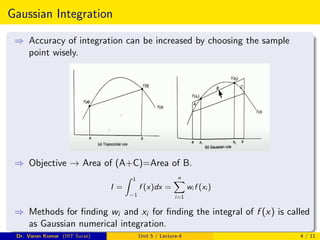
⇒ Accuracy of integration can be increased by choosing the sample
point wisely.
⇒ Objective → Area of (A+C)=Area of B.
I =
Z 1
−1
f (x)dx =
n
X
i=1
wi f (xi )
⇒ Methods for finding wi and xi for finding the integral of f (x) is called
as Gaussian numerical integration.
Dr. Varun Kumar (IIIT Surat) Unit 5 / Lecture-4 4 / 11
Methods of Gaussian Integral
1 Gauss quadrature 2 point formula
2 Gauss quadrature 3 point formula
Gauss quadrature 2 point formula
⇒ It is also called Gauss Legendre 2 point formula.
⇒ Assume,
I =
Z 1
−1
f (x)dx =
n
X
i=1
wi f (xi ) (1)
⇒ By putting n = 2, we get
I =
Z 1
−1
f (x)dx =
n
X
i=1
wi f (xi ) = w1f (x1) + w2f (x2) (2)
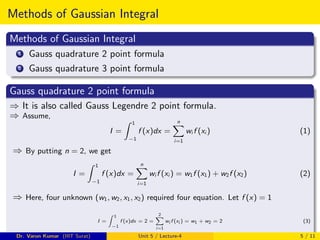
⇒ Here, four unknown (w1, w2, x1, x2) required four equation. Let f (x) = 1
I =
Z 1
−1
f (x)dx = 2 =
2
X
i=1
wi f (xi ) = w1 + w2 = 2 (3)
Dr. Varun Kumar (IIIT Surat) Unit 5 / Lecture-4 5 / 11
Continued–
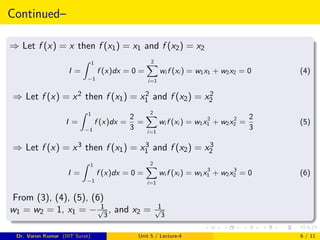
⇒ Let f (x) = x then f (x1) = x1 and f (x2) = x2
I =
Z 1
−1
f (x)dx = 0 =
2
X
i=1
wi f (xi ) = w1x1 + w2x2 = 0 (4)
⇒ Let f (x) = x2 then f (x1) = x2
1 and f (x2) = x2
2
I =
Z 1
−1
f (x)dx =
2
3
=
2
X
i=1
wi f (xi ) = w1x2
1 + w2x2
2 =
2
3
(5)
⇒ Let f (x) = x3 then f (x1) = x3
1 and f (x2) = x3
2
I =
Z 1
−1
f (x)dx = 0 =
2
X
i=1
wi f (xi ) = w1x3
1 + w2x3
2 = 0 (6)
From (3), (4), (5), (6)
w1 = w2 = 1, x1 = − 1
√
3
, and x2 = 1
√
3
Dr. Varun Kumar (IIIT Surat) Unit 5 / Lecture-4 6 / 11
Continued–
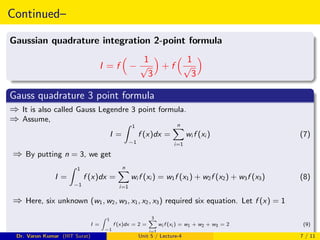
Gaussian quadrature integration 2-point formula
I = f

−
1
√
3

+ f
 1
√
3

Gauss quadrature 3 point formula
⇒ It is also called Gauss Legendre 3 point formula.
⇒ Assume,
I =
Z 1
−1
f (x)dx =
n
X
i=1
wi f (xi ) (7)
⇒ By putting n = 3, we get
I =
Z 1
−1
f (x)dx =
n
X
i=1
wi f (xi ) = w1f (x1) + w2f (x2) + w3f (x3) (8)
⇒ Here, six unknown (w1, w2, w3, x1, x2, x3) required six equation. Let f (x) = 1
I =
Z 1
−1
f (x)dx = 2 =
3
X
i=1
wi f (xi ) = w1 + w2 + w3 = 2 (9)
Dr. Varun Kumar (IIIT Surat) Unit 5 / Lecture-4 7 / 11
Continued–
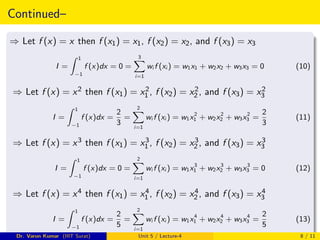
⇒ Let f (x) = x then f (x1) = x1, f (x2) = x2, and f (x3) = x3
I =
Z 1
−1
f (x)dx = 0 =
3
X
i=1
wi f (xi ) = w1x1 + w2x2 + w3x3 = 0 (10)
⇒ Let f (x) = x2 then f (x1) = x2
1 , f (x2) = x2
2 , and f (x3) = x2
3
I =
Z 1
−1
f (x)dx =
2
3
=
2
X
i=1
wi f (xi ) = w1x2
1 + w2x2
2 + w3x2
3 =
2
3
(11)
⇒ Let f (x) = x3 then f (x1) = x3
1 , f (x2) = x3
2 , and f (x3) = x3
3
I =
Z 1
−1
f (x)dx = 0 =
2
X
i=1
wi f (xi ) = w1x3
1 + w2x3
2 + w3x3
3 = 0 (12)
⇒ Let f (x) = x4 then f (x1) = x4
1 , f (x2) = x4
2 , and f (x3) = x4
3
I =
Z 1
−1
f (x)dx =
2
5
=
2
X
i=1
wi f (xi ) = w1x4
1 + w2x4
2 + w3x4
3 =
2
5
(13)
Dr. Varun Kumar (IIIT Surat) Unit 5 / Lecture-4 8 / 11
Continued–
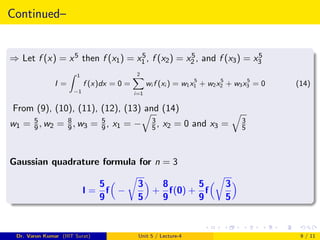
⇒ Let f (x) = x5 then f (x1) = x5
1 , f (x2) = x5
2 , and f (x3) = x5
3
I =
Z 1
−1
f (x)dx = 0 =
2
X
i=1
wi f (xi ) = w1x5
1 + w2x5
2 + w3x5
3 = 0 (14)
From (9), (10), (11), (12), (13) and (14)
w1 = 5
9, w2 = 8
9, w3 = 5
9, x1 = −
q
3
5, x2 = 0 and x3 =
q
3
5
Gaussian quadrature formula for n = 3
I =
5
9
f

−
r
3
5

+
8
9
f(0) +
5
9
f
r
3
5

Dr. Varun Kumar (IIIT Surat) Unit 5 / Lecture-4 9 / 11
Gauss quadrature formula when limit differs from [-1,1]
♦ Gauss quadrature 2-point formula ⇒ I =
R 1
−1
f (x)dx = f

− 1
√
3

+ f

1
√
3

♦ Gauss quadrature 3-point formula ⇒ I = 5
9
f

−
q
3
5

+ 8
9
f (0) + 5
9
f
q
3
5

Interval Transformation:
⇒ Objective→ To find
R b
a f (x)dx
⇒ Interval transformation refers →
R b
a ⇐⇒
R 1
−1 and f (x) ⇐⇒ f (z)
Let
x = Az + B
dx = Adz
When I =
R b
a
f (x)dx =
R 1
−1
Af (z)dz = A
Pn
i=1 wi f (zi )
At x = a → z = −1 and x = b → z = 1
a = −A + B and b = A + B
A = b−a
2 and B = a+b
2
Dr. Varun Kumar (IIIT Surat) Unit 5 / Lecture-4 10 / 11
Continued–
For Gauss 2-point formula
I =
Z b
a
f (x)dx = A
2
X
i=1
wi f (zi ) =
b − a
2
[w1f (z1) + w2f (z2)] (15)
where w1 = w2 = 1 and z1 = − 1
√
3
, z2 = 1
√
3
For Gauss 3-point formula
I =
Z b
a
f (x)dx = A
3
X
i=1
wi f (zi ) =
b − a
2
[w1f (z1) + w2f (z2) + w3f (z3)]
(16)
where w1 = 5
9, w2 = 8
9, w3 = 5
9 and z1 = −
q
3
5, z2 = 0, z3 =
q
3
5
Dr. Varun Kumar (IIIT Surat) Unit 5 / Lecture-4 11 / 11

Gaussian Numerical Integration

  • 1.
    Gaussian Numerical Integration Dr.Varun Kumar Dr. Varun Kumar (IIIT Surat) Unit 5 / Lecture-4 1 / 11
  • 2.
    Outlines 1 Newton’s CotesIntegration 2 Gaussian Integration 3 Gauss Quadrature 2 Point Formula 4 Gauss Quadrature 3 Point Formula Dr. Varun Kumar (IIIT Surat) Unit 5 / Lecture-4 2 / 11
  • 3.
    Newton’s Cotes Integration Newton’sCotes Integration ⇒ Trapezoidal rule ⇒ Simpson’s 1 3rd rule ⇒ Simpson’s 3 8th rule ⇒ Romberg’s Integration Important points ⇒ Above rules are derived from Newton’s divide difference interpolation. ⇒ In all the rules range of integral is divide into equally space. Dr. Varun Kumar (IIIT Surat) Unit 5 / Lecture-4 3 / 11
  • 4.
    Gaussian Integration ⇒ Accuracyof integration can be increased by choosing the sample point wisely. ⇒ Objective → Area of (A+C)=Area of B. I = Z 1 −1 f (x)dx = n X i=1 wi f (xi ) ⇒ Methods for finding wi and xi for finding the integral of f (x) is called as Gaussian numerical integration. Dr. Varun Kumar (IIIT Surat) Unit 5 / Lecture-4 4 / 11
  • 5.
    Methods of GaussianIntegral Methods of Gaussian Integral 1 Gauss quadrature 2 point formula 2 Gauss quadrature 3 point formula Gauss quadrature 2 point formula ⇒ It is also called Gauss Legendre 2 point formula. ⇒ Assume, I = Z 1 −1 f (x)dx = n X i=1 wi f (xi ) (1) ⇒ By putting n = 2, we get I = Z 1 −1 f (x)dx = n X i=1 wi f (xi ) = w1f (x1) + w2f (x2) (2) ⇒ Here, four unknown (w1, w2, x1, x2) required four equation. Let f (x) = 1 I = Z 1 −1 f (x)dx = 2 = 2 X i=1 wi f (xi ) = w1 + w2 = 2 (3) Dr. Varun Kumar (IIIT Surat) Unit 5 / Lecture-4 5 / 11
  • 6.
    Continued– ⇒ Let f(x) = x then f (x1) = x1 and f (x2) = x2 I = Z 1 −1 f (x)dx = 0 = 2 X i=1 wi f (xi ) = w1x1 + w2x2 = 0 (4) ⇒ Let f (x) = x2 then f (x1) = x2 1 and f (x2) = x2 2 I = Z 1 −1 f (x)dx = 2 3 = 2 X i=1 wi f (xi ) = w1x2 1 + w2x2 2 = 2 3 (5) ⇒ Let f (x) = x3 then f (x1) = x3 1 and f (x2) = x3 2 I = Z 1 −1 f (x)dx = 0 = 2 X i=1 wi f (xi ) = w1x3 1 + w2x3 2 = 0 (6) From (3), (4), (5), (6) w1 = w2 = 1, x1 = − 1 √ 3 , and x2 = 1 √ 3 Dr. Varun Kumar (IIIT Surat) Unit 5 / Lecture-4 6 / 11
  • 7.
    Continued– Gaussian quadrature integration2-point formula I = f − 1 √ 3 + f 1 √ 3 Gauss quadrature 3 point formula ⇒ It is also called Gauss Legendre 3 point formula. ⇒ Assume, I = Z 1 −1 f (x)dx = n X i=1 wi f (xi ) (7) ⇒ By putting n = 3, we get I = Z 1 −1 f (x)dx = n X i=1 wi f (xi ) = w1f (x1) + w2f (x2) + w3f (x3) (8) ⇒ Here, six unknown (w1, w2, w3, x1, x2, x3) required six equation. Let f (x) = 1 I = Z 1 −1 f (x)dx = 2 = 3 X i=1 wi f (xi ) = w1 + w2 + w3 = 2 (9) Dr. Varun Kumar (IIIT Surat) Unit 5 / Lecture-4 7 / 11
  • 8.
    Continued– ⇒ Let f(x) = x then f (x1) = x1, f (x2) = x2, and f (x3) = x3 I = Z 1 −1 f (x)dx = 0 = 3 X i=1 wi f (xi ) = w1x1 + w2x2 + w3x3 = 0 (10) ⇒ Let f (x) = x2 then f (x1) = x2 1 , f (x2) = x2 2 , and f (x3) = x2 3 I = Z 1 −1 f (x)dx = 2 3 = 2 X i=1 wi f (xi ) = w1x2 1 + w2x2 2 + w3x2 3 = 2 3 (11) ⇒ Let f (x) = x3 then f (x1) = x3 1 , f (x2) = x3 2 , and f (x3) = x3 3 I = Z 1 −1 f (x)dx = 0 = 2 X i=1 wi f (xi ) = w1x3 1 + w2x3 2 + w3x3 3 = 0 (12) ⇒ Let f (x) = x4 then f (x1) = x4 1 , f (x2) = x4 2 , and f (x3) = x4 3 I = Z 1 −1 f (x)dx = 2 5 = 2 X i=1 wi f (xi ) = w1x4 1 + w2x4 2 + w3x4 3 = 2 5 (13) Dr. Varun Kumar (IIIT Surat) Unit 5 / Lecture-4 8 / 11
  • 9.
    Continued– ⇒ Let f(x) = x5 then f (x1) = x5 1 , f (x2) = x5 2 , and f (x3) = x5 3 I = Z 1 −1 f (x)dx = 0 = 2 X i=1 wi f (xi ) = w1x5 1 + w2x5 2 + w3x5 3 = 0 (14) From (9), (10), (11), (12), (13) and (14) w1 = 5 9, w2 = 8 9, w3 = 5 9, x1 = − q 3 5, x2 = 0 and x3 = q 3 5 Gaussian quadrature formula for n = 3 I = 5 9 f − r 3 5 + 8 9 f(0) + 5 9 f r 3 5 Dr. Varun Kumar (IIIT Surat) Unit 5 / Lecture-4 9 / 11
  • 10.
    Gauss quadrature formulawhen limit differs from [-1,1] ♦ Gauss quadrature 2-point formula ⇒ I = R 1 −1 f (x)dx = f − 1 √ 3 + f 1 √ 3 ♦ Gauss quadrature 3-point formula ⇒ I = 5 9 f − q 3 5 + 8 9 f (0) + 5 9 f q 3 5 Interval Transformation: ⇒ Objective→ To find R b a f (x)dx ⇒ Interval transformation refers → R b a ⇐⇒ R 1 −1 and f (x) ⇐⇒ f (z) Let x = Az + B dx = Adz When I = R b a f (x)dx = R 1 −1 Af (z)dz = A Pn i=1 wi f (zi ) At x = a → z = −1 and x = b → z = 1 a = −A + B and b = A + B A = b−a 2 and B = a+b 2 Dr. Varun Kumar (IIIT Surat) Unit 5 / Lecture-4 10 / 11
  • 11.
    Continued– For Gauss 2-pointformula I = Z b a f (x)dx = A 2 X i=1 wi f (zi ) = b − a 2 [w1f (z1) + w2f (z2)] (15) where w1 = w2 = 1 and z1 = − 1 √ 3 , z2 = 1 √ 3 For Gauss 3-point formula I = Z b a f (x)dx = A 3 X i=1 wi f (zi ) = b − a 2 [w1f (z1) + w2f (z2) + w3f (z3)] (16) where w1 = 5 9, w2 = 8 9, w3 = 5 9 and z1 = − q 3 5, z2 = 0, z3 = q 3 5 Dr. Varun Kumar (IIIT Surat) Unit 5 / Lecture-4 11 / 11