📖
Numerical method
errors analysis
What is Error Analysis in
Numerical method?
Errors Analysis
The error of a quantity is the difference
between it’s true value and
approximate.
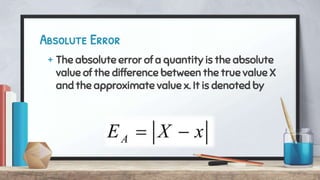
Absolute Error
+ The absolute error of a quantity is the absolute
value of the difference between the true value X
and the approximate value x. It is denoted by
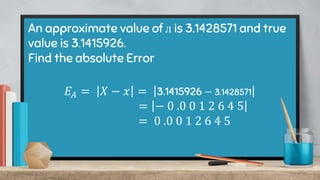
An approximate value of ᴫ is 3.1428571 and true
value is 3.1415926.
Find the absolute Error
𝐸𝐴 = 𝑋 − 𝑥 = 3.1415926 − 3.1428571
= − 0 .0 0 1 2 6 4 5
= 0 .0 0 1 2 6 4 5
Find the absolute errors of the number 8.6 if both of its
digits are correct.
• If the number X is rounded to N decimal places, then 𝐸𝐴 =
1
2
(10−𝑁
)
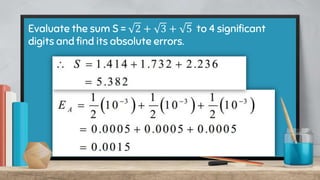
Evaluate the sum S = 2 + 3 + 5 to 4 significant
digits and find its absolute errors.
The relative error of a
quantity is the ratio of it’s
absolute error to it’s true
value. It is denoted by ER
Relative Error
ER =
EA
𝑋
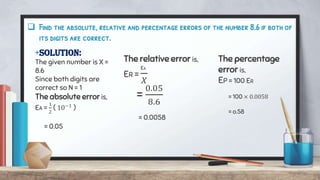
 Find the absolute, relative and percentage errors of the number 8.6 if both of
its digits are correct.
+Solution:
The given number is X =
8.6
Since both digits are
correct so N = 1
The absolute error is,
EA =
1
2
( 10−1
)
= 0.05
The relative error is,
ER =
EA
𝑋
=
0.05
8.6
= 0.0058
The percentage
error is,
EP = 100 ER
= 100 × 0.0058
= o.58
Percentage Error
+Formula
PE =
|𝑡𝑟𝑢𝑒 𝑣𝑎𝑙𝑢𝑒−𝑎𝑝𝑝𝑟𝑜𝑥𝑖𝑚𝑎𝑡𝑒𝑑 𝑣𝑎𝑙𝑢𝑒|
|𝑡𝑟𝑢𝑒 𝑣𝑎𝑙𝑢𝑒|
x 100
How to Calculate
In order to calculate percentage error in some experiment, one needs to follow
the steps written below:
Step 1: Obtain the true value and approximated value.
Step 2: Find the difference between them and take absolute value, ignore if there is a negative
sign. This is known as error.
Step 3: Find the absolute value of true of exact value as well.
Step 4: Divide the absolute error by absolute true value.
Step 5: Multiply the outcome by 100 to convert it to the percent value and add a "%" sign at the
end
Example 1: It was assumed that around 1,00,000 people would reach at a certain hill station in a month
summer. But the exact number of people counted was 88,000. Calculate the percentage error.
Solution: Assumed or approximated value = 100000
true value = 88000
The formula for the percentage error is:
PE =
|𝑡𝑟𝑢𝑒 𝑣𝑎𝑙𝑢𝑒− 𝑎𝑝𝑝𝑟𝑜𝑥𝑖𝑚𝑎𝑡𝑒𝑑 𝑣𝑎𝑙𝑢𝑒|
|𝑡𝑟𝑢𝑒 𝑣𝑎𝑙𝑢𝑒|
x 100
PE =
|88000−100000|
|88000|
x 100
PE =
|22000|
|88000|
x 100
PE= 25%
Example 2: The approximated time of a ball to reach at ground when dropped from a 4-
meter height is 3 seconds. But during the experiment, it was found that it took 2.1 seconds.
Solution: Approximated time = 3 sec
true time = 2.1 sec
The formula for the percentage error is given by:
PE =
|𝑡𝑟𝑢𝑒 𝑣𝑎𝑙𝑢𝑒−𝑎𝑝𝑝𝑟𝑜𝑥𝑖𝑚𝑎𝑡𝑒𝑑 𝑣𝑎𝑙𝑢𝑒|
|𝑡𝑟𝑢𝑒 𝑣𝑎𝑙𝑢𝑒|
x 100
PE =
|2.1−3|
|2.1|
x 100
PE =
|0.9|
|2.1|
x 100
PE = 42.86%
Thanks!
Any questions?

Error Finding in Numerical method

  • 1.
  • 2.
    What is ErrorAnalysis in Numerical method?
  • 3.
    Errors Analysis The errorof a quantity is the difference between it’s true value and approximate.
  • 4.
    Absolute Error + Theabsolute error of a quantity is the absolute value of the difference between the true value X and the approximate value x. It is denoted by
  • 5.
    An approximate valueof ᴫ is 3.1428571 and true value is 3.1415926. Find the absolute Error 𝐸𝐴 = 𝑋 − 𝑥 = 3.1415926 − 3.1428571 = − 0 .0 0 1 2 6 4 5 = 0 .0 0 1 2 6 4 5
  • 6.
    Find the absoluteerrors of the number 8.6 if both of its digits are correct. • If the number X is rounded to N decimal places, then 𝐸𝐴 = 1 2 (10−𝑁 )
  • 7.
    Evaluate the sumS = 2 + 3 + 5 to 4 significant digits and find its absolute errors.
  • 8.
    The relative errorof a quantity is the ratio of it’s absolute error to it’s true value. It is denoted by ER Relative Error ER = EA 𝑋
  • 9.
     Find theabsolute, relative and percentage errors of the number 8.6 if both of its digits are correct. +Solution: The given number is X = 8.6 Since both digits are correct so N = 1 The absolute error is, EA = 1 2 ( 10−1 ) = 0.05 The relative error is, ER = EA 𝑋 = 0.05 8.6 = 0.0058 The percentage error is, EP = 100 ER = 100 × 0.0058 = o.58
  • 10.
    Percentage Error +Formula PE = |𝑡𝑟𝑢𝑒𝑣𝑎𝑙𝑢𝑒−𝑎𝑝𝑝𝑟𝑜𝑥𝑖𝑚𝑎𝑡𝑒𝑑 𝑣𝑎𝑙𝑢𝑒| |𝑡𝑟𝑢𝑒 𝑣𝑎𝑙𝑢𝑒| x 100
  • 11.
    How to Calculate Inorder to calculate percentage error in some experiment, one needs to follow the steps written below: Step 1: Obtain the true value and approximated value. Step 2: Find the difference between them and take absolute value, ignore if there is a negative sign. This is known as error. Step 3: Find the absolute value of true of exact value as well. Step 4: Divide the absolute error by absolute true value. Step 5: Multiply the outcome by 100 to convert it to the percent value and add a "%" sign at the end
  • 12.
    Example 1: Itwas assumed that around 1,00,000 people would reach at a certain hill station in a month summer. But the exact number of people counted was 88,000. Calculate the percentage error. Solution: Assumed or approximated value = 100000 true value = 88000 The formula for the percentage error is: PE = |𝑡𝑟𝑢𝑒 𝑣𝑎𝑙𝑢𝑒− 𝑎𝑝𝑝𝑟𝑜𝑥𝑖𝑚𝑎𝑡𝑒𝑑 𝑣𝑎𝑙𝑢𝑒| |𝑡𝑟𝑢𝑒 𝑣𝑎𝑙𝑢𝑒| x 100 PE = |88000−100000| |88000| x 100 PE = |22000| |88000| x 100 PE= 25%
  • 13.
    Example 2: Theapproximated time of a ball to reach at ground when dropped from a 4- meter height is 3 seconds. But during the experiment, it was found that it took 2.1 seconds. Solution: Approximated time = 3 sec true time = 2.1 sec The formula for the percentage error is given by: PE = |𝑡𝑟𝑢𝑒 𝑣𝑎𝑙𝑢𝑒−𝑎𝑝𝑝𝑟𝑜𝑥𝑖𝑚𝑎𝑡𝑒𝑑 𝑣𝑎𝑙𝑢𝑒| |𝑡𝑟𝑢𝑒 𝑣𝑎𝑙𝑢𝑒| x 100 PE = |2.1−3| |2.1| x 100 PE = |0.9| |2.1| x 100 PE = 42.86%
  • 14.