MOTOR FUNCTIONS 
PRESETED BY 
SRILOY MOHANTY 
B.N.Y.S
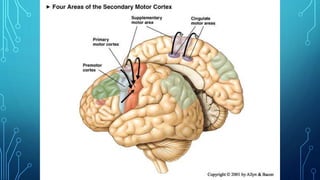
MOTOR CORTEX 
• Primary motor cortex ( M1) 
• Premotor area (PMA) 
• Supplementary motor area (SMA) 
Note: All the three projects directly to the spinal cord via 
corticospinal tract. 
• Premotor and supplementary motor cortex also project to 
primary motor cortex and is involved in coordinating & 
planning complex sequences of movement (motor learning).
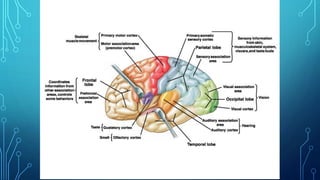
PRIMARY MOTOR CORTEX (M-I) 
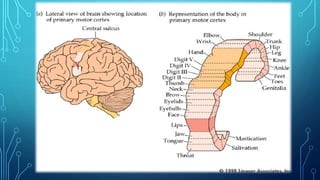
Location :- 
Immediately anterior to the central sulcus and 
extends to the medial surface of hemisphere 
also known as Broadmann’s area 4 is a 
motor homunculus. 
Description: Body is represented as up side 
down and stretched on the medial surface 
where pelvic and leg muscles are 
represented. 
Hand and mouth has a greater area of
- It controls the musculature of the opposite side of 
the body. 
-Face area is bilaterally represented. 
Functions:- 
Is used in execution of skilled movements also in 
codes the direction, force and velocity of 
movements. 
Lesions:- 
Pure M-I lesions are rare. May have contra lateral 
weakness in distal muscle (fingers). 
Ability to control fine movements is gone. 
Ablation of M-I alone cause hypotonia not Spasticity.
SUPPLEMENTARY MOTOR AREA (M-II) 
Location: 
Found on both in lateral and medial aspect of the frontal 
lobe. It extends from cingulate sulcus on the medial side 
to reach premotor cortex on the lateral surface of the 
brain. 
Function: 
It works together with premotor cortex. 
Involved in programming of motor sequences. 
Lesions: 
Produces awkwardness in performing complex activity like 
bimanual coordinated activity.
It function in mental rehearsal of movements before 
performing a complex motor functions. 
With premotor cortex it translates the desire to 
perform a motor task into a series of motor 
command that will do the task.
PREMOTOR CORTEX (PMC) 
Location: 
Broadmann’s area 6. It lies immediately anterior to primary 
motor cortex. It is more extensive than primary motor 
cortex (about 6 times) 
Functions: 
It works with the help of basal ganglia, thalamus, primary 
motor cortex, posterior parietal cortex. It plays role in 
planning and anticipation of a specific motor act.
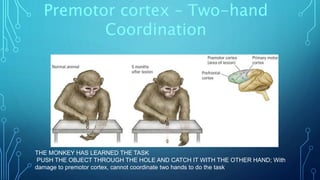
Premotor cortex – Two-hand 
Coordination 
THE MONKEY HAS LEARNED THE TASK 
PUSH THE OBJECT THROUGH THE HOLE AND CATCH IT WITH THE OTHER HAND; With 
damage to premotor cortex, cannot coordinate two hands to do the task
Lesion: 
It results in re-emergence of suckling and grasp 
reflex in adults. 
Its lesion do not case paralysis but only slowing of 
the complex limb movement. 
Lesion may result in loss of short-term or working 
memory. 
When damaged with supplementary cortex it may 
result in APRAXIA.
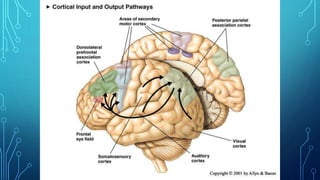
VOLUNTARY MOVEMENT: INSTRUCTIONS 
FROM CEREBRAL CORTEX 
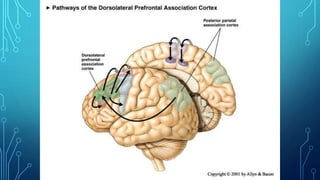
• Dorsolateral Prefrontal Cortex: directs movement of 
our limbs (as in reaching) and movements of our 
fingers. 
• Actual signal for movement must go through pre-motor 
cortex, then motor cortex. 
• From motor cortex, signal travels down spinal cord 
eventually reaching the alpha motor neuron. 
• BUT, the instructions for this movement ultimately 
comes from our Parietal lobe, which receives sensory 
input.
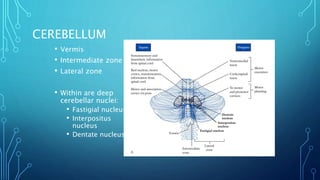
CEREBELLUM 
• Vermis 
• Intermediate zone 
• Lateral zone 
• Within are deep 
cerebellar nuclei: 
• Fastigial nucleus 
• Interpositus 
nucleus 
• Dentate nucleus
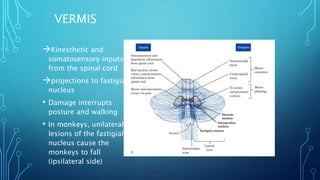
VERMIS 
Kinesthetic and 
somatosensory inputs 
from the spinal cord 
projections to fastigial 
nucleus 
• Damage interrupts 
posture and walking 
• In monkeys, unilateral 
lesions of the fastigial 
nucleus cause the 
monkeys to fall 
(ipsilateral side)
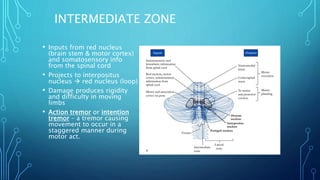
INTERMEDIATE ZONE 
• Inputs from red nucleus 
(brain stem & motor cortex) 
and somatosensory info 
from the spinal cord 
• Projects to interpositus 
nucleus  red nucleus (loop) 
• Damage produces rigidity 
and difficulty in moving 
limbs 
• Action tremor or intention 
tremor – a tremor causing 
movement to occur in a 
staggered manner during 
motor act.
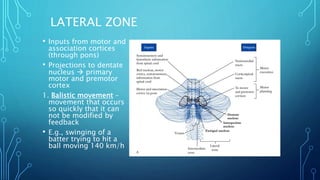
LATERAL ZONE 
• Inputs from motor and 
association cortices 
(through pons) 
• Projections to dentate 
nucleus  primary 
motor and premotor 
cortex 
1. Balistic movement – 
movement that occurs 
so quickly that it can 
not be modified by 
feedback 
• E.g., swinging of a 
batter trying to hit a 
ball moving 140 km/h
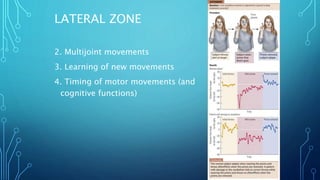
LATERAL ZONE 
2. Multijoint movements 
3. Learning of new movements 
4. Timing of motor movements (and 
cognitive functions)
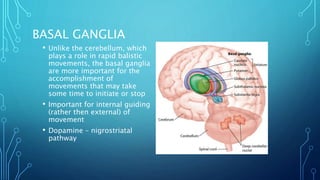
BASAL GANGLIA 
• Unlike the cerebellum, which 
plays a role in rapid balistic 
movements, the basal ganglia 
are more important for the 
accomplishment of 
movements that may take 
some time to initiate or stop 
• Important for internal guiding 
(rather then external) of 
movement 
• Dopamine – nigrostriatal 
pathway
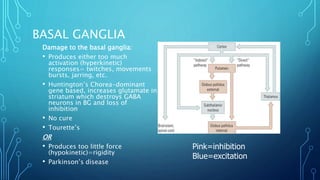
BASAL GANGLIA 
Damage to the basal ganglia: 
• Produces either too much 
activation (hyperkinetic) 
responses= twitches, movements 
bursts, jarring, etc. 
• Huntington’s Chorea-dominant 
gene based, increases glutamate in 
striatum which destroys GABA 
neurons in BG and loss of 
inhibition 
• No cure 
• Tourette’s 
OR 
• Produces too little force 
(hypokinetic)=rigidity 
• Parkinson’s disease 
Pink=inhibition 
Blue=excitation
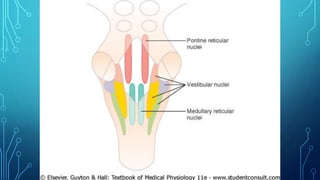
BRAIN STEM MOTOR CENTERS 
• Pontine reticular nuclei – excite antigravity 
muscles (muscles of the vertebral column and 
limb extensor muscles) – pontine reticulospinal 
tract. 
• Medullary reticular nuclei – inhibit antigravity 
muscles – medullary reticulospinal tract. 
Pontine & medullary systems balance each other. 
• Vestibular nuclei – supplement the excitatory 
function of the pontine system by integrating 
vestibular information – lateral and medial 
vestibulospinal tracts.
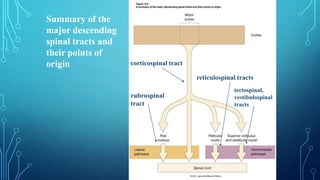
Summary of the 
major descending 
spinal tracts and 
their points of 
origin corticospinal tract 
rubrospinal 
tract 
reticulospinal tracts 
tectospinal, 
vestibulospinal 
tracts
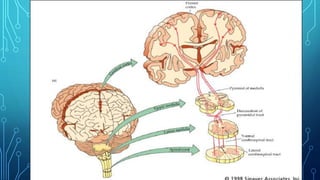
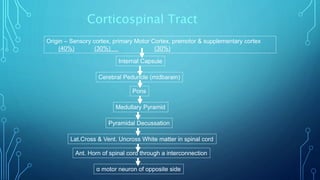
Corticospinal Tract 
Origin – Sensory cortex, primary Motor Cortex, premotor & supplementary cortex 
(40%) (30%) (30%) 
Internal Capsule 
Cerebral Peduncle (midbarain) 
Pons 
Medullary Pyramid 
Pyramidal Decussation 
Lat.Cross & Vent. Uncross White matter in spinal cord 
Ant. Horn of spinal cord through a interconnection 
α motor neuron of opposite side
MOTOR UNIT…
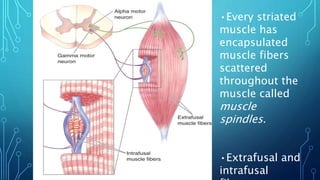
•Every striated 
muscle has 
encapsulated 
muscle fibers 
scattered 
throughout the 
muscle called 
muscle 
spindles. 
•Extrafusal and 
intrafusal 
fibers
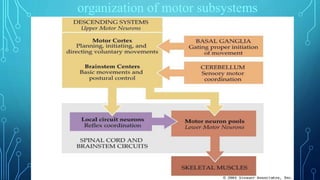
organization of motor subsystems
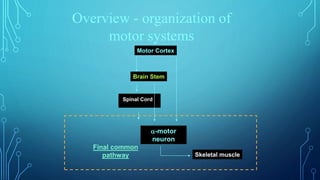
Overview - organization of 
motor systems 
Motor Cortex 
Brain Stem 
Spinal Cord 
Skeletal muscle 
-motor 
neuron 
Final common 
pathway
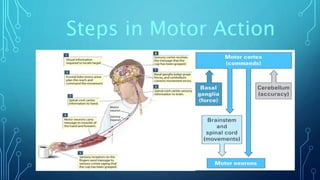
Steps in Motor Action
THANK YOU…

Motor functions

  • 1.
    MOTOR FUNCTIONS PRESETEDBY SRILOY MOHANTY B.N.Y.S
  • 2.
    MOTOR CORTEX •Primary motor cortex ( M1) • Premotor area (PMA) • Supplementary motor area (SMA) Note: All the three projects directly to the spinal cord via corticospinal tract. • Premotor and supplementary motor cortex also project to primary motor cortex and is involved in coordinating & planning complex sequences of movement (motor learning).
  • 3.
    PRIMARY MOTOR CORTEX(M-I) Location :- Immediately anterior to the central sulcus and extends to the medial surface of hemisphere also known as Broadmann’s area 4 is a motor homunculus. Description: Body is represented as up side down and stretched on the medial surface where pelvic and leg muscles are represented. Hand and mouth has a greater area of
  • 4.
    - It controlsthe musculature of the opposite side of the body. -Face area is bilaterally represented. Functions:- Is used in execution of skilled movements also in codes the direction, force and velocity of movements. Lesions:- Pure M-I lesions are rare. May have contra lateral weakness in distal muscle (fingers). Ability to control fine movements is gone. Ablation of M-I alone cause hypotonia not Spasticity.
  • 5.
    SUPPLEMENTARY MOTOR AREA(M-II) Location: Found on both in lateral and medial aspect of the frontal lobe. It extends from cingulate sulcus on the medial side to reach premotor cortex on the lateral surface of the brain. Function: It works together with premotor cortex. Involved in programming of motor sequences. Lesions: Produces awkwardness in performing complex activity like bimanual coordinated activity.
  • 6.
    It function inmental rehearsal of movements before performing a complex motor functions. With premotor cortex it translates the desire to perform a motor task into a series of motor command that will do the task.
  • 7.
    PREMOTOR CORTEX (PMC) Location: Broadmann’s area 6. It lies immediately anterior to primary motor cortex. It is more extensive than primary motor cortex (about 6 times) Functions: It works with the help of basal ganglia, thalamus, primary motor cortex, posterior parietal cortex. It plays role in planning and anticipation of a specific motor act.
  • 8.
    Premotor cortex –Two-hand Coordination THE MONKEY HAS LEARNED THE TASK PUSH THE OBJECT THROUGH THE HOLE AND CATCH IT WITH THE OTHER HAND; With damage to premotor cortex, cannot coordinate two hands to do the task
  • 9.
    Lesion: It resultsin re-emergence of suckling and grasp reflex in adults. Its lesion do not case paralysis but only slowing of the complex limb movement. Lesion may result in loss of short-term or working memory. When damaged with supplementary cortex it may result in APRAXIA.
  • 11.
    VOLUNTARY MOVEMENT: INSTRUCTIONS FROM CEREBRAL CORTEX • Dorsolateral Prefrontal Cortex: directs movement of our limbs (as in reaching) and movements of our fingers. • Actual signal for movement must go through pre-motor cortex, then motor cortex. • From motor cortex, signal travels down spinal cord eventually reaching the alpha motor neuron. • BUT, the instructions for this movement ultimately comes from our Parietal lobe, which receives sensory input.
  • 20.
    CEREBELLUM • Vermis • Intermediate zone • Lateral zone • Within are deep cerebellar nuclei: • Fastigial nucleus • Interpositus nucleus • Dentate nucleus
  • 21.
    VERMIS Kinesthetic and somatosensory inputs from the spinal cord projections to fastigial nucleus • Damage interrupts posture and walking • In monkeys, unilateral lesions of the fastigial nucleus cause the monkeys to fall (ipsilateral side)
  • 22.
    INTERMEDIATE ZONE •Inputs from red nucleus (brain stem & motor cortex) and somatosensory info from the spinal cord • Projects to interpositus nucleus  red nucleus (loop) • Damage produces rigidity and difficulty in moving limbs • Action tremor or intention tremor – a tremor causing movement to occur in a staggered manner during motor act.
  • 23.
    LATERAL ZONE •Inputs from motor and association cortices (through pons) • Projections to dentate nucleus  primary motor and premotor cortex 1. Balistic movement – movement that occurs so quickly that it can not be modified by feedback • E.g., swinging of a batter trying to hit a ball moving 140 km/h
  • 24.
    LATERAL ZONE 2.Multijoint movements 3. Learning of new movements 4. Timing of motor movements (and cognitive functions)
  • 25.
    BASAL GANGLIA •Unlike the cerebellum, which plays a role in rapid balistic movements, the basal ganglia are more important for the accomplishment of movements that may take some time to initiate or stop • Important for internal guiding (rather then external) of movement • Dopamine – nigrostriatal pathway
  • 26.
    BASAL GANGLIA Damageto the basal ganglia: • Produces either too much activation (hyperkinetic) responses= twitches, movements bursts, jarring, etc. • Huntington’s Chorea-dominant gene based, increases glutamate in striatum which destroys GABA neurons in BG and loss of inhibition • No cure • Tourette’s OR • Produces too little force (hypokinetic)=rigidity • Parkinson’s disease Pink=inhibition Blue=excitation
  • 27.
    BRAIN STEM MOTORCENTERS • Pontine reticular nuclei – excite antigravity muscles (muscles of the vertebral column and limb extensor muscles) – pontine reticulospinal tract. • Medullary reticular nuclei – inhibit antigravity muscles – medullary reticulospinal tract. Pontine & medullary systems balance each other. • Vestibular nuclei – supplement the excitatory function of the pontine system by integrating vestibular information – lateral and medial vestibulospinal tracts.
  • 29.
    Summary of the major descending spinal tracts and their points of origin corticospinal tract rubrospinal tract reticulospinal tracts tectospinal, vestibulospinal tracts
  • 30.
    Corticospinal Tract Origin– Sensory cortex, primary Motor Cortex, premotor & supplementary cortex (40%) (30%) (30%) Internal Capsule Cerebral Peduncle (midbarain) Pons Medullary Pyramid Pyramidal Decussation Lat.Cross & Vent. Uncross White matter in spinal cord Ant. Horn of spinal cord through a interconnection α motor neuron of opposite side
  • 31.
  • 32.
    •Every striated musclehas encapsulated muscle fibers scattered throughout the muscle called muscle spindles. •Extrafusal and intrafusal fibers
  • 33.
  • 34.
    Overview - organizationof motor systems Motor Cortex Brain Stem Spinal Cord Skeletal muscle -motor neuron Final common pathway
  • 35.
  • 36.