cerebellum centre of motor coordination cerebellar disorders cause  incoordination  or  ataxia


structure Cerebellum is divided into 3 lobes by 2 transverse fissures anterior lobe posterior lobe flocculonodular lobe
 
structure anterior lobe (paleocerebellum) large posterior lobe (neocerebellum) flocculonodular lobe (archicerebellum is the oldest lobe)
Anterior cerebellum and part of posterior cerebellum  receives information from the spinal cord Rest of the posterior cerebellum  receives information from the cortex Flocculonodular lobe  involved in controlling the balance through vestibular apparatus
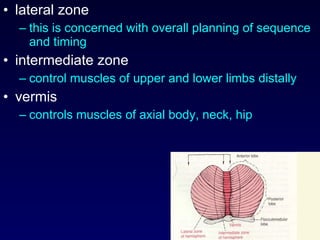
Functionally cerebellum is divided into 3 areas medial to lateral lateral zone intermediate zone vermis
 
lateral zone this is concerned with overall planning of sequence and timing intermediate zone control muscles of upper and lower limbs distally vermis controls muscles of axial body, neck, hip
Inputs corticopontocerebellar from motor and premotor cortex (also sensory cortex) these tracts supplies the contralateral cerebellar cortex olivocerebellar from inferior olive excited by fibres from motor cx basal ganglia reticular formation spinal cord
Inputs (cont’d) vestibulocerebellar to the flocculonodular lobe reticulocerebellar to the vermis spinocerebellar tracts dorsal spinocerebellar tracts from muscle spindle, prorpioceptive mechanoreceptor (feedback information) ventral spinocerebellar tarcts from anterior horn cell  excited by motor signals arriving through descending tracts (efference copy)
Outputs through deep cerebellar nuclei: dentate, fastigial, interpositus 1.  vermis  -> fastigial nucleus ->  medulla, pons 2.  intermediate zone   -> nucleus interpositus ->  thalamus -> cortex -> basal ganglia -> red nucleus -> reticular formation 3.  lateral zone  -> dentate nucleus  ->  thalamus -> cortex
Outputs Functions 1.  vermis  -> fastigial nucleus ->  medulla, pons control balance and equilibrium with the vestibular pathways
Outputs Functions 2.  intermediate zone   -> nucleus interpositus ->  thalamus -> cortex -> basal ganglia -> red nucleus -> reticular formation coordinate reciprocal contractions of agonist & antagonist muscles in limbs
Outputs Functions 3.  lateral zone  -> dentate nucleus  ->  thalamus -> cortex coordinate sequential motor activities initiated by the cerebral cortex
Neuronal circuitry of the cerebellum Main cortical cells in cerebellum are known as Purkinje Cells (large cells).  There are about 30 million such cells.  These cells constitute a unit which repeats along the cerebellar cortex.


Somatotopic representation of the body is present in cerebellar cortex although it is not as clear as cerebral cortex.
Topographical representation vermis intermediate zone
Functional unit of the cerebellar cortex a Purkinje cell a deep nuclear cell inputs output from the deep nuclear cell
Purkinje cell Input from Inferior olive Input from other afferents Climbing fibre Mossy fibre Granule cells Deep nuclear cell Output excitation excitation inhibition
Output Inputs Inputs
Purkinje cells & deep nuclear cells fire continuously afferents  excite  the deep nuclear cells Purkinje cells  inhibit  the deep nuclear cells
Functions of cerebellum planning of movements timing & sequencing of movements particularly during rapid movments such as during walking, running from the peripheral feedback & motor cortical impulses, cerebellum calculates when does a movement should begin and stop
Motor Cortex Thalamus Cerebellum Muscles brain  stem  nuclei proprioceptive tactile feedback
‘ Error correction’ cerebellum receives two types of information intended  plan of movement direct information from the motor cortex what  actual  movements result feedback from periphery these two are compared: an error is calculated corrective output signals goes to motor cortex via thalamus brain stem nuclei and then down to the anterior horn cell through extrapyramidal tracts
‘ Prevention of overshoot’ Soon after a movement  has been initiated cerebellum send signals to stop the movement at the intended point (otherwise overshooting occurs) Ballistic movements rapid movements of the body, eg. finger movements during typing, rapid eye movements (saccadic eye movements) movements are so rapid it is difficult to decide on feedback therefore the movement is  preplanned
planning of movements mainly performed by lateral zones sequencing & timing lateral zones communicate with premotor areas, sensory cortex & basal ganglia to receive the plan next sequential movement is planned predicting the timings of each movement
features of cerebellar disorders ataxia  incoordination of movements ataxic gait broad based gait leaning towards side of the lesion dysmetria cannot plan movements past pointing & overshoot decomposition of movements intentional tremor
features of cerebellar disorders dysdiadochokinesis unable to perform rapidly alternating movements dysarthria slurring of speech nystagmus oscillatory movements of the eye
features of cerebellar disorders hypotonia reduction in tone due to excitatory influence on gamma motor neurons by cerebellum (through vestibulospinal tracts) decreased reflexes head tremor head tilt

Motor system3 cerebellum

  • 1.
    cerebellum centre ofmotor coordination cerebellar disorders cause incoordination or ataxia
  • 2.
  • 3.
  • 4.
  • 5.
  • 6.
    structure Cerebellum isdivided into 3 lobes by 2 transverse fissures anterior lobe posterior lobe flocculonodular lobe
  • 7.
  • 8.
    structure anterior lobe(paleocerebellum) large posterior lobe (neocerebellum) flocculonodular lobe (archicerebellum is the oldest lobe)
  • 9.
    Anterior cerebellum andpart of posterior cerebellum receives information from the spinal cord Rest of the posterior cerebellum receives information from the cortex Flocculonodular lobe involved in controlling the balance through vestibular apparatus
  • 10.
    Functionally cerebellum isdivided into 3 areas medial to lateral lateral zone intermediate zone vermis
  • 11.
  • 12.
    lateral zone thisis concerned with overall planning of sequence and timing intermediate zone control muscles of upper and lower limbs distally vermis controls muscles of axial body, neck, hip
  • 13.
    Inputs corticopontocerebellar frommotor and premotor cortex (also sensory cortex) these tracts supplies the contralateral cerebellar cortex olivocerebellar from inferior olive excited by fibres from motor cx basal ganglia reticular formation spinal cord
  • 14.
    Inputs (cont’d) vestibulocerebellarto the flocculonodular lobe reticulocerebellar to the vermis spinocerebellar tracts dorsal spinocerebellar tracts from muscle spindle, prorpioceptive mechanoreceptor (feedback information) ventral spinocerebellar tarcts from anterior horn cell excited by motor signals arriving through descending tracts (efference copy)
  • 15.
    Outputs through deepcerebellar nuclei: dentate, fastigial, interpositus 1. vermis -> fastigial nucleus -> medulla, pons 2. intermediate zone -> nucleus interpositus -> thalamus -> cortex -> basal ganglia -> red nucleus -> reticular formation 3. lateral zone -> dentate nucleus -> thalamus -> cortex
  • 16.
    Outputs Functions 1. vermis -> fastigial nucleus -> medulla, pons control balance and equilibrium with the vestibular pathways
  • 17.
    Outputs Functions 2. intermediate zone -> nucleus interpositus -> thalamus -> cortex -> basal ganglia -> red nucleus -> reticular formation coordinate reciprocal contractions of agonist & antagonist muscles in limbs
  • 18.
    Outputs Functions 3. lateral zone -> dentate nucleus -> thalamus -> cortex coordinate sequential motor activities initiated by the cerebral cortex
  • 19.
    Neuronal circuitry ofthe cerebellum Main cortical cells in cerebellum are known as Purkinje Cells (large cells). There are about 30 million such cells. These cells constitute a unit which repeats along the cerebellar cortex.
  • 20.
  • 21.
  • 22.
  • 23.
    Somatotopic representation ofthe body is present in cerebellar cortex although it is not as clear as cerebral cortex.
  • 24.
  • 25.
    Functional unit ofthe cerebellar cortex a Purkinje cell a deep nuclear cell inputs output from the deep nuclear cell
  • 26.
    Purkinje cell Inputfrom Inferior olive Input from other afferents Climbing fibre Mossy fibre Granule cells Deep nuclear cell Output excitation excitation inhibition
  • 27.
  • 28.
    Purkinje cells &deep nuclear cells fire continuously afferents excite the deep nuclear cells Purkinje cells inhibit the deep nuclear cells
  • 29.
    Functions of cerebellumplanning of movements timing & sequencing of movements particularly during rapid movments such as during walking, running from the peripheral feedback & motor cortical impulses, cerebellum calculates when does a movement should begin and stop
  • 30.
    Motor Cortex ThalamusCerebellum Muscles brain stem nuclei proprioceptive tactile feedback
  • 31.
    ‘ Error correction’cerebellum receives two types of information intended plan of movement direct information from the motor cortex what actual movements result feedback from periphery these two are compared: an error is calculated corrective output signals goes to motor cortex via thalamus brain stem nuclei and then down to the anterior horn cell through extrapyramidal tracts
  • 32.
    ‘ Prevention ofovershoot’ Soon after a movement has been initiated cerebellum send signals to stop the movement at the intended point (otherwise overshooting occurs) Ballistic movements rapid movements of the body, eg. finger movements during typing, rapid eye movements (saccadic eye movements) movements are so rapid it is difficult to decide on feedback therefore the movement is preplanned
  • 33.
    planning of movementsmainly performed by lateral zones sequencing & timing lateral zones communicate with premotor areas, sensory cortex & basal ganglia to receive the plan next sequential movement is planned predicting the timings of each movement
  • 34.
    features of cerebellardisorders ataxia incoordination of movements ataxic gait broad based gait leaning towards side of the lesion dysmetria cannot plan movements past pointing & overshoot decomposition of movements intentional tremor
  • 35.
    features of cerebellardisorders dysdiadochokinesis unable to perform rapidly alternating movements dysarthria slurring of speech nystagmus oscillatory movements of the eye
  • 36.
    features of cerebellardisorders hypotonia reduction in tone due to excitatory influence on gamma motor neurons by cerebellum (through vestibulospinal tracts) decreased reflexes head tremor head tilt