How mirror neurons
            help us in
         making meaning?
                            Presented at IMS STUTTGART
                             During TSM ERASMUS 2010
                               Konrad Juszczyk, Ph.D.
                             Adam Mickiewicz University
                                  Poznań-Poland
                                                          1
czwartek, 6 stycznia 2011                                     1
V. S. Ramachandran
             I predict that mirror neurons will do for
             psychology what DNA did for biology.
             MNs are Necessary but not sufficient:
             their emergence and further develo-
             pment in hominids was a decisive step.
             Research in MNs may explain the evolution
             of language, learning by imitation and culture.

                                                               2
czwartek, 6 stycznia 2011                                          2
Questions and challenges
         What do we know about mirror neurons?

         Why and what do we want to know about MNs?

         What do we gain from having known MNs?

         When and where are MNs active?

         How do MNs discoveries support meaning
         making and its properties in communication?
                                                       3
czwartek, 6 stycznia 2011                                  3
Mirror neurons in monkeys
                       Original discovery by Parma neurologists:
                            Rizzolatti, Fadiga, Fogassi, Gallese since 1996...

                       Depth electrodes measure single-neuron
                       activity of macaques’ brain when they
                            pick up food (action)
                            observe a person picking up food (perception of
                            action).

                       Some neurons give similar responses,
                       so they are dubbed mirror neurons.                        4
czwartek, 6 stycznia 2011                                                            4
MNs in human brain
                       No possibility of measuring the single-
                       neuron activity with depth electrodes
                       (excluding testing for neurosurgery).
                       Most evidence for human MNs is indirect.
                       Neurological experiments suggest that
                       a mirror system for gesture recognition
                       also exists in humans and includes
                       Broca’s area (Rizzolatti & Arbib 1998)
                                                                  5
czwartek, 6 stycznia 2011                                             5
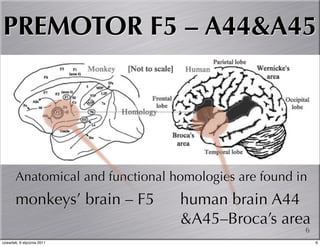
PREMOTOR F5 – A44&A45


       Anatomical and functional homologies are found in
       monkeys’ brain – F5        human brain A44
                                  &A45–Broca’s area
                                                       6
czwartek, 6 stycznia 2011                                  6
What are mirror neurons?
                       MNs are the cells in our brain that make our
                       experience, mostly made of interactions with other
                       people, deeply meaningful.
                       MNs are brain cells that seem specialized in
                       understanding our existential condition and our
                       involvement with others.
                       MNs show we are not alone, we are
                       interconnected.
                                                          Iacoboni 2008

                                                                            7
czwartek, 6 stycznia 2011                                                       7
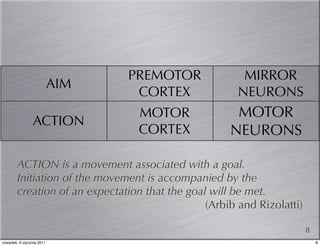
PREMOTOR              MIRROR
                            AIM
                                   CORTEX              NEURONS
                                   MOTOR              MOTOR
                 ACTION
                                   CORTEX            NEURONS

        ACTION is a movement associated with a goal.
        Initiation of the movement is accompanied by the
        creation of an expectation that the goal will be met.
                                                (Arbib and Rizolatti)

                                                                        8
czwartek, 6 stycznia 2011                                                   8
Arbib’s questions
             How to view a language in a way which better
             defines its relation to goal-directed action?


             How to link perception with perfomance?


             How to explain evolution of communication?


                                                            9
czwartek, 6 stycznia 2011                                       9
Michael Arbib claims:
                       Language is essentially multi-modal, not
                       just a set of sequences of words which
                       can be completely captured by marks on
                       the printed page.
                       Written language reflects the lessons of
                       grammar more than does spoken
                       language.
                       The language of the brain or schema
                       network is vastly richer than a linear
                       sequence of words.
                                                                  10
czwartek, 6 stycznia 2011                                              10
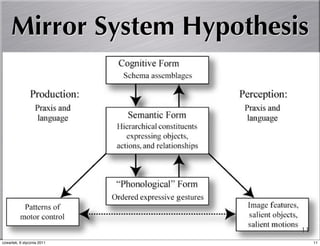
Mirror System Hypothesis
                            The Mirror System Hypothesis


                                                           11
czwartek, 6 stycznia 2011                                       11
Mirror System Hypothesis

         The mechanisms which support language in the
         human brain evolved atop a basic mechanism
         not originally related to communication.
         Instead, the mirror system for grasping with its
         capacity to generate and recognize a set of
         actions, provides the evolutionary basis for
         language parity – i.e., an utterance means
         roughly the same for both speaker and hearer.
                                                       12
czwartek, 6 stycznia 2011                                   12
Mirror System Hypothesis
                       In particular, human Broca’s area
                       contains a mirror system for grasping
                       which is homologous to the F5 mirror
                       system of macaque.


                       Arbib, M. 2006. Action to Language via
                       the Mirror Neuron System


                                                                13
czwartek, 6 stycznia 2011                                            13
Mirror System Hypothesis
                               the mirror system for grasping
                                  (F5 in macaques brain)
                                             /
                               the motor system for gesturing
                                             /
                            mechanisms which support language
                               (Broca’s area in human brain)
                                                                14
czwartek, 6 stycznia 2011                                            14
MNs in DIALOGUE
                       We imitate each others gestures, words
                       and syntactic structures in conversation.
                       We can guess and make meaning with
                       the nonverbal cues seen in our partner.
                       We use mirror neurons to do all that!
                       Giving speech is more challenging
                       than taking part in a conversation!
                                                      Iacoboni 2008
                                                                      15
czwartek, 6 stycznia 2011                                                  15
MONOLOGUE VS DIALOGUE
     You can plan your
     speech as a text.
     You can control the
     pace of your speech.
     You are supposed
     to give the speech.
     well-formed
     & coherent sentences
                            Iacoboni 2008
                                        16
czwartek, 6 stycznia 2011                    16
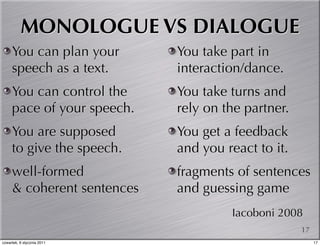
MONOLOGUE VS DIALOGUE
     You can plan your      You take part in
     speech as a text.      interaction/dance.
     You can control the    You take turns and
     pace of your speech.   rely on the partner.
     You are supposed       You get a feedback
     to give the speech.    and you react to it.
     well-formed            fragments of sentences
     & coherent sentences   and guessing game
                                     Iacoboni 2008
                                                   17
czwartek, 6 stycznia 2011                               17
Meaning making
                        Communication is about sharing:
                            unison: how it is similar to my partner?
                            attention: what do we need to do it?
                                      How am I going to make
                                      you think about it?
                            emotions: how do I feel about doing it?
                            intentions: what do I want you to do?

                                                                       18
czwartek, 6 stycznia 2011                                                   18
Unison and synchrony
                 in social coordination
             Rhythms of people sitting opposite each other
             may synchronise if they perform the same
             activity and look at each other.
             Pairs of subjects move their fingers at their
             own preferred frequency and amplitude with
             and without vision of the other’s movements.
             Brain activity was measured with dual-EEG.

                            Tognoli, Lagarde, DeGuzman       19
czwartek, 6 stycznia 2011                                         19
The PHI complex
             Spontaneous coordination in the form of
             synchronized behavior was observed between
             participants during visual contact even though
             no instruction to coordinate was given.
             Precise analysis of oscillatory components
             (phi1 and phi2) may distinguish effective from
             ineffective social coordination.


                             Tognoli, Lagarde, DeGuzman   20
czwartek, 6 stycznia 2011                                      20
McNeill: One system
                            of gesture and language
              Gestures facilitate making meaning:
                   retrieval of the missing word (help for the speaker)
                   reflection on the content of the speech (iconic type)
                   rhytmical organisation of speech (beat type)

              MNs fire when we observe iconic gestures
              because these are important in face2face
              conversation (Molnar-Szakacs 2005)
               Making meaning is multimodal!
                                                                          21
czwartek, 6 stycznia 2011                                                      21
Gestures lead–speech follows

            MNs support gestural origins of a language.
            MNs are critical in lg evolution and development.
            MNs respond to hierarchical organization of
            the actions of other people (Molnar-Szakacs).
            MNs seem to exist in Broca’s area which
            suggest the imitational basis of language.


                                                            22
czwartek, 6 stycznia 2011                                        22
If mirror neurons can code the hierarchy of
              manual activities, they may also code
              hierarchy in other domains, for instance, in
              linguistic material.
              When we humans are engaged in
              conversation, we tend to imitate each other's
              syntactical structures.


                                                          23
czwartek, 6 stycznia 2011                                      23
MNs simulate the actions we observe while
             watching a video or reading a sentence.

             Brain activity was measured during
                   reading sentences about hand and mouth actions
                   watching movies showing hand and mouth actions
                   hand action: grasping and mouth action: biting

             Selective activation of MNs was reported in
             the areas of hand and mouth action control
             respectively for hand and mouth sentences or
             movies (Lakoff 2005 and Aziz Zadeh 2006)

                                                                    24
czwartek, 6 stycznia 2011                                                24
ATTENTION
                 Mirror neurons fire when we observe actions
                 and when we perform the same actions.


                       Observing sb’s mental state and action
                       activates the same brain cells and circuts
                       that are used to perform the same action.
                                            Wicker, Keysers, Plailly

                                                                    25
czwartek, 6 stycznia 2011                                                25
EMOTIONS and EMPATHY
               Understanding emotions of our partners
               is an important skill in communication.
               People experience other people’s emotions
               because they can simulate them in the brain.
               Empathy is not merely the consequence of
               the passive observation of emotional cues
               but it is subject to contextual appraisal and
               modulation (similarity and familiarity).

           De Vignemont & Singer The empathic brain: how, when and why?
                                                                    26
czwartek, 6 stycznia 2011                                             26
Roles of empathy
             Epistemological empathy might enable us to
             make faster and more accurate predictions of
             other people’s needs and actions and discover
             salient aspects of our environment.
             Social empathy might serve as the origin
             of motivation for altruistic behavior and
             cooperation, hence – communication.


           De Vignemont & Singer The empathic brain: how, when and why?
                                                                    27
czwartek, 6 stycznia 2011                                             27
EMOTION CONTAGION

             Functional magnetic resonance imaging
             (fMRI) studies have shown that observing
             another person’s emotional state activates
             parts of the neuronal network involved in
             processing that same state in oneself, whether
             it is disgust, touch or pain (several studies).


       De Vignemont & Singer The empathic brain: how, when and why?
                                                                 28
czwartek, 6 stycznia 2011                                             28
INTENTIONS
              Bower: Goal oriented brain cells. Neurons
              may track action as a prelude to empathy
                   Monkeys’ premotor neurons get fired up both when
                   the animals perform an action, such as grasping or
                   manipulating an object, and when they watch an
                   experimenter do the same.
                   Observing an action helps in understanding intention.
                   Mirror neurons observed in monkeys may work
                   similarly in human brain, if we have them;)

                                                                           29
czwartek, 6 stycznia 2011                                                       29
Simulation theory of
                            Mindreading theory
             Mirror neurons appear to form a cortical
             system matching observation and execution
             of goal-related motor actions.
             Experimental evidence suggests that a similar
             matching system also exists in humans.
             Other people’s mental states are represented
             by adopting their perspective: by tracking or
             matching their states with resonant states of
             one’s own.                                      30
czwartek, 6 stycznia 2011                                         30
Gallese and Goldman
             MNs represent neural correlate of simulation
             of other’s action and learning by imitation.
             MNs underlie the process of ‘mind-reading’.
             Mind-reading is the activity of representing
             specific mental states of others, for example,
             their perceptions, goals, beliefs, expectations,
             and the like.
             Accurate understanding and anticipation
             enable the observer to adjust his responses
             appropriately. (communication planning)            31
czwartek, 6 stycznia 2011                                            31
EPILEPSY PATIENTS
                       April 2010: some mirror neurons activity
                       was measured in human brain with
                       intracranial depth electrodes.


                       New mirror neurons are to be found in
                       different than expected areas of brain.
                       Interpretation of data is still unclear.

                                                                  32
czwartek, 6 stycznia 2011                                              32
What is existentialism?
                       What is worth understanding
                       and knowing is our existence,
                       the human condition, and that
                       engagement and involvement are
                       superior to a detached stance.


                                                        33
czwartek, 6 stycznia 2011                                    33
EXISTENSIAL NEUROSCIENCE

                       Iacoboni: Kierkegaard’s existentialism
                       maps well onto mirror neuron properties:
                       Kierkegaard proposed that our existence
                       becomes meaningful only through our
                       authenthic commitment to the finite and
                       temporal, a commitment that defines us.


                                                                  34
czwartek, 6 stycznia 2011                                              34
EXISTENSIAL NEUROSCIENCE

                       The neural resonance between self and
                       other that mirror neurons allow is in my
                       opinion the embodiment of such
                       commitment.


                       Our neurobiology–our mirror neurons–
                       commits us to others.

                                                                  35
czwartek, 6 stycznia 2011                                              35
EXISTENSIAL NEUROSCIENCE

                       Mirror neurons show the deepest way
                       we relate to and understand each other:
                       they demonstrate how we are wired for
                       empathy, which we should inspire us to
                       shape our society and make it a better
                       place to live.
                                       Iacoboni 2008:267-268


                                                                 36
czwartek, 6 stycznia 2011                                             36
embodied cognition
             Mental processes are shaped by our bodies and by
             the types of perceptual and motor experiences
             that are the product of their movement through
             and interaction with the surrounding world.
             This view is generally called embodied cognition,
             and the version of this theory especially dedicated
             to language is known as embodied semantics.
             The discovery of mirror neurons has strongly
             reinforced this hypothesis that cognition and
             language are embodied.

                                                               37
czwartek, 6 stycznia 2011                                           37
Bibliography
                       http://www.zotero.org/groups/
                       meaningmaking/items/collection/
                       2724947


                       Iacoboni, M. 2008. Mirroring People.
                       Arbib, M. 2006. Action to Language via
                       the Motor Mirror System (first chapters)
                       email me: juszczyk@amu.edu.pl
                                                                 38
czwartek, 6 stycznia 2011                                             38

MNsMM

  • 1.
    How mirror neurons help us in making meaning? Presented at IMS STUTTGART During TSM ERASMUS 2010 Konrad Juszczyk, Ph.D. Adam Mickiewicz University Poznań-Poland 1 czwartek, 6 stycznia 2011 1
  • 2.
    V. S. Ramachandran I predict that mirror neurons will do for psychology what DNA did for biology. MNs are Necessary but not sufficient: their emergence and further develo- pment in hominids was a decisive step. Research in MNs may explain the evolution of language, learning by imitation and culture. 2 czwartek, 6 stycznia 2011 2
  • 3.
    Questions and challenges What do we know about mirror neurons? Why and what do we want to know about MNs? What do we gain from having known MNs? When and where are MNs active? How do MNs discoveries support meaning making and its properties in communication? 3 czwartek, 6 stycznia 2011 3
  • 4.
    Mirror neurons inmonkeys Original discovery by Parma neurologists: Rizzolatti, Fadiga, Fogassi, Gallese since 1996... Depth electrodes measure single-neuron activity of macaques’ brain when they pick up food (action) observe a person picking up food (perception of action). Some neurons give similar responses, so they are dubbed mirror neurons. 4 czwartek, 6 stycznia 2011 4
  • 5.
    MNs in humanbrain No possibility of measuring the single- neuron activity with depth electrodes (excluding testing for neurosurgery). Most evidence for human MNs is indirect. Neurological experiments suggest that a mirror system for gesture recognition also exists in humans and includes Broca’s area (Rizzolatti & Arbib 1998) 5 czwartek, 6 stycznia 2011 5
  • 6.
    PREMOTOR F5 –A44&A45 Anatomical and functional homologies are found in monkeys’ brain – F5 human brain A44 &A45–Broca’s area 6 czwartek, 6 stycznia 2011 6
  • 7.
    What are mirrorneurons? MNs are the cells in our brain that make our experience, mostly made of interactions with other people, deeply meaningful. MNs are brain cells that seem specialized in understanding our existential condition and our involvement with others. MNs show we are not alone, we are interconnected. Iacoboni 2008 7 czwartek, 6 stycznia 2011 7
  • 8.
    PREMOTOR MIRROR AIM CORTEX NEURONS MOTOR MOTOR ACTION CORTEX NEURONS ACTION is a movement associated with a goal. Initiation of the movement is accompanied by the creation of an expectation that the goal will be met. (Arbib and Rizolatti) 8 czwartek, 6 stycznia 2011 8
  • 9.
    Arbib’s questions How to view a language in a way which better defines its relation to goal-directed action? How to link perception with perfomance? How to explain evolution of communication? 9 czwartek, 6 stycznia 2011 9
  • 10.
    Michael Arbib claims: Language is essentially multi-modal, not just a set of sequences of words which can be completely captured by marks on the printed page. Written language reflects the lessons of grammar more than does spoken language. The language of the brain or schema network is vastly richer than a linear sequence of words. 10 czwartek, 6 stycznia 2011 10
  • 11.
    Mirror System Hypothesis The Mirror System Hypothesis 11 czwartek, 6 stycznia 2011 11
  • 12.
    Mirror System Hypothesis The mechanisms which support language in the human brain evolved atop a basic mechanism not originally related to communication. Instead, the mirror system for grasping with its capacity to generate and recognize a set of actions, provides the evolutionary basis for language parity – i.e., an utterance means roughly the same for both speaker and hearer. 12 czwartek, 6 stycznia 2011 12
  • 13.
    Mirror System Hypothesis In particular, human Broca’s area contains a mirror system for grasping which is homologous to the F5 mirror system of macaque. Arbib, M. 2006. Action to Language via the Mirror Neuron System 13 czwartek, 6 stycznia 2011 13
  • 14.
    Mirror System Hypothesis the mirror system for grasping (F5 in macaques brain) / the motor system for gesturing / mechanisms which support language (Broca’s area in human brain) 14 czwartek, 6 stycznia 2011 14
  • 15.
    MNs in DIALOGUE We imitate each others gestures, words and syntactic structures in conversation. We can guess and make meaning with the nonverbal cues seen in our partner. We use mirror neurons to do all that! Giving speech is more challenging than taking part in a conversation! Iacoboni 2008 15 czwartek, 6 stycznia 2011 15
  • 16.
    MONOLOGUE VS DIALOGUE You can plan your speech as a text. You can control the pace of your speech. You are supposed to give the speech. well-formed & coherent sentences Iacoboni 2008 16 czwartek, 6 stycznia 2011 16
  • 17.
    MONOLOGUE VS DIALOGUE You can plan your You take part in speech as a text. interaction/dance. You can control the You take turns and pace of your speech. rely on the partner. You are supposed You get a feedback to give the speech. and you react to it. well-formed fragments of sentences & coherent sentences and guessing game Iacoboni 2008 17 czwartek, 6 stycznia 2011 17
  • 18.
    Meaning making Communication is about sharing: unison: how it is similar to my partner? attention: what do we need to do it? How am I going to make you think about it? emotions: how do I feel about doing it? intentions: what do I want you to do? 18 czwartek, 6 stycznia 2011 18
  • 19.
    Unison and synchrony in social coordination Rhythms of people sitting opposite each other may synchronise if they perform the same activity and look at each other. Pairs of subjects move their fingers at their own preferred frequency and amplitude with and without vision of the other’s movements. Brain activity was measured with dual-EEG. Tognoli, Lagarde, DeGuzman 19 czwartek, 6 stycznia 2011 19
  • 20.
    The PHI complex Spontaneous coordination in the form of synchronized behavior was observed between participants during visual contact even though no instruction to coordinate was given. Precise analysis of oscillatory components (phi1 and phi2) may distinguish effective from ineffective social coordination. Tognoli, Lagarde, DeGuzman 20 czwartek, 6 stycznia 2011 20
  • 21.
    McNeill: One system of gesture and language Gestures facilitate making meaning: retrieval of the missing word (help for the speaker) reflection on the content of the speech (iconic type) rhytmical organisation of speech (beat type) MNs fire when we observe iconic gestures because these are important in face2face conversation (Molnar-Szakacs 2005) Making meaning is multimodal! 21 czwartek, 6 stycznia 2011 21
  • 22.
    Gestures lead–speech follows MNs support gestural origins of a language. MNs are critical in lg evolution and development. MNs respond to hierarchical organization of the actions of other people (Molnar-Szakacs). MNs seem to exist in Broca’s area which suggest the imitational basis of language. 22 czwartek, 6 stycznia 2011 22
  • 23.
    If mirror neuronscan code the hierarchy of manual activities, they may also code hierarchy in other domains, for instance, in linguistic material. When we humans are engaged in conversation, we tend to imitate each other's syntactical structures. 23 czwartek, 6 stycznia 2011 23
  • 24.
    MNs simulate theactions we observe while watching a video or reading a sentence. Brain activity was measured during reading sentences about hand and mouth actions watching movies showing hand and mouth actions hand action: grasping and mouth action: biting Selective activation of MNs was reported in the areas of hand and mouth action control respectively for hand and mouth sentences or movies (Lakoff 2005 and Aziz Zadeh 2006) 24 czwartek, 6 stycznia 2011 24
  • 25.
    ATTENTION Mirror neurons fire when we observe actions and when we perform the same actions. Observing sb’s mental state and action activates the same brain cells and circuts that are used to perform the same action. Wicker, Keysers, Plailly 25 czwartek, 6 stycznia 2011 25
  • 26.
    EMOTIONS and EMPATHY Understanding emotions of our partners is an important skill in communication. People experience other people’s emotions because they can simulate them in the brain. Empathy is not merely the consequence of the passive observation of emotional cues but it is subject to contextual appraisal and modulation (similarity and familiarity). De Vignemont & Singer The empathic brain: how, when and why? 26 czwartek, 6 stycznia 2011 26
  • 27.
    Roles of empathy Epistemological empathy might enable us to make faster and more accurate predictions of other people’s needs and actions and discover salient aspects of our environment. Social empathy might serve as the origin of motivation for altruistic behavior and cooperation, hence – communication. De Vignemont & Singer The empathic brain: how, when and why? 27 czwartek, 6 stycznia 2011 27
  • 28.
    EMOTION CONTAGION Functional magnetic resonance imaging (fMRI) studies have shown that observing another person’s emotional state activates parts of the neuronal network involved in processing that same state in oneself, whether it is disgust, touch or pain (several studies). De Vignemont & Singer The empathic brain: how, when and why? 28 czwartek, 6 stycznia 2011 28
  • 29.
    INTENTIONS Bower: Goal oriented brain cells. Neurons may track action as a prelude to empathy Monkeys’ premotor neurons get fired up both when the animals perform an action, such as grasping or manipulating an object, and when they watch an experimenter do the same. Observing an action helps in understanding intention. Mirror neurons observed in monkeys may work similarly in human brain, if we have them;) 29 czwartek, 6 stycznia 2011 29
  • 30.
    Simulation theory of Mindreading theory Mirror neurons appear to form a cortical system matching observation and execution of goal-related motor actions. Experimental evidence suggests that a similar matching system also exists in humans. Other people’s mental states are represented by adopting their perspective: by tracking or matching their states with resonant states of one’s own. 30 czwartek, 6 stycznia 2011 30
  • 31.
    Gallese and Goldman MNs represent neural correlate of simulation of other’s action and learning by imitation. MNs underlie the process of ‘mind-reading’. Mind-reading is the activity of representing specific mental states of others, for example, their perceptions, goals, beliefs, expectations, and the like. Accurate understanding and anticipation enable the observer to adjust his responses appropriately. (communication planning) 31 czwartek, 6 stycznia 2011 31
  • 32.
    EPILEPSY PATIENTS April 2010: some mirror neurons activity was measured in human brain with intracranial depth electrodes. New mirror neurons are to be found in different than expected areas of brain. Interpretation of data is still unclear. 32 czwartek, 6 stycznia 2011 32
  • 33.
    What is existentialism? What is worth understanding and knowing is our existence, the human condition, and that engagement and involvement are superior to a detached stance. 33 czwartek, 6 stycznia 2011 33
  • 34.
    EXISTENSIAL NEUROSCIENCE Iacoboni: Kierkegaard’s existentialism maps well onto mirror neuron properties: Kierkegaard proposed that our existence becomes meaningful only through our authenthic commitment to the finite and temporal, a commitment that defines us. 34 czwartek, 6 stycznia 2011 34
  • 35.
    EXISTENSIAL NEUROSCIENCE The neural resonance between self and other that mirror neurons allow is in my opinion the embodiment of such commitment. Our neurobiology–our mirror neurons– commits us to others. 35 czwartek, 6 stycznia 2011 35
  • 36.
    EXISTENSIAL NEUROSCIENCE Mirror neurons show the deepest way we relate to and understand each other: they demonstrate how we are wired for empathy, which we should inspire us to shape our society and make it a better place to live. Iacoboni 2008:267-268 36 czwartek, 6 stycznia 2011 36
  • 37.
    embodied cognition Mental processes are shaped by our bodies and by the types of perceptual and motor experiences that are the product of their movement through and interaction with the surrounding world. This view is generally called embodied cognition, and the version of this theory especially dedicated to language is known as embodied semantics. The discovery of mirror neurons has strongly reinforced this hypothesis that cognition and language are embodied. 37 czwartek, 6 stycznia 2011 37
  • 38.
    Bibliography http://www.zotero.org/groups/ meaningmaking/items/collection/ 2724947 Iacoboni, M. 2008. Mirroring People. Arbib, M. 2006. Action to Language via the Motor Mirror System (first chapters) email me: juszczyk@amu.edu.pl 38 czwartek, 6 stycznia 2011 38